


The importance of an adequate diet in infancy and early childhood has long been recognised and it has become evident that nutrition during childhood and early infancy has importance for the development of disease later in life(Reference Berenson1–Reference Guo, Wu and Chumlea3).
The timing of the first introduction of complementary foods has shown to be an important factor for subsequent health. Studies have shown a protective effect of later introduction of complementary foods in relation to infancy weight gain(Reference Baker, Michaelsen and Rasmussen4), adult overweight(Reference Schack-Nielsen, Sorensen and Mortensen5) and respiratory illness during childhood(Reference Wilson, Forsyth and Greene6). A longer duration of breast-feeding is associated with a delayed introduction of complementary foods(Reference Baker, Michaelsen and Rasmussen4, Reference Burdette, Whitaker and Hall7, Reference Kramer8) and results from a large cohort study showed an interaction between breast-feeding and introduction of complementary foods, suggesting that the combination of short periods of breast-feeding and early introduction of complementary foods may contribute to increased infancy weight gain(Reference Baker, Michaelsen and Rasmussen4). The effect of early introduction of complementary foods on overweight later in life is not known, but it has been suggested that individuals introduced early to complementary foods are more susceptible to an obesogenic environment, involving both physiological and psychological factors(Reference Schack-Nielsen, Sorensen and Mortensen5).
Several studies have reported differences in food intake between infants being partly breast-fed and those completely weaned in the second half of infancy, where foods and drinks become an increasing part of the diet(Reference Heinig, Nommsen and Peerson9–Reference North, Emmett and Noble13). Whether this difference is caused by delay in the progression towards spoon feeding due to later introduction to complementary foods is uncertain, but of interest for future investigations on breast-feeding and later health outcomes. Moreover, this could be beneficial for counselling of mothers and fathers in healthy infant feeding practices. For this reason the aim of the present study was to test whether there are differences in diet diversity between children still being partly breast-fed at 9 months and those completely weaned at the same age.
Materials and methods
Data for the present study were obtained from infants seen at the first examination of the SKOT cohort, an ongoing prospective cohort which has the overall aim to describe how complementary feeding influences growth, development and risk factors for later disease. The infants were examined at age 9 months ± 2 weeks.
A random sample of 9-month-old infants living in Copenhagen and Frederiksberg was established through the National Danish Civil Registry. The sample included infants born from April 2007 to May 2008. An invitation was posted to 2211 families, 4 to 7 weeks before the infants turned 9 months of age. The inclusion criteria were singleton infants born at ≥37 weeks of gestation and without diseases expected to affect growth or food intake. Written consent to participate was obtained from parents. An interview on diet, growth and health of the infant was performed, and instruction on food recording was given. The age of the infant at which full and partial breast-feeding stopped was recorded, and for infants still being breast-fed information on the daily frequency the infant was breast-fed a meal or part of a meal, according to the parent, was obtained. The parent was told that a breast-feed for comfort should not be counted. Less than once per day was coded as zero. Full breast-feeding was defined as only receiving breast milk, water, vitamins and minerals. The study protocol was approved by The Committees on Biomedical Research Ethics for the Capital Region of Denmark (H-KF-2007-0003).
At the examination nude weight to the nearest 1 g was measured for all infants using a digital paediatric scale (Saratorius IP 65; Bie & Berntsen AS, Herlev, Denmark). Recumbent length was measured using a digital measuring board (Force Technology, Brondby, Denmark) and recorded to the nearest 0·5 cm. All measurements were performed by four well-trained observers.
The diet was recorded for seven consecutive days using a validated method consisting of pre-coded booklets accompanied by a booklet with twelve food photograph series(Reference Gondolf, Tetens and Hills14). The pre-coded food record was developed specifically for children between 6 months and 4 years of age and the booklets were divided into different parts corresponding to breakfast, lunch, dinner and in-between meals. The quantities were estimated from standard portion sizes, household measures or from the twelve food photograph series, depending on the specific food or drink. At the end of each meal and each group of food or drink, blank fields were present for the parents to use if appropriate. If the child attended day care the food and drinks were recorded in household measures by the day care staff on a sheet, and then transferred to the pre-coded food record by the parents. In the study, the pre-coded food booklets were checked for completeness after the registration period, so any inappropriate responses could be clarified immediately.
All intakes of energy, nutrients and food items recorded in the pre-coded food record were calculated for each individual using the software system GIES version 1·000d, developed at the National Food Institute, Technical University of Denmark (Søborg, Denmark), and the Danish Food Composition Databank version 7 (National Food Institute, Technical University of Denmark; http://www.Foodcomp.dk). The intake model in GIES operates with three separate data layers: the recorded food intake, recipes and food composition data. The Danish Food Composition Databank and the recipes were amended to include products and recipes common for infants and young children.
To estimate the quantity of breast milk consumed, information on the frequency of feeding was used combined with data on the volume of breast milk per feed from Dewey et al.(Reference Dewey, Finley and Lonnerdal15). If the child received breast milk ≥6 times/d, the assigned volume was 130 ml/feed; with 3–5 feeds/d, the assigned volume was 89 ml/feed; and with <3 feeds/d, the volume assigned was 53 ml/feed. The nutritional content of breast milk was calculated according to published values(Reference Michaelsen, Larsen and Thomsen16, 17).
Estimation of the degree of possible over- and under-reporting was done by comparing each infant's daily energy intake with his/her likely energy requirement, as described by Conn et al.(Reference Conn, Davies and Walker18). In brief, each infant's energy requirement was calculated according to values obtained by the doubly labelled water method for 9-month-old infants(Reference Wells and Davies19). Subsequently, 95 % confidence limits around the total energy expenditure value were added(Reference Wells and Davies20) and the range was used as plausible intake.
Anthropometric measurements were entered into the software program WHO Anthro 2005 (WHO, Geneva, Switzerland; http://www.who.int/childgrowth/software/en/).
Intakes of energy-yielding nutrients were presented as means and standard deviations, and the t test was used to test if the intake differed between feeding groups. Because of the skewed distribution, added sugars were presented as median values and the Mann–Whitney U test was used to test if the intake differed between the feeding groups. Estimated intakes of foods and food groups are presented as medians, 25th and 75th percentile (P25 and P75), and comparison of the groups partly breast-fed and completely weaned was done with the Mann–Whitney U test. The two feeding groups were also compared adjusting for weight of the infant, mother's age, mother's education and number of persons in the household using the general linear model. Comparisons between categorical values were made using the χ 2 test. All P values are two-sided with a level of significance of P < 0·05. Data were analysed with the SAS for Windows statistical software package version 9·1 (SAS Institute Inc., Cary, NC, USA).
Results
Three hundred and twelve infants participated and were examined. Of these, two were excluded because of too many missing recordings days (>2 d) and one due to unrealistically high intakes of energy and fat. Thus the final study sample included 309 infants with a mean age at examination of 9·1 (sd 0·3) months. Almost all infants (99 %) had received breast milk at some time and 141 were still partly breast-fed (46 %) at 9 months. The median (P25, P75) duration of exclusive breast-feeding was 4·2 (2·5, 5·1) months. The majority of the infants were Caucasian and eleven (4 %) had mixed Caucasian/non-Caucasian parents. Selected characteristics of all infants and their mothers, and according to partly breast-fed and completely weaned feeding groups, are presented in Table 1. Mothers of partly breast-fed infants were more likely to be less than 35 years of age and to be higher educated than mothers of completely weaned infants. No differences between the two groups were seen for number of persons in the household, household income or birth weight of the infant. The partly breast-fed infants were significantly lighter, shorter, had lower BMI Z-score and were introduced to complementary foods later than completely weaned infants (Fig. 1).
CharacteristicsFootnote * of all mothers and infants surveyed and according to feeding group: healthy term infants at 9 months of age, SKOT cohort, Copenhagen, Denmark

DKK, Danish krone.
* Percentages for categorical variables and means and standard deviations for continuous variables.
Cumulative percentage of infants introduced to complementary foods per month ( , among those who were partly breast-fed at 9 months;
  , among those who were completely weaned infants at 9 months): healthy term infants (n 309) at 9 months of age, SKOT cohort, Copenhagen, Denmark

In absolute terms, partly breast-fed infants had lower energy intake than completely weaned infants (Table 2). When analysed per kilogram of body weight these differences were reduced considerably, only just reaching the significance level. For absolute intakes of protein and carbohydrate, partly breast-fed infants had lower intakes than the completely weaned infants; however, no difference was found for fat and added sugars. Comparing nutrient densities, the percentage of energy provided by protein and carbohydrate was lower for partly breast-fed infants than for completely weaned infants, but higher for fat. Despite differences between the two groups all overall mean intakes for the energy-yielding nutrients were within the recommendations for this age group(21).
Daily macronutrient intakes (inclusive of estimated breast milk intake) of all infants surveyed and according to feeding group: healthy term infants at 9 months of age, SKOT cohort, Copenhagen, Denmark

%E, percentage of energy intake; CHO, carbohydrate.
*Nordic Council of Ministers, 2004(21).
†Comparing breast-feeding groups by the Student t test or the Mann–Whitney U test (added sugars).
‡Median value and 25th, 75th percentiles because of the skewed distribution.
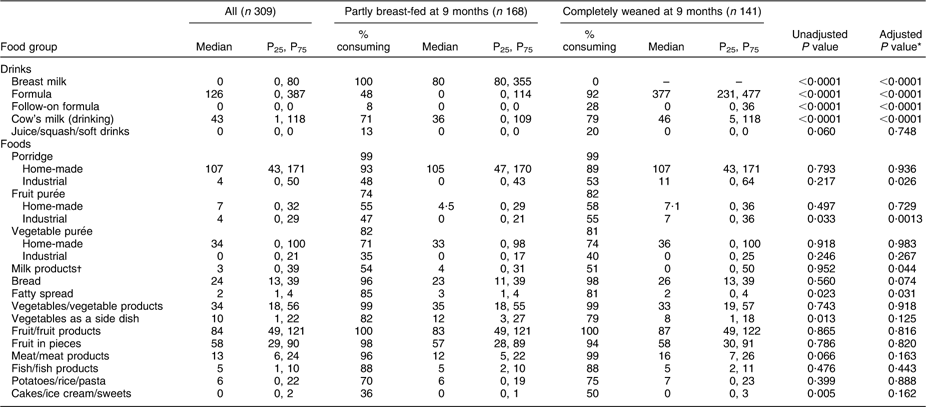
Comparison of the proportions of partly breast-fed and completely weaned infants consuming selected foods and food groups showed that partly breast-fed infants were, as expected, less likely to drink formula (P < 0·0001) and if they did so the median daily intake was much lower (Table 3). Also gruel was consumed less frequently (P < 0·0001) and in much smaller amounts by partly breast-fed infants compared with completely weaned (P < 0·0001; data not shown). Although similar proportions of partly breast-fed and completely weaned infants drank cow's milk (P = 0·676), smaller amounts by the former were recorded. Considering foods, similar proportions of the partly breast-fed and completely weaned infants consumed porridge (P = 0·279), fruit purée and vegetable purée (P = 0·146 and P = 0·337, respectively), milk products (P = 0·215), bread (P = 0·942), vegetables/vegetable products (P = 0·667), vegetables as a side dish (P = 0·067), fruit/fruit products (P = 0·867), fruit in pieces (P = 0·222), meat/meat products (P = 0·092), fish/fish products (P = 0·200) and potatoes/rice/pasta (P = 0·427). However, partly breast-fed infants were more likely to consume fatty spread (P = 0·039) and less likely to consume cakes/ice cream/sweets (P = 0·024). In absolute terms, partly breast-fed infants consumed less industrially produced fruit purée (P = 0·033) and cakes/ice cream/sweets (P = 0·005) and more fatty spread (P = 0·023) and vegetables as a side dish (P = 0·013) than the completely weaned infants. Adjusting for the weight of the infant, mother's age, mother's education and number of persons in the household, the only differences were that vegetables and cakes/ice cream/sweets lost significance, but industrial porridge (P = 0·026) and milk products (P = 0·044) became significant with the partly breast-fed eating less than the completely weaned (Table 3).
Daily intakes (g/d) of selected foods and drinks and percentages of consumers among all infants surveyed and according to feeding group: healthy term infants at 9 months of age, SKOT cohort, Copenhagen, Denmark
P25, 25th percentile; P75, 75th percentile.
*Comparing intakes from breast-feeding groups by general linear models adjusted for weight of the infant, mother's age, mother's education and number of persons in the household.
†Not potable milk products, including yoghurt and milk on cereals.
Unadjusted values for the contribution of energy from selected foods and food groups to total energy (covering 95 % of the energy intake) showed that formula contributed less to the daily energy intake for the partly breast-fed infants compared with the completely weaned (P < 0·001). The same was seen for gruel (P < 0·001). Considering the contribution of energy from food sources, the partly breast-fed infants received more energy from vegetables as a side dish (P = 0·004) and fatty spread (P = 0·0005) and less from cakes/ice cream/sweets (P = 0·009) compared with the completely weaned infants. Adjusting for the same covariates as above, the only difference was that cakes/ice cream/sweets lost significance (Table 4).
Contribution (%) of selected foods and food groups to total energy intake among all infants surveyed and according to feeding group: healthy term infants at 9 months of age, SKOT cohort, Copenhagen, Denmark

P25, 25th percentile; P75, 75th percentile.
*Comparing breast-feeding groups by general linear models adjusted for weight of the infant, mother's age, mother's education and number of persons in the household.
†Not potable milk products, including yoghurt and milk on cereals.
Regarding over- and under-reporters we found that about 11 % of the infants in both groups were possible over-reporters and 3 % and 0 % were possible under-reporters in the partly breast-fed group and the completely weaned group, respectively.
Discussion
The present results showed that infants partly breast-fed at 9 months do not eat less diversified diets compared with those completely weaned at the same age, despite later introduction to complementary foods. They had lower intake of energy, both in absolute amounts and per kilogram of body weight, even though the significance decreased when adjusting for body weight. Lower intakes of most energy-yielding nutrients were seen for the partly breast-fed compared with the completely weaned infants. These differences appear to be caused primarily by differences in the type and amount of milk consumed, as the energy derived from sources other than milk was similar, except for fatty spread and vegetables as a side dish (Table 4). This result is in agreement with findings from studies of 9-month-old infants from both the USA and Australia(Reference Heinig, Nommsen and Peerson9, Reference Conn, Davies and Walker18). However, the present study found only small differences for intakes of foods between groups, although fatty spread showed significantly higher intake rates and consumption among partly breast-fed compared with completely weaned infants. A higher intake of fatty spread was also recorded for partly breast-fed infants at 12 months of age compared with non-breast-fed infants at the same age in a study by Lande et al. (Reference Lande, Andersen and Veierod10). It is possible that mothers of the partly breast-fed infants in the present study were more focused on including fatty spread in generous amounts in their infants’ diet, due to concern about their infants’ energy intake, as these infants generally were leaner than the completely weaned infants. The absolute fat intake was similar in the present study for the two groups of infants, resulting in a significantly higher contribution of fat to total energy for the partly breast-fed infants. This difference may partly be due to a significantly higher contribution of fatty spread to total energy for the partly breast-fed infants. Fat contributed on average 40 % of dietary energy for infants who were still breast-fed and 36 % of dietary energy for infants who were not. These values are well within the Nordic Nutrient Recommendations 2004 for this age group (30–45 % of energy), but are considerably higher than figures reported from the Copenhagen Cohort Study, in which the percentage of energy from fat for 9-month-old infants was 32 % and 31 % respectively for partially breast-fed v. not breast-fed infants(Reference Michaelsen11, 21). The Copenhagen Cohort Study raised concerns about inadequate fat intake in infants, which was supported by several international studies(Reference Alexy, Kersting and Sichert-Hellert22, Reference Koletzko23). Subsequently more focus in dietary guidelines in Denmark has been placed on the importance of infants receiving fat in adequate amounts and our results may reflect this effort.
Regarding drinks, the present study did not find any difference in intake of sugar-sweetened drinks (juice/squash/soft drinks) between the two feeding groups. In contrast, several studies found a significantly lower intake of sugar-sweetened drinks among completely weaned infants compared with infants being partially breast-fed(Reference Lande, Andersen and Veierod10, Reference Michaelsen11, Reference North, Emmett and Noble13).
The partly breast-fed infants had considerably lower intakes of formula and cow's milk compared with the completely weaned, which is reflected in their lower protein intake. In contrast to most countries, in Denmark it is recommended that cow's milk be introduced gradually: from the age of 9 months it can gradually become the main milk, while very small amounts can be given from the age of 6 months(24). Many countries, including the USA and the UK, do not recommend that cow's milk is used as the main milk before the age of 12 months(25, 26). The main reason for delaying the introduction of cow's milk in the diet is to prevent the development of Fe deficiency and to avoid high protein intake, as the Fe content of cow's milk is very low, while high in protein. However, the protein intake of the infants in both feeding groups in the present study and in the other Danish study (the Copenhagen Cohort Study) is comparable with that of infants at the same age in other countries(Reference Michaelsen11, Reference Noble and Emmett12, Reference Conn, Davies and Walker18).
In the present study the infants were introduced to complementary foods at a mean age of 4·7 (sd 0·8) months and 4·3 (sd 0·7) months, respectively, for partially breast-fed infants and completely weaned infants. Of these only 3 % from each group were introduced before 4 months (Fig. 1). This is in accordance with the Danish recommendations recommending exclusive breast-feeding up until 6 months; however, complementary foods may be introduced from 4 months of age to support optimal growth and development(24). The mean introduction times in the present study are in remarkable contrast to those found for infants from other industrialized countries. An analysis of five European countries found that 37 % of formula-fed infants and 17 % of breast-fed infants were introduced to complementary foods at 4 completed months(Reference Schiess, Grote and Scaglioni27), despite the fact that in 2001 WHO changed the recommendation for introducing complementary foods from 4–6 months to 6 months(28). The Committee on Nutrition of the European Society for Paediatric Gastroenterology, Hepatology and Nutrition concluded likewise in 2008 that exclusive or full breast-feeding for about 6 months is a desirable goal(Reference Agostoni, Braegger and Decsi29).
In the present study breast milk intake was estimated from frequency of feeding, which may be a rather crude estimate, not taking into account the duration of feeding and the variation in milk composition during a feed. Ideally, test weighing of milk intake, information on the duration of each feed and milk samples from each mother should have been collected. However, this requires extreme effort by the participants and was not a possibility in our study. The methods used for estimation of breast milk intake in the present study are comparable to those used in other studies(Reference Noble and Emmett12, Reference Conn, Davies and Walker18). Still, a potential small underestimation of the breast milk intake may be present. The mothers were asked about the frequency they breast-fed their infants a meal, and those who did not breast-feed whole meals were coded as zero and no energy from breast milk was added to their total energy intake. The mean energy intake of the breast-fed infants in the present study was 3284 kJ/d, which is similar to earlier reported intakes from breast-fed infants at the same age(Reference Noble and Emmett12, Reference Conn, Davies and Walker18, Reference Alexy, Kersting and Sichert-Hellert22). However, slightly lower intakes have been reported in studies where test weighing of the breast milk intake was performed, but in these studies the fat energy percentage was correspondingly lower(Reference Michaelsen11, Reference Alexy, Kersting and Sichert-Hellert22).
One limitation of the present study is the presence of possible over- and under-reporters. However, by estimating the degree of possible over- and under-reporters we found that about 11 % of the infants in both groups were possible over-reporters and only 3 % and 0 % were possible under-reporters in the partly breast-fed group and the completely weaned group, respectively. In comparison, Conn et al.(Reference Conn, Davies and Walker18) found that 32 % were likely to be over-reporting and <1 % under-reporting, using the same method. We chose not to exclude these possible over- and under-reporters as intakes in this age group may vary a lot and most infants classified as possible over-reporters were just above the calculated limit.
The present study consists of infants from the Copenhagen area. The parents were well educated, motivated and may have been more health conscious than the majority, resulting in a sample that may not have been representative. This might increase compliance with advice on weaning, resulting in a more homogeneous sample than expected. It is conceivable that a larger deviation between the two feeding groups with regard to introduction time of complementary foods could have resulted in more significant dietary differences than noted in our study.
Conclusion
The present study showed in a Danish cohort of 9-month-old infants that partly breast-fed infants did not eat less diversified diets compared with those completely weaned at the same age. Despite later introduction to complementary foods than for those completely weaned, their intake of foods was similar and no delay in their progression towards the family foods was noted.
Acknowledgements
The study was supported by grants from the Danish Directorate for Food, Fisheries and Agri Business. The authors have no conflict of interests. U.H.G. was the primary writer of the paper. K.F.M. initiated the cohort study. All authors commented on drafts. The authors gratefully acknowledge the contribution of all of the families and children who participated in the study and Tue Christensen for help with the nutritional calculations.



