

Highlights
Although complex, working across scales and actors is critical for food-system transformation.
In most cases, working at the local scale, that is, with farms and districts, is the most important, as this is where action is required.
Through effective cross-scale work, lessons from local levels can shape the thinking of regional and national governments, as well as the private sector.
Involving multiple and ideally nested scales, designing sets of solutions, and developing actionable, fundable, and implementable solutions is likely to provide rich food-system outcomes.
Partners need to provide the tools, signals, and resources so that local people, communities, and policy planners are empowered to drive transformation.
17.1 Introduction
There have been several calls for transformation in food systems to address the challenges of climate change, hunger, continuing population pressure, and to meet the Sustainable Development Goals (SDGs) (see Chapter 1, also Herrero et al., Reference Herrero, Thornton and Mason-D’Croz2021). This would require more interactive, participatory, and cross-scale processes linking value-adding activities and systems (Abel et al., Reference Abel2016). Multi- and cross-scale linkages are common in both agroecological research and analyses of socio-ecological processes. A cross-scale approach connects actions across local, national, regional, and global levels, capturing convergences and divergences in transforming agriculture and food systems. However, these interactions come at a high transaction cost as it is effort-intensive and requires actors to learn how to engage policymakers through scientific and technical language (Adger et al., Reference Adger, Brown and Tompkins2005). The transaction cost also increases owing to mismatches of cross-scale dynamics problems, such as when there is a poor institutional fit between the management and bio-geophysical systems (Cash & Moser, Reference Cash and Moser2000).
Climate-smart agriculture (CSA) is an important component for building resilience and for mitigating greenhouse gas (GHG) emissions in agricultural systems. Several key CSA options have been proposed, including technologies such as zero tillage, residue management, micro-irrigation, and improved and stress-tolerant seeds and breeds. The success of these technological interventions has been demonstrated globally in the thousands of pilots that have been undertaken. Yet, even today, most of these technologies have not reached the necessary scale. Cross-scale work that supports decision-making at different scales by various stakeholders is needed for transformation, alongside understanding the entry points. More so, these technologies need evaluating across climatic risks, soils, and management practices at different scales, plus a comprehensive understanding of farmers’ resource bases, institutions, financial systems, and policies. The CGIAR research program on Climate Change, Agriculture and Food Security (CCAFS) has worked across scales, from the global level to the community level, engaging a wide range of actors. This chapter reviews several case studies from this program, carried out in different regions of the world, to assess how working across scales and actors has helped achieve climate-resilience outcomes for millions of farmers, private sector agencies, and governments.
17.2 Farmer-to-Farmer Scaling of Climate-Smart Agriculture
CCAFS developed the climate-smart village (CSV) concept as an agricultural research for development (AR4D) approach to test technological and institutional options for dealing with climate change in agriculture through participatory methods (Aggarwal et al., Reference Aggarwal, Jarvis and Campbell2018). The key focus of this approach is to generate evidence on synergies and trade-offs between different options in terms of productivity, adaptation, and mitigation at the field and/or village scale. The lessons learnt in terms of suitable portfolios of CSA technology options and institutional and financial mechanisms are then scaled horizontally and vertically.1 In this section, we look at horizontal scaling by local government, community organisations, NGOs, and private sector actors.
Horizontal scaling involving multiple actors was fostered widely in India and Nepal (CIMMYT-CCAFS, 2014), with similar approaches also used in Africa and Latin America (Aggarwal et al., Reference Aggarwal, Jarvis and Campbell2018). In India, CSV pilots were set up at field/village community scale in the states of Haryana, Punjab, Madhya Pradesh, Bihar, and Maharashtra, and in Nepal’s Rupandehi district. The CSVs involved participatory evaluation of all locally relevant technological and institutional adaptation options (Box 17.1). Individuals and collectives of farmers, local governments, private sector actors, various CGIAR centres, and national agricultural research systems have been involved in this evaluation. Farmers’ fairs, video testimonials, and village bulletins were organised to scale-out CSA practices and promote farmer-to-farmer learnings within the study region and other similar agroecological regions. The use of a climate analogue tool further supported horizontal scaling in Rupandehi, Nepal. The tool assisted the identification of homologous regions in Nepal where the future climate of Rupandehi exists today. Young farmers of Rupandehi stayed with the farmers of the analogue region to learn the agriculture adaptation strategies that they could utilise in the future.
The evidence-backed success of the CSV approach has attracted private sector players to make investments in CSA/CSVs. ITC Limited is a large Indian company present in multiple sectors, including agribusiness. Its business model is sustainability embedded in its strategy, encompassing economic, environmental, and social objectives along its supply chain. ITC has taken several steps to strengthen resilience and reduce GHG emissions, to combat its agribusiness supply chain’s vulnerability to increasing climatic risks. To strengthen resilience at the farm level, ITC managers adopted the CSV approach, merged it with their ongoing programs, and transferred it to several of the company’s sites. These interventions led to a substantial increase in yield and income, climate-risk reduction, and GHG mitigation. In the last five years, the program has been expanded to around 1 762 villages, using the hub-and-spoke approach, covering over 200 000 farmers. With these encouraging results, ITC is now set to scale out the CSV approach in its core agribusiness catchments, aiming to cover over 1 million hectares across 15 Indian states by 2030.
While this is referred to as horizontal scaling, inevitably there is some cross-scale interaction, for example between the local level and the district level, with even national actors playing a role in fostering horizontal scaling. For example, the results of the CSV evaluations have been integrated into village and district agriculture development plans and linked with local and national adaptation plans. As Schut et al. (Reference Schut, Leeuwis and Thiele2020) imply, there is a strong link between horizontal and vertical scaling.
17.3 Vertical Scaling of Lessons from Climate-Smart Villages
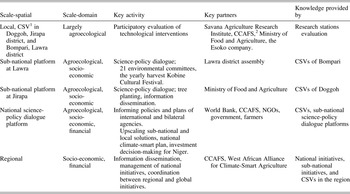
The work done at the village scale has also fostered the uptake of CSA ideas and influenced policy and investment decisions at sub-national, national, and regional scales in Asia, Africa, and Latin America. In Ghana, for example, the sub-national and national science-policy platforms took up lessons learnt from the CSVs (Table 17.1). The national science-policy dialogue platform is a multi-stakeholder body hosted by a national government institute. The platform has 100 participating stakeholders, including NGOs, policymakers, academics, traditional authorities, and farmers. The platform co-produced the National Climate-Smart Agriculture and Food Security Action Plan and operationalised the National Climate Change Policy. The stakeholders prioritised CSA solutions for the different ecological zones in Ghana (Essegbey et al., Reference Essegbey, Nutsukpo and Karbo2015).
In Nepal, climate-smart investment profiles were prepared, inspired by work at the local level. These guided three provincial governments and the federal government to invest a part of their agriculture budget to implement the CSV approach in a few hundred villages.
1 Climate-Smart Villages (CSVs).
2 The CGIAR research program on Climate Change, Agriculture and Food Security (CCAFS).
17.4 Multi-Scale Research and Engagement
In transforming food systems, we can seldom consider purely horizontal or vertical scaling. Scaling is often much more complex, involving work at multiple levels. Hierarchy theory suggests that minimal complexity when problem-solving involves three hierarchical levels: the focus level, a level below, and a level above (Allen & Starr, Reference Allen and Starr2017). Therefore, if we want to alter farming practices and work at the focus level, we must understand stand-level processes at the level below, as well as explore the enabling policy environment at the level above. Even this notion, however, is too simple for most AR4D challenges, where problems need to be dealt with across a multi-levelled domain of interest. This can be seen in the Ghana example (Table 17.1), where considerable work was done at the local, national, and regional levels. The West African work also included collaboration with national negotiators, who then transferred lessons to the global negotiating processes; based on their experience in the global forums, negotiators undoubtedly applied the lessons learnt back home (Simone & Rusdal, Reference Simone and Rusdal2017). Alongside experience gained from other countries, the work in Niger helped the West African regional team to inform the design of the World Bank’s US$100 million CSA investment in Niger (CCAFS, 2016).
Working at multiple levels is not simple and comes with the high transaction costs of managing multiple partnerships. Although the national platform of Ghana gathered multiple stakeholders and engaged high-level decision-makers, thereby influencing national policymaking, it also lacked a closely coordinated cross-scale communication process among the national and sub-national platforms and local CSVs. This limited the possibilities for upscaling and mainstreaming solutions from the local level to national, regional, and global levels.
Other examples of multi-scale research and engagement come from Latin America. Farmers in Central America are highly vulnerable to climate variability. They lack the weather, climate, and tailored local information necessary to make best-bet decisions and manage different types of agroclimatic risks. This gap has been identified as a key action point in the Climate-Smart Agricultural Strategy for the Central American Integration System (SICA) region, 2018–30. CCAFS and the International Research Institute for Climate and Society worked together with regional, national, and local partners within the SICA region to co-develop, test, and scale-out approaches to assess, co-produce, translate, and transfer climate information to enable agricultural decision-making (Martínez-Barón et al., Reference Martínez-Barón, Navarro-Racines and Martinez-Salgado2021). At the regional level, the meteorological services of all eight SICA countries have enhanced their capacity through ‘next generation’ climate forecasts (Muñoz et al., Reference Muñoz2019) through the Central American Climate Outlook Forum, allowing the generation of a consistent and high-performance climate outlook with local relevance (Martínez-Barón et al., Reference Martínez-Barón, Navarro-Racines and Martinez-Salgado2021). At the national and sub-national levels, regional and national partners have scaled out Local Technical Agroclimatic Committees (LTACs). There are many linkages between the different levels (Figure 17.1).
A cross-scale process in implementing climate information services in Latin America

LTACs have regular meetings to share agroclimatic forecasts, a result of downscaled seasonal predictions and modelling (Loboguerrero et al., Reference Loboguerrero, Boshell and León2018). Participants discuss how crops might be affected based on the forecasts and their own experience and agree on best-bet climate-smart recommendations to reduce potential crop losses, increase productivity, and enhance management efficiency. Through local agroclimatic bulletins, local technicians, community leaders, and producers can access the forecasts and recommendations needed to support climate-change-related decision-making. Today, over 50 LTACs have been established across 11 countries in Latin America, including six in Central America, which reach out to about 300 000 farmers across the region (Giraldo et al., 2019). To scale the knowledge generated by the LTACs at the farm level, a Participatory Integrated Climate Services for Agriculture (PICSA) approach is used (Chapter 8). PICSA involves agriculture-extension staff working with farmers ahead of the agricultural season to firstly analyse historical climate information, then use participatory tools to develop and choose the crop, livestock, and livelihood options best suited to individual farmers’ circumstances. Local technicians and farmers use the information on the local agroclimatic bulletins produced by the LTACs and the participatory tools support farmers in making timely decisions to mitigate climate risks. Based on such work, CCAFS gained legitimacy with national and regional governments, leading to several initiatives that inform policy processes. In this case, coordination between stakeholders across scales informed local decision-making processes and needs, as well as higher-level governance processes.
In some cases, research engagement results in more top-down impacts. Experience from other regions and countries has helped researchers inform national-level policies, strategies, and projects. CCAFS developed a national CSA profile for Kenya and, thereafter, many county-level climate risk profiles (World Bank & CIAT, 2015). Such work contributed to the Kenya Climate-Smart Agriculture Project (KCSAP) 2017–22 implemented in more than twenty counties across diverse agroecologies under the framework of the Agriculture Sector Development Strategy and National Climate Change Response Strategy (www.kcsap.go.ke/). To date, CCAFS has completed CSA profiles for 30 countries.
Vietnam’s climatically vulnerable Mekong River Delta (MRD) region provides another example of multi-scale resilience-building work with multiple partners. A participatory Climate-Smart Mapping and Adaptation Planning (CS-MAP) was used to map key climate-risk-prone areas and potential adaptation interventions for them (see Chapter 7 for a more detailed description). This involved mapping work at local levels and setting up an early warning system at local and provincial government levels. The implementation of CS-MAP during 2018–19 and 2019–20 provided the basis for adjusting the rice cropping calendar in salinity-affected areas; this resulted in a 70 percent reduction in losses in affected areas, despite high salinity intrusion owing to substantially lower rainfall and a significant reduction in river flow (CCAFS SEA & DCP-MARD, 2020). As engagement was also carried out at the national level, 13 MRD provinces in Vietnam are now implementing the recommended CS-MAP actions for climate-risk management.
Another example from Vietnam concerns GHG mitigation in rice production. Alternate wetting and drying (AWD) in rice farming, originally developed as a water-saving irrigation practice, has a positive impact on GHG mitigation. In recent years, the mitigation benefit has been well demonstrated in farmers’ fields, resulting in strong endorsement by multiple institutions and many national scientists. In Vietnam, AWD was integrated into the crop-management packages promoted in provincial and nationwide technology campaigns. The Department of Agriculture and Rural Development (DARD) in the Vietnamese MRD, and the International Rice Research Institute (IRRI) co-developed the ‘One Must Do, Five Reductions’ (1M5R) program (Flor et al., Reference Flor, Tuan and Hung2021). One of the reductions concerns water use, facilitated through the application of AWD. This best-practice recommendation was also adopted as an integral part of the World Bank’s ‘Vietnam – Sustainable Agricultural Transformation’ program. Following these efforts, AWD is now the recommended water management practice throughout the Mekong Delta and has also been introduced in other rice-growing regions in Vietnam, as well as in neighbouring countries. This is the result of work at the plot, farm, irrigation, provincial, and national levels, though the work also involved engagement in global processes. AWD was integrated into the first standard for sustainable rice production developed by the Sustainable Rice Platform (SRP), a multi-stakeholder platform with strong private sector involvement (SRP, 2020). The wide scope of SRP members that cuts across different stakeholders in the rice value chain, along with its reach-out to different rice-exporting and -importing countries enables broad awareness of AWD as a beneficial production practice. Given the involvement of supermarket chains and consumer groups, the scaling of AWD under the SRP umbrella represents a quantum leap forward.
While national governments must specify their reduction targets through their Nationally Determined Contributions (NDC), AWD can be considered both an adaptation and mitigation strategy. As for Vietnam, the NDC has incorporated ambitious targets for the implementation of AWD and similar water-saving practices, aiming to cover 1.7 million ha by 2030 (MARD, 2016). This target, as well as the geographic focus for AWD, has been substantiated by an analysis of biophysical factors for its application. The large-scale implementation of AWD will require a paradigm shift in government policies that, to date, have mainly been driven by production targets.
17.5 Way Forward
Through the case studies, we have shown that working across multiple scales and actors, although complex, is critical to make an impact from local to global levels, and from farmers to global negotiators. The transformation needed to attain CSA-related development outcomes requires transformative thinking. We need to recognise that science and technology are just one part of the whole development puzzle. Focusing on innovations at one scale can sometimes be successful but, in general, one needs to have a clear theory of change for outcomes (Chapter 15), which includes appropriate partnerships with national and local next users (Chapter 16), raising their capacity, understanding the policy processes, and facilitating the finance (Chapter 12) required to implement at the desired scale.
Our case studies suggest three key lessons in guiding AR4D.
1. Always consider the local scale, particularly farms and districts; that is where the farmers are and where activities must occur.
Interventions need to focus on the problem to be solved and to identify which scale is the most critical entry point. As AR4D is ultimately about farming practices and farmer livelihoods, a focus on the local scale is essential. For direct benefits to farmers, local and sub-national scales are most important. The critical elements here are raising the capacity of farmers to understand new technologies and to access available incentives and climate finance to adopt these. Even at the policy level, CSA adoption at different scales is linked to a profound evidence base created in the field – in CSVs, for example – that demonstrates performance under the given local context, constraints, and opportunities. The case studies also show how crucial it is to use local–national experience to help frame global narratives, as in the case of Ghana and AWD in the Mekong. These learnings also shape the thinking of the private sector, to promote investments that use a scientific approach to build climate resilience, as in the case of India.
2. Enable coordination and facilitate effective communication at least one level above the level of interest and one level below.
There is often an optimal scale for a specific decision and/or intervention that needs to take place (Gunderson & Holling, eds., 2002), but it is likely to interact with at least two more scales. As a minimum, we generally need activities and engagement at three levels. Figure 17.2 summarises the most important scales to focus on for climate-smart technologies, climate information services, and climate policies. Partnerships are essential for working across such levels, and require tailored, timely, and understandable information for all parties involved.
3. Work will inevitably be required at multiple levels for significant change to be fostered.
The examples of climate-information services in the Latin America region and AWD in Vietnam demonstrate the value of working at multiple levels, creating impacts in places ranging from farmers’ plots to global processes. Such cross-scale approaches involve interactions with different stakeholders at different levels and consequently have large transactions costs, including the requirement of substantial investments in social capital. As can also be expected, there are often conflicting interests across multiple levels and actors in the desired outcomes of climate-change adaptation actions. Even within national governments, several institutions are mandated to perform active roles and responsibilities in climate-change policy definition and implementation. As illustrated by the Latin America case study, a well-coordinated effort to facilitate communication among stakeholders across scales is crucial to informed local decision-making, as well as informed higher-level governance processes. In Vietnam, several line ministries cutting across the national, regional, and local levels are involved in developing policies for mitigating GHG emissions from rice production. While the guideline competencies rest with the national agencies for specifying NDC targets, the system has various iterative elements, that is, checks and balances, to ensure participation in subordinate levels. In Ghana, however, scaling was associated with the high transaction costs of managing partners at multiple levels, and the lack of a closely coordinated cross-scale communication process was problematic (Simone & Rusdal, Reference Simone and Rusdal2017).
Diverse scales as entry points for reaching impact in respect of climate-smart technologies, climate information services, and climate policies

Although multi-scale efforts are complex and have high transaction costs, we conclude that these are needed to address complex problems such as food-system transformation in a changing climate. Research for development initiatives needs to focus on increased cross-scale interactions, particularly between the sub-national, national, and global levels, by building informal networks of partners at all stages of the research cycle and impact pathway. The art of communicating between multiple actors across different scales requires more investment and attention. All the relevant partners need to provide the right tools, signals, and resources so that local people, communities, and policymakers are empowered to make the right decisions themselves, thus driving transformation.


 Open access