











1 Introduction
Ritt operators have a long history, tracing back to the foundational work of Ritt [Reference Ritt25] and later developed by Lyubich [Reference Lyubich21], Nevanlinna and Zemanek [Reference Nagy and Zemanek22, Reference Nevanlinna23], and others [Reference Blunck4]. In recent years, they have been the focus of renewed interest [Reference Arhancet1, Reference Arhancet and Le Merdy2, Reference Blunck4, Reference Cohen, Cuny and Lin5, Reference Dungey9–Reference Haak and Haase11, Reference Le Merdy and Xu16–Reference Le Merdy18] due to the development of their
$H^{\infty }$
 -functional calculus which made possible estimates for square functions in
$L^p$
-functional calculus which made possible estimates for square functions in
$L^p$
 for
$1<p<\infty $
for
$1<p<\infty $
 . Square functions and variational inequalities have been fruitful in martingale theory and harmonic analysis, with applications to Littlewood–Paley theory and in ergodic theory. They were instrumental in bounding associated maximal functions, establishing convergence of sequences of operators and controlling their rate of convergence.
Definition 1.1. Let T be a linear operator on a Banach space such that it is (doubly) power-bounded. If supp
$(\nu )\subset \mathbb N_0$
 , assume that T is power-bounded, that is,
${\sup _{n\ge 0} \lVert T^n\rVert <\infty} $
, assume that T is power-bounded, that is,
${\sup _{n\ge 0} \lVert T^n\rVert <\infty} $
 . Otherwise assume T is invertible and doubly power-bounded:
$\sup _{n\in \mathbb Z} \lVert T^n\rVert <\infty $
. Otherwise assume T is invertible and doubly power-bounded:
$\sup _{n\in \mathbb Z} \lVert T^n\rVert <\infty $
 . Let
$\nu $
. Let
$\nu $
 be a finite signed measure on
$\mathbb Z$
be a finite signed measure on
$\mathbb Z$
 . Define the operator induced by
$\nu $
. Define the operator induced by
$\nu $
 as
as

Given
$0<a<1$
 , the series expansion of
$(1-x)^{a}=1-\sum _{k\ge 1} g(a,k) x^k$
, the series expansion of
$(1-x)^{a}=1-\sum _{k\ge 1} g(a,k) x^k$
 ,
$|x|\le 1$
,
$|x|\le 1$
 , yields a probability measure
$\nu _{a}$
, yields a probability measure
$\nu _{a}$
 on
$\mathbb N$
on
$\mathbb N$
 with
$\nu _{a}(1)=a$
with
$\nu _{a}(1)=a$
 and
and

Definition 1.2. Let T be a power-bounded linear operator on a Banach space. For
${0<a<1}$
 , define
$(I-T)^{a}$
, define
$(I-T)^{a}$
 as
as

The operators
$T_{\nu _{a}}$
 have been considered by many authors. The first systematic study of their properties is due to Derrienic and Lin [Reference Derriennic and Lin8].
Decomposing any real
$r>0$
 into its integer and fractional components allows us to extend the definition of
$(I-T)^r$
into its integer and fractional components allows us to extend the definition of
$(I-T)^r$
 for all real
$r>0$
for all real
$r>0$
 . In particular, if
$\mu $
. In particular, if
$\mu $
 is a finite measure on
$\mathbb Z$
is a finite measure on
$\mathbb Z$
 ,
$T_{\mu }^n(I-T_{\mu })^r f = T_{\nu _{n,r}} f$
,
$T_{\mu }^n(I-T_{\mu })^r f = T_{\nu _{n,r}} f$
 where
$\nu _{n,r}$
where
$\nu _{n,r}$
 is a signed measure on
$\mathbb Z$
is a signed measure on
$\mathbb Z$
 satisfying
${\hat \nu _{n,r}(t) = \hat \mu ^n(t) (1-\hat \mu (t))^r}$
satisfying
${\hat \nu _{n,r}(t) = \hat \mu ^n(t) (1-\hat \mu (t))^r}$
 .
.
Definition 1.3. For real numbers
$s\ge 1,r\ge 0$
 , define generalized square functions as follows:

Definition 1.4. Let T be a linear operator on a Banach space. T is a Ritt operator if T is power-bounded and
$\sup _n n \lVert T^n(1-T)\rVert <\infty $
 .
.
For any sequence of complex numbers
$\{x_n\}$
 , the s-variational norm is defined as

where the sup is taken over all possible increasing sequences
$\{n_k\}$
 .
.
Given any fixed sequence of increasing integers
$\{n_k\}$
 , the s-oscillation norm is defined as

Neither of these are proper norms, but they are seminorms. We refer the reader to [Reference Jones, Kaufman, Rosenblatt and Wierdl13, Reference Jones, Seeger and Wright15] for discussion of their properties.
The works of Le Merdy and Xu [Reference Le Merdy and Xu17], Arhancet and Le Merdy [Reference Arhancet and Le Merdy2], and Cuny, Cohen and Lin [Reference Cohen, Cuny and Lin5], established the following results for Ritt operators on
$L^p$
 ,
$1<p<\infty $
,
$1<p<\infty $
 .
.
Theorem 1.5. Let
$(X,\mathcal B,m)$
 be a
$\sigma $
be a
$\sigma $
 -finite measure space,
$1<p<\infty $
-finite measure space,
$1<p<\infty $
 , and T a positive contraction of
$L^p(X)$
, and T a positive contraction of
$L^p(X)$
 . If
$\sup _n n \lVert T^n-T^{n+1} \rVert <\infty $
. If
$\sup _n n \lVert T^n-T^{n+1} \rVert <\infty $
 , then, for any fixed real number
$r> 0$
, then, for any fixed real number
$r> 0$
 :
:
-
(a) for $s\ge 2$
 ,
$\mathbf {Q}_{2r-1,s,r}f$
is bounded on
$L^p$
;
,
$\mathbf {Q}_{2r-1,s,r}f$
is bounded on
$L^p$
; -
(b) for $s>2$
,
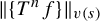
$\lVert \{T^nf\} \rVert _{v(s)}$
and, for any increasing sequence
$\{n_k\}$
,
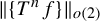
$\lVert \{T^nf\} \rVert _{o(2)}$
, are bounded on
$L^p$
; and -
(c) for $s\ge 2$
,
$\lVert \{n^r T^n(I-T)^r f\} \rVert_{v(s)}$
is bounded on
$L^p$
. -
(d) Let $\{n_k\}\subset \mathbb N$
be an increasing sequence with
$n_{k+1}-n_k \sim n_k$
. Then
$(\sum _k \max _{n_k\le n\le n_{k+1}}\, n^{2r}|T^n(I-T)^r|^2 )^{1/2}$
is bounded on
$L^p$
.











Note that Le Merdy and Xu [Reference Le Merdy and Xu17] proved part (a) for integer r and
$s=2$
 , but since
$(\sum _k |a_k|^s)^{1/s} \le (\sum _k |a_k|^2)^{1/2}$
, but since
$(\sum _k |a_k|^s)^{1/s} \le (\sum _k |a_k|^2)^{1/2}$
 if
$s\ge 2$
if
$s\ge 2$
 , (a) also holds for
$s>2$
, (a) also holds for
$s>2$
 . Arhancet and Le Merdy [Reference Arhancet and Le Merdy2] subsequently showed that any pair of norms of the form
$\lVert {\mathbf {Q}_{2r-1,2,r}}f\rVert _p$
. Arhancet and Le Merdy [Reference Arhancet and Le Merdy2] subsequently showed that any pair of norms of the form
$\lVert {\mathbf {Q}_{2r-1,2,r}}f\rVert _p$
 (with (
${r>0}$
(with (
${r>0}$
 ) are equivalent in
$L^p$
) are equivalent in
$L^p$
 ,
$1<p<\infty $
,
$1<p<\infty $
 . Hence, (a) holds for any
$r>0$
. Hence, (a) holds for any
$r>0$
 . Additionally, Le Merdy and Xu [Reference Le Merdy and Xu17] proved (b) and that, for
$r\ge 1$
. Additionally, Le Merdy and Xu [Reference Le Merdy and Xu17] proved (b) and that, for
$r\ge 1$
 integer,
$\lVert \{n^r T^n(I-T)^r f\} \rVert _{v(s)}$
integer,
$\lVert \{n^r T^n(I-T)^r f\} \rVert _{v(s)}$
 for
${s>2}$
for
${s>2}$
 ; and
$\lVert \{n^r T^n(I-T)^r f\} \rVert _{o(2)}$
; and
$\lVert \{n^r T^n(I-T)^r f\} \rVert _{o(2)}$
 are bounded on
$L^p$
are bounded on
$L^p$
 . Cuny, Cohen and Lin [Reference Cohen, Cuny and Lin5] strengthened these results by establishing that
$\lVert \{n^r T^n(I-T)^r f\} \rVert _{v(2)}$
. Cuny, Cohen and Lin [Reference Cohen, Cuny and Lin5] strengthened these results by establishing that
$\lVert \{n^r T^n(I-T)^r f\} \rVert _{v(2)}$
 is bounded on
$L^p$
is bounded on
$L^p$
 ,
$r>0$
,
$r>0$
 . Their theorem focused on
$0<r<1$
. Their theorem focused on
$0<r<1$
 , but their methods apply to any
$r>0$
, but their methods apply to any
$r>0$
 . They also showed item (d) for
$n_k=2^k$
. They also showed item (d) for
$n_k=2^k$
 , but their proof applies to sequences with
$n_{k+1}-n_k \sim n_k$
, but their proof applies to sequences with
$n_{k+1}-n_k \sim n_k$
 with minor modifications.
In martingale theory, the equivalence between the square function and associated maximal functions is a classical result. This naturally raises the question of whether such an equivalence holds in other contexts. Cohen, Cuny and Lin [Reference Cohen, Cuny and Lin5] established that a similar equivalence holds in the context of Ritt operators.
Theorem 1.6. Let
$(X,\mathcal B,m)$
 be a
$\sigma $
be a
$\sigma $
 -finite measure space,
$1 <p <\infty $
-finite measure space,
$1 <p <\infty $
 , and T a positive contraction on
$L^p(X, m)$
, and T a positive contraction on
$L^p(X, m)$
 . Then the following assertions are equivalent:
-
(a) $\sup _n n\lVert T^n-T^{n+1}\rVert <\infty $
; -
(b) there exists a constant $C_p>0$
such that
$\lVert {\mathbf {Q}_{1,2,1}}f \rVert _p \le C_p \lVert f\rVert _p$
.



Let
$X=(X,\beta ,m)$
 be a
$\sigma $
be a
$\sigma $
 -finite measure space. Throughout these notes, Y denotes a Banach function space, that is, a Banach space of measurable complex-valued functions on X. In particular, this class includes
$L^1(X)$
-finite measure space. Throughout these notes, Y denotes a Banach function space, that is, a Banach space of measurable complex-valued functions on X. In particular, this class includes
$L^1(X)$
 and Orlicz spaces.
Theorem 1.7. Let T be a Ritt operator on a Banach function space Y. Let
$s\ge 1$
 and
$r> 0$
and
$r> 0$
 . Then the following assertions hold.
-
(a) If $sr>\alpha +1$
, then
${\mathbf {Q}^T_{\alpha ,s,r}}f$
is bounded on Y. -
(b) If $\beta <r$
and
$\{n_k\}\subset \mathbb N$
is an increasing sequence with
$n_{k+1}-n_k\sim n_k$
, then
$\sup _n n^{\beta } |T^n (I- T)^{r} f|$
and
$(\sum _k \sup _{n_k< n<n_{k+1}} n^{\beta s} |T^n (I- T)^{r} f|^s)^{1/s}$
are bounded on Y,
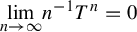
$\lim _{n\to \infty } n^{r} \lVert T^n (I- T)^{r} f\rVert =0$
and
$\lim _{n\to \infty } n^{\beta } |T^n (I- T)^{r}f | = 0$
almost everywhere. -
(c) If $\beta <r$
and
$s\ge 1$
then both
$\lVert n^{\beta } T^n(I-T)^r f\rVert _{v(s)}$
and
$\lVert n^{\beta } T^n(I-T)^r f\rVert _{o(s)}$
are bounded on Y. -
(d) Let $\{n_k\}$
be any increasing sequence with
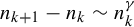
$ n_{k+1} -n_k \sim n_k^{\gamma }$
, for some
$\gamma \in (0,1]$
. If
$\beta \kern1.4pt{<}\kern1.4pt r\kern1.4pt{+}\kern1.4pt(1-\gamma )(1-1/s)$
then
${(\sum _k n_k^{\beta s} \max _{ n_k\le n,m\le n_{k+1} } |(T^n \kern1.4pt{-}\kern1.4pt T^{m})(I\kern1.4pt{-}\kern1.4pt T)^r f|^s)^{1/s}} $
and
$(\sum _k n_k^{\beta s} |(T^{n_k}-T^{n_{k+1}}) (I-T)^r f|^s)^{1/s}$
are bounded on Y. In particular, these results hold for
$\beta < r$
and
$s\ge 1$
or
$\beta \le r>0$
and
$s> 1>\gamma $
.


















Remark. By Theorem 1.6,
${\mathbf {Q}_{1,2,1}}f$
 is bounded on
$L^p$
is bounded on
$L^p$
 for any
$p>1$
for any
$p>1$
 , but on
$L^1$
, but on
$L^1$
 ,
${\mathbf {Q}_{1,s,1}}f$
,
${\mathbf {Q}_{1,s,1}}f$
 is bounded for
$s>2$
is bounded for
$s>2$
 , and in general,
${\mathbf {Q}_{r,s,r}}f$
, and in general,
${\mathbf {Q}_{r,s,r}}f$
 is bounded on
$L^1$
is bounded on
$L^1$
 for
$s>1+1/r$
for
$s>1+1/r$
 . More generally, by Theorem 1.5,
${\mathbf {Q}_{2r-1,2,r}}f$
. More generally, by Theorem 1.5,
${\mathbf {Q}_{2r-1,2,r}}f$
 is bounded on
$L^p$
is bounded on
$L^p$
 for any
$p>1$
for any
$p>1$
 , but on
$L^1$
, but on
$L^1$
 ,
${\mathbf {Q}_{2r-1,s,r}}f$
,
${\mathbf {Q}_{2r-1,s,r}}f$
 bounded for any
$s>2$
bounded for any
$s>2$
 , and
${\mathbf {Q}_{\alpha ,2,r}}f$
, and
${\mathbf {Q}_{\alpha ,2,r}}f$
 is bounded for any
$\alpha <2r-1$
is bounded for any
$\alpha <2r-1$
 .
.
Open Question 1. Is
${\mathbf {Q}_{\alpha ,s,r}}f$
 of weak type
$(1,1)$
of weak type
$(1,1)$
 for
$sr=\alpha +1$
for
$sr=\alpha +1$
 ?
?
Open Question 2. For what range of s are
$\lVert T^nf\rVert _{v(s)}$
 and
$\lVert T^n f\rVert _{o(s)}$
and
$\lVert T^n f\rVert _{o(s)}$
 of weak type
$(1,1)$
of weak type
$(1,1)$
 ? And in general, for what range of s are
$\lVert n^r T^n(I-T)^rf\rVert _{v(s)}$
? And in general, for what range of s are
$\lVert n^r T^n(I-T)^rf\rVert _{v(s)}$
 and
$\lVert n^r T^n(I-T)^r f\rVert _{o(s)}$
and
$\lVert n^r T^n(I-T)^r f\rVert _{o(s)}$
 of weak type
$(1,1)$
of weak type
$(1,1)$
 ?
?
Estimates in
$L^1$
 present more challenges. For the maximal function
$Mf=\sup _{n\ge 1} |T^nf|$
present more challenges. For the maximal function
$Mf=\sup _{n\ge 1} |T^nf|$
 only partial results are available, showing that
$Mf$
only partial results are available, showing that
$Mf$
 is a weak
$(1,1)$
is a weak
$(1,1)$
 operator for a restricted class of operators acting on probability spaces [Reference Bellow and Calderón3, Reference Cuny7, Reference Reinhold-Larsson24]. In what follows (and in §5), we provide answers for the above questions under assumptions analogous to those imposed in the study of
$Mf$
operator for a restricted class of operators acting on probability spaces [Reference Bellow and Calderón3, Reference Cuny7, Reference Reinhold-Larsson24]. In what follows (and in §5), we provide answers for the above questions under assumptions analogous to those imposed in the study of
$Mf$
 .
.
For the rest of this section
$X=(X,\mathcal B,m)$
 denotes a probability space and
$\tau $
denotes a probability space and
$\tau $
 an invertible measure-preserving transformation on X. T is the composition operator
${Tf=f\circ \tau }$
an invertible measure-preserving transformation on X. T is the composition operator
${Tf=f\circ \tau }$
 . To distinguish this case from the general setting, we denote

We say that
$\mu $
 has bounded angular ratio (BA) if there exists a constant
$C>0$
has bounded angular ratio (BA) if there exists a constant
$C>0$
 such that
$|1-\hat \mu (t)|\le C (1-|\hat \mu (t)|)$
such that
$|1-\hat \mu (t)|\le C (1-|\hat \mu (t)|)$
 for all
$|t|\le 1$
for all
$|t|\le 1$
 , where
$\hat {\mu }(t)=\sum _k \mu (k) e^{-2\pi i kt}$
, where
$\hat {\mu }(t)=\sum _k \mu (k) e^{-2\pi i kt}$
 .
.
Bellow and Calderón [Reference Bellow and Calderón3] showed that the maximal function
$M_{\mu }f= \sup _{n\ge 1} |\tau ^n_{\mu }f|$
 is weak
$(1,1)$
is weak
$(1,1)$
 for centered measures
$\mu $
for centered measures
$\mu $
 with finite second moment. Such measures have the BA property. Further extensions of this result, relaxing the moment condition, were obtained by Dungey [Reference Dungey9] in 2011, Wedrychowicz [Reference Wedrychowicz29] also in 2011, and Cuny [Reference Cuny7] in 2016, while in 1999 and 2001 Losert [Reference Losert19, Reference Losert20] constructed measures
$\mu $
with finite second moment. Such measures have the BA property. Further extensions of this result, relaxing the moment condition, were obtained by Dungey [Reference Dungey9] in 2011, Wedrychowicz [Reference Wedrychowicz29] also in 2011, and Cuny [Reference Cuny7] in 2016, while in 1999 and 2001 Losert [Reference Losert19, Reference Losert20] constructed measures
$\mu $
 without the BA property, for which pointwise convergence of
$\tau ^n_{\mu }$
without the BA property, for which pointwise convergence of
$\tau ^n_{\mu }$
 failed.
In [Reference Cuny7], Cuny introduced a modification of the BA property (see properties
$\text {BA}_1$
 and
$\text {BA}_2$
and
$\text {BA}_2$
 in §2) to obtain the following
$L^1$
in §2) to obtain the following
$L^1$
 results.
Theorem 1.8. [Reference Cuny7]
Let
$(X,\mathcal B,m)$
 be a probability space and
$\tau :X\to X$
be a probability space and
$\tau :X\to X$
 an invertible measure-preserving transformation. Let
$\mu $
an invertible measure-preserving transformation. Let
$\mu $
 be a probability measure on
$\mathbb Z$
be a probability measure on
$\mathbb Z$
 with property
$\text {BA}_1$
with property
$\text {BA}_1$
 . Then:
-
(a) the maximal function $\sup _n |\tau _{\mu }^n f|$
is of weak type
$(1,1)$
; and -
(b) for $r{\kern-1.5pt}\in{\kern-1.5pt} \mathbb N$
,
$m(x{\kern-1.5pt}\in{\kern-1.5pt} X{\kern-1.5pt}:{\kern-2pt} \sup_n n^r |(\tau_{\mu}^n{\kern-1.5pt}-{\kern-1.5pt}\tau_{\mu}^{n+r})f(x)|{\kern-1.5pt}>{\kern-1.5pt}\lambda) {\kern-1.5pt}\le{\kern-1.5pt} ({C_r}/{\lambda}) \lVert f\rVert_1$
for any
${f{\kern-2pt}\in{\kern-1.5pt} L^1(X)}$
. -
(c) If $\mu $
satisfies
$\text {BA}_2$
, then
$\tau _{\mu }$
is Ritt on
$L^1$
.





Strengthening the control over the fluctuations of
$\tau _{\mu }^n$
 , we establish weak
$(1,1)$
, we establish weak
$(1,1)$
 results for generalized square functions and variation-type operators.
Theorem 1.9. Let
$(X,\mathcal B,m)$
 be a standard probability space,
$\tau :X\to X$
be a standard probability space,
$\tau :X\to X$
 an invertible measure-preserving transformation. Let
$\mu $
an invertible measure-preserving transformation. Let
$\mu $
 be a probability measure on
$\mathbb Z$
be a probability measure on
$\mathbb Z$
 with property
$\text {BA}_2$
with property
$\text {BA}_2$
 . Then, for any
$r\ge 0$
. Then, for any
$r\ge 0$
 , the following assertions hold.
-
(A) If $sr\ge \alpha +1$
and
${\mathbf {Q}^{\tau _{\mu }}_{\alpha ,s,r}}f$
is bounded on
$L^2$
, then it is of weak type
$(1,1)$
. -
(B) Let $s> 1$
and
$0\le \beta \le r$
. If
$ \lVert n^{\beta } \tau _{\mu }^n (I-\tau _{\mu })^r f \rVert _{v(s)}$
is bounded on
$L^2$
, then it is of weak type
$(1,1)$
, and if
$\lVert n^{\beta } \tau _{\mu }^n (I-\tau _{\mu })^r f\rVert _{o(s)}$
is bounded on
$L^2$
, then it is of weak type
$(1,1)$
.








Theorem 1.10. Let
$\tau , \mu $
 be as in Theorem 1.9 and
$r> 0$
be as in Theorem 1.9 and
$r> 0$
 . Then the following assertions hold.
-
(a) For all $s\ge 2$
,
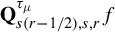
$\mathbf{Q}^{\tau_{\mu}}_{s(r-1/2),s,r}f$
is of weak type
$(1,1)$
. -
(b) For all $s>2, \tau_{\mu}^nf\rVert_{v(s)}$
is of weak type
$(1,1)$
; and
$\lVert \tau_{\mu}^n f\rVert_{o(2)}$
is of weak type
$(1,1)$
. -
(c) More generally, $\lVert n^{r} \tau _{\mu }^n (I-\tau _{\mu })^r f\rVert _{v(s)}$
is of weak type
$(1,1)$
for all
$s\ge 2$
; and
$\lVert n^{r} \tau _{\mu }^n (I-\tau _{\mu })^r f\rVert _{o(2)}$
is of weak type
$(1,1)$
. -
(d) Let $\{n_k\}\kern1.4pt{\subset}\kern1.4pt \mathbb N$
be an increasing sequence with
$n_{k+1}\kern1.4pt{-}\kern1.4pt n_k \kern1.4pt{\sim}\kern1.4pt n_k$
, then
$(\sum _k \max _{n_k\le n\le n_{k+1}} n^{sr}|\tau _{\mu }^n(I-\tau _{\mu })^rf|^s )^{1/s}$
is of weak type
$(1,1)$
for
$s\ge 2$
.















Items (a), (b) and (c) of Theorem 1.10 are a straightforward application of Theorems 1.5 and 1.9. Item (d) is proven in §4.
This paper is organized as follows. Section 2 introduces the general framework and develops the main results for the special case of
$T_{\mu }$
 . Section 3 presents a key technical lemma, central to the proofs of the general case. Section 4 provides detailed proofs for operators of the form
$T_{\mu }$
. Section 3 presents a key technical lemma, central to the proofs of the general case. Section 4 provides detailed proofs for operators of the form
$T_{\mu }$
 , and concludes with the proof of Theorem 1.7. Section 5 establishes weak type
$(1,1)$
, and concludes with the proof of Theorem 1.7. Section 5 establishes weak type
$(1,1)$
 bounds in Theorem 1.10.
2 The case of
$T_{\mu }$

We begin this section with a brief discussion of sufficient conditions under which
$T_{\mu }$
 is a Ritt operator on
$L^1$
is a Ritt operator on
$L^1$
 . For an
$L^1$
. For an
$L^1$
 –
$L^{\infty }$
–
$L^{\infty }$
 contraction, Blunck [Reference Blunck4] showed, via a clever interpolation argument, that if T is Ritt on
$L^2$
contraction, Blunck [Reference Blunck4] showed, via a clever interpolation argument, that if T is Ritt on
$L^2$
 , it is also Ritt on
$L^p$
, it is also Ritt on
$L^p$
 ,
$1<p<\infty $
,
$1<p<\infty $
 . This interpolation technique does not extend to the case
$p=1$
. This interpolation technique does not extend to the case
$p=1$
 . However, for the special case of
$T_{\mu }$
. However, for the special case of
$T_{\mu }$
 , Dungey [Reference Dungey9] showed
$T_{\mu }$
, Dungey [Reference Dungey9] showed
$T_{\mu }$
 is Ritt on
$L^1$
is Ritt on
$L^1$
 provided
$\mu $
provided
$\mu $
 satisfies a set of stronger regularity conditions than BA.
Theorem 2.1. (Dungey [Reference Dungey9, Theorem 4.1])
Let
$\mu $
 be a probability measure on
$\mathbb N_0$
be a probability measure on
$\mathbb N_0$
 such that there exist constants
$0<\alpha ,c<1$
such that there exist constants
$0<\alpha ,c<1$
 with (i)
$\mbox {Re} \, \hat \mu (t) \le 1-c |t|^{\alpha }$
with (i)
$\mbox {Re} \, \hat \mu (t) \le 1-c |t|^{\alpha }$
 , and (ii)
$|\hat \mu '(t)|\lesssim |t|^{\alpha -1}$
, and (ii)
$|\hat \mu '(t)|\lesssim |t|^{\alpha -1}$
 for
${0<|t|\le 1/2}$
for
${0<|t|\le 1/2}$
 . If
$T\in \mathcal (L^1)$
. If
$T\in \mathcal (L^1)$
 is power-bounded, then
$T_{\mu }$
is power-bounded, then
$T_{\mu }$
 is Ritt on
$L^1$
is Ritt on
$L^1$
 .
.
Inspired by [Reference Dungey9] and also [Reference Wedrychowicz29], Cuny [Reference Cuny7] considered broader spectral conditions, referred to below as properties
$\text {BA}_1$
 and
$\text {BA}_2$
and
$\text {BA}_2$
 , for measures supported on
$\mathbb Z$
, for measures supported on
$\mathbb Z$
 and showed these suffice to guarantee that
$\tau _{\mu }$
and showed these suffice to guarantee that
$\tau _{\mu }$
 is Ritt on
$L^1$
is Ritt on
$L^1$
 in a broader setting.
Definition 2.2. Let
$\mu $
 be a probability measure on
$\mathbb Z$
be a probability measure on
$\mathbb Z$
 whose Fourier transform
$\hat \mu (t)$
whose Fourier transform
$\hat \mu (t)$
 is twice continuously differentiable on
$|t|\in (0,1)$
is twice continuously differentiable on
$|t|\in (0,1)$
 . We say
$\mu $
. We say
$\mu $
 has property
$\text {BA}_1$
has property
$\text {BA}_1$
 if there exists a continuous function
$h(t)$
if there exists a continuous function
$h(t)$
 on
$|t|\le 1$
on
$|t|\le 1$
 with
$h(0)=0$
with
$h(0)=0$
 ,
$h(-t)=h(t)$
,
$h(-t)=h(t)$
 , continuously differentiable on
$|t|\in (0,1)$
, continuously differentiable on
$|t|\in (0,1)$
 satisfying the following conditions: there exist some constants
$c,C>0$
satisfying the following conditions: there exist some constants
$c,C>0$
 such that (i)
$|\hat \mu (t)|\le 1-ch(t)$
such that (i)
$|\hat \mu (t)|\le 1-ch(t)$
 , (ii)
$|t \hat \mu '(t)|\le Ch(t)$
, (ii)
$|t \hat \mu '(t)|\le Ch(t)$
 , (iii)
$|\hat \mu '(t)|\le Ch'(t)$
, (iii)
$|\hat \mu '(t)|\le Ch'(t)$
 , and (iv)
$|t \hat \mu "(t)|\le C |\hat \mu '(t)|$
, and (iv)
$|t \hat \mu "(t)|\le C |\hat \mu '(t)|$
 . If, in addition,
$\hat \mu $
. If, in addition,
$\hat \mu $
 satisfies (v)
$h(t)\le C th'(t)$
satisfies (v)
$h(t)\le C th'(t)$
 for
$0<t<1$
for
$0<t<1$
 , then we say
$\mu $
, then we say
$\mu $
 satisfies condition
$\text {BA}_2$
satisfies condition
$\text {BA}_2$
 .
.
Note that
$\text {BA}_1$
 (iii) implies bounded angular ratio

Centered measures with finite second moment satisfy property
$\text {BA}_2$
 with
$h(t)=t^2$
with
$h(t)=t^2$
 . The next example exhibits a non-centered measure without finite first moment that still satisfies
$\text {BA}_2$
. The next example exhibits a non-centered measure without finite first moment that still satisfies
$\text {BA}_2$
 .
.
Example 2.3. For fixed
$0<a<1$
 , let
$\nu _{a}$
, let
$\nu _{a}$
 be the probability measure on
$\mathbb Z$
be the probability measure on
$\mathbb Z$
 defined in (2). Then
$\hat \nu _{a}(t) = 1-(1-e^{2\pi i t})^{a}$
defined in (2). Then
$\hat \nu _{a}(t) = 1-(1-e^{2\pi i t})^{a}$
 . From [Reference Dungey9],
$\nu _{a}$
. From [Reference Dungey9],
$\nu _{a}$
 satisfies the conditions of Theorem 2.1 and hence
$T_{\nu _{a}} = I-(I-T)^{a}$
satisfies the conditions of Theorem 2.1 and hence
$T_{\nu _{a}} = I-(I-T)^{a}$
 is a Ritt operator on
$L^1$
is a Ritt operator on
$L^1$
 . Additionally,
$\nu _{a}$
. Additionally,
$\nu _{a}$
 satisfies property
$\text {BA}_2$
satisfies property
$\text {BA}_2$
 .
.
More examples of measures with property
$\text {BA}_2$
 can be found in Cuny [Reference Cuny7].
For general Banach function spaces, including
$L^1$
 , we obtain the following results.
Theorem 2.4. Let
$\mu $
 be as in Theorem 1.8 and Y be a Banach function space. Let T be a (doubly) power-bounded linear operator on Y. If
$r>0$
be as in Theorem 1.8 and Y be a Banach function space. Let T be a (doubly) power-bounded linear operator on Y. If
$r>0$
 and
$sr>\alpha +1$
and
$sr>\alpha +1$
 , then
${\mathbf {Q}_{\alpha ,s,r}^{T_{\mu }}}f$
, then
${\mathbf {Q}_{\alpha ,s,r}^{T_{\mu }}}f$
 is bounded on Y.
Corollary 2.5. Let
$\mu $
 , T and Y be as in Theorem 2.4 and
$\{n_k\}\subset \mathbb N$
, T and Y be as in Theorem 2.4 and
$\{n_k\}\subset \mathbb N$
 an increasing sequence with
$n_{k+1}-n_k\sim n_k$
an increasing sequence with
$n_{k+1}-n_k\sim n_k$
 . If
$0\le \beta <r$
. If
$0\le \beta <r$
 and
$s\ge 1$
and
$s\ge 1$
 ,
$\sup _n n^{\beta } |T_{\mu }^n (I- T_{\mu })^{r}f|$
,
$\sup _n n^{\beta } |T_{\mu }^n (I- T_{\mu })^{r}f|$
 and
$(\sum _k \max _{n_{k}\le n\le n_{k+1}} n^{\beta s} |T_{\mu }^{n}(I-T_{\mu })^{r} f|^s)^{1/s} $
and
$(\sum _k \max _{n_{k}\le n\le n_{k+1}} n^{\beta s} |T_{\mu }^{n}(I-T_{\mu })^{r} f|^s)^{1/s} $
 are both bounded on Y,
$\lim _{n\to \infty } n^{r} \lVert T_{\mu }^n (I- T_{\mu })^{r}f \rVert = 0$
are both bounded on Y,
$\lim _{n\to \infty } n^{r} \lVert T_{\mu }^n (I- T_{\mu })^{r}f \rVert = 0$
 and
$\lim _{n\to \infty } n^{\beta } |T_{\mu }^n (I- T_{\mu })^{r}f | = 0$
and
$\lim _{n\to \infty } n^{\beta } |T_{\mu }^n (I- T_{\mu })^{r}f | = 0$
 almost everywhere.
Proposition 2.6. Let
$\mu $
 , T and Y be as in Theorem 2.4. Let
$\{n_k\}$
, T and Y be as in Theorem 2.4. Let
$\{n_k\}$
 be an increasing sequence with
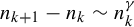
$n_{k+1} -n_k \sim n_k^{\gamma }$
be an increasing sequence with
$n_{k+1} -n_k \sim n_k^{\gamma }$
 for some
$0<\gamma \le 1$
for some
$0<\gamma \le 1$
 . Let
$s\ge 1$
. Let
$s\ge 1$
 ,
$r\ge 0$
,
$r\ge 0$
 . If
$\beta <r+(1-\gamma ) (1-1/s)$
. If
$\beta <r+(1-\gamma ) (1-1/s)$
 , then
$(\sum _k n_k^{\beta s} \max _{ n_k\le n,m\le n_{k+1} } |(T_{\mu }^n -T_{\mu }^{m})(I-T_{\mu })^r f|^s)^{1/s} $
, then
$(\sum _k n_k^{\beta s} \max _{ n_k\le n,m\le n_{k+1} } |(T_{\mu }^n -T_{\mu }^{m})(I-T_{\mu })^r f|^s)^{1/s} $
 and
$(\sum _k n_k^{\beta s} |(T_{\mu }^{n_k}-T_{\mu }^{n_{k+1}})(I-T_{\mu })^rf|^s)^{1/s}$
and
$(\sum _k n_k^{\beta s} |(T_{\mu }^{n_k}-T_{\mu }^{n_{k+1}})(I-T_{\mu })^rf|^s)^{1/s}$
 are bounded on Y.
Proposition 2.7. Let
$\mu $
 , T and Y be as in Theorem 2.4. Let
$r> 0$
, T and Y be as in Theorem 2.4. Let
$r> 0$
 . If
$\beta < r$
. If
$\beta < r$
 and
$s\ge 1$
and
$s\ge 1$
 , then both
$\lVert n^{\beta } T_{\mu }^n(I-T_{\mu })^r f \rVert _{v(s)}$
, then both
$\lVert n^{\beta } T_{\mu }^n(I-T_{\mu })^r f \rVert _{v(s)}$
 and
$\lVert n^{\beta } T_{\mu }^n(I-T_{\mu })^r f \rVert _{o(s)}$
and
$\lVert n^{\beta } T_{\mu }^n(I-T_{\mu })^r f \rVert _{o(s)}$
 are bounded on Y.
3 Auxiliary lemma
Across these notes, c and C denote constants whose values may change from one instance to the next, and
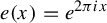
$e(x)=e^{2\pi i x}$
 . For
$0\le x,y$
. For
$0\le x,y$
 , we say
$x \lesssim y$
, we say
$x \lesssim y$
 if there exists a constant
$c>0$
if there exists a constant
$c>0$
 such that
$x \le c y$
such that
$x \le c y$
 , and
$x\sim y$
, and
$x\sim y$
 if
$x \lesssim y$
if
$x \lesssim y$
 and
$y \lesssim x$
and
$y \lesssim x$
 .
.
For completeness, we recall the Stein–Minkowski integral inequality [Reference Stein27]. Suppose that
$(X_1,\nu _1)$
 and
$(X_2,\nu _2)$
and
$(X_2,\nu _2)$
 are two
$\sigma $
are two
$\sigma $
 -finite measure spaces and
$g:X_1\times X_2\to \mathbb R$
-finite measure spaces and
$g:X_1\times X_2\to \mathbb R$
 is measurable. Then, for any
$1\le s <\infty $
is measurable. Then, for any
$1\le s <\infty $
 ,
,

Lemma 3.1. Let
$S=\{\Delta _n\}$
 be a sequence of (finite) signed measures on
$\mathbb Z$
be a sequence of (finite) signed measures on
$\mathbb Z$
 whose Fourier transforms
$\hat \Delta _n$
whose Fourier transforms
$\hat \Delta _n$
 are twice continuously differentiable on
$|t|\in (0,1)$
are twice continuously differentiable on
$|t|\in (0,1)$
 . Let T be a linear (doubly) power-bounded operator on a Banach function space, and let

If
$A, B, C$
 and D are all finite, then, for any
$f\in Y$
and D are all finite, then, for any
$f\in Y$
 ,
$\lVert ( \sum _n |T_{\Delta _n}f|^s)^{1/s} \rVert \lesssim \lVert f\rVert .$
,
$\lVert ( \sum _n |T_{\Delta _n}f|^s)^{1/s} \rVert \lesssim \lVert f\rVert .$

Proof. Without loss of generality, we assume
$\sup _{n\ge 0} \lVert T^n \rVert = 1$
 if
$\bigcup _n \mbox {supp}(\Delta _n) \subset \mathbb N_0$
if
$\bigcup _n \mbox {supp}(\Delta _n) \subset \mathbb N_0$
 and assume
$\sup _{n\in \mathbb Z} \lVert T^n \rVert = 1$
and assume
$\sup _{n\in \mathbb Z} \lVert T^n \rVert = 1$
 otherwise. We have

Applying the Stein–Minkowski integral inequality, we obtain the following estimate for the first term:

Also

For the second term, by the Stein–Minkowski integral inequality, we have

Since
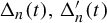
$\Delta _n(t), \Delta ^{\prime }_n(t)$
 and
$e(kt)$
and
$e(kt)$
 are 1-periodic,
$\Delta _n(-t)=\overline {\Delta _n(t)}$
are 1-periodic,
$\Delta _n(-t)=\overline {\Delta _n(t)}$
 , and
$\Delta ^{\prime }_n(-t)=\overline {\Delta ^{\prime }_n(t)}$
, and
$\Delta ^{\prime }_n(-t)=\overline {\Delta ^{\prime }_n(t)}$
 , we estimate

By the Stein–Minkowski integral inequality,

Thus,
$\mbox {II}\lesssim (B+C+D) \lVert f\rVert $
 .
.
The proof of this lemma can be adapted to the following setting.
Lemma 3.2. Let
$\Delta _n$
 and T be as in Lemma 3.1,
$\{n_k\}$
and T be as in Lemma 3.1,
$\{n_k\}$
 an increasing sequence, and
${J_k=[n_k,n_{k+1})}$
an increasing sequence, and
${J_k=[n_k,n_{k+1})}$
 . Let
. Let

If
$A, B, C$
 and D are all finite, then, for any
$f\in Y$
and D are all finite, then, for any
$f\in Y$
 ,
$ \lVert ( \sum _k n_k^{\beta } \max _{n\in I_k} |T_{\Delta _{n}}f|^s )^{1/s} \rVert \lesssim \lVert f \rVert .$
,
$ \lVert ( \sum _k n_k^{\beta } \max _{n\in I_k} |T_{\Delta _{n}}f|^s )^{1/s} \rVert \lesssim \lVert f \rVert .$

4 Proofs of results for
$T_{\mu }$
and Theorem 1.7

Proof of Theorem 2.4
Let
$\Delta _n$
 be the measure on the integers defined by

that is,
$T_{\Delta _n}=n^{\alpha /s} T_{\mu }^n (I-T_{\mu })^r$
 . Using Lemma 3.1 with
$\Delta _n$
. Using Lemma 3.1 with
$\Delta _n$
 , it suffices to show that the corresponding terms defined in the lemma,
$A, B, C, D$
, it suffices to show that the corresponding terms defined in the lemma,
$A, B, C, D$
 , are bounded.
We assume
$\alpha \ge -1$
 because, if
$\alpha <-1$
because, if
$\alpha <-1$
 ,
${\mathbf {Q}_{\alpha ,s,r}}f \le {\mathbf {Q}_{-1,s,r}}f$
,
${\mathbf {Q}_{\alpha ,s,r}}f \le {\mathbf {Q}_{-1,s,r}}f$
 .
.
If
$\alpha>-1$
 , dominating the sum by an integral and using property
$\text {BA}_1$
, dominating the sum by an integral and using property
$\text {BA}_1$
 (i), we obtain

If
$\alpha =-1$
 ,
,

for any
$\gamma>0$
 .
.
For term A, using properties
$\text {BA}_2$
 , we estimate

When
$\alpha>-1$
 the integral is finite for
$sr>\alpha +1$
the integral is finite for
$sr>\alpha +1$
 , and when
$\alpha =-1$
, and when
$\alpha =-1$
 the integral is finite for
$r>0$
the integral is finite for
$r>0$
 since we can choose
$\gamma $
since we can choose
$\gamma $
 arbitrarily small, say
$\gamma =sr/2$
arbitrarily small, say
$\gamma =sr/2$
 .
.
With
$B_n=T^n (I-T)^r$
 ,
,

and by
$\text {BA}_1$
 ,
,

Thus, for
$\alpha>-1$
 ,
,

Since
$(1+\alpha )< s r $
 ,
,

When
$\alpha =-1$
 , choosing
$0<\gamma <r$
, choosing
$0<\gamma <r$
 , the estimate is

For the remaining terms, we address the case
$\alpha>-1$
 since the estimates for the case
$\alpha =-1$
since the estimates for the case
$\alpha =-1$
 follow similar arguments.
For
$(1+\alpha )< s r $
 , by
$\text {BA}_2$
, by
$\text {BA}_2$
 and dominating the kth term by an integral over intervals
$(1/{k+1}, 1/k)$
and dominating the kth term by an integral over intervals
$(1/{k+1}, 1/k)$
 , we have

From (6) and
$\text {BA}_1$
 (ii),
(ii),

Thus,

Proof of Corollary 2.5
Let
$\{n_k\}$
 be an increasing sequence in
$\mathbb N$
be an increasing sequence in
$\mathbb N$
 such that
${n_{k+1}-n_k\sim n_k}$
such that
${n_{k+1}-n_k\sim n_k}$
 . Then we have
$n_{k+1}=n_{k+1}-n_k+n_k\lesssim 2n_k$
. Then we have
$n_{k+1}=n_{k+1}-n_k+n_k\lesssim 2n_k$
 .
.
Applying Abel’s summation,

Thus,

Decomposing
$n\in (n_k,n_{k+1}]$
 as
$n=n_{k-1}+l$
as
$n=n_{k-1}+l$
 with
$l\in (n_k-n_{k-1},n_{k+1}-n_{k-1}]$
with
$l\in (n_k-n_{k-1},n_{k+1}-n_{k-1}]$
 , and applying the above to the function
$T_{\mu }^{n_{k-1}}(1-T_{\mu })^rf$
, and applying the above to the function
$T_{\mu }^{n_{k-1}}(1-T_{\mu })^rf$
 with
$u=l$
with
$u=l$
 ,
,

because
${n}/{l} \le ({n_{k+1}}/{n_k-n_{k-1}})\lesssim ({2n_k}/{n_{k-1}})\lesssim 4$
 . Thus,

By Theorem 2.4, both generalized square functions are bounded in Y when
$0\le \beta < r$
 . Therefore
  is also bounded in Y.
By [Reference Cohen, Cuny and Lin5],
$\lim _{n\to \infty } n^{r} \lVert T_{\mu }^n(I - T_{\mu })^{r}f \rVert = 0$
 .
.
From these results, it follows that
$n^{\beta } |T_{\mu }^n(I - T_{\mu })^{r}f|\to 0$
 almost everywhere as well.
Note that in [Reference Cohen, Cuny and Lin5, Proposition 6.4], it was shown that

This result holds for general
$s>1$
 . Let
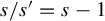
$s'=s/(s-1)$
. Let
$s'=s/(s-1)$
 . From equation (9) with
$\beta =1$
. From equation (9) with
$\beta =1$
 ,
,

Since
$s/s'=s-1$
 and
$\sum _{j=1}^{u} j^{1/(s-1)} \lesssim u^{1+1/(s-1)}=u^{s'}$
and
$\sum _{j=1}^{u} j^{1/(s-1)} \lesssim u^{1+1/(s-1)}=u^{s'}$
 ,
,

Following arguments similar to those in the corollary, it follows that

Proof of Proposition 2.6
We prove only the result for the convolution measures with
$\hat \Delta _{k,r}=n_k^{\beta } ({\hat \mu }^{n_k} - {\hat \mu }^{n_{k+1}})(1-\hat \mu )^r$
 because the other case follows similar arguments. It suffices to verify that
$\{\Delta _{k,r}\}_k$
because the other case follows similar arguments. It suffices to verify that
$\{\Delta _{k,r}\}_k$
 satisfy the conditions of Lemma 3.1.
If
$\delta \ge 0$
 ,
,

We also have

Under the assumptions for
$\gamma $
 ,
$\beta $
,
$\beta $
 and s we have
$\beta +\gamma +(1-\gamma )/s <1+r$
and s we have
$\beta +\gamma +(1-\gamma )/s <1+r$
 .
.
Then, since
$|h(t)|\lesssim |t| h'(t)$
 ,
,

and dominating the terms of the sum by an integral over intervals of length
$l^{-2}$
 ,
,

Let
$B_k=\hat \mu ^{n_k}(t)- \hat \mu ^{n_{k+1}}(t)$
 . Then

and

Since

we have

Estimating

we have

Since

we have

and

For the last term, from equation (12) and
$|t\hat \mu '(t)|\lesssim h(t)$
 , we have

Proof of Proposition 2.7
Let
$\Delta _{n,r}f=T_{\mu }^n(I-T_{\mu })^r f$
 , and
$\{n_k\}$
, and
$\{n_k\}$
 be any increasing sequence. By Abel summation,

Hence,

Applied to the function
$(I-T_{\mu })^r f$
 , we obtain

Since
$s\ge 1$
 ,
,

Then

which, by Theorem 2.4, are bounded on Y because
$\beta <r$
 .
.
Since
$ \lVert n^{\beta } \Delta _{n,r}f \rVert _{o(s)}\le \lVert n^{\beta } \Delta _{n,r}f \rVert _{v(s)}$
 the result also holds for oscillation norms.
Proof of Theorem 1.7
By [Reference Dungey9], there exist a power-bounded operator R and
$a\in (0,1)$
 such that
$T=I-(I-R)^{a} = R_{\nu _{a}}$
such that
$T=I-(I-R)^{a} = R_{\nu _{a}}$
 , where
$\nu _{a}$
, where
$\nu _{a}$
 is the probability measure on
$\mathbb Z$
is the probability measure on
$\mathbb Z$
 defined in equation (2). Therefore Theorem 2.4, Corollary 2.5 and Propositions 2.6 and 2.7 apply to T.
5 The case of
$\tau _{\mu }$

We now turn to the special case of the operators
$\tau _{\mu }$
 induced by a measure-preserving transformation on a probability space.
By the ergodic decomposition of probability measures, it suffices to work with ergodic systems.
Lemma 5.1. Let
$X=(X,\mathcal B,m)$
 be a standard probability space and
$\tau :X\to X$
be a standard probability space and
$\tau :X\to X$
 a measure-preserving transformation. Let
$U_{\tau }$
a measure-preserving transformation. Let
$U_{\tau }$
 be a sublinear operator defined on measurable functions on X. Suppose that there exists a constant
$C>0$
be a sublinear operator defined on measurable functions on X. Suppose that there exists a constant
$C>0$
 such that for any
$\tau $
such that for any
$\tau $
 -invariant ergodic probability measure
$\nu $
-invariant ergodic probability measure
$\nu $
 on
$(X, \mathcal B)$
on
$(X, \mathcal B)$
 ,
$\nu (|U_{\tau }f|>\unicode{x3bb} ) \le (C/{\unicode{x3bb} }) \int |f| \,d\nu $
,
$\nu (|U_{\tau }f|>\unicode{x3bb} ) \le (C/{\unicode{x3bb} }) \int |f| \,d\nu $
 . Then

Proof. There are several versions of the ergodic decomposition of measures [Reference Cornfeld, Fomin and Sinai6, Reference Walters28]. We use the formulation based on conditional expectation on a standard probability space [Reference Sarig26]. (The argument works for any other formulation.)
Let
$\mathrm {Inv}(\tau )=\{E \in \mathcal B : E = \tau ^{-1}E\}$
 . Let
$m_y$
. Let
$m_y$
 be the conditional probabilities with respect to
$\mathrm {Inv}(\tau )$
be the conditional probabilities with respect to
$\mathrm {Inv}(\tau )$
 . (Refer to [Reference Sarig26] to see how the
$\{m_y\}$
. (Refer to [Reference Sarig26] to see how the
$\{m_y\}$
 are constructed.) Then, for m-almost every
$y\in X$
are constructed.) Then, for m-almost every
$y\in X$
 ,
$m_y$
,
$m_y$
 is
$\tau $
is
$\tau $
 -invariant and ergodic and
$\int _X f \,dm= E(E(f|\mathrm {Inv}(\tau ))= \int _X \int _X f \,dm_y \,dm(y)$
-invariant and ergodic and
$\int _X f \,dm= E(E(f|\mathrm {Inv}(\tau ))= \int _X \int _X f \,dm_y \,dm(y)$
 . Then

For operators
$\tau _{\mu }$
 , the estimates developed in §§4 can be improved with the aid of the ergodic Calderón–Zygmund decomposition introduced by Jones [Reference Jones12], because the cancelation provided by the ‘bad’ function gives improved control on Fourier coefficients.
Proposition 5.2. (Ergodic Calderón–Zygmund decomposition [Reference Jones12])
Let
$(X, m)$
 be a probability space and
$\tau : X \to X$
be a probability space and
$\tau : X \to X$
 and ergodic, invertible measure-preserving transformation. Let
$f\in L^1(X)$
and ergodic, invertible measure-preserving transformation. Let
$f\in L^1(X)$
 and
$f^*(x)= \sup _{n,m} ( 1/{n+m+1}) |\sum _{k=-m}^n f(\tau ^kx)|$
and
$f^*(x)= \sup _{n,m} ( 1/{n+m+1}) |\sum _{k=-m}^n f(\tau ^kx)|$
 , the maximal function for averages. Then f can be decomposed as
$f=g+b$
, the maximal function for averages. Then f can be decomposed as
$f=g+b$
 , with
$g\in L^{\infty }$
, with
$g\in L^{\infty }$
 and
${b\in L^1(X)}$
and
${b\in L^1(X)}$
 , called the ‘bad’ function, with the following properties:
-
(a) the set $B=\{x: f^*(x) \le \unicode{x3bb} \}$
decomposes as
$B= \bigcup _i B_i$
where the
$B_i$
are pairwise disjoint; -
(b) $b=\sum _i b_i$
where each
$b_i$
is supported on a set
$E_i$
of the form
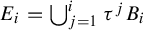
$E_i=\bigcup _{j=1}^{i} \tau ^jB_i$
, union of pairwise disjoint sets; -
(c) $\sum _{k=1}^{i}b_i(\tau ^kx)=0$
if
$x\in B_i$
; -
(d) $\sum _{k=1}^{i}|b_i(\tau ^kx)| \le 2 \unicode{x3bb} $
if
$x\in B_i$
; -
(e) $\sum _i m(E_i) \le 2 {\lVert f\rVert _1}/{\unicode{x3bb} }$
; -
(f) $\lVert g\rVert _{\infty } \le 2\unicode{x3bb} $
and
$\lVert g\lVert _1\le \lVert f\rVert _1$
.










This decomposition reduces the problem on
$L^1$
 to working with simpler building blocks called ‘atoms’, which are defined below.
Definition 5.3. Let
$\tau :X\to X$
 be an invertible, measure-preserving transformation on a standard probability space
$(X,\mathcal B,m)$
be an invertible, measure-preserving transformation on a standard probability space
$(X,\mathcal B,m)$
 . Given
$\unicode{x3bb}>0$
. Given
$\unicode{x3bb}>0$
 , a
$\unicode{x3bb} $
, a
$\unicode{x3bb} $
 -atom is a function
$a\in L^1(X)$
-atom is a function
$a\in L^1(X)$
 for which there exist a measurable set
$B\in X$
for which there exist a measurable set
$B\in X$
 and an integer
$d>0$
and an integer
$d>0$
 such that:
-
(a) $\{\tau ^k B\}_{k=1}^n$
are pairwise disjoint sets; -
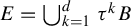
(b) a is supported on the set $E=\bigcup _{k=1}^d \tau ^k B$
; -
(c) $\sum _{k=1}^d a(\tau ^k x) =0$
for all
$x\in B$
; -
(d) $\sum _{k=1}^d |a(\tau ^k x)|\le 2\unicode{x3bb} $
if
$x\in B$
.





We call B the generator set (of length d) and define

Notice that, as a consequence of the properties of atoms,

Proposition 5.4. Let X and
$\tau $
 as in Definition 5.3. Suppose Q is a sublinear operator defined on measurable functions on X satisfying the following properties:
-
(a) Q is bounded on $L^2(X)$
; -
(b) there exists a constant $C>0$
such that, for every
$\unicode{x3bb} $
-atom a, $$ \begin{align*}\int_{(E^*)^c} |Q(a)| \,dm \le C \, \unicode{x3bb} m(E),\end{align*} $$where E and $E^*$
are defined as in Definition 5.3.


Then Q is of weak type
$(1,1)$
 .
.
Proof. By Lemma 5.1, it suffices to consider the case when
$(X, \mathcal B, m,\tau )$
 is an ergodic measure-preserving system.
Given
$\unicode{x3bb}>0$
 and
$f\in L^1$
and
$f\in L^1$
 , decompose f via the ergodic Calderón–Zygmund decomposition, with the sets
$B,B_i, E_i$
, decompose f via the ergodic Calderón–Zygmund decomposition, with the sets
$B,B_i, E_i$
 and the associated good and bad functions g and b defined as in Proposition 5.2.
Since Q is sublinear, we have

By the
$L^2$
 -boundedness of Q,
$m(x:|Q g(x)|>\unicode{x3bb} ) \lesssim {\lVert g\rVert _2^2}/{\unicode{x3bb} ^2} \le {2\lVert g\rVert _1}/{\unicode{x3bb} } \le {2\lVert f\rVert _1}/{\unicode{x3bb} }$
-boundedness of Q,
$m(x:|Q g(x)|>\unicode{x3bb} ) \lesssim {\lVert g\rVert _2^2}/{\unicode{x3bb} ^2} \le {2\lVert g\rVert _1}/{\unicode{x3bb} } \le {2\lVert f\rVert _1}/{\unicode{x3bb} }$
 .
.
Let
$E_i^*=E_i\cup \tau ^{i}E_i \cup \tau ^{2 i}E_i \cup \tau ^{-i} E_i \cup \tau ^{-2i} E_i$
 . By property (e) of the ergodic Calderón–Zygmund decomposition,

Noting that each
$b_i$
 is a
$\unicode{x3bb} $
is a
$\unicode{x3bb} $
 -atom, apply assumption (b) to obtain

completing the proof.
Theorem 5.5. Let
$\tau :X\to X$
 be an invertible, measure-preserving transformation on a standard probability space
$(X,\mathcal B,m)$
be an invertible, measure-preserving transformation on a standard probability space
$(X,\mathcal B,m)$
 . Let
$s\ge 1$
. Let
$s\ge 1$
 ,
$\{n_k\}$
,
$\{n_k\}$
 be an increasing sequence of positive integers,
$J_k=[n_k,n_{k+1})$
be an increasing sequence of positive integers,
$J_k=[n_k,n_{k+1})$
 , and
$\{\Delta _n\}$
, and
$\{\Delta _n\}$
 a collection of finite, signed measures on
$\mathbb Z$
a collection of finite, signed measures on
$\mathbb Z$
 such that
$\{\hat \Delta _n\}$
such that
$\{\hat \Delta _n\}$
 are twice continuously differentiable on
$|t|\in (0,1)$
are twice continuously differentiable on
$|t|\in (0,1)$
 . Suppose
$\{\Delta _n\}$
. Suppose
$\{\Delta _n\}$
 satisfy the following conditions:
-
• $\int _{|t|<0.5} ( \sum _k \max _{n\in J_k} |\hat \Delta _n(t)|^s )^{1/s} \, dt<\infty $
; -
• $\sum _{|j|>1} (1/{j^2}) ( \sum _k \max _{n\in J_k} |\hat \Delta _n(1/|j|)|^s )^{1/s}<\infty $
; -
• $\int _{|t|<0.5} ( \sum _k \max _{n\in J_k} |\hat \Delta ^{\prime \prime }_n(t)|^s )^{1/s}|t|^2 \, dt<\infty $
; -
• $\sum _{|j|>1} (1/{|j|^3}) ( \sum _k \max _{n\in J_k} |\hat \Delta ^{\prime }_n(1/|j|)|^s )^{1/s}<\infty $
.




Let

Then the following assertions hold:
-
(a) for every $\unicode{x3bb} $
-atom a (
$\unicode{x3bb}>0$
), $$ \begin{align*} \int_{(E^*)^c} Qa\, dm \le C \, \unicode{x3bb} m(E), \end{align*} $$where E and $E^*$
are as in Definition 5.3;
-
(b) if $Qf$
is bounded on
$L^2$
then
$Qf$
is weak
$(1,1)$
.


Proof. Let a be a
$\unicode{x3bb} $
 -atom and let B, d, E and
$E^*$
-atom and let B, d, E and
$E^*$
 as in Definition 5.3. Since a is supported on E, and using the cancelation property (c) of Definition 5.3,

Then

Let
$I(x)$
 and
$II(x)$
and
$II(x)$
 be the expressions obtained by replacing the integral over
$\{|t|<0.5\}$
be the expressions obtained by replacing the integral over
$\{|t|<0.5\}$
 with integrals over
$\{|t|<1/|j|\}$
with integrals over
$\{|t|<1/|j|\}$
 and
$\{1/|j|<|t|<0.5\}$
and
$\{1/|j|<|t|<0.5\}$
 , respectively. We have

By the triangular inequality of the
$\ell ^s$
 -norm,

From the construction of
$E^*$
 , if
$x\in (E^*)^c$
, if
$x\in (E^*)^c$
 and
$\tau ^jx\in B$
and
$\tau ^jx\in B$
 , we must have
$|j|\ge 2d>1$
, we must have
$|j|\ge 2d>1$
 .
.
We estimate
$I(x)$
 as follows:

Then

Handling
$II(x)$
 requires integration by parts. We will need the following estimates. Because
$\Delta _n(t),\Delta ^{\prime }_n(t),e(kt)$
requires integration by parts. We will need the following estimates. Because
$\Delta _n(t),\Delta ^{\prime }_n(t),e(kt)$
 are 1-periodic, the same procedure as (4) yields, for
${|j|>2|l|}$
are 1-periodic, the same procedure as (4) yields, for
${|j|>2|l|}$
 ,
,

From [Reference Bellow and Calderón3], since
$2|l|<2d<|j|$
 , we have

Thus,

Accordingly,
$II(x)$
 is dominated by three parts
$II_1$
is dominated by three parts
$II_1$
 ,
$II_2$
,
$II_2$
 and
$III_3$
and
$III_3$
 estimated below.

Integrating over
$(E^*)^c$
 ,
,

Lastly, we need to handle two remaining pieces:

and

Combining the estimates for
$I(x),II_{1}(x), II_{2}(x)$
 and
$II_{3}(x)$
and
$II_{3}(x)$
 , we obtain the desired result:

Proof of Theorem 1.9
Proof of Part A. Assuming that
${\mathbf {Q}_{{\alpha ,s,r}}}$
 is bounded on
$L^2$
is bounded on
$L^2$
 , we simply need to check the requirements in Theorem 5.5 for
$\hat \Delta _n=n^{\alpha /s} \hat \mu ^n(1-\hat \mu )^{r}$
, we simply need to check the requirements in Theorem 5.5 for
$\hat \Delta _n=n^{\alpha /s} \hat \mu ^n(1-\hat \mu )^{r}$
 and the sequence
$n_k=k$
and the sequence
$n_k=k$
 ,
$r\ge 0$
,
$r\ge 0$
 .
.
First note that, under the assumptions for h, if
$(1\kern1pt{+}\kern1pt\alpha )\kern1pt{\le}\kern1pt sr\kern-0.4pt$
 ,
${\int _{|t|<0.5} h^{r-(1+\alpha )/s}(t) \, dt\kern1pt{<}\kern1pt\infty \kern-0.3pt.}$
,
${\int _{|t|<0.5} h^{r-(1+\alpha )/s}(t) \, dt\kern1pt{<}\kern1pt\infty \kern-0.3pt.}$
 Using estimates for
$\Delta _n(t)$
Using estimates for
$\Delta _n(t)$
 in equation (5), for
$(1+\alpha )\le sr$
in equation (5), for
$(1+\alpha )\le sr$
 we have

and

From property
$\text {BA}_1$
 (ii) and equation (8),

By the estimates for
$|\hat \Delta ^{\prime \prime }_n(t)|$
 in equation (7) and
$\text {BA}_1$
in equation (7) and
$\text {BA}_1$
 (ii),
(ii),

Proof of Part B. Since
$\lVert \{n^{\beta }\tau _{\mu }^n(I-\tau _{\mu })^r f\} \rVert _{v(s)}$
 is bounded on
$L^2$
is bounded on
$L^2$
 , by Proposition 5.4 it suffices to check the conditions of Theorem 5.5 for the corresponding sublinear operator Q defined by
$\hat \Delta _n=n^{\beta }({\hat \mu }^n(1-\hat \mu )^r)$
, by Proposition 5.4 it suffices to check the conditions of Theorem 5.5 for the corresponding sublinear operator Q defined by
$\hat \Delta _n=n^{\beta }({\hat \mu }^n(1-\hat \mu )^r)$
 .
.
Because
$s>1$
 we can choose
$0<\delta <\min (1,(s-1)/(s+1))$
we can choose
$0<\delta <\min (1,(s-1)/(s+1))$
 . Starting with the sequence
$\{2^k\}$
. Starting with the sequence
$\{2^k\}$
 , enlarge it by adding
$N_k=2^{k(1-\delta )}$
, enlarge it by adding
$N_k=2^{k(1-\delta )}$
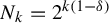 equally spaced points in between; call these
$\{r_{k,j}\}_{j=0,N_k-1}$
equally spaced points in between; call these
$\{r_{k,j}\}_{j=0,N_k-1}$
 . These points have the properties
$r_{k,0}=2^k$
. These points have the properties
$r_{k,0}=2^k$
 and
$r_{k,j+1}-r_{k,j}\sim 2^k/N_k=2^{\delta k}\sim r_{k,j}^{\delta }$
and
$r_{k,j+1}-r_{k,j}\sim 2^k/N_k=2^{\delta k}\sim r_{k,j}^{\delta }$
 . Denote the full collection of these by
$\{r_j\}$
. Denote the full collection of these by
$\{r_j\}$
 with the indices rearranged appropriately.
Let
$B_{n,r}=n^{\beta } \tau _{\mu }^{n}(I-\tau _{\mu })^r$
 and
$K_n=B_{r_j,r}$
and
$K_n=B_{r_j,r}$
 for
$r_j\le n<r_{j+1}$
for
$r_j\le n<r_{j+1}$
 . Also let
$I_j=[r_j,r_{j+1}]$
. Also let
$I_j=[r_j,r_{j+1}]$
 . We have

By properties of variational norms [Reference Jones, Kaufman, Rosenblatt and Wierdl13–Reference Jones, Seeger and Wright15],

Using Abel summation as in equation (14), bound the last term by

Thus,

Since
$\beta \le r$
 and
$\delta (1+s)+1<s$
and
$\delta (1+s)+1<s$
 , these are bounded on
$L^1$
, these are bounded on
$L^1$
 .
.
When
$r>0$
 ,
,

Since
$\beta \le r$
 , Lemma 5.6(a) applies to the first term with
$s=1$
, Lemma 5.6(a) applies to the first term with
$s=1$
 , and Lemma 5.6(b) applies to the second term.
When
$r=0$
 and
$\beta =0$
and
$\beta =0$
 , we have

Thus, Lemma 5.6(a) applies.
In either case, we obtain

Finally, from equations (15), (16) and (17),

The result for the oscillation norm follows from noticing that
$ \lVert B_{n,r}a \rVert _{o(s)}\le \lVert B_{n,r}a \rVert _{v(s)}$
 .
.
Proof of Theorem 1.10(d)
By equation (10), if
$s\ge 2$
 , then

Thus, the result follows from Theorem 1.10(a) with
$s=2$
 .
.
Lemma 5.6. Let
$(X,\beta ,m)$
 be a probability space,
$\tau :X\to X$
be a probability space,
$\tau :X\to X$
 an ergodic, invertible measure-preserving transformation. Let
$\mu $
an ergodic, invertible measure-preserving transformation. Let
$\mu $
 be a probability measure on
$\mathbb Z$
be a probability measure on
$\mathbb Z$
 with property
$\text {BA}_1$
with property
$\text {BA}_1$
 , and
$s\ge 1$
, and
$s\ge 1$
 . Let
$\{r_{n+1}\} $
. Let
$\{r_{n+1}\} $
 be a sequence with
$r_{n+1}-r_n\sim r_n^{\delta }$
be a sequence with
$r_{n+1}-r_n\sim r_n^{\delta }$
 for some
$0<\delta \le 1$
for some
$0<\delta \le 1$
 . Let
$\unicode{x3bb}>0$
. Let
$\unicode{x3bb}>0$
 and a be a
$\unicode{x3bb} $
and a be a
$\unicode{x3bb} $
 -atom, with E and
$E^*$
-atom, with E and
$E^*$
 as in definition 5.3.
-
(a) If $\beta \le r+(1-\delta )(1-1/s)$
, then -
(b) If $r>0$
and
$\beta \le r-(1-\delta )/s$
, then





Proof. For simplicity, we only prove case (a) because case (b) follows from similar estimates.
By Theorem 5.5, it suffices to check the assumptions of that theorem for
$\hat \Delta _n=r_n^{\beta }({\hat \mu }^{r_n}-{\hat \mu }^{r_{n+1}})(1-\hat \mu )^r$
 and the sequence
$n_k=k$
and the sequence
$n_k=k$
 .
.
From equation (11), and since
$\beta +\delta +(1-\delta )/s\le r+1$
 ,
,

Hence,

By equation (12),

and by
$\text {BA}_1$
 (ii),
$|t \hat \mu '(t)| \lesssim h(t)$
(ii),
$|t \hat \mu '(t)| \lesssim h(t)$
 ,
,

By equation (13) and
$\text {BA}_1$
 ,
,



 Open access

