Contents
Research Article
Riemann Domains with Boundary of Capacity Zero
-
- Published online by Cambridge University Press:
- 22 January 2016, pp. 1-15
-
- Article
-
- You have access
- Export citation
On Projective Differential Equations on Complex Analytic Manifolds
-
- Published online by Cambridge University Press:
- 22 January 2016, pp. 17-37
-
- Article
-
- You have access
- Export citation
-
Linear differential equations have been studied more throughly than any other class. They posses a group of characteristic properties: the invariance of linearity by linear transformations, the linearly dependence of solutions on their initial values, e.t.c. The next simple type of differential equations is quadratic type

On Derivations and Holomorphs of Nilpotent Lie Algebras
-
- Published online by Cambridge University Press:
- 22 January 2016, pp. 39-50
-
- Article
-
- You have access
- Export citation
Units of Real Quadratic Fields
-
- Published online by Cambridge University Press:
- 22 January 2016, pp. 51-55
-
- Article
-
- You have access
- Export citation
-
1. Let D be a positive square-free integer. Throughout this note we shall use the following notations;
d = d(D): the discriminant of
 ,
,t0, u0 : the least positive solution of Pell’s equation t2 — du2 = 4,

 ,
,
On the Block of Defect Zero
-
- Published online by Cambridge University Press:
- 22 January 2016, pp. 57-59
-
- Article
-
- You have access
- Export citation
Noyaux de Convolution Réguliers et Noyaux de Convolution Singuliers
-
- Published online by Cambridge University Press:
- 22 January 2016, pp. 61-77
-
- Article
-
- You have access
- Export citation
-
Soient X un groupe abélien localement compact et non-compact, et dx sa mesure de Haar. Rappelons qu’un noyau de convolution N sur X est une mesure de Radon positive dans X. Il est symétrique s’il est symétrique par rapport à l’origine. Notons MK la totalité de fonctions mesurables, bornées dans X, à valeurs réelles et à support compact. On dit que N est de type positif si, quelle que soit f une fonction de

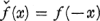 et la signe * est la convolution sur X.
 et la signe * est la convolution sur
 Puissance Fractionnaire d’un Noyau Positif dont le Carré est Encore un Noyau
-
- Published online by Cambridge University Press:
- 22 January 2016, pp. 79-88
-
- Article
-
- You have access
- Export citation
Functional Equations of Generalized Epstein Zeta Functions in Several Complex Variables
-
- Published online by Cambridge University Press:
- 22 January 2016, pp. 89-95
-
- Article
-
- You have access
- Export citation
-
Let S (n) be the matrix of a positive definite quadratic form and
 Define
1.

Here the sum is over unimodular matrices
 which lie in a complete set of representatives for the equivalence relation
  with P unimodular and having block form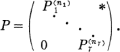
 Define
 which lie in a complete set of representatives for the equivalence relation
  with
with 
Relations between Non-Compact Transformation Groups and Compact Transformation Groups
-
- Published online by Cambridge University Press:
- 22 January 2016, pp. 97-117
-
- Article
-
- You have access
- Export citation
Stable Manifolds of a Map and a Flow for a Compact Manifold
-
- Published online by Cambridge University Press:
- 22 January 2016, pp. 119-132
-
- Article
-
- You have access
- Export citation
Sur les Principes Divers du Maximum et le Type Positif
-
- Published online by Cambridge University Press:
- 22 January 2016, pp. 133-164
-
- Article
-
- You have access
- Export citation
Comparison Theorems on Regular Points for Multidimensional Markov Processes of Transient Type1)
-
- Published online by Cambridge University Press:
- 22 January 2016, pp. 165-214
-
- Article
-
- You have access
- Export citation
Front Matter
NMJ volume 44 Cover and Front matter
-
- Published online by Cambridge University Press:
- 22 January 2016, pp. f1-f4
-
- Article
-
- You have access
- Export citation
Back Matter
NMJ volume 44 Cover and Back matter
-
- Published online by Cambridge University Press:
- 22 January 2016, pp. b1-b2
-
- Article
-
- You have access
- Export citation