Contents
Research Article
Reciprocal Algebraic Integers Whose Mahler Measures are Non-Reciprocal
-
- Published online by Cambridge University Press:
- 20 November 2018, pp. 3-8
-
- Article
-
- You have access
- Export citation
-
The Mahler measure M (α) of an algebraic integer α is the product of the moduli of the conjugates of α which lie outside the unit circle. A number α is reciprocal if α- 1 is a conjugate of α. We give two constructions of reciprocal a for which M (α) is non-reciprocal producing examples of any degree n of the form 2h with h odd and h ≥ 3, or else of the form
 with s ≥ 2. We give explicit examples of degrees 10, 14 and 20.
 with s ≥ 2. We give explicit examples of degrees 10, 14 and 20.
An Amalgamation Theorem For Soluble Groups
-
- Published online by Cambridge University Press:
- 20 November 2018, pp. 9-18
-
- Article
-
- You have access
- Export citation
Dickson Polynomials Over Finite Fields and Complete Mappings
-
- Published online by Cambridge University Press:
- 20 November 2018, pp. 19-27
-
- Article
-
- You have access
- Export citation
Sign Properties of Green's Functions For Two Classes of Boundary Value Problems
-
- Published online by Cambridge University Press:
- 20 November 2018, pp. 28-35
-
- Article
-
- You have access
- Export citation
Integral Group Rings Without Proper Units
-
- Published online by Cambridge University Press:
- 20 November 2018, pp. 36-42
-
- Article
-
- You have access
- Export citation
On Vector-Valued Lipschitz Function Spaces
-
- Published online by Cambridge University Press:
- 20 November 2018, pp. 43-48
-
- Article
-
- You have access
- Export citation
Rectangularity Versus Piecewise Rectangularity of Product Spaces
-
- Published online by Cambridge University Press:
- 20 November 2018, pp. 49-56
-
- Article
-
- You have access
- Export citation
The Algebra of Stable Operations For ρ-Local Complex K-Theory
-
- Published online by Cambridge University Press:
- 20 November 2018, pp. 57-62
-
- Article
-
- You have access
- Export citation
Cocyclic Maps and Coevaluation Subgroups
-
- Published online by Cambridge University Press:
- 20 November 2018, pp. 63-71
-
- Article
-
- You have access
- Export citation
Sharp Bounds on the Diameter of a Graph
-
- Published online by Cambridge University Press:
- 20 November 2018, pp. 72-74
-
- Article
-
- You have access
- Export citation
-
Let Dn.m , be the diameter of a connected undirected graph on n ≥2 vertices and n - 1 ≤ m ≤ s(n) edges, where s(n) = n(n — l)/2. Then Dn.s(n) = 1, and for m s(n) it is shown that

The bounds on Dn.m , are sharp.
Examples of Factorial Rings in Algebraic Geometry
-
- Published online by Cambridge University Press:
- 20 November 2018, pp. 75-79
-
- Article
-
- You have access
- Export citation
Some Remarks on Artin's Conjecture
-
- Published online by Cambridge University Press:
- 20 November 2018, pp. 80-85
-
- Article
-
- You have access
- Export citation
On Weighted Geodesics in Groups
-
- Published online by Cambridge University Press:
- 20 November 2018, pp. 86-91
-
- Article
-
- You have access
- Export citation
Centralizing Mappings of Semiprime Rings
-
- Published online by Cambridge University Press:
- 20 November 2018, pp. 92-101
-
- Article
-
- You have access
- Export citation
On The Lavrentiev Phenomenon
-
- Published online by Cambridge University Press:
- 20 November 2018, pp. 102-108
-
- Article
-
- You have access
- Export citation
Continuous Images of Compact Semilattices
-
- Published online by Cambridge University Press:
- 20 November 2018, pp. 109-113
-
- Article
-
- You have access
- Export citation
SP Transform and Uniform Convergence of Laurent and Power Series
-
- Published online by Cambridge University Press:
- 20 November 2018, pp. 114-123
-
- Article
-
- You have access
- Export citation
-
If the Laurent series
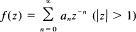
is transformed to

it is shown that convergence of the former at z = 1 implies the uniform convergence of the latter on a symmetric arc of |z - 1/P| = 1/P - 1 not containing z = 1 and that the uniform convergence of the former over a symmetric arc of |z| = 1 containing z = 1 implies uniform convergence of the latter on the entire circle |z — 1/P| = 1/P — 1.
Comment on the Nullenstellensatz for Regular Rings
-
- Published online by Cambridge University Press:
- 20 November 2018, pp. 124-128
-
- Article
-
- You have access
- Export citation