

11.1 Introduction
A global perspective on literacy compels our attention to global variation in languages and writing systems. The history of writing involves processes of discovery, borrowing, and modification, which language communities go through when they move toward a literate society. These processes require choices regarding the graphic forms of that writing system and how they connect to the spoken language, as well as choices regarding broader cultural and educational considerations, including how new generations can learn this writing to understand their language. Across the globe, writing systems have developed varying solutions to how to represent their spoken language, that is, its phonological, morphological, and semantic properties. In what follows, we examine some of the solutions to this mapping problem using invention and variation and suggest how general principles aid the process of learning to read across languages and writing systems.
11.2 Inventing a Writing System
A single hypothetical situation can set the stage for the invention of a writing system: Suppose a preliterate people want to bring literacy to their language and come to an expert – a reading scientist, a linguist, or a writing scholar – for advice on how to design the writing system. What should the advice be – about the graphic forms? About how these forms relate the spoken language? About how people will learn to use this writing to understand their language? Before we turn to these questions, we consider the plausibility of this hypothetical situation.
Of course, written language did not usually come into existence through the advice of expert counsel, but through cultural and technological developments mediated by social transactions within and between language communities. In other words, written language evolved. Nevertheless, there have been many inventions of writing systems, or, more carefully, rediscoveries involving language-specific and culturally specific adaptations of the basic systems described by writing scholars (e.g., Reference DanielsDaniels, 1990; Reference Daniels, Daniels and Bright1996; Reference GelbGelb, 1952). One of the most widely noted of these inventions is the creation of the alphabetic Hangul for the Korean language by King Sejong in the fifteenth century (Reference DeFrancisDe Francis, 1989; Reference Kim-RenaudKim-Renaud, 2000), which has now served the Korean language for about 470 years. However, the survival of an invented writing system to multigenerational use is relatively rare. The overwhelming majority of invented systems were limited in use and survive mainly as curiosities. For example, Benjamin Franklin, a prolific inventor, tried his hand at improving the English alphabet by getting rid of the consonants c, j, q, w, x, and y, and, adding some vowel letters, keeping the number of letters at twenty-six. Dozens of similar examples exist.
More relevant for a global perspective on universal literacy are cases of invention in nonliterate societies. For example, in regions of West Africa, some twenty scripts have been developed since 1830, including one in 2002 (Reference Kelly, Ferrara and ValerioKelly, 2019). Among cases in which the development was led by nonliterate speakers, some systems survived – for example, the Vai language (Mande family) spoken in present-day Sierra Leone and Liberia, for which a syllabary was invented. Other inventions by nonliterates did not survive. For example, the Kpelle syllabary was developed in 1935 to write another West African language, Kpelle (also Mande family), and was used in Liberia and Guinea for a time before succumbing to the fate of a “failed script” (Reference Unseth, Fishman and GarciaUnseth, 2011).
Especially interesting is the suggestion by Reference Daniels, Downing, Lima and NoonanDaniels (1992) that the kind of writing developed was different when it was invented by illiterates, as syllabaries were chosen more often than when the system was created by a person who was literate. As noted by Reference Kelly, Ferrara and ValerioKelly (2019), this suggestion resonates with the conclusion that syllables are perceptually salient and are more manageable speech units for mapping to writing than those used in other systems (e.g., Reference LibermanLiberman, 1973). A literate mind is aware of other possibilities for mapping, including the less perceptually accessible phoneme. Indeed, the application of alphabetic systems on nonliterate languages seems to arise only when those who develop the system are not only literate, but alphabetically literate. Additionally, the replacement of existing systems also occurs, and when this happens it is usually replacement by alphabet. This occurred, for example, when Portuguese missionaries introduced alphabetic writing for the Vietnamese language, which had been written in the Chinese system. This led eventually to the replacement of the Chinese system by the Portuguese version of the Latin alphabet, leading to its modern form of Chữ Quốc Ngữ, which requires diacritics to represent additional phonemes and the five tones of Vietnamese.
Consistent with the idea of the basic discoverability of syllabaries are the inventions of syllabaries for indigenous peoples of North America. An especially informative case is the invention of a syllabary for Cherokee, provided by Sequoyah, a member of the Cherokee nation. Sequoyah began by developing a pictorial or meaning symbol for each word in Cherokee. However, he eventually abandoned this solution because of the excessive demand of creating pictures and more abstract symbols. According to an entry in the Chronicles of Oklahoma (Reference DavisDavis, 1930, p. 160):
Sequoyah at last discovered that the language was made up of a number of recurring sounds, that there were certain voiced sounds with which the words ended and other less pronounced sounds to go with these to make up the word. He set to work to analyze the language, to go to all public gatherings and to listen attentively to all speeches and conversations in order to be sure that no sound was overlooked.
To map this inventory of sounds to writing, Sequoyah developed a graph for each syllable, arriving at a system of eighty-six characters. To quote again from Davis’s entry in the Chronicles of Oklahoma (p. 160):
He obtained an old English book, and, although he had no idea of the sounds represented by the English characters, he decided to adapt these characters to his use. The forms were simpler and more distinct than the ones he had been making, they were more easily read and remembered and were easier to make. After taking some of the letters, modifying others, and inventing some forms of his own, Sequoyah had … a syllabary, with which he could write any word in his native language.
The resulting Cherokee syllabary is illustrated in Figure 11.1, where one can see a combination of familiar Latin letters and some less familiar invented forms. Thus, we see here the recapitulation of the ordering of writing system mapping levels (syllables before phonemes) that developed over a period of time between 5,000 and 3,000 years ago.
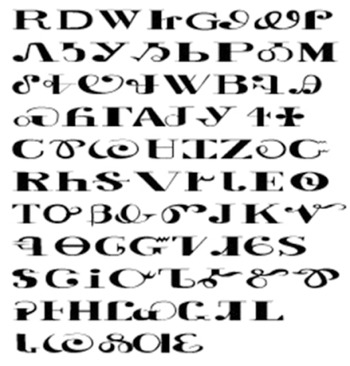
Figure 11.1 The Cherokee syllabary invented by Sequoya. Each “letter” stands for a syllable in the spoken language.
A realization that written graphs can represent ideas comes relatively easily, beginning with the idea of using pictures (pictographs). When followed later by the insight that abstract symbols can also refer to ideas, this allows even more ideas to be expressed. But the challenge of the large inventory of symbols required for this solution is daunting enough to eventually prompt the idea of having the graphs represent sounds instead of meanings. The speech sounds that are the most accessible are syllables. Hence, the syllabary is likely to be the form invented by the nonliterate mind, although there are some examples of alphasyllabaries being invented (Reference Kelly, Ferrara and ValerioKelly, 2019).
Other indigenous languages in North America also created syllabaries. The Cree syllabary is used by about 70,000 Algonquian-speaking people in Canada. Its form as an invented script was influenced by the Cherokee example. Unlike the case of Cherokee, the inventor of Cree, James Evans, a missionary and amateur linguist, was far from illiterate. He was familiar with the alphasyllabic (abugida) Devanagari as well as shorthand. The Cree forms, shown in Table 11.1, suggest an adaptation of an alphasyllabary form, using the orientation of a consonant graph (rather than a diacritic) to represent the vowel.
Table 11.1 The Cree Syllabary: Basic forms represent consonants. The orientation of the form represents a vowel
| a | E | I | o | |
|---|---|---|---|---|
| - | ᐊ | ᐁ | ᐃ | ᐅ |
| p | ᐸ | ᐯ | ᐱ | ᐳ |
| t | ᑕ | ᑌ | ᑎ | ᑐ |
| k | ᑲ | ᑫ | ᑭ | ᑯ |
| ch | ᒐ | ᒉ | ᒋ | ᒍ |
| m | ᒪ | ᒣ | ᒥ | ᒧ |
| n | ᓇ | ᓀ | ᓂ | ᓄ |
| s | ᓴ | ᓭ | ᓯ | ᓱ |
| y | ᔭ | ᔦ | ᔨ | ᔪ |
We have highlighted some examples of invented systems with an emphasis on the tendency for invented writing systems to be syllabaries when the inventor is nonliterate. In contrast, there is a tendency for alphabets to be adapted to the language when the inventors are literate. The history of writing is dominantly one of discovery, borrowing, and modification over long periods of time. However, the processes of invention and adaptation of existing systems have been rather common, for both a language that is not yet written and also a language that already has a writing system. Invention and adaptation, in addition to simple adoption, are the two avenues open to language communities seeking to move from nonliterate to literate.
11.3 Variations in How Language Is Written
The preceding section highlighted just a few of the variations in writing that have come through invention and adaptation. In this section, we provide a general account of the relevant features of writing that might matter for literacy.
11.3.1 Graphic Forms and Mapping Solutions in Writing Systems
When one examines the writing of a specific language or reviews the large inventory of invented writing, one is struck by the variety of visual forms. On further examination, one is impressed by the relative complexity of possible mapping solutions. The job of classification of writing, as with any taxonomy, is a balancing act. The need to provide principled structure to the variety of what is found must be balanced against the obligation to respect significant differences. The balance point differs in alternative classification schemes. The three-way classification scheme (Reference GelbGelb, 1952) struck the balance on the side of the broadest principles that could characterize solutions to the mapping problem. The five-way classification of Reference Daniels, Daniels and BrightDaniels (1996) struck a balance that added differentiation, partly reflective of analyses of the historical development of writing and arguably more accurately reflecting the differences among syllabaries, alphabets, and systems that represent consonant phonemes only and that represent some syllabic information blended into phoneme representation.
The mapping problem to solve is how the written graphs will be related to units in the spoken language. The mapping solutions have been to map graphs onto (1) morphemes (meaning forms), (2) syllables or (3) phonemes, often mixing at least two of these three solutions, with more weight on one or the other. The solution to the mapping problem faces multiple constraints. Meaning mapping presents a simple solution that gets from a graphic form to a meaning, but leads to an enormous number of graphs, even when the graphs for meanings can be combined for new meanings, as they can be in Chinese meaning compounds. Mapping to speech units is much more productive: Relatively few graphs allow the expression in writing of any idea that can be expressed in the language. Thus, speech-level mapping allows the written language to attain the full productivity of the spoken language.
A system of five mapping solutions (Reference DanielsDaniels, 1990; Reference Daniels and BrightDaniels and Bright, 1996) provides a useful balance between simplicity and differentiation. This system, using terms introduced by Reference DanielsDaniels (1990), refines the broader category of alphabetic writing used by Reference GelbGelb (1952), adding consonant-based systems: abjads, the consonant systems that originated in the Middle East (and were the forbearers of alphabets) and serve West Semitic languages, and the abugida or alphasyllabariesFootnote 1 that serve many languages of South Asia. Table 11.2 shows these five types.
Table 11.2 Five-way classification of writing systems
| Mapping type | Written language examples |
|---|---|
| Morphosyllabary | Chinese, Japanese Kanji |
| Syllabary | Cree, Japanese Kana |
| Abjad | Arabic, Amharic, Hebrew, |
| Alphasyllabary (abugida) | Hindi, Telugu |
| Alphabet | Spanish, Korean, English |
All systems represent speech to some extent. Syllable-based mapping is seen in the syllabary system, in which graph-to-syllable mapping is direct and exclusive; that is, the graphs do not generally map onto morphemes. In contrast, the morphosyllabary system that evolved in China, spreading also to other areas in East and Southeast Asia, maps the graphs to syllables that are also morphemes, with the syllable pronunciation of complex graphs (characters) inconsistently signaled by components within the character. The abjad system is consonant-based, with root consonants that represent morphemes and that are spatially distributed rather than necessarily contiguous. The abugida orthographies combine syllabic and alphabetic features with graphs that represent consonant–vowel sequences; as in the abjads, the consonant is the obligatory element.
These five types appear to sample the full range of implemented solutions to the mapping problem. They all meet the fundamental constraint on writing systems, that they connect graphs with units of language. Pictographs and ideographs are possible, but because they are not practical, they have not survived the pressure for efficiency that is provided by language mapping. Pure logography, mapping graphs to words, is an inefficient option that does not survive among modern writing systems; despite the recurring use of this term to refer to Chinese, it is only roughly approximated by the Chinese morphosyllabary. Thus, writing maps to language, to its phonology (always), and to its morphology (often, and in variable ways).
11.3.2 Scripts and Layouts of Writing
It is important not to be misled by the simplicity of these solutions to the mapping problem. If we shift attention from what matters for classification to what matters for reading, we find there are more things to consider than whether a graph maps to a morpheme, a syllable, or a phoneme. Reference Daniels and ShareDaniels and Share (2018; also Reference Share and DanielsShare & Daniels, 2015) describe ten dimensions of writing variation that may be important in characterizing the complexity of a writing system and its impact on reading. Most of these dimensions concern the details of the orthography, or the specific way in which a written language implements its writing systems. The orthographic features center on phonographic challenges that have been a focus of much discussion, for example, the failure of spellings to change when pronunciations do. Others are about visual-spatial factors that arise from the choice of graphs and their arrangement for the reader, for example, the distorting of standalone graph shapes when they are joined together though ligature.
The visual forms of the graphs, along with conventions for displaying the graphs, constitute the script of a writing system. Compared with issues of mapping, i.e., the differences between alphabetic and nonalphabetic systems, differences between scripts have received less attention, even though the visual appearance of the script is initially the most salient feature confronting the learner. The forms of the graphs, which reflect their intrinsic visual complexity and their discriminability from other graphs, could potentially affect the identification of written units – single letters and letter combinations in alphabets and abjads, akshara (consonant–vowel combinations) in alphasyllabaries, syllables in syllabaries, and characters in morphosyllabaries (Reference Pelli, Burns, Farell and Moore-PagePelli et al., 2006). Thus, the visual complexity of graphs is a prime candidate for a nonmapping factor that could make a difference in reading.
One proven measure of a graph’s visual demands is perimetric complexity, which captures the overall configurational complexity of a graph (Reference Pelli, Burns, Farell and Moore-PagePelli et al., 2006)Footnote 2. Another is a multidimensional approach, which uses perimetric complexity and additional graph-design measures (Reference Chang, Chen and PerfettiChang, Chen, & Perfetti, 2017). GraphCom, the measure described by Reference Chang, Chen and PerfettiChang et al. (2017), consists of four dimensions applied to a graph: perimetric complexity, number of disconnected components, number of connected points, and number of simple features (strokes). Chang et al. applied GraphCom to 131 written languages representing the 5 major writing systems of Table 11.2.
Table 11.3 shows an example of GraphCom’s complexity dimensions applied to a representative orthography from each of the five systems. One can see relatively simple graphs, from abjads and alphabets, compared with much more complex graphs from alphasyllabaries and the Chinese morphosyllabary. Further, one can see that while Telugu and Chinese are fairly close in perimetric complexity, Chinese is more complex in its use of connected points and the total number of simple features.
Table 11.3 Example graphs from five writing systems with GraphCom complexity valuesFootnote *

* PC = Perimetric complexity, DC = number of disconnected components, CP = number of connected points, SF = number of simple features. Based on Reference Chang, Chen and PerfettiChang et al. (2017).
GraphCom has been validated through correlations with performance on perceptual tasks, and provides an ordering of graphic complexity across 131 languages that aligns with intuitive judgments and demonstrates differences among writing systems. Chinese has by far the highest average complexity in its graphs; abjads and alphabets have the least complexity. The number of disconnected components is generally the most important distinguisher among writing systems.
Although visual complexity might be considered a factor independent of the writing system, in fact it is not. What drives graphic complexity is the number of graphs in the writing system. The more graphs are required, the more complex graphs must become to distinguish them from other graphs. And writing systems differ substantially in the number of graphs required. A writing system based on meaning units requires more than a system based on syllables, which in turn requires more than a system based on phonemes. The correlation between the number of graphs and the average complexity in each of the 131 languages in Chang et al. is r=.78. Thus, written Chinese stands alone in its average complexity, as well as in the size of its graphic inventory. Both factors can affect the time and effort required for learning to read.
11.4 How Language Matters in Considering a Writing System
We next ask whether the choice of a writing system reflects the properties of the language. The wide variety of languages and the relatively limited options for writing systems suggest that any adaptation will be at the broad systems level. The adaptation must also reflect understanding writing as encoded language, not just encoded speech (Reference Perfetti and HarrisPerfetti & Harris, 2013). If a writing system tends to be somehow adaptive for its spoken language, the adaptations are based on the linguistic system, not just its phoneme inventory.
The idea that “languages get the writing systems they deserve” has a history dating back at least to Reference HallidayHalliday (1977) with more recent claims by Reference FrostFrost (2012) and by Reference Seidenberg, McCardle, Ren, Tzeng and MillerSeidenberg (2011). This idea, when applied to mapping solutions, is that writing systems make the trade-off between morphology and phonology in response to relevant properties of the language (Reference Seidenberg, McCardle, Ren, Tzeng and MillerSeidenberg, 2011). Reference Perfetti and HarrisPerfetti and Harris (2013) argued that specific language factors (phoneme inventory, syllable inventory, morphological complexity) were consistent with the choice of writing systems across a sample of languages. In Table 11.4, we show five languages to illustrate how writing systems may be well suited for the languages they serve. (See also a summary table of seventeen languages whose linguistic and writing systems features were reviewed in Perfetti & Verhoeven in Learning to Read across Languages and Writing Systems, Verhoeven & Perfetti, 2017.)
The languages shown in Table 11.4 appear to be reasonably well aligned with properties of their writing systems. Within the three alphabetic languages, there are significant differences in the trade-off between phonology and morphology. If such cases of apparent accommodation proved to be widespread across the world’s thousands of languages, this would be impressive, indeed. We might, as Reference FrostFrost (2012) suggested, refer to optimization; that is, each language gets the writing system that is optimal for its linguistic features. This degree of optimization seems unlikely given counter-pressures for the adoption of specific writing systems, especially alphabetic systems. Instead, it seems more plausible that languages tend to get a good-enough writing system. As Japanese shows, a writing system that seems very well suited (kana) can be replaced by one that, at least in its implementation, may seem less well suited (kanji).
Table 11.4 Five languages whose writing systems show some alignment with properties of the language
| Chinese | Syllable/morpheme units. Extensive homophony. Alphabets and syllabaries not adaptive to the language. Characters can distinguish between homophones. |
| Japanese | Simple syllable types (V and CV) and small number of syllables. Prevalence of multisyllabic words. These factors favor a syllabary. |
| Finnish | Extensive homophony avoided, despite a small number of phonemes, through long words of several syllables. Transparent alphabet adapts to complex inflectional morphology. |
| English | Phonological complexity and a large number of syllables make an alphabet efficient. Simple inflectional morphology and morphophonemes favor morpheme spellings. A mismatched letter-to-phoneme ratio keeps phonological transparency low. |
| Spanish | Phonologically simple; open syllables; Inflectional morphology (typical of Romance languages); transparent orthography with one-to-one mapping (except for three graphemes and multiple use of consonant letters). |
Moreover, cases in which writing systems are imposed on nonliterate languages do not reflect an adaptive strategy, except by chance. The two large indigenous languages of South America that have gained official recognition, Queschua and Guarni, are written only in the Latin alphabet, as imposed by European missionaries. Cases in which one writing system is replaced by another also provide a different perspective: Turkish, following the end of the Ottoman Empire, moved from the Arabic abjad to the Latin alphabet. Korean and Vietnamese moved from morphosyllabic Chinese to nonlinear alphabetic and linear alphabetic, respectively. Such changes occur in cultural-political contexts that may (Korean) or may not be more adaptive to the language. Phonemically rich languages with tones or large numbers of vowels, if they move to Latin-based linear alphabets, may gain simplicity in some ways while taking on complexity in additional graphs or diacritics. Although it is an interesting exercise to imagine a different writing system for a given language, it seems more useful to explore how a different system would affect literacy.
11.5 Impact of Written Language on Literacy Development
Although many cross-language comparisons are important for considering the impact of writing systems on literacy development, a case of high contrast is especially useful.
11.5.1 A High-Contrast Case: Comparing Morphosyllabic and Alphabetic Literacy
The question of whether the form of the writing system influences the way we read and write is a long-standing one. In contrasting morphosyllabic literacy (e.g., Chinese) with alphabetic literacy, a popular view, based on the differences in the mapping principles and the script was that Chinese is read directly, from graphs to meaning; in contrast, on this view, alphabetic writing is read indirectly, from graphs to speech to meaning. An example from an online discussion board illustrates this view:
I feel English is a reading language, if you are reading an English book, you watch the word and make sound in your brain. But Chinese can be a watching language, take a Chinese book, I can watch over a paragraph and get the meaning of most part.
It is usually wise to consider that an opinion held by so many might contain an element of correctness. The broad endorsement – in reading research (e.g., Reference SmithSmith, 1979) as well as popular opinion – of Chinese as a system that allows a very direct meaning-based reading suggests this opinion deserves serious attention. However, the results of research on morphosyllabic-alphabetic literacy comparisons present a different picture, with more complexity. One of the chapter’s authors (CP) carried out a research program that targeted the specific question of whether reading Chinese for meaning evaded phonology. The answer was “no” according to studies of character-meaning decisions and Stroop-based color naming. These studies led us to propose the Universal Phonological Principle (Reference PerfettiPerfetti, 2003; Reference Perfetti, Zhang, Berent, Frost and KatzPerfetti, Zhang, & Berent, 1992), that reading activates phonology in all writing systems. The conclusion concerning phonology in Chinese reading specifically has continued to be upheld in more recent research (e.g. Reference Ma, Wang and LiMa, Wang, & Li, 2016).
The picture gets more complex when we consider a different component of reading, familiarity-based word identification. Reading experience promotes the establishment of word-specific representations, based on increasingly familiar orthographic objects. This applies to all written languages and does not depend on a reduced role for phonology, because both orthographic identification and phonological activation become automatic. With the experience that brings familiarity-based identification comes increasing use of the lexical-level phonology that is partly redundant (and thus helpful) with sublexical phonology in retrieving word pronunciations. This growth of familiarity-based reading with reading experience comes through context-sensitive orthographic-phonological mappings (Reference Perfetti, Gough, Ehri and TreimanPerfetti, 1992) than can be acquired through self-teaching (Reference ShareShare, 1995).
Thus, there are two issues involving the large contrast between morphosyllabic and alphabetic literacy, both of which work against the idea of profound differences. In both systems, phonology is part of reading. In both systems, reading increasingly becomes familiarity-based with skilled experience. However, that is not the end of the story.
Differences between morphosyllabic and alphabetic literacy lead to differences in the procedures that produce orthographic identification and phonology. These differences have been discussed in a number of papers and in some detail by Reference Perfetti, Cao and BoothPerfetti, Cao, and Booth (2013). Alphabetic reading allows cascade-style identification, as alphabetic constituents activate corresponding phonemes during the process of identification. Morphosyllabic reading, which allows character embedding and thus lexical-level facilitation or competition, is better understood as a threshold system in which orthographic identification of the character precedes a resolved phonological identity. Table 11.5 summarizes some of these differences.
We highlight morphosyllabic-alphabetic comparisons because the two systems maximally contrast in their mapping systems. If there are similarities between these two systems in literacy (and there are), then we conclude that more similar writing systems must also produce similarities in literacy processes. However, there are some differences, as we noted. Those in Table 11.5 arise from orthographic mapping. Others arise from the perceptual and memory processes that stem from the differences in script. The large number of characters required for morphosyllabic literacy challenges perceptual discrimination and memory inventories. Familiarity-based identification is continuously required in morphosyllabic literacy.
Table 11.5 Comparisons of morphosyllabic and alphabetic literacy
| Alphabetic | Morphosyllabic | ||
|---|---|---|---|
| Sublexical graphic units | Hierarchically compositional | Embedded lexical units | Both systems reflect statistical regularities in the relation of subunits to lexical units. |
| Basic phonological unit | Phoneme | Syllable | |
| Phonological activation | Cascade style | Threshold style diffuse because of homophones | |
| Meaning activation | May be “mediated” by phonology | Less mediation by phonology | For both systems, activation of phonology is rapid and supports identification |
11.5.2 Operating Principles in Literacy Development across Languages and Writing Systems
If literacy development implies learning how a writing system encodes language, we can ask whether there are general, universal procedures to support this learning. We have proposed a set of operating principles that do this, enabling children to perceive, analyze, and use written language in ways that support the mastery of a particular orthography. Two recent volumes on learning to read (Verhoeven & Perfetti, 2017a) and dyslexia (Reference Verhoeven, Perfetti and PughVerhoeven, Perfetti, & Pugh, 2019) across languages and writing systems examined reading across seventeen different languages and five writing systems. The authors of specific language chapters reviewed research and provided insights that could be used to probe for evidence for universal aspects of reading and differences associated with specific languages and writing systems. Here we draw on some of the generalizations that were supported by the evidence gathered from a close study of these languages, which represent all of the five major writing systems. (The languages are Arabic, Hebrew, Chinese [Mandarin], Japanese, Korean, Kannada, Greek, Italian, French, Spanish, Czech-Slovak, Russian, Finnish, Turkish, German, Dutch, English.) Reference Verhoeven, Perfetti, Verhoeven and PerfettiVerhoeven and Perfetti (2017b) proposed a universal set of operating principles that support the acquisition of implicit knowledge of how a given writing system relates to a learner’s spoken language. These are shown in Table 11.6.
Table 11.6 Operating principles in literacy development
| Becoming linguistically aware |
| OP1: Attend to salient stretches of speech as indicated by stress, intonation, rhythm |
| OP2: Attend to any salient syllabic, onset-rime, or phoneme boundaries in words |
| OP3: Attend to written language signals for their connection to language |
| Developing word identification and spelling |
| OP4: Increase the orthographic inventory |
| OP5: Increase the inventory of familiar words through reading and spelling |
| OP6: Read to gain word-identification fluency |
| Developing reading comprehension and writing |
| OP7: Attend to morphological affixes |
| OP8: Use knowledge of language as you read and write |
| OP9: Mobilize executive skills to supplement text with relevant background knowledge and inferences |
The first three operating principles concern the development of awareness of linguistic elements conveyed through speech, which are the foundation of written forms onto which reading is built.
OP1 holds that children must attend to salient stretches of speech indicated by stress, intonation, rhythm. The acquisition of literacy is supported by a learned sensitivity to the units of spoken language. To the extent that visual word identification in a language requires the connection of a familiar phonological form to a familiar or to-be-learned orthographic form, the quality of the child’s phonological knowledge and processing is essential. This is most clearly the case when the phonological grain size is at the level of the phoneme, as for alphabetic reading. Acquiring the alphabetic principle requires representations of phonemes. But the speech signal is continuous and rapid, with sharp modulations in both frequency and amplitude. Moreover, the same phoneme can manifest itself differently in the speech stream, depending on the phonetic environment, speaker, and rate of speech. With exposure to speech, infants begin to parse the incoming acoustic signal into consistent, replicable chunks that come to represent phonemes (cf. Reference Kuhl, Andruski and ChistovichKuhl et al., 1997). By continuing to attend to salient stretches of speech, which are typically indicated by stress, intonation, and rhythm, children can build high-quality speech-based lexical representations. And stable and precise representations at the level of the phoneme are what are needed for the retrieval and discrimination of word identities.
OP2 asserts the importance of attending to salient syllabic, onset-rime, or phoneme boundaries in words. Becoming literate builds upon a child’s vocabulary and phonological awareness. Children need to increase their knowledge of word forms and their associated meanings, increasing both the size of their vocabularies and their quality of knowledge of the meaning of individual words. As the number of words in the spoken lexicon increases, so does pressure to make finer phonological representations to accommodate this increase, according to the phonological restructuring hypothesis (Reference Metsala, Walley, Metsala and EhriMetsala & Walley, 1998). In this account, words are initially underspecified phonemically, until a growing lexicon that applies pressure for increased discriminability among words forces greater phonological specification. The growth of the spoken lexicon is important for later literacy development and also supports the preliterate linguistic awareness that aids the early stages of learning to read. Syllable awareness universally emerges earlier than phonemic awareness, and a failure to acquire it predicts difficulty in learning to read. Phonemic awareness prior to literacy enables easy learning of the alphabetic principle. However, phoneme awareness typically develops reciprocally with the beginning of instruction in alphabetic reading. Not showing phoneme awareness prior to literacy instruction does not predict difficulties in learning to read; but a lack of phonemic awareness after literacy instruction has begun does. The role of phonemic awareness in alphabetic reading does not significantly depend on the transparency of the orthography; its role in more transparent Dutch and Czech is comparable to its role in English. There is a writing system factor, however: Phoneme-level awareness is not uniformly important for learning to read syllabaries and morphosyllabaries, where other factors may matter more, for example syllable awareness and tone awareness in Chinese (Reference Shu, Peng and McBride-ChangShu, Peng, & McBride-Chang, 2008).
OP3 stresses the importance of children’s attention to written language signals that connect to their spoken language. Interactions with symbols in the environment and with literate others help children learn that print carries meaning, that written texts may have various forms and functions, and that ideas can be expressed with spontaneous (non)conventional writing (Reference Yaden, Rowe, MacGillivray, Kamil, Mosenthal, Pearson and BarrYaden, Rowe, & MacGillivray, 2000). Such attention can set the stage for learning that printed words consist of graphs that not only link to spoken language but also allow the discovery of phonological recoding (Ehri, 2014). During a period of early emerging literacy, children may acquire only a limited collection of written words that have personal meaning. However, attending to the sounds and letters of these words supports the child’s insight that written language codes spoken language, and can lead to self-teaching of orthography, as the child associates graphs with sounds as they attempt to read a word (see Reference ShareShare, 2004). The research suggests that more is needed for most children: a systematic approach that directly instructs children on the mapping principle and on specific correspondences between graphic units and sound units.
To summarize, emerging literacy growth is supported by the first three operating principles, which focus on attention to first spoken and then written language in ways that build a foundation for reading. This foundation provides the basic linkage between spoken and written language and may bring a small inventory of familiar written words. Additional operating principles are critical for the continued development of word identification and spelling.
OP4 supports the development of word identification as a generalized skill built on what is required by the writing system. In productive systems with small graphic inventories, such as alphabets, abjads, and syllabaries, there is some learning of additional graphic forms along with the primary learning of mappings between specific graphic forms and their language units (syllables, phonemes) and the ability to use these mappings to read words. However, in alphasyllabaries there is prolonged multiyear learning of graphic forms and their associations with spoken language (Reference NagNag, 2007). Chinese requires six years to teach a curriculum of 2,570 characters, a standard of basic reading (Reference Shu, Chen, Anderson, Wu and XuanShu et al., 2003). An important practice that supports the beginning of this character learning is the use of an alphabet (e.g., Pinyin) prior to the introduction of learning, although learning also occurs without this first step in some Chinese-speaking areas (e.g., Hong Kong). For alphabets, learning grapheme-to-phoneme mappings and their variations across words comprises the primary learning. This learning is affected by the consistencies of the grapheme-phoneme mappings, which varies across alphabetic languages and is lower in English than other alphabetic languages. Spelling in alphabetic languages tends to lag behind reading, even for consistent orthographies, and benefits from specific instruction beyond reading practice.
OP5. The ability to access language through orthography, the systematic structuring of basic graphic units, is the heart of skilled reading. It enables the language system to use information from the visual system with astonishing speed. It is accompanied, subjectively, by a sense that one can see the language through the print. This ability does not come automatically with the learning required by OP4. Instead, it requires an increase of the inventory of highly familiar words that is acquired through reading and spelling experience. This development marks a shift of reading from computation to memory-based retrieval for words that have become familiar. In all languages, written words can become familiar perceptual objects that are recognized quickly. Learning to read fluently builds on this increasing familiarity. Turning the unfamiliar into the familiar is relatively simple in a consistent orthography. The first encounter with a new written word leads to decoding of the written form into its phonological form and establishes initial familiarity with the word’s orthography (Reference ShareShare, 1995). Relatively few additional exposures may be needed to establish an orthographic memory for the word; for inconsistent orthographies, more exposures are needed. The resulting high-quality orthographic representation supports familiarity-based memory retrieval. Gaining familiarity is especially important in systems that lack explicit phonological composition, as in Chinese and in Japanese kanji. Abugidas (alphasyllabaries) are phonologically compositional, but fluent recognition of consonant–vowel combinations requires considerable practice that also brings about familiarity-based reading.
OP6 also targets the effects of reading experience and provides a link to reading comprehension. It emphasizes that beyond establishing words as familiar, reading experience produces gains in reading fluency that arise from the automatization of word decoding, familiarity-based memory retrieval, and experience in connected text reading. These developments allow cognitive resources to be directed to comprehension (Reference Perfetti, Gough, Ehri and TreimanPerfetti, 1992; Reference StanovichStanovich, 2000; Reference Verhoeven and van LeeuweVerhoeven & van Leeuwe, 2008). Across different orthographies, parallel developmental gains in word decoding occur very rapidly after the start of explicit reading instruction, while steady improvements in the speed and accuracy of word decoding continue in the years thereafter. With effective reading practice, children advance from having partially specified to more fully specified representations of written words, as the strength of the association between print and sound becomes increasingly automated and words come to be retrieved as familiar orthographic objects (Reference Coltheart, Rastle, Perry, Langdon and ZieglerColtheart et al., 2001). This provides mental resources for text meaning and makes reading a tool for the acquisition of knowledge.
The final two operating principles apply to the development of reading comprehension and writing.
OP7 captures the importance of attending to morphological affixes. Current models of reading and writing have focused on how letter strings are mapped onto phonological strings (pronunciations), essentially ignoring any internal structure that words have as morpheme units. Morphological processes, including some decomposition of written forms into their constituent morphemes, may be a part of word identification and they are essential in cueing meaning information (case, tense, number, aspect). Morphological knowledge is variably associated with reading success across languages and writing systems. We expect the relevant morphological knowledge to depend on the writing system. Chinese word formation demands knowledge of compounding morphology; Finnish word formation demands knowledge of inflectional morphology. The explicit teaching of morphology is increasingly part of instruction in some languages.
OP8 reflects the importance of the learner’s mobilizing knowledge of language (oral language skill) to build meaning structures from words in text and vice versa. This involves sentence processes and processes across sentences. Within a sentence, meaning-related constituent structures are built from words, immediately attaching each word to a meaningful syntactic phrase. In reading and writing, word meanings, meaningful phrases, and sentence meanings are connected to a continuously updated representation of the text. These integrative processes take place throughout the reading and writing of a text, both within a sentence and across sentences. This integration is necessary to maintain a coherent understanding and production. Models of text comprehension (Reference KintschKintsch, 1988) and text production (Reference Berman and VerhoevenBerman & Verhoeven, 2002) incorporate the conclusion that comprehension and production of text cannot be accomplished on the basis of text information alone, but require the use of prior knowledge.
Finally, OP9 highlights the importance of mobilizing executive functions (attention, inhibition, working memory, cognitive flexibility) to supplement the literal meaning of the text with relevant background knowledge. Because texts are never fully explicit, inferences are needed both to maintain the coherence of the text and to establish more referentially rich situational meanings, thus supplementing the basic propositional meanings expressed in the text. Activation of knowledge from the reader’s memory occurs rapidly and automatically, but not all activated knowledge is relevant for a veridical understanding or production of the text. The selection of text-relevant knowledge builds a veridical situation model, one that is consistent with the meaning of the text. A situation model can help readers and writers identify and define problems, specify options for solving identified problems, generate problem-solving strategies, and observe the results of attempted solutions (cf. Reference Zwaan, Kaup, Stanfield and MaddenZwaan et al., 2001).
11.6 The Universal Brain Network for Literacy
Although the most important information on becoming literate comes from behavioral research, there is by now substantial research on the neural correlates of reading and writing. This research has led to the identification of functional brain networks that link functionally defined areas of specialization. The research suggests that neural networks for reading are largely shared across languages and writing systems; to that extent, one can speak of a universal network. However, the writing system appears to influence the detailed functionality of the reading network through the demands it places on reading procedures.
In reading, the brain connects visual input to the posterior regions with language areas in the frontal regions. For alphabetic reading, three nodes in the left hemisphere are prominent. The visual recognition of graphic strings is supported by neural structures in the posterior temporal lobe, adjacent to visual cortex, the posterior fusiform gyrus. This occipital-temporal “visual word form” area connects to frontal areas through both a ventral and a dorsal pathway. The ventral pathway connects to anterior brain areas, the middle/inferior temporal gyrus, while the dorsal pathway connects upward to temporal-parietal cortex, the posterior superior temporal gyrus, and the inferior parietal lobule and its angular and supramarginal gyri. The anterior component of the reading network is the left inferior frontal gyrus (IFG), Broca’s region, which, in its different parts, is involved in multiple language functions, including phonological processes during reading. The dorsal pathway is engaged by more complex phonological analysis, whereas the ventral pathway is engaged when reading is simpler or more automatized. This relatively simple network has been observed across many studies (Shuai et al., 2017), achieving the status of a “standard view,” although refinements of the network have highlighted additional components (Reference Richlan, Kronbichler and WimmerRichlan, Kronbichler, & Wimmer, 2009).
Research on reading East Asian writing systems has produced results for Chinese, both Japanese kanji and kana, and the alphabetic but nonlinear Korean. Imaging studies of Chinese readers find areas of brain activation that overlap with alphabetic reading, as well some differences, as shown in early metanalyses (Reference Bolger, Perfetti and SchneiderBolger, Perfetti, & Schneider, 2005 and Reference Tan, Spinks, Eden, Perfetti and SiokTan et al., 2005). The left fusiform gyrus (posterior temporal lobe) is universally observed in reading, because it functions in coding graphic input to connect with left hemisphere language areas. This is a consequence of the fact that true writing encodes language, whatever the written forms or their mapping levels. Frontal, temporal, and parietal areas also function in all languages, although not always within precisely the same anatomical subregions. A recent candidate for a universal function is the left inferior parietal lobule (IPL), observed in alphabetic reading (Reference Richlan, Kronbichler and WimmerRichlan et al., 2009) and in Chinese (Reference Cao, Bitan, Chou, Burman and BoothCao et al., 2006). The development of reading skill in both Chinese and English seems to lead to the increased functionality of the left IPL, which may function as part of an integrating network for orthography, phonology, and meaning (Reference Perfetti, Cao and BoothPerfetti, Cao, & Booth, 2013)
The most noted difference between Chinese and alphabetic reading is the greater role of the left middle frontal gyrus (LMFG) in Chinese, although its activation during reading is observed across languages. One idea about its greater role in Chinese is that it reflects the more intimate connection between reading and writing as a result of Chinese literacy education, which traditionally emphasizes character writing. On this hypothesis, reading Chinese characters may evoke a premotor memory trace of its writing sequence. Reference Cao and PerfettiCao & Perfetti (2017) found not only that the LFMG was more active in Chinese than English, but also that its activation showed more overlap between writing and reading in Chinese than it did in English. Reference Nakamura, Kuo and PegadoNakamura et al. (2012) also investigated handwriting across alphabetic (French) and Chinese writing. Their experiments led them to conclude that there are two intimately connected subsystems in reading, one for word shape and one for handwriting gestures, and these two subsystems are universal.
There is much more to consider if we are to form a fuller picture of the brain networks for reading across languages and writing systems (see recent reviews by Shuai et al., 2017; Rigatti et al., Chapter 12 in this volume). Also of interest for reading across writing systems are the neural bases of learning to read a second language and its possible assimilation into the L1 network (Reference Perfetti, Liu and FiezPerfetti et al., 2007). A study of L1 Korean trilinguals who were equally proficient in L2 English and L2 Chinese by Reference Kim, Qi, Feng, Ding, Liu and CaoKim et al. (2016) found that brain areas overlap more for Korean–English, both of which are alphabetic but different in spatial layout, than for Korean–Chinese. This adds to the picture that reading is affected by writing-system differences, even when the high-level view is one of universality.
11.7 Educational Relevance
Writing systems and the orthographies and scripts that implement them matter for reading and learning to read. Meaning-weighted systems like Chinese require a larger inventory of graphs than do writing systems that are phonology weighted. Alphasyllabaries, which are phonology weighted, also require longer periods for the acquisition of basic reading levels. Behavioral and brain data suggest the reading processes show differences due both to the mapping levels of writing and to script factors (visual complexity and layout).
Within the family of alphabetic writing, cross-language comparisons show that English-speaking children lag behind children who speak German (Reference Wimmer and GoswamiWimmer & Goswami, 1994), Spanish and French (Reference Goswami, Gombert and de BarreraGoswami, Gombert, & de Barrera, 1998), Greek (Reference Goswami, Porpodas and WheelwrightGoswami, Porpodas, & Wheelwright, 1997), and Dutch (Reference Patel, Snowling and de JongPatel, Snowling, & de Jong, 2004). Reference Seymour, Aro and ErskineSeymour, Aro, and Erskine’s (2003) comparison of children after one year of instruction found that English children showed only a 40 percent accuracy rate in reading words and nonwords. Most other European samples were above 90 percent, and the worst among the remainder, France and Denmark, were much higher on word reading.
The invited inference is that the disadvantages of English are due to English orthography; and they may be. However, it is useful to keep in mind the many factors that vary across national and regional settings – the language, the culture and its emphasis on literacy, variations among children and families, instructional method, and the familiarity of specific words used to test reading. In studies that are able to control for these factors by research on a single bilingual population reading two different orthographies, the evidence does suggest that learning English produces a reading strategy that is less phonetic than learning Welsh, a transparent orthography (Reference Ellis and HooperEllis & Hooper, 2001).
We can conclude that the writing system and orthographies matter for reading. However, to place this difference in the context of other considerations for emerging literacy, the question is how much this matters compared with other factors. Perhaps not so much. Learning to read is, in part, learning how one’s writing system works. Thus, we can suggest that sound instruction – instruction that is designed to teach (directly or indirectly) the mapping properties of the writing system – can succeed. To suggest the obvious, teaching a syllabary requires focus on the syllabic principle, teaching an alphabet requires focus on the alphabetic principle, teaching an abjad requires focus on both the alphabetic principle and the consonantal root principle; teaching an abugida requires focus on the alphabetic principle and the akshara principle. Across all systems, effective practice in real reading is needed to shift reading procedures to become familiarity based.
11.8 Conclusion and Discussion
We began by pointing out that a global perspective on literacy compels attention to the possible variations in how language is written, whether the language matters in considering a writing system, and whether variation in written language leads to important differences in learning and teaching to read. Our conclusion is that writing systems follow the same set of operating principles in learning to read but that the differences between them do matter for understanding the weighting of reading procedures and different educational challenges. We also emphasize that the existence of a variety of flourishing systems means that all writing systems are learnable, and instruction effectively geared toward their specific properties will be successful for most children.
We also posed a hypothetical, in which a preliterate people come to an expert for help in designing a writing system to bring literacy to their language. Nearly all experts read an alphabetic system in either a second or first language. Accordingly, the advice from most of these experts may be “use an alphabet”; not any old alphabet, but a perfect one with one-to-one mappings between graphs and phonemes. If the phoneme inventory is not too large, this will work very well and would be highly productive. Others, drawn to the primacy of the syllable, might suggest a syllabary. If the language has a simple syllable structure and not too many syllables, this would work very well. Importantly, it would be the easiest to learn, at least at the beginning. The fact that syllabaries are what tend to be invented by nonexperts who are also nonliterate stands in support of this approach. The most accessible unit of speech becomes the basis for an easy-to-learn writing system.
Finally, the hypothetical gives way to the reality that the abundance of orthographies within both alphabetic and syllabic systems, as well as the enormous variety in alphasyllabaries, gives us many choices for models. The creation of a new system is less likely than the adaptation of an existing system. One guiding principle for invention or adaptation is to consider the fundamental phonological and morphological structures of the language. These really do matter.


