

6.1 Introduction
The accent of Liverpool, in the north-west of England, is one that many non-linguists find easy to identify (see, e.g., Montgomery Reference Montgomery2007). Linguists, too, often acknowledge the distinctiveness of the variety, pointing out that it is ‘not quite like its neighbours’ (Honeybone Reference Honeybone, Grant and Grey2007: 106). Trudgill (Reference Trudgill1999: 65), for example, uses dialect maps to paint a picture of a dialectal island which separates Liverpool and some other parts of Merseyside, the region in which Liverpool sits, from nearby localities. Many of the phonological characteristics which are diagnostic of Liverpool English are well known, both to lay speakers (see Honeybone and Watson Reference Honeybone and Watson2013) and linguists, and include the following: (1) the absence of rhotic /r/, when other parts of the nearby county of Lancashire are rhotic, (2) th/dh-stopping, which is common in varieties of Irish English (Hickey Reference Hickey2007: 326–332) but is not found in other parts of north-west England, (3) a lack of contrast between the lexical sets nurse and square, which are both realised as a front vowel [ɛː],Footnote 1 which results in homophonous pairs of words such as hair/her and fair/fur, and (4) plosive lenition, which, like th/dh-stopping, is not found in nearby localities but is attested in Irish Englishes (for /t/, see Hickey Reference Hickey2007: 322–325; Reference Hickey and Minkova2009). The fact that th/dh-stopping and plosive lenition are found in Irish Englishes is not trivial, since it has often been suggested that contact between Liverpool English and Irish varieties in the mid-nineteenth century is what has given the Liverpool accent, popularly called Scouse, some of its distinguishing characteristics (see Knowles Reference Knowles1973; Wells Reference Wells1982: 371; Honeybone Reference Honeybone, Grant and Grey2007). Honeybone (Reference Honeybone, Grant and Grey2007) considers the origins of Liverpool English in some detail, couching the development of the variety – and in particular the four phonological features mentioned above – in terms of Trudgill's (Reference Trudgill1986, Reference Trudgill2004) model of new dialect formation. Honeybone (Reference Honeybone, Grant and Grey2007) uses contemporary data to shed light on these historical issues. This is an important foundation but is not without problems because, as Honeybone (Reference Honeybone, Grant and Grey2007: 122) acknowledges, it assumes that mid-/late-nineteenth century Liverpool English is the same as the contemporary variety. If there have been phonological changes during this substantial period of time, as seems likely, we need additional resources to substantiate Honeybone's trajectory of new dialect formation in Liverpool.
In this chapter we explore the origins of Liverpool English by examining Honeybone's (Reference Honeybone, Grant and Grey2007) claims using both contemporary and historical data. Specifically, we utilise the new Origins of Liverpool English (OLIVE) corpus,Footnote 2 which consists of recordings of speakers from Liverpool born between 1890 and 1994, representing over 100 years in apparent time. The two questions we ask are: (1) What did Liverpool English sound like in the late 1800s? And (2) How have some of its characteristic features developed over the last 100 years? The chapter is structured as follows. In Section 6.2 we elaborate on the features of Liverpool English introduced above, before turning to Honeybone's (Reference Honeybone, Grant and Grey2007) discussion of their origins in Section 6.3. We provide an outline of the OLIVE corpus in Section 6.4, before using the corpus to address our two main questions, in Section 6.5.Footnote 3
6.2 Some Diagnostic Features of Liverpool English
The phonetic/phonological characteristics of Liverpool English are relatively well documented (for an overview, see Watson Reference Watson2007b). Here we comment on the four features mentioned above, namely: (non)rhoticity, th/dh stopping, the front nurse-square merger and plosive lenition. It is of course not the case that each of these features is individually diagnostic of Liverpool English, but their combination, and the frequency with which they occur in the variety, is largely confined to the Liverpool area.
Knowles (Reference Knowles1973) is the first serious linguistic study of Liverpool English, so is a good place to look for evidence of what early Liverpool English was like. Knowles (Reference Knowles1973) collected data from spontaneous interviews and elicitation tasks from forty-seven informants, stratified by the social variables of age, sex, social class and religion.Footnote 4 The number of speakers per cell is between zero and three, which is low by modern standards of work on language variation and change, but there is broadly an even split by sex (twenty-three female and nineteen male speakers) and an exact split by social class (twenty-one working-class and middle-class speakers). The oldest speakers were born in 1897, but this group is represented only by two working-class females. There are more speakers in the next oldest group (people born 1898–1907), but they are unevenly distributed in terms of age and social class: one working-class and three middle-class males, and two working-class and five middle-class females. Although Knowles's description of the data is very detailed, we should be cautious about relying solely on these speakers for a comprehensive picture of what Liverpool English was like at the turn of the twentieth century because the cell counts are too low to generalise across the community.
Perhaps a greater challenge in gleaning a more detailed picture of late nineteenth-century Liverpool English from Knowles (Reference Knowles1973) is that the data presented is not quantified using the phonological variable, in the Labovian sense of the term. Written shortly after Labov's (Reference Labov1966) ground-breaking work in New York, Knowles writes:
[T]he original intention was to apply some of Labov's methods to Liverpool speech, identifying socially significant variables, and subjecting them to detailed analysis. However, it proved a major problem to identify the variables themselves, and to describe them in a simple and meaningful way. Consequently, although it is hoped that this work will be of interest to sociolinguistics, it is not intended to be a contribution to sociolinguistics as such.
It is not always clear exactly why identifying the variables (or, perhaps, variants) posed such a problem, but the decision not to fully quantify the data means that direct comparison with subsequent work is not always straightforward. Nevertheless, we attempt this here by first commenting on Knowles's observations of the phonological variables highlighted above, before elaborating on them by, where possible, discussing findings from other more recent work.
Like Received Pronunciation and many other varieties of English in England, contemporary Liverpool English is non-rhotic. This is despite the fact that Liverpool is in close proximity to other localities in Lancashire, one of the few remaining pockets of rhotic accents in England. (Non-)rhoticity has never been studied as a variable in Liverpool English. Knowles (Reference Knowles1973: 259) notes that ‘Scouse and RP agree … offa and offer are identical [ɒfə]’,Footnote 5 Trudgill (Reference Trudgill1999: 72) writes that being r-less is one of the features which distinguishes Liverpool from central Lancashire, and Honeybone (Reference Honeybone, Grant and Grey2007: 125) observes that ‘no trace of rhoticity has been reported for any speaker of the variety’. Without a quantitative study of rhoticity in Liverpool, however, we cannot be certain. While it seems clear that contemporary Liverpool speakers are non-rhotic, we do not know whether this was truly the case in early Liverpool English.
Although th/dh-stopping in Liverpool English is regularly included in textbook accounts of the accent and is often identified by lay speakers (see Honeybone and Watson Reference Honeybone and Watson2013), it has not been the focus of much published work. Wells (Reference Wells1982: 371), citing Knowles, notes ‘the use by some speakers of dental or alveolar stops for /è,ð/ as in [tɾɪi] three, [tɹuːt̪] truth, [mʊnt̪(è)] month, [d̪;at ∼ dat] that’, and Hughes, Trudgill and Watt (Reference Hughes, Trudgill and Watt2012: 113) support this observation, at least for /ð/ in initial position. Stopped realisations are similar to those found in varieties of Irish English, which, as Hickey (Reference Hickey, Foulkes and Docherty1999) notes, are not recent innovations but have been well established since at least the seventeenth century. Knowles (Reference Knowles1973: 323) directly connects the presence of stops for /è, ð/ in Liverpool English to contact with Irish varieties, even explicitly making a binary distinction between ‘consonants that sound “English” [the dental fricatives] and those that sound “Irish” [the dental stops or more occasionally affricates]’. Like the other phonological variables that Knowles describes, the data for th-stopping is not fully quantified, but it is possible to reinterpret Knowles's results in a way sociolinguists are now more familiar with. Knowles reports that the ‘Irish’ types (the dental stops) are ‘virtually restricted to working class Catholics’, and he presents a table which lists realisations of these words for this speaker group (stratified by age and sex) in an elicitation task (1973: 323). There are five tokens of th and just two tokens of dh per speaker. Since quantifying this low number of tokens is somewhat problematic, we focus here and in the remainder of this chapter only on th. Figure 6.1 is a reinterpretation of Knowles's th data.

Figure 6.1 th variation in working-class Catholic Liverpool speakers, adapted from Knowles (Reference Knowles1973: 324). N values are speaker counts per group. There are five tokens of th words per speaker (thirteen, three, mouth, truth, month). Because of the low token numbers, we make no distinction between tokens at different word positions, but acknowledge this would be desirable. Knowles's table includes one male and one female speaker from Dublin. These speakers have been removed from this reinterpreted graph.
When discussing this data, Knowles (Reference Knowles1973: 324) says, ‘there is no clear pattern, the frequency of the Irish forms being idiosyncratic for each person…’. The patterns are indeed far from clear cut, but they may well be being masked by the low speaker and token numbers. There are some suggestive patterns which warrant further investigation. For example, there is a suggestion of a sex effect: six of the eleven female speakers are categorical users of [è], compared to just one of the seven male speakers. Conversely, two male but no female speakers are categorical users of a stopped variant.Footnote 6 The stopped variants also appear to be changing over time, although there is not enough data to present a clear picture. For the male speakers, use of [t̪] decreases in speakers born from 1918 to 1947, and in the female group no speaker born in 1918 or later uses [t̪] at all. While th-stopping is something of a stereotype of Liverpool English, it does not seem to have been very widespread or very stable, even in early varieties of the accent, and the tentative pattern here is that [t̪] was already beginning to decline early in the twentieth century.
On the phonetic quality of nurse/square, Knowles (Reference Knowles1973: 318) writes that ‘there are a number of variants of first, girl, word etc., and – for most speakers – square, pear, swear. We have distinguished the rounded [ɵ], the RP-type [ɜ], the slightly fronter [ɜ̟], the fronter still and half open [ɛ̈], and the “closer” [ë], where the term “closer” is entirely auditory.’ This suggests that the phonetic quality of nurse/square was characterised by much variation in early Liverpool English. Knowles attempted to identify how the nurse/square variants patterned according to different speaker groups, observing that ‘the most conservative vowel is almost certainly [ɵ]’ (Knowles Reference Knowles1973: 319) and that over time ‘the [ɵ] gives way to [ɜ̟], which is somewhat more open, front of centre, and perhaps a little “rounded”; [ɜ̟] is the characteristic middle class vowel … Many Vauxhall [working class] speakers have [ɛ̈], but this has largely given way in the younger groups to [ë]’Footnote 7 (Knowles Reference Knowles1973: 320). As well as noting high variability, then, Knowles also presents a picture of change, where the nurse/square vowels are becoming somewhat more front and possibly more close over time. There has been very little work published more recently on the production of nurse/square (see De Lyon Reference De Lyon1981 for some elaboration, and Watson and Clark Reference Watson and Clark2013 for an investigation into the perception of these vowels), so we cannot say whether the changes identified by Knowles have continued. But it seems nevertheless apparent that the lack of contrast between nurse/square sets was likely present in Liverpool speakers born at the turn of the nineteenth century, along with realisational variation.
The varied realisations of Liverpool English plosives have been examined in a considerable amount of work (as well as Knowles Reference Knowles1973, see De Lyon Reference De Lyon1981; Sangster Reference Sangster2001; Honeybone Reference Honeybone2001; and Watson Reference Watson2006a, Reference Watson2006b, Reference Watson2007a). The typical attested patterns are those of plosive lenition, where plosives are regularly realised as affricates or fricatives (see Honeybone Reference Honeybone2001; Watson Reference Watson2007a). Sometimes described as a ‘cline of weakening’ (Hickey Reference Hickey1996: 182), lenition processes can be ordered along ‘scales’ or ‘trajectories’ such as that in Figure 6.2, adapted from Lass (Reference Lass1984: 178).

Figure 6.2 A typical lenition trajectory, adapted from Lass (Reference Lass1984: 178).
In Figure 6.2 any step right-ward would count as a process of lenition. In the case of Liverpool, lenitions are attested at every step such that, for /t/, particularly in utterance-final or prepausal position, we find that but, for example, can be realised as: [bʊt, bʊts, bʊs, bʊh].Footnote 8 Like th-stopping, plosive lenition is often mentioned in textbook accounts of the variety. Wells (Reference Wells1982: 317), citing Knowles, notes that ‘voiceless stops sometimes lack complete closure in certain syllable-final environments, so that varieties of fricatives … result for /p, t, k/ in such words as [sneɪx] snake, [ʃɔːt̜] short, [dɔːt̜ə] daughter…’, and Hughes, Trudgill and Watt (Reference Hughes, Trudgill and Watt2012: 113) add that ‘/p t k/ are heavily aspirated or affricated … In final position, /p t k/ may be fully spirantised, that is realised as the homorganic fricatives [ɸ s x]’. Fricative realisations of /t/ are universal in Irish varieties (e.g. Hickey Reference Hickey, Foulkes and Docherty1999 on Dublin English; Hickey Reference Hickey2007: 322–325 on supraregional Irish English). Knowles (Reference Knowles1973: 324–325) does not refer to these realisations as processes of lenition but instead refers to ‘incomplete stops’ which result from a ‘lax’ articulatory setting. Nevertheless, he observes that ‘most Merseysiders use stops with incomplete closure at least sometimes, and the majority of informants use them even in the slow deliberate style of the questionnaire responses’. Knowles lists twelve speakers from Vauxhall who use ‘incomplete /t/’ at least once, in the seven words intended to capture this feature in the elicitation tasks (namely: white, that, short, foot, sprout, thirteen, daughter; Knowles Reference Knowles1973: 326). Figure 6.3 reinterprets Knowles's description of individual speakers and plots the use of ‘incomplete /t/’ over time, for males and females. Words which do not have /t/ in word-final position (i.e. thirteen and daughter) are excluded, leaving five words per speaker.
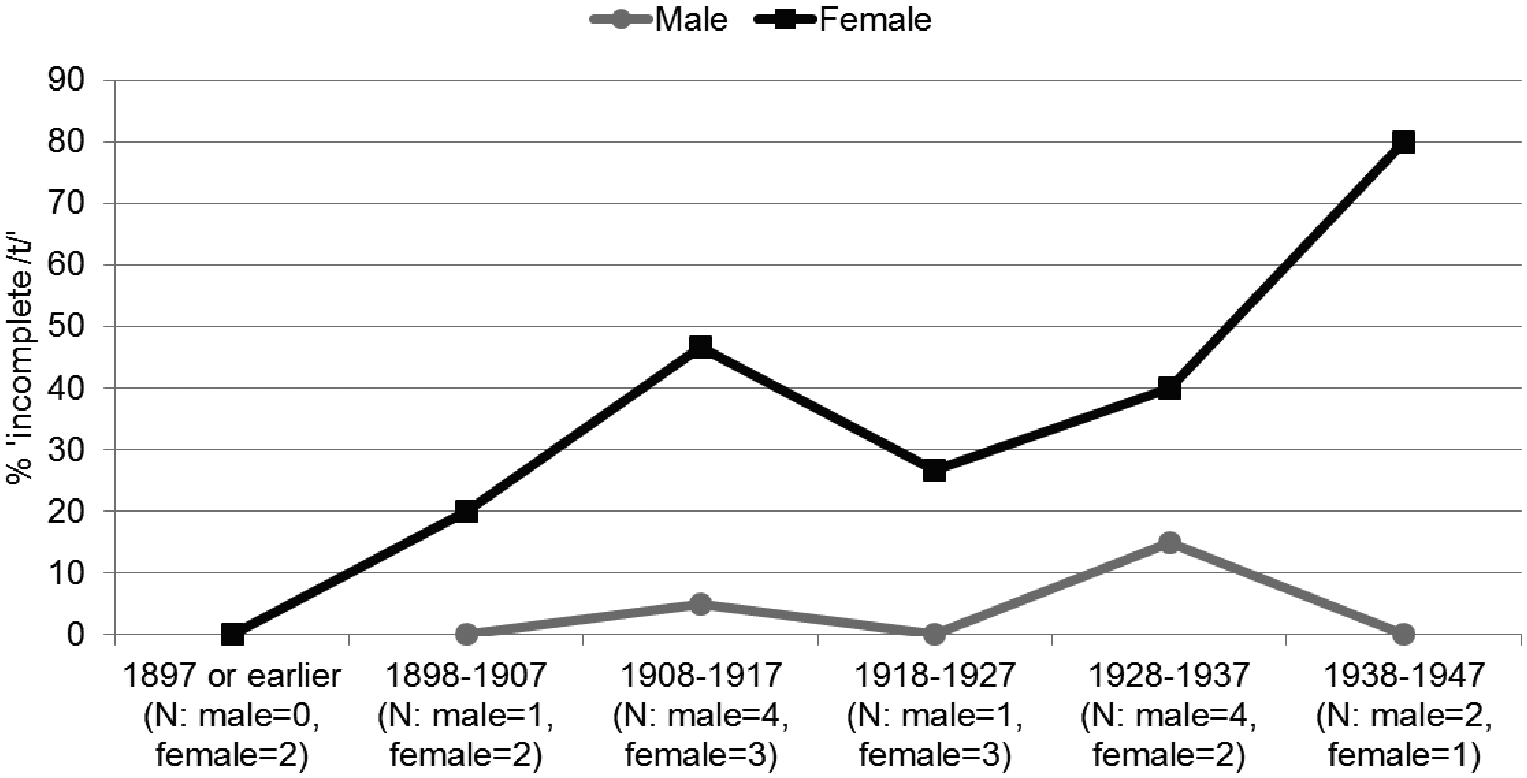
Figure 6.3 Word-final /t/ variation in working-class Liverpool speakers, adapted from Knowles (Reference Knowles1973: 326). N values are speaker counts per group.
This data shows that lenited variants of /t/ have been present in Liverpool English for a reasonably long time, even though they appear to be absent for speakers born in 1897 or earlier. Female speakers use ‘incomplete /t/’ 20 per cent of the time if born between 1898 and 1907, and this has increased by the time the female speakers in the youngest age group are born (1938–1947), but there is only one speaker in this group. Male speakers lag behind the females, never reaching the 20 per cent mark. Knowles (Reference Knowles1973: 233–234) identifies another variant of /t/, writing: ‘there is a small class of words including get, got, bit, what, that, it, not in which the final /t/ is pronounced before another consonant, but can be elided in absolute final position’. Although labelled as /t/ elision, it is possible that this variant is actually [h] – the final step before deletion on the sort of lenition scale presented in Figure 6.2.Footnote 9 If this is correct, it suggests another connection to Ireland, where in vernacular varieties [h] is also a variant of /t/. However, there are differences. In local Dublin English, [h] can be found in intervocalic position and word-final position following a long vowel (e.g. motorway [moːhəwe], thought [tɑːh]; Hickey Reference Hickey, Foulkes and Docherty1999: 217) but in Liverpool, according to Knowles's description of this variant, it appears only in pre-pausal position and only in a small set of lexical items, usually monosyllabic function words or high-frequency content words with short vowels.
Recent work has shown that plosive lenition remains a common characteristic of contemporary Liverpool English. Sangster (Reference Sangster2001) elicited word-initial and word-final alveolar stops from sixteen female adolescents aged 16–17 from two social classes. She observed that there was no effect of social class, but that ‘lenition of alveolar stops is evident to some degree in all speakers of Liverpool English studied. This non-standard feature does not pattern sociolinguistically in a straightforward way … it appears to be a prominent feature of Liverpudlian's speech generally’Footnote 11 (Sangster Reference Sangster2001: 410). That plosive lenition is common across many speakers is confirmed by Watson (Reference Watson2007a), who elicited utterance-final plosives from teenage speakers born in 1985–1986. Every speaker used a lenited variant for /t/ at least some of the time. Figure 6.4 presents the realisations of utterance-final /t/ for male and female speakers, adapted from Watson (Reference Watson2007a: 181). Although male speakers use fricative variants more often overall than females, both groups are equally likely to use a lenited variant of some form (i.e. an affricate or a fricative) – canonical stop variants are very rare.

Figure 6.4 Utterance-final /t/ variation in working-class adolescent speakers (nine female, seven male), adapted from Watson (Reference Watson2007a: 181).Footnote 10 N values are token counts per group.
Watson (Reference Watson2006b, Reference Watson2007a, Reference Watson, Grant and Grey2007c) argues that the use of the [h] variant of /t/ has increased over time. Whereas Knowles reports that [h] is a possible variant for a small set of words, Watson finds that in younger speakers [h] is also found in polysyllabic words with an unstressed final syllable. That is, [h] is a possible variant of utterance final /t/ in words such as biscuit, bucket, certificate and aggregate (with a preceding schwa) but not in words like jackpot, acrobat or internet (with a preceding full vowel), where lenition to an oral fricative or affricate is more likely. This appears to be a relatively recent change (see Clark and Watson 2016 for further details).
In this section we have elaborated on four of the phonological features often thought to be diagnostic of Liverpool English. There are no existing reports of rhoticity in Liverpool, even in Knowles's description of his oldest speakers. If rhoticity was ever present, it seems it had been lost in speakers born by 1897. There is stronger evidence for the presence of the other three variables we have considered. th-stopping, the realisation of nurse/square as a front vowel, and plosive lenition, at least as far as our focus on /t/ goes, were all clearly part of nineteenth-century Liverpool English, but to varying degrees. Knowles described how the nurse/square vowel was becoming more front and close over time, the reinterpreted (th) data implied that the stopped variant was already in decline for speakers born in 1918, and /t/ lenition seemed to be on the rise. In the next section, we discuss the likely origins of these features, by examining Honeybone's (Reference Honeybone, Grant and Grey2007) analysis of new dialect formation in Liverpool.
6.3 New Dialect Formation in Liverpool
Honeybone (Reference Honeybone, Grant and Grey2007) is the first to couch the birth of Liverpool English in terms of Trudgill's model of new dialect formation, e.g. Trudgill (Reference Trudgill2004). Situating new dialect formation firmly in the context of dialect contact, Trudgill (Reference Trudgill2004) proposes that the birth of a new dialect, at least in tabula rasa situations, is predictable, once we know about the early speakers involved and their dialects (but see differing views, e.g. Hickey Reference Hickey and Hickey2003). The first stage of Trudgillian new dialect formation involves the initial contact between adult speakers of different regional and social varieties in a new location. Typically, when speakers of different regional accents come together, they accommodate to each other, resulting in the levelling of more marked linguistic features (Trudgill Reference Trudgill1986). The outcome is that, even among the first generation of immigrants, their accents will be a little less ‘broad’ than they otherwise would have been (Trudgill Reference Trudgill2004: 84). The second stage of new dialect formation predicts the behaviour of children born into this unique linguistic melting pot. Essentially, as a result of having not one but several different adult linguistic models to aim towards, children will select variants or features from different dialects, potentially creating new combinations. They may also generate ‘interdialect’ forms, i.e. features which are not present in any of the input varieties. This stage of new dialect formation is characterised by extreme variability, resulting in an unstable linguistic situation. Stability begins to emerge in the next stage, driven by the next generation of speakers, who create a more focused koine – a new dialect (Trudgill Reference Trudgill2004: 88).
Honeybone (Reference Honeybone, Grant and Grey2007) briefly outlines the social history of Liverpool in light of these stages of new dialect formation. First, citing Neal (Reference Neal1988: 2), Honeybone (Reference Honeybone, Grant and Grey2007) provides the population figures in the city, gleaned from census data. These are reported in Table 6.1. The rapid growth of the city should be clear, particularly between 1831 and 1861, when the population almost trebles.
Table 6.1 The population of Liverpool between 1801 and 1911, from census returns. Taken from Honeybone (Reference Honeybone, Grant and Grey2007: 115, via Neal Reference Neal1988: 2)
| Year | Population |
|---|---|
| 1801 | 77,653 |
| 1811 | 94,376 |
| 1821 | 118,972 |
| 1831 | 165,175 |
| 1841 | 286,656 |
| 1851 | 375,955 |
| 1861 | 443,938 |
| 1871 | 493,405 |
| 1881 | 552,508 |
| 1891 | 517,980 |
| 1901 | 684,958 |
| 1911 | 746,421 |
The reasons for this rapid increase are complex, but an important factor was the migration of people to Liverpool from elsewhere. Honeybone (Reference Honeybone, Grant and Grey2007), using data from Munro and Sim (Reference Munro and Sim2001), Neal (Reference Neal1988) and Knowles (Reference Knowles1973), also reports on where the migrants to Liverpool came from, summarised in Table 6.2. A large part of the population of Liverpool came from Ireland as adults. An often cited reason for this is the Irish famine, which began in 1845 and forced people to leave their homes, in the direction of Liverpool (often as a port of departure for emigrant ships to the USA and Canada). But the population of people in Liverpool who were born in Ireland was already high in 1841, so the famine cannot have been the only factor. Liverpool was a major port city even by this point in time, so was an attractive destination for anyone looking to improve their economic circumstances. This will have meant that there was migration to Liverpool from other parts of England, too, and from elsewhere, adding other dialects into the melting pot.
Table 6.2 The proportion of Liverpool population born outside of England, from Honeybone (Reference Honeybone, Grant and Grey2007: 116)
| Year | Population | % Irish-born | % Welsh-born | % Scots-born |
|---|---|---|---|---|
| 1841 | 286,656 | 17.3 | ||
| 1851 | 375,955 | 22.3 | 4.9 | 3.6 |
| 1861 | 443,938 | 18.9 | 4.7 | 4.0 |
| 1871 | 493,405 | 15.6 | 4.3 | 4.1 |
| 1881 | 552,508 | 12.8 | 3.9 | 3.7 |
| 1891 | 517,980 | 9.1 | 3.4 | 2.9 |
Honeybone (Reference Honeybone, Grant and Grey2007: 117), based on Knowles (Reference Knowles1973), argues that the period 1841–1871 covers the ‘crucial period in which levelling, koineisation and new dialect formation occurred in Liverpool’. Before the nineteenth century, Honeybone claims, there was no distinct ‘Liverpool English’, but by the end of the century we see the ‘focusing of the dialect mixture and the emergence of a stable koine’ (2007: 119). This means, in Trudgill's (Reference Trudgill2004: 112) terms, the dialect appears as a ‘stable, crystallised variety’, largely because of the ‘survival of majority forms’ (Trudgill Reference Trudgill2004: 114). As part of this process, we expect to see ‘variant reduction’ where, as we move from the position of ‘extreme variability’ in earlier stages of new dialect formation to a more stable variety, the number of variants of a given variable are reduced, leaving perhaps just one remaining variant.
This brings us back to the four phonological features highlighted above, which are the features which Honeybone discusses in light of the predictions of Trudgill's dialect formation model. As we noted in Section 6.2, Honeybone (Reference Honeybone, Grant and Grey2007: 125) observes that ‘no trace of rhoticity has ever been reported for Liverpool English’. However, many of the varieties in the Liverpool melting pot in the mid-nineteenth century were rhotic – both the varieties of the speakers who came from other countries (e.g. such as Scotland and rural Ireland, although working-class Dublin English was already non-rhotic at this time, Hickey p.c.) and those of speakers from neighbouring localities in north-west England. Honeybone (Reference Honeybone, Grant and Grey2007: 126) points out that if Trudgill's principles of new dialect formation are correct, we might expect that Liverpool English became rhotic when it was formed, but then lost rhoticity at a subsequent period of time, in line with other varieties in England. But without some evidence which suggests that Liverpool English was once rhotic, we cannot be sure of this. With this in mind, our first question, to be discussed in Section 6.5, is: Is there any evidence of rhoticity in early Liverpool English?
The presence of th-stopping seems at first to result somewhat straightforwardly from processes of new dialect formation, since it is a feature common in southern Irish English varieties, and so would have likely been present in Liverpool's dialect mixture in the nineteenth century. Honeybone (Reference Honeybone, Grant and Grey2007: 124) argues that this is an example of ‘a Southern Irish English feature winning out’ over its competing counterparts from other varieties in the mix. However, recall that Trudgill's (Reference Trudgill2004) model predicts that in the focusing of a new dialect, it is the majority form which will win out, eradicating competing variants. This does not seem to be the case with th-stopping. The evidence above suggested that th-stopping was not a clear categorical variant of (th), or even the majority form, in early Liverpool English, as it appeared to be in decline in speakers born from 1918 onwards. Of course, we were limited by a small data set, so it may be that a different picture emerges when a larger corpus is examined. The next question we ask in Section 6.5, then, is: Was the stopped variant of (th) ever the majority variant in early Liverpool English?
Like th-stopping, the origin of the lack of contrast between nurse and square, and the realisational variability of the vowels, is also complex. South Lancashire varieties merge these sets to a central vowel like [ɜː], while Irish varieties maintain two distinct lexical sets, with a front vowel in square and, at least in Dublin, a high back vowel in nurse (e.g. [nʊː(ɹ)s], Hickey, p.c.). We saw above that there were many different realisations of nurse and square in early Liverpool English, in line with Trudgill's predictions of extreme variability in the early stages of new dialect formation, and we saw tentative evidence of the change towards a more front and closer vowel in younger speakers. This may be evidence of the beginnings of a stabilised feature in Liverpool's koine. Or it may be – and this is the position that Honeybone (Reference Honeybone, Grant and Grey2007: 128–129) takes – that the front variant emerged as the ‘realisation of choice in Liverpool English since koineisation’. In Section 6.5 we ask: If Knowles is correct in suggesting that the front, more close variant was a new variant in his data, when did it ‘win out’ over the other competing variants?
The final feature, plosive (particularly /t/) lenition, while present in Irish varieties, is thought not to have been borrowed wholesale from there into Liverpool English. This is mainly because the features do not pattern in exactly the same way in Irish varieties and Liverpool English, as we saw briefly in Section 6.2 when we discussed the [h] variant of /t/. Nevertheless, contact between the varieties is thought to have been crucial in innovating plosive lenition in Liverpool English. Honeybone (Reference Honeybone, Grant and Grey2007: 132) writes that the presence of lenited forms gave Liverpool children acquiring the variety ‘a clear indication that spirantisation and affrication of at least certain stops was possible’. The Irish realisations would presumably have been minority forms in early Liverpool English, but they appear not to have been levelled out, as Trudgill's model would predict. Instead, Honeybone argues, children extended these lenitional patterns, both in terms of their frequency of occurrence and in terms of the phonological environments in which they are likely to occur. To examine whether this is correct, we first need to corroborate observations about /t/ lenition in early Liverpool English. We do this in Section 6.5, before asking: Have the patterns been extended by younger speakers, over the last 100 years? To answer all the questions posed here, we utilise the Origins of Liverpool English corpus, which we outline in the next section.
6.4 The OLIVE Corpus
The Origins of Liverpool English corpus – OLIVE – was created as part of the ESRC-funded project ‘Phonological Levelling, Diffusion and Divergence in Liverpool and its Hinterland’. It holds recordings of 140 speakers from three localities in north-west England: Liverpool, a major urban centre in the region, and two smaller towns, Skelmersdale and St Helens. These smaller towns are equidistant from Liverpool, but the former saw much more migration from Liverpool in the 1960s when it was designated a new town. There are three age cohorts for each locality in the corpus, split into subcorpora: the ‘Archive’ subcorpus has speakers born between 1890 and 1943, the ‘Older’ subcorpus has speakers born between 1918 and 1942, and the ‘Teen’ subcorpus has speakers born between 1992 and 1994.Footnote 12 OLIVE is fully time-aligned and searchable, following a similar structure to the Origins of New Zealand English (ONZE) corpus, and using the same browser-based LaBB-CAT client (see Gordon et al. Reference Gordon, Maclagan, Hay, Beal, Corrigan and Moisl2007; Fromont and Hay Reference Fromont and Hay2008). When an orthographic transcript, time-aligned at the utterance level, is uploaded to OLIVE along with an audio file, LaBB-CAT performs a series of automatic processes to add further annotations. These include phonemic transcriptions and part of speech tags, taken from the CELEX database (Baayen et al. Reference Baayen, Piepenbrock and Gulikers1995). These are added to the orthographic transcript as additional layers (see Figure 6.5 for an example of the phonological transcription tier) and then become fully searchable. The audio data is also further time-aligned at the word and segment level (see Figure 6.6; the segment tier is represented in the CELEX ‘DISC’ format which associates one character per phoneme) and users can interact with these annotations using Praat, which can be called directly from the OLIVE client.

Figure 6.5 An example of a transcript in OLIVE, showing the orthographic and phonological tiers.

Figure 6.6 An example of a textgrid generated automatically by OLIVE. The utterance level alignment is done manually but the word and segment levels are completed automatically.
In this chapter, our analysis is based mainly on twenty-four speakers from the Liverpool corpus of OLIVE, with four female and four male speakers from each of the three subcorpora: Archive (speakers born 1897–1919), Older (speakers born 1937–1955) and Teen (speakers born 1992–1994).Footnote 13 Our oldest speaker was born in 1897, a couple of generations after the beginning of significant waves of migration from Ireland. In the terminology of new dialect formation, we would expect this speaker to be taking part in the early processes of koineisation, including levelling and the development of interdialect forms. Perhaps by the time the youngest speakers in the Archive subcorpus are born, and certainly by the time the speakers in the Older subcorpus are born, following the process of focusing, we should expect to see the emergence of a more stable koine.
6.5 Using Olive to Understand Liverpool English in the Past and in the Present
In this section we take each of the phonological features in focus in this chapter in turn and begin by first describing the speech of two typical speakers from OLIVE's Archive subcorpus, before examining a much larger data set. M07 is a working-class male who was born in Liverpool in 1897. He lived his entire life in the house in which he was born. He was recorded late in life as part of an oral history project chronicling the working lives of cartersFootnote 14 in the early 1900s. F05 is a working-class female who also lived her whole life in Liverpool. She was born in 1905 and was recorded as part of an oral history project to collect stories about the sinking of the Lusitania in 1915. Below is an orthographic transcript of an extract of these speakers’ stories, followed by a relatively broad phonetic transcription. Pauses are marked in each transcription with a vertical line.
Speaker M07
took her out on the road / with just / what with just ten hundred weight of coal on it / and when she heard, she heard the tram cars rattling / ooh there / up comes the ears / cost me five hundred quid that lot / knocked a wall down
[tʰʊk ə:ɹaʊtɒnðə ɹoəd | wɪðʤəst | wɒʔ wɪðʤəs tʰɛn ʊndɹə weɪt ə kʰoəl ɒn ɪts | ən wɛn ʃi: ɜ:dʃi: ɜ:dðə tsɹam kʰa:zɹatlɪn | u: ðɜ:ɹ | ʊp kʰʊmz ði e:z | kʰɒs mi: fɒɪv hʊndɹɪ kwɪd ðatl lɒts | nɒxt ə wɔ:l daʊn]
Speaker F05
my mother said to don't don't go away or anywhere cos the bag will be coming / and it never come and none of us thought of that / and at just half past two / quarter to three / the Echo papers come flying up the street / Lusitania gone down, all hands lost! / well the world went / berserk / the world went mad
[mi mʊðə sɛd tə dəo dəo gəo əweɪ ə ɛnɪwɛ: kʰəz ðə bag l̩ bi: kʰʊmən | an ɪʔ nɛvə kʰʊm an nʊn əv əz t̪èɔ:t əv ðats | an aʔʤʊst haf pas tsu: | kwɔ:tsə tə t̪ɹi: | ðɪ ɛkəo pʰeɪpəz kʰʊm flaɪn ʊp ðə stɹi:ts | lu:sɪteɪniə gɒn daʊn ɔ:l hanz lɒst | wɛl ə wɛ:ld wɛnts | bəzɛ:k | ðə wɛ:ld wɛnʔ mad]
As we discussed above, Honeybone's (Reference Honeybone, Grant and Grey2007) predictions of new dialect formation suggest that Liverpool English may have become rhotic during the koineisation process. We can see that the speech of M07 is variably rhotic. In the words heard, cars and ears /r/ is not realised, but in there, where the variable is in a pre-pausal position, there is a clear realisation of a rhotic consonant. F05, however, shows no sign of rhoticity, in any portion of her interview. The other Archive speakers analysed in this chapter show no signs of rhoticity either. A quantitative analysis of M07's interview revealed that a non-prevocalic /r/ was realised in 14/482 tokens (3 per cent). This is obviously a very small number, but that doesn't mean it is trivial, since no other speaker had any realisations of /r/ in this position at all. We have no reason to think M07 has a social history which is very different from the other speakers, so it is possible that this speaker is demonstrating the last vestige of rhoticity in Liverpool English. If this is correct, then Trudgill's model of new dialect formation would be supported. Liverpool English may have been at least partially rhotic in the mid-/late nineteenth century, but then rhoticity was lost, in line with what has happened in other English localities.
There is also a difference between speaker M07 and F05 in the use of th-stopping. Only F05 uses the stopped variant of (th), in thought and three, and there is no dh-stopping for either speaker in these short extracts. To see if this pattern extended to the wider speech community, 1,380 tokens of (th) were extracted and analysed across the three subcorpora (see Figure 6.7).Footnote 15 In line with the observations about the extracts from M07 and F05, in the Archive subcorpus overall the female speakers use a stopped variant of (th) more often than the males. This difference has disappeared in the Older and Teen subcorpora, as the use of the stopped variant declines. In the Teen subcorpus, the stopped variant is again further reduced in frequency, but it has still not disappeared completely. The stopped variant is never particularly common, however, even for the Archive speakers – [è] is the majority variant for both Archive and Older groups. This means that if the stopped variant did ‘win out’ during new dialect formation in the mid-nineteenth century, it must have begun to recede again quite rapidly. It seems unlikely that [è] was ever lost completely because of variant reduction during the levelling process, but that the fricative and stopped variants were used together. Rather than reducing the number of variants of this variable, then, we have an increase, which has still not fully levelled away even for speakers born in 1992–1994.

Figure 6.7 th variation, by corpus and sex. N values are token counts per group.
Moreover, in the Teen subcorpus we see the rapid increase of th-fronting, which was entirely absent from the other subcorpora. This is perhaps unsurprising, since th-fronting is a feature known to have been spreading across the UK over the last few decades (see Kerswill Reference Kerswill, Britain and Cheshire2003 for an overview of the geographical diffusion of this feature). The usual claim in the literature is that th-fronting is absent from Liverpool. Indeed, this is the picture presented in Watson (Reference Watson, Grant and Grey2007c), which examined (th/dh) in Liverpool teens born in 1985–1986. The Teen speakers in the OLIVE corpus were born in 1992–1994, and by this period th-fronting is firmly established in Liverpool English, adding another possible variant for (th).Footnote 16
Another difference between the features used by M07 and F05 is their realisation of the nurse and square lexical sets. Both speakers merge these phonological categories, but for M07 the merger is to a central vowel (typical of the present-day realisation of these words in south Lancashire) but for F05, the merger is to a fronter vowel (typical of modern Liverpool English). To explore whether this pattern holds for the other Archive speakers, we extracted 11,068 vowels from OLIVE (6,283 vowel tokens from four male speakers, 4,785 vowel tokens from four female speakers – see Table 6.3).
Table 6.3 Numbers of Archive vowel tokens analysed across each lexical set, arranged by sex
| Female | bath | book | dress | fleece | foot | goose | kit |
| 88 | 58 | 1,235 | 251 | 72 | 149 | 516 | |
| lot | nurse | square | start | strut | thought | trap | |
| 437 | 314 | 321 | 91 | 331 | 479 | 443 | |
| Male | bath | book | dress | fleece | foot | goose | kit |
| 115 | 62 | 1,594 | 305 | 158 | 179 | 543 | |
| lot | nurse | square | start | strut | thought | trap | |
| 605 | 271 | 406 | 256 | 462 | 710 | 617 |
The vowels, normalised using the Lobanov method (Reference Lobanov1971), are plotted for each Archive speaker group in Figure 6.8. We can clearly see that the nurse and square lexical sets are indeed more central for men and more front for women, on average. The pattern described above from the speech of M05 and F05 is not simply an artefact of the few tokens within the transcript; rather, M05 and F07 pattern with the rest of the speech community. Figures 6.9 and 6.10 show vowel plots of male and female speakers from the Older and Teen subcorpora.Footnote 17 We can see that for the Older male speakers, nurse and square are realised in a more front position – the men seem to have caught up with the women by this point. This is continued in the Teen corpus, where again both male and female speakers use front realisations for each of these lexical sets. These results, based on a total of 1,410 nurse/square vowels, support Knowles's (Reference Knowles1973) early observation that these vowels were moving to a more front position. Females seem to have been in the lead, since a front variant was used for the female speakers even in the Archive corpus.

Figure 6.8 Vowel plots for female Archive speakers (F, bottom pane) and male Archive speakers (M, top pane).

Figure 6.9 Vowel plots for female Older speakers (F, bottom pane) and male Older speakers (M, top pane).

Figure 6.10 Vowel plots for female Teen speakers (F, bottom pane) and male Teen speakers (M, top pane).
Finally, there is some evidence of /t/ lenition in the extracts from M07 and F05 – both speakers produce a phonetically affricated /t/ in pre-pausal position. There are no examples of fricative variants of /t/, so in order to explore the extent to which lenition was present across the OLIVE subcorpora, we extracted and analysed 1,536 tokens of utterance final /t/ from the conversational data.Footnote 18 Averaged group data is presented in Figure 6.11.

Figure 6.11 Realisation of utterance final /t/, by age and sex.
We can see that /t/ lenition, at least in utterance-final position, is clearly present in the Archive subcorpus, for both male and female speakers. There are, as expected, realisations of /t/ as [h], although this is more common for the male speakers than the females. When describing (what we interpreted as) this variant, Knowles restricted its occurrence to a small set of single syllable, high-frequency words with short vowels. In our Archive subcorpus, [h] is attested for /t/ in the following words only: bit, but, get, got, it, lot, minute, not, street, that, what. In general, these fit Knowles's pattern – it is much more likely for [h] to appear in a monosyllabic function word than in other words, but there are some exceptions, i.e. the bisyllabic minute, and street, with a long vowel. This is the first time [h] has been documented as a possible variant of /t/ in these words in earlier Liverpool English. The [h] variant increases rapidly in the Older and Teen subcorpora. In the Older subcorpus, [h] occurs in the following words: but, got, it, market, not, passport, that, thought, what, and the Teen speakers have [h] in: about, bit, but, Charlotte, get, got, it, lot, not, put, quiet, rabbit, that, what, yet. Again, [h] is more likely in monosyllabic function words, and it is possible in polysyllabic words with a final unstressed syllable (e.g. market, Charlotte, rabbit), as reported in the literature. But it is also attested in words with a long vowel in the final syllable (e.g. about, thought). This is different from the original environment proposed by Knowles (Reference Knowles1973) but it is in keeping with the observations from the Archive subcorpus. One possible interpretation of this data is that, while the frequency of the [h] variant has increased over time, the linguistic constraints operating on this variable may have remained relatively stable. Clark and Watson (2016) examine this feature in more detail, and show that the phonological constraints operating on the [h] realization of /t/ are indeed stable over time in Liverpool.
Importantly, the patterning of Liverpool English utterance final /t/ is unlike that of Irish English. Honeybone's (Reference Honeybone, Grant and Grey2007) idea that Liverpool lenition is a creative act by the young, after they heard certain lenited variants in their linguistic environment during the early processes of new dialect formation, seems to be supported by data from the OLIVE corpus. There is little evidence here of a wholesale adoption of a feature from Irish varieties. Neither is there conclusive evidence of variant reduction. While there is more equal usage of the range of variants in the Archive subcorpus, every variant used by the oldest speakers is still used by the Teen speakers, albeit at different rates.
To summarise, in the last two sections we have presented data from the OLIVE corpus, the largest time-aligned corpus of Liverpool English and two varieties in its hinterland. In doing so, we have made a number of observations about Liverpool English which have not been previously documented in the literature. These are: (1) there is evidence of rhoticity in early Liverpool English; (2) the realisation of nurse/square as a front vowel appears to be gendered, at least in earlier forms of the accent, where female speakers use the fronter, closer vowel, in line with contemporary Liverpool speakers; (3) th-stopping is not very common, even in early Liverpool English, even though it is a stereotype of the variety; (4) th-fronting, previously thought to be absent in Liverpool English, is now attested in younger speakers; and (5) [h] was a possible variant of utterance-final /t/ in polysyllabic words even for speakers born 100 years ago, and is not an entirely modern innovation. Until now, sufficient data was not available in large enough quantities to be able to document these characteristics. The OLIVE corpus provides such data and allows us to push our understanding of Liverpool English further back in time than has hitherto been possible.
6.6 Conclusion
In this chapter, we have explored Liverpool English and contributed to the discussion of its origins by bringing historical data to bear on Honeybone's (Reference Honeybone, Grant and Grey2007) hypotheses about the emergence of the variety. The results largely support Honeybone's (Reference Honeybone, Grant and Grey2007) observations. Rhoticity is expected, given that it is present in some of the input varieties (e.g. Lancashire English), and the move towards the front vowel in nurse/square indicates a degree of focusing over time, to a more stable koine. In this case it is led by the female speakers. The direct influence of Irish varieties seems to be less clear cut than is sometimes assumed. Although th-stopping was adopted in Liverpool, it declined again rather quickly. The stopped variant did not really ‘win out’ as is sometimes claimed – other variants are continually used, usually more often. Plosive lenition, too, is complex, and seems not to have been directly borrowed from Irish varieties.
If claims about the emergence of this variety are correct, and modern Liverpool English really started to come into existence in the middle of the nineteenth century, then we have not examined the earliest Liverpool English in this chapter. But, as far as we know, no earlier recordings than those in OLIVE exist. If some are found, it will be important to see how they fit into the picture presented here.


