

Highlights
Transformation is required in complex food systems; the key is to identify the best levers to achieve change.
Food-system transformation has four major interlocking elements: rerouting systems into new trajectories; addressing climate impacts, thereby reducing risks; addressing new environmental issues, thereby lessening emissions; and realigning the ‘enablers of change’ such as policies, regulation, finance, and innovation.
This book proposes 11 specific, concrete actions within these four areas.
Achieving food-system transformation will require annual investments of US$1.3 trillion through the decade, with private-sector finance helping to fill current gaps.
2.1 The Vision
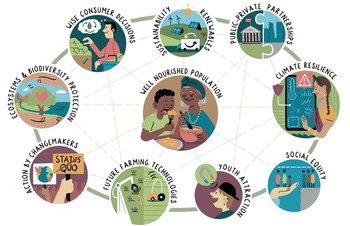
We envision a world where all people, including future generations, are well nourished and food-secure. This vision can be achieved through transformed food systems that sustainably manage current and future resources and stresses. Such food systems will be built by empowering people along the food value chain and strengthening their resilience to natural, social, and climate-related hazards, while contributing to emissions reductions, the capture of greenhouse gasses (GHGs), sustainable land use, and ecosystem and biodiversity protection (Figure 2.1).
The vision for a transformed food system
Ambitious targets must be achieved if the Paris Agreement and the United Nations’ Sustainable Development Goals (SDGs) are to be realised. Food and nutritional security targets are themselves challenging but are overlaid by the need to achieve global zero net emissions, with food systems requiring substantial emission reductions and carbon capture. In addition, global temperatures will overshoot the predicted 1.5°C warming scenario, and are highly likely to overshoot 2°C, meaning considerable adaptation to extreme events is necessary. Given these challenges, comprehensive changes are requisite across entire food systems.
New food systems will revolve around radical changes in the strategies and operations of all actors within the value chain, including how ecosystems are maintained and how policies, human behaviour, financing criteria, and political economies can solve the urgent problems of agriculture and climate change. A fundamental shift in the power balance of food system actors is required to achieve these improvements.
A primary challenge in transforming food systems under a changing climate relates to the scalability of successful adaptation and mitigation approaches; currently, too many successful pilots are not scaled up. Transformed food systems will be embedded in enabling environments where knowledge – including indigenous and local knowledge – policies and institutions, finance, the private sector, and civil society help overcome the scaling barriers in climate-resilient and low-emission approaches. This enabling environment will support all types and sizes of farmers and other food system actors, including women and youths, in accessing resources and decision-making power, to ultimately achieve productive, sustainable livelihoods. Developing economically attractive livelihoods that can encourage youth participation in food value chains would form part of this enabling environment. As technologies evolve and population distributions change, attaining this goal will likely require re-skilling and capacity building in new areas.
Alongside these supply-side changes, alterations in demand will be essential to achieving food-system transformation. The demand for sustainable ecosystem use and a massive shift in food consumption behaviour towards nutritious diets within planetary boundaries are critical to achieving global aspirations for sustainable development and healthy populations (Rockström et al., Reference Rockström, Steffen and Noone2009). Transformation of diets will go beyond informing or nudging consumer choices towards a more systemic approach that encompasses regulation, infrastructure, private and public investment, and social movements that shape consumers’ choices and options. Public-sector procurement may be as important in leading the way forward as private-sector food retail and food service industries. A fundamental shift in political economy, power relations, and behaviours must underpin such shifts, recognising that producers must adapt their skills and labour requirements.
2.2 Four Key Areas in Achieving Transformation
Food systems require transformation. Given the enormous complexity of food systems – not to mention the heterogeneity in the way food is produced, processed, distributed, and consumed among and within individual countries – the best levers to trigger transformative change need examining. Four action areas have been defined, drawing attention to four objective outcomes necessary for transformative change. These action areas include 11 key actions (Chapters 4–14), drawing on the work of Steiner et al. (Reference Steiner, Aguilar and Bomba2020).
2.2.1 Action Area 1: Rerouting Farming and Rural Livelihoods to New Trajectories
Significant investments can enable farming systems and rural livelihoods sources to course-correct towards a sustainable, climate-resilient future that benefits the environment, people, and animals. This future would involve reallocating and refocusing current investments, backed by supportive policies and institutional reforms. Expected outcomes include higher agricultural productivity, conservation of ecosystems and the natural resource base, low GHG emissions, reduced social inequality, food and nutrition security for all, and elimination of social conflict that generates pressure to migrate. Three actions are identified to reroute farming and rural livelihoods (Table 2.1), to foster the emergence of a reinvigorated rural economy where agriculture serves as a driver of inclusive rural development and sustainable growth.
| Actions | Goal (‘what’) | Actions and transformations (‘how’) | Geographical focus (‘where’) | Stakeholders (‘who’) |
|---|---|---|---|---|
Action 1.1 Ensure zero agricultural land expansion in high-carbon landscapes (Chapter 4). | Avoid the conversion of 250 million ha of forests and 400 million ha of peatlands. | Integrate policy action across climate targets, subsidies, protected areas, and taxes. Implement innovative financial mechanisms such as debt for nature swaps, blended finance, and green bonds to radically increase the funds available for conservation and restoration. | Tropical developing countries, particularly Brazil, Indonesia, Peru, the Congo Basin, and Colombia | Stakeholders range from global policymakers and investors to indigenous communities and wild area stewards. |
Action 1.2 Enable markets and public-sector actions to incentivise climate-resilient, low emission practices (Chapter 5). | Widely adopt climate-resilient innovations; integrate more farmers into inclusive, sustainable markets. | Strengthen public- and private-sector measures that incentivise the adoption of climate-resilient innovations and improve livelihood opportunities for farmers. Catalyse and leverage the resources and dynamism of local small and medium-sized agribusinesses to create inclusive, sustainable markets. Support community-based initiatives to enhance the livelihood, security, and resilience of marginalised and resource-constrained smallholder farmers. | Climate-change and poverty hotspots in Africa, Latin America and Asia | Stakeholders include government agencies, small and medium-sized enterprises (SMEs), farmer communities, and development partners. |
Action 1.3 Support prosperity through mobility and rural reinvigoration (Chapter 6). | Reroute farming and rural livelihoods to new trajectories that enable farmers to ‘step up’ and ‘step out’. | Invest in secondary and tertiary industries in rural areas. Revolutionise agricultural production systems towards greater automation. Increase youths’ capacity for entrepreneurship. Establish safety net policies to facilitate migration out of failing farming systems. | Global scope, with a focus on the developing world | Youths and women in rural areas are the key stakeholders. |
Action 2.1 Secure resilient livelihoods through early warning systems and adaptive safety nets (Chapter 7). | End dependence on humanitarian assistance for 40 million rural dwellers by 2030. Realign US$5 billion per year for adaptive safety nets. | Construct a tighter continuum from humanitarian assistance to development processes. Develop and improve early warning systems in climate risk hotspots. Align best-practice safety net programmes in climate risk hotspots. Support early action with risk finance. Undertake the following actions to build a climate security agenda:
| Countries exposed to climate extremes and variability, fragility, conflict, and socio-political insecurities | End users include policymakers and stakeholders from the climate-action and emergency sector. |
Action 2.2 Help farmers make better choices (Chapter 8). | Scale climate services by connecting 200 million farmers and agribusinesses to information and communication technology-enabled bundled advisory services by 2030 | Amplify farmers’ voices and improve their capacity to use climate information. Bundle climate services with agri-advisories, inputs, and financial services. Invest in public institutions such as national meteorological services and extension services. Employ a diverse delivery strategy for climate services that exploit digital innovation. Embed services in a sustainable, enabling policy and governance environment. | Global scope | Stakeholders include farmers, government ministries and agencies, insurance providers, communications companies, universities, research organisations, non-governmental organisations, funders, and donors |
| Actions | Goal (‘what’) | Actions and transformations (‘how’) | Geographical focus (‘where’) | Stakeholders (‘who’) |
|---|---|---|---|---|
Action 3.1 Shift to healthy, sustainable, climate-friendly diets (Chapter 9). | Reduce red meat consumption in high-income countries to support healthier, low-emission, sustainable diets. Increase the availability of alternative protein sources. | Improve the cost, ease, and appeal of alternative meat products for large segments of populations in all countries. Promote policy targets and actions for reduced-meat diets in high- and middle-income countries with excessive meat consumption. Use public–private finance to drive more rapid improvements in alternative meat products and their sustainability. Enhance business opportunities, including the availability of open-source technologies for alternative meat production in low- and middle-income countries, such as for small-scale production. | High- and middle-income countries and C40 Cities with substantial meat and dairy consumption. Low- and middle-income countries for business opportunities. | Consumers of meat, companies, investors, donors, policymakers, and social movements are crucial stakeholders. |
Action 3.2 Reduce food loss and waste (Chapter 10). | Reduce food loss and waste to improve food security, with trade-offs for climate impacts (shrink the percentage of global GHG emissions associated with food loss and waste). | Use regional and national hotspot analysis to derive priority product categories and chain stages. Identify solutions at the value chain level. Improve harvesting and on-farm handling. Enhance perishable cooling procedures across the value chain to minimise food loss and waste. Coordinate demand-driven planning and supply chain transformations to reduce waste, particularly when serving remote and urban markets. Develop business models in which costs and benefits are distributed among actors that invest and benefit from measures to decrease food loss and waste. Reduce food loss and waste from high-emission crops to substantially cut GHG emissions. | Situation-specific locations, including Africa broadly and all low-income countries | Policymakers, value chain actors, services providers, cooperatives, and investors comprise the major stakeholders. |
Action 4.1 Implement policy and institutional changes that enable transformation (Chapter 11). | Utilise deliberative, multi-stakeholder approaches to produce collective knowledge, which increase the legitimacy of policy and help create buy-in for implementation. These approaches provide insightful ideas for rapid, effective transformations with long-term success. | Hold inclusive, participatory workshops with diverse stakeholders about specific current and future scenarios. Ensure policy can be implemented as necessary through multi-level government interaction and involvement. Advance gender and social inclusion to redistribute power dynamics and empower marginalised groups. Reconfigure funding mechanisms to improve policy processes and implementation. | Global public- and private-sector investors and SMEs | Essential stakeholders include governments, producers, businesses, civil society, international funders, and research organisations. |
Action 4.2 Unlock billions in sustainable finance (Chapter 12). | Overcome barriers finance actors face in deploying sustainable finance to transform food systems under a changing climate. | Create attractive investment opportunities for mainstream investors. Build the capacity of financial intermediaries to accurately assess risk, lower transaction costs, and deploy risk-mitigating mechanisms. Utilise robust science-based metrics and standards to catalyse capital. | Global small-scale producers and small and medium-sized investees in low- and middle-income countries | Public- and private-sector investors and SMEs are the main stakeholders. |
Action 4.3 Drive social change for more sustainable decisions (Chapter 13). | Promote organisational empowerment as a critical pathway to support sustainable transformation of food systems, mediated through different types of organisations. | Undertake the following actions to empower farmer and producer organisations:
| Global | Farmers, women, youths, and communities are crucial stakeholders. |
| Actions | Goal (‘what’) | Actions and transformations (‘how’) | Geographical focus (‘where’) | Stakeholders (‘who’) |
|---|---|---|---|---|
Action 4.4 Transform innovation systems to deliver impacts at scale (Chapter 14). | Accelerate research, knowledge generation, and innovation to create large-scale impact, meet the Paris Agreement, and achieve the SDGs. | Transform innovation systems across three key dimensions: the design and management process, the culture and structures of organisations, and their engagement with the wider innovation ecosystem. Connect stakeholders across different dimensions, themes, and levels through the following actions:
These actions connect to the paradigm of ‘Open Innovation 2.0’ and both imply and require the upstream transformation of funding and incentive schemes. | Local to global networks and mesh-works | All actors along the food value chain are relevant, especially research and innovation institutions. |
2.2.2 Action Area 2: De-risking Livelihoods, Farms, and Value Chains
Global food-system transformation will take place against the backdrop of a changing climate that is subjecting the entire food value chain to increasingly frequent and extreme weather events. These events depress productivity and cause widespread damage, sometimes inflicting catastrophic losses on individuals, families, and businesses. The uncertainty arising from future climate variables and current impacts can discourage farmers from investing in adaptive innovations, reducing their prospects for improving their livelihoods, including potential pathways out of poverty. In that context, measures to build resilience among food system actors would allow them to anticipate, respond to, and recover from climate-associated events. Two actions have been identified to de-risk livelihoods, farms, and value chains.
2.2.3 Action Area 3: Reducing Emissions through Diet and Value Chain Transformations
Global food systems are a leading contributor of GHGs, but two opportunities for reductions are waiting to be seized (Table 2.1). The first concerns dietary change; too many people currently consume foods that generate high levels of GHG emissions – either directly or indirectly – during production, processing, and distribution. The second concerns food loss and waste, with up to 40 percent of all food produced for people not being consumed by them; 8–10 percent of global anthropogenic GHG emissions are associated with these losses.
2.2.4 Action Area 4: Realigning Policies, Finance, and Support for Social Movements and Innovation to Build More Resilient, Sustainable Food Systems
The three action areas above include measures that can directly alter the trajectory of global food systems. These will depend on a conducive policy environment, adequate financing, innovative approaches that can replace ‘business as usual’, and support from both policymakers and broader society. Four actions have been identified to create an enabling environment, ensure the availability of financing, promote innovations, and mobilise support for transformative change (Table 2.1).
2.3 Eleven Key Actions for Transformation on the Ground
The four action areas encompass 11 transformative actions (Chapters 4–14). The 11 actions are developed extensively to understand the goal (the ‘what’), the mechanisms to achieve it (the ‘how’), the targeted geographic areas (the ‘where’), and the key stakeholders (the ‘who’). Table 2.1 summarises these points.
2.4 The Underlying Costs of Transformation
Considering the actions and targets, achieving the necessary transformation in food systems will require annual investments of about US$1.3 trillion through the decade (Table 2.2) (Steiner et al., Reference Steiner, Aguilar and Bomba2020; Thornton et al., 2022). This figure is equivalent to less than 15 percent of the estimated US$9 trillion yearly monetary value of global food consumption or less than 7 percent of the hidden externalities generated by the current food system at US$19.8 trillion (Hendriks et al., Reference Hendriks, de Groot Ruiz and Acosta2021). Most of the US$1.3 trillion investment – US$1 trillion – would be for Rerouting, with the remainder for De-risking, Reducing, and Realigning aspects of food systems.
Between 2000 and 2018, the share of the global climate finance flow in the agriculture and land-use sector decreased from an average of 45 percent in the year 2000 to 24 percent in 2013, where it has since remained (Buto et al., Reference Buto, Galbiati and Alekseeva2021). In 2017–18, US$20 billion in climate finance flowed annually to the agriculture, forestry, and land-use sectors (CPI & IFAD, 2020; CPI, 2019). This amount is well below the US$1.3 trillion needed. It is not only the lack of sufficient investment in food-system transformation that should come as a wake-up call, however; the current dependence on the public sector as a source of financing is also of concern. Unlike other sectors that are less concessional and attract diverse types of finance flows, at present, more than 90 percent of tracked climate-finance contributions to agriculture and the land-use sector come from Development Assistance Committee (DAC) members and multilateral development banks, which contribute 67.5 percent and 23.8 percent respectively (Buto et al., 2021). Public sources alone are insufficient to meet the estimated costs, and private-sector investment will play a critical role in closing the gap; global wealth was estimated at US$431 trillion in assets in 2020 (Boston Consulting Group, 2021). A better understanding of how to build business cases to attract private investors, with risks and returns in line with comparable mainstream investment options, would be a pathway to mobilise and scale up finance, eventually lessening the heavy financial dependence on the public sector.
Geographically, the regions that are most vulnerable to climate change and urgently need food-system transformation are those without adequate assets under management. In our estimation, there is a massive need for annual investments worth US$165 billion in Sub-Saharan Africa. Leaving aside the investment needed for Action 1.1, this region has the greatest need in terms of investments for food-system transformation. These investments are needed because of the inadequate rural infrastructure, large numbers of small-scale farmers, and slow progress towards alleviating poverty and achieving gender equity in this region. We need to reorient global finances to effectively connect North–South or South–South capital flows and assist developing countries. On the way to doing so, we must ensure that capital flows align with vulnerability levels and reach areas most in need. Constructing an architecture of global climate finance that includes diverse sectors and that collaboratively leverages financial resources to reach vulnerable areas will be a major challenge in realising food-system transformation.


 Open access