Contents
Office bearers
Office Bearers
-
- Published online by Cambridge University Press:
- 20 January 2009, p. 1
-
- Article
-
- You have access
- Export citation
Other
Some new Properties of the Triangle
-
- Published online by Cambridge University Press:
- 20 January 2009, p. 5
-
- Article
-
- You have access
- Export citation
Research Article
Green's and allied theorems: a historical sketch
-
- Published online by Cambridge University Press:
- 20 January 2009, pp. 2-5
-
- Article
-
- You have access
- Export citation
-
The chief purpose of the paper was to indicate the rise of transformations of the type
 where the integral in the first member of the equation is taken throughout a closed surface, and that in the second member over the surface, a being the angle made with the axis of x by the normal to the element dS drawn outwards. It is on this transformation the analytical proof of Green's theorem depends, and it was shown to have been employed in various forms by Poisson, Duhamel, Gauss, and others, before Green's essay was generally known on the Continent. It may be observed that the essay was published at Nottingham in 1828, and seems to have been unknown to continental mathematicians till its reprint in Crelle's Journal, vols. 39 (1850), 44 (1852), and 47 (1854).
 where the integral in the first member of the equation is taken throughout a closed surface, and that in the second member over the surface, a being the angle made with the axis of x by the normal to the element dS drawn outwards. It is on this transformation the analytical proof of Green's theorem depends, and it was shown to have been employed in various forms by Poisson, Duhamel, Gauss, and others, before Green's essay was generally known on the Continent. It may be observed that the essay was published at Nottingham in 1828, and seems to have been unknown to continental mathematicians till its reprint in Crelle's Journal, vols. 39 (1850), 44 (1852), and 47 (1854).
A special case of three-bar motion
-
- Published online by Cambridge University Press:
- 20 January 2009, pp. 5-15
-
- Article
-
- You have access
- Export citation
On some theorems in the theory of numbers
-
- Published online by Cambridge University Press:
- 20 January 2009, pp. 16-19
-
- Article
-
- You have access
- Export citation
-
The number of groups of n which may be selected from 2n is 2n(2n − l)…(n + l)/n! But make the 2n into two groups of n, and select r out of the first and n − r out of the second. This gives [n(n−l)…(n−r+l)/r!] + [n(n−l)…(r + l)/(n−r)!] ways of thus making a group of n. Hence

Note on normals to conics
-
- Published online by Cambridge University Press:
- 20 January 2009, pp. 19-21
-
- Article
-
- You have access
- Export citation
-
1. The following condition may be new; it does not appear in any of the books:—
The condition that the straight line

should be a normal to the general conic,

referred to rectangular axes, is

where Σ is written for

and Δ, A, B, C, F, G, H have their usual meanings.
Note on a curious operational theorem
-
- Published online by Cambridge University Press:
- 20 January 2009, pp. 21-22
-
- Article
-
- You have access
- Export citation
-
The idea in the following note is evidently capable of very wide development, but it can be made clear by a very simple example.
Whatever be the vectors α, β, γ, δ, we have always

But vector operators are to be treated in all respects like vectors, provided each be always kept before its subject.
On a property of odd and even polygons
-
- Published online by Cambridge University Press:
- 20 January 2009, pp. 22-26
-
- Article
-
- You have access
- Export citation
On some properties of the quadrilateral
-
- Published online by Cambridge University Press:
- 20 January 2009, pp. 27-29
-
- Article
-
- You have access
- Export citation
Other
On the Moduluses of Elasticity of an Elastic Solid according to Boscovich's Theory
-
- Published online by Cambridge University Press:
- 20 January 2009, p. 29
-
- Article
-
- You have access
- Export citation
Research Article
On the different possible non-linear arrangements of eight men on a Chess-board
-
- Published online by Cambridge University Press:
- 20 January 2009, pp. 30-43
-
- Article
-
- You have access
- Export citation
On the equations of Vortex motion, with special reference to the use of polar co-ordinates
-
- Published online by Cambridge University Press:
- 20 January 2009, pp. 43-64
-
- Article
-
- You have access
- Export citation
On a problem in permutations
-
- Published online by Cambridge University Press:
- 20 January 2009, pp. 64-69
-
- Article
-
- You have access
- Export citation
On a hydromechanical theorem
-
- Published online by Cambridge University Press:
- 20 January 2009, pp. 69-77
-
- Article
-
- You have access
- Export citation
On Rankine's Formula for Earth Pressure
-
- Published online by Cambridge University Press:
- 20 January 2009, pp. 77-80
-
- Article
-
- You have access
- Export citation
On a certain expression for a spherical harmonic, with some extensions
-
- Published online by Cambridge University Press:
- 20 January 2009, pp. 81-89
-
- Article
-
- You have access
- Export citation
A Method of Teaching Electrostatics in School
-
- Published online by Cambridge University Press:
- 20 January 2009, pp. 89-91
-
- Article
-
- You have access
- Export citation
Other
Quaternion Synopsis of Hertz' View of the Electrodynamical Equations
-
- Published online by Cambridge University Press:
- 20 January 2009, p. 92
-
- Article
-
- You have access
- Export citation
Research Article
Note on the Orthomorphic Transformation of a circle into itself
-
- Published online by Cambridge University Press:
- 20 January 2009, pp. 91-92
-
- Article
-
- You have access
- Export citation
-
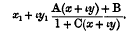
“The following is, of course, substantially well-known, but it strikes me as rather pretty:—to find the Orthomorphic transformation of the circle

into itself. Assume this to be

Note on Menelaus's Theorem
-
- Published online by Cambridge University Press:
- 20 January 2009, pp. 92-93
-
- Article
-
- You have access
- Export citation