

Looking Far Back into the Past
Much sustainability science focuses on a relatively short period of human history, even though it may seem long to us, such as 50, or 100, maybe 200 years. That is justified on the one hand by pointing to the fact that the Earth and everything on it has undergone such drastic anthropogenic changes that the situation in earlier periods seems to be so different that at first sight it appears irrelevant. Another reason often invoked is that for periods beyond the last 100 or 200 years we do not have sufficient quantitative data about such things as the climate, the circulation of oceans, and other natural dynamics, so that in our increasingly quantitative science working on earlier periods is discounted.
But choices made in the past are the initial conditions of the dynamics of the present. Since their earliest days on this planet, human groups, whether as hunters, farmers, stock raisers, or urban residents, have continuously engaged in activities that alter and restructure the natural and societal order. Part of this process is a slow but fundamental change in the dynamic between man and nature that has occurred over a very long time (van der Leeuw Reference van der Leeuw, Berger, Nuninger, Kohler and van der Leeuw2007, see also Chapters 8 and 10).
At the beginning of the Holocene – some 10,000 years BCE – for example, we find in the Rhône Valley that there is only perceptible change in the terrestrial environment when both climate and people are pushing for such change in the same direction, such as is the case in the Neolithic (van der Leeuw Reference van der Leeuw1998b; Berger & van der Leeuw Reference van der Leeuw, Berger, Nuninger, Kohler and van der Leeuw2007). Currently, on the other hand, the overall socioenvironmental system has become so thoroughly integrated (“hyper-coherent”), that the slightest change in either climate or anthropogenic impact can push the terrestrial ecosystem out of balance. This is argued, for example, for the Little Ice Age in the sixteenth to nineteenth centuries CE, with three particularly cold intervals: one beginning about 1650, another about 1770, and the last in 1850, each separated by intervals of slight warming. They may have been due to volcanic eruptions that spewed such masses of various gases and fine dust into the atmosphere that the quantity of solar radiation reaching the Earth was temporarily reduced. The effect of this relative cooling of the Earth is noticeable in a number of economic and social indicators (Le Roy Ladurie Reference Le Roy Ladurie1967; Behringer Reference Behringer1999; Cullen Reference Cullen2010).
Similar long-term changes are noticeable in the spatial patterning of human activity. In the Neolithic (around 10,000 BCE), for example, settlement location in the Alpilles (France) was highly dependent on the environment, but over time the spatial aspects of human communication and information processing began to dominate and settlement patterns changed quite substantially. This is clearly visible in the European Iron Age (around 600 BCE) settlement pattern, when new, essentially trade-based, settlements emerged along rivers and at river crossings to complement the traditional settlements on hilltops that were based on agriculture and herding (Gazenbeek 1995).
Presently, humans are adapting less and less to nature; humanity is controlling the ecological dynamic - a symbiosis in which humans are responsible for the behavior and evolution of the natural environment has now developed in a number of locations. Landscapes have become “disturbance dependent”; that is, they have become dependent on human control to remain within a narrow range of states (Naveh & Lieberman Reference Naveh and Lieberman1984).
But, importantly, the consequences of past dynamics often still affect the present in many places, and we need to include them in our research. Hegmon et al. (Reference Nelson and Hegmon2001) show, for example, how the early indigenous agriculture in an area of the southwestern United States transformed patches of the landscape by systematically fertilizing them, creating black soils. Today, centuries later, these patches are still visible, and provide a better environment for agriculture than the areas around them. But in many parts of the world the reverse is also true, for example on northern China’s loess soils, which nowadays show spectacular erosion.
In summary, we must above all remember that complex phenomena such as the ones we are dealing with operate simultaneously at many, many different and interacting temporal rhythms and spatial scales, from seconds or minutes to seasons, years, decades, centuries, and millennia (see Allen & Star Reference Allen and Starr1982; Allen & Hoekstra Reference Allen and Hoekstra1992; Steffen et al. Reference Steffen, Sanderson and Tyson2005), and from microns to thousands of miles. Most research, however, has essentially been looking at a very limited number of interacting scales – most often only three (macro-, meso- and micro-). That has left most of the dynamics involved outside the scope of our investigations. Furthermore, the choice of scalar levels was often arbitrary from the perspective of the processes going on, but determined by the availability of either data or tools to analyze them, biasing the outcome of our researches and thus our understanding of the socioenvironmental dynamics.
As new techniques such as Arctic glacier coring, accelerator mass spectrometry radiocarbon dating, and isotope analysis of speleothems, among many others, begin to facilitate more precise measurement of climatic and environmental conditions going back tens of thousands of years, four major deficiencies of the focus on short-term dynamics are emerging.
The Importance of Slow Dynamics
Focusing mostly on the last couple of centuries overlooks very slow dynamics that may yet be important constraints or even drivers of shorter-term processes. One example is the millennial accumulation of low-level tectonic activity that shapes landscapes, such as in Epirus in Northern Greece. We are all familiar with major earthquakes, but often do not pay attention to the fact that in regions such as Epirus where they occur, there are also thousands of small shocks annually. The cumulative effects of such small shocks over thousands of years may shape the landscape more than heavier, rarer, earthquakes, and therefore constrain human action in and on the environment. Yet they are not noticeable as a major force when one only looks at their effects over years, decades, or one or two centuries.
Similar long-term dynamics impact the course of rivers, including the landscapes at their mouths. Yet another millennial phenomenon that is barely noticeable at an annual, decadal, or even centennial timescale is the rising or lowering of sea levels. Yet over time it too has (had) major consequences, in coastal areas, such as the western Netherlands, Northern Italy, the state of Louisiana in the USA, and most of Bangladesh and other river deltas, and for a number of low-lying islands in the Pacific.
But millennial effects are not limited to the natural environment. Human societies undergo long-term evolutions because of exogenous changes in the environment as well as endogenous changes that are inherent in society itself. Scientists are used to looking at the major changes that have occurred over the last few centuries, for example in technology and urbanization. But earlier periods have seen changes that, though much slower, are driven by fundamentally similar dynamics if one looks at them from a systemic point of view. From beginning to end, the Roman Republic and Empire evolved over 1,200 years, and the Chinese Empire even longer. Within such long periods the societal dynamics changed slowly but surely from expansion to contraction, to fragmentation to reconfiguration, and renewed expansion based on a different kind of organization. One can usefully think of this in terms of the approach proposed by Gunderson & Holling (Reference Gunderson and Holling2002) and the resilience community. They view any societal environmental system as a nested set of dynamic institutions. They see the dynamics that each of these institutions undergoes as constrained by potential and connectedness. In this discussion, potential is the extent to which a system can expand further while maintaining its structure, by increasing the scope of its organization and its energy flow. Connectedness represents, in the framework proposed here, the degree of alignment of the people, external processes, networks, and resources that constitute the information flow.
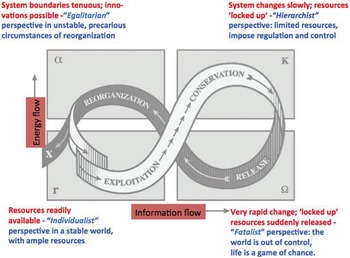
Much of the focus of the resilience community has been on studying the transitions that dynamic systems go through in their relationship with their environment. While not in the least arguing that history repeats itself, at the most abstract level they conceive of four major stages that the interaction between potential (= energy) and connectedness (= information) can drive any system through. By way of metaphor, they represent these phases as a lemniscate combining the four phases through which systems cycle, according to them. Because this metaphor is indeed a handy tool for thought (see Figure 5.1), I would like to discuss it briefly here, even though I am fully aware such metaphors are oversimplifications.
Schematic illustration of the resilience cycle. The red text describes the state of the ecological component of the system (after Holling Reference Holling1973, Reference Holling, Jantsch and Waddington1976, Reference Holling, Clark and Munn1986); the blue text describes the dominant perspective of the society (after Thompson et al. Reference Thompson, Ellis and Wildavsky1990). The interpretation in terms of energy and information flows is mine.

The first of the phases distinguished, exploitation, is the one in which a community grows based on a particular form of organization that permits an increase in energy flow in exchange for an increasingly coherent institutional organization, which increases its impact on the environment over time. As resources are overabundant, every individual has a chance to make something of his or her situation, and according to Thompson et al. (Reference Thompson, Ellis and Wildavsky1990), the culture is one of individualism. The phase of growth of the Roman Republic (until c. 200 BCE) and that of Europe between 1400 and 1800 are – to an extent – examples of this dynamic.
A crucial aspect of this phase is that the system suppresses structural innovation and institutional change because the dominant structure is (and later appears to be) so effective that there seems no reason to innovate. Because any institution is based on the exploitation of a limited set of resources, ultimately the growth curve involved levels off and the system’s effectiveness and growth decrease.
The next phase is that of conservation, in which the limits of expansion are appearing on the horizon and the community defends itself by becoming more regulated and hierarchical, as a consequence of the need to deal with increasing levels of conflict over resources (Thompson et al. Reference Thompson, Ellis and Wildavsky1990). Bottom-up power to achieve things is slowly but surely replaced by top-down power over people (see Foucault 1977) to control actions. We see this in Rome after c. AD 0, beginning in the political history of modern Europe after 1600, and coming to a head in around 1800. As the limits of the particular mode of organization become clearer, elements in the system may contemplate change. But generally, fundamental change is not implemented because the system as a whole is still aligned on the preexisting dynamics.
In the next phase, release, innovation is freed up once the system reaches a tipping point in which the potential for further growth of the existing structure collapses. The immediate result of that is a complete lack of institutional structure, a true chaos in which the system can transform in many different ways, but none of these profiles itself clearly enough to give a sense of direction. It is this phase that we have characterized as a crisis: the collapse of the existing structure results in the disaffection of people with that structure, and their inability to understand. This in turn leads, in Thompson et al.’s “cultural theory of risk” perspective (Reference Thompson, Ellis and Wildavsky1990), to a fatalist attitude. In effect, this is the kind of collapse that we see in Europe after the end of the Roman Empire, between 600 and 1000 CE. The fourth phase distinguished by the resilience community is that of reorganization – a phase of experiments with different forms of organization on a very local scale (Thompson et al. Reference Thompson, Ellis and Wildavsky1990). Once some of these succeed, one sees the slow but unstoppable growth of new forms of institutional organization bottom up, aligning more and more people. As the contours of the organization that will ultimately dominate are profiled, the institution itself will increase its potential, strengthen, and stabilize.
Particularly at the beginning of this part of the trajectory, people will seek local support, forming small and often egalitarian groups. With time, these will align with others, so that the structure can grow and form the basis for a new phase of exploitation – rooted in a different worldview and extracting a different set of resources from the environment.
Clearly, as presented here, this very schematic synthesis of such long-term evolutionary community transitions is insufficiently detailed to apply to any specific instance, but it accentuates the need to think over the very long term if one is to understand any present. One illustrative example of such an instantiation has been the work of the ARCHAEOMEDES team on the last couple of centuries of the history of the Epirus region in Greece (van der Leeuw 1998, Reference van der Leeuw, McIntosh and Tainter2000, Reference van der Leeuw2012, Reference van der Leeuw, Wilson and Kirman2016; van der Leeuw & Green Reference van der Leeuw, Green, Mazzoleni, Di Pasquale, Di Martino and Rego2004), but other instances abound, and have been studied worldwide (see www.resalliance.org/ and www.stockholmresilience.org/).1
We Need to Know the Healthy State of Our Planet
The second major problem with focusing on short-term dynamics is that looking back only one or two centuries limits our insights into the set of potential states of Earth’s socio-natural systems to those that have undergone major anthropogenic impacts, to the detriment of the system states that existed before any, or with little, human impact. It is as if a doctor were to look at a seriously ill patient without having any idea what a healthy person looks like. How could one then identify a sustainable future for the patient?
Over the last 300 years or so our planet has been thoroughly transformed by anthropogenic action, to the point that anyone living, for example, 2,000 years ago would not possibly recognize it in the present. Yet the state of the Earth system 2,000 years ago is a stage in the accumulation of initial conditions that have shaped the present. We need to know and understand such past dynamics between societies and their environments if we are to be able to fully appreciate what is going on today, because they enable us to widen our inquiry to a range of states of the Earth system that can no longer be observed today, and thereby change our perspective on the dynamics that have driven the changes involved.
For example, one would need to have a good idea of the state of socioecological interactions before the Industrial Revolution in order to be able to assess how the industrial paradigm that is currently dominant in the western world has changed agriculture by slowly, but surely, isolating the agricultural system from the wider ecology in which it was embedded, substituting artificial fertilizer and pesticides for the ecological processes that nourished crops and dealt with pests – in essence industrializing agriculture. And that process not only concerned what was happening on the ground, but also involved such things as mechanization and the emergence of modern marketing, transport, and other societal aspects of the system.
The Importance of Second-Order Change
Looking only at the short term ignores second order change in socioenvironmental systems – changes in the way change occurs and in the dynamics that drive it. This is a point that is of capital importance, yet is rarely discussed or taken into account. Over longer periods, the impact of drivers upon each other very often changes the process of change itself. Such second order change (the change of change) may concern a simple acceleration of certain dynamics or the emergence of one or more new feedback loops, but it may also be more consequential, for example when a conjunction of drivers tips a system’s dynamic into a different state altogether, as the crossing of several of our planetary boundaries threatens to do to the overall dynamics of the Earth system (Rockström et al. Reference Rockström, Steffen, Noone, Persson, Chapin, Lambin, Lenton, Scheffer, Folke, Schellnhuber, Nykvist, de Wit, Hughes, van der Leeuw, Rodhe, Sörlin, Snyder, Costanza, Svedin, Falkenmark, Karlberg, Corell, Fabry, Hansen, Liverman, Richardson, Crutzen and Foley2009b). An example from the sociocultural sphere, discussed in Chapter 3, is the way in which the Black Death of the fourteenth century initiated a transformation of the intellectual conception of the world in which people were living, leading to the “great wall of dualism” enabling and ultimately driving the overwhelming development of the natural and life sciences over the past six centuries (Evernden Reference Evernden1992).
Such second order changes are usually taking place over longer periods, and they can only be discerned by detailed study of the first-order dynamics over long time frames. That may be difficult, but this should not deter us from doing it. Understanding second order changes is fundamental to understanding the trajectories of societies and their environments, because such changes often reflect bifurcation points.
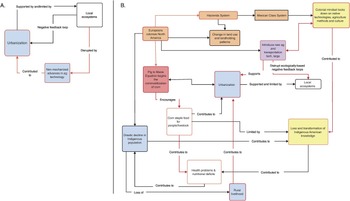
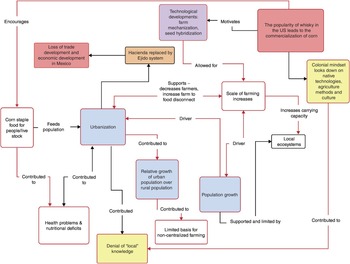
In an interesting study, Barton et al. (Reference Barton2015) have mapped the changes in the structure of the dynamics between corn production and urbanization in North America from the precolonial period (up to c. 1550), through the colonial (c. 1550–c. 1850) and the industrial period (c. 1850–c. 2000) to the present, with an extrapolation toward the future.
In that process, we see how the rapid growth of the urban population, especially in the USA, has both necessitated and been enabled by changes in the agricultural system, involving institutional, technological, legal, health, and ideational changes. What the study accentuates is how, through the whole period of almost five centuries, the feedback loops have evolved, mapping not only the dynamics within each of the three regimes, but also the second order changes between the regimes.
To explain these, and the path dependency that is the result, one has to go back to the precolonial period, in which the initial feedback loops between food production and urbanization were established. Only by doing that, and looking at the pressures and constraints at any particular stage, can one then understand the emergence of the next stage. Between the precolonial and the colonial stages, one aspect of the transition is, for example, the institution of the hacienda system, with concomitant changes leading to the commoditization of corn as a cash crop that is tradable in increasing volumes. It is part of a process in which. owing to a decrease in the indigenous population (and the know-how that it had), Spanish technology takes over, the indigenous population is looked down upon, and its health suffers.
In the next stage, driven by industrialization in North America, the ejido system replaces the haciendas; the scale of farming is drastically increased, in part enabled by increasing mechanization; local knowledge is ignored; corn becomes the universal staple, leading to more health problems but enabling the feeding of the increasing masses in the (mostly North American) cities, which entails in the end that many more people live in the cities than in the countryside that feeds them. International and long-distance trade (and the concomitant political and economic dependencies between nations) emerge and grow.
The relationship between food production and urbanization in precolonial Mexico. The red lines indicate feedback loops that are subsequently transformed.
Figure 5.2b The relationship between food production and urbanization in colonial North America (Mexico). The red lines indicate feedback loops that have emerged out of the precolonial situation and are subsequently transformed.

The relationship between food production and urbanization in Mexico under the impact of industrial North America. The red lines indicate feedback loops that have emerged out of the colonial situation and are subsequently transformed.

Essentially similar processes have of course been part and parcel of many instances of the emergence and collapse of complex societies, such as in China, Mesopotamia, Egypt, and Mesoamerica. The institutions and the relationships between them were different, but the underlying dynamics initially pushing such systems toward increasing complexity and then tipping them into disaggregation are the same. In Chapter 10 I present yet another historical case of this kind of dynamic in much more detail. But similar second order dynamics are of course also relevant to the present, as the last section of this book will show.
The Accumulation of Unintended Consequences
Short-term approaches, even if they include a century or two, leave long-term unintended consequences of human actions in the dark. We will deal with the importance of such unintended consequences extensively in Chapters 16–18, but a brief description is essential at this point. These unintended consequences result from the fact that as human beings we have only a very partial perception of our environment, and therefore undertake actions based on a biased and limited knowledge of the effects of those actions. These actions affect many more aspects of our environment than we are aware of. Some of these unintended and unanticipated consequences only emerge much later. When Henry Ford, for example, invented the serial production of affordable automobiles, he was not aware of the environmental and social consequences of having over a billion of them drive around the globe, heavily contributing to atmospheric pollution with CO2, NO2 and other greenhouse gases, but also leading to the rise of “new” cities, such as Phoenix and Las Vegas in the western USA, that cannot function without cars and other motorized transportation. I am arguing throughout this book that a failure to look at the unintended consequences of societal decisions has been an important cause of crises in human history, and is a major cause of the crisis in which we find ourselves. Some such unintended consequences may emerge centuries or even millennia after the event or process that triggered them. Yet for a full understanding of the long-term dynamics of a system, it is essential that these consequences are taken into account. Limiting our investigations to a century or two will at best catch a subset of them.
Summary
Geology, archaeology, and history can now provide the data and information to develop a more coherent long-term perspective that enables us to overcome some of these four categories of limitations (e.g., Berger & van der Leeuw Reference Berger, van der Leeuw, Nuninger, Kohler and van der Leeuw2007). Although the information presented by those disciplines is often too fragmentary or partial to deal with small-scale changes, it is able to provide an insight in long-term transformations in sufficient detail to outline a crude look at the genesis of the present (van der Leeuw 1998, Reference van der Leeuw, Costanza, Graumlich and Steffen2007). Therefore, combining such a long-term skeletal perspective with a short-term and more detailed perspective, which can be derived from studies focusing on the recent past and the present, we are able to understand socioenvironmental dynamics more precisely, putting meat on the bones. We can then begin to map path dependencies and take more than two or three spatiotemporal scales into account, for example. And all this is necessary to holistically understand the challenges that we are facing today.

 Open access