





1 Introduction and the main result
Recent developments of optimal mass transport theory [Reference Ambrosio and Gigli1–Reference Ambrosio, Pratelli, Caffarelli and Salsa3, Reference Figalli and Glaudo9, Reference Villani16, Reference Villani17] serve as main motivation for studying the Wasserstein space; that is, the space of probability measures endowed with a metric generated by optimal mass transport. The structure of the isometry group of Wasserstein spaces has been studied for the first time in a groundbreaking paper by Kloeckner [Reference Kloeckner13] in the case when the underlying space is the Euclidean space $\mathbb {R}^n$
. This research has been followed up by Bertrand and Kloeckner [Reference Bertrand and Kloeckner6, Reference Bertrand and Kloeckner7], Gehér, Titkos, Virosztek [Reference Gy, Gehér and Titkos10, Reference Gy, Gehér and Titkos11], Santos-Rodriguez [Reference Santos-Rodríguez15]. These authors considered various underlying metric spaces with different properties. The general feature of these spaces was, that they were non-branching geodesic metric spaces. This non-branching property of the underlying space was inherited by the Wasserstein space as well [Reference Ambrosio and Gigli1, Reference Santos-Rodríguez15] and it was used in an essential way (e.g., in [Reference Santos-Rodríguez15]) to show that isometries of Wasserstein spaces preserve the class of Dirac masses.
$\mathbb {R}^n$
. This research has been followed up by Bertrand and Kloeckner [Reference Bertrand and Kloeckner6, Reference Bertrand and Kloeckner7], Gehér, Titkos, Virosztek [Reference Gy, Gehér and Titkos10, Reference Gy, Gehér and Titkos11], Santos-Rodriguez [Reference Santos-Rodríguez15]. These authors considered various underlying metric spaces with different properties. The general feature of these spaces was, that they were non-branching geodesic metric spaces. This non-branching property of the underlying space was inherited by the Wasserstein space as well [Reference Ambrosio and Gigli1, Reference Santos-Rodríguez15] and it was used in an essential way (e.g., in [Reference Santos-Rodríguez15]) to show that isometries of Wasserstein spaces preserve the class of Dirac masses.
In this article, we consider the situation of branching spaces, namely $\mathbb {R}^2$
and
$\mathbb {R}^2$
and ${Q=[-1,1]^2}$
endowed with the maximum metric. Since the above-mentioned technique does not work in our case, we shall use a different method in order to determine the structure of the isometry group of the Wasserstein space over these spaces.
${Q=[-1,1]^2}$
endowed with the maximum metric. Since the above-mentioned technique does not work in our case, we shall use a different method in order to determine the structure of the isometry group of the Wasserstein space over these spaces.
Before defining the necessary notions and introducing the notation we will use throughout this article, we highlight a very recent result of Che, Galaz-García, Kerin, and Santos-Rodríguez [Reference Che, Galaz-García, Kerin and Santos-Rodríguez8] which provided interesting examples of non-rigid Wasserstein spaces over certain classes of normed spaces.
To state our main result, we start by introducing some notation. Let $X\subseteq \mathbb {R}^2$
be a closed subset equipped with the maximum metric
$X\subseteq \mathbb {R}^2$
be a closed subset equipped with the maximum metric $d_{\mathrm {{m}}}:X\times X\to [0,\infty )$
 $$ \begin{align*}d_{\mathrm{{m}}}\big((x_1, x_2), (y_1,y_2)\big)=\max\big\{|x_1-y_1|,|x_2-y_2|\big\},\end{align*} $$
which is a complete and separable metric space. For $p\geq 1$
we consider the p-Wasserstein space
$p\geq 1$
we consider the p-Wasserstein space $\big (\mathcal {P}_p(X,d_{\mathrm {{m}}}),d_{W_p}\big )$
, where
$\big (\mathcal {P}_p(X,d_{\mathrm {{m}}}),d_{W_p}\big )$
, where $X \subseteq \mathbb {R}^2$
is a closed subset and
$X \subseteq \mathbb {R}^2$
is a closed subset and $\mathcal {P}_p(X,d_{\mathrm {{m}}})$
is the space of Borel probability measures
$\mathcal {P}_p(X,d_{\mathrm {{m}}})$
is the space of Borel probability measures $\mu $
supported on
$\mu $
supported on $X \subseteq \mathbb {R}^2$
with finite pth moments:
$X \subseteq \mathbb {R}^2$
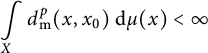
with finite pth moments:
 $$ \begin{align*}\int\limits_{X} d_{\mathrm{{m}}}^p(x, x_0) ~\mathrm{d}\mu(x) < \infty\end{align*} $$
for some (and thus for all) $x_0 \in \mathbb {R}^2$
. This set is endowed with the Wasserstein metric coming from optimal mass transport, i.e.,
$x_0 \in \mathbb {R}^2$
. This set is endowed with the Wasserstein metric coming from optimal mass transport, i.e.,
 $$ \begin{align*}d_{W_p}(\mu, \nu)=\min_{\pi\in C(\mu,\nu)}\left(\iint\limits_{X\times X} d_{\mathrm{{m}}}^p(x,y) ~\mathrm{d}\pi(x,y)\right)^{\frac{1}{p}},\end{align*} $$
where $C(\mu , \nu )$
is in the set of couplings between
$C(\mu , \nu )$
is in the set of couplings between $\mu $
and
$\mu $
and $\nu $
. That is,
$\nu $
. That is, $\pi \in \mathcal {P}(X\times X)$
and its marginals are equal to
$\pi \in \mathcal {P}(X\times X)$
and its marginals are equal to $\mu $
and
$\mu $
and $\nu $
:
$\nu $
: $\pi (A\times X) = \mu (A)$
, and
$\pi (A\times X) = \mu (A)$
, and $\pi (X\times A) = \nu (A)$
for any Borel set
$\pi (X\times A) = \nu (A)$
for any Borel set $A\subseteq X$
. Recall that if
$A\subseteq X$
. Recall that if $0<p<1$
, then the definition of the p-Wasserstein distance is slightly different. In that case,
$0<p<1$
, then the definition of the p-Wasserstein distance is slightly different. In that case, $d_{W_p}(\mu , \nu )=\min _{\pi \in C(\mu ,\nu )}\iint \limits _{X\times X} d_{\mathrm {{m}}}^p(x,y) ~\mathrm {d}\pi (x,y)$
.
$d_{W_p}(\mu , \nu )=\min _{\pi \in C(\mu ,\nu )}\iint \limits _{X\times X} d_{\mathrm {{m}}}^p(x,y) ~\mathrm {d}\pi (x,y)$
.
For the sake of brevity, we will denote the Wasserstein space $\big (\mathcal {P}_p(X,d_{\mathrm {{m}}}),d_{W_p}\big )$
by
$\big (\mathcal {P}_p(X,d_{\mathrm {{m}}}),d_{W_p}\big )$
by $\mathcal {W}_p(X,d_{\mathrm {{m}}})$
.
$\mathcal {W}_p(X,d_{\mathrm {{m}}})$
.
The support of a measure $\mu $
will be denoted by
$\mu $
will be denoted by $\mathrm {supp}(\mu )$
. For some distinguished collection of lines
$\mathrm {supp}(\mu )$
. For some distinguished collection of lines $L\subset \mathbb {R}^2$
the set
$L\subset \mathbb {R}^2$
the set
 $$ \begin{align*}\mathcal{W}_p(L,d_{\mathrm{{m}}})=\{\mu\in \mathcal{W}_p(\mathbb{R}^2,d_{\mathrm{{m}}})\,|\, \mathrm{supp}(\mu)\subseteq L\}\end{align*} $$
will play an important role. Recall that a geodesic segment (or shortly: geodesic) is a curve $\gamma : [a,b] \to \mathcal {W}_p(X,d_{\mathrm {{m}}})$
such that
$\gamma : [a,b] \to \mathcal {W}_p(X,d_{\mathrm {{m}}})$
such that
 $$ \begin{align*}d_{W_p}(\gamma(t),\gamma(s)) = C|t-s|\end{align*} $$
for all $t,s \in \mathbb {R}$
. Note, that by reparametrizing the curve
$t,s \in \mathbb {R}$
. Note, that by reparametrizing the curve $\gamma $
we can always achieve that
$\gamma $
we can always achieve that $C=1$
. Geodesics with
$C=1$
. Geodesics with $C=1$
will be called unit-speed geodesics.
$C=1$
will be called unit-speed geodesics.
This article aims to connect isometries of the underlying space X, and the Wasserstein space $\mathcal {W}_p(X,d_{\mathrm {{m}}})$
. Recall that given a metric space
$\mathcal {W}_p(X,d_{\mathrm {{m}}})$
. Recall that given a metric space $(M,\varrho )$
a map
$(M,\varrho )$
a map ${f:M\to M}$
is called an isometry if it is bijective and distance preserving, i.e.,
${f:M\to M}$
is called an isometry if it is bijective and distance preserving, i.e., $\varrho (f(m), f(m'))=\varrho (m,m')$
for all
$\varrho (f(m), f(m'))=\varrho (m,m')$
for all $m,m'\in M$
.
$m,m'\in M$
.
Recall that any isometry of $(X, d_{\mathrm {{m}}})$
induces an isometry of
$(X, d_{\mathrm {{m}}})$
induces an isometry of $\mathcal {W}_p(X,d_{\mathrm {{m}}})$
by push-forward. Indeed, if
$\mathcal {W}_p(X,d_{\mathrm {{m}}})$
by push-forward. Indeed, if $T: X \to X$
is an isometry, then the map
$T: X \to X$
is an isometry, then the map $T_{\#}$
is an isometry of
$T_{\#}$
is an isometry of $\mathcal {W}_p(X,d_{\mathrm {{m}}})$
, where
$\mathcal {W}_p(X,d_{\mathrm {{m}}})$
, where $T_{\#} \mu $
stands for the push-forward measure of
$T_{\#} \mu $
stands for the push-forward measure of $\mu $
by T
$\mu $
by T
 $$ \begin{align*}T_{\#} \mu(A) = \mu(T^{-1}(A)\quad\mbox{for all Borel sets}\quad A \subseteq X.\end{align*} $$
In what follows, we shall call isometries of the type $T_{\#}$
trivial isometries. We call the Wasserstein space
$T_{\#}$
trivial isometries. We call the Wasserstein space $\mathcal {W}_p(X,d_{\mathrm {{m}}})$
isometrically rigid if all of its isometries are trivial.
$\mathcal {W}_p(X,d_{\mathrm {{m}}})$
isometrically rigid if all of its isometries are trivial.
Let us recall that by the results of Kloeckner [Reference Kloeckner13] the quadratic Wasserstein space $\mathcal {W}_2(\mathbb {R}^n,d_{\|\cdot \|_2})$
is not rigid as it has non-trivial shape-preserving isometries. Moreover, in the case
$\mathcal {W}_2(\mathbb {R}^n,d_{\|\cdot \|_2})$
is not rigid as it has non-trivial shape-preserving isometries. Moreover, in the case $n=1$
there is a flow of exotic (non-shape-preserving) isometries. Furthermore, the structure of the isometry group of Wasserstein spaces could depend both on the choice of X and the value of p. Indeed, the results of [Reference Gy, Gehér and Titkos10] show in the one-dimensional case
$n=1$
there is a flow of exotic (non-shape-preserving) isometries. Furthermore, the structure of the isometry group of Wasserstein spaces could depend both on the choice of X and the value of p. Indeed, the results of [Reference Gy, Gehér and Titkos10] show in the one-dimensional case $X=\mathbb {R}$
that the isometry group of
$X=\mathbb {R}$
that the isometry group of $\mathcal {W}_2(\mathbb {R},d_{|\cdot |})$
is much larger than the isometry group of
$\mathcal {W}_2(\mathbb {R},d_{|\cdot |})$
is much larger than the isometry group of $\mathcal {W}_p(\mathbb {R},d_{|\cdot |})$
for all
$\mathcal {W}_p(\mathbb {R},d_{|\cdot |})$
for all $p\neq 2$
, while if
$p\neq 2$
, while if $X=[0,1]$
, then the isometry group of
$X=[0,1]$
, then the isometry group of $\mathcal {W}_1([0,1],d_{|\cdot |})$
is richer than the isometry group of
$\mathcal {W}_1([0,1],d_{|\cdot |})$
is richer than the isometry group of $\mathcal {W}_p([0,1],d_{|\cdot |})$
for all
$\mathcal {W}_p([0,1],d_{|\cdot |})$
for all $p>1$
(see [Reference Gy, Gehér and Titkos10]). As it was already pointed out in [Reference Gy, Gehér and Titkos10], the same conclusion holds for every compact interval
$p>1$
(see [Reference Gy, Gehér and Titkos10]). As it was already pointed out in [Reference Gy, Gehér and Titkos10], the same conclusion holds for every compact interval $[a,b]$
. For our considerations, the relevant conclusion is that
$[a,b]$
. For our considerations, the relevant conclusion is that $\mathcal {W}_p([-1,1],|\cdot |)$
is rigid if and only if
$\mathcal {W}_p([-1,1],|\cdot |)$
is rigid if and only if $p\neq 1$
.
$p\neq 1$
.
In this article, we distinguish the cases $p=1$
and
$p=1$
and $p>1$
. We note that the case
$p>1$
. We note that the case $p<1$
has already been covered by the general result [Reference Gy, Gehér and Titkos11, Corollary 4.7] which says that the Wasserstein space
$p<1$
has already been covered by the general result [Reference Gy, Gehér and Titkos11, Corollary 4.7] which says that the Wasserstein space $\mathcal {W}_p(X,d)$
is isometrically rigid for every Polish underlying space
$\mathcal {W}_p(X,d)$
is isometrically rigid for every Polish underlying space $(X,d)$
and for every parameter
$(X,d)$
and for every parameter $p<1.$
Furthermore, the underlying space X will be either
$p<1.$
Furthermore, the underlying space X will be either $\mathbb {R}^2$
or the closed unit ball
$\mathbb {R}^2$
or the closed unit ball $Q= [-1,1]^2$
. Our main result shows, that in contrast to the above non-rigidity results in the one-dimensional case, (and also in the higher dimensional
$Q= [-1,1]^2$
. Our main result shows, that in contrast to the above non-rigidity results in the one-dimensional case, (and also in the higher dimensional $\mathbb {R}^n$
with the Euclidean metric) in our situation the Wasserstein spaces are isometrically rigid when the underlying space
$\mathbb {R}^n$
with the Euclidean metric) in our situation the Wasserstein spaces are isometrically rigid when the underlying space $\mathbb {R}^2$
or Q is considered with the maximum metric.
$\mathbb {R}^2$
or Q is considered with the maximum metric.
Theorem 1.1 Let $X= \mathbb {R}^2$
or
$X= \mathbb {R}^2$
or $X= Q= [-1,1]^2$
equipped with the maximum metric. Then for any
$X= Q= [-1,1]^2$
equipped with the maximum metric. Then for any $p\geq 1$
the Wasserstein space
$p\geq 1$
the Wasserstein space $\mathcal {W}_p(X,d_{\mathrm {{m}}})$
is isometrically rigid. That is, for any isometry
$\mathcal {W}_p(X,d_{\mathrm {{m}}})$
is isometrically rigid. That is, for any isometry $\Phi : \mathcal {W}_p(X,d_{\mathrm {{m}}}) \to \mathcal {W}_p(X,d_{\mathrm {{m}}})$
there exists a unique isometry
$\Phi : \mathcal {W}_p(X,d_{\mathrm {{m}}}) \to \mathcal {W}_p(X,d_{\mathrm {{m}}})$
there exists a unique isometry $T:(X,d_{\mathrm {{m}}})\to (X,d_{\mathrm {{m}}})$
such that
$T:(X,d_{\mathrm {{m}}})\to (X,d_{\mathrm {{m}}})$
such that
 $$ \begin{align*}\Phi (\mu) = T_{\#} \mu , \ \text{ for any } \ \mu \in \mathcal{W}_p(X,d_{\mathrm{{m}}}).\end{align*} $$
The proof will be a combination of Proposition 2.1 with Theorems 3.3, 3.6, 3.9, and 3.10.
Due to the difficulty caused by the branching nature of the underlying space, instead of Dirac masses, we shall consider measures supported on diagonal lines and prove that this class of measures is preserved by isometries. This seems to be a similar phenomenon to the one in the recent work of Balogh, Titkos, and Virosztek [Reference Balogh, Titkos and Virosztek5] about rigidity in the setting of the Heisenberg group. In that paper, the authors proved that measures supported on vertical lines in the Heisenberg group are preserved. In our setting vertical lines will be replaced by diagonals that are suitable to our geometry. In the sequel, we shall consider two special lines (briefly: diagonals)
 $$ \begin{align*}L_{+}=\{(t,t)\,|\, t\in \mathbb{R}\} \quad \text{and} \quad L_{-}=\{(t, -t)\,|\, t\in \mathbb{R}\},\end{align*} $$
and their translates:
 $$ \begin{align} L= L_{\varepsilon, a} =\left\{ (x_1, x_2) \in \mathbb{R}^2 \, \middle| \, x_2= \varepsilon x_1 +a \right\} \text{ for some } \varepsilon \in \{-1,1\} \text{ and } a \in \mathbb{R}. \end{align} $$
When we are working in $Q=[-1,1]^2$
, (with a slight abuse of notation) these symbols denote the line segment contained in Q.
$Q=[-1,1]^2$
, (with a slight abuse of notation) these symbols denote the line segment contained in Q.
The consideration of diagonal lines in our arguments is based on the observation that there is a unique geodesic (with respect to the maximum metric) connecting two points in the plane if and only if the two points are on the same diagonal $L_{\varepsilon , a}$
. We think that understanding rigidity in this special branching space will give us important clues to tackle the same question in general normed spaces.
$L_{\varepsilon , a}$
. We think that understanding rigidity in this special branching space will give us important clues to tackle the same question in general normed spaces.
Definition 1.1 Let X be either $\mathbb {R}^2$
or Q equipped by the maximum metric. We call the Wasserstein space
$\mathbb {R}^2$
or Q equipped by the maximum metric. We call the Wasserstein space $\mathcal {W}_p(X,d_{\mathrm {{m}}})$
diagonally rigid, if for every Wasserstein isometry
$\mathcal {W}_p(X,d_{\mathrm {{m}}})$
diagonally rigid, if for every Wasserstein isometry $\Phi :\mathcal {W}_p(X,d_{\mathrm {{m}}})\to \mathcal {W}_p(X,d_{\mathrm {{m}}})$
there exists an isometry
$\Phi :\mathcal {W}_p(X,d_{\mathrm {{m}}})\to \mathcal {W}_p(X,d_{\mathrm {{m}}})$
there exists an isometry $T:(X,d_{\mathrm {{m}}})\to (X,d_{\mathrm {{m}}})$
such that
$T:(X,d_{\mathrm {{m}}})\to (X,d_{\mathrm {{m}}})$
such that $\Phi (\mu )=T_\#(\mu )$
whenever the support of
$\Phi (\mu )=T_\#(\mu )$
whenever the support of $\mu $
is a subset of
$\mu $
is a subset of $L_+$
or
$L_+$
or $L_{-}$
.
$L_{-}$
.
Our aim in Section 2 is to prove that diagonal rigidity implies rigidity. This step is quite general in the sense that its proof works the same way for any $p\geq 1$
and
$p\geq 1$
and ${X\in \{\mathbb {R}^2,Q\}}$
. To prove that
${X\in \{\mathbb {R}^2,Q\}}$
. To prove that $\mathcal {W}_p(X,d_{\mathrm {{m}}})$
is indeed diagonally rigid is more tricky and uses very different arguments for different underlying spaces
$\mathcal {W}_p(X,d_{\mathrm {{m}}})$
is indeed diagonally rigid is more tricky and uses very different arguments for different underlying spaces $X= \mathbb {R}^2$
and
$X= \mathbb {R}^2$
and $X= [-1,1]^2$
and for different values of p. These results are proven in Section 3.
$X= [-1,1]^2$
and for different values of p. These results are proven in Section 3.
2 Diagonal rigidity implies rigidity
The main result of this section is the following.
Proposition 2.1 Let $p\geq 1$
and
$p\geq 1$
and $X\in \{\mathbb {R}^2,Q\}$
. Assume that the space
$X\in \{\mathbb {R}^2,Q\}$
. Assume that the space $\mathcal {W}_p(X,d_{\mathrm {{m}}})$
is diagonally rigid. Then the
$\mathcal {W}_p(X,d_{\mathrm {{m}}})$
is diagonally rigid. Then the $\mathcal {W}_p(X,d_{\mathrm {{m}}})$
is rigid.
$\mathcal {W}_p(X,d_{\mathrm {{m}}})$
is rigid.
For the sake of brevity, we only prove the case $X=\mathbb {R}^2$
. The same argument works in the case
$X=\mathbb {R}^2$
. The same argument works in the case $X=Q$
, replacing lines by line segments contained in Q.
$X=Q$
, replacing lines by line segments contained in Q.
The proof of the statement will be a combination of lemmas. The first lemma is about the minimal distance projection onto lines.
Lemma 2.2 Let $L\subset \mathbb {R}^2$
be a line that is not parallel to the x-axis and the y-axis, and let
$L\subset \mathbb {R}^2$
be a line that is not parallel to the x-axis and the y-axis, and let $x\in \mathbb {R}^2$
. Then there exists unique
$x\in \mathbb {R}^2$
. Then there exists unique $\hat {x}\in L$
such that
$\hat {x}\in L$
such that $d_{\mathrm {{m}}}(x,\hat {x})\le d_{\mathrm {{m}}}(x,y)$
for all
$d_{\mathrm {{m}}}(x,\hat {x})\le d_{\mathrm {{m}}}(x,y)$
for all $y\in L$
.
$y\in L$
.
Proof If $x\in L$
, then we take
$x\in L$
, then we take $\hat {x}:=x$
and the claim is obvious. If
$\hat {x}:=x$
and the claim is obvious. If $x\not \in L$
, then
$x\not \in L$
, then $\hat {x}$
is the first point of contact of metric balls centered at x with L. Since metric balls are squares aligned with the x and y-axes, and by assumption L is not parallel to any of these axes,
$\hat {x}$
is the first point of contact of metric balls centered at x with L. Since metric balls are squares aligned with the x and y-axes, and by assumption L is not parallel to any of these axes, $\hat {x}$
is uniquely defined.
$\hat {x}$
is uniquely defined.
Denoting by $P_L(x)=\hat {x}$
, we obtain a well-defined projection map
$P_L(x)=\hat {x}$
, we obtain a well-defined projection map $P_L:\mathbb {R}^2\to L$
. Our second statement is about the projection of measures defined by the push forward under this projection map.
$P_L:\mathbb {R}^2\to L$
. Our second statement is about the projection of measures defined by the push forward under this projection map.
Lemma 2.3 Let $\mu \in \mathcal {W}_p(\mathbb {R}^2,d_{\mathrm {{m}}})$
. Then, the measure
$\mu \in \mathcal {W}_p(\mathbb {R}^2,d_{\mathrm {{m}}})$
. Then, the measure $\hat {\mu }={P_L}_{\#}(\mu )$
is the metric projection
$\hat {\mu }={P_L}_{\#}(\mu )$
is the metric projection $\mathcal {W}_p(\mathbb {R}^2,d_{\mathrm {{m}}}) \to \mathcal {W}_p(L,d_{\mathrm {{m}}})$
i.e., the unique measure in
$\mathcal {W}_p(\mathbb {R}^2,d_{\mathrm {{m}}}) \to \mathcal {W}_p(L,d_{\mathrm {{m}}})$
i.e., the unique measure in $\mathcal {W}_p(L,d_{\mathrm {{m}}})$
such that
$\mathcal {W}_p(L,d_{\mathrm {{m}}})$
such that
 $$ \begin{align*}d_{W_p}(\mu, \hat{\mu})\le d_{W_p}(\mu, \nu)\end{align*} $$
for all $\nu \in \mathcal {W}_p(L,d_{\mathrm {{m}}})$
.
$\nu \in \mathcal {W}_p(L,d_{\mathrm {{m}}})$
.
Proof To prove the inequality in the statement, let $\nu \in \mathcal {W}_p(L,d_{\mathrm {{m}}})$
be an arbitrary measure and
$\nu \in \mathcal {W}_p(L,d_{\mathrm {{m}}})$
be an arbitrary measure and $\pi $
be an optimal coupling between
$\pi $
be an optimal coupling between $\mu $
and
$\mu $
and $\nu $
. Then
$\nu $
. Then
 $$ \begin{align*}d_{W_p}^p(\mu, \nu)=\int\limits_{\mathbb{R}^2\times L}d_{\mathrm{{m}}}^p(x,y)~\mathrm{d}\pi(x,y).\end{align*} $$
Since $d_{\mathrm {{m}}}^p(x,y)\ge d_{\mathrm {{m}}}^p(x, P_L(x))$
for all
$d_{\mathrm {{m}}}^p(x,y)\ge d_{\mathrm {{m}}}^p(x, P_L(x))$
for all $x\in \mathbb {R}^2, y\in L$
and
$x\in \mathbb {R}^2, y\in L$
and $\mathrm {supp}(\pi )\subseteq \mathbb {R}^2\times L$
, we have that
$\mathrm {supp}(\pi )\subseteq \mathbb {R}^2\times L$
, we have that
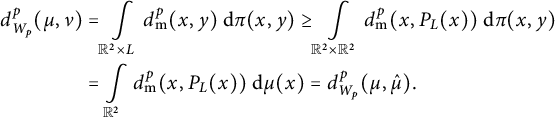 $$ \begin{align*} \begin{split} d_{W_p}^p(\mu, \nu)&=\int\limits_{\mathbb{R}^2\times L}d_{\mathrm{{m}}}^p(x,y)~\mathrm{d}\pi(x,y) \ge \int\limits_{\mathbb{R}^2\times \mathbb{R}^2}d_{\mathrm{{m}}}^p(x, P_L(x))~\mathrm{d}\pi(x, y)\\&=\int\limits_{\mathbb{R}^2}d_{\mathrm{{m}}}^p(x, P_L(x))~\mathrm{d}\mu(x)=d_{W_p}^p(\mu , \hat{\mu}). \end{split} \end{align*} $$
This shows that $\hat {\mu }$
is a minimizer for the problem
$\hat {\mu }$
is a minimizer for the problem $\inf \{d_{W_p}^p(\mu , \nu )\colon \nu \in \mathcal {W}_p(L,d_{\mathrm {{m}}})\}$
.
$\inf \{d_{W_p}^p(\mu , \nu )\colon \nu \in \mathcal {W}_p(L,d_{\mathrm {{m}}})\}$
.
To show that $\hat {\mu }$
is the unique minimizer, note that in the case equality we have that
$\hat {\mu }$
is the unique minimizer, note that in the case equality we have that $y= P_L(x)$
for
$y= P_L(x)$
for $\pi $
almost every
$\pi $
almost every $(x,y)$
showing that
$(x,y)$
showing that $\pi = (Id \times P_L)_{\#} \mu $
and thus
$\pi = (Id \times P_L)_{\#} \mu $
and thus $\nu = P_{L\#} \mu $
.
$\nu = P_{L\#} \mu $
.
The next lemma shows that the action of the isometry and the push-forward by projection commute.
Lemma 2.4 If $\Phi : \mathcal {W}_p(\mathbb {R}^2,d_{\mathrm {{m}}}) \to \mathcal {W}_p(\mathbb {R}^2,d_{\mathrm {{m}}})$
is an isometry such that
$\Phi : \mathcal {W}_p(\mathbb {R}^2,d_{\mathrm {{m}}}) \to \mathcal {W}_p(\mathbb {R}^2,d_{\mathrm {{m}}})$
is an isometry such that $\Phi (\mu )=\mu $
for all
$\Phi (\mu )=\mu $
for all $\mu \in \mathcal {W}_p(L_+,d_{\mathrm {{m}}})\cup \mathcal {W}_p(L_-,d_{\mathrm {{m}}})$
then we have the commutation relations
$\mu \in \mathcal {W}_p(L_+,d_{\mathrm {{m}}})\cup \mathcal {W}_p(L_-,d_{\mathrm {{m}}})$
then we have the commutation relations
 $$ \begin{align*}\Phi({P_{L_+}}_{\#}(\mu))={P_{L_+}}_{\#}(\Phi(\mu)) \qquad\text{ and }\qquad \Phi({P_{L_-}}_{\#}(\mu))={P_{L_-}}_{\#}(\Phi(\mu)) \end{align*} $$
for all $\mu \in \mathcal {W}_p(\mathbb {R}^2,d_{\mathrm {{m}}}).$
Proof The proof is based on the previous lemma, and we prove only the first commutation relation regarding $L_+$
as the case of
$L_+$
as the case of $L_-$
is very similar.
$L_-$
is very similar.
Let $\mu \in \mathcal {W}_p(\mathbb {R}^2,d_{\mathrm {{m}}})$
and
$\mu \in \mathcal {W}_p(\mathbb {R}^2,d_{\mathrm {{m}}})$
and $\hat {\mu }={P_{L_+}}_{\#}(\mu )$
. We have to show that
$\hat {\mu }={P_{L_+}}_{\#}(\mu )$
. We have to show that $\Phi (\hat {\mu })={P_{L_+}}_{\#}(\Phi (\mu ))$
. Since
$\Phi (\hat {\mu })={P_{L_+}}_{\#}(\Phi (\mu ))$
. Since $\hat \mu \in \mathcal {W}_p(L_+,d_{\mathrm {{m}}})$
, we note that
$\hat \mu \in \mathcal {W}_p(L_+,d_{\mathrm {{m}}})$
, we note that $\Phi (\hat \mu ) = \hat \mu $
by assumption. As
$\Phi (\hat \mu ) = \hat \mu $
by assumption. As $\Phi $
is an isometry,
$\Phi $
is an isometry,
 $$ \begin{align*}D:=d_{W_p}(\mu, \hat{\mu})=d_{W_p}(\Phi(\mu), \Phi(\hat{\mu}))=d_{W_p}(\Phi(\mu), \hat{\mu}) .\end{align*} $$
Let $\nu \in \mathcal {W}_p(L_+,d_{\mathrm {{m}}})$
. Thus
$\nu \in \mathcal {W}_p(L_+,d_{\mathrm {{m}}})$
. Thus $ \nu =\Phi ^{-1}(\nu )\in \mathcal {W}_p(L_+,d_{\mathrm {{m}}}),$
and therefore
$ \nu =\Phi ^{-1}(\nu )\in \mathcal {W}_p(L_+,d_{\mathrm {{m}}}),$
and therefore
 $$ \begin{align*}d_{W_p}(\Phi(\mu), \nu)=d_{W_p}(\mu, \Phi^{-1}(\nu)) =d_{W_p}(\mu, \nu) \ge D \ \ \text{ for all}\ \nu\in \mathcal{W}_p(L_+,d_{\mathrm{{m}}}). \end{align*} $$
Since $d_{W_p}(\Phi (\mu ), \Phi (\hat {\mu }))=D$
and
$d_{W_p}(\Phi (\mu ), \Phi (\hat {\mu }))=D$
and $\hat {\mu }=\Phi (\hat {\mu })\in \mathcal {W}_p(L_+,d_{\mathrm {{m}}})$
is the minimizer of the distance, from the uniqueness part of Lemma 2.3, we have
$\hat {\mu }=\Phi (\hat {\mu })\in \mathcal {W}_p(L_+,d_{\mathrm {{m}}})$
is the minimizer of the distance, from the uniqueness part of Lemma 2.3, we have $\hat {\mu }= \Phi (\hat {\mu })={P_{L_+}}_{\#}(\Phi (\mu ))$
as required.
$\hat {\mu }= \Phi (\hat {\mu })={P_{L_+}}_{\#}(\Phi (\mu ))$
as required.
After this preparation we can turn to the proof of Proposition 2.1. The proof is inspired by Bertrand and Kloeckner [Reference Bertrand and Kloeckner6] and it is based on the method of Radon transform. In our case, the Radon transform will be a mapping $\mathcal {R}: \mathcal {W}_p(\mathbb {R}^2,d_{\mathrm {{m}}})\to \mathcal {W}_p(L_+,d_{\mathrm {{m}}})\times \mathcal {W}_p(L_-,d_{\mathrm {{m}}})$
defined by
$\mathcal {R}: \mathcal {W}_p(\mathbb {R}^2,d_{\mathrm {{m}}})\to \mathcal {W}_p(L_+,d_{\mathrm {{m}}})\times \mathcal {W}_p(L_-,d_{\mathrm {{m}}})$
defined by
 $$ \begin{align} \mathcal{R}(\mu) :=\Big( {P_{L_{+}}}_{\#}(\mu), {P_{L_{-}}}_{\#}(\mu)\Big). \end{align} $$
Proof of Proposition 2.1
Without loss of generality, we can assume that $\Phi (\mu )=\mu $
for all
$\Phi (\mu )=\mu $
for all $\mu \in \mathcal {W}_p(L_{+},d_{\mathrm {{m}}})\cup \mathcal {W}_p(L_{-},d_{\mathrm {{m}}})$
. Now we want to extend this property to the whole
$\mu \in \mathcal {W}_p(L_{+},d_{\mathrm {{m}}})\cup \mathcal {W}_p(L_{-},d_{\mathrm {{m}}})$
. Now we want to extend this property to the whole $\mathcal {W}_p(\mathbb {R}^2,d_{\mathrm {{m}}})$
. The main idea is to consider a subset
$\mathcal {W}_p(\mathbb {R}^2,d_{\mathrm {{m}}})$
. The main idea is to consider a subset $\mathcal {F}\subset \mathcal {W}_p(\mathbb {R}^2,d_{\mathrm {{m}}})$
such that
$\mathcal {F}\subset \mathcal {W}_p(\mathbb {R}^2,d_{\mathrm {{m}}})$
such that
-
• $\mathcal {F}$
is dense in
$\mathcal {W}_p(\mathbb {R}^2,d_{\mathrm {{m}}})$
,
$\mathcal {F}$
is dense in
$\mathcal {W}_p(\mathbb {R}^2,d_{\mathrm {{m}}})$
, -
• for any
$\mu _1, \mu _2\in \mathcal {F}$
the following holds:
$$ \begin{align*}{P_{L_{+}}}_{\#}(\mu_1)={P_{L_{+}}}_{\#}(\mu_2)\quad\mbox{and}\quad {P_{L_{-}}}_{\#}(\mu_1)={P_{L_{-}}}_{\#}(\mu_2) \qquad\Longrightarrow\qquad \mu_1=\mu_2,\end{align*} $$
-
•
$\Phi (\mathcal {F}) \subseteq \mathcal {F}$
.


The second condition is the injectivity of the Radon transform on the set $\mathcal {F}$
. Suppose that we have such an
$\mathcal {F}$
. Suppose that we have such an $\mathcal {F}$
. Then, applying Lemma 2.4 we get that for any
$\mathcal {F}$
. Then, applying Lemma 2.4 we get that for any $\mu \in \mathcal {F}$
 $$ \begin{align*}{P_{L_{+}}}_{\#}(\Phi(\mu))=\Phi({P_{L_{+}}}_{\#}(\mu))={P_{L_{+}}}_{\#}(\mu)\end{align*} $$
and
 $$ \begin{align*}{P_{L_{-}}}_{\#}(\Phi(\mu))=\Phi({P_{L_{-}}}_{\#}(\mu))={P_{L_{-}}}_{\#}(\mu).\end{align*} $$
By the third condition we have $\Phi (\mu ) \in \mathcal {F}$
and so we can apply the second condition for the two measures
$\Phi (\mu ) \in \mathcal {F}$
and so we can apply the second condition for the two measures $\mu _1 = \mu $
and
$\mu _1 = \mu $
and $\mu _2 = \Phi (\mu )$
. This implies that
$\mu _2 = \Phi (\mu )$
. This implies that $\Phi (\mu )=\mu $
for all
$\Phi (\mu )=\mu $
for all $\mu \in \mathcal {F}$
. Using the density of
$\mu \in \mathcal {F}$
. Using the density of $\mathcal {F}$
in
$\mathcal {F}$
in $\mathcal {W}_p(\mathbb {R}^2,d_{\mathrm {{m}}})$
(the first condition) we get that
$\mathcal {W}_p(\mathbb {R}^2,d_{\mathrm {{m}}})$
(the first condition) we get that $\Phi (\mu )=\mu $
for all
$\Phi (\mu )=\mu $
for all $\mu \in \mathcal {W}_p(\mathbb {R}^2,d_{\mathrm {{m}}})$
.
$\mu \in \mathcal {W}_p(\mathbb {R}^2,d_{\mathrm {{m}}})$
.
Therefore it is enough to find a set $\mathcal {F}$
that satisfies the conditions above. We define
$\mathcal {F}$
that satisfies the conditions above. We define $\mathcal {F}$
by the following:
$\mathcal {F}$
by the following:
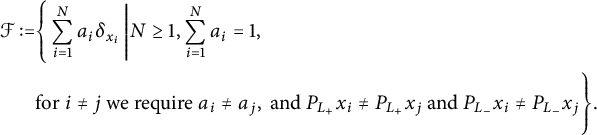 $$ \begin{align*} \mathcal{F}:=&\Bigg\{\sum_{i=1}^N a_i\delta_{x_i}\,\Bigg| N\ge 1, \sum_{i=1}^Na_i = 1, \\ & \textrm{for} \ i\ne j \ \textrm{we require} \ a_i\ne a_j, \ \textrm{and} \ P_{L_+} x_i\ne P_{L_+} x_j \textrm{ and } P_{L_-} x_i\ne P_{L_-} x_j \Bigg\}. \end{align*} $$
Let us check the required conditions for this choice of $\mathcal {F}$
. For the first condition we use the fact that the set of finitely supported measures is dense in
$\mathcal {F}$
. For the first condition we use the fact that the set of finitely supported measures is dense in $\mathcal {W}_p(\mathbb {R}^2,d_{\mathrm {{m}}})$
. Since a finitely supported measure can be clearly approximated in
$\mathcal {W}_p(\mathbb {R}^2,d_{\mathrm {{m}}})$
. Since a finitely supported measure can be clearly approximated in $\mathcal {W}_p(\mathbb {R}^2,d_{\mathrm {{m}}})$
by elements of
$\mathcal {W}_p(\mathbb {R}^2,d_{\mathrm {{m}}})$
by elements of $\mathcal {F}$
, the first property follows.
$\mathcal {F}$
, the first property follows.
In order to show the second property, let $\mu _1, \mu _2 \in \mathcal {F}$
such that
$\mu _1, \mu _2 \in \mathcal {F}$
such that $P_{L_{+}}{}_{\#}(\mu _1) = P_{L_{+}}{}_{\#}(\mu _2)$
and
$P_{L_{+}}{}_{\#}(\mu _1) = P_{L_{+}}{}_{\#}(\mu _2)$
and $P_{L_{-}}{}_{\#}(\mu _1) = P_{L_{-}}{}_{\#}(\mu _2)$
. We have to conclude that
$P_{L_{-}}{}_{\#}(\mu _1) = P_{L_{-}}{}_{\#}(\mu _2)$
. We have to conclude that $\mu _1= \mu _2$
.
$\mu _1= \mu _2$
.
To check this, let us assume that
 $$ \begin{align*}\mu_1 = \sum_{i=1}^{N_1} a_i^{(1)} \delta_{x_i^{(1)}}, \ \textrm{and} \ \mu_2 = \sum_{i=1}^{N_2} a_i^{(2)} \delta_{x_i^{(2)}}.\end{align*} $$
By the condition that $P_{L_{+}}{}_{\#}(\mu _1) = P_{L_{+}}{}_{\#}(\mu _2)$
and
$P_{L_{+}}{}_{\#}(\mu _1) = P_{L_{+}}{}_{\#}(\mu _2)$
and $P_{L_{-}}{}_{\#}(\mu _1) = P_{L_{-}}{}_{\#}(\mu _2)$
, we obtain the equations
$P_{L_{-}}{}_{\#}(\mu _1) = P_{L_{-}}{}_{\#}(\mu _2)$
, we obtain the equations
 $$ \begin{align*}\sum_{i=1}^{N_1} a_i^{(1)} \delta_{P_{L_{+}}(x_i^{(1)})} = \sum_{i=1}^{N_2} a_i^{(2)} \delta_{P_{L_{+}}(x_i^{(2)})}\end{align*} $$
and
 $$ \begin{align*}\sum_{i=1}^{N_1} a_i^{(1)} \delta_{P_{L_{-}}(x_i^{(1)})} = \sum_{i=1}^{N_2} a_i^{(2)} \delta_{P_{L_{-}}(x_i^{(2)})}.\end{align*} $$
From here we conclude, that $N_1=N_2= N$
,
$N_1=N_2= N$
, $a_i^{(1)}=a_i^{(2)}$
and
$a_i^{(1)}=a_i^{(2)}$
and $x_i^{(1)}= x_i^{(2)}$
for
$x_i^{(1)}= x_i^{(2)}$
for $i= 1,\ldots , N$
which gives that
$i= 1,\ldots , N$
which gives that $\mu _1=\mu _2$
.
$\mu _1=\mu _2$
.
To verify the third property, i.e., that $\Phi (\mathcal {F})\subseteq \mathcal {F}$
, let us take an element
$\Phi (\mathcal {F})\subseteq \mathcal {F}$
, let us take an element ${\mu =\sum _{i=1}^N a_i \delta _{x_i} \in \mathcal {F}}$
. Recalling that
${\mu =\sum _{i=1}^N a_i \delta _{x_i} \in \mathcal {F}}$
. Recalling that $\Phi $
fixes all measures supported on the diagonals
$\Phi $
fixes all measures supported on the diagonals $L_+$
and
$L_+$
and $L_-$
, we get by Lemma 2.4 that
$L_-$
, we get by Lemma 2.4 that
 $$ \begin{align*}{P_L}_{\#}(\mu)=\Phi({P_L}_{\#}(\mu))={P_L}_{\#}(\Phi(\mu))\end{align*} $$
for $L\in \{L_+,L_{-}\}$
, and therefore we have
$L\in \{L_+,L_{-}\}$
, and therefore we have
 $$ \begin{align*}{P_{L_+}}_{\#}(\Phi(\mu))= {P_{L_+}}_{\#}(\mu) = \sum_{i=1}^N a_i \delta_{P_{L_+}(x_i)} ,\end{align*} $$
where $P_{L_+}(x_i) \in L_+$
and
$P_{L_+}(x_i) \in L_+$
and
 $$ \begin{align*}{P_{L_-}}_{\#}(\Phi(\mu))= {P_{L_-}}_{\#}(\mu) = \sum_{i=1}^N a_i \delta_{P_{L_-}(x_i)} ,\end{align*} $$
where $P_{L_-}(x_i)\in L_{-}$
. In conclusion, we obtain that the Radon transform of
$P_{L_-}(x_i)\in L_{-}$
. In conclusion, we obtain that the Radon transform of $\mu $
and
$\mu $
and $\Phi (\mu )$
are equal
$\Phi (\mu )$
are equal
 $$ \begin{align*} \mathcal{R} :=\mathcal{R}(\mu)=\mathcal{R}(\Phi(\mu))= \left( \sum_{i=1}^N a_i \delta_{P_{L_+}(x_i)}, \sum_{i=1}^N a_i \delta_{P_{L_-}(x_i)} \right). \end{align*} $$
Now observe that $\Phi (\mu )$
is a finitely supported measure with support contained in the intersection of the two pre-images:
$\Phi (\mu )$
is a finitely supported measure with support contained in the intersection of the two pre-images:
 $$ \begin{align*}(P_{L_+})^{-1}( \{ P_{L_+}(x_1), \ldots, P_{L_+}(x_N) \} ) \cap (P_{L_-})^{-1}( \{ P_{L_-}(x_1), \ldots, P_{L_-}(x_N) \} ).\end{align*} $$
This intersection is an N-by-N grid, and we refer to its points by $z_{i,j} (1\le i,j\le N)$
, where
$z_{i,j} (1\le i,j\le N)$
, where $z_{i,j}$
satisfies that
$z_{i,j}$
satisfies that $P_{L_+}(z_{i,j})=P_{L_+}(x_i)$
and
$P_{L_+}(z_{i,j})=P_{L_+}(x_i)$
and $P_{L_-}(z_{i,j})=P_{L_-}(x_j)$
. Hence
$P_{L_-}(z_{i,j})=P_{L_-}(x_j)$
. Hence $\Phi (\mu )$
can be written as
$\Phi (\mu )$
can be written as
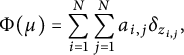 $$ \begin{align*}\Phi(\mu)=\sum_{i=1}^N\sum_{j=1}^N a_{i,j} \delta_{z_{i,j}},\end{align*} $$
where $a_{i,j}\ge 0$
,
$a_{i,j}\ge 0$
, $\sum _{i=1}^N\sum _{j=1}^N a_{i,j}=1$
and
$\sum _{i=1}^N\sum _{j=1}^N a_{i,j}=1$
and $\sum _{i=1}^N a_{i,j}=a_j$
and
$\sum _{i=1}^N a_{i,j}=a_j$
and $\sum _{j=1}^N a_{i,j}=a_i$
. Since the grid is finite, there is a positive minimal distance between its points
$\sum _{j=1}^N a_{i,j}=a_i$
. Since the grid is finite, there is a positive minimal distance between its points
 $$ \begin{align*} c := \min_{(i,j)\ne(i',j')}d_m(z_{i,j},z_{i',j'})>0. \end{align*} $$
From here, we assume by contradiction that $\Phi (\mu )\notin \mathcal {F}$
. Since
$\Phi (\mu )\notin \mathcal {F}$
. Since $\Phi (\mu )\notin \mathcal {F}$
, then there exist at least two points
$\Phi (\mu )\notin \mathcal {F}$
, then there exist at least two points $z,z'\in \mathrm {supp}(\Phi (\mu ))$
such that their projection onto either
$z,z'\in \mathrm {supp}(\Phi (\mu ))$
such that their projection onto either $L_+$
or
$L_+$
or $L_-$
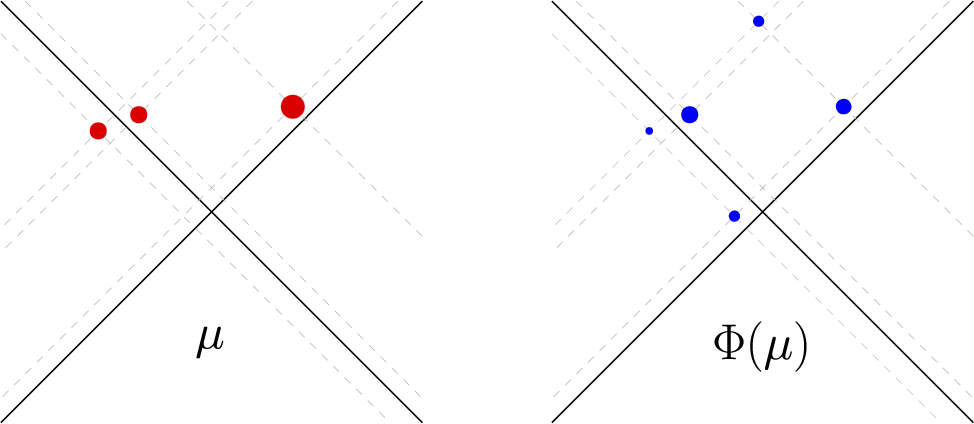
coincide (Figure 1) .
$L_-$
coincide (Figure 1) .
Illustration of a finitely supported measure $\mu $
with a possible image
$\mu $
with a possible image $\Phi (\mu )$
and the grid determined by the pre-images of
$\Phi (\mu )$
and the grid determined by the pre-images of $P_{L_+}$
and
$P_{L_+}$
and $P_{L_-}$
.
$P_{L_-}$
.
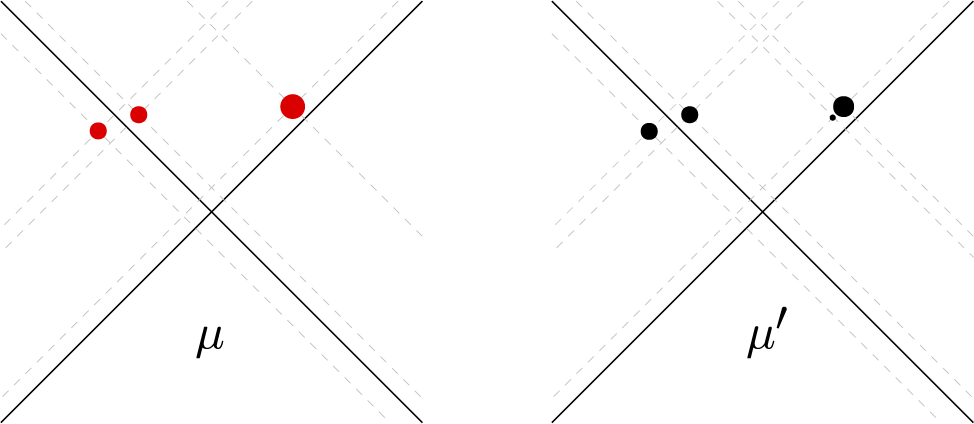
We briefly sketch how to obtain the desired contradiction and we give the details later.
First, by slightly perturbing the measure $\mu $
we will construct a measure
$\mu $
we will construct a measure $\mu '$
(Figure 2) such that
$\mu '$
(Figure 2) such that
 $$ \begin{align} \arg\min\big\{d_{W_p}(\mu,\xi)\,\big|\,\xi\in\mathcal{W}_p(\mathbb{R}^2,d_{\mathrm{{m}}}), \mathcal{R}(\xi)=\mathcal{R}(\mu')\big\}=\{\mu'\}. \end{align} $$
Illustration of $\mu '$
, the measure that we obtain by a sufficiently small perturbation of
$\mu '$
, the measure that we obtain by a sufficiently small perturbation of $\mu $
.
$\mu $
.
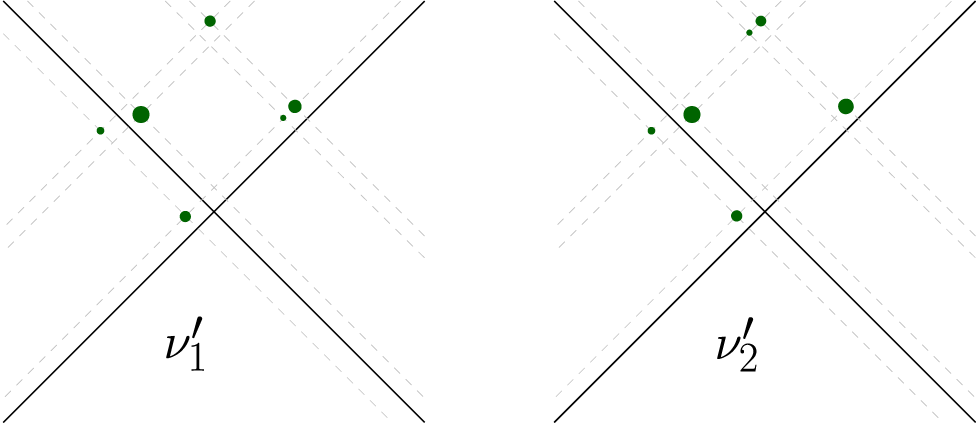
Next, using the existence of z and $z'$
as above; by small perturbations of
$z'$
as above; by small perturbations of $\Phi (\mu )$
we will construct two measures
$\Phi (\mu )$
we will construct two measures $\nu _1'$
and
$\nu _1'$
and $\nu _2'$
(Figure 3) such that
$\nu _2'$
(Figure 3) such that $\mathcal {R}(\nu _1')=\mathcal {R}(\nu _2')= \mathcal {R}(\mu ')$
and
$\mathcal {R}(\nu _1')=\mathcal {R}(\nu _2')= \mathcal {R}(\mu ')$
and
 $$ \begin{align} \arg\min\big\{d_{W_p}(\Phi(\mu),\xi)\,\big|\,\xi\in\mathcal{W}_p(\mathbb{R}^2,d_{\mathrm{{m}}}), \mathcal{R}(\xi)=\mathcal{R}(\mu')\big\} \supseteq \{\nu_1', \nu_2'\}. \end{align} $$
Illustration for $\nu _1'$
and
$\nu _1'$
and $\nu _2'$
- the two measures that we obtained by sufficiently small perturbations of
$\nu _2'$
- the two measures that we obtained by sufficiently small perturbations of $\Phi (\mu )$
.
$\Phi (\mu )$
.
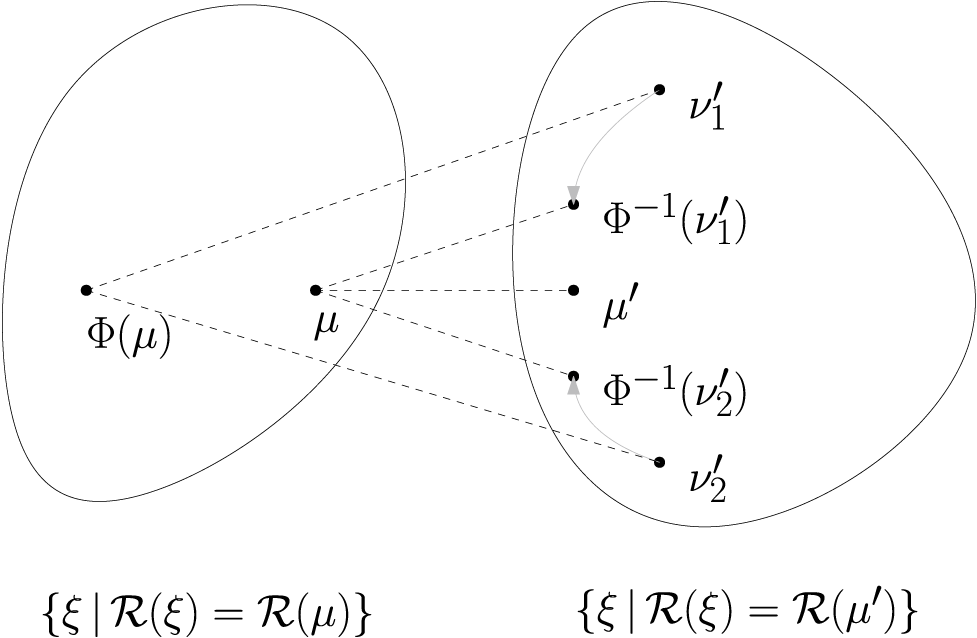
Finally, $d_{W_p}(\mu ,\Phi ^{-1}(\nu _1'))=d_{W_p}(\mu ,\mu ')=d_{W_p}(\mu ,\Phi ^{-1}(\nu _2'))$
contradicts the fact that
$d_{W_p}(\mu ,\Phi ^{-1}(\nu _1'))=d_{W_p}(\mu ,\mu ')=d_{W_p}(\mu ,\Phi ^{-1}(\nu _2'))$
contradicts the fact that $\mu '$
is the unique minimizer (Figure 4). This contradiction guarantees that
$\mu '$
is the unique minimizer (Figure 4). This contradiction guarantees that $\Phi (\mu )\in \mathcal {F}$
.
$\Phi (\mu )\in \mathcal {F}$
.
Illustration of the final step leading to a contradiction. Dashed lines represent equal distances.
After this brief sketch of the proof, we turn to the details.
If $\Phi (\mu ) \not \in \mathcal {F}$
, then there exist two points
$\Phi (\mu ) \not \in \mathcal {F}$
, then there exist two points $z, z' \in \mathrm {supp} (\Phi (\mu ))$
such that their projections onto either
$z, z' \in \mathrm {supp} (\Phi (\mu ))$
such that their projections onto either $L_+$
or
$L_+$
or $L_-$
coincide. Indeed, if there are no such points, then all points of the support of
$L_-$
coincide. Indeed, if there are no such points, then all points of the support of $\Phi (\mu )$
project to different points of
$\Phi (\mu )$
project to different points of $L_+$
and
$L_+$
and $L_-$
. Since
$L_-$
. Since
 $$ \begin{align*}{P_{L_-}}_{\#}(\Phi(\mu)) = \sum_{i=1}^N a_i \delta_{P_{L_-}(x_i)}, \ \ {P_{L_+}}_{\#}(\Phi(\mu)) = \sum_{i=1}^N a_i \delta_{P_{L_+}(x_i)}\end{align*} $$
and $a_i\ne a_j$
(
$a_i\ne a_j$
( $1\le i\ne j\le N$
), this implies that
$1\le i\ne j\le N$
), this implies that $\Phi (\mu )=\sum _{i=1}^N a_i \delta _{x_i}=\mu $
, which leads to a contradiction. Without loss of generality, we can assume that this common projection is
$\Phi (\mu )=\sum _{i=1}^N a_i \delta _{x_i}=\mu $
, which leads to a contradiction. Without loss of generality, we can assume that this common projection is $P_{L_+}(x_1)\in L_+$
, i.e.,
$P_{L_+}(x_1)\in L_+$
, i.e., $P_{L_+}(z)=P_{L_+}(z')=P_{L_+}(x_1)$
, and for some
$P_{L_+}(z)=P_{L_+}(z')=P_{L_+}(x_1)$
, and for some $1\le j_1\ne j_2\le N$
we have
$1\le j_1\ne j_2\le N$
we have $z=z_{1,j_1}, z'=z_{1,j_2}$
and
$z=z_{1,j_1}, z'=z_{1,j_2}$
and $a_{1,j_1}>0, a_{1,j_2}>0$
. Using this observation, we construct the measures
$a_{1,j_1}>0, a_{1,j_2}>0$
. Using this observation, we construct the measures $\mu ',\nu _1',\nu _2'$
as follows. We take a point
$\mu ',\nu _1',\nu _2'$
as follows. We take a point $x'\in L_+$
such that
$x'\in L_+$
such that $c_0:=d_m(P_{L_+}(x_1),x')<c/2$
. Let us denote the elements of
$c_0:=d_m(P_{L_+}(x_1),x')<c/2$
. Let us denote the elements of
 $$ \begin{align*}\Big((P_{L_+})^{-1}( \{ P_{L_+}(x') \} )\Big) \cap \Big((P_{L_-})^{-1}( \{ P_{L_-}(x_1), \ldots, P_{L_-}(x_N) \} )\Big)\end{align*} $$
by $z_{0,j}$
(
$z_{0,j}$
( $1\le j\le N$
) so that
$1\le j\le N$
) so that $P_{L_+}(z_{0,j})=x'$
and
$P_{L_+}(z_{0,j})=x'$
and $P_{L_-}(z_{0,j})=P_{L_-}(x_j)$
. We will also use the notation
$P_{L_-}(z_{0,j})=P_{L_-}(x_j)$
. We will also use the notation $x_0=z_{0,1}$
. For every
$x_0=z_{0,1}$
. For every $0\le i'\le N,1\le j,j'\le N$
 $$ \begin{align*}d_m(z_{0,j},z_{1,j})< d_m(z_{i',j'},z_{1,j})\end{align*} $$
if $(i',j')\notin \{ (0,j),(1,j)\}$
. To see this, observe that by construction,
$(i',j')\notin \{ (0,j),(1,j)\}$
. To see this, observe that by construction, ${d_m(z_{0,j},z_{1,j})= c_0}$
. If
${d_m(z_{0,j},z_{1,j})= c_0}$
. If $i'\ne 0$
and
$i'\ne 0$
and $(i',j')\neq (1,j)$
, then we have
$(i',j')\neq (1,j)$
, then we have $d_m(z_{i',j'},z_{1,j})>c$
by definition. If
$d_m(z_{i',j'},z_{1,j})>c$
by definition. If ${i'=0}$
and
${i'=0}$
and $j'\ne j$
, then using the reverse triangle inequality, we have
$j'\ne j$
, then using the reverse triangle inequality, we have $d_m(z_{0,j'}, z_{1,j})\ge d_m(z_{1,j'},z_{1,j})-d_m(z_{0,j'}, z_{1,j'})\ge c- c_0> c_0.$
Let us fix a weight a satisfying
$d_m(z_{0,j'}, z_{1,j})\ge d_m(z_{1,j'},z_{1,j})-d_m(z_{0,j'}, z_{1,j'})\ge c- c_0> c_0.$
Let us fix a weight a satisfying $0<a< \min \{a_{1,j_1}, a_{1,j_2}\} <a_1$
. Now, we consider the following measures
$0<a< \min \{a_{1,j_1}, a_{1,j_2}\} <a_1$
. Now, we consider the following measures
 $$ \begin{align*} \mu'= a\delta_{x_0}+(a_1-a)\delta_{x_1}+\sum_{i=2}^N a_i \delta_{x_i}, \end{align*} $$
 $$ \begin{align*} \nu_1'= a\delta_{z_{0,j_1}}+(a_{1,j_1}-a)\delta_{z_{1,j_1}}+a_{1,j_2}\delta_{z_{1,j_2}}+\sum_{j=1, j\ne j_1,j_2}^N a_{1,j}\delta_{z_{1,j}}+\sum_{i=2}^{N}\sum_{j=1}^N a_{i,j} \delta_{z_{i,j}}, \end{align*} $$
 $$ \begin{align*} \nu_2'= a\delta_{z_{0,j_2}}+a_{1,j_1}\delta_{z_{1,j_1}}+(a_{1,j_2}-a)\delta_{z_{1,j_2}}+\sum_{j=1, j\ne j_1,j_2}^N a_{1,j}\delta_{z_{1,j}}+\sum_{i=2}^{N}\sum_{j=1}^N a_{i,j} \delta_{z_{i,j}}. \end{align*} $$
Obviously, $\mu ', \nu _1'$
, and
$\mu ', \nu _1'$
, and $\nu _2'$
are probability measures satisfying
$\nu _2'$
are probability measures satisfying $\mathcal {R}(\mu ')=\mathcal {R}(\nu _1')=\mathcal {R}(\nu _2')=:\mathcal {R'}$
, namely
$\mathcal {R}(\mu ')=\mathcal {R}(\nu _1')=\mathcal {R}(\nu _2')=:\mathcal {R'}$
, namely
 $$ \begin{align*}\mathcal{R'}=\left( a\delta_{x'}+(a_1-a)\delta_{P_{L_+}(x_1)} + \sum_{i=2}^N a_i \delta_{P_{L_+}(x_i)}, \sum_{i=1}^N a_i \delta_{P_{L_-}(x_i)}\right). \end{align*} $$
Our next step is to prove that:
 $$ \begin{align} d_{W_p}(\mu, \mu')=d_{W_p}(\Phi(\mu), \nu'_1)=d_{W_p}(\Phi(\mu),\nu'_2)=a^{\frac{1}{p}} c_0, \end{align} $$
moreover, $\mu '$
satisfies the following uniqueness property:
$\mu '$
satisfies the following uniqueness property:
 $$ \begin{align} \text{if} \ d_{W_p}(\mu, \xi)=a^{\frac{1}{p}} c_0, \ \text{and} \ \mathcal{R}(\xi)=\mathcal{R}' \ \text{then} \ \xi=\mu'. \end{align} $$
Equations (2.4) and (2.5) together will justify relations (2.2) and (2.3).
In order to show (2.4) note that if $\xi _1,\xi _2$
are finitely supported probability measures with supports in a discrete set P, then
$\xi _1,\xi _2$
are finitely supported probability measures with supports in a discrete set P, then
 $$ \begin{align*}d_{W_p}(\xi_1,\xi_2)=\min_{\Pi\in C(\xi_1, \xi_2)}\bigg(\sum_{(u,v)\in P \times P}d_m^p(u,v)\cdot \Pi(u,v)\bigg)^{\frac{1}{p}}.\end{align*} $$
The proof of each of the equations in (2.4) is similar, therefore we will only prove the equality $d_{W_p}(\mu , \mu ')=a^{\frac {1}{p}} c_0$
. Notice first, that since every transport plan must move a total weight of at least a to
$d_{W_p}(\mu , \mu ')=a^{\frac {1}{p}} c_0$
. Notice first, that since every transport plan must move a total weight of at least a to $x_1$
from the support points of
$x_1$
from the support points of $\mu '$
, we have that
$\mu '$
, we have that
 $$ \begin{align*}d_{W_p}(\mu,\mu')\ge \bigg( \sum_{i=0}^N d_m^p(x_i,x_1)\Pi(x_i, x_1)\bigg)^{\frac{1}{p}}\ge (d_m^p(x_0,x_1)a)^{\frac{1}{p}}=a^{\frac{1}{p}} c_0,\end{align*} $$
since $d_m^p(x_i,x_1)\ge d_m^p(x_0,x_1)$
and
$d_m^p(x_i,x_1)\ge d_m^p(x_0,x_1)$
and $\sum _{i=0}^N \Pi (x_i,x_1)\ge a$
. On the other hand, if we move weight a directly from
$\sum _{i=0}^N \Pi (x_i,x_1)\ge a$
. On the other hand, if we move weight a directly from $x_0$
to
$x_0$
to $x_1$
, we exactly get that the cost of this transport plan is
$x_1$
, we exactly get that the cost of this transport plan is $a^{\frac {1}{p}} c_0$
. Now we turn to the proof of (2.5). Let us suppose that we have a probability measure
$a^{\frac {1}{p}} c_0$
. Now we turn to the proof of (2.5). Let us suppose that we have a probability measure $\xi $
with
$\xi $
with $\mathcal {R}(\xi )=\mathcal {R}'$
. Then
$\mathcal {R}(\xi )=\mathcal {R}'$
. Then $\xi $
can be written in the form
$\xi $
can be written in the form
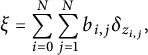 $$ \begin{align*}\xi=\sum_{i=0}^N\sum_{j=1}^N b_{i,j}\delta_{z_{i,j}},\end{align*} $$
such that
 $$ \begin{align*}\sum_{j=1}^N b_{0,j}=a,\ \ \sum_{j=1}^N b_{1,j}=a_1-a, \ \ \sum_{j=1}^N b_{i,j}=a_i \ (2\le i\le N),\ \ \sum_{i=0}^N b_{i,j}=a_j.\end{align*} $$
Again, every transport plan must move a total weight of at least a to $x_1$
from the support points of
$x_1$
from the support points of $\xi $
. Hence, we get that again
$\xi $
. Hence, we get that again
 $$ \begin{align} d_{W_p}(\xi, \mu)\ge \bigg( \sum_{i=0}^N\sum_{j=1}^N d_m^p(z_{i,j},x_1)\Pi(z_{i,j}, x_1)\bigg)^{\frac{1}{p}}\ge (d_m^p(x_0,x_1)a)^{\frac{1}{p}}=a^{\frac{1}{p}} c_0. \end{align} $$
Let us recall that $d_m(x_0,x_1)<d_m(z_{i,j},x_1)$
, if
$d_m(x_0,x_1)<d_m(z_{i,j},x_1)$
, if $(i,j)\notin \{(0,1),(1,1)\}$
. (Note that
$(i,j)\notin \{(0,1),(1,1)\}$
. (Note that ${z_{0,1}=x_0}$
,
${z_{0,1}=x_0}$
, $z_{1,1}=x_1$
). Therefore, equality holds in (2.6) if and only if all transport occurs between
$z_{1,1}=x_1$
). Therefore, equality holds in (2.6) if and only if all transport occurs between $x_0$
and
$x_0$
and $x_1$
with weight a. This implies that
$x_1$
with weight a. This implies that $\xi -a\delta _{x_0}=\mu -a\delta _{x_1}$
and hence
$\xi -a\delta _{x_0}=\mu -a\delta _{x_1}$
and hence $\xi =\mu '$
.
$\xi =\mu '$
.
In the last step, we show that the existence of $\nu _1'\neq \nu _2'$
implies that
$\nu _1'\neq \nu _2'$
implies that $\mu '$
is not a unique minimizer in relation (2.2). Indeed, since
$\mu '$
is not a unique minimizer in relation (2.2). Indeed, since $\Phi ^{-1}$
is an isometry preserving measures supported on
$\Phi ^{-1}$
is an isometry preserving measures supported on $L_+$
and
$L_+$
and $L_-$
we have by Lemma 2.4 that
$L_-$
we have by Lemma 2.4 that $\mathcal {R}(\Phi ^{-1}(\nu _1'))= \mathcal {R}(\Phi ^{-1}(\nu _2'))= \mathcal {R}'$
. Furthermore, according to (2.4), we have
$\mathcal {R}(\Phi ^{-1}(\nu _1'))= \mathcal {R}(\Phi ^{-1}(\nu _2'))= \mathcal {R}'$
. Furthermore, according to (2.4), we have
 $$ \begin{align*}d_{W_p} (\mu, \Phi^{-1}(\nu'_1))=d_{W_p} (\Phi(\mu), \nu'_1)=a^{\frac{1}{p}} c_0=d_{W_p}(\mu,\mu'),\end{align*} $$
and similarly,
 $$ \begin{align*}d_{W_p} (\mu, \Phi^{-1}(\nu'_2))=d_{W_p} (\Phi(\mu), \nu'_2)=a^{\frac{1}{p}} c_0=d_{W_p}(\mu,\mu').\end{align*} $$
Since $\Phi ^{-1}(\nu _1')\neq \Phi ^{-1}(\nu _2')$
, this is a contradiction.
$\Phi ^{-1}(\nu _1')\neq \Phi ^{-1}(\nu _2')$
, this is a contradiction.
3 Proof of the main result
According to Proposition 2.1, it is enough to show that the Wasserstein space $\mathcal {W}_p(X,d_{\mathrm {{m}}})$
is diagonally rigid. The proof of this fact is divided into four parts according to the choice of
$\mathcal {W}_p(X,d_{\mathrm {{m}}})$
is diagonally rigid. The proof of this fact is divided into four parts according to the choice of $X= \mathbb {R}^2$
or
$X= \mathbb {R}^2$
or $X= Q$
and
$X= Q$
and $p=1$
or
$p=1$
or $p>1$
.
$p>1$
.
3.1 Diagonal rigidity of
$\mathcal {W}_1(\mathbb {R}^2,d_{\mathrm {{m}}})$

In this subsection, we deal with the case $p=1$
and show that
$p=1$
and show that $\mathcal {W}_1(\mathbb {R}^2,d_{\mathrm {{m}}})$
is diagonally rigid. That is, we show that if
$\mathcal {W}_1(\mathbb {R}^2,d_{\mathrm {{m}}})$
is diagonally rigid. That is, we show that if $\Phi : \mathcal {W}_1(\mathbb {R}^2,d_{\mathrm {{m}}}) \to \mathcal {W}_1(\mathbb {R}^2,d_{\mathrm {{m}}})$
is an isometry, then
$\Phi : \mathcal {W}_1(\mathbb {R}^2,d_{\mathrm {{m}}}) \to \mathcal {W}_1(\mathbb {R}^2,d_{\mathrm {{m}}})$
is an isometry, then $\Phi (\mu )=\mu $
for all
$\Phi (\mu )=\mu $
for all $\mu \in \mathcal {W}_1(L_{+}) \cup \mathcal {W}_1(L_{-})$
—up to a trivial isometry induced by an isometry of the underlying space
$\mu \in \mathcal {W}_1(L_{+}) \cup \mathcal {W}_1(L_{-})$
—up to a trivial isometry induced by an isometry of the underlying space $\mathbb {R}^2.$
We recall the slightly more general notion than $L_+$
and
$L_+$
and $L_-$
of diagonal lines by calling
$L_-$
of diagonal lines by calling $L \subset \mathbb {R}^2$
a diagonal line if
$L \subset \mathbb {R}^2$
a diagonal line if
 $$ \begin{align} L= L_{\varepsilon, a} =\left\{ (x_1, x_2) \in \mathbb{R}^2 \, \middle| \, x_2= \varepsilon x_1 +a \right\} \text{ for some } \varepsilon \in \{-1,1\} \text{ and } a \in \mathbb{R}. \end{align} $$
Observe that these lines coincide with the set of images of $L_+$
by the isometry group of
$L_+$
by the isometry group of $(\mathbb {R}^2,d_m).$
The following proposition is a metric characterization of those elements of
$(\mathbb {R}^2,d_m).$
The following proposition is a metric characterization of those elements of $\mathcal {W}_1(\mathbb {R}^2,d_{\mathrm {{m}}})$
that are supported on a diagonal line. Let us note that this statement plays the same role as [Reference Gy, Gehér and Titkos11, Lemma 3.5], where Dirac masses were characterized in a similar way in Wasserstein spaces over a Hilbert space. In this sense, diagonally supported measures in our space have the same metric property as Dirac masses in the case of Hilbert spaces.
$\mathcal {W}_1(\mathbb {R}^2,d_{\mathrm {{m}}})$
that are supported on a diagonal line. Let us note that this statement plays the same role as [Reference Gy, Gehér and Titkos11, Lemma 3.5], where Dirac masses were characterized in a similar way in Wasserstein spaces over a Hilbert space. In this sense, diagonally supported measures in our space have the same metric property as Dirac masses in the case of Hilbert spaces.
Proposition 3.1 Let $\mu \in \mathcal {W}_1(\mathbb {R}^2,d_{\mathrm {{m}}}).$
The following statements are equivalent.
$\mu \in \mathcal {W}_1(\mathbb {R}^2,d_{\mathrm {{m}}}).$
The following statements are equivalent.
-
(i)
$\mu $
is supported on a diagonal line
$L_{\varepsilon , a} \subset \mathbb {R}^2.$
-
(ii) For every
$\nu \in \mathcal {W}_1(\mathbb {R}^2,d_{\mathrm {{m}}})$
there exists an
$\eta \in \mathcal {W}_1(\mathbb {R}^2,d_{\mathrm {{m}}})$
such that (3.2)
$$ \begin{align} d_{W_1}(\mu, \nu)=d_{W_1}(\nu, \eta)=\frac{1}{2}d_{W_1}(\mu, \eta). \end{align} $$
In words, this item means that
$\mu $
admits a symmetrical with respect to every other measure.


Proof We prove the direction (i) $\Longrightarrow $
(ii) first. Let
$\Longrightarrow $
(ii) first. Let $\varepsilon \in \{-1,1\}$
and
$\varepsilon \in \{-1,1\}$
and $a \in \mathbb {R}$
be fixed, let
$a \in \mathbb {R}$
be fixed, let $\mu \in \mathcal {W}_1(\mathbb {R}^2,d_{\mathrm {{m}}})$
such that
$\mu \in \mathcal {W}_1(\mathbb {R}^2,d_{\mathrm {{m}}})$
such that
 $$ \begin{align*}\mathrm{supp}(\mu) \subset L=L_{\varepsilon, a}=\left\{ (x_1, x_2) \in \mathbb{R}^2 \, \middle| \, x_2= \varepsilon x_1 +a \right\}. \end{align*} $$
Let us construct the following map, which we will call the allocation of directions in the sequel:
 $$ \begin{align} e: \mathbb{R}^2 \rightarrow \mathbb{R}^2; \, (y_1,y_2) \mapsto e((y_1,y_2)):= \begin{cases} (-\varepsilon, 1) & \text{if } y_2 \geq \varepsilon y_1+a, \\ (\varepsilon, -1) & \text{if } y_2 < \varepsilon y_1+a. \end{cases} \end{align} $$
See Figure 5 for an illustration the map given above.
The allocation of directions in $\mathbb {R}^2$
according to (3.3).
$\mathbb {R}^2$
according to (3.3).
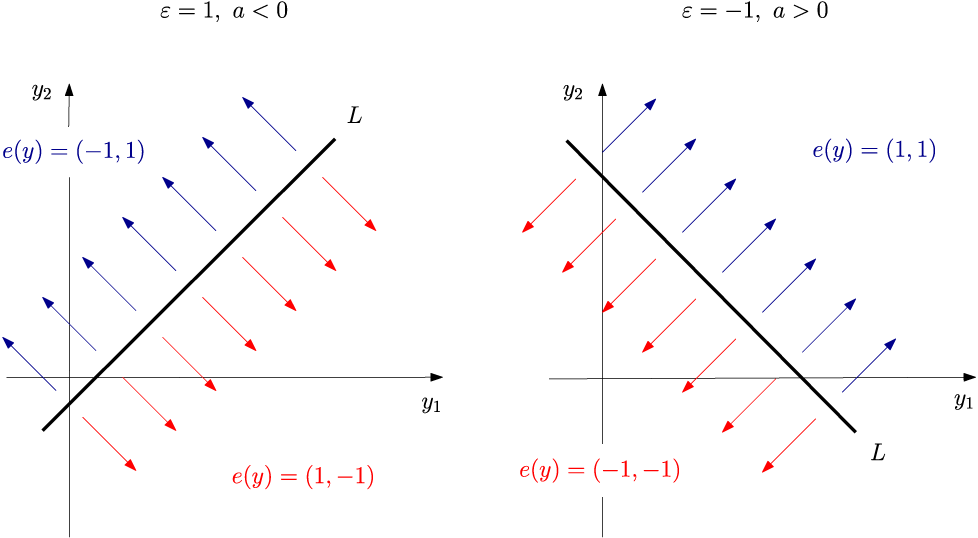
The above allocation of directions has the crucial property that for all ${x=(x_1,x_2) \in L,}$
for all
${x=(x_1,x_2) \in L,}$
for all $y=(y_1,y_2) \in \mathbb {R}^2,$
and for all
$y=(y_1,y_2) \in \mathbb {R}^2,$
and for all $t \geq 0$
we have
$t \geq 0$
we have
 $$ \begin{align} d_{\mathrm{{m}}}(x,y+t e(y))=d_{\mathrm{{m}}}(x,y)+d_{\mathrm{{m}}}(y, y+t e(y))=d_{\mathrm{{m}}}(x,y)+t. \end{align} $$
Let us justify (3.4) only in the sub-case $\varepsilon =1$
and
$\varepsilon =1$
and $y_2 \geq \varepsilon y_1 +a$
as the other three sub-cases are very similar. We know that
$y_2 \geq \varepsilon y_1 +a$
as the other three sub-cases are very similar. We know that $x_2=x_1+a$
and
$x_2=x_1+a$
and $y_2 \geq y_1+a$
which implies that
$y_2 \geq y_1+a$
which implies that $y_2-x_2 \geq y_1 - x_1,$
or equivalently,
$y_2-x_2 \geq y_1 - x_1,$
or equivalently, $x_1-y_1 \geq x_2 - y_2.$
Therefore,
$x_1-y_1 \geq x_2 - y_2.$
Therefore,
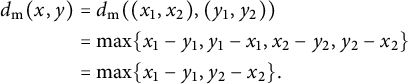 $$ \begin{align} \begin{aligned} d_{\mathrm{{m}}}(x,y)&=d_{\mathrm{{m}}}((x_1,x_2),(y_1,y_2)) \\ &=\max\{x_1-y_1, y_1-x_1,x_2-y_2,y_2-x_2\}\\ &=\max\{x_1-y_1,y_2-x_2\}. \end{aligned} \end{align} $$
Moreover,
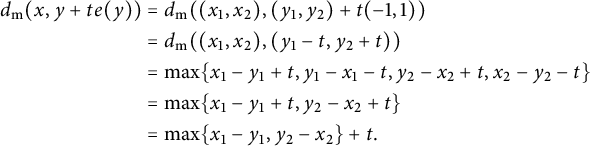 $$ \begin{align} \begin{aligned} d_{\mathrm{{m}}}(x, y+t e(y)) &=d_{\mathrm{{m}}}((x_1,x_2), (y_1,y_2)+t(-1,1)) \\ &=d_{\mathrm{{m}}}((x_1,x_2), (y_1-t,y_2+t)) \\ &=\max\{x_1-y_1+t, y_1-x_1-t, y_2-x_2+t, x_2-y_2-t\} \\ &=\max\{x_1-y_1+t, y_2-x_2+t\} \\ &=\max\{x_1-y_1, y_2-x_2\}+t. \end{aligned} \end{align} $$
That is, (3.5) and (3.6) show that $d_{\mathrm {{m}}}(x, y+t e(y))=d_{\mathrm {{m}}}(x,y)+t$
indeed, and it is clear by the definition (3.3) that
$d_{\mathrm {{m}}}(x, y+t e(y))=d_{\mathrm {{m}}}(x,y)+t$
indeed, and it is clear by the definition (3.3) that $d_{\mathrm {{m}}}(y, y+ t e(y))=t$
for every nonnegative
$d_{\mathrm {{m}}}(y, y+ t e(y))=t$
for every nonnegative $t.$
$t.$
It is a straightforward consequence of the definition of $e(y)$
—see eq. (3.3)—that for every
$e(y)$
—see eq. (3.3)—that for every $t \geq 0$
the map
$t \geq 0$
the map $y \mapsto y+t e(y)$
is an injection of
$y \mapsto y+t e(y)$
is an injection of $\mathbb {R}^2$
and hence invertible on its range.
$\mathbb {R}^2$
and hence invertible on its range.
Let $\nu \in \mathcal {W}_1(\mathbb {R}^2,d_{\mathrm {{m}}})$
and let
$\nu \in \mathcal {W}_1(\mathbb {R}^2,d_{\mathrm {{m}}})$
and let $t_0:=d_{W_1}(\mu , \nu ).$
Let us define
$t_0:=d_{W_1}(\mu , \nu ).$
Let us define
 $$ \begin{align} \eta_t:=\left(y \mapsto y + t e(y) \right)_{\#} \nu \end{align} $$
for $t \geq 0.$
As the map
$t \geq 0.$
As the map $y \mapsto y+t e(y)$
is invertible, the couplings of
$y \mapsto y+t e(y)$
is invertible, the couplings of $\mu $
and
$\mu $
and $\nu $
are in a one-by-one correspondence with the couplings of
$\nu $
are in a one-by-one correspondence with the couplings of $\mu $
and
$\mu $
and $\eta _t$
(for every
$\eta _t$
(for every $t\geq 0$
), and this correspondence is given by
$t\geq 0$
), and this correspondence is given by
 $$ \begin{align} \pi_{(\mu, \eta_{t})}=\left(\mathrm{id}_{\mathbb{R}^2} \times \left(y \mapsto y+ t e(y) \right)\right)_{\#}\pi_{(\mu, \nu)} \qquad (\pi_{(\mu, \nu)} \in C(\mu,\nu), \, \pi_{(\mu, \eta_{t})} \in C(\mu, \eta_t)). \end{align} $$
Therefore,
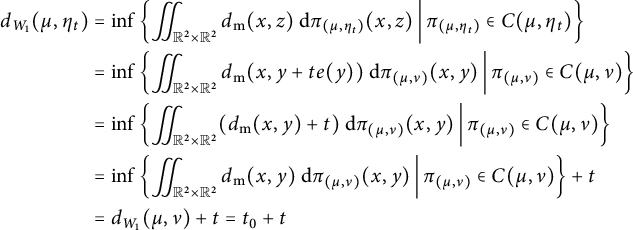 $$ \begin{align} \begin{aligned} d_{W_1}(\mu,\eta_t)&=\inf \left\{ \iint_{\mathbb{R}^2 \times \mathbb{R}^2} d_{\mathrm{{m}}}(x,z) ~\mathrm{d} \pi_{(\mu, \eta_{t})} (x,z) \, \middle| \, \pi_{(\mu, \eta_{t})} \in C(\mu, \eta_t) \right\} \\ &=\inf \left\{ \iint_{\mathbb{R}^2 \times \mathbb{R}^2} d_{\mathrm{{m}}}(x,y+t e(y)) ~\mathrm{d} \pi_{(\mu, \nu)} (x,y) \, \middle| \, \pi_{(\mu, \nu)} \in C(\mu, \nu) \right\} \\ &=\inf \left\{ \iint_{\mathbb{R}^2 \times \mathbb{R}^2} (d_{\mathrm{{m}}}(x,y)+t) ~\mathrm{d} \pi_{(\mu, \nu)} (x,y) \, \middle| \, \pi_{(\mu, \nu)} \in C(\mu, \nu) \right\}\\ &=\inf \left\{ \iint_{\mathbb{R}^2 \times \mathbb{R}^2} d_{\mathrm{{m}}}(x,y) ~\mathrm{d} \pi_{(\mu, \nu)} (x,y) \, \middle| \, \pi_{(\mu, \nu)} \in C(\mu, \nu) \right\}+t \\ &=d_{W_1}(\mu, \nu)+t=t_0+t \end{aligned} \end{align} $$
for every $t \geq 0.$
Note, that in the above computation, we heavily relied on the identity (3.4). The reversed triangle inequality implies that
 $$ \begin{align*}d_{W_1}(\nu, \eta_t) \geq \left| d_{W_1}(\mu, \eta_t)- d_{W_1}(\mu, \nu)\right|=(t_0+t)-t_0=t. \end{align*} $$
On the other hand, the cost of the coupling $\left (y \mapsto (y, y+ t e(y))\right )_{\#} \nu \in C(\nu , \eta _t)$
is simply
$\left (y \mapsto (y, y+ t e(y))\right )_{\#} \nu \in C(\nu , \eta _t)$
is simply $t,$
and hence
$t,$
and hence $d_{W_1}(\nu , \eta _t)=t.$
Therefore, with the particular choice
$d_{W_1}(\nu , \eta _t)=t.$
Therefore, with the particular choice $t:=t_0=d_{W_1}(\mu ,\nu )$
the triple
$t:=t_0=d_{W_1}(\mu ,\nu )$
the triple $(\mu , \nu , \eta _{t_0})$
satisfies the requirement
$(\mu , \nu , \eta _{t_0})$
satisfies the requirement
 $$ \begin{align} d_{W_1}(\mu, \nu)=d_{W_1}(\nu, \eta_{t_0})=\frac{1}{2}d_{W_1}(\mu,\eta_{t_0}) \end{align} $$
as every expression in (3.10) is equal to $t_0.$
We turn to the proof of the direction (ii) $\Longrightarrow $
(i). The assumption (ii) implies in particular that for every
$\Longrightarrow $
(i). The assumption (ii) implies in particular that for every $y \in \mathbb {R}^2$
there exists an
$y \in \mathbb {R}^2$
there exists an $\eta \in \mathcal {W}_1(\mathbb {R}^2,d_{\mathrm {{m}}})$
such that
$\eta \in \mathcal {W}_1(\mathbb {R}^2,d_{\mathrm {{m}}})$
such that
 $$ \begin{align} d_{W_1}(\mu, \delta_y)=d_{W_1}(\delta_y, \eta)=\frac{1}{2}d_{W_1}(\mu, \eta). \end{align} $$
Note that
 $$ \begin{align*}d_{W_1}(\mu, \delta_y)=\int\limits_{\mathbb{R}^2} d_{\mathrm{{m}}}(x,y) ~\mathrm{d} \mu(x) \text{ and } d_{W_1}(\delta_y,\eta)=\int\limits_{\mathbb{R}^2} d_{\mathrm{{m}}}(y,z) ~\mathrm{d} \eta(z). \end{align*} $$
Moreover, let $\pi _{(\mu ,\eta )}^{*}$
denote an optimal coupling of
$\pi _{(\mu ,\eta )}^{*}$
denote an optimal coupling of $\mu $
and
$\mu $
and $\eta ,$
and let us note that we have the following chain of inequalities:
$\eta ,$
and let us note that we have the following chain of inequalities:
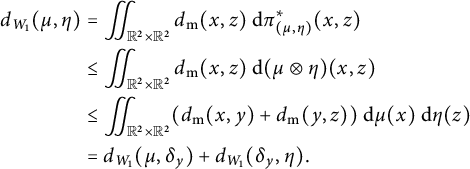 $$ \begin{align} \begin{aligned} d_{W_1}(\mu, \eta)&=\iint_{\mathbb{R}^2 \times \mathbb{R}^2} d_{\mathrm{{m}}}(x,z) ~\mathrm{d} \pi_{(\mu,\eta)}^{*}(x,z) \\ &\leq \iint_{\mathbb{R}^2 \times \mathbb{R}^2} d_{\mathrm{{m}}}(x,z) ~\mathrm{d} (\mu \otimes \eta)(x,z) \\ &\leq \iint_{\mathbb{R}^2 \times \mathbb{R}^2} (d_{\mathrm{{m}}}(x,y)+d_{\mathrm{{m}}}(y,z)) ~\mathrm{d} \mu(x) ~\mathrm{d} \eta(z)\\ &=d_{W_1}(\mu, \delta_y)+ d_{W_1}(\delta_y,\eta). \end{aligned} \end{align} $$
Therefore, (3.11) implies that both inequalities of (3.12) are saturated. The saturation of the first inequality means that $\mu \otimes \eta $
is an optimal coupling of
$\mu \otimes \eta $
is an optimal coupling of $\mu $
and
$\mu $
and $\nu $
with respect to the transport cost
$\nu $
with respect to the transport cost $c(x,y)=d_{\mathrm {{m}}}(x,y),$
while the saturation of the second inequality means that
$c(x,y)=d_{\mathrm {{m}}}(x,y),$
while the saturation of the second inequality means that
 $$ \begin{align} d_{\mathrm{{m}}}(x,z)=d_{\mathrm{{m}}}(x,y)+d_{\mathrm{{m}}}(y,z) \text{ for } \mu \otimes \eta \text{-almost every } (x,z) \in \mathbb{R}^2 \times \mathbb{R}^2. \end{align} $$
In order to get a contradiction, assume that $\mu $
is not supported on a diagonal line, and let x and
$\mu $
is not supported on a diagonal line, and let x and $x'$
be points of the support of
$x'$
be points of the support of $\mu $
that do not lie on a common diagonal line. Now let us choose y to be
$\mu $
that do not lie on a common diagonal line. Now let us choose y to be $y:=\frac {1}{2}(x+x').$
With this choice we get
$y:=\frac {1}{2}(x+x').$
With this choice we get
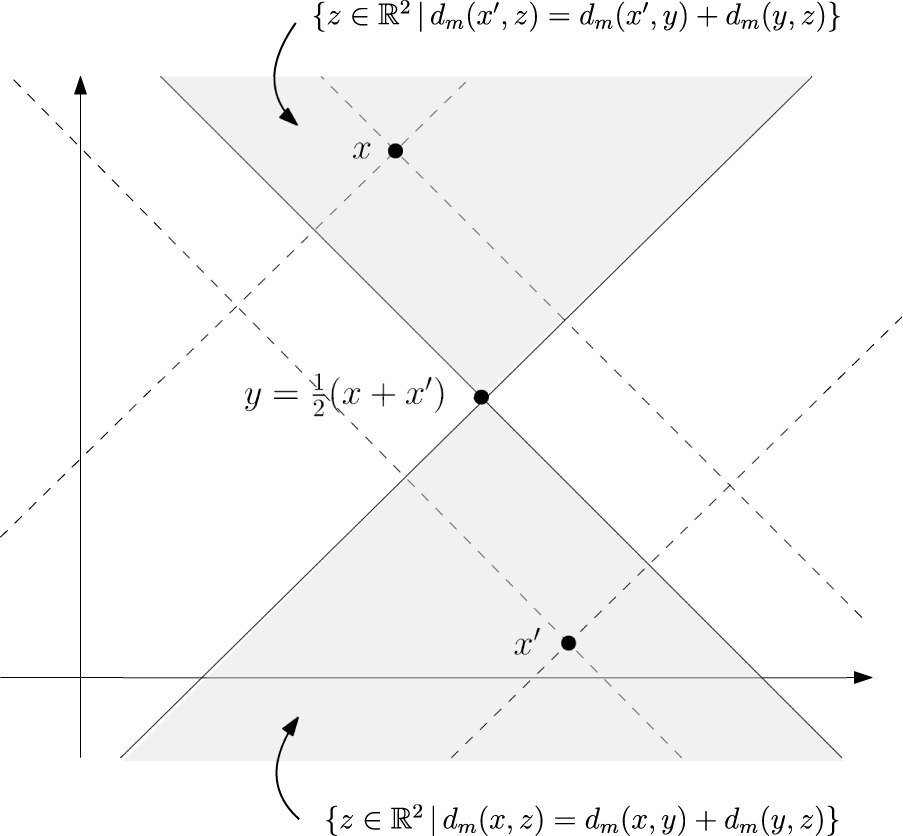
 $$ \begin{align} d_{\mathrm{{m}}}(x,z) & < d_{\mathrm{{m}}}(x,y)+d_{\mathrm{{m}}}(y,z) \text{ or } d_{\mathrm{{m}}}(x',z) \nonumber \\ & < d_{\mathrm{{m}}}(x',y)+d_{\mathrm{{m}}}(y,z) \text{ for all } z \in \mathbb{R}^2 \setminus\{y\}. \end{align} $$
Indeed, it is easy to check—see also Figure 6—that if both triangle inequalities in (3.14) are saturated, then $z=y$
by necessity.
$z=y$
by necessity.
Illustration for eq. (3.14).
Consequently, (3.13) forces $\eta $
to be
$\eta $
to be $\eta =\delta _y.$
But then
$\eta =\delta _y.$
But then $d_{W_1}(\delta _y,\eta )=0,$
which contradicts to (3.11), because
$d_{W_1}(\delta _y,\eta )=0,$
which contradicts to (3.11), because $d_{W_1}(\mu , \delta _y)>0$
as
$d_{W_1}(\mu , \delta _y)>0$
as $\mu $
is not diagonally supported and hence not a Dirac. This contradiction completes the proof of the implication (ii)
$\mu $
is not diagonally supported and hence not a Dirac. This contradiction completes the proof of the implication (ii) $\Longrightarrow $
(i).
$\Longrightarrow $
(i).
Now we give a metric characterization of the property that two measures $\mu _1$
and
$\mu _1$
and $\mu _2$
are supported on the same diagonal line.
$\mu _2$
are supported on the same diagonal line.
Proposition 3.2 Let $\mu _1, \mu _2 \in \mathcal {W}_1(\mathbb {R}^2,d_{\mathrm {{m}}}).$
The following statements are equivalent.
$\mu _1, \mu _2 \in \mathcal {W}_1(\mathbb {R}^2,d_{\mathrm {{m}}}).$
The following statements are equivalent.
-
(i)
$\mu _1$
and
$\mu _2$
are supported on the same diagonal line. -
(ii) For every
$\nu \in \mathcal {W}_1(\mathbb {R}^2,d_{\mathrm {{m}}})$
, there exists an
$\eta \in \mathcal {W}_1(\mathbb {R}^2,d_{\mathrm {{m}}})$
such that (3.15)
$$ \begin{align} d_{W_1}(\mu_i, \eta)=d_{W_1}(\mu_i, \nu)+d_{W_1}(\nu, \eta) \text{ for } i=1,2 \text{ and } d_{W_1}(\nu, \eta)=1. \end{align} $$
In words, this item means that there is a measure
$\eta $
aligned with both
$(\mu _1, \nu )$
and
$(\mu _2, \nu )$
.


Proof Let us start with the proof of the direction (i) $\Longrightarrow $
(ii). Assume that
$\Longrightarrow $
(ii). Assume that $\mu _1$
and
$\mu _1$
and $\mu _2$
are supported on the diagonal line
$\mu _2$
are supported on the diagonal line $L=\left \{(x_1, x_2) \in \mathbb {R}^2 \, \middle | \, x_2= \varepsilon x_1 +a\right \}.$
Let us recall the allocation of directions (3.3) and its crucial property (3.4). Let
$L=\left \{(x_1, x_2) \in \mathbb {R}^2 \, \middle | \, x_2= \varepsilon x_1 +a\right \}.$
Let us recall the allocation of directions (3.3) and its crucial property (3.4). Let $\eta $
be defined by
$\eta $
be defined by
 $$ \begin{align} \eta:=\left(y \mapsto y + e(y) \right)_{\#} \nu. \end{align} $$
Note that (3.16) is a special case of (3.7) with $t=1,$
and hence
$t=1,$
and hence $d_{W_1}(\mu _i, \eta )=d_{W_1}(\mu _i, \nu )+1$
for
$d_{W_1}(\mu _i, \eta )=d_{W_1}(\mu _i, \nu )+1$
for $i=1,2.$
Similarly as in the previous proposition, the reverse triangle inequality ensures that $d_{W_1}(\nu , \eta ) \geq \left |d_{W_1}(\mu _i,\eta )-d_{W_1}(\mu _i,\nu )\right |=1,$
and the transport map
$d_{W_1}(\nu , \eta ) \geq \left |d_{W_1}(\mu _i,\eta )-d_{W_1}(\mu _i,\nu )\right |=1,$
and the transport map $(y \mapsto (y,y+e(y)))_{\#}\nu $
between
$(y \mapsto (y,y+e(y)))_{\#}\nu $
between $\nu $
and
$\nu $
and $\eta $
shows that
$\eta $
shows that $d_{W_1}(\nu , \eta )=1$
which completes the proof of this direction.
$d_{W_1}(\nu , \eta )=1$
which completes the proof of this direction.
To prove the direction (ii) $\Longrightarrow $
(i), note that by the previous statement, both of the measures
$\Longrightarrow $
(i), note that by the previous statement, both of the measures $\mu _1$
and
$\mu _1$
and $\mu _2$
are supported on some diagonal line. Assume by contradiction that
$\mu _2$
are supported on some diagonal line. Assume by contradiction that $\mu _1$
and
$\mu _1$
and $\mu _2$
are not supported on the same diagonal line, and hence in particular there exist points
$\mu _2$
are not supported on the same diagonal line, and hence in particular there exist points $x_1 \in \mathrm {supp}(\mu _1)$
and
$x_1 \in \mathrm {supp}(\mu _1)$
and $x_2 \in \mathrm {supp}(\mu _2)$
that do not lie on a common diagonal line. As in the proof of Proposition 3.1 let us choose
$x_2 \in \mathrm {supp}(\mu _2)$
that do not lie on a common diagonal line. As in the proof of Proposition 3.1 let us choose $\nu :=\delta _y$
where
$\nu :=\delta _y$
where ${y=\frac {1}{2}(x_1+x_2).}$
With this choice, (3.15) implies that
${y=\frac {1}{2}(x_1+x_2).}$
With this choice, (3.15) implies that
 $$ \begin{align*}d_{\mathrm{{m}}}(x,z) & =d_{\mathrm{{m}}}(x,y) \\ &\quad +d_{\mathrm{{m}}}(y,z) \text{ for } \mu_i \otimes \eta \text{-almost every } (x,z) \in \mathbb{R}^2 \times \mathbb{R}^2 \qquad (i=1,2). \end{align*} $$
In particular, $d_{\mathrm {{m}}}(x_i,z)=d_{\mathrm {{m}}}(x_i,y)+d_{\mathrm {{m}}}(y,z)$
for
$d_{\mathrm {{m}}}(x_i,z)=d_{\mathrm {{m}}}(x_i,y)+d_{\mathrm {{m}}}(y,z)$
for $i=1,2$
which implies
$i=1,2$
which implies $z=y$
for
$z=y$
for $\eta $
-almost every
$\eta $
-almost every $z,$
and hence forces
$z,$
and hence forces $\eta $
to be
$\eta $
to be $\delta _y.$
However, this contradicts the requirement
$\delta _y.$
However, this contradicts the requirement $d_{W_1}(\nu ,\eta )=1,$
so we got the desired contradiction.
$d_{W_1}(\nu ,\eta )=1,$
so we got the desired contradiction.
Now we are in the position to prove the main result of this section.
Theorem 3.3 The Wasserstein space $\mathcal {W}_1(\mathbb {R}^2,d_{\mathrm {{m}}})$
is diagonally rigid. That is, for any isometry
$\mathcal {W}_1(\mathbb {R}^2,d_{\mathrm {{m}}})$
is diagonally rigid. That is, for any isometry $\Phi : \mathcal {W}_1(\mathbb {R}^2,d_{\mathrm {{m}}}) \to \mathcal {W}_1(\mathbb {R}^2,d_{\mathrm {{m}}})$
there exists an isometry
$\Phi : \mathcal {W}_1(\mathbb {R}^2,d_{\mathrm {{m}}}) \to \mathcal {W}_1(\mathbb {R}^2,d_{\mathrm {{m}}})$
there exists an isometry $T: \mathbb {R}^2 \to \mathbb {R}^2$
such that
$T: \mathbb {R}^2 \to \mathbb {R}^2$
such that $\Phi \circ T_\#$
fixes all measures supported on
$\Phi \circ T_\#$
fixes all measures supported on $L_+$
and
$L_+$
and $L_-$
.
$L_-$
.
Proof Let $\Phi : \mathcal {W}_1(\mathbb {R}^2,d_{\mathrm {{m}}}) \to \mathcal {W}_1(\mathbb {R}^2,d_{\mathrm {{m}}})$
be an isometry, and let
$\Phi : \mathcal {W}_1(\mathbb {R}^2,d_{\mathrm {{m}}}) \to \mathcal {W}_1(\mathbb {R}^2,d_{\mathrm {{m}}})$
be an isometry, and let $\mu ,\mu ' \in \mathcal {W}_1(L_{+})$
be two measures,
$\mu ,\mu ' \in \mathcal {W}_1(L_{+})$
be two measures, $\mu \neq \mu '$
. According to Proposition 3.2, their images
$\mu \neq \mu '$
. According to Proposition 3.2, their images $\Phi (\mu )$
and
$\Phi (\mu )$
and $\Phi (\mu ')$
are supported on a diagonal line
$\Phi (\mu ')$
are supported on a diagonal line $L_{\varepsilon ,a}$
for a suitable
$L_{\varepsilon ,a}$
for a suitable $\varepsilon \in \{-1,1\}$
and
$\varepsilon \in \{-1,1\}$
and $a\in \mathbb {R}$
. Since for every
$a\in \mathbb {R}$
. Since for every $\varepsilon \in \{-1,1\}$
and
$\varepsilon \in \{-1,1\}$
and $a\in \mathbb {R}$
there is an isometry
$a\in \mathbb {R}$
there is an isometry $T: \mathbb {R}^2 \to \mathbb {R}^2 $
that maps
$T: \mathbb {R}^2 \to \mathbb {R}^2 $
that maps $L_{\varepsilon , a} $
onto
$L_{\varepsilon , a} $
onto $L_+$
, we can assume that
$L_+$
, we can assume that $\mathrm {supp}\big (\Phi (\mu )\big )\subseteq L_+$
and
$\mathrm {supp}\big (\Phi (\mu )\big )\subseteq L_+$
and $\mathrm {supp}\big (\Phi (\mu ')\big )\subseteq L_+$
. In fact, for every
$\mathrm {supp}\big (\Phi (\mu ')\big )\subseteq L_+$
. In fact, for every $\nu $
with
$\nu $
with $\mathrm {supp}(\nu )\subseteq L_+$
we conclude that
$\mathrm {supp}(\nu )\subseteq L_+$
we conclude that $\mathrm {supp}\big (\Phi (\nu )\big )\subseteq L_+$
. Indeed, let us repeat the above argument for
$\mathrm {supp}\big (\Phi (\nu )\big )\subseteq L_+$
. Indeed, let us repeat the above argument for $\mu $
and
$\mu $
and $\nu $
. Since they are both supported on
$\nu $
. Since they are both supported on $L_+$
their images are supported on the same diagonal line. We already know that
$L_+$
their images are supported on the same diagonal line. We already know that $\mathrm {supp}\big (\Phi (\mu )\big )\subseteq L_+$
, and therefore if
$\mathrm {supp}\big (\Phi (\mu )\big )\subseteq L_+$
, and therefore if $\Phi (\mu )$
is not a Dirac mass, then Proposition 3.2 guarantees that
$\Phi (\mu )$
is not a Dirac mass, then Proposition 3.2 guarantees that $\mathrm {supp}\big (\Phi (\nu )\big )\subseteq L_+$
. If
$\mathrm {supp}\big (\Phi (\nu )\big )\subseteq L_+$
. If $\Phi (\mu )$
is a Dirac mass, say
$\Phi (\mu )$
is a Dirac mass, say $\Phi (\mu )=\delta _{(x,x)}$
then we have to exclude the possibility of
$\Phi (\mu )=\delta _{(x,x)}$
then we have to exclude the possibility of $\mathrm {supp}\big (\Phi (\nu )\big )\subseteq L_{-1,2x}$
. To this aim, consider
$\mathrm {supp}\big (\Phi (\nu )\big )\subseteq L_{-1,2x}$
. To this aim, consider $\nu $
and
$\nu $
and $\mu '$
, and again, apply Proposition 3.2 to conclude that
$\mu '$
, and again, apply Proposition 3.2 to conclude that $\mathrm {supp}\big (\Phi (\mu ')\big )\subseteq L_{-1,2x}$
. But this is a contradiction, as we already know that
$\mathrm {supp}\big (\Phi (\mu ')\big )\subseteq L_{-1,2x}$
. But this is a contradiction, as we already know that $\mathrm {supp}\big (\Phi (\mu ')\big )\subseteq L_+$
and therefore
$\mathrm {supp}\big (\Phi (\mu ')\big )\subseteq L_+$
and therefore $\mathrm {supp}\big (\Phi (\mu ')\big )=\{(x,x)\}$
, or equivalently
$\mathrm {supp}\big (\Phi (\mu ')\big )=\{(x,x)\}$
, or equivalently $\Phi (\mu ')=\delta _{(x,x)}=\Phi (\mu )$
.
$\Phi (\mu ')=\delta _{(x,x)}=\Phi (\mu )$
.
We obtain in this way, that $\Phi $
restricted to
$\Phi $
restricted to $\mathcal {W}_1(L_{+})$
is a (bijective) isometry of
$\mathcal {W}_1(L_{+})$
is a (bijective) isometry of $\mathcal {W}_1(L_{+}),$
which is isomorphic to
$\mathcal {W}_1(L_{+}),$
which is isomorphic to $W_1(\mathbb {R}, |\cdot |)$
which is known to be isometrically rigid — see [Reference Gy, Gehér and Titkos10]. Therefore measures in
$W_1(\mathbb {R}, |\cdot |)$
which is known to be isometrically rigid — see [Reference Gy, Gehér and Titkos10]. Therefore measures in $\mathcal {W}_1(L_{+})$
are left invariant by
$\mathcal {W}_1(L_{+})$
are left invariant by $\Phi .$
Finally we need to show that measures in $\mathcal {W}_1(L_{-})$
are also left invariant by
$\mathcal {W}_1(L_{-})$
are also left invariant by $\Phi .$
To see this note that
$\Phi .$
To see this note that $(0,0) \in L_{+} \cap L_{-}$
and considering the measure
$(0,0) \in L_{+} \cap L_{-}$
and considering the measure $\mu = \delta _{(0,0)}$
together with another measure
$\mu = \delta _{(0,0)}$
together with another measure $\nu $
supported on
$\nu $
supported on $L_{-}$
we conclude by applying Proposition 3.2 that both
$L_{-}$
we conclude by applying Proposition 3.2 that both $\Phi (\mu )$
and
$\Phi (\mu )$
and $\Phi (\nu )$
are supported on the same diagonal line. Since we know already that
$\Phi (\nu )$
are supported on the same diagonal line. Since we know already that $\Phi (\mu ) = \mu = \delta _{(0,0)}$
we can conclude that the support of
$\Phi (\mu ) = \mu = \delta _{(0,0)}$
we can conclude that the support of $\Phi (\nu )$
is in
$\Phi (\nu )$
is in $L_+$
or it is in
$L_+$
or it is in $L_-$
. Since the first option cannot hold as the pre-images of measures supported on
$L_-$
. Since the first option cannot hold as the pre-images of measures supported on $L_+$
are supported on
$L_+$
are supported on $L_+$
by the previous paragraph, we are left with the second one. This shows that if
$L_+$
by the previous paragraph, we are left with the second one. This shows that if $ \nu \in \mathcal {W}_1(L_{-})$
then so is
$ \nu \in \mathcal {W}_1(L_{-})$
then so is $\Phi (\nu )$
. By possibly applying another isometry of
$\Phi (\nu )$
. By possibly applying another isometry of $\mathbb {R}^2$
we obtain that
$\mathbb {R}^2$
we obtain that $\Phi $
fixes the elements of
$\Phi $
fixes the elements of $ \nu \in \mathcal {W}_1(L_{-})$
as well.
$ \nu \in \mathcal {W}_1(L_{-})$
as well.
3.2 Diagonal rigidity of
$\mathcal {W}_p(\mathbb {R}^2,d_{\mathrm {{m}}})$
for
$p>1$


In this subsection, we show that the Wasserstein space $\mathcal {W}_p(\mathbb {R}^2,d_{\mathrm {{m}}})$
for
$\mathcal {W}_p(\mathbb {R}^2,d_{\mathrm {{m}}})$
for $p>1$
is diagonally rigid. First, we give a metric characterization of Dirac measures. Such a characterization will guarantee that if
$p>1$
is diagonally rigid. First, we give a metric characterization of Dirac measures. Such a characterization will guarantee that if $\mu $
is a Dirac mass, then
$\mu $
is a Dirac mass, then $\Phi (\mu )$
is a Dirac mass as well.
$\Phi (\mu )$
is a Dirac mass as well.
Proposition 3.4 Let $p>1$
and
$p>1$
and $\mu \in \mathcal {W}_p(\mathbb {R}^2,d_{\mathrm {{m}}}).$
The following statements are equivalent.
$\mu \in \mathcal {W}_p(\mathbb {R}^2,d_{\mathrm {{m}}}).$
The following statements are equivalent.
-
(i’)
$\mu $
is a Dirac mass, that is,
$\mu =\delta _x$
for some
$x \in \mathbb {R}^2,$
-
(ii’) For every
$\nu \in \mathcal {W}_p(\mathbb {R}^2,d_{\mathrm {{m}}})$
there exists an
$\eta \in \mathcal {W}_p(\mathbb {R}^2,d_{\mathrm {{m}}})$
such that (3.17)
$$ \begin{align} d_{W_p}(\mu, \nu)=d_{W_p}(\nu, \eta)=\frac{1}{2}d_{W_p}(\mu, \eta). \end{align} $$


In words, item (ii’) means that $\mu $
admits a symmetrical with respect to every other measure.
$\mu $
admits a symmetrical with respect to every other measure.
Note that the above Proposition 3.4 characterizing Dirac masses in $\mathcal {W}_p(\mathbb {R}^2,d_{\mathrm {{m}}})$
for
$\mathcal {W}_p(\mathbb {R}^2,d_{\mathrm {{m}}})$
for $p>1$
highlights the difference between the cases
$p>1$
highlights the difference between the cases $p=1$
and
$p=1$
and $p>1$
. This statement is very similar in spirit to Proposition 3.1 characterizing measures supported on diagonal lines in
$p>1$
. This statement is very similar in spirit to Proposition 3.1 characterizing measures supported on diagonal lines in $\mathcal {W}_1(\mathbb {R}^2,d_{\mathrm {{m}}}).$
In fact, condition (ii) of Proposition 3.1 is the same as condition (ii’) of Proposition 3.4, up to a modification in the parameter value of the Wasserstein distance that we consider. This means that diagonally supported measures play the role of Dirac masses in the case
$\mathcal {W}_1(\mathbb {R}^2,d_{\mathrm {{m}}}).$
In fact, condition (ii) of Proposition 3.1 is the same as condition (ii’) of Proposition 3.4, up to a modification in the parameter value of the Wasserstein distance that we consider. This means that diagonally supported measures play the role of Dirac masses in the case $p=1,$
and in particular, there are plenty of examples of non-Dirac measures satisfying condition (ii), which is the
$p=1,$
and in particular, there are plenty of examples of non-Dirac measures satisfying condition (ii), which is the $1$
-Wasserstein version of condition (ii’) above. These examples are explicitly constructed in the proof of the (i)
$1$
-Wasserstein version of condition (ii’) above. These examples are explicitly constructed in the proof of the (i) $\Longrightarrow $
(ii) part of Proposition 3.1.
$\Longrightarrow $
(ii) part of Proposition 3.1.
Proof Let us prove the direction (i’) $\Longrightarrow $
(ii’) first. Let
$\Longrightarrow $
(ii’) first. Let $x \in \mathbb {R},$
let
$x \in \mathbb {R},$
let $\mu =\delta _x,$
and let us define the following dilation with center x on
$\mu =\delta _x,$
and let us define the following dilation with center x on $\mathbb {R}^2$
:
$\mathbb {R}^2$
:
 $$ \begin{align} D_x: \mathbb{R}^2 \to \mathbb{R}^2; \, y \mapsto D_x(y):=x+2(y-x). \end{align} $$
Now, for any $\nu \in \mathcal {W}_p(\mathbb {R}^2,d_{\mathrm {{m}}}),$
let us define the corresponding
$\nu \in \mathcal {W}_p(\mathbb {R}^2,d_{\mathrm {{m}}}),$
let us define the corresponding $\eta _{\nu }$
by
$\eta _{\nu }$
by
 $$ \begin{align} \eta_{\nu}:=\left(D_x\right)_{\#}\nu. \end{align} $$
It is clear that $d_{W_p}(\mu , \eta _{\nu })=2 d_{W_p}(\mu , \nu ).$
Indeed,
$d_{W_p}(\mu , \eta _{\nu })=2 d_{W_p}(\mu , \nu ).$
Indeed,
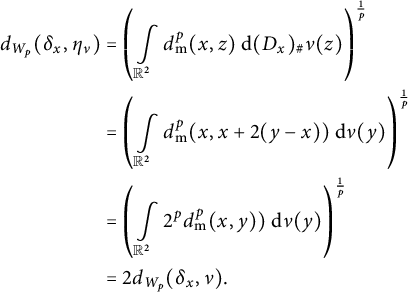 $$ \begin{align*} \begin{aligned} d_{W_p}(\delta_x, \eta_{\nu})&=\left(\int\limits_{\mathbb{R}^2}d_{\mathrm{{m}}}^p(x,z)~\mathrm{d}(D_x)_{\#}\nu (z)\right)^{\frac{1}{p}} \\ &=\left(\int\limits_{\mathbb{R}^2}d_{\mathrm{{m}}}^p(x,x+2(y-x))~\mathrm{d}\nu (y)\right)^{\frac{1}{p}} \\ &=\left(\int\limits_{\mathbb{R}^2}2^p d_{\mathrm{{m}}}^p(x,y))~\mathrm{d}\nu (y)\right)^{\frac{1}{p}} \\ &=2 d_{W_p}(\delta_x, \nu). \end{aligned} \end{align*} $$
Moreover, by the reversed triangle inequality, $d_{W_p}(\nu , \eta _{\nu }) \geq d_{W_p}(\mu , \eta _{\nu })-d_{W_p}(\mu , \nu )=d_{W_p}(\mu , \nu ),$
while the obvious coupling of
$d_{W_p}(\nu , \eta _{\nu }) \geq d_{W_p}(\mu , \eta _{\nu })-d_{W_p}(\mu , \nu )=d_{W_p}(\mu , \nu ),$
while the obvious coupling of $\nu $
and
$\nu $
and $\eta _{\nu }$
given by the dilation
$\eta _{\nu }$
given by the dilation $D_x$
guarantees that
$D_x$
guarantees that $d_{W_p}(\nu , \eta _{\nu }) \leq d_{W_p}(\mu , \nu ),$
and hence the direction (i’)
$d_{W_p}(\nu , \eta _{\nu }) \leq d_{W_p}(\mu , \nu ),$
and hence the direction (i’) $\Longrightarrow $
(ii’) is proved.
$\Longrightarrow $
(ii’) is proved.
To prove the other direction (ii’) $\Longrightarrow $
(i’), let
$\Longrightarrow $
(i’), let $\nu $
be a Dirac mass,
$\nu $
be a Dirac mass, $\nu =\delta _y,$
and let
$\nu =\delta _y,$
and let $\eta $
be as in condition (ii’). Then
$\eta $
be as in condition (ii’). Then
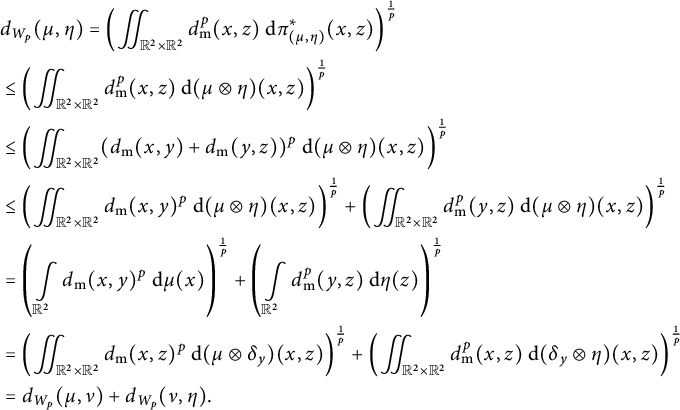 $$ \begin{align*} \begin{aligned} &d_{W_p}(\mu, \eta)=\left(\iint_{\mathbb{R}^2 \times \mathbb{R}^2} d_{\mathrm{{m}}}^p(x,z) ~\mathrm{d} \pi_{(\mu,\eta)}^{*}(x,z)\right)^{\frac{1}{p}} \\ &\leq \left(\iint_{\mathbb{R}^2 \times \mathbb{R}^2} d_{\mathrm{{m}}}^p(x,z) ~\mathrm{d} (\mu \otimes \eta)(x,z)\right)^{\frac{1}{p}} \\ &\leq \left(\iint_{\mathbb{R}^2 \times \mathbb{R}^2} (d_{\mathrm{{m}}}(x,y)+d_{\mathrm{{m}}}(y,z))^p ~\mathrm{d} (\mu \otimes \eta)(x,z)\right)^{\frac{1}{p}} \\ &\leq \left(\iint_{\mathbb{R}^2 \times \mathbb{R}^2} d_{\mathrm{{m}}}(x,y)^p ~\mathrm{d} (\mu \otimes \eta)(x,z)\right)^{\frac{1}{p}}+ \left(\iint_{\mathbb{R}^2 \times \mathbb{R}^2} d_{\mathrm{{m}}}^p(y,z) ~\mathrm{d} (\mu \otimes \eta)(x,z)\right)^{\frac{1}{p}}\\ &= \left(\int\limits_{\mathbb{R}^2} d_{\mathrm{{m}}}(x,y)^p ~\mathrm{d} \mu(x)\right)^{\frac{1}{p}}+ \left(\int\limits_{\mathbb{R}^2} d_{\mathrm{{m}}}^p(y,z) ~\mathrm{d} \eta(z)\right)^{\frac{1}{p}} \\ &=\left(\iint_{\mathbb{R}^2 \times \mathbb{R}^2} d_{\mathrm{{m}}}(x,z)^p ~\mathrm{d} (\mu \otimes \delta_y)(x,z)\right)^{\frac{1}{p}}+ \left(\iint_{\mathbb{R}^2 \times \mathbb{R}^2} d_{\mathrm{{m}}}^p(x,z) ~\mathrm{d} (\delta_y \otimes \eta)(x,z)\right)^{\frac{1}{p}} \\ &=d_{W_p}(\mu,\nu)+d_{W_p}(\nu,\eta). \end{aligned} \end{align*} $$
Since we assumed that $d_{W_p}(\mu , \nu )=d_{W_p}(\nu , \eta )=\frac {1}{2}d_{W_p}(\mu , \eta )$
, all the inequalities in the above chain are saturated. In particular, by the saturation of the
$d_{W_p}(\mu , \nu )=d_{W_p}(\nu , \eta )=\frac {1}{2}d_{W_p}(\mu , \eta )$
, all the inequalities in the above chain are saturated. In particular, by the saturation of the $L_p$
-Minkowski inequality for
$L_p$
-Minkowski inequality for $p>1$
(strictly convex norm), we get that there is a nonnegative constant
$p>1$
(strictly convex norm), we get that there is a nonnegative constant $\alpha \geq 0$
such that
$\alpha \geq 0$
such that
 $$ \begin{align} d_{\mathrm{{m}}}(y,z)=\alpha d_{\mathrm{{m}}}(x,y) \qquad \text{ for } \mu\text{-a.e. } x \in \mathbb{R}^2 \text{ and for } \eta\text{-a.e. } z \in \mathbb{R}^2. \end{align} $$
If $\mu $
is not a Dirac mass, then let
$\mu $
is not a Dirac mass, then let $x_1$
and
$x_1$
and $x_2$
be two different points in its support, and let
$x_2$
be two different points in its support, and let $y:=\frac 23 x_1 +\frac 13 x_2.$
Then the left-hand side of (3.20) is independent of
$y:=\frac 23 x_1 +\frac 13 x_2.$
Then the left-hand side of (3.20) is independent of $x,$
while the right-hand side is not—a contradiction.
$x,$
while the right-hand side is not—a contradiction.
The next step is to find a metric characterization of the property that the support of a measure $\mu $
is diagonally aligned with a point x in the underlying space, that is,
$\mu $
is diagonally aligned with a point x in the underlying space, that is, $\mathrm {supp}(\mu ) \subset (x+ L_{+}) \cup (x + L_{-}).$
This metric characterization turns out to be the property that there is only one p-Wasserstein geodesic between
$\mathrm {supp}(\mu ) \subset (x+ L_{+}) \cup (x + L_{-}).$
This metric characterization turns out to be the property that there is only one p-Wasserstein geodesic between $\delta _x$
measure and
$\delta _x$
measure and $\mu $
.
$\mu $
.
Proposition 3.5 Let $p>1$
and
$p>1$
and $x\in \mathbb {R}^2$
be fixed. For a measure
$x\in \mathbb {R}^2$
be fixed. For a measure $\mu \in \mathcal {W}_p(\mathbb {R}^2,d_{\mathrm {{m}}})$
the following statements are equivalent:
$\mu \in \mathcal {W}_p(\mathbb {R}^2,d_{\mathrm {{m}}})$
the following statements are equivalent:
-
(a) There exists a unique unit-speed geodesic segment
$\gamma $
such that
$\gamma (0)=\delta _x$
and
${\gamma (T)=\mu} $
, where
$d_{W_p}(\delta _x,\mu )=T$
, -
(b) We have the inclusion
$\mathrm {supp}\mu \subseteq D_x$
, where
$D_x = (x + L_+) \cup (x+L_-)$
.


Proof To prove the statement let us note that Corollary 7.22 in Villani’s book [Reference Villani17] says that if $p>1$
, and the underlying metric space is a complete, separable, and locally compact length space, then constant-speed geodesics connecting two measures are all displacement interpolations, i.e., geodesics are always constructed from optimal transport plans.
$p>1$
, and the underlying metric space is a complete, separable, and locally compact length space, then constant-speed geodesics connecting two measures are all displacement interpolations, i.e., geodesics are always constructed from optimal transport plans.
Therefore (see [Reference Villani17, Corollary 7.23]), if we want to guarantee that there is only one geodesic between two measures $\mu ,\nu $
, we need two properties:
$\mu ,\nu $
, we need two properties:
-
• we need a unique optimal transport plan
$\widetilde {\pi }$
, -
• and for
$\widetilde {\pi }$
-almost every
$(x,y)$
, x and y must be joined by a unique geodesic.


Let us note that the first property is automatically satisfied since one of the masses that we consider is a Dirac mass. Furthermore, note that in $(\mathbb {R}^2,d_{\mathrm {{m}}})$
, the second property means exactly that x and y are diagonally aligned, i.e., both points lie on the same diagonal line. For a fixed
$(\mathbb {R}^2,d_{\mathrm {{m}}})$
, the second property means exactly that x and y are diagonally aligned, i.e., both points lie on the same diagonal line. For a fixed $x\in \mathbb {R}^2$
let us denote by
$x\in \mathbb {R}^2$
let us denote by $D_x$
the set of those points that are diagonally aligned with x. Of course,
$D_x$
the set of those points that are diagonally aligned with x. Of course, $D_x$
is the union of the two diagonal lines
$D_x$
is the union of the two diagonal lines $L_++x$
and
$L_++x$
and $L_{-}+x$
passing through x concluding the proof.
$L_{-}+x$
passing through x concluding the proof.
Now we are in position to prove that $\mathcal {W}_p(\mathbb {R}^2,d_{\mathrm {{m}}})$
is diagonally rigid for
$\mathcal {W}_p(\mathbb {R}^2,d_{\mathrm {{m}}})$
is diagonally rigid for $p>1$
.
$p>1$
.
Theorem 3.6 For all $p>1$
the Wasserstein space
$p>1$
the Wasserstein space $\mathcal {W}_p(\mathbb {R}^2,d_{\mathrm {{m}}})$
is diagonally rigid.
$\mathcal {W}_p(\mathbb {R}^2,d_{\mathrm {{m}}})$
is diagonally rigid.
Proof Let $\Phi $
be an isometry. Since Proposition 3.4 is a metric characterization of Dirac masses, we know that
$\Phi $
be an isometry. Since Proposition 3.4 is a metric characterization of Dirac masses, we know that $\Phi $
maps the set of Dirac masses onto itself. That is, there exists a bijection
$\Phi $
maps the set of Dirac masses onto itself. That is, there exists a bijection $T:\mathbb {R}^2\to \mathbb {R}^2$
such that
$T:\mathbb {R}^2\to \mathbb {R}^2$
such that $\Phi (\delta _x)=\delta _{T(x)}$
. In fact, T is an isometry, as
$\Phi (\delta _x)=\delta _{T(x)}$
. In fact, T is an isometry, as $d_{W_p}(\delta _x,\delta _y)=d_{\mathrm {{m}}}(x,y)$
for all
$d_{W_p}(\delta _x,\delta _y)=d_{\mathrm {{m}}}(x,y)$
for all $x,y\in \mathbb {R}^2$
. Without loss of generality, we can assume that
$x,y\in \mathbb {R}^2$
. Without loss of generality, we can assume that $T(x)=x$
, and thus
$T(x)=x$
, and thus $\Phi (\delta _x)=\delta _x$
for all
$\Phi (\delta _x)=\delta _x$
for all $x\in \mathbb {R}^2$
. Next, consider the diagonal line
$x\in \mathbb {R}^2$
. Next, consider the diagonal line $L_+$
. (The case of
$L_+$
. (The case of $L_-$
is completely analogous.) Fix an arbitrary
$L_-$
is completely analogous.) Fix an arbitrary $x\in L_+$
, and observe that according to Proposition 3.5, for any
$x\in L_+$
, and observe that according to Proposition 3.5, for any $\mu $
such that
$\mu $
such that $\mathrm {supp}(\mu )\subseteq L$
, there is only one geodesic connecting
$\mathrm {supp}(\mu )\subseteq L$
, there is only one geodesic connecting $\delta _x$
and
$\delta _x$
and $\mu $
. Therefore, there must be only one geodesic between
$\mu $
. Therefore, there must be only one geodesic between $\Phi (\delta _x)=\delta _x$
and
$\Phi (\delta _x)=\delta _x$
and $\Phi (\mu )$
. Again, according to Proposition 3.5 this means that
$\Phi (\mu )$
. Again, according to Proposition 3.5 this means that $\mathrm {supp}\big (\Phi (\mu )\big )\subseteq D_x$
. Now choose a
$\mathrm {supp}\big (\Phi (\mu )\big )\subseteq D_x$
. Now choose a $y\in L_+$
(
$y\in L_+$
( $y\neq x$
) and repeat the argument. The conclusion is that
$y\neq x$
) and repeat the argument. The conclusion is that $\mathrm {supp}\big (\Phi (\mu )\big )\subseteq D_y$
. But
$\mathrm {supp}\big (\Phi (\mu )\big )\subseteq D_y$
. But $D_x\cap D_y=L_+$
, and therefore
$D_x\cap D_y=L_+$
, and therefore $\mathrm {supp}\big (\Phi (\mu )\big )\subseteq L_+$
. Now we know that
$\mathrm {supp}\big (\Phi (\mu )\big )\subseteq L_+$
. Now we know that $\Phi $
sends measures supported on
$\Phi $
sends measures supported on $L_+$
into measures supported on
$L_+$
into measures supported on $L_+$
. Since
$L_+$
. Since $L_+$
endowed with the restriction of
$L_+$
endowed with the restriction of $d_{\mathrm {{m}}}:\mathbb {R}^2\times \mathbb {R}^2\to \mathbb {R}_+$
onto
$d_{\mathrm {{m}}}:\mathbb {R}^2\times \mathbb {R}^2\to \mathbb {R}_+$
onto $L_+\times L_+$
is nothing else but
$L_+\times L_+$
is nothing else but $(\mathbb {R},|\cdot |)$
, the set
$(\mathbb {R},|\cdot |)$
, the set
 $$ \begin{align*}\mathcal{W}_p(L_+,d_{\mathrm{{m}}}):=\{\mu\in\mathcal{W}_p(\mathbb{R}^2,d_{\mathrm{{m}}})\,|\,\mathrm{supp}\mu\subseteq L_+\}\end{align*} $$
endowed with the Wasserstein distance is isometrically isomorphic to the Wasserstein space $\mathcal {W}_p(\mathbb {R},d_{|\cdot |})$
investigated in [Reference Gy, Gehér and Titkos10, Reference Kloeckner13], which is isometrically rigid if
$\mathcal {W}_p(\mathbb {R},d_{|\cdot |})$
investigated in [Reference Gy, Gehér and Titkos10, Reference Kloeckner13], which is isometrically rigid if $p\neq 2$
. Since we assumed that
$p\neq 2$
. Since we assumed that $\Phi (\delta _x)=\delta _x$
, isometric rigidity forces the restriction
$\Phi (\delta _x)=\delta _x$
, isometric rigidity forces the restriction $\Phi |_{\mathcal {W}_p(L_+,d_{\mathrm {{m}}})}$
to be the identity, i.e.,
$\Phi |_{\mathcal {W}_p(L_+,d_{\mathrm {{m}}})}$
to be the identity, i.e., $\Phi (\mu )=\mu $
for all
$\Phi (\mu )=\mu $
for all $\mu $
supported on
$\mu $
supported on $L_+$
. The same argument with
$L_+$
. The same argument with $L_-$
completes the proof in the
$L_-$
completes the proof in the $p\neq 2$
case.
$p\neq 2$
case.
If $p=2$
we need to use a more involved argument, since
$p=2$
we need to use a more involved argument, since $\mathcal {W}_2(\mathbb {R},d_{|\cdot |})$
is not isometrically rigid. In fact, if
$\mathcal {W}_2(\mathbb {R},d_{|\cdot |})$
is not isometrically rigid. In fact, if $\Psi :\mathcal {W}_2(\mathbb {R},d_{|\cdot |})\to \mathcal {W}_2(\mathbb {R},d_{|\cdot |})$
is an isometry, then
$\Psi :\mathcal {W}_2(\mathbb {R},d_{|\cdot |})\to \mathcal {W}_2(\mathbb {R},d_{|\cdot |})$
is an isometry, then $\Psi (\delta _x)=\delta _x$
for all
$\Psi (\delta _x)=\delta _x$
for all $x\in \mathbb {R}$
itself does not imply
$x\in \mathbb {R}$
itself does not imply $\Psi (\mu )=\mu $
for all
$\Psi (\mu )=\mu $
for all $\mu \in \mathcal {W}_2(\mathbb {R},d_{|\cdot |})$
, as
$\mu \in \mathcal {W}_2(\mathbb {R},d_{|\cdot |})$
, as $\mathcal {W}_2(\mathbb {R},d_{|\cdot |})$
admits exotic isometries and a non-trivial shape-preserving isometry.
$\mathcal {W}_2(\mathbb {R},d_{|\cdot |})$
admits exotic isometries and a non-trivial shape-preserving isometry.
Therefore, even if we know that $\Phi (\delta _{(x,x)})=\delta _{(x,x)}$
for all
$\Phi (\delta _{(x,x)})=\delta _{(x,x)}$
for all $(x,x)\in L_+$
we cannot guarantee yet that
$(x,x)\in L_+$
we cannot guarantee yet that $\Phi (\mu )=\mu $
for all
$\Phi (\mu )=\mu $
for all $\mu $
with
$\mu $
with $\mathrm {supp}(\mu )\subseteq L_+$
. We have to rule out that the restriction of
$\mathrm {supp}(\mu )\subseteq L_+$
. We have to rule out that the restriction of $\Phi $
onto
$\Phi $
onto $\mathcal {W}_p(L_+,d_{\mathrm {{m}}})$
does not act like a non-trivial isometry. This boils down to investigating the action on measures whose support consists of two points of
$\mathcal {W}_p(L_+,d_{\mathrm {{m}}})$
does not act like a non-trivial isometry. This boils down to investigating the action on measures whose support consists of two points of $L_+$
as follows: using the isometric identification
$L_+$
as follows: using the isometric identification $t\mapsto (t,t)$
between the real line and
$t\mapsto (t,t)$
between the real line and $L_+$
, we will use Kloeckner’s result which tells us how the image of a
$L_+$
, we will use Kloeckner’s result which tells us how the image of a $\mu =\alpha \delta _{(x,x)}+(1-\alpha )\delta _{(y,y)}$
would look like if
$\mu =\alpha \delta _{(x,x)}+(1-\alpha )\delta _{(y,y)}$
would look like if $\Phi $
would act on
$\Phi $
would act on $L_+$
like non-trivial isometry. Then we will choose a special
$L_+$
like non-trivial isometry. Then we will choose a special $\mu $
and a special Dirac measure
$\mu $
and a special Dirac measure $\delta _{(u,v)}$
(not supported on
$\delta _{(u,v)}$
(not supported on $L_+$
) with the property that
$L_+$
) with the property that $d_{W_2}(\mu ,\delta _{(u,v)})\neq d_{W_2}(\Phi (\mu ),\delta _{(u,v)})=d_{W_2}(\Phi (\mu ),\Phi (\delta _{(u,v)}))$
, a contradiction.
$d_{W_2}(\mu ,\delta _{(u,v)})\neq d_{W_2}(\Phi (\mu ),\delta _{(u,v)})=d_{W_2}(\Phi (\mu ),\Phi (\delta _{(u,v)}))$
, a contradiction.
Let us introduce some notations. For the diagonal line $L_+$
the set of measures supported on two points of
$L_+$
the set of measures supported on two points of $L_+$
will be denoted by
$L_+$
will be denoted by $\Delta _2$
 $$ \begin{align} \Delta_2=\{\alpha\delta_{(x,x)}+(1-\alpha)\delta_{(y,y)}\,|\, \alpha\in(0,1),\, x,y\in \mathbb{R}\}. \end{align} $$
Following the notations in Kloeckner’s paper [Reference Kloeckner13], elements of $\Delta _2$
will be parametrized by three parameters
$\Delta _2$
will be parametrized by three parameters $m\in \mathbb {R}$
,
$m\in \mathbb {R}$
, $\sigma \geq 0$
, and
$\sigma \geq 0$
, and $r\in \mathbb {R}$
as follows:
$r\in \mathbb {R}$
as follows:
 $$ \begin{align} \mu(m,\sigma,r)=\frac{e^{-r}}{e^r+e^{-r}}\delta_{(m-\sigma e^r,m-\sigma e^r)}+\frac{e^{r}}{e^r+e^{-r}}\delta_{(m+\sigma e^{-r},m+\sigma e^{-r})}. \end{align} $$
According to [Reference Kloeckner13, Lemma 5.2], if an isometry $\Phi $
fixes all Dirac masses, then its action on
$\Phi $
fixes all Dirac masses, then its action on $\Delta _2$
is
$\Delta _2$
is
 $$ \begin{align*}\Phi\big(\mu(m,\sigma,r)\big):=\mu(m,\sigma,\varphi(r)),\end{align*} $$
where $\varphi :\mathbb {R}\to \mathbb {R}$
is an isometry. In other words,
$\varphi :\mathbb {R}\to \mathbb {R}$
is an isometry. In other words, $\Phi $
is equal to the shape-preserving isometry
$\Phi $
is equal to the shape-preserving isometry
 $$ \begin{align} \Phi^*:\mathcal{W}_2(L_+)\to\mathcal{W}_2(L_+),\quad\Phi^*\big(\mu(m,\sigma,r)\big):=\mu(m,\sigma,-r), \end{align} $$
or $\Phi $
is equal to an exotic isometry
$\Phi $
is equal to an exotic isometry
 $$ \begin{align} \Phi_t:\mathcal{W}_2(L_+)\to\mathcal{W}_2(L_+),\quad\Phi^t\big(\mu(m,\sigma,r)\big):=\mu(m,\sigma,r+t) \end{align} $$
for some $t\neq 0$
, or
$t\neq 0$
, or $\Phi $
is the composition
$\Phi $
is the composition $\Phi _t\circ \Phi ^*$
for some
$\Phi _t\circ \Phi ^*$
for some $t\neq 0$
. Note, that if
$t\neq 0$
. Note, that if $t=0$
, then
$t=0$
, then $\Phi _t$
is the identity, so
$\Phi _t$
is the identity, so $\Phi _0$
is not an exotic isometry.
$\Phi _0$
is not an exotic isometry.
To handle the case $\Phi ^*$
, choose
$\Phi ^*$
, choose $\mu =\mu (0,1,\ln 2)=\frac 15\delta _{(-2,-2)}+\frac 45\delta _{(\frac 12,\frac 12)}$
. Then
$\mu =\mu (0,1,\ln 2)=\frac 15\delta _{(-2,-2)}+\frac 45\delta _{(\frac 12,\frac 12)}$
. Then
 $$ \begin{align*}\Phi^*(\mu)=\mu(0,1,-\ln2)=\frac45\delta_{(-\frac12,-\frac12)}+\frac15\delta_{(2,2)}.\end{align*} $$
Calculating the Wasserstein distance of $\mu $
and
$\mu $
and $\Phi (\mu )$
from
$\Phi (\mu )$
from $\delta _{(2,0)}$
, we obtain that
$\delta _{(2,0)}$
, we obtain that
 $$ \begin{align*}d_{W_2}\big(\delta_{(2,0)},\mu(0,1,\ln2)\big)=\sqrt{5}\quad\mbox{and}\quad d_{W_2}\big(\delta_{(2,0)},\mu(0,1,-\ln2)\big)=\sqrt{5+\frac45}.\end{align*} $$
So if $\Phi $
is an isometry, it cannot act on
$\Phi $
is an isometry, it cannot act on $L_+$
like
$L_+$
like $\Phi ^*$
.
$\Phi ^*$
.
To handle the case $\Phi _t$
for
$\Phi _t$
for $t>0$
, choose
$t>0$
, choose $\mu =\mu (0,1,0)=\frac 12\delta _{(-1,-1)}+\frac 12\delta _{(1,1)}$
. Then
$\mu =\mu (0,1,0)=\frac 12\delta _{(-1,-1)}+\frac 12\delta _{(1,1)}$
. Then $\Phi (\mu (0,1,0))=\mu (0,1,t)$
. Now fix the Dirac measure
$\Phi (\mu (0,1,0))=\mu (0,1,t)$
. Now fix the Dirac measure $\delta _{(-1,0)}$
and calculate
$\delta _{(-1,0)}$
and calculate $d_{W_2}(\delta _{(-1,0)},\mu (0,1,0)$
and
$d_{W_2}(\delta _{(-1,0)},\mu (0,1,0)$
and $d_{W_2}(\delta _{(-1,0)},\mu (0,1,t)$
. Again, if
$d_{W_2}(\delta _{(-1,0)},\mu (0,1,t)$
. Again, if $\Phi $
would act like
$\Phi $
would act like $\Phi _t$
on
$\Phi _t$
on $L_+$
, we should get the same result, since
$L_+$
, we should get the same result, since $\Phi $
is an isometry. The calculation shows that
$\Phi $
is an isometry. The calculation shows that $d_{W_2}\big (\delta _{(-1,0)},\mu (0,1,0)\big )=\sqrt {\frac 52}$
and
$d_{W_2}\big (\delta _{(-1,0)},\mu (0,1,0)\big )=\sqrt {\frac 52}$
and
 $$ \begin{align*}d_{W_2}\big(\delta_{(-1,0)},\mu(0,1,t)\big)=\sqrt{2+\frac{2-e^{-t}}{e^t+e^{-t}}}.\end{align*} $$
These two numbers are equal if and only if $t=0$
or
$t=0$
or $t=\ln 3$
. We assumed that
$t=\ln 3$
. We assumed that $t>0$
, so one single Dirac
$t>0$
, so one single Dirac $\delta _{(-1,0)}$
excluded all
$\delta _{(-1,0)}$
excluded all $\Phi _t$
except
$\Phi _t$
except $t=\ln 3$
. Choosing a different Dirac measure, say
$t=\ln 3$
. Choosing a different Dirac measure, say $\delta _{(-\frac 12,0)}$
, a simple calculation shows that
$\delta _{(-\frac 12,0)}$
, a simple calculation shows that
 $$ \begin{align*}\sqrt{\frac{13}{8}}=d_{W_2}\big(\delta_{(-\frac12,0)},\mu(0,1,0)\big)=d_{W_2}\big(\delta_{(-\frac12,0)},\mu(0,1,\ln3)\big)=\sqrt{\frac{12}{8}+\frac{1}{40}},\end{align*} $$
a contradiction. Similar calculations for $\Phi _t$
with negative t and for
$\Phi _t$
with negative t and for $\Phi ^*\circ \Phi _t$
show that the only case when we don’t get a contradiction is when
$\Phi ^*\circ \Phi _t$
show that the only case when we don’t get a contradiction is when $\Phi $
acts as
$\Phi $
acts as $\Phi _0$
, which is the identity.
$\Phi _0$
, which is the identity.
3.3 Diagonal rigidity of
$\mathcal {W}_1(Q,d_{\mathrm {{m}}})$

In this subsection, we consider the case when $X= Q= [-1,1]^2$
and
$X= Q= [-1,1]^2$
and $p=1$
. Diagonal rigidity is achieved as a result of the following statements about measures that are supported on the sides, at the corners, and finally on the diagonals of Q. The first statement concerns measures supported on the opposite sides of the boundary of
$p=1$
. Diagonal rigidity is achieved as a result of the following statements about measures that are supported on the sides, at the corners, and finally on the diagonals of Q. The first statement concerns measures supported on the opposite sides of the boundary of $Q $
and it is valid for all
$Q $
and it is valid for all $p\geq 1$
.
$p\geq 1$
.
Lemma 3.7 Let $p\geq 1$
and
$p\geq 1$
and $\Phi : \mathcal {W}_p(Q,d_{\mathrm {{m}}}) \to \mathcal {W}_p(Q,d_{\mathrm {{m}}})$
be an isometry. If
$\Phi : \mathcal {W}_p(Q,d_{\mathrm {{m}}}) \to \mathcal {W}_p(Q,d_{\mathrm {{m}}})$
be an isometry. If ${\mu , \nu \in \mathcal {W}_p(Q,d_{\mathrm {{m}}}) }$
are two probability measures whose supports lie on opposite sides of the closed unit ball
${\mu , \nu \in \mathcal {W}_p(Q,d_{\mathrm {{m}}}) }$
are two probability measures whose supports lie on opposite sides of the closed unit ball $Q= [-1,1]^2$
, then their isometric images
$Q= [-1,1]^2$
, then their isometric images $\Phi (\mu )$
and
$\Phi (\mu )$
and $\Phi (\nu )$
have the same property.
$\Phi (\nu )$
have the same property.
Proof Let us note that if $x,y \in Q$
are any two points then
$x,y \in Q$
are any two points then $d_{\mathrm {{m}}}(x,y) \leq 2 $
with equality if and only if x and y lie on two opposite sides of Q.
$d_{\mathrm {{m}}}(x,y) \leq 2 $
with equality if and only if x and y lie on two opposite sides of Q.
This implies that if $\mu , \nu \in \mathcal {W}_p(Q,d_{\mathrm {{m}}})$
, then
$\mu , \nu \in \mathcal {W}_p(Q,d_{\mathrm {{m}}})$
, then
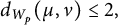 $$ \begin{align} d_{W_p}(\mu, \nu) \leq 2, \end{align} $$
with equality if and only if the supports $\mathrm {supp}(\mu )$
and
$\mathrm {supp}(\mu )$
and $\mathrm {supp}(\nu ) $
are contained in two opposite sides of Q. To see this, note that inequality (3.25) follows immediately from the definition of the Wasserstein metric
$\mathrm {supp}(\nu ) $
are contained in two opposite sides of Q. To see this, note that inequality (3.25) follows immediately from the definition of the Wasserstein metric $d_{W_p}$
and the fact that
$d_{W_p}$
and the fact that $d_{\mathrm {{m}}}(x,y) \leq 2$
for all
$d_{\mathrm {{m}}}(x,y) \leq 2$
for all ${x,y\in Q}$
. Furthermore, if
${x,y\in Q}$
. Furthermore, if $\mathrm {supp}(\mu )$
and
$\mathrm {supp}(\mu )$
and $\mathrm {supp}(\nu ) $
are contained in two opposite sides of Q, then
$\mathrm {supp}(\nu ) $
are contained in two opposite sides of Q, then $d_{\mathrm {{m}}}(x,y) = 2$
for all
$d_{\mathrm {{m}}}(x,y) = 2$
for all $x\in \mathrm {supp} (\mu )$
and
$x\in \mathrm {supp} (\mu )$
and $y\in \mathrm {supp}(\nu )$
.
$y\in \mathrm {supp}(\nu )$
.
Let $\pi _0 $
be an optimal coupling of
$\pi _0 $
be an optimal coupling of $\mu $
and
$\mu $
and $\nu $
. Since
$\nu $
. Since $\mathrm {supp}(\pi _0) \subseteq \mathrm {supp} (\mu ) \times \mathrm {supp} (\nu )$
we have that
$\mathrm {supp}(\pi _0) \subseteq \mathrm {supp} (\mu ) \times \mathrm {supp} (\nu )$
we have that $d_{\mathrm {{m}}}(x,y)= 2$
for any
$d_{\mathrm {{m}}}(x,y)= 2$
for any $(x,y) \in \mathrm {supp} (\pi _0)$
and therefore
$(x,y) \in \mathrm {supp} (\pi _0)$
and therefore
 $$ \begin{align*}d_{W_p}^p(\mu, \nu) = \int\limits_{Q\times Q} d_{\mathrm{{m}}}^p(x,y) ~\mathrm{d}\pi_0(x,y) = 2^p.\end{align*} $$
To show the converse, let us assume that $d_{W_p}^p(\mu , \nu ) = 2^p$
. Then for all couplings
$d_{W_p}^p(\mu , \nu ) = 2^p$
. Then for all couplings ${\pi \in C(\mu , \nu )}$
we have
${\pi \in C(\mu , \nu )}$
we have
 $$ \begin{align*}2^p =d_{W_p}^p(\mu, \nu)= \int\limits_{Q\times Q} d_{\mathrm{{m}}}^p(x,y) ~\mathrm{d}\pi(x,y) \leq \int\limits_{Q\times Q} 2^p ~\mathrm{d}\pi(x,y) = 2^p,\end{align*} $$
thus $d_{\mathrm {{m}}}(x,y) =2 $
for
$d_{\mathrm {{m}}}(x,y) =2 $
for $\pi $
almost all
$\pi $
almost all $(x,y)$
. This applies for
$(x,y)$
. This applies for $\pi = \mu \otimes \nu $
, and so
$\pi = \mu \otimes \nu $
, and so $\mu $
and
$\mu $
and $\nu $
must be concentrated on the opposite sides of Q.
$\nu $
must be concentrated on the opposite sides of Q.
The statement of the lemma is now an immediate consequence of this claim. Indeed, assume that $\mathrm {supp}(\mu )$
and
$\mathrm {supp}(\mu )$
and $\mathrm {supp}(\nu ) $
are contained in two opposite sides of Q. Then we have
$\mathrm {supp}(\nu ) $
are contained in two opposite sides of Q. Then we have $d_{W_p}^p(\mu , \nu )=2^p$
. Since
$d_{W_p}^p(\mu , \nu )=2^p$
. Since $\Phi : \mathcal {W}_p(Q,d_{\mathrm {{m}}}) \to \mathcal {W}_p(Q,d_{\mathrm {{m}}})$
is an isometry, we have
$\Phi : \mathcal {W}_p(Q,d_{\mathrm {{m}}}) \to \mathcal {W}_p(Q,d_{\mathrm {{m}}})$
is an isometry, we have $d_{W_p}^p(\Phi (\mu ), \Phi (\nu ))=2^p.$
But, then the supports of the two measures
$d_{W_p}^p(\Phi (\mu ), \Phi (\nu ))=2^p.$
But, then the supports of the two measures $\Phi (\mu )$
and
$\Phi (\mu )$
and $\Phi (\nu )$
must be contained in two opposite sides of Q.
$\Phi (\nu )$
must be contained in two opposite sides of Q.
Corollary 3.8 Let us fix a $p\geq 1$
and denote by
$p\geq 1$
and denote by $ D= \{ x_1, x_2, x_3, x_4 \} $
the set of vertices of Q and let V be the set of Dirac measures supported on the points of D, i.e.,
$ D= \{ x_1, x_2, x_3, x_4 \} $
the set of vertices of Q and let V be the set of Dirac measures supported on the points of D, i.e.,
 $$ \begin{align*}V=\{ \delta _{x_1} = \delta_{(-1,-1)} , \delta_{x_2} =\delta_{(1,-1)} , \delta_{x_3}=\delta_{(1,1)}, \delta_{x_4} = \delta_{(-1,1)} \}.\end{align*} $$
Given any isometry $\Phi : \mathcal {W}_p(Q,d_{\mathrm {{m}}}) \to \mathcal {W}_p(Q,d_{\mathrm {{m}}})$
, there exists an isometry
$\Phi : \mathcal {W}_p(Q,d_{\mathrm {{m}}}) \to \mathcal {W}_p(Q,d_{\mathrm {{m}}})$
, there exists an isometry $\Psi : (Q, d_{\mathrm {{m}}}) \to (Q, d_{\mathrm {{m}}})$
such that
$\Psi : (Q, d_{\mathrm {{m}}}) \to (Q, d_{\mathrm {{m}}})$
such that $\Phi \circ \Psi _{\#} (\delta _x) = \delta _x$
for all
$\Phi \circ \Psi _{\#} (\delta _x) = \delta _x$
for all $x\in D$
.
$x\in D$
.
Proof Let us denote by $S_1, S_3$
the two vertical and by
$S_1, S_3$
the two vertical and by $S_2, S_4$
the two horizontal sides of Q such that
$S_2, S_4$
the two horizontal sides of Q such that $S_1$
is the left vertical and
$S_1$
is the left vertical and $S_4$
is the top horizontal side.
$S_4$
is the top horizontal side.
We apply Lemma 3.7 to every pair of elements of $V,$
and we conclude that for every
$V,$
and we conclude that for every $j \in \{1,2,3,4\},$
the measure
$j \in \{1,2,3,4\},$
the measure $\Phi (\delta _{x_j})$
is supported on a certain side
$\Phi (\delta _{x_j})$
is supported on a certain side $S_i$
of
$S_i$
of $Q.$
$Q.$
We claim that each $\Phi (\delta _{x_j})$
must be in fact supported on some vertex. To see this we argue by contradiction. Let us assume that for example
$\Phi (\delta _{x_j})$
must be in fact supported on some vertex. To see this we argue by contradiction. Let us assume that for example $\Phi (\delta _{x_1})$
is supported on one of the sides, say
$\Phi (\delta _{x_1})$
is supported on one of the sides, say $S_1$
but not on any of the vertices of
$S_1$
but not on any of the vertices of $S_1$
.
$S_1$
.
It is clear by Lemma 3.7 that all other measures $\Phi (\delta _{x_i})$
for
$\Phi (\delta _{x_i})$
for $i=2,3,4$
must be supported on the opposite side of
$i=2,3,4$
must be supported on the opposite side of $S_1$
, that is
$S_1$
, that is $S_3.$
But the mutual distance of any pair of these measures must be equal to
$S_3.$
But the mutual distance of any pair of these measures must be equal to $2$
which shows that any two of these three measures must be lying on opposite sides again, which is
$2$
which shows that any two of these three measures must be lying on opposite sides again, which is $S_2$
and
$S_2$
and $S_4$
. But there are only two possibilities for measures with support in
$S_4$
. But there are only two possibilities for measures with support in $S_2\cap S_3$
and
$S_2\cap S_3$
and $S_4 \cap S_3$
, namely the two Dirac masses on the vertices of
$S_4 \cap S_3$
, namely the two Dirac masses on the vertices of $S_3$
which gives a contradiction.
$S_3$
which gives a contradiction.
It is easy to see that there exists an isometry $\Psi : Q \to Q$
such that
$\Psi : Q \to Q$
such that $\Phi \circ \Psi _{\#}$
fixes
$\Phi \circ \Psi _{\#}$
fixes $\delta _{x_i}$
and
$\delta _{x_i}$
and $\delta _{x_{i+1}}$
for some
$\delta _{x_{i+1}}$
for some $i \in \{1,2,3,4\},$
and therefore we can assume without loss of generality that
$i \in \{1,2,3,4\},$
and therefore we can assume without loss of generality that $(\Phi \circ \Psi _{\#})(\delta _{x_i})=\delta _{x_i}$
for
$(\Phi \circ \Psi _{\#})(\delta _{x_i})=\delta _{x_i}$
for $i=1,2.$
This will imply that all measures supported on
$i=1,2.$
This will imply that all measures supported on $S_4$
are fixed. We must show that
$S_4$
are fixed. We must show that $\Phi \circ \Psi _{\#} (\delta _{x_i}) = \delta _{x_i}$
for
$\Phi \circ \Psi _{\#} (\delta _{x_i}) = \delta _{x_i}$
for $i=3,4$
. Note, that the map
$i=3,4$
. Note, that the map
 $$ \begin{align*}\Phi \circ \Psi_{\#}: \mathcal{W}_p(Q,d_{\mathrm{{m}}}) \to \mathcal{W}_p(Q,d_{\mathrm{{m}}})\end{align*} $$
is itself an isometry. Let us assume indirectly that $\Phi \circ \Psi _{\#} (\delta _{x_3}) = \delta _{x_4}$
(which implies that and
$\Phi \circ \Psi _{\#} (\delta _{x_3}) = \delta _{x_4}$
(which implies that and $\Phi \circ \Psi _{\#} (\delta _{x_4}) = \delta _{x_3}$
), and take a
$\Phi \circ \Psi _{\#} (\delta _{x_4}) = \delta _{x_3}$
), and take a $\xi $
such that
$\xi $
such that $\mathrm {supp}(\xi )\subseteq S_3$
,
$\mathrm {supp}(\xi )\subseteq S_3$
, $\xi \notin \{\delta _{x_2},\delta _{x_3}\}$
. Since
$\xi \notin \{\delta _{x_2},\delta _{x_3}\}$
. Since $d_{W_p}(\delta _{x_1},\xi )=2$
, we have
$d_{W_p}(\delta _{x_1},\xi )=2$
, we have
 $$ \begin{align*}2=d_{W_p}(\delta_{x_1},\xi)=d_{W_p}(\Phi(\delta_{x_1}),\Phi(\xi))=d_{W_p}(\delta_{x_1},\Phi(\xi)), \end{align*} $$
which implies that $\mathrm {supp}(\Phi (\xi ))\subseteq S_3\cup S_4$
. Similarly,
$\mathrm {supp}(\Phi (\xi ))\subseteq S_3\cup S_4$
. Similarly, $d_{W_p}(\delta _{x_4},\xi )=2$
, and thus
$d_{W_p}(\delta _{x_4},\xi )=2$
, and thus
 $$ \begin{align*}2=d_{W_p}(\delta_{x_4},\xi)=d_{W_p}(\Phi(\delta_{x_4}),\Phi(\xi))=d_{W_p}(\delta_{x_3},\Phi(\xi)), \end{align*} $$
which implies that $\mathrm {supp}(\Phi (\xi ))\subseteq S_1\cup S_2$
. Combining
$\mathrm {supp}(\Phi (\xi ))\subseteq S_1\cup S_2$
. Combining $\mathrm {supp}(\Phi (\xi ))\subseteq S_1\cup S_2$
and
$\mathrm {supp}(\Phi (\xi ))\subseteq S_1\cup S_2$
and $\mathrm {supp}(\Phi (\xi ))\subseteq S_3\cup S_4$
with
$\mathrm {supp}(\Phi (\xi ))\subseteq S_3\cup S_4$
with $\xi \notin \{\delta _{x_2},\delta _{x_3}\}$
, we get that
$\xi \notin \{\delta _{x_2},\delta _{x_3}\}$
, we get that $\Phi (\xi )=\alpha ^{\ast }\delta _{x_2}+(1-\alpha ^{\ast }) \delta _{x_4}$
for some
$\Phi (\xi )=\alpha ^{\ast }\delta _{x_2}+(1-\alpha ^{\ast }) \delta _{x_4}$
for some $\alpha ^{\ast }\in (0,1).$
(Recall that
$\alpha ^{\ast }\in (0,1).$
(Recall that $\Phi (\delta _{x_2})=\delta _{x_2}$
,
$\Phi (\delta _{x_2})=\delta _{x_2}$
, $\Phi (\delta _{x_3})=\delta _{x_4}$
, and
$\Phi (\delta _{x_3})=\delta _{x_4}$
, and $\Phi $
is injective.) If
$\Phi $
is injective.) If $p>1$
, then this is a contradiction. Indeed, choose
$p>1$
, then this is a contradiction. Indeed, choose $\xi :=\delta _y$
with
$\xi :=\delta _y$
with $y\in S_3\setminus \{x_2,x_3\}$
, and observe that the triple
$y\in S_3\setminus \{x_2,x_3\}$
, and observe that the triple $\delta _{x_2}$
,
$\delta _{x_2}$
, $\delta _y$
, and
$\delta _y$
, and $\delta _{x_3}$
saturates the triangle inequality, but the triple
$\delta _{x_3}$
saturates the triangle inequality, but the triple $\Phi (\delta _{x_2})=\delta _{x_2}$
,
$\Phi (\delta _{x_2})=\delta _{x_2}$
, $\Phi (\delta _y)=\alpha ^{\ast }\delta _{x_2}+(1-\alpha ^{\ast }) \delta _{x_4}$
and
$\Phi (\delta _y)=\alpha ^{\ast }\delta _{x_2}+(1-\alpha ^{\ast }) \delta _{x_4}$
and $\Phi (\delta _{x_3})=\delta _{x_4}$
does not, as
$\Phi (\delta _{x_3})=\delta _{x_4}$
does not, as $\sqrt [p]{2^p(1-\alpha ^{\ast })}+\sqrt [p]{2^p\alpha ^{\ast }}\neq 2$
. If
$\sqrt [p]{2^p(1-\alpha ^{\ast })}+\sqrt [p]{2^p\alpha ^{\ast }}\neq 2$
. If $p=1$
, we need a different argument. The set
$p=1$
, we need a different argument. The set $\mathcal {I}:=\{ \mu _{\alpha }:=\alpha \delta _{x_2}+(1-\alpha ) \delta _{x_4}\,|\,\alpha \in (0,1)\}$
is isometric to the set
$\mathcal {I}:=\{ \mu _{\alpha }:=\alpha \delta _{x_2}+(1-\alpha ) \delta _{x_4}\,|\,\alpha \in (0,1)\}$
is isometric to the set $\big ((0,1),2|\cdot |\big )$
, since
$\big ((0,1),2|\cdot |\big )$
, since ${d_{W_1}(\mu _{\alpha },\mu _{\beta })=|\alpha -\beta |}$
. Therefore for any three different elements
${d_{W_1}(\mu _{\alpha },\mu _{\beta })=|\alpha -\beta |}$
. Therefore for any three different elements $\mu _{\alpha _1}, \mu _{\alpha _3}$
, and
$\mu _{\alpha _1}, \mu _{\alpha _3}$
, and $\mu _{\alpha _3}$
there exists a bijection
$\mu _{\alpha _3}$
there exists a bijection $\sigma :\{1,2,3\}\to \{1,2,3\}$
such that
$\sigma :\{1,2,3\}\to \{1,2,3\}$
such that $d_{W_1}(\mu _{\alpha _{\sigma (1)}},\mu _{\alpha _{\sigma (3)}})=(\mu _{\alpha _{\sigma (1)}},\mu _{\alpha _{\sigma (2)}})+(\mu _{\alpha _{\sigma (2)}},\mu _{\alpha _{\sigma (3)}})$
. Now choose a non-degenerate triangle
$d_{W_1}(\mu _{\alpha _{\sigma (1)}},\mu _{\alpha _{\sigma (3)}})=(\mu _{\alpha _{\sigma (1)}},\mu _{\alpha _{\sigma (2)}})+(\mu _{\alpha _{\sigma (2)}},\mu _{\alpha _{\sigma (3)}})$
. Now choose a non-degenerate triangle $\xi _1,\xi _2,$
and
$\xi _1,\xi _2,$
and $\xi _3$
supported on
$\xi _3$
supported on $S_3\setminus \{x_2,x_3\}$
in the sense that they do not saturate the triangle inequality in any order. The existence of such a triple is a contradiction, as an appropriate permutation of their image in
$S_3\setminus \{x_2,x_3\}$
in the sense that they do not saturate the triangle inequality in any order. The existence of such a triple is a contradiction, as an appropriate permutation of their image in $\mathcal {I}$
will saturate the triangle inequality.
$\mathcal {I}$
will saturate the triangle inequality.
From now on we shall assume without loss of generality that our isometry
 $$ \begin{align*}\Phi: \mathcal{W}_p(Q,d_{\mathrm{{m}}}) \to \mathcal{W}_p(Q,d_{\mathrm{{m}}})\end{align*} $$
fixes the elements of V, i.e., the Dirac masses on the corners of Q. Note that this property implies by Lemma 3.7 that any measure supported on one of the sides of Q will be mapped to a measure supported on the same side of Q.
In what follows we shall prove, even a stronger property for measures supported on the main diagonals
 $$ \begin{align*}L_+ = \{ (t,t): t\in [-1,1] \}, \ \textrm{and } \ L_- = \{ (t,-t): t\in [-1,1] \},\end{align*} $$
namely, that they are fixed under the action of the isometry. This is valid for the case $p=1$
.
$p=1$
.
Theorem 3.9 The Wasserstein space $\mathcal {W}_1(Q,d_{\mathrm {{m}}})$
is diagonally rigid.
$\mathcal {W}_1(Q,d_{\mathrm {{m}}})$
is diagonally rigid.
Proof By Corollary 3.8, we can assume without loss of generality that $\Phi $
fixes the Dirac masses at the four corners of Q. It is enough to show that if
$\Phi $
fixes the Dirac masses at the four corners of Q. It is enough to show that if $\mu \in \mathcal {W}_1(Q,d_{\mathrm {{m}}})$
supported on
$\mu \in \mathcal {W}_1(Q,d_{\mathrm {{m}}})$
supported on $L_+ $
, then
$L_+ $
, then $\Phi (\mu )=\mu $
as the case of
$\Phi (\mu )=\mu $
as the case of $L_{-}$
is similar. We show first that if
$L_{-}$
is similar. We show first that if $\mathrm {supp}(\mu ) \subseteq L_+$
, then
$\mathrm {supp}(\mu ) \subseteq L_+$
, then $\mathrm {supp}\big (\Phi (\mu )\big ) \subseteq L_+$
. This is based on the following observation: If
$\mathrm {supp}\big (\Phi (\mu )\big ) \subseteq L_+$
. This is based on the following observation: If $x \in Q $
then
$x \in Q $
then
 $$ \begin{align} d_{\mathrm{{m}}}((-1,-1), x ) + d_{\mathrm{{m}}}(x, (1,1))\geq d_{\mathrm{{m}}}((-1,-1), (1,1)) = 2 \end{align} $$
with equality if and only if $x \in L_+$
.
$x \in L_+$
.
The above inequality follows simply by the triangle inequality applied for the metric $d_{\mathrm {{m}}}$
. The characterization of the equality case is slightly more tricky. It is based on the fact that the line segment
$d_{\mathrm {{m}}}$
. The characterization of the equality case is slightly more tricky. It is based on the fact that the line segment $ L_+: t\to (t,t), t\in [-1,1] $
is the only geodesic with respect to the metric
$ L_+: t\to (t,t), t\in [-1,1] $
is the only geodesic with respect to the metric $d_{\mathrm {{m}}}$
connecting the endpoints
$d_{\mathrm {{m}}}$
connecting the endpoints $(-1,-1)$
and
$(-1,-1)$
and $(1,1)$
. This observation has the following consequence for measures: If
$(1,1)$
. This observation has the following consequence for measures: If $\mu \in \mathcal {W}_1(Q,d_{\mathrm {{m}}})$
, then
$\mu \in \mathcal {W}_1(Q,d_{\mathrm {{m}}})$
, then
 $$ \begin{align} d_{W_1}(\delta_{(-1,-1)}, \mu) + d_{W_1}(\mu, \delta_{(1,1)}) \geq 2, \end{align} $$
with equality if and only if $\mathrm {supp}(\mu ) \subseteq L_+$
. To show inequality (3.27), we integrate inequality (3.26) with respect to
$\mathrm {supp}(\mu ) \subseteq L_+$
. To show inequality (3.27), we integrate inequality (3.26) with respect to $\mu $
. In this way, we obtain
$\mu $
. In this way, we obtain
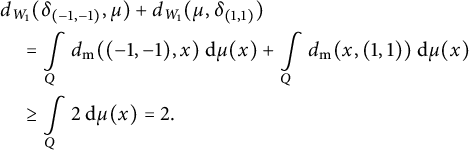 $$ \begin{align} \begin{aligned} & d_{W_1}(\delta_{(-1,-1)}, \mu) + d_{W_1}(\mu, \delta_{(1,1)})\\ &\quad = \int\limits_{Q}d_{\mathrm{{m}}}((-1,-1), x )~\mathrm{d}\mu(x) + \int\limits_{Q} d_{\mathrm{{m}}}(x, (1,1)) ~\mathrm{d}\mu(x) \\ &\quad \geq \int\limits_Q 2~\mathrm{d}\mu(x) = 2. \end{aligned} \end{align} $$
Let us assume that $\mathrm {supp}(\mu ) \subseteq L_+$
. Then equality holds true in (3.26) for every point
$\mathrm {supp}(\mu ) \subseteq L_+$
. Then equality holds true in (3.26) for every point $x\in \mathrm {supp} (\mu )$
and thus by integrating, we obtain that equality holds in (3.28) as well.
$x\in \mathrm {supp} (\mu )$
and thus by integrating, we obtain that equality holds in (3.28) as well.
Conversely, let us assume, that
 $$ \begin{align*}d_{W_1}( \delta_{(-1,-1)},\mu) + d_{W_1}(\mu, \delta_{(1,1)}) = 2\end{align*} $$
for some measure $\mu \in \mathcal {W}_1(Q,d_{\mathrm {{m}}})$
. We have to show that
$\mu \in \mathcal {W}_1(Q,d_{\mathrm {{m}}})$
. We have to show that $\mathrm {supp}(\mu ) \subseteq L_+$
. We argue by contradiction: assume that the exists a point
$\mathrm {supp}(\mu ) \subseteq L_+$
. We argue by contradiction: assume that the exists a point $x_0 \in \mathrm {supp}( \mu )$
that is not contained in
$x_0 \in \mathrm {supp}( \mu )$
that is not contained in $L_+$
. Then there exists a small radius
$L_+$
. Then there exists a small radius $r>0$
and a small
$r>0$
and a small $\varepsilon>0$
with the property that
$\varepsilon>0$
with the property that $\delta = \mu (B(x_0, r)>0 $
and
$\delta = \mu (B(x_0, r)>0 $
and
 $$ \begin{align*}d_{\mathrm{{m}}}((-1,-1), x) + d_{\mathrm{{m}}}(x,(1,1))>2 +\varepsilon , \ \textrm{for all} \ x \in B(x_0,r).\end{align*} $$
Using this relation, we obtain
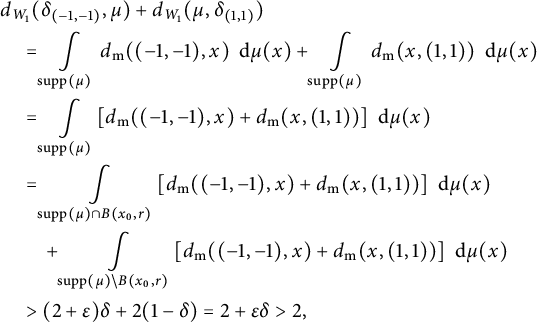 $$ \begin{align*} &d_{W_1}( \delta_{(-1,-1)},\mu) + d_{W_1}(\mu, \delta_{(1,1)}) \\ &\quad = \int\limits_{\mathrm{supp}(\mu)}d_{\mathrm{{m}}}((-1,-1), x )\ ~\mathrm{d}\mu(x) + \int\limits_{\mathrm{supp}(\mu)} d_{\mathrm{{m}}}(x,(1,1)) \ ~\mathrm{d}\mu(x) \\ &\quad = \int\limits_{\mathrm{supp}(\mu)}[d_{\mathrm{{m}}}((-1,-1), x ) + d_{\mathrm{{m}}}(x, (1,1))] \ ~\mathrm{d}\mu(x) \\ &\quad = \int\limits_{\mathrm{supp}(\mu) \cap B(x_0,r)}[d_{\mathrm{{m}}}((-1,-1), x ) + d_{\mathrm{{m}}}(x,(1,1)) ]\ ~\mathrm{d}\mu(x) \\ & \qquad + \int\limits_{\mathrm{supp}(\mu) \setminus B(x_0,r)}[d_{\mathrm{{m}}}((-1,-1), x ) + d_{\mathrm{{m}}}(x,(1,1) ) ] \ ~\mathrm{d}\mu(x)\\ &\quad > (2+\varepsilon) \delta + 2(1-\delta)= 2+\varepsilon\delta >2, \end{align*} $$
which is a contradiction. Let us consider an isometry $\Phi : \mathcal {W}_1(Q,d_{\mathrm {{m}}}) \to \mathcal {W}_1(Q,d_{\mathrm {{m}}})$
that fixes the elements of V (i.e., the Dirac masses on the corners of Q). Then we have
$\Phi : \mathcal {W}_1(Q,d_{\mathrm {{m}}}) \to \mathcal {W}_1(Q,d_{\mathrm {{m}}})$
that fixes the elements of V (i.e., the Dirac masses on the corners of Q). Then we have
 $$ \begin{align*}d_{W_1}(\delta_{(-1,-1)},\Phi(\mu))+ d_{W_1}(\Phi(\mu),\delta_{(1,1)}) = d_{W_1}(\delta_{(-1,-1)},\mu))+ d_{W_1}(\mu,\delta_{(1,1)}).\end{align*} $$
Assuming that $\mathrm {supp}(\mu ) \subseteq L_+$
we obtain that by the above that
$\mathrm {supp}(\mu ) \subseteq L_+$
we obtain that by the above that
 $$ \begin{align*}d_{W_1}(\delta_{(-1,-1)},\mu))+ d_{W_1}(\mu,\delta_{(1,1)})=2.\end{align*} $$
By the above equality we have, then
 $$ \begin{align*}d_{W_1}(\delta_{(-1,-1)},\Phi(\mu))+ d_{W_1}(\Phi(\mu),\delta_{(1,1)})=2,\end{align*} $$
which implies in turn that $\mathrm {supp}\big (\Phi (\mu )\big ) \subseteq L_+$
.
$\mathrm {supp}\big (\Phi (\mu )\big ) \subseteq L_+$
.
As mentioned at the beginning of the proof, the same argument shows that if we have $\mathrm {supp}(\mu ) \subseteq L_-$
, then it follows that
$\mathrm {supp}(\mu ) \subseteq L_-$
, then it follows that $\mathrm {supp}\big (\Phi (\mu )\big ) \subseteq L_-$
as well. Since
$\mathrm {supp}\big (\Phi (\mu )\big ) \subseteq L_-$
as well. Since $\mu _0=\delta _{(0,0)}$
has its support in
$\mu _0=\delta _{(0,0)}$
has its support in $L_+ \cap L_-$
, and it is the unique measure with this property, we conclude, that
$L_+ \cap L_-$
, and it is the unique measure with this property, we conclude, that $\Phi (\mu _0) = \mu _0$
. Now let us consider the Wasserstein space
$\Phi (\mu _0) = \mu _0$
. Now let us consider the Wasserstein space $\mathcal {W}_1(L_+,d_{\mathrm {{m}}})$
of measures supported on
$\mathcal {W}_1(L_+,d_{\mathrm {{m}}})$
of measures supported on $L_+$
. By the above consideration, we have
$L_+$
. By the above consideration, we have
 $$ \begin{align*}\Phi:\mathcal{W}_1(L_+,d_{\mathrm{{m}}}) \to \mathcal{W}_1(L_+,d_{\mathrm{{m}}}),\end{align*} $$
moreover, we know that $\Phi (\mu _0) = \mu _0$
for the measure
$\Phi (\mu _0) = \mu _0$
for the measure $\mu _0=\delta _{(0,0)}\in \mathcal {W}_1(L_+,d_{\mathrm {{m}}}) $
. We cannot apply the characterization of Wasserstein isometries on a line segment (see [Reference Gy, Gehér and Titkos10, Theorem 2.5]) which implies that
$\mu _0=\delta _{(0,0)}\in \mathcal {W}_1(L_+,d_{\mathrm {{m}}}) $
. We cannot apply the characterization of Wasserstein isometries on a line segment (see [Reference Gy, Gehér and Titkos10, Theorem 2.5]) which implies that $\Phi (\mu ) = \mu $
for all measures
$\Phi (\mu ) = \mu $
for all measures $\mu \in \mathcal {W}_1(L_+,d_{\mathrm {{m}}}) $
. In the same way we can also conclude, that
$\mu \in \mathcal {W}_1(L_+,d_{\mathrm {{m}}}) $
. In the same way we can also conclude, that $\Phi (\mu ) = \mu $
for all measures
$\Phi (\mu ) = \mu $
for all measures $\mu \in \mathcal {W}_1(L_-,d_{\mathrm {{m}}}) $
.
$\mu \in \mathcal {W}_1(L_-,d_{\mathrm {{m}}}) $
.
The combination of Proposition 2.1 and Theorem 3.9 implies that $\mathcal {W}_1(Q,d_{\mathrm {{m}}})$
is isometrically rigid.
$\mathcal {W}_1(Q,d_{\mathrm {{m}}})$
is isometrically rigid.
3.4 Diagonal rigidity of
$\mathcal {W}_p(Q,d_{\mathrm {{m}}})$
for
$p>1$


In this final subsection, we consider the case $X= Q= [-1,1]^2$
and
$X= Q= [-1,1]^2$
and $p>1$
. In this case, we also have the following statement.
$p>1$
. In this case, we also have the following statement.
Theorem 3.10 The Wasserstein space $\mathcal {W}_p(Q,d_{\mathrm {{m}}})$
is diagonally rigid.
$\mathcal {W}_p(Q,d_{\mathrm {{m}}})$
is diagonally rigid.
Proof Let $\Phi $
be an isometry of the Wasserstein space
$\Phi $
be an isometry of the Wasserstein space $\mathcal {W}_p(Q,d_{\mathrm {{m}}})$
. Since the Wasserstein space
$\mathcal {W}_p(Q,d_{\mathrm {{m}}})$
. Since the Wasserstein space $\mathcal {W}_p([-1,1],d_{|\cdot |})$
is isometrically rigid, Corollary 3.8 and the remark after that, implies that we can assume without loss of generality that
$\mathcal {W}_p([-1,1],d_{|\cdot |})$
is isometrically rigid, Corollary 3.8 and the remark after that, implies that we can assume without loss of generality that $\Phi $
leaves every measure supported either on the right vertical side
$\Phi $
leaves every measure supported either on the right vertical side $[(1,-1),(1,1)]$
or on the top horizontal side
$[(1,-1),(1,1)]$
or on the top horizontal side $[(-1,1),(1,1)]$
fixed. We are going to show that
$[(-1,1),(1,1)]$
fixed. We are going to show that $\Phi $
leaves every measure supported on the line diagonal segment
$\Phi $
leaves every measure supported on the line diagonal segment $[(-1,-1),(1,1)] \subset Q$
fixed. The case of the other diagonal is analogous.
$[(-1,-1),(1,1)] \subset Q$
fixed. The case of the other diagonal is analogous.
In the first step, we consider measures supported on the upper half of the diagonal, i.e., on the line segment $[(0,0),(1,1)]$
. We prove first that these measures will be fixed. In the second step, we proceed to consider general measures supported on the full segment
$[(0,0),(1,1)]$
. We prove first that these measures will be fixed. In the second step, we proceed to consider general measures supported on the full segment $[(-1,-1),(1,1)]$
.
$[(-1,-1),(1,1)]$
.
Let $\mu $
be a measure supported on the upper half of the diagonal of Q (that is, on
$\mu $
be a measure supported on the upper half of the diagonal of Q (that is, on $[(0,0),(1,1)]$
), and consider the projections
$[(0,0),(1,1)]$
), and consider the projections $p_r: \, (t,t) \mapsto (1, 2t-1)$
and
$p_r: \, (t,t) \mapsto (1, 2t-1)$
and $p_u: (t,t) \mapsto (2t-1,1)$
that map
$p_u: (t,t) \mapsto (2t-1,1)$
that map $[(0,0),(1,1)]$
onto the right vertical side
$[(0,0),(1,1)]$
onto the right vertical side $[(1,-1),(1,1)]$
and the top horizontal side
$[(1,-1),(1,1)]$
and the top horizontal side $[(-1,1),(1,1)],$
respectively (Figure 7). Let us introduce the notation
$[(-1,1),(1,1)],$
respectively (Figure 7). Let us introduce the notation $\mu _r:=(p_r)_{\#}(\mu )\quad \mbox {and}$
and
$\mu _r:=(p_r)_{\#}(\mu )\quad \mbox {and}$
and $\mu _u:=(p_u)_{\#}(\mu )$
.
$\mu _u:=(p_u)_{\#}(\mu )$
.
Illustration for the definition of $p_u$
,
$p_u$
, $p_r$
,
$p_r$
, $\mu _u$
, and
$\mu _u$
, and $\mu _r$
.
$\mu _r$
.
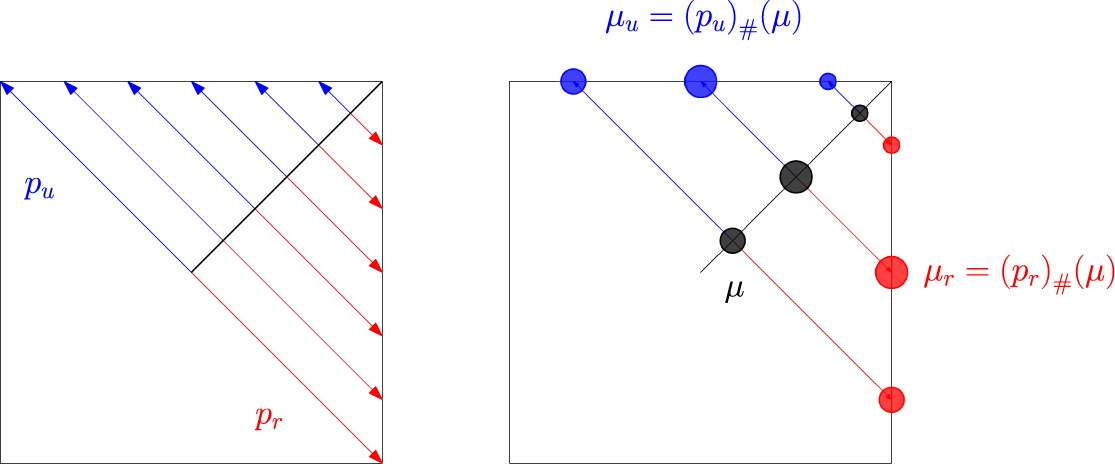
Our goal is to show that $\mu $
is the unique minimizer of the functional
$\mu $
is the unique minimizer of the functional
 $$ \begin{align} \mathcal{W}_p(Q,d_{\mathrm{{m}}}) \ni \nu \mapsto d_{W_p}^p(\mu_r, \nu)+d_{W_p}^p(\nu, \mu_u). \end{align} $$
Once this is proved, we are done, as in this case the equation
 $$ \begin{align} \begin{aligned} d_{W_p}^p(\mu_r, \Phi(\mu))+d_{W_p}^p(\Phi(\mu), \mu_u)&=d_{W_p}^p(\Phi(\mu_r), \Phi(\mu))+d_{W_p}^p(\Phi(\mu), \Phi(\mu_u)) \\ &=d_{W_p}^p(\mu_r,\mu)+d_{W_p}^p(\mu, \mu_u) \\ &=\min_{\nu \in \mathcal{W}_p(Q,d_{\mathrm{{m}}})}(d_{W_p}^p(\mu_r, \nu)+d_{W_p}^p(\nu, \mu_u)) \end{aligned} \end{align} $$
forces $\Phi (\mu )$
to be
$\Phi (\mu )$
to be $\mu .$
Let $\nu \in \mathcal {W}_p(Q,d_{\mathrm {{m}}})$
be arbitrary, let
$\nu \in \mathcal {W}_p(Q,d_{\mathrm {{m}}})$
be arbitrary, let $\pi _{(\mu _r,\nu )}^*$
be an optimal transport plan between
$\pi _{(\mu _r,\nu )}^*$
be an optimal transport plan between $\mu _r$
and
$\mu _r$
and $\nu $
with respect to the cost
$\nu $
with respect to the cost $c(x,y)=d_{\mathrm {{m}}}^p(x,y)$
, let
$c(x,y)=d_{\mathrm {{m}}}^p(x,y)$
, let $\pi _{(\nu ,\mu _u)}^*$
be an optimal transport plan between
$\pi _{(\nu ,\mu _u)}^*$
be an optimal transport plan between $\nu $
and
$\nu $
and $\mu _u$
with respect to the same cost, and let
$\mu _u$
with respect to the same cost, and let $\pi _{(\mu _r,\nu ,\mu _u)}^* \in \mathrm {Prob}(Q^3)$
be the gluing of them—see the “gluing lemma” [Reference Villani16, Lemma 7.6] for further details of this construction. Moreover, set
$\pi _{(\mu _r,\nu ,\mu _u)}^* \in \mathrm {Prob}(Q^3)$
be the gluing of them—see the “gluing lemma” [Reference Villani16, Lemma 7.6] for further details of this construction. Moreover, set $\pi _{(\mu _r,\mu _u)}^*:=\left ( \pi _{(\mu _r,\nu ,\mu _u)}^* \right )_{13}.$
Now
$\pi _{(\mu _r,\mu _u)}^*:=\left ( \pi _{(\mu _r,\nu ,\mu _u)}^* \right )_{13}.$
Now
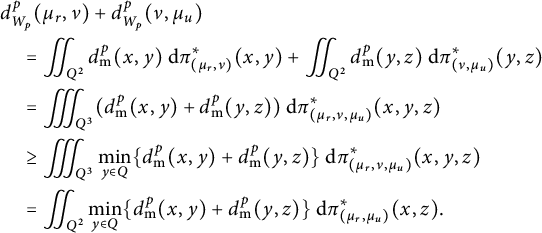 $$ \begin{align} \begin{aligned} & d_{W_p}^p(\mu_r, \nu)+d_{W_p}^p(\nu, \mu_u) \\ & \quad =\iint_{Q^2}d_{\mathrm{{m}}}^p(x,y) ~\mathrm{d} \pi_{(\mu_r,\nu)}^*(x,y)+\iint_{Q^2}d_{\mathrm{{m}}}^p(y,z) ~\mathrm{d} \pi_{(\nu,\mu_u)}^*(y,z) \\ &\quad =\iiint_{Q^3} (d_{\mathrm{{m}}}^p(x,y)+d_{\mathrm{{m}}}^p(y,z)) ~\mathrm{d} \pi_{(\mu_r,\nu,\mu_u)}^*(x,y,z) \\ &\quad \geq \iiint_{Q^3} \min_{y \in Q}\{d_{\mathrm{{m}}}^p(x,y)+d_{\mathrm{{m}}}^p(y,z)\} ~\mathrm{d} \pi_{(\mu_r,\nu,\mu_u)}^*(x,y,z) \\ &\quad = \iint_{Q^2} \min_{y \in Q}\{d_{\mathrm{{m}}}^p(x,y)+d_{\mathrm{{m}}}^p(y,z)\} ~\mathrm{d} \pi_{(\mu_r,\mu_u)}^*(x,z). \end{aligned} \end{align} $$
Let us compute $\min _{y \in Q}\{d_{\mathrm {{m}}}^p(x,y)+d_{\mathrm {{m}}}^p(y,z)\}$
for any
$\min _{y \in Q}\{d_{\mathrm {{m}}}^p(x,y)+d_{\mathrm {{m}}}^p(y,z)\}$
for any $(x,z) \in Q^2$
— the case
$(x,z) \in Q^2$
— the case $x=z$
gives a trivial zero. By the reversed triangle inequality, we have
$x=z$
gives a trivial zero. By the reversed triangle inequality, we have
 $$ \begin{align*}d_{\mathrm{{m}}}^p(x,y) \geq |d_{\mathrm{{m}}}(x,z)-d_{\mathrm{{m}}}(y,z)|^p=d_{\mathrm{{m}}}^p(x,z)\left| 1 -\frac{d_{\mathrm{{m}}}(y,z)}{d_{\mathrm{{m}}}(x,z)}\right|^p. \end{align*} $$
Consequently,
 $$ \begin{align*}d_{\mathrm{{m}}}^p(x,y)+d_{\mathrm{{m}}}^p(y,z) \geq d_{\mathrm{{m}}}^p(x,z) \left( \left| 1 -\frac{d_{\mathrm{{m}}}(y,z)}{d_{\mathrm{{m}}}(x,z)}\right|^p + \left| \frac{d_{\mathrm{{m}}}(y,z)}{d_{\mathrm{{m}}}(x,z)}\right|^p\right). \end{align*} $$
It is crucial that $p>1$
and hence the map
$p>1$
and hence the map $t \mapsto |t|^p$
is strictly convex on
$t \mapsto |t|^p$
is strictly convex on $\mathbb {R}.$
Therefore, the function
$\mathbb {R}.$
Therefore, the function $\mathbb {R} \ni \lambda \mapsto |1-\lambda |^p+|\lambda |^p$
has a unique minimizer which is
$\mathbb {R} \ni \lambda \mapsto |1-\lambda |^p+|\lambda |^p$
has a unique minimizer which is $\lambda _0=\frac {1}{2},$
and the minimum is
$\lambda _0=\frac {1}{2},$
and the minimum is $2^{1-p}$
— this can be justified by simple one-variable calculus. To sum up,
$2^{1-p}$
— this can be justified by simple one-variable calculus. To sum up,
 $$ \begin{align*}\min_{y \in Q}\{d_{\mathrm{{m}}}^p(x,y)+d_{\mathrm{{m}}}^p(y,z)\}=2^{1-p} d_{\mathrm{{m}}}^p(x,z), \end{align*} $$
and this minimum is achieved if and only if $d_{\mathrm {{m}}}(x,y)=d_{\mathrm {{m}}}(y,z)=\frac {1}{2}d_{\mathrm {{m}}}(x,z)$
—note that this does not imply that
$d_{\mathrm {{m}}}(x,y)=d_{\mathrm {{m}}}(y,z)=\frac {1}{2}d_{\mathrm {{m}}}(x,z)$
—note that this does not imply that $y=\frac {1}{2}(x+z).$
So we can continue (3.31) as follows:
$y=\frac {1}{2}(x+z).$
So we can continue (3.31) as follows:
 $$ \begin{align} \begin{aligned} \iint_{Q^2} \min_{y \in Q}\{d_{\mathrm{{m}}}^p(x,y)+d_{\mathrm{{m}}}^p(y,z)\} ~\mathrm{d} \pi_{(\mu_r,\mu_u)}^*(x,z)&=2^{1-p} \iint_{Q^2} d_{\mathrm{{m}}}^p(x,z) ~\mathrm{d} \pi_{(\mu_r,\mu_u)}^*(x,z) \\ &\geq 2^{1-p} d_{W_p}^p(\mu_r,\mu_u). \end{aligned} \end{align} $$
The inequality in (3.32) is saturated if and only if $\pi _{(\mu _r,\mu _u)}^*$
is an optimal transport plan between
$\pi _{(\mu _r,\mu _u)}^*$
is an optimal transport plan between $\mu _r$
and
$\mu _r$
and $\mu _u$
with respect to the cost
$\mu _u$
with respect to the cost $c(x,z)=d_{\mathrm {{m}}}^p(x,z).$
Observe, that
$c(x,z)=d_{\mathrm {{m}}}^p(x,z).$
Observe, that $(p_r \times p_u)_{\#}(\mu )$
is the unique optimal transport plan between
$(p_r \times p_u)_{\#}(\mu )$
is the unique optimal transport plan between $\mu _r$
and
$\mu _r$
and $\mu _u$
for this cost. Indeed, by the definition of the max norm we get
$\mu _u$
for this cost. Indeed, by the definition of the max norm we get
 $$ \begin{align} (1-(2t-1))^p \leq d_{\mathrm{{m}}}^p((1, 2t-1),(2s-1,1)) \end{align} $$
and
 $$ \begin{align} (1-(2s-1))^p \leq d_{\mathrm{{m}}}^p((1, 2t-1),(2s-1,1)) \end{align} $$
for all $(s,t) \in [0,1] \times [0,1].$
By the construction of
$(s,t) \in [0,1] \times [0,1].$
By the construction of $\mu _r$
and
$\mu _r$
and $\mu _u,$
the couplings of these measures are in
$\mu _u,$
the couplings of these measures are in $1-1$
correspondence with the couplings of
$1-1$
correspondence with the couplings of $\mu $
with itself—now we consider
$\mu $
with itself—now we consider $\mu $
as a measure on
$\mu $
as a measure on $[0,1].$
This correspondence is described as follows: if
$[0,1].$
This correspondence is described as follows: if $\pi \in C(\mu _r,\mu _u),$
then let us define
$\pi \in C(\mu _r,\mu _u),$
then let us define $\tilde {\pi } \in C(\mu ,\mu )$
by
$\tilde {\pi } \in C(\mu ,\mu )$
by $\tilde {\pi }:=(p_r^{-1} \times p_u^{-1})_{\#} (\pi ).$
Then
$\tilde {\pi }:=(p_r^{-1} \times p_u^{-1})_{\#} (\pi ).$
Then
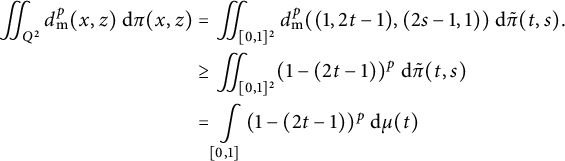 $$ \begin{align} \begin{aligned} \iint_{Q^2}d_{\mathrm{{m}}}^p(x,z) ~\mathrm{d} \pi(x,z)&=\iint_{[0,1]^2} d_{\mathrm{{m}}}^p((1, 2t-1),(2s-1,1)) ~\mathrm{d} \tilde{\pi}(t,s). \\ &\geq \iint_{[0,1]^2} (1-(2t-1))^p ~\mathrm{d} \tilde{\pi}(t,s) \\ &=\int\limits_{[0,1]} (1-(2t-1))^p ~\mathrm{d} \mu(t) \end{aligned} \end{align} $$
and (3.35) is saturated if and only if $s \geq t$
for
$s \geq t$
for $\tilde {\pi }-$
a.e.
$\tilde {\pi }-$
a.e. $(s,t).$
Using (3.34) we get
$(s,t).$
Using (3.34) we get
 $$ \begin{align*}\iint_{Q^2}d_{\mathrm{{m}}}^p(x,z) ~\mathrm{d} \pi(x,z) \geq \int\limits_{[0,1]} (1-(2s-1))^p ~\mathrm{d} \mu(s) \end{align*} $$
which is saturated if and only if $t \geq s$
for
$t \geq s$
for $\tilde {\pi }-$
a.e.
$\tilde {\pi }-$
a.e. $(s,t).$
Therefore, if
$(s,t).$
Therefore, if $\pi $
is an optimal coupling of
$\pi $
is an optimal coupling of $\mu _r$
and
$\mu _r$
and $\mu _u,$
then
$\mu _u,$
then $\tilde {\pi }$
is supported on the diagonal of
$\tilde {\pi }$
is supported on the diagonal of $[0,1]^2$
which implies that
$[0,1]^2$
which implies that $\tilde {\pi }=(id \times id)_{\#}(\mu )$
. This means that
$\tilde {\pi }=(id \times id)_{\#}(\mu )$
. This means that $\pi = (p_r \times p_u)_{\#}(\mu ).$
So
$\pi = (p_r \times p_u)_{\#}(\mu ).$
So $(p_r \times p_u)_{\#}(\mu )$
is the only optimal transport plan.
$(p_r \times p_u)_{\#}(\mu )$
is the only optimal transport plan.
At this point we know by (3.31) and (3.32) that
 $$ \begin{align} d_{W_p}^p(\mu_r, \nu)+d_{W_p}^p(\nu, \mu_u) \geq 2^{1-p} d_{W_p}^p(\mu_r,\mu_u), \end{align} $$
and (3.36) is saturated if and only if $\pi _{(\mu _r,\mu _u)}^*=(p_r \times p_u)_{\#}(\mu )$
and
$\pi _{(\mu _r,\mu _u)}^*=(p_r \times p_u)_{\#}(\mu )$
and $d_{\mathrm {{m}}}(x,y)=d_{\mathrm {{m}}}(y,z)=\frac {1}{2}d_{\mathrm {{m}}}(x,z)$
for
$d_{\mathrm {{m}}}(x,y)=d_{\mathrm {{m}}}(y,z)=\frac {1}{2}d_{\mathrm {{m}}}(x,z)$
for $\pi _{(\mu _r, \nu ,\mu _u)}^*-$
a.e.
$\pi _{(\mu _r, \nu ,\mu _u)}^*-$
a.e. $(x,y,z) \in Q^3.$
Therefore, equality in (3.36) implies that
$(x,y,z) \in Q^3.$
Therefore, equality in (3.36) implies that
 $$ \begin{align*}\mathrm{supp}(\pi_{(\mu_r,\nu,\mu_u)}^*) \subset \left\{((1, 2t-1),y,(2t-1,1)) \, \middle| \, t \in [0,1], \, y \in Q\right\}. \end{align*} $$
However, the unique metric midpoint of $(1, 2t-1)$
and
$(1, 2t-1)$
and $(2t-1,1)$
is
$(2t-1,1)$
is $(t,t).$
Therefore,
$(t,t).$
Therefore, $y=\frac {1}{2}(x+z)$
must hold for
$y=\frac {1}{2}(x+z)$
must hold for $\pi _{(\mu _r,\nu ,\mu _u)}^*$
-a.e.
$\pi _{(\mu _r,\nu ,\mu _u)}^*$
-a.e. $(x,y,z) \in Q^3,$
which forces
$(x,y,z) \in Q^3,$
which forces $\nu $
to be
$\nu $
to be
 $$ \begin{align*}\left((x,z) \mapsto \frac{1}{2}(x+z) \right)_{\#} \pi_{(\mu_r,\mu_u)}^* =\left((x,z) \mapsto \frac{1}{2}(x+z) \right)_{\#} (p_r \times p_u)_{\#}(\mu)= \mu. \end{align*} $$
Now let us consider $\mu $
, a probability measure supported on the main diagonal
$\mu $
, a probability measure supported on the main diagonal $[(-1,-1),(1,1)].$
The displacement interpolation given by
$[(-1,-1),(1,1)].$
The displacement interpolation given by
 $$ \begin{align*}\mu_s:=\left((x,x) \mapsto (1-s)(1,1)+s(x,x)\right)_{\#}(\mu) \qquad (s \in [0,1]) \end{align*} $$
is the unique geodesic line segment between $\mu _0=\delta _{(1,1)}$
and
$\mu _0=\delta _{(1,1)}$
and $\mu _1=\mu .$
Note that
$\mu _1=\mu .$
Note that $\mu _{\frac {1}{2}}$
is supported on the “upper half of the diagonal”
$\mu _{\frac {1}{2}}$
is supported on the “upper half of the diagonal” $[(0,0),(1,1)]$
and hence preserved by
$[(0,0),(1,1)]$
and hence preserved by $\Phi .$
Moreover,
$\Phi .$
Moreover, $\left (\mu _s\right )_{0\leq s\leq \frac {1}{2}}$
is the only geodesic line segment between
$\left (\mu _s\right )_{0\leq s\leq \frac {1}{2}}$
is the only geodesic line segment between $\delta _{(1,1)}$
and
$\delta _{(1,1)}$
and $\mu _{\frac {1}{2}},$
and the unique extension of this geodesic segment to the parameter domain
$\mu _{\frac {1}{2}},$
and the unique extension of this geodesic segment to the parameter domain $[0,1]$
is
$[0,1]$
is $\left (\mu _s\right )_{0\leq s\leq 1}.$
Therefore, the geodesic line segment
$\left (\mu _s\right )_{0\leq s\leq 1}.$
Therefore, the geodesic line segment $\left (\phi (\mu _s)\right )_{0\leq s\leq 1}$
containing
$\left (\phi (\mu _s)\right )_{0\leq s\leq 1}$
containing $\Phi (\mu _0)=\Phi (\delta _{(1,1)})=\delta _{(1,1)}$
and
$\Phi (\mu _0)=\Phi (\delta _{(1,1)})=\delta _{(1,1)}$
and $\Phi (\mu _{\frac {1}{2}})=\mu _{\frac {1}{2}}$
must coincide with
$\Phi (\mu _{\frac {1}{2}})=\mu _{\frac {1}{2}}$
must coincide with $\left (\mu _s\right )_{0\leq s\leq 1},$
in particular,
$\left (\mu _s\right )_{0\leq s\leq 1},$
in particular, $\Phi (\mu )=\Phi (\mu _1)=\mu _1=\mu .$
The combination of Proposition 2.1 and the above theorem implies that the Wasserstein space $\mathcal {W}_p(Q,d_{\mathrm {{m}}})$
is isometrically rigid for
$\mathcal {W}_p(Q,d_{\mathrm {{m}}})$
is isometrically rigid for $p>1$
.
$p>1$
.
4 Final remarks and open questions
We think that the ideas developed in this article can be used to prove isometric rigidity of Wasserstein spaces that are built over certain normed spaces. Recent studies of the structure of Wasserstein isometries feature interesting examples of both rigid and non-rigid Wasserstein spaces. Kloeckner showed in [Reference Kloeckner13] that the quadratic Wasserstein space over $\mathbb {R}^n$
admits non-trivial isometries. As a recent result of Che, Galaz-García, Kerin, and Santos-Rodríguez demonstrates [Reference Che, Galaz-García, Kerin and Santos-Rodríguez8], non-trivial isometries show up even if the underlying normed space X can be written as
$\mathbb {R}^n$
admits non-trivial isometries. As a recent result of Che, Galaz-García, Kerin, and Santos-Rodríguez demonstrates [Reference Che, Galaz-García, Kerin and Santos-Rodríguez8], non-trivial isometries show up even if the underlying normed space X can be written as $H\times Y$
, where H is a Hilbert space and Y is a finite-dimensional normed space. Furthermore, by an application of a recent result of Balogh, Stöher, Titkos, and Virosztek (see [Reference Balogh, Ströher, Titkos and Virosztek4, Theorem 1.1]) it follows that the Wasserstein space
$H\times Y$
, where H is a Hilbert space and Y is a finite-dimensional normed space. Furthermore, by an application of a recent result of Balogh, Stöher, Titkos, and Virosztek (see [Reference Balogh, Ströher, Titkos and Virosztek4, Theorem 1.1]) it follows that the Wasserstein space $\mathcal {W}_1(Q, d_1)$
, (where
$\mathcal {W}_1(Q, d_1)$
, (where $d_1$
is the
$d_1$
is the $\ell _1$
- metric on Q) is non-rigid as it contains mass-splitting isometries. This result is in sharp contrast to our main result, Theorem 1.1. On the other hand, non-quadratic Wasserstein spaces over Hilbert spaces [Reference Gy, Gehér and Titkos10, Reference Gy, Gehér and Titkos11], and Wasserstein spaces over spheres, tori, and Heisenberg groups [Reference Balogh, Titkos and Virosztek5, Reference Gy, Gehér and Titkos12] turned out to be rigid in the last years. Based on these recent developments, it would be an intricate question to study the problem of rigidity of quadratic and non-quadratic Wasserstein spaces over general normed spaces.
$\ell _1$
- metric on Q) is non-rigid as it contains mass-splitting isometries. This result is in sharp contrast to our main result, Theorem 1.1. On the other hand, non-quadratic Wasserstein spaces over Hilbert spaces [Reference Gy, Gehér and Titkos10, Reference Gy, Gehér and Titkos11], and Wasserstein spaces over spheres, tori, and Heisenberg groups [Reference Balogh, Titkos and Virosztek5, Reference Gy, Gehér and Titkos12] turned out to be rigid in the last years. Based on these recent developments, it would be an intricate question to study the problem of rigidity of quadratic and non-quadratic Wasserstein spaces over general normed spaces.
The question of rigidity of quadratic Wasserstein spaces have been investigated for various underlying spaces including Hadamard spaces [Reference Bertrand and Kloeckner6], [Reference Bertrand and Kloeckner7] and more general metric spaces with negative curvature in the sense of Alexandrov. The case of positive sectional curvature has been considered by Santos-Rodriguez [Reference Santos-Rodríguez15]. It would be an interesting question to study the problem of rigidity in more general metric measure spaces satisfying a curvature-dimension condition, the so-called $CD(K,N)$
(see [Reference Lott and Villani14] and [Reference Villani17]) for
$CD(K,N)$
(see [Reference Lott and Villani14] and [Reference Villani17]) for $K>0$
Note, that
$K>0$
Note, that $CD(K,N)$
spaces have a generalized lower bound on the Ricci curvature and therefore are more general objects that the spaces considered in [Reference Santos-Rodríguez15].
$CD(K,N)$
spaces have a generalized lower bound on the Ricci curvature and therefore are more general objects that the spaces considered in [Reference Santos-Rodríguez15].
Acknowledgements
The authors wish to express their gratitude to Eric Ströher for pointing out a gap in one of our proofs and to the anonymous referee for numerous comments improving both content and presentation of the manuscript.
Competing interests
The authors declare that they have no competing interests.


 Open access

