




1. Introduction
On the flip side of its wide applicability, bounded cohomology of groups is infamously hard to compute. One of the few strong and general results is that all amenable groups are boundedly acyclic, namely their bounded cohomology $H^n_b(-; \mathbb{R})$
vanishes for all
$H^n_b(-; \mathbb{R})$
vanishes for all $n \geq 1$
(see [Reference JohnsonJoh72]). This is not a characterization of amenability: Matsumoto and Morita have proved that the group of compactly supported homeomorphisms of
$n \geq 1$
(see [Reference JohnsonJoh72]). This is not a characterization of amenability: Matsumoto and Morita have proved that the group of compactly supported homeomorphisms of $\mathbb{R}^n$
is boundedly acyclic [Reference Matsumoto and MoritaMM85]. Indeed, Johnson [Reference JohnsonJoh72] has provided the following criterion for amenability by appealing to a larger class of coefficients:
$\mathbb{R}^n$
is boundedly acyclic [Reference Matsumoto and MoritaMM85]. Indeed, Johnson [Reference JohnsonJoh72] has provided the following criterion for amenability by appealing to a larger class of coefficients: $\Gamma$
is an amenable group if and only if
$\Gamma$
is an amenable group if and only if $H^n_b(\Gamma; E) = 0$
for every dual Banach
$H^n_b(\Gamma; E) = 0$
for every dual Banach $\Gamma$
-module E and all
$\Gamma$
-module E and all $n\geq 1$
. Beyond amenable groups, the strongest vanishing result known to date has recently been obtained by Monod, who has shown that for every group
$n\geq 1$
. Beyond amenable groups, the strongest vanishing result known to date has recently been obtained by Monod, who has shown that for every group $\Gamma$
, the wreath product
$\Gamma$
, the wreath product $\Gamma \wr {\mathbb{Z}}$
has vanishing bounded cohomology with all separable dual coefficients [Reference MonodMon22].
$\Gamma \wr {\mathbb{Z}}$
has vanishing bounded cohomology with all separable dual coefficients [Reference MonodMon22].
The subject has a history of the deployment of certain topologically flavoured displacement techniques, such as those emerging in the work of Matsumoto and Morita [Reference FisherFis60, Reference MatherMat71, Reference Matsumoto and MoritaMM85]. Such techniques have also led to the proof of bounded acyclicity for certain homeomorphism groups [Reference Fournier-Facio, Löh and MoraschiniFFLM23] and diffeomorphism groups [Reference Monod and NarimanMN23]. They have also played a crucial role in the study of the second bounded cohomology and stable commutator length [Reference KotschickKot08], [Reference CalegariCal09, Example 3.66] (which are closely related via Bavard duality [Reference BavardBav91]). More recently, the vanishing of the second bounded cohomology has been studied via the notion of commuting conjugates [Reference Fournier-Facio and LodhaFFL23]. However, as remarked by Monod [Reference MonodMon22, p. 664], there is no reason why all groups studied with these techniques [Reference KotschickKot08, Reference Fournier-Facio and LodhaFFL23] should exhibit vanishing beyond degree 2 or beyond trivial coefficients.
In this paper, we take an algebraic approach, as captured by the following definition.
Definition 1.1
(Commuting cyclic conjugates). A group $\Gamma$
has commuting cyclic conjugates if for every finitely generated subgroup
$\Gamma$
has commuting cyclic conjugates if for every finitely generated subgroup $H \leq \Gamma$
, there exist
$H \leq \Gamma$
, there exist $t \in \Gamma$
and
$t \in \Gamma$
and $n \in {\mathbb{N}}_{\geq 2} \cup \{\infty\}$
such that:
$n \in {\mathbb{N}}_{\geq 2} \cup \{\infty\}$
such that:
-
(1) $[H, t^pHt^{-p}] = 1$
for all
$1\leq p< n$
; and
$[H, t^pHt^{-p}] = 1$
for all
$1\leq p< n$
; and -
(2)
$[H, t^n] = 1$
.



Here, we read that $t^\infty = 1$
.
$t^\infty = 1$
.
We state the property algebraically; however, as we mentioned before, the motivation comes from displacement properties satisfied by many groups of dynamical origin (Lemma 5.9). Observe that Definition 1.1 only applies to groups that cannot be finitely generated (unless they are abelian); however, we will see that many finitely generated groups (even finitely presented and type $F_\infty$
) contain subgroups with commuting cyclic conjugates, which provides a starting point for further computations.
$F_\infty$
) contain subgroups with commuting cyclic conjugates, which provides a starting point for further computations.
Our primary goal is to show that this notion has powerful consequences for the vanishing of bounded cohomology for a large family of coefficients; in particular, we have the following.
Definition 1.2 ( $\mathfrak{X}^{\text{sep}}$
-bounded acyclicity). A group
$\mathfrak{X}^{\text{sep}}$
-bounded acyclicity). A group $\Gamma$
is said to be
$\Gamma$
is said to be $\mathfrak{X}^{\text{sep}}$
-boundedly acyclic if
$\mathfrak{X}^{\text{sep}}$
-boundedly acyclic if $H^n_b(\Gamma; E) = 0$
for all
$H^n_b(\Gamma; E) = 0$
for all $n \geq 1$
and every separable dual Banach
$n \geq 1$
and every separable dual Banach $\Gamma$
-module E.
$\Gamma$
-module E.
The property of $\mathfrak{X}^{\text{sep}}$
-bounded acyclicity is a very strong property with powerful consequences in rigidity theory: for a discussion, see § 6. We can now state our main result.
$\mathfrak{X}^{\text{sep}}$
-bounded acyclicity is a very strong property with powerful consequences in rigidity theory: for a discussion, see § 6. We can now state our main result.
Theorem 1.3
(Main theorem). Let $\Gamma$
be a group with commuting cyclic conjugates. Then
$\Gamma$
be a group with commuting cyclic conjugates. Then $\Gamma$
is
$\Gamma$
is $\mathfrak{X}^{\text{sep}}$
-boundedly acyclic.
$\mathfrak{X}^{\text{sep}}$
-boundedly acyclic.
Theorem 1.3 provides a very general tool that applies to many groups of interest in geometry, dynamics, and algebra, as shown in the following examples; they include all the groups whose stable commutator length and second bounded cohomology have previously been studied with displacement techniques [Reference KotschickKot08, Reference Burago, Ivanov and PolterovichBIP08, Reference Fournier-Facio and LodhaFFL23]. Our criterion applies immediately to various families of non-finitely generated groups. We also apply it to several important classes of finitely generated and finitely presented groups, via co-amenability: indeed, $\mathfrak{X}^{\text{sep}}$
-bounded acyclicity passes to co-amenable overgroups (see Theorem 2.8).
$\mathfrak{X}^{\text{sep}}$
-bounded acyclicity passes to co-amenable overgroups (see Theorem 2.8).
In a companion paper [Reference Campagnolo, Fournier-Facio, Lodha and MoraschiniCFFL+25], we survey all the displacement techniques available in the literature for the study of bounded cohomology and stable commutator length and we discuss the implications between them. In particular, to the best of the authors’ knowledge, having commuting cyclic conjugates turns out to be the weakest condition that ensures $\mathfrak{X}^{\text{sep}}$
-bounded acyclicity.
$\mathfrak{X}^{\text{sep}}$
-bounded acyclicity.
1.1 Subgroups of big mapping class groups
The first source of applications are stable mapping class groups.
1.1.1 The stable mapping class group
$\Gamma_\infty$

Since we can embed a genus-g surface with k boundary components $\Sigma_{g, k}$
into
$\Sigma_{g, k}$
into $\Sigma_{g+1, k}$
by attaching a two-holed torus along a single boundary component, every diffeomorphism of
$\Sigma_{g+1, k}$
by attaching a two-holed torus along a single boundary component, every diffeomorphism of $\Sigma_{g, k}$
fixing each boundary component extends to the larger surface. This leads to a group inclusion
$\Sigma_{g, k}$
fixing each boundary component extends to the larger surface. This leads to a group inclusion $\Gamma_g^{k} \leq \Gamma_{g+1}^k$
, where
$\Gamma_g^{k} \leq \Gamma_{g+1}^k$
, where $\Gamma_g^k$
denotes the group of isotopy classes of diffeomorphisms of
$\Gamma_g^k$
denotes the group of isotopy classes of diffeomorphisms of $\Sigma_{g, k}$
with compact support in the interior (i.e. those that fix the boundary pointwise). The direct union of these groups is denoted by
$\Sigma_{g, k}$
with compact support in the interior (i.e. those that fix the boundary pointwise). The direct union of these groups is denoted by $\Gamma_\infty^{k-1}$
; it is known as the stable mapping class group for
$\Gamma_\infty^{k-1}$
; it is known as the stable mapping class group for $k = 1$
, and denoted by either
$k = 1$
, and denoted by either $\Gamma_\infty^0$
or
$\Gamma_\infty^0$
or $\Gamma_\infty$
. The rational cohomology ring of
$\Gamma_\infty$
. The rational cohomology ring of $\Gamma_\infty$
has been conjectured by Mumford and then computed by Madsen and Weiss (also in the integral case) [Reference Madsen and WeissMW07].
$\Gamma_\infty$
has been conjectured by Mumford and then computed by Madsen and Weiss (also in the integral case) [Reference Madsen and WeissMW07].
Moreover, Kotschick has first proved that the stable commutator length of $\Gamma_\infty$
vanishes [Reference KotschickKot08, Theorem 3.1] and then Bowden has proved that
$\Gamma_\infty$
vanishes [Reference KotschickKot08, Theorem 3.1] and then Bowden has proved that $H^2_b(\Gamma_\infty;\; {\mathbb{R}})$
is zero [Reference BowdenBow11, Proposition 4.7]; this, together with the fact that stable classes in stable groups tend to unbounded classes, has led Bowden to conjecture that the bounded cohomology of the stable mapping class group vanishes in all positive degrees.
$H^2_b(\Gamma_\infty;\; {\mathbb{R}})$
is zero [Reference BowdenBow11, Proposition 4.7]; this, together with the fact that stable classes in stable groups tend to unbounded classes, has led Bowden to conjecture that the bounded cohomology of the stable mapping class group vanishes in all positive degrees.
Conjecture 1.4 (Bowden [Reference BowdenBow11]). The stable mapping class group $\Gamma_\infty$
is boundedly acyclic.
$\Gamma_\infty$
is boundedly acyclic.
Here, we confirm the conjecture in a strong way.
Corollary 1.5
(Corollary 5.1). The stable mapping class group $\Gamma_\infty$
is
$\Gamma_\infty$
is $\mathfrak{X}^{\text{sep}}$
-boundedly acyclic.
$\mathfrak{X}^{\text{sep}}$
-boundedly acyclic.
This contrasts with the case $k \geq 2$
since Baykur, Korkmaz, and Monden have shown that the stable commutator length of
$k \geq 2$
since Baykur, Korkmaz, and Monden have shown that the stable commutator length of $\Gamma_\infty^{k-1}$
does not vanish [Reference Baykur, Korkmaz and MondenBKM13, § 3.2]. This is also in contrast with other compactly supported subgroups of big mapping class groups (see § 5.2).
$\Gamma_\infty^{k-1}$
does not vanish [Reference Baykur, Korkmaz and MondenBKM13, § 3.2]. This is also in contrast with other compactly supported subgroups of big mapping class groups (see § 5.2).
1.1.2 Stable braid group and the bounded cohomology of the braided Ptolemy–Thompson group
The stable braid group is the direct union of the braid groups under the inclusion $B_n \to B_{n+1}$
given by adding a strand. Kotschick has shown that the stable commutator length of such a group vanishes [Reference KotschickKot08, Theorem 3.5]. Here, we prove the following.
$B_n \to B_{n+1}$
given by adding a strand. Kotschick has shown that the stable commutator length of such a group vanishes [Reference KotschickKot08, Theorem 3.5]. Here, we prove the following.
Corollary 1.6
(Corollary 5.3) The stable braid group $B_\infty$
is
$B_\infty$
is $\mathfrak{X}^{\text{sep}}$
-boundedly acyclic. The same is true for its commutator subgroup
$\mathfrak{X}^{\text{sep}}$
-boundedly acyclic. The same is true for its commutator subgroup $[B_\infty, B_\infty]$
.
$[B_\infty, B_\infty]$
.
Recall that Thompson’s group T can be identified with the asymptotically rigid mapping classes of the two-dimensional closed disc D (see [Reference KimKim16]). As an immediate consequence of Corollary 1.6, we can fully compute the bounded cohomology of the braided Ptolemy–Thompson group $T^\ast$
(see [Reference Funar and KapoudjianFK08]) with trivial real coefficients. Recall that the group
$T^\ast$
(see [Reference Funar and KapoudjianFK08]) with trivial real coefficients. Recall that the group $T^\ast$
consists in all asymptotically rigid mapping classes of
$T^\ast$
consists in all asymptotically rigid mapping classes of $D^\ast$
, where
$D^\ast$
, where $D^\ast$
denotes D with a countable infinite locally finite collection of punctures [Reference KimKim16].
$D^\ast$
denotes D with a countable infinite locally finite collection of punctures [Reference KimKim16].
Corollary 1.7
(Corollary 5.5). The bounded cohomology ring (with the cup-product structure) of $T^\ast$
with trivial real coefficients is the following:
$T^\ast$
with trivial real coefficients is the following:
 \begin{align*} H_b^\bullet(T^\ast; {\mathbb{R}}) \cong {\mathbb{R}}[x], \end{align*}
where the degree of x is 2. Under this isomorphism, x corresponds to the Euler class of the defining action on the circle of the quotient T.
This approach can produce analogous results for several other groups defined this way, such as the braided Higman–Thompson groups [Reference Funar, Kapoudjian and SergiescuFKS12] and other related groups [Reference Genevois, Lonjou and UrechGLU22, § 2].
1.1.3 Braided Thompson groups
The braided Thompson group bV has been introduced independently by Brin [Reference BrinBri07] and Dehornoy [Reference DehornoyDeh06], and can be realized as a dense subgroup of the mapping class group of a disc minus a Cantor set [Reference Skipper and WuSW21]. Analogously to the braided Ptolemy–Thompson group, there exists an epimorphism $bV \to V$
whose kernel bP is a direct union of pure braid groups. However, this directed union is not the standard one, and corresponds to splitting strands, rather than adding unbraided strands. In fact, both bV and bP have been shown to admit an infinite-dimensional space of homogeneous quasimorphisms [Reference Fournier-Facio, Lodha and ZaremskyFFLZ24a].
$bV \to V$
whose kernel bP is a direct union of pure braid groups. However, this directed union is not the standard one, and corresponds to splitting strands, rather than adding unbraided strands. In fact, both bV and bP have been shown to admit an infinite-dimensional space of homogeneous quasimorphisms [Reference Fournier-Facio, Lodha and ZaremskyFFLZ24a].
On the other hand, bV contains a subgroup $\widehat{bV}$
, also defined by Brin [Reference BrinBri07], which can be seen as a braided version of a point stabilizer in V. The commutator subgroup of
$\widehat{bV}$
, also defined by Brin [Reference BrinBri07], which can be seen as a braided version of a point stabilizer in V. The commutator subgroup of $\widehat{bV}$
has been shown to have commuting conjugates [Reference Fournier-Facio, Lodha and ZaremskyFFLZ24a], and it turns out that it also has commuting cyclic conjugates. So we obtain the following.
$\widehat{bV}$
has been shown to have commuting conjugates [Reference Fournier-Facio, Lodha and ZaremskyFFLZ24a], and it turns out that it also has commuting cyclic conjugates. So we obtain the following.
Corollary 1.8
(Corollary 5.6). The Brin group $\widehat{bV}$
is
$\widehat{bV}$
is $\mathfrak{X}^{\text{sep}}$
-boundedly acyclic.
$\mathfrak{X}^{\text{sep}}$
-boundedly acyclic.
1.2 Direct limit groups
Many groupsnvolved in constructions of algebraic K-theory are $\mathfrak{X}^{\text{sep}}$
-boundedly acyclic. Such groups also arise naturally as direct limits of linear groups, and other groups of this form can be treated with the same approach.
$\mathfrak{X}^{\text{sep}}$
-boundedly acyclic. Such groups also arise naturally as direct limits of linear groups, and other groups of this form can be treated with the same approach.
1.2.1 Linear groups and K-theory
Recall that the higher K-theory groups of a ring R are defined as the higher homotopy groups of $\text{BGL}(R)^+$
, i.e. Quillen’s plus construction applied to the classifying space of the direct limit general linear group
$\text{BGL}(R)^+$
, i.e. Quillen’s plus construction applied to the classifying space of the direct limit general linear group $\text{GL}(R)$
(see [Reference WeibelWei13]). By construction,
$\text{GL}(R)$
(see [Reference WeibelWei13]). By construction, $K_1(R)$
is the abelianization of
$K_1(R)$
is the abelianization of $\text{GL}(R)$
, explicitly the quotient
$\text{GL}(R)$
, explicitly the quotient $\text{GL}(R)/\text{E}(R)$
, where
$\text{GL}(R)/\text{E}(R)$
, where $\text{E}(R)$
is the commutator subgroup of
$\text{E}(R)$
is the commutator subgroup of $\text{GL}(R)$
, generated by elementary matrices. Moreover, Milnor’s definition of
$\text{GL}(R)$
, generated by elementary matrices. Moreover, Milnor’s definition of $K_2$
is given in terms of the kernel of the homomorphism
$K_2$
is given in terms of the kernel of the homomorphism $\text{St}(R) \to \text{E}(R)$
from the Steinberg group
$\text{St}(R) \to \text{E}(R)$
from the Steinberg group $\text{St}(R)$
onto
$\text{St}(R)$
onto $\text{E}(R)$
(see [Reference MilnorMil71]). Finally, Gersten has proved that
$\text{E}(R)$
(see [Reference MilnorMil71]). Finally, Gersten has proved that $K_3(R) = H_3(\text{St}(R), {\mathbb{Z}})$
(see [Reference GerstenGer73]).
$K_3(R) = H_3(\text{St}(R), {\mathbb{Z}})$
(see [Reference GerstenGer73]).
We show that all the groups appearing in this context are $\mathfrak{X}^{\text{sep}}$
-boundedly acyclic. In particular, the case of
$\mathfrak{X}^{\text{sep}}$
-boundedly acyclic. In particular, the case of $\text{GL}(R)$
(in the special case in which R is the suspension of a ring) provides a strong positive answer to the question of its bounded acyclicity [Reference Fournier-Facio, Löh and MoraschiniFFLM23, Question 4.8].
$\text{GL}(R)$
(in the special case in which R is the suspension of a ring) provides a strong positive answer to the question of its bounded acyclicity [Reference Fournier-Facio, Löh and MoraschiniFFLM23, Question 4.8].
Corollary 1.9
(Corollary 5.45). Let R be a ring with identity. Then, the following groups are $\mathfrak{X}^{\text{sep}}$
-boundedly acyclic:
$\mathfrak{X}^{\text{sep}}$
-boundedly acyclic:
-
(1) the direct limit general linear group
$\text{GL}(R)$
; -
(2) the direct limit special linear group
$\text{SL}(R)$
; -
(3) the direct limit symplectic group
$\text{Sp}(R)$
; -
(4) the direct limit elementary group
$\text{E}(R)$
; and
-
(5) the Steinberg group
$\text{St}(R)$
.


Note that the previous result also has consequences for the (acyclic) Volodin space X(R). Indeed, since the fundamental group of X(R) is $\text{St}(R)$
, Gromov’s mapping theorem with coefficients [Reference GromovGro82, Reference LöhLöh10, Reference Moraschini and RaptisMR23] implies that the Volodin space is also boundedly acyclic for all coefficients in
$\text{St}(R)$
, Gromov’s mapping theorem with coefficients [Reference GromovGro82, Reference LöhLöh10, Reference Moraschini and RaptisMR23] implies that the Volodin space is also boundedly acyclic for all coefficients in $\mathfrak{X}^{\text{sep}}$
. This situation witnesses the fact that Quillen’s plus construction is intrinsically unbounded, since each of the spaces appearing in the homotopy fibration
$\mathfrak{X}^{\text{sep}}$
. This situation witnesses the fact that Quillen’s plus construction is intrinsically unbounded, since each of the spaces appearing in the homotopy fibration $X(R) \to \text{BGL}(R) \to \text{BGL}(R)^+$
is boundedly acyclic [Reference WeibelWei13, Reference RaptisRap19, Reference Moraschini and RaptisMR23].
$X(R) \to \text{BGL}(R) \to \text{BGL}(R)^+$
is boundedly acyclic [Reference WeibelWei13, Reference RaptisRap19, Reference Moraschini and RaptisMR23].
1.2.2 Automorphisms of products
Similar to the previous cases, we can also stabilize the free group on n generators as follows. We consider the inclusion $F_n \to F_{n+1} = F_n \ast {\mathbb{Z}}$
and we then consider the direct limit
$F_n \to F_{n+1} = F_n \ast {\mathbb{Z}}$
and we then consider the direct limit
 \begin{align*}\text{Aut}_{\infty}(F_\infty) = \bigcup_{n \in {\mathbb{N}}} \text{Aut}(F_n) \leq \text{Aut}(F_\infty). \end{align*}
This is an instance of a more general construction for free products of arbitrary groups, which leads to the definition of the groups $\text{Aut}_{\infty}(\Gamma^{* \infty})$
, and can also be adapted for direct products and direct sums, yielding the groups
$\text{Aut}_{\infty}(\Gamma^{* \infty})$
, and can also be adapted for direct products and direct sums, yielding the groups $\text{Aut}_{\infty}(\Gamma^{\times \infty})$
and
$\text{Aut}_{\infty}(\Gamma^{\times \infty})$
and $\text{Aut}_{\infty}(\Gamma^{\oplus \infty})$
(see [Reference Randal-Williams and WahlRWW17]). We show that all groups arising in this way are
$\text{Aut}_{\infty}(\Gamma^{\oplus \infty})$
(see [Reference Randal-Williams and WahlRWW17]). We show that all groups arising in this way are $\mathfrak{X}^{\text{sep}}$
-boundedly acyclic. This extends Kotschick’s result on the vanishing of the stable commutator length of
$\mathfrak{X}^{\text{sep}}$
-boundedly acyclic. This extends Kotschick’s result on the vanishing of the stable commutator length of $\text{Aut}_{\infty}(F)$
(see [Reference KotschickKot08]).
$\text{Aut}_{\infty}(F)$
(see [Reference KotschickKot08]).
Corollary 1.10
(Corollary 5.7). Let $\Gamma$
be any group. Then, the groups
$\Gamma$
be any group. Then, the groups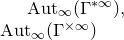 $\text{Aut}_{\infty}(\Gamma^{* \infty}), \text{Aut}_{\infty}(\Gamma^{\times \infty})$
and
$\text{Aut}_{\infty}(\Gamma^{* \infty}), \text{Aut}_{\infty}(\Gamma^{\times \infty})$
and $\text{Aut}_{\infty}(\Gamma^{\oplus \infty})$
are
$\text{Aut}_{\infty}(\Gamma^{\oplus \infty})$
are $\mathfrak{X}^{\text{sep}}$
-boundedly acyclic. In particular,
$\mathfrak{X}^{\text{sep}}$
-boundedly acyclic. In particular, $\text{Aut}_{\infty}(F_\infty)$
is
$\text{Aut}_{\infty}(F_\infty)$
is $\mathfrak{X}^{\text{sep}}$
-boundedly acyclic.
$\mathfrak{X}^{\text{sep}}$
-boundedly acyclic.
1.2.3 Cremona groups
Let K be a field, and consider the Cremona groups $\mathrm{Cr}_n(K)=\mathrm{Aut}(K(x_1, \ldots, x_n)|K)$
, which are the automorphism groups of the field of rational functions
$\mathrm{Cr}_n(K)=\mathrm{Aut}(K(x_1, \ldots, x_n)|K)$
, which are the automorphism groups of the field of rational functions $K(x_1, \ldots, x_n)$
over K. These groups can also be viewed as the birational transformation groups of the projective spaces
$K(x_1, \ldots, x_n)$
over K. These groups can also be viewed as the birational transformation groups of the projective spaces $\mathbb{P}^n_K$
over K. They have been studied for centuries in classical algebraic geometry, and more recently they have been approached via geometric group theory [Reference CantatCan11, Reference CantatCan18]. Standout results include acylindrical hyperbolicity in the rank-2 case [Reference Cantat and LamyCL13, Reference Blanc and CantatBC16, Reference Dahmani, Guirardel and OsinDGO17] and actions on CAT(0) cube complexes for all ranks [Reference Lonjou and UrechLU21]. As above, we can stabilize these groups along the natural inclusions
$\mathbb{P}^n_K$
over K. They have been studied for centuries in classical algebraic geometry, and more recently they have been approached via geometric group theory [Reference CantatCan11, Reference CantatCan18]. Standout results include acylindrical hyperbolicity in the rank-2 case [Reference Cantat and LamyCL13, Reference Blanc and CantatBC16, Reference Dahmani, Guirardel and OsinDGO17] and actions on CAT(0) cube complexes for all ranks [Reference Lonjou and UrechLU21]. As above, we can stabilize these groups along the natural inclusions $\mathrm{Cr}_n(K)\hookrightarrow \mathrm{Cr}_{n+1}(K)$
, fixing the coordinate
$\mathrm{Cr}_n(K)\hookrightarrow \mathrm{Cr}_{n+1}(K)$
, fixing the coordinate $x_{n+1}$
. We consider their direct limit
$x_{n+1}$
. We consider their direct limit
 \begin{align*} \mathrm{Cr}_{\infty}(K)=\bigcup_{n\in\mathbb{N}}\mathrm{Cr}_n(K). \end{align*}
We show that this group is $\mathfrak{X}^{\text{sep}}$
-boundedly acyclic.
$\mathfrak{X}^{\text{sep}}$
-boundedly acyclic.
Corollary 1.11
(Corollary 5.8). The group $\mathrm{Cr}_{\infty}(K)$
is
$\mathrm{Cr}_{\infty}(K)$
is $\mathfrak{X}^{\text{sep}}$
-boundedly acyclic.
$\mathfrak{X}^{\text{sep}}$
-boundedly acyclic.
1.3 Stability
The previous results have interesting implications for the theory of homological stability (we refer the reader to work of Randal-Williams and Wahl [Reference Randal-Williams and WahlRWW17] and the references therein). A family of groups $\Gamma_1 \hookrightarrow \Gamma_2 \hookrightarrow \cdots$
satisfies homological stability if, for all
$\Gamma_1 \hookrightarrow \Gamma_2 \hookrightarrow \cdots$
satisfies homological stability if, for all $i \geq 1$
, the maps
$i \geq 1$
, the maps $H_i(\Gamma_n) \to H_i(\Gamma_{n+1})$
are eventually isomorphisms (this is usually meant with respect to trivial integral coefficients). Homological stability has been an important tool for studying the homology of certain families of groups. Typically, the approach splits into three steps: prove homological stability, then compute the homology of the colimit group
$H_i(\Gamma_n) \to H_i(\Gamma_{n+1})$
are eventually isomorphisms (this is usually meant with respect to trivial integral coefficients). Homological stability has been an important tool for studying the homology of certain families of groups. Typically, the approach splits into three steps: prove homological stability, then compute the homology of the colimit group $\text{colim}_{n \to \infty} \Gamma_n$
(which in this setting is a direct limit), and use it to compute the homology of the groups
$\text{colim}_{n \to \infty} \Gamma_n$
(which in this setting is a direct limit), and use it to compute the homology of the groups $\Gamma_n$
, at least for n large enough.
$\Gamma_n$
, at least for n large enough.
The following families of groups encountered so far satisfy homological stability [Reference Randal-Williams and WahlRWW17, Reference SzymikSzy24]: the mapping class groups with one boundary component $\{ \Gamma^1_g \}_{g \geq 1}$
; the braid groups
$\{ \Gamma^1_g \}_{g \geq 1}$
; the braid groups $\{ B_n \}_{n \geq 1}$
; the linear groups
$\{ B_n \}_{n \geq 1}$
; the linear groups $\{ \text{GL}_n(R) \}_{n \geq 1}$
and some subgroups thereof; the automorphism groups
$\{ \text{GL}_n(R) \}_{n \geq 1}$
and some subgroups thereof; the automorphism groups $\{ \textrm{Aut}(\Gamma^{*n})\}_{n \geq 1}$
and
$\{ \textrm{Aut}(\Gamma^{*n})\}_{n \geq 1}$
and $\{ \textrm{Aut}(\Gamma^{\times n})\}_{n \geq 1}$
; and the Cremona groups
$\{ \textrm{Aut}(\Gamma^{\times n})\}_{n \geq 1}$
; and the Cremona groups $\{\mathrm{Cr}_n(K)\}_{n\geq 1}$
.
$\{\mathrm{Cr}_n(K)\}_{n\geq 1}$
.
These results therefore show that the colimit groups coming from homologically stable families tend to be $\mathfrak{X}^{\text{sep}}$
-boundedly acyclic (in fact, it has been suggested to us by Thorben Kastenholz that Theorem 1.3 might apply every time that the homologically stable system has an underlying
$\mathfrak{X}^{\text{sep}}$
-boundedly acyclic (in fact, it has been suggested to us by Thorben Kastenholz that Theorem 1.3 might apply every time that the homologically stable system has an underlying $E_\infty$
structure; see [Reference Randal-Williams and WahlRWW17]). This provides an obstacle for adapting homological stability arguments to the setting of bounded cohomology, and answers a question of Kastenholz and Sroka [Reference Kastenholz and SrokaKS23, Question 1.4] about the scope of this approach, for the homologically stable families above. However, let us remark that bounded cohomological stability has been proved and applied with success in various contexts, where the bounded cohomology of the colimit groups plays no role [Reference MonodMon04, Reference MonodMon10, Reference De la Cruz Mengual and HartnickDlCMH25, Reference De la Cruz Mengual and HartnickDlCMH23, Reference De la Cruz MengualDlCM23, Reference KastenholzKas25, Reference Kastenholz and SrokaKS23].
$E_\infty$
structure; see [Reference Randal-Williams and WahlRWW17]). This provides an obstacle for adapting homological stability arguments to the setting of bounded cohomology, and answers a question of Kastenholz and Sroka [Reference Kastenholz and SrokaKS23, Question 1.4] about the scope of this approach, for the homologically stable families above. However, let us remark that bounded cohomological stability has been proved and applied with success in various contexts, where the bounded cohomology of the colimit groups plays no role [Reference MonodMon04, Reference MonodMon10, Reference De la Cruz Mengual and HartnickDlCMH25, Reference De la Cruz Mengual and HartnickDlCMH23, Reference De la Cruz MengualDlCM23, Reference KastenholzKas25, Reference Kastenholz and SrokaKS23].
1.4. Transformation groups
Monod and Nariman have recently shown that the compactly supported diffeomorphism and homeomorphism groups of certain portable manifolds, in the sense of Burago, Ivanov, and Polterovich [Reference Burago, Ivanov and PolterovichBIP08], are $\mathfrak{X}^{\text{sep}}$
-boundedly acyclic [Reference Monod and NarimanMN23]. More precisely, they have considered manifolds that are products of a closed manifold M with
$\mathfrak{X}^{\text{sep}}$
-boundedly acyclic [Reference Monod and NarimanMN23]. More precisely, they have considered manifolds that are products of a closed manifold M with $ {\mathbb{R}}^n$
for some
$ {\mathbb{R}}^n$
for some $n \geq 1$
. Their argument is based on the observation that every bounded set can be displaced infinitely many times within a bounded set; thus there is no hope of extending it to the case of compactly supported symplectic or volume-preserving diffeomorphism groups. Here, we show how our algebraic criterion can still apply in this rigid setting.
$n \geq 1$
. Their argument is based on the observation that every bounded set can be displaced infinitely many times within a bounded set; thus there is no hope of extending it to the case of compactly supported symplectic or volume-preserving diffeomorphism groups. Here, we show how our algebraic criterion can still apply in this rigid setting.
Let $(M, \omega)$
be a symplectic manifold and let
$(M, \omega)$
be a symplectic manifold and let $\text{Symp}_c(M, \omega)$
be the group of compactly supported diffeomorphisms that preserve the 2-form
$\text{Symp}_c(M, \omega)$
be the group of compactly supported diffeomorphisms that preserve the 2-form $\omega$
. We denote by
$\omega$
. We denote by $\text{Symp}^0_c(M, \omega)$
the path-connected component of the identity. An important subgroup of
$\text{Symp}^0_c(M, \omega)$
the path-connected component of the identity. An important subgroup of $\text{Symp}^0_c(M, \omega)$
is the group of compactly supported Hamiltonian diffeomorphisms that is denoted by
$\text{Symp}^0_c(M, \omega)$
is the group of compactly supported Hamiltonian diffeomorphisms that is denoted by $\text{Ham}_c(M, \omega)$
. Kotschick has proved that the stable commutator length of
$\text{Ham}_c(M, \omega)$
. Kotschick has proved that the stable commutator length of $\text{Symp}^0_c({\mathbb{R}}^{2m}, \omega)$
and
$\text{Symp}^0_c({\mathbb{R}}^{2m}, \omega)$
and $\text{Ham}_c( {\mathbb{R}}^{2m}, \omega)$
vanishes, as well as the one of the group of compactly supported volume-preserving diffeomorphisms
$\text{Ham}_c( {\mathbb{R}}^{2m}, \omega)$
vanishes, as well as the one of the group of compactly supported volume-preserving diffeomorphisms $\text{Diff}_{c, \text{vol}}({\mathbb{R}}^n)$
for
$\text{Diff}_{c, \text{vol}}({\mathbb{R}}^n)$
for $n \geq 2$
(see [Reference KotschickKot08, Theorem 4.2]).
$n \geq 2$
(see [Reference KotschickKot08, Theorem 4.2]).
These groups are part of the classical diffeomorphism groups of ${\mathbb{R}}^n$
(see [Reference BanyagaBan97]). To complete the picture, we also consider the group of compactly supported contactomorphisms
${\mathbb{R}}^n$
(see [Reference BanyagaBan97]). To complete the picture, we also consider the group of compactly supported contactomorphisms $\text{Cont}_c({\mathbb{R}}^{2k+1}, \xi)$
. We are able to show that all classical diffeomorphism groups of
$\text{Cont}_c({\mathbb{R}}^{2k+1}, \xi)$
. We are able to show that all classical diffeomorphism groups of ${\mathbb{R}}^n$
are
${\mathbb{R}}^n$
are $\mathfrak{X}^{\text{sep}}$
-boundedly acyclic, as are their identity components, in all regularities.
$\mathfrak{X}^{\text{sep}}$
-boundedly acyclic, as are their identity components, in all regularities.
Corollary 1.12
((Corollaries 5.11, 5.14, and 5.25). Let $n \geq 2$
, and let
$n \geq 2$
, and let ${\mathbb{R}}^n$
be endowed with its standard volume form, with its standard symplectic form
${\mathbb{R}}^n$
be endowed with its standard volume form, with its standard symplectic form $\omega$
if
$\omega$
if $n = 2m$
is even, and with its standard contact structure
$n = 2m$
is even, and with its standard contact structure $\xi$
if
$\xi$
if $n = 2k+1$
is odd. Then the following groups are
$n = 2k+1$
is odd. Then the following groups are $\mathfrak{X}^{\text{sep}}$
-boundedly acyclic:
$\mathfrak{X}^{\text{sep}}$
-boundedly acyclic:
-
(1)
$\text{Diff}_{c, \text{vol}}({\mathbb{R}}^n)$
; -
(2)
$\text{Symp}_c({\mathbb{R}}^{2m}, \omega)$
and
$\text{Ham}_c({\mathbb{R}}^{2m}, \omega)$
; and -
(3)
$\text{Cont}_c({\mathbb{R}}^{2k+1}, \xi)$
.




Moreover, the same holds for the identity components of these groups, for all regularities, and for commutator subgroups.
In fact, we prove that the conclusion of Corollary 1.12 holds for all compactly supported groups of homeomorphisms that contain one of the groups in the statement. This is the advantage of proving $\mathfrak{X}^{\text{sep}}$
-bounded acyclicity using the commuting cyclic conjugates condition. So, for example, it also holds for the group
$\mathfrak{X}^{\text{sep}}$
-bounded acyclicity using the commuting cyclic conjugates condition. So, for example, it also holds for the group $\text{Homeo}_{c, \text{Leb}}({\mathbb{R}}^n)$
of Lebesgue-measure-preserving homeomorphisms of
$\text{Homeo}_{c, \text{Leb}}({\mathbb{R}}^n)$
of Lebesgue-measure-preserving homeomorphisms of ${\mathbb{R}}^n$
, or for the group of compactly supported Hamiltonian homeomorphisms of
${\mathbb{R}}^n$
, or for the group of compactly supported Hamiltonian homeomorphisms of $ {\mathbb{R}}^{2m}$
(see [Reference Buhovsky, Humilière and SeyfaddiniBHS18, Reference Cristofaro-Gardiner, Humilière and SeyfaddiniCGHS24]). These statements can be generalized from
$ {\mathbb{R}}^{2m}$
(see [Reference Buhovsky, Humilière and SeyfaddiniBHS18, Reference Cristofaro-Gardiner, Humilière and SeyfaddiniCGHS24]). These statements can be generalized from ${\mathbb{R}}^n$
to manifolds of the form
${\mathbb{R}}^n$
to manifolds of the form ${\mathbb{R}}^n \times M$
, where M is closed (Corollary 5.27). Note that the statement for commutator subgroups is a strict generalization, since these groups are not perfect [Reference BanyagaBan97, Chapters 4and 5] (for contactomorphisms, this seems to be an open question [Reference BanyagaBan97, Remark after Theorem 6.3.7]).
${\mathbb{R}}^n \times M$
, where M is closed (Corollary 5.27). Note that the statement for commutator subgroups is a strict generalization, since these groups are not perfect [Reference BanyagaBan97, Chapters 4and 5] (for contactomorphisms, this seems to be an open question [Reference BanyagaBan97, Remark after Theorem 6.3.7]).
The ordinary homology of diffeomorphism groups of ${\mathbb{R}}^n$
has often been studied in the past. Its study is typically split into two parts. On the one hand, one can investigate the homology of the topological group
${\mathbb{R}}^n$
has often been studied in the past. Its study is typically split into two parts. On the one hand, one can investigate the homology of the topological group $\text{Diff}_{c, \text{vol}}( {\mathbb{R}}^n)^\tau$
, with its usual
$\text{Diff}_{c, \text{vol}}( {\mathbb{R}}^n)^\tau$
, with its usual $C^\infty$
-topology. This is the same as the homology of the topological group
$C^\infty$
-topology. This is the same as the homology of the topological group $\text{Diff}_{\text{vol}}(\mathbb{D}^n, \partial \mathbb{D}^n)^\tau$
(see [Reference McDuffMcD83a]), which in turn is the same as the homology of the topological group
$\text{Diff}_{\text{vol}}(\mathbb{D}^n, \partial \mathbb{D}^n)^\tau$
(see [Reference McDuffMcD83a]), which in turn is the same as the homology of the topological group $\text{Diff}(\mathbb{D}^n, \partial \mathbb{D}^n)^\tau$
, as follows by an application of Banyaga’s version of Moser’s trick [Reference MoserMos65, Reference BanyagaBan74]. The latter group has a very rich and mysterious homology theory (when
$\text{Diff}(\mathbb{D}^n, \partial \mathbb{D}^n)^\tau$
, as follows by an application of Banyaga’s version of Moser’s trick [Reference MoserMos65, Reference BanyagaBan74]. The latter group has a very rich and mysterious homology theory (when $n \geq 4$
) [Reference Randal-WilliamsRW23]. On the other hand, there is the study of the local homology of
$n \geq 4$
) [Reference Randal-WilliamsRW23]. On the other hand, there is the study of the local homology of $\text{Diff}_{c, \text{vol}}({\mathbb{R}}^n)$
, i.e. the homology of the homotopy fiber of the map
$\text{Diff}_{c, \text{vol}}({\mathbb{R}}^n)$
, i.e. the homology of the homotopy fiber of the map $B\text{Diff}_{c, \text{vol}}({\mathbb{R}}^n) \to B\text{Diff}_{c, \text{vol}}( {\mathbb{R}}^n)^\tau$
. This has been extensively studied, especially by McDuff [Reference McDuffMcD82, Reference McDuffMcD83a, Reference McDuffMcD83b, Reference McDuffMcD83c, Reference HurderHur83].
$B\text{Diff}_{c, \text{vol}}({\mathbb{R}}^n) \to B\text{Diff}_{c, \text{vol}}( {\mathbb{R}}^n)^\tau$
. This has been extensively studied, especially by McDuff [Reference McDuffMcD82, Reference McDuffMcD83a, Reference McDuffMcD83b, Reference McDuffMcD83c, Reference HurderHur83].
The bounded cohomology of transformation groups as in Corollary 1.12 is well studied in the cases of compact (or more generally finite-volume) manifolds [Reference Gambaudo and GhysGG04, Reference PolterovichPol06, Reference PyPy06, Reference Entov, Polterovich and PyEPP12, Reference Brandenbursky and MarcinkowskiBM19, Reference NitscheNit21, Reference Brandenbursky and MarcinkowskiBM22, Reference Cristofaro-Gardiner, Humilière, Mak, Seyfaddini and SmithCGHM+22, Reference Brandenbursky and MarcinkowskiBM25]. In those cases, it is generally non vanishing, even in high degree, in stark contrast with our result. Note that the inclusion $\text{Diff}_{\text{vol}}(\mathbb{D}^n, \partial\mathbb{D}^n) \to \text{Diff}_{c, \text{vol}}({\mathbb{R}}^n)$
induces an isomorphism in ordinary cohomology [Reference McDuffMcD83a]. However, this is not the case in bounded cohomology, at least for
$\text{Diff}_{\text{vol}}(\mathbb{D}^n, \partial\mathbb{D}^n) \to \text{Diff}_{c, \text{vol}}({\mathbb{R}}^n)$
induces an isomorphism in ordinary cohomology [Reference McDuffMcD83a]. However, this is not the case in bounded cohomology, at least for $n = 2$
and degrees 2 and 3 (see [Reference Barge and GhysBG92, Reference KimuraKim25]; as far as we know, nothing is known about the bounded cohomology of
$n = 2$
and degrees 2 and 3 (see [Reference Barge and GhysBG92, Reference KimuraKim25]; as far as we know, nothing is known about the bounded cohomology of $\text{Diff}_{\text{vol}}(\mathbb{D}^n, \partial\mathbb{D}^n)$
for
$\text{Diff}_{\text{vol}}(\mathbb{D}^n, \partial\mathbb{D}^n)$
for $n \geq 3$
; see [Reference Burago, Ivanov and PolterovichBIP08, Open Problem, p. 230]).
$n \geq 3$
; see [Reference Burago, Ivanov and PolterovichBIP08, Open Problem, p. 230]).
If we consider the full group of compactly supported diffeomorphisms, we can in fact prove $\mathfrak{X}^{\text{sep}}$
-bounded acyclicity for all portable manifolds.
$\mathfrak{X}^{\text{sep}}$
-bounded acyclicity for all portable manifolds.
Corollary 1.13
(Corollary 5.19). Let M be a portable manifold. Then, $\text{Diff}^0_c(M)$
and
$\text{Diff}^0_c(M)$
and $\text{Diff}_c(M)$
are
$\text{Diff}_c(M)$
are $\mathfrak{X}^{\text{sep}}$
-boundedly acyclic.
$\mathfrak{X}^{\text{sep}}$
-boundedly acyclic.
Examples of portable manifolds include (open) manifolds that are the product of ${\mathbb{R}}^n$
and a closed manifold M. Moreover, an (open) manifold M is portable if it admits an exhausting Morse function f such that f has only finitely many critical points and they all have index strictly less than
${\mathbb{R}}^n$
and a closed manifold M. Moreover, an (open) manifold M is portable if it admits an exhausting Morse function f such that f has only finitely many critical points and they all have index strictly less than $({1}/{2})\dim(M)$
. For instance, the latter property is satisfied by every three-dimensional (open) handlebody [Reference Burago, Ivanov and PolterovichBIP08]. In fact, our result on contactomorphisms of
$({1}/{2})\dim(M)$
. For instance, the latter property is satisfied by every three-dimensional (open) handlebody [Reference Burago, Ivanov and PolterovichBIP08]. In fact, our result on contactomorphisms of ${\mathbb{R}}^{2k+1}$
is part of a more general result on contact portable manifolds [Reference Fraser, Polterovich and RosenFPR18]; however, the only other examples of contact portable manifolds seem to be contact handlebodies.
${\mathbb{R}}^{2k+1}$
is part of a more general result on contact portable manifolds [Reference Fraser, Polterovich and RosenFPR18]; however, the only other examples of contact portable manifolds seem to be contact handlebodies.
1.5 One-dimensional actions
1.5.1 Piecewise linear groups of the interval, and piecewise projective groups of the line
Theseroups have a rich subgroup structure: they both contain the famous Thompson’s group F (see [Reference Cannon, Floyd and ParryCFP96]), and the latter contains Monod’s groups H(A), where A is a dense subring of ${\mathbb{R}}$
(see [Reference MonodMon13, Reference MonodMon25]), as well as the Lodha–Moore group
${\mathbb{R}}$
(see [Reference MonodMon13, Reference MonodMon25]), as well as the Lodha–Moore group $G_0$
(see [Reference Lodha and MooreLM16]). The groups H(A) where A is a dense subring of
$G_0$
(see [Reference Lodha and MooreLM16]). The groups H(A) where A is a dense subring of ${\mathbb{R}}$
, and
${\mathbb{R}}$
, and $G_0$
, are examples of non-amenable groups without non-abelian free subgroups (and the Lodha–Moore group
$G_0$
, are examples of non-amenable groups without non-abelian free subgroups (and the Lodha–Moore group $G_0$
is a finitely presented and type
$G_0$
is a finitely presented and type $F_{\infty}$
example). These groups have the striking property that they do not contain non-abelian free subgroups, and yet they do not satisfy a law [Reference Brin and SquierBS85]. Their homology has been computed in various cases, and it is typically non-zero in infinitely many degrees [Reference Brown and GeogheganBG84, Reference Ghys and SergiescuGS87, Reference GreenbergGre89, Reference SteinSte92, Reference BrownBro06].
$F_{\infty}$
example). These groups have the striking property that they do not contain non-abelian free subgroups, and yet they do not satisfy a law [Reference Brin and SquierBS85]. Their homology has been computed in various cases, and it is typically non-zero in infinitely many degrees [Reference Brown and GeogheganBG84, Reference Ghys and SergiescuGS87, Reference GreenbergGre89, Reference SteinSte92, Reference BrownBro06].
As a consequence of our main theorem, we obtain the following corollary.
Corollary 1.14
(Corollaries 5.30, 5.31, and 5.32). Let $\Gamma$
be a group that lies in one of the following families:
$\Gamma$
be a group that lies in one of the following families:
-
(1) a group of piecewise linear homeomorphisms of the interval, or a group of piecewise projective homeomorphisms of the line;
-
(2) a group of compactly supported homeomorphisms of the line acting without a global fixpoint;
-
(3) a chain group of homeomorphisms of the line [Reference Kim, Koberda and LodhaKKL19]; and
-
(4) a group that admits a coherent action on the line [Reference LodhaLod20a].
Then $\Gamma$
is
$\Gamma$
is $\mathfrak{X}^{\text{sep}}$
-boundedly acyclic.
$\mathfrak{X}^{\text{sep}}$
-boundedly acyclic.
-1This corollary not only recovers the $\mathfrak{X}^{\text{sep}}$
-bounded acyclicity of Thompson’s group F (see [Reference MonodMon22]), but also generalizes the result to all subgroups thereof. The subgroup structure of Thompson’s group F is wild [Reference Guba and SapirGS99, Reference Golan and SapirGS17, Reference Bleak, Brin and MooreBBM21], and so very few general statements are known to be valid for all subgroups. Among these are the Brin–Squier theorem, stating that they have no free subgroups [Reference Brin and SquierBS85]; the result of Calegari, stating that they have vanishing stable commutator length [Reference CalegariCal07]; and the result from the second and third authors, stating that they have vanishing second bounded cohomology [Reference Fournier-Facio and LodhaFFL23]. Each result is a strengthening of the previous one, and Corollary 1.14 extends all the aforementioned results.
$\mathfrak{X}^{\text{sep}}$
-bounded acyclicity of Thompson’s group F (see [Reference MonodMon22]), but also generalizes the result to all subgroups thereof. The subgroup structure of Thompson’s group F is wild [Reference Guba and SapirGS99, Reference Golan and SapirGS17, Reference Bleak, Brin and MooreBBM21], and so very few general statements are known to be valid for all subgroups. Among these are the Brin–Squier theorem, stating that they have no free subgroups [Reference Brin and SquierBS85]; the result of Calegari, stating that they have vanishing stable commutator length [Reference CalegariCal07]; and the result from the second and third authors, stating that they have vanishing second bounded cohomology [Reference Fournier-Facio and LodhaFFL23]. Each result is a strengthening of the previous one, and Corollary 1.14 extends all the aforementioned results.
The same is true in the case of piecewise projective groups. In particular, we can prove that the group $G_0$
(see [Reference Lodha and MooreLM16]) has the following surprising property.
$G_0$
(see [Reference Lodha and MooreLM16]) has the following surprising property.
Corollary 1.15
(Corollary 5.34). There exists a group of type $F_\infty$
that is non-amenable, but all of whose subgroups are
$F_\infty$
that is non-amenable, but all of whose subgroups are $\mathfrak{X}^{\text{sep}}$
-boundedly acyclic.
$\mathfrak{X}^{\text{sep}}$
-boundedly acyclic.
Calegari has proposed a homological version of the von Neumann–Day problem [Reference CalegariCal07], stating that if $\Gamma$
is a (finitely presented, torsion-free) group such that every subgroup has vanishing stable commutator length, then
$\Gamma$
is a (finitely presented, torsion-free) group such that every subgroup has vanishing stable commutator length, then $\Gamma$
is amenable. This has recently been proved to fail, even for vanishing of second bounded cohomology [Reference Fournier-Facio and LodhaFFL23]. Corollary 5.34 shows that this also fails when including higher degrees and non-trivial coefficients.
$\Gamma$
is amenable. This has recently been proved to fail, even for vanishing of second bounded cohomology [Reference Fournier-Facio and LodhaFFL23]. Corollary 5.34 shows that this also fails when including higher degrees and non-trivial coefficients.
1.5.2 Highly transitive actions
Boundedcyclicity results can also be used as a basis for more complicated computations. Indeed, if a group admits a highly transitive action on a set with (uniformly) boundedly acyclic stabilizers, this can lead to full computations of bounded cohomology rings. This approach has been carried out with success in various contexts [Reference Fournier-Facio, Löh and MoraschiniFFLM23, Reference Monod and NarimanMN23, Reference Fournier-Facio and LodhaFFL23, Reference AndritschAnd22], and here we can push these methods further. First, we generalize the computation of the bounded cohomology of Thompson’s group T to many more groups of homeomorphisms of the circle.
Corollary 1.16
(Corollary 5.35). Let $\Gamma$
be a group of orientation-preserving piecewise linear homeomorphisms of the circle, or piecewise projective homeomorphisms of the projective line. Suppose that there exists an infinite orbit S of
$\Gamma$
be a group of orientation-preserving piecewise linear homeomorphisms of the circle, or piecewise projective homeomorphisms of the projective line. Suppose that there exists an infinite orbit S of $\Gamma$
such that, for all
$\Gamma$
such that, for all $n \geq 1$
,
$n \geq 1$
, $\Gamma$
acts transitively on positively oriented n-tuples in S. Then there exists an isomorphism
$\Gamma$
acts transitively on positively oriented n-tuples in S. Then there exists an isomorphism
 \begin{align*} H^\bullet_b(\Gamma; {\mathbb{R}}) \cong {\mathbb{R}}[x], \end{align*}
where the degree of x is 2, and x corresponds to the Euler class of the defining action on the circle of $\Gamma$
.
$\Gamma$
.
This applies to Thompson’s group T, but also to Stein–Thompson groups of the form $T_{2, n_2, \ldots, n_k}$
(see [Reference SteinSte92]), to the golden ratio Thompson’s group
$T_{2, n_2, \ldots, n_k}$
(see [Reference SteinSte92]), to the golden ratio Thompson’s group $T_\tau$
(see [Reference ClearyCle00, Reference Burillo, Nucinkis and ReevesBNR22]), and to the piecewise projective group S (see [Reference LodhaLod19]). Example 5.36 provides further details.
$T_\tau$
(see [Reference ClearyCle00, Reference Burillo, Nucinkis and ReevesBNR22]), and to the piecewise projective group S (see [Reference LodhaLod19]). Example 5.36 provides further details.
In this work, we push this method further to also encompass group actions on the line, and obtain the following.
Corollary 1.17
(Corollary 5.38). Let $\Gamma$
be a group of orientation-preserving homeomorphisms of the line, and let S be an infinite orbit of
$\Gamma$
be a group of orientation-preserving homeomorphisms of the line, and let S be an infinite orbit of $\Gamma$
. Suppose that for all
$\Gamma$
. Suppose that for all $n \geq 1$
, the action of
$n \geq 1$
, the action of $\Gamma$
on linearly ordered n-tuples in S is transitive. Suppose, moreover, that for
$\Gamma$
on linearly ordered n-tuples in S is transitive. Suppose, moreover, that for $s \in S$
, the stabilizer
$s \in S$
, the stabilizer $\Gamma_s$
admits a co-amenable subgroup
$\Gamma_s$
admits a co-amenable subgroup $\Gamma_s^0$
, such that every finitely generated subgroup of
$\Gamma_s^0$
, such that every finitely generated subgroup of $\Gamma_s^0$
is isomorphic to a group of piecewise linear homeomorphisms of the interval. Then
$\Gamma_s^0$
is isomorphic to a group of piecewise linear homeomorphisms of the interval. Then $\Gamma$
is boundedly acyclic.
$\Gamma$
is boundedly acyclic.
This corollary applies to several constructions of finitely generated simple left-orderable groups: the groups $G_\varrho$
of the third author and Hyde [Reference Hyde and LodhaHL19], the groups
$G_\varrho$
of the third author and Hyde [Reference Hyde and LodhaHL19], the groups $T(\varphi)$
of Matte Bon and Triestino [Reference Matte Bon and TriestinoMBT20], and the groups
$T(\varphi)$
of Matte Bon and Triestino [Reference Matte Bon and TriestinoMBT20], and the groups $T(\varphi, \sigma)$
of Le Boudec and Matte Bon [Reference Le Boudec and Matte BonLBMB22].
$T(\varphi, \sigma)$
of Le Boudec and Matte Bon [Reference Le Boudec and Matte BonLBMB22].
In his 2018 ICM address, Navas asked whether there exist finitely generated left-orderable groups that do not surject onto $ {\mathbb{Z}}$
, and with vanishing second bounded cohomology with trivial coefficients [Reference NavasNav18, Question 8]. The groups
$ {\mathbb{Z}}$
, and with vanishing second bounded cohomology with trivial coefficients [Reference NavasNav18, Question 8]. The groups $G_\varrho$
have been proved to have this property [Reference Fournier-Facio and LodhaFFL23], and now it is possible to strengthen this to include vanishing in higher degrees, thus giving a strong positive answer to Navas’s question.
$G_\varrho$
have been proved to have this property [Reference Fournier-Facio and LodhaFFL23], and now it is possible to strengthen this to include vanishing in higher degrees, thus giving a strong positive answer to Navas’s question.
Since the first version of this paper, this approach has been used successfully in more contexts, always using Theorem 1.3 as a starting point (see [Reference Wu, Wu, Zhao and ZhouWWZ+25, Reference Fournier-Facio, Monod and NarimanFFMN24, Reference ZhouZho24]).
1.5.3 Interval exchange transformations
Anotherroup of interest arising from one-dimensional dynamics is the group of interval exchange transformations $\text{IET}([0, 1))$
. This is defined as the group of right-continuous bijections of [0, 1) given by cutting the interval into finitely many pieces and rearranging by translations. The group, as well as many generalizations, has been widely studied [Reference Dahmani, Fujiwara and GuirardelDFG13, Reference Juschenko, Matte Bon, Monod and de la SalleJMBM+18, DFG20, GL22, CL22]. The two main open problems about it are whether it is amenable (known as de Cornulier’s conjecture [Reference de CornulierdC14]), or contains non-abelian free subgroups (known as Katok’s conjecture [Reference Dahmani, Fujiwara and GuirardelDFG13]). Therefore, it is natural to wonder whether
$\text{IET}([0, 1))$
. This is defined as the group of right-continuous bijections of [0, 1) given by cutting the interval into finitely many pieces and rearranging by translations. The group, as well as many generalizations, has been widely studied [Reference Dahmani, Fujiwara and GuirardelDFG13, Reference Juschenko, Matte Bon, Monod and de la SalleJMBM+18, DFG20, GL22, CL22]. The two main open problems about it are whether it is amenable (known as de Cornulier’s conjecture [Reference de CornulierdC14]), or contains non-abelian free subgroups (known as Katok’s conjecture [Reference Dahmani, Fujiwara and GuirardelDFG13]). Therefore, it is natural to wonder whether $\text{IET}([0, 1))$
has vanishing bounded cohomology (Question 5.44). This can be seen as an analogue to Grigorchuk’s question about bounded acyclicity of Thompson’s group F (see [Reference GrigorchukGri95]), which has been answered by Monod [Reference MonodMon22].
$\text{IET}([0, 1))$
has vanishing bounded cohomology (Question 5.44). This can be seen as an analogue to Grigorchuk’s question about bounded acyclicity of Thompson’s group F (see [Reference GrigorchukGri95]), which has been answered by Monod [Reference MonodMon22].
Instead, we consider the group of interval exchange transformations of the half line interval $[0, \infty)$
, which is defined in the same way. In particular, we allow only finitely many intervals to be exchanged. Note that this group is amenable, respectively, contains non-abelian free subgroups, if and only if
$[0, \infty)$
, which is defined in the same way. In particular, we allow only finitely many intervals to be exchanged. Note that this group is amenable, respectively, contains non-abelian free subgroups, if and only if $\text{IET}([0, 1))$
has the same property (Lemma 5.41).
$\text{IET}([0, 1))$
has the same property (Lemma 5.41).
Corollary 1.18
(Corollary 5.42). The group $\text{IET}([0, \infty))$
is
$\text{IET}([0, \infty))$
is $\mathfrak{X}^{\text{sep}}$
-boundedly acyclic, and so are all of its derived subgroups.
$\mathfrak{X}^{\text{sep}}$
-boundedly acyclic, and so are all of its derived subgroups.
1.6 Algebraically closed and generic groups
Our next two applications of Theorem 1.3 come from combinatorial group theory. A group $\Gamma$
is said to be algebraically closed if every finite system of equations with constants in
$\Gamma$
is said to be algebraically closed if every finite system of equations with constants in $\Gamma$
that has a solution in some overgroup of
$\Gamma$
that has a solution in some overgroup of $\Gamma$
has a solution in
$\Gamma$
has a solution in $\Gamma$
. This class of groups has been introduced by Scott [Reference ScottSco51], and it has turned out to coincide with the class of existentially closed groups, where one also includes inequations in the definition. Baumslag, Dyer, and Heller have proved that algebraically closed groups are mitotic [Reference Baumslag, Dyer and HellerBDH80], from which it follows that they are acyclic [Reference Baumslag, Dyer and HellerBDH80] and boundedly acyclic [Reference LöhLöh17]. We extend this to include non-trivial coefficients.
$\Gamma$
. This class of groups has been introduced by Scott [Reference ScottSco51], and it has turned out to coincide with the class of existentially closed groups, where one also includes inequations in the definition. Baumslag, Dyer, and Heller have proved that algebraically closed groups are mitotic [Reference Baumslag, Dyer and HellerBDH80], from which it follows that they are acyclic [Reference Baumslag, Dyer and HellerBDH80] and boundedly acyclic [Reference LöhLöh17]. We extend this to include non-trivial coefficients.
Corollary 1.19
(Corollary 5.48). Algebraically closed groups are $\mathfrak{X}^{\text{sep}}$
-boundedly acyclic.
$\mathfrak{X}^{\text{sep}}$
-boundedly acyclic.
Perhaps the most surprising application of Theorem 1.3 is the following. The space of enumerated groups has been recently introduced [Reference Goldbring, Kunnawalkam Elayavalli and LodhaGKEL23]; it is a Polish space that parametrizes all countable groups with a fixed enumeration. The structure of Polish space allows us to use the language of descriptive set theory to talk about properties of groups. In this sense, a property is called generic if the subspace of groups that enjoy it is comeager in the sense of the Baire category. We show that the generic enumerated group has commuting cyclic conjugates and deduce the following.
Corollary 1.20
(Corollary 5.51). The generic enumerated group is $\mathfrak{X}^{\text{sep}}$
-boundedly acyclic.
$\mathfrak{X}^{\text{sep}}$
-boundedly acyclic.
This theorem is in stark contrast with Gromov’s model of random presentations of groups [Reference GromovGro93, § 9.B], where depending on the density, the random group is either of order at most 2 or hyperbolic [Reference YuOls92, Reference ChampetierCha95], and in the latter case it has large second [Reference Epstein and FujiwaraEF97] and third bounded cohomology in a large class of coefficients [Reference Frigerio, Pozzetti and SistoFPS15]. We may interpret this discrepancy as meaning that while bounded cohomology vanishing is rare among finitely presented groups, it becomes the norm among countable groups.
1.7 Methods
The technical tool underlying these results is the vanishing modulus, a numerical invariant, introduced independently by different teams [Reference Monod and NarimanMN23, Reference Fournier-Facio, Löh and MoraschiniFFLM23], that attaches a quantity to a vanishing bounded cohomology group. In particular, the bounded cohomology vanishes in degree n if and only if its nth vanishing modulus is finite [Reference Fournier-Facio, Löh and MoraschiniFFLM23]. The importance of the vanishing modulus is encoded in the following. A direct union of boundedly acyclic groups stays boundedly acyclic if the vanishing moduli of all the groups are uniformly bounded [Reference Fournier-Facio, Löh and MoraschiniFFLM23, Proposition 4.13]. Here, we generalize this result to $\mathfrak{X}^{\text{sep}}$
-bounded acyclicity. Therefore, the technical core of this paper consists in a further study of the vanishing modulus, and in particular in a proof that the vanishing modulus of the class of permutational wreath products
$\mathfrak{X}^{\text{sep}}$
-bounded acyclicity. Therefore, the technical core of this paper consists in a further study of the vanishing modulus, and in particular in a proof that the vanishing modulus of the class of permutational wreath products $\Gamma \wr_X A$
is uniformly bounded. To this end, we first give a complete proof of the
$\Gamma \wr_X A$
is uniformly bounded. To this end, we first give a complete proof of the $\mathfrak{X}^{\text{sep}}$
-bounded acyclicity of permutational wreath products, with the additional assumption that the action
$\mathfrak{X}^{\text{sep}}$
-bounded acyclicity of permutational wreath products, with the additional assumption that the action $A \curvearrowright X$
has infinite orbits [Reference MonodMon22, § 4.2]. Then, we have to show that those groups are not only
$A \curvearrowright X$
has infinite orbits [Reference MonodMon22, § 4.2]. Then, we have to show that those groups are not only $\mathfrak{X}^{\text{sep}}$
-boundedly acyclic (whence with finite vanishing modulus), but that their vanishing modulus is uniformly bounded independently of
$\mathfrak{X}^{\text{sep}}$
-boundedly acyclic (whence with finite vanishing modulus), but that their vanishing modulus is uniformly bounded independently of $\Gamma$
, X, A, or even the coefficient module E. The last step, which is purely algebraic, consists in expressing groups with commuting cyclic conjugates as a directed union of quotients of groups of the form
$\Gamma$
, X, A, or even the coefficient module E. The last step, which is purely algebraic, consists in expressing groups with commuting cyclic conjugates as a directed union of quotients of groups of the form $\Gamma \wr_X A$
by amenable normal subgroups. This requires a careful inductive construction, since A needs to be infinite for the previous results to hold, but the obvious wreath products arising from the definition of commuting cyclic conjugates may well have finite acting group.
$\Gamma \wr_X A$
by amenable normal subgroups. This requires a careful inductive construction, since A needs to be infinite for the previous results to hold, but the obvious wreath products arising from the definition of commuting cyclic conjugates may well have finite acting group.
1.8 Plan of the paper
In § 2, we go through the basics of bounded cohomology and the framework of highly ergodic Zimmer-amenable actions, and discuss the main technical tool of this paper: the vanishing modulus and its application to directed unions. In § 3, we prove that certain permutational wreath products are $\mathfrak{X}^{\text{sep}}$
-boundedly acyclic, and estimate their vanishing modulus. In § 4, we prove Theorem 1.3. In § 5, we go through many examples, proving all corollaries from this introductory § 1. This motivates some questions about possible generalizations of our
$\mathfrak{X}^{\text{sep}}$
-boundedly acyclic, and estimate their vanishing modulus. In § 4, we prove Theorem 1.3. In § 5, we go through many examples, proving all corollaries from this introductory § 1. This motivates some questions about possible generalizations of our $\mathfrak{X}^{\text{sep}}$
-bounded acyclicity results: see Questions 5.4, 5.29, 5.40, and 5.44. In § 6, we briefly discuss some implications of
$\mathfrak{X}^{\text{sep}}$
-bounded acyclicity results: see Questions 5.4, 5.29, 5.40, and 5.44. In § 6, we briefly discuss some implications of $\mathfrak{X}^{\text{sep}}$
-bounded acyclicity.
$\mathfrak{X}^{\text{sep}}$
-bounded acyclicity.
2. Preliminaries
2.1 Bounded cohomology with dual coefficients
Every group in this paper is assumed to be discrete. In this section, we recall the basic definitions of bounded cohomology of groups [Reference FrigerioFri17, Reference MonodMon01].
Let $\Gamma$
be a group. We say that E is a Banach
$\Gamma$
be a group. We say that E is a Banach $\Gamma$
-module if E is a complete normed
$\Gamma$
-module if E is a complete normed $ {\mathbb{R}}$
-module admitting a
$ {\mathbb{R}}$
-module admitting a $\Gamma$
-action by linear isometries. We refer to E as a trivial module when the
$\Gamma$
-action by linear isometries. We refer to E as a trivial module when the $\Gamma$
-action is the trivial action. In this paper, the Banach
$\Gamma$
-action is the trivial action. In this paper, the Banach $\Gamma$
-module
$\Gamma$
-module ${\mathbb{R}}$
will be always assumed to be trivial, unless specified otherwise.
${\mathbb{R}}$
will be always assumed to be trivial, unless specified otherwise.
Given a group $\Gamma$
and a Banach
$\Gamma$
and a Banach $\Gamma$
-module E, we can then define the cochain complex of bounded functions,
$\Gamma$
-module E, we can then define the cochain complex of bounded functions,
 \begin{align*}C_b^\bullet(\Gamma; E) := \{f \colon \Gamma^{\bullet + 1} \to E \, \mid \, \| f \|_\infty := \sup_{\gamma_0, \ldots, \gamma_\bullet} \|f(\gamma_0, \ldots, \gamma_\bullet)\|_E< +\infty\} , \end{align*}
endowed with the simplicial coboundary operator
 \begin{align*}\delta^\bullet \colon C_b^\bullet(\Gamma; E) \to C_b^{\bullet+1}(\Gamma; E) \end{align*}
 $$\delta^\bullet f(g_0,\ldots,g_{\bullet+1})=\sum_{0\leq i\leq \bullet+1} (-1)^i f(g_0,\ldots,\hat{g_i},\ldots,g_{\bullet+1})$$
that sends bounded functions to bounded functions (we will typically simply denote it by $\delta$
when the degree is clear from the context). By construction,
$\delta$
when the degree is clear from the context). By construction, $\Gamma$
acts on
$\Gamma$
acts on $C_b^\bullet(\Gamma; E)$
as follows. For every
$C_b^\bullet(\Gamma; E)$
as follows. For every $f \in C_b^\bullet(\Gamma; E)$
,
$f \in C_b^\bullet(\Gamma; E)$
,
 \begin{equation}(\gamma \cdot f)(\gamma_0, \ldots, \gamma_\bullet) = \gamma f(\gamma^{-1} \gamma_0, \ldots, \gamma^{-1}\gamma_\bullet)\end{equation}
for all $\gamma, \gamma_0, \ldots, \gamma_\bullet \in \Gamma$
. We denote by
$\gamma, \gamma_0, \ldots, \gamma_\bullet \in \Gamma$
. We denote by $C_b^\bullet(\Gamma; E)^\Gamma$
the subspace of
$C_b^\bullet(\Gamma; E)^\Gamma$
the subspace of $\Gamma$
-invariant bounded functions. It is immediate to check that the coboundary operator is
$\Gamma$
-invariant bounded functions. It is immediate to check that the coboundary operator is $\Gamma$
-equivariant, so that
$\Gamma$
-equivariant, so that $(C_b^\bullet(\Gamma; E)^\Gamma, \delta^\bullet)$
is also a cochain complex. We denote by
$(C_b^\bullet(\Gamma; E)^\Gamma, \delta^\bullet)$
is also a cochain complex. We denote by $Z^\bullet_b(\Gamma; E)$
its cocycles and by
$Z^\bullet_b(\Gamma; E)$
its cocycles and by $B^\bullet_b(\Gamma; E)$
its coboundaries.
$B^\bullet_b(\Gamma; E)$
its coboundaries.
Definition 2.1
(Bounded cohomology). We define the bounded cohomology of $\Gamma$
with coefficients E as the cohomology of the cochain complex
$\Gamma$
with coefficients E as the cohomology of the cochain complex $(C_b^\bullet(\Gamma; E)^\Gamma, \delta^\bullet)$
:
$(C_b^\bullet(\Gamma; E)^\Gamma, \delta^\bullet)$
:
 \begin{align*} H_b^\bullet(\Gamma; E) := H^\bullet(C_b^\bullet(\Gamma; E)^\Gamma, \delta^\bullet) = Z^\bullet_b(\Gamma; E)/B^\bullet_b(\Gamma; E). \end{align*}
Remark 2.2
(Comparison map). Since the cochain complex of $\Gamma$
-invariant bounded functions sits inside the cochain complex of
$\Gamma$
-invariant bounded functions sits inside the cochain complex of $\Gamma$
-invariant (possibly unbounded) functions, there exists a canonical map, called a comparison map,
$\Gamma$
-invariant (possibly unbounded) functions, there exists a canonical map, called a comparison map,
 \begin{align*}\textrm{comp}^{\bullet} \colon H_b^\bullet(\Gamma; E) \to H^\bullet(\Gamma; E), \end{align*}
induced by the inclusion.
Following Monod’s notation [Reference MonodMon01, § 11.1], given a group $\Gamma$
, we denote by
$\Gamma$
, we denote by $\mathfrak{X}$
a class of Banach
$\mathfrak{X}$
a class of Banach $\Gamma$
-modules. Throughout the paper, we will exclusively consider the following three classes.
$\Gamma$
-modules. Throughout the paper, we will exclusively consider the following three classes.
-
(1) We denote by
$\mathfrak{X}^{\text{dual}}$
the class of all dual Banach
$\Gamma$
-modules. We recall that a Banach
$\Gamma$
-module lies in
$\mathfrak{X}^{\text{dual}}$
if it is isometrically
$\Gamma$
-isomorphic to the dual of some Banach
$\Gamma$
-module. -
(2) We denote by
$\mathfrak{X}^{\text{sep}}$
the class of all separable dual Banach
$\Gamma$
-modules. -
(3) We denote by
$\mathfrak{X}^{\{{\mathbb{R}}\}}$
the class consisting only of the Banach
$\Gamma$
-module
$ {\mathbb{R}}$
endowed with the trivial
$\Gamma$
-action.


By definition, we have the following inclusions:
 \begin{equation}\mathfrak{X}^{\{{\mathbb{R}}\}} \subset \mathfrak{X}^{\text{sep}} \subset \mathfrak{X}^{\text{dual}}.\end{equation}
Definition 2.3 ( $\mathfrak{X}$
-boundedly acyclic groups). Let
$\mathfrak{X}$
-boundedly acyclic groups). Let $\Gamma$
be a group, let
$\Gamma$
be a group, let $\mathfrak{X}$
be a class of Banach modules, and let
$\mathfrak{X}$
be a class of Banach modules, and let $n \geq 1$
be an integer or
$n \geq 1$
be an integer or $n = \infty$
. We say that
$n = \infty$
. We say that $\Gamma$
is
$\Gamma$
is $\mathfrak{X}$
-boundedly n-acyclic if
$\mathfrak{X}$
-boundedly n-acyclic if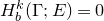 $H^k_b(\Gamma; E) = 0$
for every
$H^k_b(\Gamma; E) = 0$
for every $1 \leq k \leq n$
and every Banach
$1 \leq k \leq n$
and every Banach $\Gamma$
-module E in
$\Gamma$
-module E in $\mathfrak{X}$
. The group
$\mathfrak{X}$
. The group $\Gamma$
is said to be
$\Gamma$
is said to be $\mathfrak{X}$
-boundedly acyclic if it is
$\mathfrak{X}$
-boundedly acyclic if it is $\mathfrak{X}$
-boundedly
$\mathfrak{X}$
-boundedly $\infty$
-acyclic.
$\infty$
-acyclic. $\mathfrak{X}^{\{{\mathbb{R}}\}}$
-boundedly acyclic groups are usually simply called boundedly acyclic.
$\mathfrak{X}^{\{{\mathbb{R}}\}}$
-boundedly acyclic groups are usually simply called boundedly acyclic.
The chain of inclusions given in Equation (*) shows that the classes of $\mathfrak{X}$
-boundedly acyclic (BAc) groups satisfy the following:
$\mathfrak{X}$
-boundedly acyclic (BAc) groups satisfy the following:
 \begin{align*}\mathfrak{X}^{\text{dual}}\mbox{-}\text{BAc} \subseteq \mathfrak{X}^{\text{sep}}\mbox{-}\text{BAc} \subseteq \mathfrak{X}^{\{ {\mathbb{R}}\}}\mbox{-}\text{BAc}. \end{align*}
Remark 2.4
(Strict inclusions). As proved by Monod [Reference MonodMon22], there are $\mathfrak{X}^{\text{sep}}$
-boundedly acyclic groups that are not amenable whence not
$\mathfrak{X}^{\text{sep}}$
-boundedly acyclic groups that are not amenable whence not $\mathfrak{X}^{\text{dual}}$
-boundedly acyclic, e.g.
$\mathfrak{X}^{\text{dual}}$
-boundedly acyclic, e.g. $F_2 \wr {\mathbb{Z}}$
, where
$F_2 \wr {\mathbb{Z}}$
, where $F_2$
denotes the non-abelian free group of rank 2. We do not know of an
$F_2$
denotes the non-abelian free group of rank 2. We do not know of an $\mathfrak{X}^{\{{\mathbb{R}}\}}$
-boundedly acyclic group that is not
$\mathfrak{X}^{\{{\mathbb{R}}\}}$
-boundedly acyclic group that is not $\mathfrak{X}^{\text{sep}}$
-boundedly acyclic.
$\mathfrak{X}^{\text{sep}}$
-boundedly acyclic.
However, there exists a group that is $\mathfrak{X}^{\{{\mathbb{R}}\}}$
-boundedly 2-acyclic but is not
$\mathfrak{X}^{\{{\mathbb{R}}\}}$
-boundedly 2-acyclic but is not $\mathfrak{X}^{\text{sep}}$
-boundedly 2-acyclic, namely
$\mathfrak{X}^{\text{sep}}$
-boundedly 2-acyclic, namely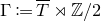 $\Gamma := \overline{T} \rtimes \mathbb{Z}/2$
, where
$\Gamma := \overline{T} \rtimes \mathbb{Z}/2$
, where $\overline{T}$
is the lift of Thompson’s group to the real line, and the order-2 automorphism is given by the change of orientation. Indeed, it follows by a combination of two results, [Reference Fournier-Facio and WadeFFW23, Example 6.12] and [Reference MonodMon01, Example 12.4.3], that
$\overline{T}$
is the lift of Thompson’s group to the real line, and the order-2 automorphism is given by the change of orientation. Indeed, it follows by a combination of two results, [Reference Fournier-Facio and WadeFFW23, Example 6.12] and [Reference MonodMon01, Example 12.4.3], that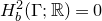 $H^2_b(\Gamma; {\mathbb{R}}) = 0$
. However, by Eckmann–Shapiro induction [Reference MonodMon01, Proposition 10.1.3], there exists an isomorphism
$H^2_b(\Gamma; {\mathbb{R}}) = 0$
. However, by Eckmann–Shapiro induction [Reference MonodMon01, Proposition 10.1.3], there exists an isomorphism $H^2_b(\Gamma; \ell^\infty(\Gamma / \overline{T}, {\mathbb{R}})) \cong H^2_b(\overline{T}; {\mathbb{R}}) \neq 0$
(via the rotation quasimorphism [Reference CalegariCal09]); but
$H^2_b(\Gamma; \ell^\infty(\Gamma / \overline{T}, {\mathbb{R}})) \cong H^2_b(\overline{T}; {\mathbb{R}}) \neq 0$
(via the rotation quasimorphism [Reference CalegariCal09]); but $\ell^\infty(\Gamma / \overline{T}, {\mathbb{R}})$
is two-dimensional, and thus dual (reflexive) and separable.
$\ell^\infty(\Gamma / \overline{T}, {\mathbb{R}})$
is two-dimensional, and thus dual (reflexive) and separable.
Here is a list of examples of $\mathfrak{X}$
-boundedly acyclic groups.
$\mathfrak{X}$
-boundedly acyclic groups.
Example 2.5 ( $\mathfrak{X}$
-boundedly acyclic groups). We have the following.
$\mathfrak{X}$
-boundedly acyclic groups). We have the following.
-
(1) All amenable groups are
$\mathfrak{X}^{\text{dual}}$
-boundedly acyclic [Reference JohnsonJoh72]. -
(2) Thompson’s group F is
$\mathfrak{X}^{\text{sep}}$
-boundedly acyclic [Reference MonodMon22]. -
(3) Let
$\Lambda$
be a group. All wreath products are
\begin{align*} \Lambda \wr {\mathbb{Z}} = (\bigoplus_{{\mathbb{Z}}} \Lambda) \rtimes {\mathbb{Z}} \end{align*}
$\mathfrak{X}^{\text{sep}}$
-boundedly acyclic [Reference MonodMon22].
-
(4) Every countable group embeds into a
$\mathfrak{X}^{\{{\mathbb{R}}\}}$
-boundedly acyclic group, and there exists a finitely presented
$\mathfrak{X}^{\{{\mathbb{R}}\}}$
-boundedly acyclic group that contains all finitely presented groups [Reference Fournier-Facio, Löh and MoraschiniFFLM24]. -
(5) All binate groups [Reference BerrickBer89] are
$\mathfrak{X}^{\{{\mathbb{R}}\}}$
-boundedly acyclic [Reference Matsumoto and MoritaMM85, Reference LöhLöh17, Reference Fournier-Facio, Löh and MoraschiniFFLM23]. -
(6) The groups of homeomorphisms and diffeomorphisms of compact support of manifolds of the form
${\mathbb{R}}^n \times M$
, with M closed and
$n\geq 1$
, are
$\mathfrak{X}^{\{{\mathbb{R}}\}}$
-boundedly acyclic [Reference Monod and NarimanMN23].


We end this section with Gromov’s foundational mapping theorem, which will be useful in some arguments throughout the text.
Theorem 2.6
(Gromov’s mapping theorem [Reference GromovGro82], [Reference FrigerioFri17, Theorem 4.24]). Let $n \geq 1$
be an integer. Let
$n \geq 1$
be an integer. Let $\Gamma$
be a group and let
$\Gamma$
be a group and let $N \leq \Gamma$
be an amenable normal subgroup. Let
$N \leq \Gamma$
be an amenable normal subgroup. Let $\pi \colon \Gamma \to \Lambda := \Gamma / N$
be the quotient, and let E be a dual Banach
$\pi \colon \Gamma \to \Lambda := \Gamma / N$
be the quotient, and let E be a dual Banach $\Lambda$
-module. Then, the pullback
$\Lambda$
-module. Then, the pullback $H^n_b(\Lambda; E) \to H^n_b(\Gamma; \pi^\ast E)$
is an isometric isomorphism in all degrees.
$H^n_b(\Lambda; E) \to H^n_b(\Gamma; \pi^\ast E)$
is an isometric isomorphism in all degrees.
In particular, given a class $\mathfrak{X} \subseteq \mathfrak{X}^{\text{dual}}$
of Banach
$\mathfrak{X} \subseteq \mathfrak{X}^{\text{dual}}$
of Banach $\Lambda$
-modules, if
$\Lambda$
-modules, if $\Gamma$
is
$\Gamma$
is $\mathfrak{X}$
-boundedly n-acyclic, then
$\mathfrak{X}$
-boundedly n-acyclic, then $\Lambda$
is also
$\Lambda$
is also $\mathfrak{X}$
-boundedly n-acyclic.
$\mathfrak{X}$
-boundedly n-acyclic.
Remark 2.7
(Gromov’s mapping theorem via inflation). Gromov’s mapping theorem can also be stated in the more general case of inflation, namely the induced map $H^n_b(\Lambda; E^N)\to H^n_b(\Gamma; E)$
is also an isometric isomorphism in all degrees and for all dual Banach
$H^n_b(\Lambda; E^N)\to H^n_b(\Gamma; E)$
is also an isometric isomorphism in all degrees and for all dual Banach $\Gamma$
-modules E (see [Reference Moraschini and RaptisMR23, theorem in the introduction]). Here,
$\Gamma$
-modules E (see [Reference Moraschini and RaptisMR23, theorem in the introduction]). Here, $E^N$
denotes the subspace of the N-fixed points of E. Thus, we also obtain a converse to the last conclusion: if
$E^N$
denotes the subspace of the N-fixed points of E. Thus, we also obtain a converse to the last conclusion: if $\Lambda$
is
$\Lambda$
is $\mathfrak{X}$
-boundedly n-acyclic for some family
$\mathfrak{X}$
-boundedly n-acyclic for some family $\mathfrak{X} \subseteq \mathfrak{X}^{\text{dual}}$
of Banach
$\mathfrak{X} \subseteq \mathfrak{X}^{\text{dual}}$
of Banach $\Gamma$
-modules, then
$\Gamma$
-modules, then $\Gamma$
is also
$\Gamma$
is also $\mathfrak{X}$
-boundedly n-acyclic.
$\mathfrak{X}$
-boundedly n-acyclic.
Recall that a subgroup $\Lambda$
of a group
$\Lambda$
of a group $\Gamma$
is co-amenable in
$\Gamma$
is co-amenable in $\Gamma$
if
$\Gamma$
if $\ell^{\infty}(\Gamma/\Lambda)$
admits a
$\ell^{\infty}(\Gamma/\Lambda)$
admits a $\Gamma$
-invariant mean.
$\Gamma$
-invariant mean.
Theorem 2.8
(Co-amenability and bounded cohomology [Reference Monod and PopaMP03, Proposition 3]). Let $n \geq 1$
be an integer. Let
$n \geq 1$
be an integer. Let $\Gamma$
be a group, let
$\Gamma$
be a group, let $\Lambda \leq \Gamma$
be a co-amenable subgroup, and let E be a dual Banach
$\Lambda \leq \Gamma$
be a co-amenable subgroup, and let E be a dual Banach $\Gamma$
-module. Then, the restriction
$\Gamma$
-module. Then, the restriction $H^n_b(\Gamma; E) \to H^n_b(\Lambda; E)$
is injective in all degrees.
$H^n_b(\Gamma; E) \to H^n_b(\Lambda; E)$
is injective in all degrees.
In particular, given a class $\mathfrak{X} \subseteq \mathfrak{X}^{\text{dual}}$
of Banach
$\mathfrak{X} \subseteq \mathfrak{X}^{\text{dual}}$
of Banach $\Gamma$
-modules, if
$\Gamma$
-modules, if $\Lambda$
is
$\Lambda$
is $\mathfrak{X}$
-boundedly n-acyclic, then
$\mathfrak{X}$
-boundedly n-acyclic, then $\Gamma$
is also
$\Gamma$
is also $\mathfrak{X}$
-boundedly n-acyclic.
$\mathfrak{X}$
-boundedly n-acyclic.
2.2 Highly ergodic Zimmer-amenable actions
We recall in this section how to compute bounded cohomology using highly ergodic Zimmer-amenable actions. Recall that a Borel space is standard if it is Borel isomorphic to the Borel space associated to a Polish space. Given a non-singular (i.e. measure class preserving) action of a group $\Gamma$
on a standard Borel measure space S, and a Banach
$\Gamma$
on a standard Borel measure space S, and a Banach $\Gamma$
-module E, there is an induced action of
$\Gamma$
-module E, there is an induced action of $\Gamma$
on
$\Gamma$
on $L^\infty(S, E)$
, defined in the same way as the action of
$L^\infty(S, E)$
, defined in the same way as the action of $\Gamma$
on
$\Gamma$
on $C^n_b(\Gamma; E)$
(see Equation (1)).
$C^n_b(\Gamma; E)$
(see Equation (1)).
Definition 2.9
(Zimmer-amenable space) Let $\Gamma$
be a group. Let S be a standard Borel probability space, equipped with a non-singular action of
$\Gamma$
be a group. Let S be a standard Borel probability space, equipped with a non-singular action of $\Gamma$
. A conditional expectation
$\Gamma$
. A conditional expectation
 \begin{align*}m \colon L^\infty(\Gamma \times S, {\mathbb{R}}) \to L^\infty(S, {\mathbb{R}}) \end{align*}
is a norm-1 linear map such that:
-
(1)
$m(\mathbb{1}_{\Gamma \times S}) = \mathbb{1}_S$
; and -
(2) for all
$f \in L^\infty(\Gamma \times S, {\mathbb{R}})$
andvery measurable subset
$A \subset S$
, it holds that
$m(f \cdot \mathbb{1}_{\Gamma \times A}) = m(f) \cdot \mathbb{1}_A$
.




We say that S is a Zimmer-amenable $\Gamma$
-space if there exists a conditional expectation
$\Gamma$
-space if there exists a conditional expectation $m \colon L^\infty(\Gamma \times S) \to L^\infty(S)$
that is, moreover,
$m \colon L^\infty(\Gamma \times S) \to L^\infty(S)$
that is, moreover, $\Gamma$
-equivariant (on
$\Gamma$
-equivariant (on $\Gamma\times S$
, we consider the diagonal
$\Gamma\times S$
, we consider the diagonal $\Gamma$
-action).
$\Gamma$
-action).
The following proposition provides useful examples of Zimmer-amenable spaces that will be of crucial use for us [Reference MonodMon22, § 2.3, Corollary 8 and Proposition 9].
Proposition 2.10 (Zimmer-amenable spaces). We have the following.
-
(1) Let
$\Gamma$
be a countable group and let S be the standard Borel probability
$\Gamma$
-space obtained by taking
$S = \Gamma$
and by endowing it with a distribution of full support. Then, the
$\Gamma$
-action on S via left multiplication turns S into a Zimmer-amenable
$\Gamma$
-space. Moreover, S is a Zimmer-amenable
$\Lambda$
-space, for every subgroup
$\Lambda < \Gamma$
. -
(2) Let
$\{\Gamma_i\}_{i \in {\mathbb{N}}}$
be a countable collection of countable groups and let
$\{S_i\}_{i \in {\mathbb{N}}}$
be a countable collection of Zimmer-amenable
$\Gamma_i$
-spaces. Then, the direct product
$\prod_{i \in {\mathbb{N}}}S_i$
is a Zimmer-amenable
$\bigoplus_{i \in {\mathbb{N}}} \Gamma_i$
-space. -
(3) Let
$\Gamma$
be a countable group and let
$\Lambda < \Gamma$
be a co-amenable subgroup. Let S be a standard Borel probability space equipped with a non-singular action of
$\Gamma$
. If S is a Zimmer-amenable
$\Lambda$
-space, then it is also a Zimmer-amenable
$\Gamma$
-space.


Zimmer-amenable spaces play a fundamental role in the theory of bounded cohomology.
Theorem 2.11
(Bounded cohomology and Zimmer-amenable spaces [Reference MonodMon01, Theorem 7.5.3]). Let $\Gamma$
be a countable group, let
$\Gamma$
be a countable group, let $E \in \mathfrak{X}^{\text{sep}}$
be a Banach
$E \in \mathfrak{X}^{\text{sep}}$
be a Banach $\Gamma$
-module, and let S be a Zimmer-amenable
$\Gamma$
-module, and let S be a Zimmer-amenable $\Gamma$
-space. Then, the complex
$\Gamma$
-space. Then, the complex
 \begin{align*} 0 \to L^\infty(S, E)^{\Gamma} \to L^\infty(S^2, E)^{\Gamma} \to L^\infty(S^3, E)^{\Gamma} \to \cdots\!, \end{align*}
endowed with the simplicial coboundary operator, isometrically computes the bounded cohomology of $\Gamma$
with coefficients in E.
$\Gamma$
with coefficients in E.
This comes in particularly handy when $L^\infty(S^{n+1}, E)^{\Gamma}$
is small. Recall the following definition.
$L^\infty(S^{n+1}, E)^{\Gamma}$
is small. Recall the following definition.
Definition 2.12
(Ergodicity with coefficients). Let S be a standard Borel probability space, equipped with a non-singular action of $\Gamma$
. We say that the action is ergodic if every
$\Gamma$
. We say that the action is ergodic if every $\Gamma$
-invariant subset of S has either zero or full measure. Equivalently, the
$\Gamma$
-invariant subset of S has either zero or full measure. Equivalently, the $\Gamma$
-action on S is ergodic if every essentially bounded measurable
$\Gamma$
-action on S is ergodic if every essentially bounded measurable $\Gamma$
-invariant function
$\Gamma$
-invariant function $S \to {\mathbb{R}}$
is essentially constant: in symbols,
$S \to {\mathbb{R}}$
is essentially constant: in symbols, $L^\infty(S, {\mathbb{R}})^{\Gamma} \cong {\mathbb{R}}$
(recall that
$L^\infty(S, {\mathbb{R}})^{\Gamma} \cong {\mathbb{R}}$
(recall that ${\mathbb{R}}$
is always endowed with the trivial
${\mathbb{R}}$
is always endowed with the trivial $\Gamma$
-action). Now let E be a Banach
$\Gamma$
-action). Now let E be a Banach $\Gamma$
-module. We say that the action of
$\Gamma$
-module. We say that the action of $\Gamma$
on S is ergodic with coefficients in E if every essentially bounded measurable
$\Gamma$
on S is ergodic with coefficients in E if every essentially bounded measurable $\Gamma$
-equivariant function
$\Gamma$
-equivariant function $S \to E$
is essentially constant: in symbols,
$S \to E$
is essentially constant: in symbols, $L^\infty(S, E)^{\Gamma} \cong E^{\Gamma}$
.
$L^\infty(S, E)^{\Gamma} \cong E^{\Gamma}$
.
Before moving on, we introduce the following definitions.
Definition 2.13
(High ergodicity). Let $\Gamma$
be a group and let S be a standard Borel probability space with a non-singular
$\Gamma$
be a group and let S be a standard Borel probability space with a non-singular $\Gamma$
-action. We say that the action
$\Gamma$
-action. We say that the action $\Gamma \curvearrowright S$
is highly ergodic if the diagonal action
$\Gamma \curvearrowright S$
is highly ergodic if the diagonal action $\Gamma \curvearrowright S^n$
is ergodic for all integers
$\Gamma \curvearrowright S^n$
is ergodic for all integers $n \geq 1$
.
$n \geq 1$
.
Definition 2.14
(The generalized Bernoulli shift). Let $\Gamma$
be a countable group acting on a countable set X. Let Y be a standard Borel probability space and assume that the measure does not concentrate on a single point. We can then define a new standard Borel probability space
$\Gamma$
be a countable group acting on a countable set X. Let Y be a standard Borel probability space and assume that the measure does not concentrate on a single point. We can then define a new standard Borel probability space $Y^X = \prod_{x \in X} Y$
. The generalized Bernoulli shift is the dynamical system given by the
$Y^X = \prod_{x \in X} Y$
. The generalized Bernoulli shift is the dynamical system given by the $\Gamma$
-action of
$\Gamma$
-action of $Y^X$
, defined as follows:
$Y^X$
, defined as follows:
 \begin{align*}\gamma \cdot(y_x)_{x \in X} := (y_{\gamma^{-1} \cdot x})_{x \in X}, \end{align*}
for all $\gamma \in \Gamma$
and
$\gamma \in \Gamma$
and $(y_x)_{x \in X} \in Y^X$
.
$(y_x)_{x \in X} \in Y^X$
.
We now characterize when the generalized Bernoulli shift is ergodic.
Proposition 2.15
(Ergodicity of the generalized Bernoulli shift). Let Y be a standard Borel probability space and assume that the measure does not concentrate on a single point. Let $\Gamma$
be a countable group acting on a countable set X. Consider the generalized Bernoulli shift action of
$\Gamma$
be a countable group acting on a countable set X. Consider the generalized Bernoulli shift action of $\Gamma$
on
$\Gamma$
on $Y^X$
(as in the above example). The following are equivalent.
$Y^X$
(as in the above example). The following are equivalent.
-
(1) The action of
$\Gamma$
on
$Y^X$
is ergodic. -
(2) The action of
$\Gamma$
on
$Y^X$
is highly ergodic. -
(3) All the orbits of the action of
$\Gamma$
on X are infinite.


Proof. (1) $\Longleftrightarrow$
(3) This is proved by Kechris and Tsankov [Reference Kechris and TsankovKT08, Proposition 2.1].
$\Longleftrightarrow$
(3) This is proved by Kechris and Tsankov [Reference Kechris and TsankovKT08, Proposition 2.1].
(2) $\Longrightarrow$
(1) It is straightforward.
$\Longrightarrow$
(1) It is straightforward.
(1) $\Longrightarrow$
(2) By assumption, the
$\Longrightarrow$
(2) By assumption, the $\Gamma$
-action on
$\Gamma$
-action on $Y^X$
is ergodic and so all the orbits of the
$Y^X$
is ergodic and so all the orbits of the $\Gamma$
-action on X are infinite by (3). We have to show that the diagonal action of
$\Gamma$
-action on X are infinite by (3). We have to show that the diagonal action of $\Gamma$
on
$\Gamma$
on $\prod_{i = 1}^n Y^X$
is ergodic for every integer
$\prod_{i = 1}^n Y^X$
is ergodic for every integer $n \geq 1$
. For each n, this action is a generalized Bernoulli shift, where
$n \geq 1$
. For each n, this action is a generalized Bernoulli shift, where $\Gamma \curvearrowright Y^{\sqcup_{i = 1}^n X}$
simply by acting diagonally on the disjoint union of the sets X. Moreover, all the orbits of the
$\Gamma \curvearrowright Y^{\sqcup_{i = 1}^n X}$
simply by acting diagonally on the disjoint union of the sets X. Moreover, all the orbits of the $\Gamma$
-action on
$\Gamma$
-action on $\sqcup_{i = 1}^n X$
are infinite. Hence, now applying (3)
$\sqcup_{i = 1}^n X$
are infinite. Hence, now applying (3) $\Rightarrow$
(1) to the generalized Bernoulli shift
$\Rightarrow$
(1) to the generalized Bernoulli shift $\Gamma \curvearrowright Y^{\sqcup_{i = 1}^n X}$
, we conclude that the action is ergodic, whence the thesis.
$\Gamma \curvearrowright Y^{\sqcup_{i = 1}^n X}$
, we conclude that the action is ergodic, whence the thesis.
Remark 2.16
(Ergodicity and subgroups). Let $\Gamma$
be a group and let Y be a standard Borel probability
$\Gamma$
be a group and let Y be a standard Borel probability $\Gamma$
-space. Suppose that there exists a subgroup
$\Gamma$
-space. Suppose that there exists a subgroup $\Lambda \leq \Gamma$
such that the restricted action
$\Lambda \leq \Gamma$
such that the restricted action $\Lambda \curvearrowright Y$
is ergodic. Then, the action
$\Lambda \curvearrowright Y$
is ergodic. Then, the action $\Gamma \curvearrowright Y$
is also ergodic (indeed, if all the
$\Gamma \curvearrowright Y$
is also ergodic (indeed, if all the $\Lambda$
-invariant functions are essentially constant, then the
$\Lambda$
-invariant functions are essentially constant, then the $\Gamma$
-invariant functions must also be so).
$\Gamma$
-invariant functions must also be so).
Definition 2.17
(HEZA). Let $\Gamma$
be a group and let S be a standard Borel probability
$\Gamma$
be a group and let S be a standard Borel probability $\Gamma$
-space. We say that S is highly ergodic Zimmer-amenable,
$\Gamma$
-space. We say that S is highly ergodic Zimmer-amenable, $\text{HEZA}$
for short, if S is a Zimmer-amenable
$\text{HEZA}$
for short, if S is a Zimmer-amenable $\Gamma$
-space and the
$\Gamma$
-space and the $\Gamma$
-action on S is highly ergodic.
$\Gamma$
-action on S is highly ergodic.
The following is an important criterion for the vanishing of bounded cohomology, which will be of key use for us.
Corollary 2.18
(HEZA spaces and bounded acyclicity [Reference MonodMon22, p. 668]). Let $\Gamma$
be a countable group for which there exists a
$\Gamma$
be a countable group for which there exists a $\text{HEZA}$
-space. Then
$\text{HEZA}$
-space. Then $\Gamma$
is
$\Gamma$
is $\mathfrak{X}^{\text{sep}}$
-boundedly acyclic.
$\mathfrak{X}^{\text{sep}}$
-boundedly acyclic.
2.3 Commuting conjugates
In the sequel, we are going to introduce sufficient conditions for $\mathfrak{X}$
-bounded acyclicity. Here, we recall the notion of commuting conjugates [Reference KotschickKot08, Reference Fournier-Facio and LodhaFFL23] that we will extend later.
$\mathfrak{X}$
-bounded acyclicity. Here, we recall the notion of commuting conjugates [Reference KotschickKot08, Reference Fournier-Facio and LodhaFFL23] that we will extend later.
Definition 2.19
(Commuting conjugates). A group $\Gamma$
has commuting conjugates if, for every finitely generated subgroup
$\Gamma$
has commuting conjugates if, for every finitely generated subgroup $H \leq \Gamma$
, there exists an element
$H \leq \Gamma$
, there exists an element $g \in \Gamma$
such that
$g \in \Gamma$
such that
 \begin{align*} [H, gHg^{-1}] = 1. \end{align*}
For simplicity, from now on we will always denote the conjugation by ${}^{g}H := gHg^{-1}$
.
${}^{g}H := gHg^{-1}$
.
This natural property detects bounded acyclicity in low degree.
Theorem 2.20
(Commuting conjugates and bounded 2-acyclicity [Reference Fournier-Facio and LodhaFFL23, Theorem 1.2]). Let $\Gamma$
be a group with commuting conjugates. Then,
$\Gamma$
be a group with commuting conjugates. Then, $\Gamma$
is
$\Gamma$
is $\mathfrak{X}^{\{{\mathbb{R}}\}}$
-boundedly 2-acyclic.
$\mathfrak{X}^{\{{\mathbb{R}}\}}$
-boundedly 2-acyclic.
Example 2.21 (Groups with commuting conjugates) The following groups have commuting conjugates.
-
(1) Let R be a ring. The infinite general linear group GL(R) has commuting conjugates [Reference Fournier-Facio, Löh and MoraschiniFFLM23, proof of Proposition 4.9].
-
(2) The group of symplectic (or Hamiltonian) diffeomorphisms of
${\mathbb{R}}^n$
with compact support and
$n \geq 2$
has commuting conjugates. This result implicitly dates back to Kotschick’s work on the stable commutator length of the identity components of symplectic (or Hamiltonian) diffeomorphism groups [Reference KotschickKot08, § 4]. -
(3) Every group
$\Gamma$
of boundedly supported homeomorphisms of the real line with no global fixpoints has commuting conjugates [Reference Fournier-Facio and LodhaFFL23, Proposition 3.8].


2.4 Direct unions
Here, we investigate the most important combination result for the proof of Theorem 1.3. To the best of the authors’ knowledge, it is not known whether direct unions of $\mathfrak{X}$
-boundedly acyclic groups are
$\mathfrak{X}$
-boundedly acyclic groups are $\mathfrak{X}$
-boundedly acyclic (besides the case
$\mathfrak{X}$
-boundedly acyclic (besides the case $\mathfrak{X}^{\text{dual}}$
, of course, corresponding to amenable groups). However, direct unions with controlled vanishing do preserve bounded acyclicity. This involves the notion of vanishing modulus with coefficients, which extends the previous notion for trivial real coefficients [Reference Fournier-Facio, Löh and MoraschiniFFLM23, Reference Monod and NarimanMN23]. The notion of vanishing modulus for trivial real coefficients has already proved useful to show that bounded acyclicity is preserved under certain constructions: namely if the vanishing modulus of a family of groups is uniformly bounded, then several constructions in bounded cohomology go through [Reference Fournier-Facio, Löh and MoraschiniFFLM23, LLM22]. Our aim is to extend this philosophy and make it quantitative in the case of coefficients. Let us start with the definition.
$\mathfrak{X}^{\text{dual}}$
, of course, corresponding to amenable groups). However, direct unions with controlled vanishing do preserve bounded acyclicity. This involves the notion of vanishing modulus with coefficients, which extends the previous notion for trivial real coefficients [Reference Fournier-Facio, Löh and MoraschiniFFLM23, Reference Monod and NarimanMN23]. The notion of vanishing modulus for trivial real coefficients has already proved useful to show that bounded acyclicity is preserved under certain constructions: namely if the vanishing modulus of a family of groups is uniformly bounded, then several constructions in bounded cohomology go through [Reference Fournier-Facio, Löh and MoraschiniFFLM23, LLM22]. Our aim is to extend this philosophy and make it quantitative in the case of coefficients. Let us start with the definition.
Definition 2.22
(Vanishing modulus with coefficients). Let $\Gamma$
be a group, let E be a Banach
$\Gamma$
be a group, let E be a Banach $\Gamma$
-module, and let n be a positive integer. The nth vanishing modulus of
$\Gamma$
-module, and let n be a positive integer. The nth vanishing modulus of $\Gamma$
with coefficients in E, denoted by
$\Gamma$
with coefficients in E, denoted by $\| H^n_b(\Gamma; E) \|$
, is defined as the minimal
$\| H^n_b(\Gamma; E) \|$
, is defined as the minimal $K \in [0, \infty]$
such that the following holds. For every cocycle
$K \in [0, \infty]$
such that the following holds. For every cocycle $z \in Z^n_b(\Gamma; E)$
, there exists a cochain
$z \in Z^n_b(\Gamma; E)$
, there exists a cochain $b \in C^{n-1}_b(\Gamma; E)^{\Gamma}$
such that
$b \in C^{n-1}_b(\Gamma; E)^{\Gamma}$
such that $\delta^{n-1}(b) = z$
and
$\delta^{n-1}(b) = z$
and $\| b \|_\infty \leq K \cdot \| z \|_\infty$
.
$\| b \|_\infty \leq K \cdot \| z \|_\infty$
.
We apply the usual convention that $\inf \varnothing = \infty$
, so if
$\inf \varnothing = \infty$
, so if $H^n_b(\Gamma; E) \neq 0$
, then
$H^n_b(\Gamma; E) \neq 0$
, then $\| H^n_b(\Gamma; E) \| = \infty$
. An easy application of the open mapping theorem implies the converse.
$\| H^n_b(\Gamma; E) \| = \infty$
. An easy application of the open mapping theorem implies the converse.
Lemma 2.23 ( $\mathfrak{X}$
-boundedly acyclic groups have uniformly bounded vanishing modulus). Let
$\mathfrak{X}$
-boundedly acyclic groups have uniformly bounded vanishing modulus). Let $\Gamma$
be a group, let E be a Banach
$\Gamma$
be a group, let E be a Banach $\Gamma$
-module, and let
$\Gamma$
-module, and let $n \geq 1$
be an integer. Then, we have the following.
$n \geq 1$
be an integer. Then, we have the following.
-
(1) If
$H^n_b(\Gamma; E) = 0$
, then
$\| H^n_b(\Gamma; E) \| < +\infty$
. -
(2) If
$H^n_b(\Gamma; E) = 0$
for every
$E \in \mathfrak{X}^{\text{sep}}$
, then
$\| H^n_b(\Gamma; E) \|$
is uniformly bounded over all such E, i.e.
\begin{align*} \sup_{E \in \mathfrak{X}^{\text{sep}}} \| H_b^n(\Gamma; E) \| < +\infty . \end{align*}





The first statement in the case of trivial real coefficients was already implicit in the work of Matsumoto and Morita [Reference Matsumoto and MoritaMM85] but the details have been worked out only recently [Reference Fournier-Facio, Löh and MoraschiniFFLM23, Lemma 4.12] (also compare with the work by Monod and Nariman [Reference Monod and NarimanMN23, after Definition 2.5]).
Proof. Ad (1) Let E be a Banach $\Gamma$
-module and let us suppose that
$\Gamma$
-module and let us suppose that $H^n_b(\Gamma; E)=0$
. Then, we can identify the space of n-cocycles with the space of n-coboundaries
$H^n_b(\Gamma; E)=0$
. Then, we can identify the space of n-cocycles with the space of n-coboundaries
 \begin{align*}Z^n_b(\Gamma; E) = B^n_b(\Gamma; E) = \delta^{n-1}(C^{n-1}_b(\Gamma; E)^{\Gamma}). \end{align*}
Since this is a closed subspace of the Banach space $C^{n}_b(\Gamma; E)^{\Gamma}$
, it is itself a Banach space. Moreover, since
$C^{n}_b(\Gamma; E)^{\Gamma}$
, it is itself a Banach space. Moreover, since $Z^{n-1}_b(\Gamma; E)$
is a closed subspace of the Banach space
$Z^{n-1}_b(\Gamma; E)$
is a closed subspace of the Banach space $C^{n-1}_b(\Gamma; E)^{\Gamma}$
there exists a natural quotient Banach space
$C^{n-1}_b(\Gamma; E)^{\Gamma}$
there exists a natural quotient Banach space $C^{n-1}_b(\Gamma; E)^{\Gamma}/Z^{n-1}_b(\Gamma; E)$
endowed with the quotient norm. It follows that the bounded linear operator
$C^{n-1}_b(\Gamma; E)^{\Gamma}/Z^{n-1}_b(\Gamma; E)$
endowed with the quotient norm. It follows that the bounded linear operator $\delta^{n-1}$
is a surjective continuous linear map between Banach spaces, so the open mapping theorem says that this is an open map. So the map
$\delta^{n-1}$
is a surjective continuous linear map between Banach spaces, so the open mapping theorem says that this is an open map. So the map
 \begin{align*} \delta^{n-1} \colon C^{n-1}_b(\Gamma; E)^{\Gamma} / Z^{n-1}_b(\Gamma; E) \to Z^n_b(\Gamma; E) \end{align*}
has a bounded inverse $\varphi$
, which has finite operator norm
$\varphi$
, which has finite operator norm $\| \varphi \|_{op}$
. Then, for every cocycle
$\| \varphi \|_{op}$
. Then, for every cocycle $z \in Z^{n}_b(\Gamma; E)$
, the class
$z \in Z^{n}_b(\Gamma; E)$
, the class $\varphi(z)$
admits a representative
$\varphi(z)$
admits a representative $b \in C^{n-1}_b(\Gamma; E)^{\Gamma}$
of
$b \in C^{n-1}_b(\Gamma; E)^{\Gamma}$
of $\ell^\infty$
-norm at most
$\ell^\infty$
-norm at most $2 \cdot \|\varphi\|_{op} \cdot \| z \|_\infty$
. This shows that
$2 \cdot \|\varphi\|_{op} \cdot \| z \|_\infty$
. This shows that $\| H^n_b(\Gamma; E) \| < +\infty$
, whence the thesis.
$\| H^n_b(\Gamma; E) \| < +\infty$
, whence the thesis.
Ad (2) Now suppose that $H^n_b(\Gamma; E) = 0$
for every Banach
$H^n_b(\Gamma; E) = 0$
for every Banach $\Gamma$
-module
$\Gamma$
-module $E \in \mathfrak{X}^{\text{sep}}$
. Assume by way of contradiction that
$E \in \mathfrak{X}^{\text{sep}}$
. Assume by way of contradiction that
 \begin{align*}\sup_{E \in \mathfrak{X}^{\text{sep}}} \| H_b^n(\Gamma; E) \| =+\infty.\end{align*}
Then there exists a countable sequence of Banach $\Gamma$
-modules
$\Gamma$
-modules $E_i \in \mathfrak{X}^{\text{sep}}$
such that
$E_i \in \mathfrak{X}^{\text{sep}}$
such that $\| H_b^n(\Gamma; E_i) \| \to +\infty$
when
$\| H_b^n(\Gamma; E_i) \| \to +\infty$
when $i \to +\infty$
. Then, we can consider their
$i \to +\infty$
. Then, we can consider their $\ell^2$
-direct sum
$\ell^2$
-direct sum $E = \bigoplus_{2} E_i$
(see [Reference ConwayCon90, p. 72]). It is easy to show that E is a separable dual Banach
$E = \bigoplus_{2} E_i$
(see [Reference ConwayCon90, p. 72]). It is easy to show that E is a separable dual Banach $\Gamma$
-module [Reference ConwayCon90, Chapter III, Proposition 4.4, Exercises 4.13 and 5.4]. By our hypothesis
$\Gamma$
-module [Reference ConwayCon90, Chapter III, Proposition 4.4, Exercises 4.13 and 5.4]. By our hypothesis $H^n_b(\Gamma; E) = 0$
, and thus
$H^n_b(\Gamma; E) = 0$
, and thus $K := \| H^n_b(\Gamma; E) \| < +\infty$
by (1).
$K := \| H^n_b(\Gamma; E) \| < +\infty$
by (1).
To achieve a contradiction, it suffices to show that $\| H^n_b(\Gamma; E_i) \| \leq K$
for all
$\| H^n_b(\Gamma; E_i) \| \leq K$
for all $i \in {\mathbb{N}}$
. Let us fix
$i \in {\mathbb{N}}$
. Let us fix $i \in {\mathbb{N}}$
. We consider the inclusion
$i \in {\mathbb{N}}$
. We consider the inclusion $\iota \colon E_i \to E$
and the projection
$\iota \colon E_i \to E$
and the projection $\pi \colon E \to E_i$
. They are both
$\pi \colon E \to E_i$
. They are both $\Gamma$
-equivariant bounded maps [Reference ConwayCon90, Chapter III, Proposition 4.4]. Hence, the inclusion and the projection maps induce the following maps at the level of bounded cochain complexes:
$\Gamma$
-equivariant bounded maps [Reference ConwayCon90, Chapter III, Proposition 4.4]. Hence, the inclusion and the projection maps induce the following maps at the level of bounded cochain complexes:
 \begin{align*}\pi_\ast^\bullet \colon C_b^\bullet(\Gamma; E)^\Gamma \to C_b^\bullet(\Gamma; E_i)^\Gamma \end{align*}
and
 \begin{align*}\iota_\ast^\bullet \colon C_b^\bullet(\Gamma; E_i)^\Gamma \to C_b^\bullet(\Gamma; E)^\Gamma.\end{align*}
Let $z \in C^n_b(\Gamma; E_i)$
be a cocycle. We are going to show that we can find a primitive of norm at most
$z \in C^n_b(\Gamma; E_i)$
be a cocycle. We are going to show that we can find a primitive of norm at most $K \cdot \|z\|_\infty$
. First note that
$K \cdot \|z\|_\infty$
. First note that $\iota_*^n(z)\in C^n_b(\Gamma; E)^\Gamma$
is also a cocycle. By the definition of the vanishing modulus with coefficients in E and the definition of K, we know that there exists a cochain
$\iota_*^n(z)\in C^n_b(\Gamma; E)^\Gamma$
is also a cocycle. By the definition of the vanishing modulus with coefficients in E and the definition of K, we know that there exists a cochain $b \in C^{n-1}_b(\Gamma; E)^{\Gamma}$
such that
$b \in C^{n-1}_b(\Gamma; E)^{\Gamma}$
such that $\delta^{n-1}(b) = \iota_*^n(z)$
and
$\delta^{n-1}(b) = \iota_*^n(z)$
and $\| b \|_\infty \leq K \cdot \| \iota_*^n(z) \|_\infty$
. We then define
$\| b \|_\infty \leq K \cdot \| \iota_*^n(z) \|_\infty$
. We then define $\pi_*^{n-1}(b) \in C^{n-1}_b(\Gamma; E_i)^{\Gamma}$
. By construction, we have that
$\pi_*^{n-1}(b) \in C^{n-1}_b(\Gamma; E_i)^{\Gamma}$
. By construction, we have that
 \begin{align*}\| \pi_*^{n-1} (b) \|_\infty \leq \| b \|_\infty \leq K \cdot \| \iota_*^n (z) \|_\infty \leq K \cdot \| z \|_\infty.\end{align*}
Since $\delta^{n-1}(\pi^{n-1}_*(b)) = z$
, this proves our claim.
$\delta^{n-1}(\pi^{n-1}_*(b)) = z$
, this proves our claim.
The reason why the vanishing modulus is relevant for us is the following result, which extends the corresponding statement for trivial real coefficients [Reference Fournier-Facio, Löh and MoraschiniFFLM23, Proposition 4.13] (in fact, that statement is only about direct unions, but for our purposes we need to treat slightly more general unions).
Proposition 2.24
(Vanishing modulus with coefficients and direct unions). Let I be an arbitrary index set and let $n \geq 1$
be an integer. Let
$n \geq 1$
be an integer. Let $\Gamma$
be a group, and let
$\Gamma$
be a group, and let $\{\Gamma_i\}_{i \in I}$
be a family of subgroups of
$\{\Gamma_i\}_{i \in I}$
be a family of subgroups of $\Gamma$
such that each finitely generated subgroup of
$\Gamma$
such that each finitely generated subgroup of $\Gamma$
is contained in some
$\Gamma$
is contained in some $\Gamma_i$
. Let E be a Banach
$\Gamma_i$
. Let E be a Banach $\Gamma$
-module in
$\Gamma$
-module in $\mathfrak{X}^{\text{dual}}$
, and thus by restriction also a Banach
$\mathfrak{X}^{\text{dual}}$
, and thus by restriction also a Banach $\Gamma_i$
-module for all
$\Gamma_i$
-module for all $i \in I$
. Then
$i \in I$
. Then
 \begin{align*} \| H^n_b(\Gamma; E) \| \leq \sup_{i \in I} \| H^n_b(\Gamma_i; E) \|.\end{align*}
In particular, if the right-hand side is finite, then $H^n_b(\Gamma; E) = 0$
.
$H^n_b(\Gamma; E) = 0$
.
Proof. Let $K := \text{sup}_{i \in I} \| H^n_b(\Gamma_i; E) \|$
and suppose that
$K := \text{sup}_{i \in I} \| H^n_b(\Gamma_i; E) \|$
and suppose that $K < +\infty$
; otherwise, there is nothing to show. Since
$K < +\infty$
; otherwise, there is nothing to show. Since $E \in \mathfrak{X}^{\text{dual}}$
, there exists a predual F with the corresponding
$E \in \mathfrak{X}^{\text{dual}}$
, there exists a predual F with the corresponding $\Gamma$
-action. This also shows that
$\Gamma$
-action. This also shows that $C^n_b(\Gamma; E) = \ell^\infty(\Gamma^{n+1}, E) \in \mathfrak{X}^{\text{dual}}$
, because it is the dual of
$C^n_b(\Gamma; E) = \ell^\infty(\Gamma^{n+1}, E) \in \mathfrak{X}^{\text{dual}}$
, because it is the dual of $\ell^1(\Gamma^{n+1}, F)$
with the contragradient
$\ell^1(\Gamma^{n+1}, F)$
with the contragradient $\Gamma$
-action. In particular, it comes endowed with the weak-
$\Gamma$
-action. In particular, it comes endowed with the weak- $\ast$
topology. Fix a cocycle
$\ast$
topology. Fix a cocycle $z \in Z^n_b(\Gamma; E)$
, and for each finitely generated subgroup
$z \in Z^n_b(\Gamma; E)$
, and for each finitely generated subgroup $H \leq \Gamma$
define
$H \leq \Gamma$
define
 \begin{align*} B_H^z := \{ b \in C^{n-1}_b(\Gamma; E)^{H} \mid \delta^{n-1}(b|_{H}) = z|_{H} \text{ and } \| b \|_\infty \leq K \cdot \| z \|_\infty \}. \end{align*}
It suffices to show that $\bigcap_{H \leq \Gamma \text{ fin. gen.}} B_H^z \neq \varnothing$
. Then, since
$\bigcap_{H \leq \Gamma \text{ fin. gen.}} B_H^z \neq \varnothing$
. Then, since $\Gamma$
is the direct union of its finitely generated subgroups, an element b in the intersection will satisfy:
$\Gamma$
is the direct union of its finitely generated subgroups, an element b in the intersection will satisfy:
-
–
$b \in C^{n-1}_b(\Gamma; E)^{\Gamma}$
; -
–
$\delta^{n-1}(b) = z$
; and -
–
$\| b \|_\infty \leq K \cdot \| z \|_\infty$
.



Now, each $B_H^z$
is a bounded weak-
$B_H^z$
is a bounded weak- $\ast$
closed subset of
$\ast$
closed subset of $B_{K \cdot \|z\|_\infty}\subset C^{n-1}_b(\Gamma; E)$
. Hence, by the Banach–Alaoglu theorem, it suffices to show that the family
$B_{K \cdot \|z\|_\infty}\subset C^{n-1}_b(\Gamma; E)$
. Hence, by the Banach–Alaoglu theorem, it suffices to show that the family $\{B_H^z\}_{H \leq \Gamma \text{ fin. gen.}}$
satisfies the finite intersection property.
$\{B_H^z\}_{H \leq \Gamma \text{ fin. gen.}}$
satisfies the finite intersection property.
Since $B_H^z \subset B_{H'}^z$
whenever
$B_H^z \subset B_{H'}^z$
whenever $H' \leq H$
, and the system is directed, the finite intersection property will follow as soon as each
$H' \leq H$
, and the system is directed, the finite intersection property will follow as soon as each $B_H^z$
is non-empty. Now, fix
$B_H^z$
is non-empty. Now, fix $H \leq \Gamma$
and let i be such that
$H \leq \Gamma$
and let i be such that $H \leq \Gamma_i$
. Since
$H \leq \Gamma_i$
. Since $\| H^n_b(\Gamma_i; E) \| \leq K$
, there exists
$\| H^n_b(\Gamma_i; E) \| \leq K$
, there exists $b \in C^{n-1}_b(\Gamma_i, E)^{\Gamma_i}$
such that
$b \in C^{n-1}_b(\Gamma_i, E)^{\Gamma_i}$
such that $\delta^{n-1}(b) = z|_{\Gamma_i}$
and
$\delta^{n-1}(b) = z|_{\Gamma_i}$
and $\| b \|_\infty \leq K \cdot \| z \|_\infty$
; extending b by 0, we obtain an element in
$\| b \|_\infty \leq K \cdot \| z \|_\infty$
; extending b by 0, we obtain an element in $B_H^z$
, which concludes the proof.
$B_H^z$
, which concludes the proof.
The nextroposition describes a way to obtain a uniform upper bound on a family of groups without actually having to estimate the individual vanishing moduli. It exploits Lemma 2.23.
Proposition 2.25
(Vanishing modulus with coefficients and direct sums). Let I be an arbitrary index set and let $n \geq 1$
be an integer. Let
$n \geq 1$
be an integer. Let $\{\Gamma_i\}_{i \in I}$
be a family of groups and let
$\{\Gamma_i\}_{i \in I}$
be a family of groups and let $\Gamma := \bigoplus_{i \in I} \Gamma_i$
. Suppose that the classes of Banach
$\Gamma := \bigoplus_{i \in I} \Gamma_i$
. Suppose that the classes of Banach $\Gamma_i$
-modules
$\Gamma_i$
-modules $\mathfrak{X}_i$
are in
$\mathfrak{X}_i$
are in $\mathfrak{X}^{\text{sep}}$
for all
$\mathfrak{X}^{\text{sep}}$
for all $i \in I$
. Then, if
$i \in I$
. Then, if $\Gamma$
is
$\Gamma$
is $\mathfrak{X}^{\text{sep}}$
-boundedly acyclic, we have that
$\mathfrak{X}^{\text{sep}}$
-boundedly acyclic, we have that
 \begin{align*}\sup_{i \in I, E_i \in \mathfrak{X}_i} \| H^n_b(\Gamma_i; E_i) \| <+\infty.\end{align*}
A similar result for trivial real coefficients and unrestricted products has been stated by Monod and Nariman [Reference Monod and NarimanMN23, Proposition 2.6]. Here, we provide an elementary, self-contained proof, which allows for non-trivial coefficients as well. The core of the proposition lies in the following more general fact. Recall that a surjective homomorphism $r \colon \Gamma \to \Lambda$
is a retraction if there exists an injective homomorphism
$r \colon \Gamma \to \Lambda$
is a retraction if there exists an injective homomorphism $\iota \colon \Lambda \to \Gamma$
such that
$\iota \colon \Lambda \to \Gamma$
such that $r \circ \iota = \text{id}_{\Lambda}$
.
$r \circ \iota = \text{id}_{\Lambda}$
.
Lemma 2.26
(Vanishing modulus with coefficients and retractions). Let $r \colon \Gamma \to \Lambda$
be a retraction, let E be a Banach
$r \colon \Gamma \to \Lambda$
be a retraction, let E be a Banach $\Lambda$
-module, and let
$\Lambda$
-module, and let $n \geq 1$
be an integer. Then
$n \geq 1$
be an integer. Then $\| H^n_b(\Gamma; r^\ast E) \| \geq \| H^n_b(\Lambda; E) \|$
.
$\| H^n_b(\Gamma; r^\ast E) \| \geq \| H^n_b(\Lambda; E) \|$
.
Proof. Let $K := \| H^n_b(\Gamma; r^\ast E) \|$
and suppose that
$K := \| H^n_b(\Gamma; r^\ast E) \|$
and suppose that $K < +\infty$
; otherwise, there is nothing to show. Let
$K < +\infty$
; otherwise, there is nothing to show. Let $z \in C^n_b(\Lambda; E)^\Lambda$
be a cocycle and let
$z \in C^n_b(\Lambda; E)^\Lambda$
be a cocycle and let $C_b^n(r)(z) \in Z^n_b(\Gamma; r^\ast E)$
be its pullback along r. Then, by definition of K, there exists a cochain
$C_b^n(r)(z) \in Z^n_b(\Gamma; r^\ast E)$
be its pullback along r. Then, by definition of K, there exists a cochain $b \in C_b^{n-1}(\Gamma; r^\ast E)^{\Gamma}$
such that
$b \in C_b^{n-1}(\Gamma; r^\ast E)^{\Gamma}$
such that $\delta^{n-1}(b) = C^n_b(r)(z)$
and
$\delta^{n-1}(b) = C^n_b(r)(z)$
and $\| b \|_\infty \leq K \cdot \| C^n_b(r)(z) \|_\infty$
. Then the cochain
$\| b \|_\infty \leq K \cdot \| C^n_b(r)(z) \|_\infty$
. Then the cochain $C^{n-1}_b(\iota) (b) \in C_b^{n-1}(\Lambda; E)^{\Lambda}$
satisfies
$C^{n-1}_b(\iota) (b) \in C_b^{n-1}(\Lambda; E)^{\Lambda}$
satisfies
 \begin{align*}\delta^{n-1} \circ C^{n-1}_b(\iota)(b) = C_b^n(\iota) \circ \delta^{n-1}(b) = C_b^n(\iota) \circ C^n_b(r) (z) = z \end{align*}
and
 \begin{align*} \| C_b^{n-1}(\iota)(b) \|_\infty \leq \| b \|_\infty \leq K \cdot \| C_b^{n}(r)(z) \|_\infty \leq K \cdot \| z \|_\infty. \end{align*}
This shows that $\| H^n_b(\Lambda; E) \| \leq K$
, whence the thesis.
$\| H^n_b(\Lambda; E) \| \leq K$
, whence the thesis.
Proof of Proposition 2.25. By Lemma 2.23(2), we know that there exists a uniform constant K such that $\| H^n_b(\Gamma; E) \| \leq K$
for every Banach
$\| H^n_b(\Gamma; E) \| \leq K$
for every Banach $\Gamma$
-module E in
$\Gamma$
-module E in $\mathfrak{X}^{\text{sep}}$
. In particular, for all
$\mathfrak{X}^{\text{sep}}$
. In particular, for all $i \in I$
and for all Banach
$i \in I$
and for all Banach $\Gamma_i$
-modules
$\Gamma_i$
-modules $E_i\in\mathfrak{X}_i$
, letting
$E_i\in\mathfrak{X}_i$
, letting $\pi_i \colon \Gamma \to \Gamma_i$
denote the corresponding retraction (that is, the projection onto the ith factor), Lemma 2.26 implies that
$\pi_i \colon \Gamma \to \Gamma_i$
denote the corresponding retraction (that is, the projection onto the ith factor), Lemma 2.26 implies that $\| H^n_b(\Gamma_i; E_i) \| \leq \| H^n_b(\Gamma; \pi_i^\ast E_i) \| \leq K$
. Since
$\| H^n_b(\Gamma_i; E_i) \| \leq \| H^n_b(\Gamma; \pi_i^\ast E_i) \| \leq K$
. Since $i \in I$
and
$i \in I$
and $E_i$
were arbitrary chosen, the thesis follows.
$E_i$
were arbitrary chosen, the thesis follows.
Remark 2.27
(Uniform vanishing moduli). -1As we mentioned before, we do not know whether in general direct unions of $\mathfrak{X}^{\text{sep}}$
-boundedly acyclic groups are
$\mathfrak{X}^{\text{sep}}$
-boundedly acyclic groups are $\mathfrak{X}^{\text{sep}}$
-boundedly acyclic. It is hard to find a counterexample, since all known examples of
$\mathfrak{X}^{\text{sep}}$
-boundedly acyclic. It is hard to find a counterexample, since all known examples of $\mathfrak{X}^{\text{sep}}$
-boundedly acyclic groups have uniform vanishing modulus, as we will see later in this paper. For
$\mathfrak{X}^{\text{sep}}$
-boundedly acyclic groups have uniform vanishing modulus, as we will see later in this paper. For $\mathfrak{X}^{\{{\mathbb{R}}\}}$
-bounded acyclicity, one may think that binate groups [Reference Fournier-Facio, Löh and MoraschiniFFLM23] provide potential counterexamples. However, their vanishing moduli (with respect to
$\mathfrak{X}^{\{{\mathbb{R}}\}}$
-bounded acyclicity, one may think that binate groups [Reference Fournier-Facio, Löh and MoraschiniFFLM23] provide potential counterexamples. However, their vanishing moduli (with respect to $\mathfrak{X}^{\{{\mathbb{R}}\}}$
) are also uniformly bounded. This follows by combining Proposition 2.25 with the fact that direct sums of binate groups are binate [Reference Sankaran and VaradarajanSV87, Proposition 1.7].
$\mathfrak{X}^{\{{\mathbb{R}}\}}$
) are also uniformly bounded. This follows by combining Proposition 2.25 with the fact that direct sums of binate groups are binate [Reference Sankaran and VaradarajanSV87, Proposition 1.7].
3. Wreath products
In this section, we extend the vanishing result of the bounded cohomology of wreath products [Reference MonodMon22] by considering permutational wreath products. That this is possible has already been noted by Monod [Reference MonodMon22, § 4.2]. Though at first glance a minor generalization, this paves the way towards our new criterion for $\mathfrak{X}^{\text{sep}}$
-bounded acyclicity.
$\mathfrak{X}^{\text{sep}}$
-bounded acyclicity.
3.1 Permutational wreath products
We extend Monod’s construction for computing the bounded cohomology of wreath products to the case of permutational wreath products.
Let $\Gamma$
and A be groups and let X be an A-set. The permutational (restricted) wreath product
$\Gamma$
and A be groups and let X be an A-set. The permutational (restricted) wreath product $\Gamma\wr_X A$
is defined as
$\Gamma\wr_X A$
is defined as $(\bigoplus_{x\in X}\Gamma)\rtimes A$
, where A acts on the subgroup
$(\bigoplus_{x\in X}\Gamma)\rtimes A$
, where A acts on the subgroup $\bigoplus_{x\in X}\Gamma$
by permutation of the factors. The case
$\bigoplus_{x\in X}\Gamma$
by permutation of the factors. The case $X = A$
with the regular action recovers the usual regular wreath product, or simply wreath product, denoted by
$X = A$
with the regular action recovers the usual regular wreath product, or simply wreath product, denoted by $\Gamma\wr A$
.
$\Gamma\wr A$
.
Setup 3.1 (Permutational wreath products with amenable acting group). We consider the following setup.
-
(1) Let
$\Gamma$
and A be two countable groups, with A amenable. -
(2) Let X be a countable A-set such that all the A-orbits are infinite.
-
(3) Let
$(Y_0, \mu_0)$
be the standard Borel probability
$\Gamma$
-space obtained by endowing
$\Gamma$
with a distribution of full support (so
$Y_0 = \Gamma$
as a set). -
(4) Let
$Y := Y_0^X$
be the standard Borel probability space endowed with the product measure
$\mu$
. -
(5) The permutational wreath product
$\Gamma \wr_X A$
acts on Y as follows:
$\bigoplus_{x \in X} \Gamma$
acts coordinate-wise and A acts by shifting the coordinates.


An analogous space has been considered by Monod [Reference MonodMon22, § 2.3] in the case of regular wreath products, and the generalization is straightforward. We have the following.
Proposition 3.2 (amenable $\Rightarrow$
is
$\Rightarrow$
is $\text{HEZA}$
) In Setup 3.1, the
$\text{HEZA}$
) In Setup 3.1, the $\Gamma \wr_X A$
-space Y is a
$\Gamma \wr_X A$
-space Y is a $\text{HEZA}$
-space.
$\text{HEZA}$
-space.
Proof. Under the hypothesis of Setup 3.1, by Proposition 2.15, we have that the action $A \curvearrowright (Y, \mu)$
is highly ergodic and so, by Remark 2.16, the same holds for
$A \curvearrowright (Y, \mu)$
is highly ergodic and so, by Remark 2.16, the same holds for $\Gamma \wr_X A \curvearrowright (Y, \mu)$
.
$\Gamma \wr_X A \curvearrowright (Y, \mu)$
.
We are left to show that the action is also Zimmer-amenable. By Proposition 2.10(1), the space $Y_0$
is a Zimmer-amenable
$Y_0$
is a Zimmer-amenable $\Gamma$
-space. Moreover, Proposition 2.10(2) shows that Y is a Zimmer-amenable
$\Gamma$
-space. Moreover, Proposition 2.10(2) shows that Y is a Zimmer-amenable $\bigoplus_{x \in X} \Gamma$
-space (because X is countable). Since the base group
$\bigoplus_{x \in X} \Gamma$
-space (because X is countable). Since the base group $\bigoplus_{x \in X} \Gamma$
is co-amenable in
$\bigoplus_{x \in X} \Gamma$
is co-amenable in $\Gamma \wr_X A$
(because A is amenable), by Proposition 2.10(3), we conclude that Y is a Zimmer-amenable
$\Gamma \wr_X A$
(because A is amenable), by Proposition 2.10(3), we conclude that Y is a Zimmer-amenable $\Gamma \wr_X A$
-space.
$\Gamma \wr_X A$
-space.
Remark 3.3
(Infinite orbits) The assumption on the cardinality of the A-orbits is essential, since as we observed in Proposition 2.15, the A-action on a generalized Bernoulli shift is ergodic if and only if the cardinality of each orbit of the action $A \curvearrowright X$
is infinite.
$A \curvearrowright X$
is infinite.
Corollary 3.4 (amenable $\Rightarrow$ $\Gamma \wr_X A$
is
$\Gamma \wr_X A$
is $\mathfrak{X}^{\text{sep}}$
-boundedly acyclic) In Setup 3.1, the permutational wreath product
$\mathfrak{X}^{\text{sep}}$
-boundedly acyclic) In Setup 3.1, the permutational wreath product $\Gamma \wr_X A$
is
$\Gamma \wr_X A$
is $\mathfrak{X}^{\text{sep}}$
-boundedly acyclic.
$\mathfrak{X}^{\text{sep}}$
-boundedly acyclic.
3.2 Vanishing modulus with coefficients
Quite surprisingly, the vanishing result in Corollary 3.4 is very controlled. Our next goal is to make this precise. This fact will be at the heart of the proof of Theorem 1.3:
Proposition 3.5
(Vanishing modulus and permutational wreath products). For every integer $n \geq 1$
, there exists
$n \geq 1$
, there exists $K_n \in [0, \infty)$
with the following property.
$K_n \in [0, \infty)$
with the following property.
Let $\Gamma$
, X, and A be as in Setup 3.1. Let
$\Gamma$
, X, and A be as in Setup 3.1. Let $\Lambda$
be a quotient of
$\Lambda$
be a quotient of $\Gamma \wr_X A$
by a normal amenable subgroup N. We then have
$\Gamma \wr_X A$
by a normal amenable subgroup N. We then have $\| H^n_b(\Lambda; E) \| \leq K_n$
for every separable dual Banach
$\| H^n_b(\Lambda; E) \| \leq K_n$
for every separable dual Banach $\Lambda$
-module E.
$\Lambda$
-module E.
Proof. Let $n \geq 1$
be an integer. Suppose by contradiction that such a
$n \geq 1$
be an integer. Suppose by contradiction that such a $K_n < +\infty$
does not exist. We can then find a countable sequence
$K_n < +\infty$
does not exist. We can then find a countable sequence
 \begin{align*}\{\Lambda_i = \Gamma_i \wr_{X_i} A_i / N_i\}_{i \in{\mathbb{N}}}, \end{align*}
where each $\Gamma_i \wr_{X_i} A_i$
is as in Setup 3.1, and
$\Gamma_i \wr_{X_i} A_i$
is as in Setup 3.1, and $N_i$
is a normal amenable subgroup; and for each
$N_i$
is a normal amenable subgroup; and for each $i \in {\mathbb{N}}$
a separable dual Banach
$i \in {\mathbb{N}}$
a separable dual Banach $\Lambda_i$
-module
$\Lambda_i$
-module $E_i$
such that
$E_i$
such that
 \begin{align*}\sup_{i \in {\mathbb{N}}} \| H^n_b(\Lambda_i; E_i) \| =+\infty. \end{align*}
Claim. The direct sum $\bigoplus_{i \in {\mathbb{N}}} \Lambda_i$
is
$\bigoplus_{i \in {\mathbb{N}}} \Lambda_i$
is $\mathfrak{X}^{\text{sep}}$
-boundedly acyclic.
$\mathfrak{X}^{\text{sep}}$
-boundedly acyclic.
Once the claim is proved, it will be in contradiction with Proposition 2.25. This will imply that the original assumption was false and the required $K_n<+\infty$
exists.
$K_n<+\infty$
exists.
Proof of the claim. Since the kernel of the quotient map $\bigoplus_{i \in {\mathbb{N}}} (\Gamma_i \wr_{X_i} A_i) \to \bigoplus_{i \in {\mathbb{N}}} \Lambda_i$
is the amenable group
$\bigoplus_{i \in {\mathbb{N}}} (\Gamma_i \wr_{X_i} A_i) \to \bigoplus_{i \in {\mathbb{N}}} \Lambda_i$
is the amenable group $\bigoplus_{i \in {\mathbb{N}}} N_i$
(being the direct sum of amenable groups), using Theorem 2.6 it suffices to show the
$\bigoplus_{i \in {\mathbb{N}}} N_i$
(being the direct sum of amenable groups), using Theorem 2.6 it suffices to show the $\mathfrak{X}^{\text{sep}}$
-bounded acyclicity of the group
$\mathfrak{X}^{\text{sep}}$
-bounded acyclicity of the group $G := \bigoplus_{i \in {\mathbb{N}}} (\Gamma_i \wr_{X_i} A_i)$
.
$G := \bigoplus_{i \in {\mathbb{N}}} (\Gamma_i \wr_{X_i} A_i)$
.
We are going to show that there exists a $\text{HEZA}$
-space for G. Let Y be G itself endowed with a distribution of full support. This is a Zimmer-amenable space for G, and for each subgroup
$\text{HEZA}$
-space for G. Let Y be G itself endowed with a distribution of full support. This is a Zimmer-amenable space for G, and for each subgroup $\Gamma_i$
, by Proposition 2.10(1). Hence for each
$\Gamma_i$
, by Proposition 2.10(1). Hence for each $i \in {\mathbb{N}}$
, we can construct a generalized Bernoulli shift
$i \in {\mathbb{N}}$
, we can construct a generalized Bernoulli shift $A_i \curvearrowright Y^{X_i}$
and obtain an action of
$A_i \curvearrowright Y^{X_i}$
and obtain an action of $\Gamma_i \wr_{X_i} A_i$
on
$\Gamma_i \wr_{X_i} A_i$
on $Y^{X_i}$
as explained in Setup 3.1. Proposition 3.2 still applies in this case (we have only changed our space Y in Setup 3.1) and so we have that for each
$Y^{X_i}$
as explained in Setup 3.1. Proposition 3.2 still applies in this case (we have only changed our space Y in Setup 3.1) and so we have that for each $i \in {\mathbb{N}}$
, the standard Borel probability space
$i \in {\mathbb{N}}$
, the standard Borel probability space $Y^{X_i}$
is a
$Y^{X_i}$
is a $\text{HEZA}$
-space for
$\text{HEZA}$
-space for $\Gamma_i \wr_{X_i} A_i$
.
$\Gamma_i \wr_{X_i} A_i$
.
We now consider the standard Borel probability space $\prod_{i \in {\mathbb{N}}} Y^{X_i}$
endowed with the product measure. We let G act on it coordinate-wise. By Proposition 2.10(2), this action is still non-singular and Zimmer-amenable. We are left to prove that the action
$\prod_{i \in {\mathbb{N}}} Y^{X_i}$
endowed with the product measure. We let G act on it coordinate-wise. By Proposition 2.10(2), this action is still non-singular and Zimmer-amenable. We are left to prove that the action $G \curvearrowright \prod_{i \in {\mathbb{N}}} Y^{X_i}$
is also highly ergodic.
$G \curvearrowright \prod_{i \in {\mathbb{N}}} Y^{X_i}$
is also highly ergodic.
Let us consider the subgroup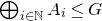 $\bigoplus_{i \in {\mathbb{N}}} A_i \leq G$
. By construction, this group acts on
$\bigoplus_{i \in {\mathbb{N}}} A_i \leq G$
. By construction, this group acts on $\prod_{i \in {\mathbb{N}}} Y^{X_i} = Y^{\sqcup_{i \in {\mathbb{N}}} X_i}$
by the shifting coordinate-wise action
$\prod_{i \in {\mathbb{N}}} Y^{X_i} = Y^{\sqcup_{i \in {\mathbb{N}}} X_i}$
by the shifting coordinate-wise action $\bigoplus_{i \in {\mathbb{N}}} A_i \curvearrowright \sqcup_{i \in {\mathbb{N}}}X_i$
. Hence by the hypothesis of Setup 3.1, all the orbits are infinite (since the orbits of each action
$\bigoplus_{i \in {\mathbb{N}}} A_i \curvearrowright \sqcup_{i \in {\mathbb{N}}}X_i$
. Hence by the hypothesis of Setup 3.1, all the orbits are infinite (since the orbits of each action $A_i \curvearrowright X_i$
are so), the group
$A_i \curvearrowright X_i$
are so), the group $\bigoplus_{i \in {\mathbb{N}}} A_i$
is countable, and the set
$\bigoplus_{i \in {\mathbb{N}}} A_i$
is countable, and the set $\sqcup_{i\in {\mathbb{N}}} X_i$
is as well. According to Proposition 2.15, this new generalized Bernoulli shift is highly ergodic. Since
$\sqcup_{i\in {\mathbb{N}}} X_i$
is as well. According to Proposition 2.15, this new generalized Bernoulli shift is highly ergodic. Since $\bigoplus_{i \in {\mathbb{N}}}A_i$
is a subgroup of G, Remark 2.16 shows that the action of G on
$\bigoplus_{i \in {\mathbb{N}}}A_i$
is a subgroup of G, Remark 2.16 shows that the action of G on $\prod_{i \in {\mathbb{N}}} Y^{X_i}$
is also highly ergodic. By Corollary 2.18, G is
$\prod_{i \in {\mathbb{N}}} Y^{X_i}$
is also highly ergodic. By Corollary 2.18, G is $\mathfrak{X}^{\text{sep}}$
-boundedly acyclic, whence the desired contradiction.
$\mathfrak{X}^{\text{sep}}$
-boundedly acyclic, whence the desired contradiction.
4. Commuting cyclic conjugates and bounded acyclicity
In this section, we introduce our main algebraic criterion of admitting commuting cyclic conjugates and we show that groups with commuting cyclic conjugates are $\mathfrak{X}^{\text{sep}}$
-boundedly acyclic.
$\mathfrak{X}^{\text{sep}}$
-boundedly acyclic.
4.1 Commuting cyclic conjugates and
$\mathfrak{X}^{\text{sep}}$
-bounded acyclicity

We recall the definition of commuting cyclic conjugates from § 1.
Definition 4.1
(Commuting cyclic conjugates). A group $\Gamma$
has commuting cyclic conjugates if for every finitely generated subgroup
$\Gamma$
has commuting cyclic conjugates if for every finitely generated subgroup $H \leq \Gamma$
, there exist
$H \leq \Gamma$
, there exist $t \in \Gamma$
and
$t \in \Gamma$
and $n \in {\mathbb{Z}}_{\geq 2} \cup \{\infty\}$
such that
$n \in {\mathbb{Z}}_{\geq 2} \cup \{\infty\}$
such that $[H, {}^{t^p}H] = 1$
for
$[H, {}^{t^p}H] = 1$
for $1 \leq p < n$
and
$1 \leq p < n$
and $[H, t^n] = 1$
. Here, we read that
$[H, t^n] = 1$
. Here, we read that $t^\infty = 1$
and
$t^\infty = 1$
and ${}^{t^p}H$
denotes the conjugation
${}^{t^p}H$
denotes the conjugation $t^p H t^{-p}$
.
$t^p H t^{-p}$
.
It will also be useful to treat the special situation in which $n = \infty$
.
$n = \infty$
.
Definition 4.2
(Commuting ${\mathbb{Z}}$
-conjugates). A group has commuting
${\mathbb{Z}}$
-conjugates). A group has commuting ${\mathbb{Z}}$
-conjugates if, for every finitely generated subgroup
${\mathbb{Z}}$
-conjugates if, for every finitely generated subgroup $H \leq \Gamma$
, there exists
$H \leq \Gamma$
, there exists $t \in \Gamma$
such that
$t \in \Gamma$
such that $[H, {}^{t^p}H] = 1$
for all integers
$[H, {}^{t^p}H] = 1$
for all integers $p \geq 1$
.
$p \geq 1$
.
Remark 4.3
(Order of
t
). In the above definitions, if the order of t is less than or equal to $n-1$
(or finite when
$n-1$
(or finite when $n = \infty$
), then the group H has to be abelian.
$n = \infty$
), then the group H has to be abelian.
Our main result is the following more precise version of Theorem 1.3.
Theorem 4.4 (Commuting cyclic conjugates $\Rightarrow$ $\mathfrak{X}^{\text{sep}}$
-boundedly acyclic). The following holds.
$\mathfrak{X}^{\text{sep}}$
-boundedly acyclic). The following holds.
-
(1) If
$\Gamma$
is a group with commuting cyclic conjugates, then it is
$\mathfrak{X}^{\text{sep}}$
-boundedly acyclic. -
(2) For every integer
$n \geq 1$
, there exists a constant
$K_n \in [0, \infty)$
such that for every group
$\Gamma$
with commuting cyclic conjugates, and every separable dual Banach
$\Gamma$
-module E, we have that
$\| H^n_b(\Gamma; E) \| \leq K_n$
. Hence, the vanishing modulus is uniform.



Our result is built on Proposition 3.5 and so we have to rephrase the definition of commuting cyclic conjugates in terms of morphisms from wreath products. This is the content of the following technical proposition.
Proposition 4.5
(Commuting cyclic conjugates and wreath products) Let $\Gamma$
be a group. Then the following are equivalent.
$\Gamma$
be a group. Then the following are equivalent.
-
(1) The group
$\Gamma$
has commuting cyclic conjugates. -
(2) For every finitely generated subgroup
$H \leq \Gamma$
, there exist a countable amenable group A, an infinite-index subgroup
$B < A$
, and a homomorphism
$f \colon A \to \Gamma$
such that: 8pt-
(i)
$[H, {}^{f(a)}H] = 1$
for all
$a \in A \setminus B$
; and -
(ii)
$[H, f(b)] = 1$
for all
$b \in B$
.
-
-
(3) For every finitely generated subgroup
$H \leq \Gamma$
, there exist a countable amenable group A, an infinite transitive A-set X, and a homomorphism such that f restricts to the inclusion on some factor H, and f has amenable kernel.
$$f\colon H \wr_X A \to \Gamma$$


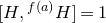


We postpone the proof of Proposition 4.5 to § 4.2 and here we give the proof of Theorem 4.4 (and thus of Theorem 1.3).
Proof of Theorem 4.4. Let $\Gamma$
be a group with commuting cyclic conjugates, and let
$\Gamma$
be a group with commuting cyclic conjugates, and let $n \geq 1$
. Let
$n \geq 1$
. Let $H \leq \Gamma$
be a finitely generated subgroup. By Proposition 4.5, there exist a countable amenable group A, an infinite transitive A-set X (which is necessarily countable), and a morphism
$H \leq \Gamma$
be a finitely generated subgroup. By Proposition 4.5, there exist a countable amenable group A, an infinite transitive A-set X (which is necessarily countable), and a morphism $f \colon H \wr_X A \to \Gamma$
that restricts to the inclusion on some factor H. In particular, we have that
$f \colon H \wr_X A \to \Gamma$
that restricts to the inclusion on some factor H. In particular, we have that $H \leq \textrm{im}(f)$
. Again by Proposition 4.5, we can assume that the kernel of f is amenable. Let
$H \leq \textrm{im}(f)$
. Again by Proposition 4.5, we can assume that the kernel of f is amenable. Let $\mathfrak{X}^{\text{sep}}$
be the class of separable dual Banach
$\mathfrak{X}^{\text{sep}}$
be the class of separable dual Banach $\Gamma$
-modules and let
$\Gamma$
-modules and let $i^*(\mathfrak{X}^{\text{sep}})$
be the class of separable dual Banach
$i^*(\mathfrak{X}^{\text{sep}})$
be the class of separable dual Banach $\textrm{im}(f)$
-modules induced by the inclusion
$\textrm{im}(f)$
-modules induced by the inclusion $i \colon \textrm{im}(f) \to \Gamma$
.
$i \colon \textrm{im}(f) \to \Gamma$
.
We are now ready to apply Proposition 3.5. Indeed, H is finitely generated and thus countable, X is countably infinite, and the amenable group A acts on X with a (unique) infinite orbit. Hence, for every integer $n \geq 1$
, there exists a constant
$n \geq 1$
, there exists a constant $K_n \in [0, \infty)$
that does not depend on H, A, X, or even
$K_n \in [0, \infty)$
that does not depend on H, A, X, or even $\Gamma$
, such that
$\Gamma$
, such that $\| H^n_b(\textrm{im}(f); E) \| \leq K_n$
for every separable dual Banach
$\| H^n_b(\textrm{im}(f); E) \| \leq K_n$
for every separable dual Banach $\textrm{im}(f)$
-module E.
$\textrm{im}(f)$
-module E.
Every finitely generated $H \leq \Gamma$
is contained in a group of the form
$H \leq \Gamma$
is contained in a group of the form $\textrm{im}(f)$
as above. Hence, applying Proposition 2.24 with
$\textrm{im}(f)$
as above. Hence, applying Proposition 2.24 with $\Gamma_i = \textrm{im}(f)$
, we conclude that
$\Gamma_i = \textrm{im}(f)$
, we conclude that $H^n_b(\Gamma; E) = 0$
.
$H^n_b(\Gamma; E) = 0$
.
4.2 Proof of Proposition 4.5
We prove the chain of implications (1) $\Rightarrow$
(2)
$\Rightarrow$
(2) $\Rightarrow$
(3)
$\Rightarrow$
(3) $\Rightarrow$
(1). The first implication is the crucial one.
$\Rightarrow$
(1). The first implication is the crucial one.
Proof of Proposition 4.5 (1) $\Rightarrow$
(2). Suppose that
$\Rightarrow$
(2). Suppose that $\Gamma$
has commuting cyclic conjugates, and let
$\Gamma$
has commuting cyclic conjugates, and let $H \leq \Gamma$
be finitely generated. Set
$H \leq \Gamma$
be finitely generated. Set $\Lambda_0 := H$
. Let
$\Lambda_0 := H$
. Let $t_1 \in \Gamma$
and
$t_1 \in \Gamma$
and $n_1 \in {\mathbb{Z}}_{\geq 2} \cup \{ \infty \}$
be such that:
$n_1 \in {\mathbb{Z}}_{\geq 2} \cup \{ \infty \}$
be such that:
-
–
$[H, {}^{t_1^p}H]=1$
for all
$1 \leq p < n_1$
; and -
–
$[H, t_1^{n_1}] = 1$
.


Define $\Lambda_1 := \langle H, t_1 \rangle$
. We proceed by induction. At the ith step,
$\Lambda_1 := \langle H, t_1 \rangle$
. We proceed by induction. At the ith step, $i \in {\mathbb{N}}$
, we have a finitely generated group
$i \in {\mathbb{N}}$
, we have a finitely generated group $\Lambda_{i-1}$
, and we find
$\Lambda_{i-1}$
, and we find $t_{i} \in \Gamma$
and
$t_{i} \in \Gamma$
and $n_{i} \in {\mathbb{Z}}_{\geq 2} \cup \{ \infty \}$
such that:
$n_{i} \in {\mathbb{Z}}_{\geq 2} \cup \{ \infty \}$
such that:
-
–
$[\Lambda_{i-1}, {}^{t_i^p}\Lambda_{i-1}]=1$
for all
$1 \leq p <n_i$
; and -
–
$[\Lambda_{i-1}, t_{i}^{n_{i}}] = 1$
.



We set $\Lambda_{i} := \langle \Lambda_{i-1}, t_{i} \rangle$
.
$\Lambda_{i} := \langle \Lambda_{i-1}, t_{i} \rangle$
.
First, suppose that $n_i = \infty$
for some
$n_i = \infty$
for some $i \in {\mathbb{N}}$
. In that case, for all integers
$i \in {\mathbb{N}}$
. In that case, for all integers $p \geq 1$
, we have
$p \geq 1$
, we have
 \begin{align*}[H, {}^{t_i^p}H] \leq [\Lambda_{i-1}, {}^{t_i^p}\Lambda_{i-1}] = 1, \end{align*}
and, moreover, for all integers $p \leq -1$
, we have
$p \leq -1$
, we have
 \begin{align*}{}^{t_i^{-p}}[H, {}^{t_i^p}H] = [{}^{t_i^{-p}} H, H] = [H, {}^{t_i^{-p}}H]^{-1} = 1 \Longrightarrow [H, {}^{t_i^p}H] = 1. \end{align*}
Thus we can choose $A = {\mathbb{Z}}, B = \{ 0 \}$
and a homomorphism
$A = {\mathbb{Z}}, B = \{ 0 \}$
and a homomorphism
 \begin{align*} f \colon A = {\mathbb{Z}} &\to \Gamma \\ m &\mapsto t_i^m,\end{align*}
which satisfies the conditions required in item (2). Note how this already suffices to show that groups with commuting $ {\mathbb{Z}}$
-conjugates satisfy condition (2). From now on, we may assume that
$ {\mathbb{Z}}$
-conjugates satisfy condition (2). From now on, we may assume that $n_i \in {\mathbb{Z}}_{\geq 2}$
for all integers
$n_i \in {\mathbb{Z}}_{\geq 2}$
for all integers $i \geq 1$
.
$i \geq 1$
.
Set $A_1 := {\mathbb{Z}}$
, and define by induction
$A_1 := {\mathbb{Z}}$
, and define by induction
 \begin{align*} A_{i+1} := A_i \wr_{{\mathbb{Z}}/n_{i+1}} {\mathbb{Z}}, \end{align*}
where the action of ${\mathbb{Z}}$
on
${\mathbb{Z}}$
on ${\mathbb{Z}}/n_{i+1}$
is by left translation. By construction, each
${\mathbb{Z}}/n_{i+1}$
is by left translation. By construction, each $A_i$
is amenable, being an extension of amenable groups. Consider the inclusion of
$A_i$
is amenable, being an extension of amenable groups. Consider the inclusion of $A_i$
into
$A_i$
into $A_{i+1}$
, concentrated at the coordinate
$A_{i+1}$
, concentrated at the coordinate $0 \in {\mathbb{Z}}/n_{i+1}$
. Let A be the direct union of the
$0 \in {\mathbb{Z}}/n_{i+1}$
. Let A be the direct union of the $A_i$
. Hence, the group A is countable and amenable, since it is a direct union of countable amenable groups.
$A_i$
. Hence, the group A is countable and amenable, since it is a direct union of countable amenable groups.
Let $B_1 := n_1 {\mathbb{Z}} \leq A_1$
, and define by induction
$B_1 := n_1 {\mathbb{Z}} \leq A_1$
, and define by induction $B_{i+1}$
to be the subgroup of
$B_{i+1}$
to be the subgroup of $A_{i+1}$
consisting of elements of the form
$A_{i+1}$
consisting of elements of the form $((a_p)_{p \in {\mathbb{Z}}/n_{i+1}}, m) \in A_i \wr_{{\mathbb{Z}}/n_{i+1}} {\mathbb{Z}}$
, where
$((a_p)_{p \in {\mathbb{Z}}/n_{i+1}}, m) \in A_i \wr_{{\mathbb{Z}}/n_{i+1}} {\mathbb{Z}}$
, where $a_0 \in B_i$
and
$a_0 \in B_i$
and $m \in n_{i+1} {\mathbb{Z}}$
. This is indeed a group, since the
$m \in n_{i+1} {\mathbb{Z}}$
. This is indeed a group, since the ${\mathbb{Z}}$
coordinate only consists of multiples of
${\mathbb{Z}}$
coordinate only consists of multiples of $n_{i+1}$
, which act trivially on
$n_{i+1}$
, which act trivially on ${\mathbb{Z}}/n_{i+1}$
. Denote by B the direct union of the
${\mathbb{Z}}/n_{i+1}$
. Denote by B the direct union of the $B_i$
. By construction,
$B_i$
. By construction, $B < A$
.
$B < A$
.
To see that the subgroup $B < A$
has infinite index, consider the A-conjugates of
$B < A$
has infinite index, consider the A-conjugates of $A_1$
. First note that there are exactly
$A_1$
. First note that there are exactly $n_i$
conjugates of
$n_i$
conjugates of $A_{i-1}$
inside
$A_{i-1}$
inside $A_i$
, which have pairwise trivial intersection: these are the copies of
$A_i$
, which have pairwise trivial intersection: these are the copies of $A_{i-1}$
concentrated at the different coordinates of
$A_{i-1}$
concentrated at the different coordinates of ${\mathbb{Z}}/n_i$
. It follows that the number of
${\mathbb{Z}}/n_i$
. It follows that the number of $A_i$
-conjugates of
$A_i$
-conjugates of $A_1$
is at least
$A_1$
is at least $n_2 \cdots n_i$
. Since, by definition of commuting cyclic conjugates, each
$n_2 \cdots n_i$
. Since, by definition of commuting cyclic conjugates, each $n_i \geq 2$
(Definition 4.1), there are infinitely many A-conjugates of
$n_i \geq 2$
(Definition 4.1), there are infinitely many A-conjugates of $A_1$
. On the other hand, let us show that B centralizes
$A_1$
. On the other hand, let us show that B centralizes $A_1$
. This is clear for
$A_1$
. This is clear for $B_1$
. Recall that an element of
$B_1$
. Recall that an element of $B_{i+1}$
is of the form
$B_{i+1}$
is of the form $((a_p)_{p \in {\mathbb{Z}}/n_{i+1}}, m)$
, where
$((a_p)_{p \in {\mathbb{Z}}/n_{i+1}}, m)$
, where $a_0 \in B_i$
and
$a_0 \in B_i$
and $m \in n_{i+1}{\mathbb{Z}}$
. Then
$m \in n_{i+1}{\mathbb{Z}}$
. Then $a_0$
centralizes
$a_0$
centralizes $A_1$
by the induction hypothesis, and
$A_1$
by the induction hypothesis, and $a_p$
with
$a_p$
with $p \neq 0$
as well as m centralize
$p \neq 0$
as well as m centralize $A_1$
by definition of the permutational wreath product. Thus all of
$A_1$
by definition of the permutational wreath product. Thus all of $B_{i+1}$
centralizes
$B_{i+1}$
centralizes $A_1$
and so their direct union B also centralizes
$A_1$
and so their direct union B also centralizes $A_1$
. In conclusion, we have proved that the conjugation action of A on the set of its subgroups has the following properties:
$A_1$
. In conclusion, we have proved that the conjugation action of A on the set of its subgroups has the following properties:
-
(1) the A-conjugates of
$A_1$
are infinite (i.e. the orbit
${}^{A}A_1$
is infinite); and -
(2) B centralizes
$A_1$
(i.e. B is a subgroup of the stabilizer
$\text{Stab}_A(A_1)$
).


The orbit-stabilizer theorem then shows that
 \begin{align*}\left[ A : B\right] \geq \left[ A : \text{Stab}_A(A_1)\right] = |{}^{A} A_1| = +\infty, \end{align*}
and thus B has infinite index in A.
We are left to define the desired homomorphism $f \colon A \to \Gamma$
as required in condition (2). We also construct the homomorphism f by induction. Let us begin by setting
$f \colon A \to \Gamma$
as required in condition (2). We also construct the homomorphism f by induction. Let us begin by setting
 \begin{align*} f \colon A_1 = {\mathbb{Z}} &\to \Gamma \\ m &\mapsto t_1^m.\end{align*}
By definition, we have $f(A_1) \leq \Lambda_1$
. Now suppose that f has already been defined on
$f(A_1) \leq \Lambda_1$
. Now suppose that f has already been defined on $A_i$
(and is such that
$A_i$
(and is such that $f(A_i) \leq \Lambda_{i}$
), and set
$f(A_i) \leq \Lambda_{i}$
), and set
 \begin{align*} f \colon A_{i+1} = A_i \wr_{{\mathbb{Z}}/n_{i+1}} {\mathbb{Z}} &\to \Gamma \\ ((a_p)_{p \in {\mathbb{Z}}/n_{i+1}}, m) &\mapsto \bigg(\prod_{p = 0}^{n_{i+1}-1} {}^{t_{i+1}^p}f(a_p) \bigg)t_{i+1}^m.\end{align*}
Let us check that this is a homomorphism. By induction, it is a homomorphism on each summand $A_i$
. Recall that
$A_i$
. Recall that $\langle t_{i+1}^{n_{i+1}} \rangle$
centralizes
$\langle t_{i+1}^{n_{i+1}} \rangle$
centralizes $\Lambda_i$
and therefore
$\Lambda_i$
and therefore $f(A_i)$
(since
$f(A_i)$
(since $f(A_i) \leq \Lambda_i$
by induction). Also recall that
$f(A_i) \leq \Lambda_i$
by induction). Also recall that $[f(A_i), {}^{t_{i+1}^p}f(A_i)] \leq [\Lambda_i, {}^{t_{i+1}^p}\Lambda_i] = 1$
for all
$[f(A_i), {}^{t_{i+1}^p}f(A_i)] \leq [\Lambda_i, {}^{t_{i+1}^p}\Lambda_i] = 1$
for all $1 \leq p < n_{i+1}$
. Applying a suitable conjugation, we see that the subgroups
$1 \leq p < n_{i+1}$
. Applying a suitable conjugation, we see that the subgroups ${}^{t_{i+1}^p}f(A_i)$
pairwise commute; hence f is a homomorphism on the direct sum of the
${}^{t_{i+1}^p}f(A_i)$
pairwise commute; hence f is a homomorphism on the direct sum of the $A_i$
. Finally, the action of
$A_i$
. Finally, the action of ${\mathbb{Z}}$
by conjugacy on the summands is respected, by construction and because
${\mathbb{Z}}$
by conjugacy on the summands is respected, by construction and because $t_{i+1}^{n_{i+1}}$
centralizes each summand.
$t_{i+1}^{n_{i+1}}$
centralizes each summand.
We now need to check the two required properties in condition (2):
-
(i)
$[H, {}^{f(a)} H] = 1$
for all
$a \in A \setminus B$
; and -
(ii)
$[H, f(b)] = 1$
for all
$b \in B$
.
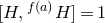


Property (ii) is verified by induction on the $B_i$
, with the same argument as the proof above that B centralizes
$B_i$
, with the same argument as the proof above that B centralizes $A_1$
together with the definition of f.
$A_1$
together with the definition of f.
Let us prove that property (i) is also satisfied. We again proceed by induction, by showing that if $a \in A_i$
is such that
$a \in A_i$
is such that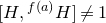 $[H,{}^{f(a)} H] \neq 1$
, then
$[H,{}^{f(a)} H] \neq 1$
, then $a \in B_i$
. For
$a \in B_i$
. For $i = 1$
, this is by definition of
$i = 1$
, this is by definition of $t_1$
. Now suppose that
$t_1$
. Now suppose that $a \in A_{i+1}$
is an element such that
$a \in A_{i+1}$
is an element such that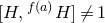 $[H, {}^{f(a)} H] \neq 1$
. Using the definition of
$[H, {}^{f(a)} H] \neq 1$
. Using the definition of $A_{i+1}= A_i \wr_{{\mathbb{Z}}/n_{i+1}} {\mathbb{Z}}$
, we write
$A_{i+1}= A_i \wr_{{\mathbb{Z}}/n_{i+1}} {\mathbb{Z}}$
, we write $a =((a_p)_{p \in {\mathbb{Z}}/n_{i+1}}, m)$
. Now, for
$a =((a_p)_{p \in {\mathbb{Z}}/n_{i+1}}, m)$
. Now, for $1 \leq p < n_{i+1}$
, the image of
$1 \leq p < n_{i+1}$
, the image of $a_p$
lies in
$a_p$
lies in ${}^{t_{i+1}^p}f(A_i) \leq {}^{t_{i+1}^p}\Lambda_i$
, which by choice of
${}^{t_{i+1}^p}f(A_i) \leq {}^{t_{i+1}^p}\Lambda_i$
, which by choice of $t_{i+1}$
commutes with
$t_{i+1}$
commutes with $\Lambda_i$
, and therefore with H. In other words, conjugating by these coordinates has no effect on H, and therefore
$\Lambda_i$
, and therefore with H. In other words, conjugating by these coordinates has no effect on H, and therefore ${}^{f(a)^{-1}} H = {}^{t_{i+1}^{-m}}({}^{f(a_0)^{-1}}H)$
. First, suppose that
${}^{f(a)^{-1}} H = {}^{t_{i+1}^{-m}}({}^{f(a_0)^{-1}}H)$
. First, suppose that $m \notin n_{i+1} {\mathbb{Z}}$
. Then
$m \notin n_{i+1} {\mathbb{Z}}$
. Then ${}^{t_{i+1}^{-m}}({}^{f(a_0)^{-1}}H) \leq {}^{t_{i+1}^{-m}}\Lambda_i$
, which commutes with
${}^{t_{i+1}^{-m}}({}^{f(a_0)^{-1}}H) \leq {}^{t_{i+1}^{-m}}\Lambda_i$
, which commutes with $\Lambda_i$
and thus with H. A standard manipulation then shows that
$\Lambda_i$
and thus with H. A standard manipulation then shows that ${}^{f(a)} H$
also commutes with H. Since we are assuming that
${}^{f(a)} H$
also commutes with H. Since we are assuming that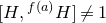 $[H, {}^{f(a)} H] \neq 1$
, we obtain a contradiction. Therefore, we must have
$[H, {}^{f(a)} H] \neq 1$
, we obtain a contradiction. Therefore, we must have $m \in n_{i+1} {\mathbb{Z}}$
, which implies that
$m \in n_{i+1} {\mathbb{Z}}$
, which implies that ${}^{t_{i+1}^{-m}}({}^{f(a_0)^{-1}}H) = {}^{f(a_0)^{-1}}H$
, since
${}^{t_{i+1}^{-m}}({}^{f(a_0)^{-1}}H) = {}^{f(a_0)^{-1}}H$
, since $t_{i+1}^{n_{i+1}}$
centralizes
$t_{i+1}^{n_{i+1}}$
centralizes $\Lambda_i$
. Since we are assuming
$\Lambda_i$
. Since we are assuming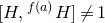 $[H, {}^{f(a)}H] \neq 1$
, or equivalently
$[H, {}^{f(a)}H] \neq 1$
, or equivalently $[H, {}^{f(a)^{-1}}H] \neq 1$
, we obtain
$[H, {}^{f(a)^{-1}}H] \neq 1$
, we obtain $[H, {}^{f(a_0)^{-1}}H] \neq 1$
and so by the induction hypothesis,
$[H, {}^{f(a_0)^{-1}}H] \neq 1$
and so by the induction hypothesis, $a_0$
actually lies in
$a_0$
actually lies in $B_i$
. We have shown that
$B_i$
. We have shown that $a = ((a_p)_{p \in {\mathbb{Z}}/n_{i+1}}, m)$
is such that
$a = ((a_p)_{p \in {\mathbb{Z}}/n_{i+1}}, m)$
is such that $a_0 \in B_i$
and
$a_0 \in B_i$
and $m \in n_{i+1}{\mathbb{Z}}$
. This shows that
$m \in n_{i+1}{\mathbb{Z}}$
. This shows that $a \in B_{i+1}$
by definition, and concludes the proof.
$a \in B_{i+1}$
by definition, and concludes the proof.
Proof of Proposition 4.5 (2) $\Rightarrow$
(3). Let
$\Rightarrow$
(3). Let $H \leq \Gamma$
be a finitely generated subgroup, and suppose that there exists a countable amenable group A, a morphism
$H \leq \Gamma$
be a finitely generated subgroup, and suppose that there exists a countable amenable group A, a morphism $f \colon A \to \Gamma$
, and an infinite index subgroup
$f \colon A \to \Gamma$
, and an infinite index subgroup $B < A$
as in condition (2). Note that the property (2)(i) implies that
$B < A$
as in condition (2). Note that the property (2)(i) implies that $[^{f(a_1)} H, ^{f(a_2)} H] = 1$
whenever
$[^{f(a_1)} H, ^{f(a_2)} H] = 1$
whenever $a_1B \neq a_2B$
. Define
$a_1B \neq a_2B$
. Define $X := A/B$
, with the left-translation action of A. By the assumptions of (2), X is a transitive infinite A-set. We extend f to a homomorphism
$X := A/B$
, with the left-translation action of A. By the assumptions of (2), X is a transitive infinite A-set. We extend f to a homomorphism $f \colon H \wr_X A \to \Gamma$
as follows:
$f \colon H \wr_X A \to \Gamma$
as follows:
 \begin{align*} f((h_{aB})_{aB \in X}, g) = \bigg(\prod_{aB \in X} {}^{f(a)}h_{aB}\bigg)f(g). \end{align*}
Since f(B) centralizes H, the value of $^{f(a)}h_{aB}$
is independent of the choice of a. Moreover, since all of the
$^{f(a)}h_{aB}$
is independent of the choice of a. Moreover, since all of the $^{f(a)}H$
pairwise commute, when a runs over a system of representatives, the product is well defined independently of the order of multiplication. Finally, the action by conjugacy of A on the H summands corresponds equivariantly to the action by conjugacy of f(A) on the commuting groups
$^{f(a)}H$
pairwise commute, when a runs over a system of representatives, the product is well defined independently of the order of multiplication. Finally, the action by conjugacy of A on the H summands corresponds equivariantly to the action by conjugacy of f(A) on the commuting groups ${}^{f(a)}H : aB \in X$
. This implies that f is indeed a homomorphism, and by construction it restricts to the inclusion of H on the factor
${}^{f(a)}H : aB \in X$
. This implies that f is indeed a homomorphism, and by construction it restricts to the inclusion of H on the factor $H_{1B}$
. This proves the first part of the claim.
$H_{1B}$
. This proves the first part of the claim.
We are left to show that f has amenable kernel. A proof in the case $A = X = {\mathbb{Z}}$
is already available in the literature [Reference Fournier-Facio and RangarajanFFR24, Lemma 5.4]. For completeness, we show how to extend it. Let
$A = X = {\mathbb{Z}}$
is already available in the literature [Reference Fournier-Facio and RangarajanFFR24, Lemma 5.4]. For completeness, we show how to extend it. Let $f \colon H \wr_X A \to \Gamma$
be as above, and let
$f \colon H \wr_X A \to \Gamma$
be as above, and let $x_0 \in X$
be such that
$x_0 \in X$
be such that $f|_{H_{x_0}}$
is the inclusion of H. Note that the structure of the wreath product implies that
$f|_{H_{x_0}}$
is the inclusion of H. Note that the structure of the wreath product implies that $\ker(f)$
can be described as the following extension:
$\ker(f)$
can be described as the following extension:
 \begin{align*} 1 \to K := \ker(f) \cap \bigoplus_{x \in X} H \to \ker(f) \to Q \to 1, \end{align*}
where Q is the subgroup of A corresponding to the projection of $\ker(f)$
to A. It is sufficient to show that K is amenable; in fact, we will show that it is abelian.
$\ker(f)$
to A. It is sufficient to show that K is amenable; in fact, we will show that it is abelian.
To see this, let $g, h \in K$
, which we write as
$g, h \in K$
, which we write as $g = (g_x)_{x \in X}, h = (h_x)_{x \in X}$
(we omit the A-component since it is always trivial). Then,
$g = (g_x)_{x \in X}, h = (h_x)_{x \in X}$
(we omit the A-component since it is always trivial). Then,
 \begin{align*} 1 = f(g) = \prod_{x \in X} f(g_x) \quad \Longrightarrow \quad f(g_{x_0})^{-1} = \prod_{x \in X \setminus \{ x_0 \}} f(g_x). \end{align*}
Since $f(H_x)$
commutes with
$f(H_x)$
commutes with $f(H_{x_0})$
for all
$f(H_{x_0})$
for all $x \in X \setminus \{ x_0 \}$
, from the above expression it follows, in particular, that
$x \in X \setminus \{ x_0 \}$
, from the above expression it follows, in particular, that $f(g_{x_0})$
commutes with
$f(g_{x_0})$
commutes with $f(h_{x_0})$
. But
$f(h_{x_0})$
. But $f|_{H_{x_0}}$
is injective by hypothesis; therefore
$f|_{H_{x_0}}$
is injective by hypothesis; therefore $g_{x_0}$
and
$g_{x_0}$
and $h_{x_0}$
commute. Up to conjugating by a suitable element of A, we obtain that
$h_{x_0}$
commute. Up to conjugating by a suitable element of A, we obtain that $g_x$
commutes with
$g_x$
commutes with $h_x$
for all
$h_x$
for all $x \in X$
, and therefore that g and h commute.
$x \in X$
, and therefore that g and h commute.
Proof of Proposition 4.5 (3) $\Rightarrow$
(1). Suppose that
$\Rightarrow$
(1). Suppose that $\Gamma$
is a group satisfying condition (3). Let
$\Gamma$
is a group satisfying condition (3). Let $H \leq \Gamma$
be a finitely generated group and let
$H \leq \Gamma$
be a finitely generated group and let $f\colon H \wr_X A \to \Gamma$
be as required by condition (3). Let
$f\colon H \wr_X A \to \Gamma$
be as required by condition (3). Let $x_0 \in X$
be such that f restricts to the identity on the
$x_0 \in X$
be such that f restricts to the identity on the $x_0$
-coordinate. We set
$x_0$
-coordinate. We set $t := f(a)$
for some
$t := f(a)$
for some $a \in A$
such that
$a \in A$
such that $a \cdot x_0 \neq x_0$
. Let
$a \cdot x_0 \neq x_0$
. Let $n \geq 2$
be the minimal integer such that
$n \geq 2$
be the minimal integer such that $a^n \cdot x_0 = x_0$
(possibly
$a^n \cdot x_0 = x_0$
(possibly $n = \infty$
). Then, for all
$n = \infty$
). Then, for all $1 \leq p < n$
, we have
$1 \leq p < n$
, we have $[H, {}^{t^p}H] = [f(H_{x_0}), {}^{f(a^p)}f(H_{x_0})] = f([H_{x_0}, H_{a^p \cdot x_0}]) = 1$
, because
$[H, {}^{t^p}H] = [f(H_{x_0}), {}^{f(a^p)}f(H_{x_0})] = f([H_{x_0}, H_{a^p \cdot x_0}]) = 1$
, because $a^p \cdot x_0 \neq x_0$
; and
$a^p \cdot x_0 \neq x_0$
; and $[H, t^n] = f([H_{x_0}, a^n]) = 1$
, since
$[H, t^n] = f([H_{x_0}, a^n]) = 1$
, since $a^n \cdot x_0 = x_0$
. Hence,
$a^n \cdot x_0 = x_0$
. Hence, $\Gamma$
has commuting cyclic conjugates.
$\Gamma$
has commuting cyclic conjugates.
4.3 Constructions
A classical question in bounded cohomology with real coefficients is whether surjective group homomorphisms induce injective maps in bounded cohomology [Reference BouarichBou01, Reference Capovilla, Löh and MoraschiniCLM22, Reference Fournier-Facio, Löh and MoraschiniFFLM24, Reference Fournier-Facio, Löh and MoraschiniFFLM23]. Since in this paper we are working with $\mathfrak{X}^{\text{sep}}$
-boundedly acyclic groups, a weaker formulation of the previous problem is whether quotients of
$\mathfrak{X}^{\text{sep}}$
-boundedly acyclic groups, a weaker formulation of the previous problem is whether quotients of $\mathfrak{X}^{\text{sep}}$
-boundedly acyclic groups are
$\mathfrak{X}^{\text{sep}}$
-boundedly acyclic groups are $\mathfrak{X}^{\text{sep}}$
-boundedly acyclic. For this reason, now that we have provided a new criterion for bounded acyclicity, it is interesting to note that it does pass to quotients. This shows that quotients of groups with commuting cyclic conjugates are
$\mathfrak{X}^{\text{sep}}$
-boundedly acyclic. For this reason, now that we have provided a new criterion for bounded acyclicity, it is interesting to note that it does pass to quotients. This shows that quotients of groups with commuting cyclic conjugates are $\mathfrak{X}^{\text{sep}}$
-boundedly acyclic.
$\mathfrak{X}^{\text{sep}}$
-boundedly acyclic.
Lemma 4.6
(Quotients). A quotient of a group with commuting cyclic conjugates has commuting cyclic conjugates. A quotient of a group with commuting $ {\mathbb{Z}}$
-conjugates has commuting
$ {\mathbb{Z}}$
-conjugates has commuting ${\mathbb{Z}}$
-conjugates.
${\mathbb{Z}}$
-conjugates.
Proof. Let $\Gamma$
be a group, and let
$\Gamma$
be a group, and let $\pi \colon \Gamma \to\overline{\Gamma}$
be a quotient. For a finitely generated subgroup
$\pi \colon \Gamma \to\overline{\Gamma}$
be a quotient. For a finitely generated subgroup $\overline{H} \leq \overline{\Gamma}$
, choose a preimage for each of the generators to obtain a finitely generated subgroup
$\overline{H} \leq \overline{\Gamma}$
, choose a preimage for each of the generators to obtain a finitely generated subgroup $H \leq \Gamma$
such that
$H \leq \Gamma$
such that $\pi(H) = \overline{H}$
. Since
$\pi(H) = \overline{H}$
. Since $\Gamma$
has commuting cyclic conjugates, there exist
$\Gamma$
has commuting cyclic conjugates, there exist $t \in \Gamma$
and
$t \in \Gamma$
and $n \in {\mathbb{Z}}_{\geq 2} \cup \{ \infty \}$
such that
$n \in {\mathbb{Z}}_{\geq 2} \cup \{ \infty \}$
such that $[H, {}^{t^p}H] = 1$
for
$[H, {}^{t^p}H] = 1$
for $1 \leq p < n$
and
$1 \leq p < n$
and $[H, t^n] = 1$
. Then, by definition of homomorphism, we have
$[H, t^n] = 1$
. Then, by definition of homomorphism, we have
 \begin{align*}[\overline{H}, {}^{\pi(t)^p}\overline{H}] = \pi([H, {}^{t^p}H]) = 1 \end{align*}
for all $1 \leq p < n$
; and
$1 \leq p < n$
; and
 \begin{align*}[\overline{H}, \pi(t)^n] = \pi([H, t^n]) = 1. \end{align*}
Thus $\overline{H}$
satisfies the condition of commuting cyclic conjugates with
$\overline{H}$
satisfies the condition of commuting cyclic conjugates with $\pi(t)$
and n. Note that n is unchanged, so this also proves that if
$\pi(t)$
and n. Note that n is unchanged, so this also proves that if $\Gamma$
has commuting
$\Gamma$
has commuting ${\mathbb{Z}}$
-conjugates, then
${\mathbb{Z}}$
-conjugates, then $\overline{\Gamma}$
also has commuting
$\overline{\Gamma}$
also has commuting ${\mathbb{Z}}$
-conjugates.
${\mathbb{Z}}$
-conjugates.
Remark 4.7 (Groups with commuting conjugates but not commuting cyclic conjugates). Using this fact, one can easily construct groups with commuting conjugates but without commuting cyclic conjugates [Reference Campagnolo, Fournier-Facio, Lodha and MoraschiniCFFL+25, Proposition 3.6].
Extensions of $\mathfrak{X}^{\text{sep}}$
-boundedly acyclic groups can be shown to be
$\mathfrak{X}^{\text{sep}}$
-boundedly acyclic groups can be shown to be $\mathfrak{X}^{\text{sep}}$
-boundedly acyclic, using either spectral sequences [Reference MonodMon01, § 12] or generalized mapping theorems [Reference Moraschini and RaptisMR23]. For groups with commuting
$\mathfrak{X}^{\text{sep}}$
-boundedly acyclic, using either spectral sequences [Reference MonodMon01, § 12] or generalized mapping theorems [Reference Moraschini and RaptisMR23]. For groups with commuting $\mathbb{Z}$
-conjugates, we can show more.
$\mathbb{Z}$
-conjugates, we can show more.
Lemma 4.8
(Products). Let $\{ \Gamma_i \}_{i \in I}$
be a collection of groups with commuting
$\{ \Gamma_i \}_{i \in I}$
be a collection of groups with commuting ${\mathbb{Z}}$
-conjugates. Then their direct product and direct sum have commuting
${\mathbb{Z}}$
-conjugates. Then their direct product and direct sum have commuting ${\mathbb{Z}}$
-conjugates.
${\mathbb{Z}}$
-conjugates.
Proof. Suppose that the $\Gamma_i$
have commuting
$\Gamma_i$
have commuting ${\mathbb{Z}}$
-conjugates. Let
${\mathbb{Z}}$
-conjugates. Let $\Gamma := \prod_{i \in I} \Gamma_i$
, and let
$\Gamma := \prod_{i \in I} \Gamma_i$
, and let $H \leq \Gamma$
be finitely generated. Let
$H \leq \Gamma$
be finitely generated. Let $H_i \leq \Gamma_i$
be the projection of H on
$H_i \leq \Gamma_i$
be the projection of H on $\Gamma_i$
, which is finitely generated. Since
$\Gamma_i$
, which is finitely generated. Since $\Gamma_i$
has commuting
$\Gamma_i$
has commuting ${\mathbb{Z}}$
-conjugates, there exists
${\mathbb{Z}}$
-conjugates, there exists $t_i \in \Gamma_i$
such that
$t_i \in \Gamma_i$
such that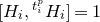 $[H_i, {}^{t_i^p} H_i] = 1$
for all
$[H_i, {}^{t_i^p} H_i] = 1$
for all $p \geq 1$
. Then
$p \geq 1$
. Then $t = (t_i)_{i \in I} \in \Gamma$
satisfies
$t = (t_i)_{i \in I} \in \Gamma$
satisfies $[H, {}^{t^p} H] = 1$
for all
$[H, {}^{t^p} H] = 1$
for all $p \geq 1$
.
$p \geq 1$
.
For direct sums, there exists a finite index set $J \subset I$
such that
$J \subset I$
such that $H_i$
is trivial for all
$H_i$
is trivial for all $i \in I \setminus J$
. So we can choose
$i \in I \setminus J$
. So we can choose $t_i = 1$
for all
$t_i = 1$
for all $i \in I \setminus J$
, and the resulting element t belongs to the direct sum.
$i \in I \setminus J$
, and the resulting element t belongs to the direct sum.
Remark 4.9 (Products). Note that the proof does not work for groups with commuting cyclic conjugates, as the numbers n appearing in the definition may be different for different factors. In fact, the product of two groups with commuting cyclic conjugates need not have commuting cyclic conjugates [Reference Campagnolo, Fournier-Facio, Lodha and MoraschiniCFFL+25, Proposition 3.6].
We use this to prove an extension of the uniformity of the vanishing modulus from Theorem 4.4, which will be useful in the sequel.
Corollary 4.10
(Uniform vanishing modulus for amenable extensions). For every integer $n \geq 1$
, there exists a constant
$n \geq 1$
, there exists a constant $K_n \in [0, \infty)$
such that for every group
$K_n \in [0, \infty)$
such that for every group $\Gamma$
containing a normal subgroup
$\Gamma$
containing a normal subgroup $\Lambda < \Gamma$
such that
$\Lambda < \Gamma$
such that $\Gamma / \Lambda$
is amenable and
$\Gamma / \Lambda$
is amenable and $\Lambda$
has commuting
$\Lambda$
has commuting ${\mathbb{Z}}$
-conjugates, and for every separable dual Banach
${\mathbb{Z}}$
-conjugates, and for every separable dual Banach $\Gamma$
-module E, we have that
$\Gamma$
-module E, we have that $\| H^n_b(\Gamma; E) \| \leq K_n$
.
$\| H^n_b(\Gamma; E) \| \leq K_n$
.
Proof. Suppose by contradiction that this is not the case. Then there exists a sequence $(\Lambda_i, \Gamma_i, E_i)_{i \in {\mathbb{N}}}$
such that
$(\Lambda_i, \Gamma_i, E_i)_{i \in {\mathbb{N}}}$
such that $\Lambda_i < \Gamma_i$
is normal with amenable quotient,
$\Lambda_i < \Gamma_i$
is normal with amenable quotient, $\Lambda_i$
has commuting
$\Lambda_i$
has commuting ${\mathbb{Z}}$
-conjugates, and
${\mathbb{Z}}$
-conjugates, and $E_i$
is a separable dual Banach
$E_i$
is a separable dual Banach $\Gamma_i$
-module such that
$\Gamma_i$
-module such that $\| H^n_b(\Gamma_i; E_i) \| \geq i$
. Let
$\| H^n_b(\Gamma_i; E_i) \| \geq i$
. Let $\Gamma := \bigoplus_{i \in {\mathbb{N}}} \Gamma_i \gt \Lambda := \bigoplus_{i \in {\mathbb{N}}} \Lambda_i$
; note that
$\Gamma := \bigoplus_{i \in {\mathbb{N}}} \Gamma_i \gt \Lambda := \bigoplus_{i \in {\mathbb{N}}} \Lambda_i$
; note that $\Lambda$
is normal in
$\Lambda$
is normal in $\Gamma$
with amenable quotient. Now,
$\Gamma$
with amenable quotient. Now, $\Lambda$
has commuting
$\Lambda$
has commuting ${\mathbb{Z}}$
-conjugates by Lemma 4.8; thus
${\mathbb{Z}}$
-conjugates by Lemma 4.8; thus $\Lambda$
is
$\Lambda$
is $\mathfrak{X}^{\text{sep}}$
-boundedly acyclic by Theorem 1.3, and therefore so is
$\mathfrak{X}^{\text{sep}}$
-boundedly acyclic by Theorem 1.3, and therefore so is $\Gamma$
by Theorem 2.8. Thus we obtain a contradiction with Proposition 2.25 and conclude.
$\Gamma$
by Theorem 2.8. Thus we obtain a contradiction with Proposition 2.25 and conclude.
We end by noting that the commuting cyclic conjugates condition passes to derived subgroups. Recall that for a group $\Gamma$
, we denote
$\Gamma$
, we denote $\Gamma^{(1)} := [\Gamma, \Gamma]$
and
$\Gamma^{(1)} := [\Gamma, \Gamma]$
and $\Gamma^{(d)} := [\Gamma^{(d-1)}, \Gamma^{(d-1)}]$
for all
$\Gamma^{(d)} := [\Gamma^{(d-1)}, \Gamma^{(d-1)}]$
for all $d \gt 1$
.
$d \gt 1$
.
Lemma 4.11
(Derived subgroups). Let $\Gamma$
be a group with commuting cyclic conjugates, and let
$\Gamma$
be a group with commuting cyclic conjugates, and let $d \geq 1$
. Then the dth derived subgroup
$d \geq 1$
. Then the dth derived subgroup $\Gamma^{(d)}$
has commuting cyclic conjugates.
$\Gamma^{(d)}$
has commuting cyclic conjugates.
Proof. It suffices to show that $[\Gamma, \Gamma]$
has commuting cyclic conjugates; the statement then follows by induction. Let
$[\Gamma, \Gamma]$
has commuting cyclic conjugates; the statement then follows by induction. Let $H \leq [\Gamma, \Gamma]$
be a finitely generated subgroup. Then there exists
$H \leq [\Gamma, \Gamma]$
be a finitely generated subgroup. Then there exists $t \in \Gamma$
and
$t \in \Gamma$
and $n \in {\mathbb{Z}}_{\geq 2} \cup \{ \infty \}$
such that
$n \in {\mathbb{Z}}_{\geq 2} \cup \{ \infty \}$
such that $[H, {}^{t^p} H] = 1$
for
$[H, {}^{t^p} H] = 1$
for $1 \leq p < n$
and
$1 \leq p < n$
and $[H, t^n] = 1$
. Now, the group
$[H, t^n] = 1$
. Now, the group $K := \langle H, t \rangle$
is also finitely generated, so there exists
$K := \langle H, t \rangle$
is also finitely generated, so there exists $s \in \Gamma$
such that
$s \in \Gamma$
such that $[K, {}^s K] = 1$
. Let
$[K, {}^s K] = 1$
. Let $c := [t, s] = t \cdot {}^s t^{-1}$
. Then, for all
$c := [t, s] = t \cdot {}^s t^{-1}$
. Then, for all $g \in K$
, it holds
$g \in K$
, it holds ${}^c g = {}^{t}({}^{{}^s t^{-1}} g) = {}^t g$
, and so by induction
${}^c g = {}^{t}({}^{{}^s t^{-1}} g) = {}^t g$
, and so by induction ${}^{c^p} g = {}^{t^p} g$
for all
${}^{c^p} g = {}^{t^p} g$
for all $p \geq 1$
. It follows that
$p \geq 1$
. It follows that $[H, {}^{c^p} H] = [H, {}^{t^p} H] = 1$
for all
$[H, {}^{c^p} H] = [H, {}^{t^p} H] = 1$
for all $1 \leq p < n$
, and
$1 \leq p < n$
, and $[H, c^n] = [H, t^n] = 1$
. Since
$[H, c^n] = [H, t^n] = 1$
. Since $c \in [\Gamma, \Gamma]$
, we conclude.
$c \in [\Gamma, \Gamma]$
, we conclude.
5. Applications
In this section, we show that many groups of interest in geometry, dynamics, and algebra have commuting cyclic conjugates. By virtue of Theorem 1.3, they will all be $\mathfrak{X}^{\text{sep}}$
-boundedly acyclic. Combining these with some structural considerations, we obtain further examples of
$\mathfrak{X}^{\text{sep}}$
-boundedly acyclic. Combining these with some structural considerations, we obtain further examples of $\mathfrak{X}^{\text{sep}}$
-boundedly acyclic groups. Lemma 4.11 allows us to extend some of our examples to derived subgroups; however, on many occasions, the groups in question are known to be perfect.
$\mathfrak{X}^{\text{sep}}$
-boundedly acyclic groups. Lemma 4.11 allows us to extend some of our examples to derived subgroups; however, on many occasions, the groups in question are known to be perfect.
5.1 Stable mapping class group
First, we show that the stable mapping class group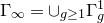 $\Gamma_\infty=\cup_{g\geq 1}\Gamma_g^1$
has commuting cyclic conjugates and so it is
$\Gamma_\infty=\cup_{g\geq 1}\Gamma_g^1$
has commuting cyclic conjugates and so it is $\mathfrak{X}^{\text{sep}}$
-boundedly acyclic, proving a conjecture by Bowden [Reference BowdenBow11].
$\mathfrak{X}^{\text{sep}}$
-boundedly acyclic, proving a conjecture by Bowden [Reference BowdenBow11].
Corollary 5.1
(Corollary 1.5). The stable mapping class group $\Gamma_\infty$
is
$\Gamma_\infty$
is $\mathfrak{X}^{\text{sep}}$
-boundedly acyclic.
$\mathfrak{X}^{\text{sep}}$
-boundedly acyclic.
Note that $\Gamma_\infty$
is perfect [Reference Farb and MargalitFM12, Theorem 5.2].
$\Gamma_\infty$
is perfect [Reference Farb and MargalitFM12, Theorem 5.2].
Proof. We adapt Kotschick’s construction [Reference KotschickKot08, Theorem 3.1] for the vanishing of the stable commutator length in order to show that $\Gamma_\infty$
has commuting cyclic conjugates. Let
$\Gamma_\infty$
has commuting cyclic conjugates. Let $H \leq \Gamma_\infty$
be a finitely generated subgroup. This is supported on the image of some
$H \leq \Gamma_\infty$
be a finitely generated subgroup. This is supported on the image of some $\Gamma_g^1$
; that is, the group of isotopy classes of diffeomorphisms of
$\Gamma_g^1$
; that is, the group of isotopy classes of diffeomorphisms of $\Sigma_g^1$
with compact support in the interior of
$\Sigma_g^1$
with compact support in the interior of $\Sigma_g^1$
. As explained in § 1.1.1, the stable mapping class group
$\Sigma_g^1$
. As explained in § 1.1.1, the stable mapping class group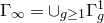 $\Gamma_\infty=\cup_{g\geq 1}\Gamma_g^1$
is the colimit along the inclusion
$\Gamma_\infty=\cup_{g\geq 1}\Gamma_g^1$
is the colimit along the inclusion $\Gamma_g^1 \hookrightarrow \Gamma_{g+1}^1$
given by adding a two-holed torus to
$\Gamma_g^1 \hookrightarrow \Gamma_{g+1}^1$
given by adding a two-holed torus to $\Sigma_g^1$
and extending the elements of
$\Sigma_g^1$
and extending the elements of $\Gamma_g^1$
via the identity. Since each element
$\Gamma_g^1$
via the identity. Since each element $\gamma \in \Gamma_g^1$
has support in the interior of
$\gamma \in \Gamma_g^1$
has support in the interior of $\Sigma_g^1$
, we can realize the previous inclusion
$\Sigma_g^1$
, we can realize the previous inclusion $\Gamma_g^1 \hookrightarrow \Gamma_{2g}^1$
as follows. Let us consider another surface
$\Gamma_g^1 \hookrightarrow \Gamma_{2g}^1$
as follows. Let us consider another surface $S_g^1$
of genus g and one boundary component and let
$S_g^1$
of genus g and one boundary component and let $\Sigma_{2g}^1$
be the boundary connected sum of
$\Sigma_{2g}^1$
be the boundary connected sum of $\Sigma_g^1$
and
$\Sigma_g^1$
and $S_g^1$
(Figures 1 and 2). Then, each element
$S_g^1$
(Figures 1 and 2). Then, each element $\gamma \in \Gamma_g^1$
that is the identity on a small neighbourhood of the boundary of
$\gamma \in \Gamma_g^1$
that is the identity on a small neighbourhood of the boundary of $\Sigma_g^1$
can be extended to the whole
$\Sigma_g^1$
can be extended to the whole $\Sigma_{2g}^1$
as the identity providing the same inclusion of
$\Sigma_{2g}^1$
as the identity providing the same inclusion of $\Gamma_g^1 \hookrightarrow \Gamma_{2g}^1$
as above. In particular, since
$\Gamma_g^1 \hookrightarrow \Gamma_{2g}^1$
as above. In particular, since $H \leq \Gamma_g^1$
we can view each element
$H \leq \Gamma_g^1$
we can view each element $h \in H$
as an element in
$h \in H$
as an element in $\Gamma_{2g}^1 \leq \Gamma_\infty$
extended as the identity over the surface
$\Gamma_{2g}^1 \leq \Gamma_\infty$
extended as the identity over the surface $S_g^1$
.
$S_g^1$
.
The boundary connected sum of $\Sigma_2^1$
and
$\Sigma_2^1$
and $S_2^1$
along the lower half of their boundaries.
$S_2^1$
along the lower half of their boundaries.
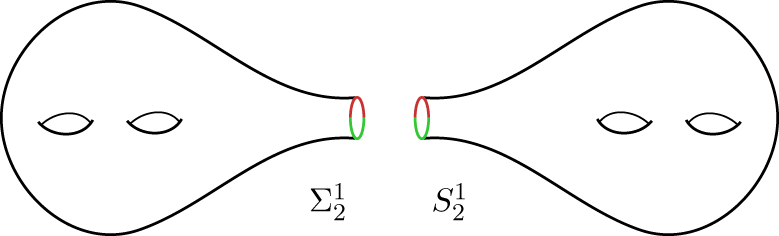
We claim that there exists an element $t \in \Gamma_{2g}^1 \leq \Gamma_\infty$
such that:
$t \in \Gamma_{2g}^1 \leq \Gamma_\infty$
such that:
-
(1)
$[H, {}^t H] = 1$
; and -
(2)
$[H, t^2] = 1$
.


Since every element h in $H \leq \Gamma_g^1$
fixes the boundary, the collar neighbourhood theorem ensures that one can find a small enough neighbourhood
$H \leq \Gamma_g^1$
fixes the boundary, the collar neighbourhood theorem ensures that one can find a small enough neighbourhood $S^1 \times [0, 1)$
of the boundary of
$S^1 \times [0, 1)$
of the boundary of $\Sigma_{2g}^1$
such that the support of every
$\Sigma_{2g}^1$
such that the support of every $h \in H$
is contained in
$h \in H$
is contained in $\Sigma_g^1 \cap (\Sigma_{2g}^1 \setminus (S^1 \times [0, 1)))$
. Now let
$\Sigma_g^1 \cap (\Sigma_{2g}^1 \setminus (S^1 \times [0, 1)))$
. Now let $t \in \Gamma_{2g}^1$
be the half turn around the curve
$t \in \Gamma_{2g}^1$
be the half turn around the curve $S^1\times \{3/4\}$
over
$S^1\times \{3/4\}$
over $\Sigma_{2g}^1 \setminus (S^1 \times [0, 1/2])$
and extend it to the rest of
$\Sigma_{2g}^1 \setminus (S^1 \times [0, 1/2])$
and extend it to the rest of $\Sigma_{2g}^1$
by fixing a neighbourhood
$\Sigma_{2g}^1$
by fixing a neighbourhood $S^1\times [0,1/4]$
of its boundary (Figure 2). This t thus acts as a central symmetry below the curve
$S^1\times [0,1/4]$
of its boundary (Figure 2). This t thus acts as a central symmetry below the curve $S^1\times \{3/4\}$
and rigidly exchanges
$S^1\times \{3/4\}$
and rigidly exchanges $\Sigma^1_g\cap (\Sigma_{2g}^1 \setminus (S^1 \times [0, 1)))$
and
$\Sigma^1_g\cap (\Sigma_{2g}^1 \setminus (S^1 \times [0, 1)))$
and $S^1_g\cap (\Sigma_{2g}^1 \setminus (S^1 \times [0, 1)))$
. By construction, for every
$S^1_g\cap (\Sigma_{2g}^1 \setminus (S^1 \times [0, 1)))$
. By construction, for every $h \in H$
, the conjugate element
$h \in H$
, the conjugate element ${}^t h$
has its compact support entirely contained in the interior of
${}^t h$
has its compact support entirely contained in the interior of $S_g^1$
and so it commutes with h. This shows that
$S_g^1$
and so it commutes with h. This shows that $[H, {}^tH] = 1$
.
$[H, {}^tH] = 1$
.
The element $t\in \Gamma_{2g}^1$
is a half turn along the middle curve in the direction of the arrows.
$t\in \Gamma_{2g}^1$
is a half turn along the middle curve in the direction of the arrows.
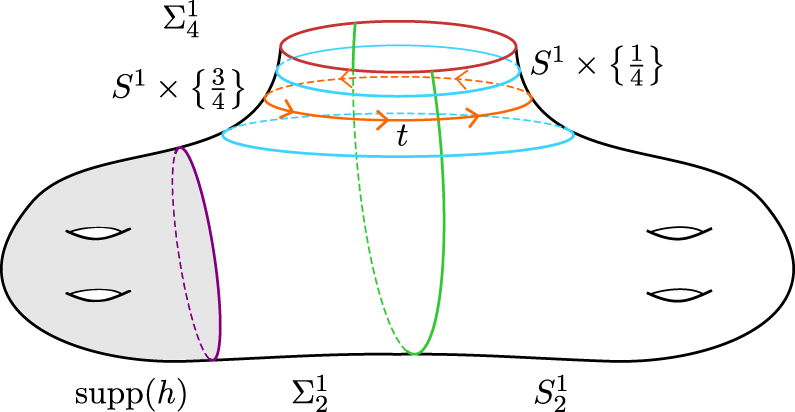
On the other hand, if we consider the Dehn twist $t^2$
, we obtain an element of
$t^2$
, we obtain an element of $\Gamma_{2g}^1$
whose compact support is entirely contained in the open neighbourhood
$\Gamma_{2g}^1$
whose compact support is entirely contained in the open neighbourhood $S^1 \times (1/4, 3/4)$
. Since we have chosen a small enough collar neighbourhood, we have that
$S^1 \times (1/4, 3/4)$
. Since we have chosen a small enough collar neighbourhood, we have that $t^2$
has support disjoint from that of every
$t^2$
has support disjoint from that of every $h \in H$
. Thus condition (2) is also satisfied and we have shown that
$h \in H$
. Thus condition (2) is also satisfied and we have shown that $\Gamma_\infty$
has commuting cyclic conjugates. By applying Theorem 1.3, we obtain the result.
$\Gamma_\infty$
has commuting cyclic conjugates. By applying Theorem 1.3, we obtain the result.
5.2 Other compactly supported big mapping class groups
We have studied the group $\Gamma_\infty$
as a natural direct limit of finite type mapping class groups. One could take another point of view, coming from the theory of big mapping class groups [Reference Aramayona and VlamisAV20]. For a connected orientable surface
$\Gamma_\infty$
as a natural direct limit of finite type mapping class groups. One could take another point of view, coming from the theory of big mapping class groups [Reference Aramayona and VlamisAV20]. For a connected orientable surface $\Sigma$
of infinite type, i.e. with infinitely generated fundamental group, we denote by
$\Sigma$
of infinite type, i.e. with infinitely generated fundamental group, we denote by $\text{MCG}(\Sigma)$
the group of orientation-preserving homeomorphisms of
$\text{MCG}(\Sigma)$
the group of orientation-preserving homeomorphisms of $\Sigma$
, modulo those that are isotopic to the identity. The compactly supported subgroup is the group
$\Sigma$
, modulo those that are isotopic to the identity. The compactly supported subgroup is the group $\text{MCG}_c(\Sigma)$
of mapping classes that admit a representative with compact support. With this language, the group
$\text{MCG}_c(\Sigma)$
of mapping classes that admit a representative with compact support. With this language, the group $\Gamma_\infty$
is nothing but
$\Gamma_\infty$
is nothing but $\text{MCG}_c(\Sigma_{LN})$
, where
$\text{MCG}_c(\Sigma_{LN})$
, where $\Sigma_{LN}$
is the Loch Ness monster surface (see Figure 3).
$\Sigma_{LN}$
is the Loch Ness monster surface (see Figure 3).
The key ingredient in the proof of Corollary 5.1 is that every subsurface $K \subset \Sigma_{LN}$
of finite type can be displaced by a compactly supported mapping class (with additional control on powers of the displacing element). This is necessary for such a result to hold, as is shown by a criterion due to Horbez, Qing, and Rafi [HQR22]. For its statement, we need some terminology. A subsurface of finite type
$K \subset \Sigma_{LN}$
of finite type can be displaced by a compactly supported mapping class (with additional control on powers of the displacing element). This is necessary for such a result to hold, as is shown by a criterion due to Horbez, Qing, and Rafi [HQR22]. For its statement, we need some terminology. A subsurface of finite type $K \subset \Sigma$
is non-displaceable if
$K \subset \Sigma$
is non-displaceable if $\varphi(K) \cap K \neq \varnothing$
for all
$\varphi(K) \cap K \neq \varnothing$
for all $\varphi \in \mathrm{Homeo}(\Sigma)$
. Let
$\varphi \in \mathrm{Homeo}(\Sigma)$
. Let $\widehat{K}$
denote the surface obtained from K by capping off each boundary component with a once-punctured disc. A subgroup
$\widehat{K}$
denote the surface obtained from K by capping off each boundary component with a once-punctured disc. A subgroup $G < \text{MCG}(\Sigma)$
is said to be K-non-elementary if the stabilizer of K in G contains two elements that induce independent pseudo-Anosov mapping classes of
$G < \text{MCG}(\Sigma)$
is said to be K-non-elementary if the stabilizer of K in G contains two elements that induce independent pseudo-Anosov mapping classes of $\widehat{K}$
.
$\widehat{K}$
.
Theorem 5.2
[HQR22, Corollary 2]. Let $\Sigma$
be a connected orientable surface, and let
$\Sigma$
be a connected orientable surface, and let $K \subset \Sigma$
be a non-displaceable subsurface. Then, every K-non-elementary subgroup
$K \subset \Sigma$
be a non-displaceable subsurface. Then, every K-non-elementary subgroup $G < \text{MCG}(\Sigma)$
has infinite-dimensional second bounded cohomology.
$G < \text{MCG}(\Sigma)$
has infinite-dimensional second bounded cohomology.
In particular, such a G does not have commuting cyclic conjugates, or even commuting conjugates. This applies to $G = \text{MCG}_c(\Sigma)$
, whenever
$G = \text{MCG}_c(\Sigma)$
, whenever $\Sigma$
contains a sufficiently complicated non-displaceable subsurface K.
$\Sigma$
contains a sufficiently complicated non-displaceable subsurface K.
As a special instance, we consider alternative stabilizations of mapping class groups, in the same spirit as the previous construction of $\Gamma_\infty$
. We attach k copies of the two-holed torus to a sphere with k boundary components, one on each of its boundary components. At each step, this produces an embedding
$\Gamma_\infty$
. We attach k copies of the two-holed torus to a sphere with k boundary components, one on each of its boundary components. At each step, this produces an embedding $\Sigma_{kg, k} \hookrightarrow \Sigma_{k(g+1), k}$
, whence an inclusion of the mapping class groups
$\Sigma_{kg, k} \hookrightarrow \Sigma_{k(g+1), k}$
, whence an inclusion of the mapping class groups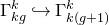 $\Gamma_{kg}^k \hookrightarrow \Gamma_{k(g+1)}^k$
.
$\Gamma_{kg}^k \hookrightarrow \Gamma_{k(g+1)}^k$
.
We denote by $\Gamma_{\infty, k}$
the direct union of these groups. We can see
$\Gamma_{\infty, k}$
the direct union of these groups. We can see $\Gamma_{\infty, k}$
as
$\Gamma_{\infty, k}$
as $\text{MCG}_c(\Sigma_{\infty, k})$
, where
$\text{MCG}_c(\Sigma_{\infty, k})$
, where $\Sigma_{\infty, k}$
is the limit of the surfaces
$\Sigma_{\infty, k}$
is the limit of the surfaces $\Sigma_{kg, k}, g \to \infty$
.
$\Sigma_{kg, k}, g \to \infty$
.
When $k = 1$
, this is just
$k = 1$
, this is just $\Gamma_\infty$
, and
$\Gamma_\infty$
, and $\Sigma_{\infty, 1} = \Sigma_{LN}$
is the Loch Ness monster surface. When
$\Sigma_{\infty, 1} = \Sigma_{LN}$
is the Loch Ness monster surface. When $k \geq 3$
, Theorem 5.2 applies, and shows that
$k \geq 3$
, Theorem 5.2 applies, and shows that $\Gamma_{\infty, k}$
has infinite-dimensional second bounded cohomology. Indeed, the subsurfaces
$\Gamma_{\infty, k}$
has infinite-dimensional second bounded cohomology. Indeed, the subsurfaces $\Sigma_{kg, k}$
are all non-displaceable, since
$\Sigma_{kg, k}$
are all non-displaceable, since $\Sigma_{\infty, k} \setminus \Sigma_{kg, k}$
has
$\Sigma_{\infty, k} \setminus \Sigma_{kg, k}$
has $k \geq 3$
connected components, while the complement of any subsurface disjoint from
$k \geq 3$
connected components, while the complement of any subsurface disjoint from $\Sigma_{kg, k}$
has at most two connected components.
$\Sigma_{kg, k}$
has at most two connected components.
An interesting intermediate case is given by $k = 2$
, when
$k = 2$
, when $\Sigma_{\infty, 2} = \Sigma_{JL}$
is also known as the Jacob’s ladder surface (see Figure 3). Then, every subsurface of finite type is displaceable by a mapping class, which can be chosen to be a vertical translation; so Theorem 5.2 does not apply. However, it is not possible to achieve this displacement using a compactly supported mapping class, i.e. an element of
$\Sigma_{\infty, 2} = \Sigma_{JL}$
is also known as the Jacob’s ladder surface (see Figure 3). Then, every subsurface of finite type is displaceable by a mapping class, which can be chosen to be a vertical translation; so Theorem 5.2 does not apply. However, it is not possible to achieve this displacement using a compactly supported mapping class, i.e. an element of $\Gamma_{\infty, 2} = \text{MCG}_c(\Sigma_{JL})$
. Indeed, let
$\Gamma_{\infty, 2} = \text{MCG}_c(\Sigma_{JL})$
. Indeed, let $K \cong \Sigma_{2g,2}$
be a subsurface of
$K \cong \Sigma_{2g,2}$
be a subsurface of $\Sigma_{JL}$
. Then, an element
$\Sigma_{JL}$
. Then, an element $t \in \Gamma_{\infty, 2}$
must be represented by a homeomorphism supported on a subsurface
$t \in \Gamma_{\infty, 2}$
must be represented by a homeomorphism supported on a subsurface $K' \cong \Sigma_{2h, 2}$
containing K, for some
$K' \cong \Sigma_{2h, 2}$
containing K, for some $h \geq g$
. The complement
$h \geq g$
. The complement $K' \setminus K$
is the disjoint union of two subsurfaces
$K' \setminus K$
is the disjoint union of two subsurfaces $\Sigma_{2g_1,2} \sqcup \Sigma_{2g_2, 2}$
, and
$\Sigma_{2g_1,2} \sqcup \Sigma_{2g_2, 2}$
, and $t(K' \setminus K) = K' \setminus t(K)$
must be of the same type. It is easy to see that it is not possible to preserve the genera
$t(K' \setminus K) = K' \setminus t(K)$
must be of the same type. It is easy to see that it is not possible to preserve the genera $g_1, g_2$
, while ensuring that
$g_1, g_2$
, while ensuring that $t(K) \subset K'$
is disjoint from K. Contrast this with the case of the Loch Ness monster, which is illustrated in Figure 2.
$t(K) \subset K'$
is disjoint from K. Contrast this with the case of the Loch Ness monster, which is illustrated in Figure 2.
Two infinite-type surfaces: (a) the Loch Ness monster and (b) Jacob’s ladder.
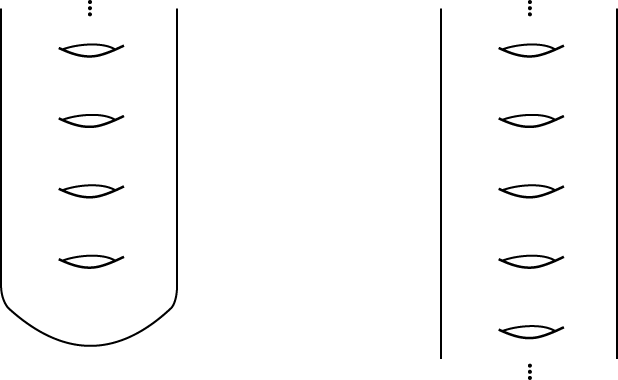
Camille Horbez has informed us that it should be possible to generalize Theorem 5.2 to include surfaces K that are only G-non-displaceable, i.e. such that $\varphi(K) \cap K \neq \varnothing$
for every homeomorphism
$\varphi(K) \cap K \neq \varnothing$
for every homeomorphism $\varphi \in \text{Homeo}_c(\Sigma)$
representing an element of G. The above argument would then imply that
$\varphi \in \text{Homeo}_c(\Sigma)$
representing an element of G. The above argument would then imply that $\Gamma_{\infty, 2}$
has infinite-dimensional second bounded cohomology.
$\Gamma_{\infty, 2}$
has infinite-dimensional second bounded cohomology.
5.3 Stable braid group and the bounded cohomology of the braided Ptolemy–Thompson group
In this section, we compute the bounded cohomology of the infinite braid group $B_\infty$
(with compact support). Kotschick has proved that
$B_\infty$
(with compact support). Kotschick has proved that $B_\infty$
has vanishing stable commutator length [Reference KotschickKot08]. We adapt his argument to show that it has, in fact, commuting cyclic conjugates. As a by-product, we fully compute the bounded cohomology of the braided Ptolemy–Thompson group
$B_\infty$
has vanishing stable commutator length [Reference KotschickKot08]. We adapt his argument to show that it has, in fact, commuting cyclic conjugates. As a by-product, we fully compute the bounded cohomology of the braided Ptolemy–Thompson group $T^\ast$
(see [Reference Funar and KapoudjianFK08]).
$T^\ast$
(see [Reference Funar and KapoudjianFK08]).
Corollary 5.3
(Corollary 1.6). The infinite braid group $B_\infty$
is
$B_\infty$
is $\mathfrak{X}^{\text{sep}}$
-boundedly acyclic, and so is its commutator subgroup.
$\mathfrak{X}^{\text{sep}}$
-boundedly acyclic, and so is its commutator subgroup.
The commutator subgroup $[B_\infty, B_\infty]$
has been studied on some occasions [Reference Burago, Ivanov and PolterovichBIP08, BK15, Reference KimuraKim18]; note that it is perfect [Reference Gorin and JaGL69].
$[B_\infty, B_\infty]$
has been studied on some occasions [Reference Burago, Ivanov and PolterovichBIP08, BK15, Reference KimuraKim18]; note that it is perfect [Reference Gorin and JaGL69].
Proof. Let $H \leq B_\infty$
be a finitely generated group. Thus, H is contained in some
$H \leq B_\infty$
be a finitely generated group. Thus, H is contained in some $B_n$
. We can then embed
$B_n$
. We can then embed $B_n$
into
$B_n$
into $B_{2n}$
simply by adding n strands on the right. Let
$B_{2n}$
simply by adding n strands on the right. Let $t \in B_{2n} \leq B_\infty$
be the element that takes the first n strands and puts them in positions
$t \in B_{2n} \leq B_\infty$
be the element that takes the first n strands and puts them in positions $n+1, \dots, 2n$
by preserving the order and passing over the strands
$n+1, \dots, 2n$
by preserving the order and passing over the strands $n+1, \dots, 2n$
, which are put in positions
$n+1, \dots, 2n$
, which are put in positions $1,\dots , n$
, while all other strands are fixed. Then, for every
$1,\dots , n$
, while all other strands are fixed. Then, for every $h \in H \leq B_n$
, the support of the element
$h \in H \leq B_n$
, the support of the element ${}^t h$
lies on the strands
${}^t h$
lies on the strands $n+1, \dots, 2n$
and so it is disjoint from the one of h (Figure 4). This shows that
$n+1, \dots, 2n$
and so it is disjoint from the one of h (Figure 4). This shows that $[H, {}^{t}H] = 1$
. Now, since
$[H, {}^{t}H] = 1$
. Now, since $t^2$
fixes the strands supporting H (Figure 5), we also have
$t^2$
fixes the strands supporting H (Figure 5), we also have $[H, t^2]=1$
, thus proving that
$[H, t^2]=1$
, thus proving that $B_\infty$
has commuting cyclic conjugates. By applying Theorem 1.3, the thesis follows.
$B_\infty$
has commuting cyclic conjugates. By applying Theorem 1.3, the thesis follows.
The conjugation $t H t^{-1}$
.
$t H t^{-1}$
.
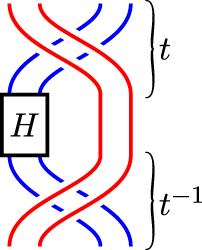
The conjugation $t^2 H t^{-2}$
.
$t^2 H t^{-2}$
.
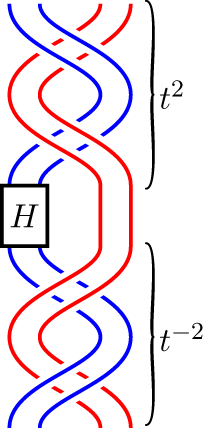
The statement for derived subgroups follows from Lemma 4.11.
Note that the proof really relies on being able to apply non-trivial permutations to the strands. This motivates the following question.
Question 5.4. Is the infinite pure braid group $PB_\infty$
(
$PB_\infty$
( $\mathfrak{X}^{\text{sep}}$
-)boundedly acyclic?
$\mathfrak{X}^{\text{sep}}$
-)boundedly acyclic?
As a consequence of Corollary 5.3, we obtain the following.
Corollary 5.5
(Corollary 1.7). The bounded cohomology ring (with the cup-product structure) of the braided Ptolemy–Thompson group $T^\ast$
with trivial real coefficients is the following:
$T^\ast$
with trivial real coefficients is the following:
 \begin{align*} H_b^\bullet(T^\ast; {\mathbb{R}}) \cong {\mathbb{R}}[x], \end{align*}
where $|x| = 2$
. Under this isomorphism, x corresponds to the Euler class of the defining action on the circle of the quotient T.
$|x| = 2$
. Under this isomorphism, x corresponds to the Euler class of the defining action on the circle of the quotient T.
Proof. It is sufficient to note that the braided Ptolemy–Thompson group $T^\ast$
is an extension of Thompson’s group T by
$T^\ast$
is an extension of Thompson’s group T by $B_\infty$
(see [Reference Funar and KapoudjianFK08]):
$B_\infty$
(see [Reference Funar and KapoudjianFK08]):
 \begin{align*} 1 \to B_\infty \to T^\ast \to T \to 1. \end{align*}
Since $B_\infty$
is boundedly acyclic by Corollary 5.3, we can apply [Reference Moraschini and RaptisMR23, Theorem 4.1.1] and obtain
$B_\infty$
is boundedly acyclic by Corollary 5.3, we can apply [Reference Moraschini and RaptisMR23, Theorem 4.1.1] and obtain
 \begin{align*} H_b^\bullet(T^\ast; {\mathbb{R}}) \cong H_b^\bullet(T; {\mathbb{R}}) \end{align*}
as the cohomology ring, where the isomorphism is induced by the pullback. The thesis now follows from the computation of the bounded cohomology of Thompson’s group T (see [Reference Fournier-Facio, Löh and MoraschiniFFLM23, Reference MonodMon22, Reference Monod and NarimanMN23]).
5.4 Braided Thompson groups
We briefly recall the definition of bV (see [Reference BrinBri07, Reference DehornoyDeh06, Reference Fournier-Facio, Lodha and ZaremskyFFLZ24a]). An element of bV is represented by a triple of the form $(T_-, \beta, T_+)$
, where
$(T_-, \beta, T_+)$
, where $T_{\pm}$
are binary trees with n leaves, and
$T_{\pm}$
are binary trees with n leaves, and $\beta \in B_n$
, the braid group on n strands. We picture
$\beta \in B_n$
, the braid group on n strands. We picture $T_+$
upside down and below
$T_+$
upside down and below $T_-$
, with
$T_-$
, with $\beta$
connecting the leaves of
$\beta$
connecting the leaves of $T_+$
up to those of
$T_+$
up to those of $T_-$
, as in Figure 6. We call such a picture a strand diagram. Elements of bV are equivalence classes of such representative triples, denoted by
$T_-$
, as in Figure 6. We call such a picture a strand diagram. Elements of bV are equivalence classes of such representative triples, denoted by $[T_-, \beta, T_+]$
, where the equivalence is generated by a suitable notion of expansion analogous to that of tree pair diagrams for Thompson’s groups. Given two elements
$[T_-, \beta, T_+]$
, where the equivalence is generated by a suitable notion of expansion analogous to that of tree pair diagrams for Thompson’s groups. Given two elements $[T_-, \beta, T_+]$
and
$[T_-, \beta, T_+]$
and $[U_-, \gamma, U_+]$
, up to expansion we can assume that
$[U_-, \gamma, U_+]$
, up to expansion we can assume that $T_+ = U_-$
, and then their product is
$T_+ = U_-$
, and then their product is $[T_-, \beta \gamma, U_+]$
.
$[T_-, \beta \gamma, U_+]$
.
The conjugation $t \widehat{bV}(1) t^{-1}$
.
$t \widehat{bV}(1) t^{-1}$
.
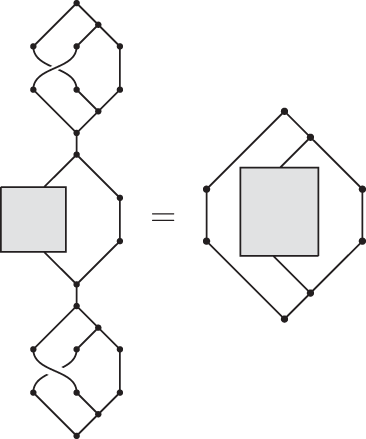
Denote by $\widehat{B_n}$
the copy of
$\widehat{B_n}$
the copy of $B_{n-1}$
inside
$B_{n-1}$
inside $B_n$
that is supported on the first
$B_n$
that is supported on the first $n-1$
strands. Then, the subset of elements of bV of the form
$n-1$
strands. Then, the subset of elements of bV of the form $[T_-, \beta, T_+]$
with
$[T_-, \beta, T_+]$
with $\beta \in \widehat{B_n}$
forms a subgroup, which is denoted by
$\beta \in \widehat{B_n}$
forms a subgroup, which is denoted by $\widehat{bV}$
.
$\widehat{bV}$
.
The right depth of a tree is the distance (length of the geodesic path) of its rightmost leaf to the root in a strand diagram (recall that $T_+$
is pictured upside down). The map
$T_+$
is pictured upside down). The map $\chi_1\colon \widehat{bV} \to {\mathbb{Z}}$
sending an element
$\chi_1\colon \widehat{bV} \to {\mathbb{Z}}$
sending an element $[T_-, \beta, T_+]$
to the right depth of
$[T_-, \beta, T_+]$
to the right depth of $T_-$
minus the right depth of
$T_-$
minus the right depth of $T_+$
, is a well-defined surjective homomorphism, which in fact realizes the abelianization of
$T_+$
, is a well-defined surjective homomorphism, which in fact realizes the abelianization of $\widehat{bV}$
(see [Reference Fournier-Facio, Lodha and ZaremskyFFLZ24a, Corollary 2.14]). We denote by
$\widehat{bV}$
(see [Reference Fournier-Facio, Lodha and ZaremskyFFLZ24a, Corollary 2.14]). We denote by $\widehat{D}$
the kernel of
$\widehat{D}$
the kernel of $\chi_1$
, and by
$\chi_1$
, and by $\widehat{bV}(1)$
the subgroup of
$\widehat{bV}(1)$
the subgroup of $\widehat{D}$
consisting of elements
$\widehat{D}$
consisting of elements $[T_-, \beta, T_+]$
, where both
$[T_-, \beta, T_+]$
, where both $T_-$
and
$T_-$
and $T_+$
have right depth 1.
$T_+$
have right depth 1.
Corollary 5.6
(Corollary 1.8). The group $\widehat{bV}$
is
$\widehat{bV}$
is $\mathfrak{X}^{\text{sep}}$
-boundedly acyclic.
$\mathfrak{X}^{\text{sep}}$
-boundedly acyclic.
Proof. By Theorems 2.8 and 1.3, it suffices to show that the co-amenable subgroup $\widehat{D}$
has commuting cyclic conjugates. Since every finitely generated subgroup of
$\widehat{D}$
has commuting cyclic conjugates. Since every finitely generated subgroup of $\widehat{D}$
is conjugate into
$\widehat{D}$
is conjugate into $\widehat{bV}(1)$
(see [Reference Fournier-Facio, Lodha and ZaremskyFFLZ24a, Lemma 2.12]), it is enough to show that there exists an element
$\widehat{bV}(1)$
(see [Reference Fournier-Facio, Lodha and ZaremskyFFLZ24a, Lemma 2.12]), it is enough to show that there exists an element $t \in \widehat{D}$
such that
$t \in \widehat{D}$
such that $[\widehat{bV}(1), {}^t \widehat{bV}(1)] = 1$
, and
$[\widehat{bV}(1), {}^t \widehat{bV}(1)] = 1$
, and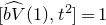 $[\widehat{bV}(1), t^2] = 1$
. We choose
$[\widehat{bV}(1), t^2] = 1$
. We choose $t = [T, \beta, T]$
, where T is a caret with a second caret hanging on the right and
$t = [T, \beta, T]$
, where T is a caret with a second caret hanging on the right and $\beta$
is the first standard generator of
$\beta$
is the first standard generator of $B_3$
(Figure 6). It is known that
$B_3$
(Figure 6). It is known that $[\widehat{bV}(1), {}^t \widehat{bV}(1)] = 1$
(see [Reference Fournier-Facio, Lodha and ZaremskyFFLZ24a, Lemma 2.16]), whereas the fact that
$[\widehat{bV}(1), {}^t \widehat{bV}(1)] = 1$
(see [Reference Fournier-Facio, Lodha and ZaremskyFFLZ24a, Lemma 2.16]), whereas the fact that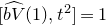 $[\widehat{bV}(1), t^2] = 1$
can be proved just as in our proof of Corollary 5.3 (compare with Figure 5).
$[\widehat{bV}(1), t^2] = 1$
can be proved just as in our proof of Corollary 5.3 (compare with Figure 5).
5.5 Automorphisms of products
Let $\Gamma$
be an arbitrary group. We denote by
$\Gamma$
be an arbitrary group. We denote by $\Gamma^{* \infty} := *_{i \in {\mathbb{N}}} \Gamma$
, by
$\Gamma^{* \infty} := *_{i \in {\mathbb{N}}} \Gamma$
, by $\Gamma^{\times \infty} := \prod_{i \in {\mathbb{N}}} \Gamma$
, and by
$\Gamma^{\times \infty} := \prod_{i \in {\mathbb{N}}} \Gamma$
, and by $\Gamma^{\oplus \infty} := \oplus_{i \in {\mathbb{N}}} \Gamma$
. In each case, we denote by
$\Gamma^{\oplus \infty} := \oplus_{i \in {\mathbb{N}}} \Gamma$
. In each case, we denote by $\Gamma_i$
the ith copy of
$\Gamma_i$
the ith copy of $\Gamma$
. We define
$\Gamma$
. We define $\textrm{Aut}_\infty(\Gamma^{* \infty})$
as the subgroup of
$\textrm{Aut}_\infty(\Gamma^{* \infty})$
as the subgroup of $\textrm{Aut}(\Gamma^{* \infty})$
consisting of automorphisms that fix pointwise the groups
$\textrm{Aut}(\Gamma^{* \infty})$
consisting of automorphisms that fix pointwise the groups $\Gamma_i$
for i large enough. Similarly, we define
$\Gamma_i$
for i large enough. Similarly, we define $\textrm{Aut}_\infty(\Gamma^{\times \infty})$
and
$\textrm{Aut}_\infty(\Gamma^{\times \infty})$
and $\textrm{Aut}_\infty(\Gamma^{\oplus \infty})$
.
$\textrm{Aut}_\infty(\Gamma^{\oplus \infty})$
.
Corollary 5.7
(Corollary 1.10). For every group $\Gamma$
, the groups
$\Gamma$
, the groups $\textrm{Aut}_\infty(\Gamma^{* \infty})$
,
$\textrm{Aut}_\infty(\Gamma^{* \infty})$
, $\textrm{Aut}_\infty(\Gamma^{\times \infty})$
and
$\textrm{Aut}_\infty(\Gamma^{\times \infty})$
and $\textrm{Aut}_\infty(\Gamma^{\oplus \infty})$
are
$\textrm{Aut}_\infty(\Gamma^{\oplus \infty})$
are $\mathfrak{X}^{\text{sep}}$
-boundedly acyclic.
$\mathfrak{X}^{\text{sep}}$
-boundedly acyclic.
Proof. We prove this for $\textrm{Aut}_\infty(\Gamma^{* \infty})$
; the other cases are analogous. First note that, by the universal property of free products, every automorphism is uniquely determined by its restriction to each free factor
$\textrm{Aut}_\infty(\Gamma^{* \infty})$
; the other cases are analogous. First note that, by the universal property of free products, every automorphism is uniquely determined by its restriction to each free factor $\Gamma_i$
. Let
$\Gamma_i$
. Let $H \leq \textrm{Aut}_\infty(\Gamma^{* \infty})$
be a finitely generated subgroup. Then there exists
$H \leq \textrm{Aut}_\infty(\Gamma^{* \infty})$
be a finitely generated subgroup. Then there exists $n\in{\mathbb{N}}$
such that H fixes
$n\in{\mathbb{N}}$
such that H fixes $\Gamma_i$
pointwise for all
$\Gamma_i$
pointwise for all $i \gt n$
. We define t as follows. For all
$i \gt n$
. We define t as follows. For all $1 \leq i \leq 2n$
, it swaps
$1 \leq i \leq 2n$
, it swaps $\Gamma_i$
and
$\Gamma_i$
and $\Gamma_{2n-i}$
, and for all
$\Gamma_{2n-i}$
, and for all $i \gt 2n$
, it fixes
$i \gt 2n$
, it fixes $\Gamma_i$
pointwise. Then t has order 2, thus
$\Gamma_i$
pointwise. Then t has order 2, thus $[H, t^2] = 1$
. Moreover,
$[H, t^2] = 1$
. Moreover, ${}^t H$
fixes
${}^t H$
fixes $\Gamma_i$
pointwise, for
$\Gamma_i$
pointwise, for $1 \leq i \leq n$
, and so
$1 \leq i \leq n$
, and so $[H, {}^t H] = 1$
. This shows that
$[H, {}^t H] = 1$
. This shows that $\textrm{Aut}_\infty(\Gamma^{* \infty})$
has commuting cyclic conjugates, and we conclude by Theorem 1.3.
$\textrm{Aut}_\infty(\Gamma^{* \infty})$
has commuting cyclic conjugates, and we conclude by Theorem 1.3.
5.6 Cremona groups
Recall that, for a field K, the Cremona groups $\mathrm{Cr}_n(K)=\mathrm{Aut}(K(x_1, \ldots, x_n)|K)$
are the groups of automorphisms of the field of rational functions
$\mathrm{Cr}_n(K)=\mathrm{Aut}(K(x_1, \ldots, x_n)|K)$
are the groups of automorphisms of the field of rational functions $K(x_1, \ldots, x_n)$
over K. We stabilize these groups along the natural inclusions
$K(x_1, \ldots, x_n)$
over K. We stabilize these groups along the natural inclusions $\mathrm{Cr}_n(K)\hookrightarrow \mathrm{Cr}_{n+1}(K)$
, fixing the coordinate
$\mathrm{Cr}_n(K)\hookrightarrow \mathrm{Cr}_{n+1}(K)$
, fixing the coordinate $x_{n+1}$
. We consider their direct limit
$x_{n+1}$
. We consider their direct limit
 $$\mathrm{Cr}_{\infty}(K)=\bigcup_{n\in\mathbb{N}}\mathrm{Cr}_n(K).$$
In this section, we apply Theorem 1.3 to $\mathrm{Cr}_\infty(K)$
and show the following.
$\mathrm{Cr}_\infty(K)$
and show the following.
Corollary 5.8
(Corollary 1.11). The group $\mathrm{Cr}_{\infty}(K)$
is
$\mathrm{Cr}_{\infty}(K)$
is $\mathfrak{X}^{\text{sep}}$
-boundedly acyclic.
$\mathfrak{X}^{\text{sep}}$
-boundedly acyclic.
Proof. Note that every element of $\mathrm{Aut}(K(x_1, \ldots, x_n)|K)$
is determined by its action on
$\mathrm{Aut}(K(x_1, \ldots, x_n)|K)$
is determined by its action on $x_1, \ldots,x_n$
. Let
$x_1, \ldots,x_n$
. Let $H\leq \mathrm{Cr}_\infty(K)$
be a finitely generated subgroup. Then there exists
$H\leq \mathrm{Cr}_\infty(K)$
be a finitely generated subgroup. Then there exists $n\in\mathbb{N}$
such that
$n\in\mathbb{N}$
such that $H\leq \mathrm{Cr}_n(K)$
. Define an element
$H\leq \mathrm{Cr}_n(K)$
. Define an element $t\in \mathrm{Cr}_{2n}(K)$
as follows: for all
$t\in \mathrm{Cr}_{2n}(K)$
as follows: for all $1\leq i\leq 2n$
, t swaps
$1\leq i\leq 2n$
, t swaps $x_i$
and
$x_i$
and $x_{2n-i}$
. Thus t has order 2, so that
$x_{2n-i}$
. Thus t has order 2, so that $[H, t^2]=1$
. Moreover,
$[H, t^2]=1$
. Moreover, ${}^t H$
fixes
${}^t H$
fixes $x_i$
for all
$x_i$
for all $1\leq i\leq n$
, so that
$1\leq i\leq n$
, so that ${}^t H$
commutes with H. This shows that
${}^t H$
commutes with H. This shows that $\mathrm{Cr}_{\infty}(K)$
has commuting cyclic conjugates, and we conclude by Theorem 1.3.
$\mathrm{Cr}_{\infty}(K)$
has commuting cyclic conjugates, and we conclude by Theorem 1.3.
5.7 Transformation groups
In this section, we apply Theorem 1.3 to some compactly supported homeomorphism and diffeomorphism groups of manifolds, proving all the parts of Corollary 1.12. The full groups of compactly supported homeomorphisms and diffeomorphisms have already been tackled via other approaches [Reference Matsumoto and MoritaMM85, Reference MonodMon22, Reference Fournier-Facio, Löh and MoraschiniFFLM23, Reference Monod and NarimanMN23]. But using the commuting cyclic conjugates condition, we are also able to treat structure-preserving groups, such as symplectomorphisms and volume-preserving diffeomorphisms. Our approach is closer to Kotschick’s argument for the vanishing of the stable commutator length of such groups [Reference KotschickKot08].
Recall that given a topological space X and a map $f \colon X \to X$
, we set
$f \colon X \to X$
, we set $\textrm{supp}(f) := \{ x \in X : f(x) \neq x \}$
and say that f is compactly supported if
$\textrm{supp}(f) := \{ x \in X : f(x) \neq x \}$
and say that f is compactly supported if $\textrm{supp}(f)$
has compact closure. We denote by
$\textrm{supp}(f)$
has compact closure. We denote by $\text{Homeo}_c(X)$
the group of compactly supported homeomorphisms of X. For a group of homeomorphisms H, we denote by
$\text{Homeo}_c(X)$
the group of compactly supported homeomorphisms of X. For a group of homeomorphisms H, we denote by $\textrm{supp}(H)$
the union of the supports of its elements. We will frequently use the formula
$\textrm{supp}(H)$
the union of the supports of its elements. We will frequently use the formula
 \begin{align*} \textrm{supp}({}^{t}H) = t (\textrm{supp}(H)). \end{align*}
We will repeatedly apply the following dynamical version of the commuting cyclic conjugates condition, both in this and the next section.
Lemma 5.9
(Dynamical commuting cyclic conjugates). Let X be a topological space, and let $T \leq \text{Homeo}_c(X)$
.
$T \leq \text{Homeo}_c(X)$
.
-
(1) Suppose that for every compact subset
$K \subset X$
, there exists
$t \in T$
such that the sets
$\{t^p(K)\}_{p \geq 1}$
are pairwise disjoint. Then, every group G such that
$T^{(d)} \leq G \leq \text{Homeo}_c(X)$
for some
$d \geq 0$
has commuting
${\mathbb{Z}}$
-conjugates. -
(2) Suppose that for every compact subset
$K \subset X$
, there exists
$t \in T$
such that
$t(K) \cap K = \varnothing$
and
$t^2|_K = \textrm{id} |_K$
. Then, every group G such that
$T^{(d)} \leq G \leq \text{Homeo}_c(X)$
for some
$d \geq 0$
has commuting cyclic conjugates.









In particular, in both cases, every such group G is $\mathfrak{X}^{\text{sep}}$
-boundedly acyclic.
$\mathfrak{X}^{\text{sep}}$
-boundedly acyclic.
Recall that $T^{(d)}$
denotes the dth derived subgroup of T. It will be apparent from the proof below that item (2) can be generalized by replacing 2 with larger positive integers n, even with n varying in terms of K. However,
$T^{(d)}$
denotes the dth derived subgroup of T. It will be apparent from the proof below that item (2) can be generalized by replacing 2 with larger positive integers n, even with n varying in terms of K. However, $n = 2$
is the only case we will use, so we state the lemma like this for clarity.
$n = 2$
is the only case we will use, so we state the lemma like this for clarity.
Proof. We will start by showing that if $T \leq G \leq \text{Homeo}_c(X)$
, then G has commuting
$T \leq G \leq \text{Homeo}_c(X)$
, then G has commuting ${\mathbb{Z}}$
-conjugates in the first case, or commuting cyclic conjugates in the second case. Let
${\mathbb{Z}}$
-conjugates in the first case, or commuting cyclic conjugates in the second case. Let $H \leq G$
be a finitely generated subgroup. Since each generator is compactly supported, there exists a compact set K such that
$H \leq G$
be a finitely generated subgroup. Since each generator is compactly supported, there exists a compact set K such that $\textrm{supp}(H) \subset K$
.
$\textrm{supp}(H) \subset K$
.
For the first item, let t be as in the hypothesis for this K, and note that $t \in T \leq G$
. Then, the groups
$t \in T \leq G$
. Then, the groups $\{{}^{t^p} H\}_{p \geq 1}$
are supported on the pairwise disjoint sets
$\{{}^{t^p} H\}_{p \geq 1}$
are supported on the pairwise disjoint sets $\textrm{supp}({}^{t^p} H) = t^p(\textrm{supp}(H)) \subset t^p(K)$
. So
$\textrm{supp}({}^{t^p} H) = t^p(\textrm{supp}(H)) \subset t^p(K)$
. So $[H, {}^{t^p} H] = 1$
for all
$[H, {}^{t^p} H] = 1$
for all $p \geq 1$
. This shows that G has commuting
$p \geq 1$
. This shows that G has commuting ${\mathbb{Z}}$
-conjugates.
${\mathbb{Z}}$
-conjugates.
For the second item, let t be such that $t(K) \cap K = \varnothing$
, and
$t(K) \cap K = \varnothing$
, and $t^2|_K = \textrm{id}|_K$
. First, we note that H and
$t^2|_K = \textrm{id}|_K$
. First, we note that H and ${}^t H$
have disjoint supports, and so
${}^t H$
have disjoint supports, and so $[H, {}^t H] = 1$
. Second, for all
$[H, {}^t H] = 1$
. Second, for all $h \in H$
, we have
$h \in H$
, we have $[h, t^2]|_K = [h, \textrm{id}]|_K = \textrm{id}|_K$
while
$[h, t^2]|_K = [h, \textrm{id}]|_K = \textrm{id}|_K$
while $[h, t^2]|_{X \setminus K} = [\textrm{id}, t^2]|_{X \setminus K} = \textrm{id}|_{X \setminus K}$
. So
$[h, t^2]|_{X \setminus K} = [\textrm{id}, t^2]|_{X \setminus K} = \textrm{id}|_{X \setminus K}$
. So $[H, t^2] = 1$
, and this proves that G has commuting cyclic conjugates (with
$[H, t^2] = 1$
, and this proves that G has commuting cyclic conjugates (with $n = 2$
in the definition).
$n = 2$
in the definition).
The generalization to derived subgroups now follows by the same argument as in Lemma 4.11.
Remark 5.10
(Universal covers) We will consider transformation groups as discrete groups. However, they all carry a natural group topology, and so to each of these groups G is associated a universal cover $\tilde{G}$
, which is also of interest in many settings [Reference BanyagaBan97]. However,
$\tilde{G}$
, which is also of interest in many settings [Reference BanyagaBan97]. However, $\tilde{G}$
is an extension of G by the group
$\tilde{G}$
is an extension of G by the group $\pi_1(G)$
, which is always abelian [Reference MunkresMun00, Exercise 52.7]. Therefore, by Gromov’s mapping theorem (Theorem 2.6) and its inflation version (Remark 2.7),
$\pi_1(G)$
, which is always abelian [Reference MunkresMun00, Exercise 52.7]. Therefore, by Gromov’s mapping theorem (Theorem 2.6) and its inflation version (Remark 2.7), $\tilde{G}$
is
$\tilde{G}$
is $\mathfrak{X}^{\text{sep}}$
-boundedly acyclic if and only if G is.
$\mathfrak{X}^{\text{sep}}$
-boundedly acyclic if and only if G is.
5.7.1 Hamiltonian diffeomorphisms and symplectomorphisms
Let $(M, \omega)$
be a symplectic manifold (i.e. an even-dimensional smooth manifold M with a symplectic form
$(M, \omega)$
be a symplectic manifold (i.e. an even-dimensional smooth manifold M with a symplectic form $\omega \in \Omega^2(M)$
). The key example is that of
$\omega \in \Omega^2(M)$
). The key example is that of ${\mathbb{R}}^{2n}$
endowed with the standard symplectic form
${\mathbb{R}}^{2n}$
endowed with the standard symplectic form $\omega = \sum_{i = 1}^n dx_i \wedge dy_i$
. We recall that
$\omega = \sum_{i = 1}^n dx_i \wedge dy_i$
. We recall that $\text{Symp}_c(M, \omega)$
denotes the group of compactly supported diffeomorphisms that preserve
$\text{Symp}_c(M, \omega)$
denotes the group of compactly supported diffeomorphisms that preserve $\omega$
and
$\omega$
and $\text{Symp}^0_c(M, \omega)$
its identity component. We will remove
$\text{Symp}^0_c(M, \omega)$
its identity component. We will remove $\omega$
from the notation if it is clear from the context. Given a compactly supported smooth function
$\omega$
from the notation if it is clear from the context. Given a compactly supported smooth function $H \colon M \to {\mathbb{R}}$
, called Hamiltonian, we say that the Hamiltonian vector field
$H \colon M \to {\mathbb{R}}$
, called Hamiltonian, we say that the Hamiltonian vector field $X_H$
is the unique vector field such that
$X_H$
is the unique vector field such that $\iota_{X_H} \omega = dH$
, where
$\iota_{X_H} \omega = dH$
, where $\iota_{X_H}$
denotes the interior product [Reference Cannas da SilvaCdS03]: note that
$\iota_{X_H}$
denotes the interior product [Reference Cannas da SilvaCdS03]: note that $X_H$
is compactly supported, so it is complete. Then, the Hamiltonian flow
$X_H$
is compactly supported, so it is complete. Then, the Hamiltonian flow $\varphi \colon M \times {\mathbb{R}} \rightarrow M$
is a one-parameter family of diffeomorphisms
$\varphi \colon M \times {\mathbb{R}} \rightarrow M$
is a one-parameter family of diffeomorphisms $\varphi_t \colon M \to M$
associated to
$\varphi_t \colon M \to M$
associated to $X_H$
. By construction, each
$X_H$
. By construction, each $\varphi_t$
is compactly supported. We call such diffeomorphisms Hamiltonian: note that up to rescaling the flow, we may realize each Hamiltonian diffeomorphism as the time-one map of a Hamiltonian flow [Reference PolterovichPol01, Exercise 1.4.A]. We denote by
$\varphi_t$
is compactly supported. We call such diffeomorphisms Hamiltonian: note that up to rescaling the flow, we may realize each Hamiltonian diffeomorphism as the time-one map of a Hamiltonian flow [Reference PolterovichPol01, Exercise 1.4.A]. We denote by $\text{Ham}_c(M, \omega)$
the group of (compactly supported) Hamiltonian diffeomorphisms. This is indeed a subgroup of
$\text{Ham}_c(M, \omega)$
the group of (compactly supported) Hamiltonian diffeomorphisms. This is indeed a subgroup of $\text{Symp}^0_c(M, \omega)$
(see [Reference PolterovichPol01]).
$\text{Symp}^0_c(M, \omega)$
(see [Reference PolterovichPol01]).
Corollary 5.11
(Symplectic transformation groups of ${\mathbb{R}}^{2n}$
). Let
${\mathbb{R}}^{2n}$
). Let ${\mathbb{R}}^{2n}$
be endowed with its standard symplectic form. Let G be a group such that
${\mathbb{R}}^{2n}$
be endowed with its standard symplectic form. Let G be a group such that $[\text{Ham}_c( {\mathbb{R}}^{2n}), \text{Ham}_c({\mathbb{R}}^{2n})] \leq G \leq \text{Homeo}_c({\mathbb{R}}^{2n})$
. Then G is
$[\text{Ham}_c( {\mathbb{R}}^{2n}), \text{Ham}_c({\mathbb{R}}^{2n})] \leq G \leq \text{Homeo}_c({\mathbb{R}}^{2n})$
. Then G is $\mathfrak{X}^{\text{sep}}$
-boundedly acyclic.
$\mathfrak{X}^{\text{sep}}$
-boundedly acyclic.
Example 5.12
(Symplectic transformation groups of ${\mathbb{R}}^{2n}$
). Corollary 5.11 applies to the groups
${\mathbb{R}}^{2n}$
). Corollary 5.11 applies to the groups $\text{Ham}_c({\mathbb{R}}^{2n})$
,
$\text{Ham}_c({\mathbb{R}}^{2n})$
, $\text{Symp}^0_c({\mathbb{R}}^{2n})$
and
$\text{Symp}^0_c({\mathbb{R}}^{2n})$
and $\text{Symp}_c({\mathbb{R}}^{2n})$
. It also applies to the group of compactly supported Hamiltonian homeomorphisms of
$\text{Symp}_c({\mathbb{R}}^{2n})$
. It also applies to the group of compactly supported Hamiltonian homeomorphisms of $ {\mathbb{R}}^{2n}$
(see [Reference Buhovsky, Humilière and SeyfaddiniBHS18, Reference Cristofaro-Gardiner, Humilière and SeyfaddiniCGHS24]). Note that we stop at the first derived subgroup, since it is perfect [Reference BanyagaBan97, Chapter 4].
$ {\mathbb{R}}^{2n}$
(see [Reference Buhovsky, Humilière and SeyfaddiniBHS18, Reference Cristofaro-Gardiner, Humilière and SeyfaddiniCGHS24]). Note that we stop at the first derived subgroup, since it is perfect [Reference BanyagaBan97, Chapter 4].
Proof. We are going to show that $\text{Ham}_c({\mathbb{R}}^{2n}) \leq \text{Homeo}_c({\mathbb{R}}^{2n})$
satisfies Lemma 5.9(2); the statement will follow.
$\text{Ham}_c({\mathbb{R}}^{2n}) \leq \text{Homeo}_c({\mathbb{R}}^{2n})$
satisfies Lemma 5.9(2); the statement will follow.
We see ${\mathbb{R}}^{2n}$
as
${\mathbb{R}}^{2n}$
as ${\mathbb{R}} \times {\mathbb{R}} \times {\mathbb{R}}^{2n - 2}$
, with coordinates
${\mathbb{R}} \times {\mathbb{R}} \times {\mathbb{R}}^{2n - 2}$
, with coordinates $(x, y, \underline{z})$
. Let
$(x, y, \underline{z})$
. Let $K \subset {\mathbb{R}}^{2n}$
be a compact set. Then there exists a compact set
$K \subset {\mathbb{R}}^{2n}$
be a compact set. Then there exists a compact set $A \subset {\mathbb{R}}^{2n-2}$
such that
$A \subset {\mathbb{R}}^{2n-2}$
such that $K \subset B_R(0, 0) \times A$
, where
$K \subset B_R(0, 0) \times A$
, where $B_R(0, 0) \subset {\mathbb{R}}^2$
is the closed disc of radius R around the origin.
$B_R(0, 0) \subset {\mathbb{R}}^2$
is the closed disc of radius R around the origin.
We define t starting from a smooth Hamiltonian $F \colon {\mathbb{R}}^{2n} \to {\mathbb{R}}$
satisfying
$F \colon {\mathbb{R}}^{2n} \to {\mathbb{R}}$
satisfying
 \begin{align*} (x, y, \underline{z}) \mapsto \begin{cases} \frac{1}{2} ((x-2R)^2 + y^2) &\mbox{ if } (x, y) \in B_{4R}(2R, 0), \\ 0 &\mbox{ if } (x, y) \in {\mathbb{R}}^2 \setminus B_{6R}(2R, 0). \end{cases} \end{align*}
When $n \gt 1$
, F is not compactly supported, so we slightly modify it by taking the product with a compactly supported function
$n \gt 1$
, F is not compactly supported, so we slightly modify it by taking the product with a compactly supported function $\eta \colon {\mathbb{R}}^{2n} \to {\mathbb{R}}$
such that
$\eta \colon {\mathbb{R}}^{2n} \to {\mathbb{R}}$
such that $\eta|_{B_{4R}(2R, 0) \times A} \equiv 1$
. Hence, we obtain a compactly supported Hamiltonian
$\eta|_{B_{4R}(2R, 0) \times A} \equiv 1$
. Hence, we obtain a compactly supported Hamiltonian $H = \eta \cdot F \colon {\mathbb{R}}^{2n} \to {\mathbb{R}}$
. The Hamiltonian vector field associated with H (represented in Figure 7 in its projection to
$H = \eta \cdot F \colon {\mathbb{R}}^{2n} \to {\mathbb{R}}$
. The Hamiltonian vector field associated with H (represented in Figure 7 in its projection to ${\mathbb{R}}^2$
) satisfies the following [Reference WoitWoi17, § 15.2]:
${\mathbb{R}}^2$
) satisfies the following [Reference WoitWoi17, § 15.2]:
 \begin{align*} X_H(x, y, \underline{z}) = y \frac{\partial}{\partial x} - (x - 2R) \frac{\partial}{\partial y} \quad \text{ if } (x, y, \underline{z}) \in B_{4R}(2R, 0) \times A. \end{align*}
This vector field over the compact set $B_{4R}(2R, 0) \times A$
produces a Hamiltonian flow that corresponds to the clockwise rotation around the point (2R, 0) in the first copy of
$B_{4R}(2R, 0) \times A$
produces a Hamiltonian flow that corresponds to the clockwise rotation around the point (2R, 0) in the first copy of ${\mathbb{R}}^2$
and that is the identity over the other coordinates. More precisely, if
${\mathbb{R}}^2$
and that is the identity over the other coordinates. More precisely, if $(x, y, \underline{z}) \in B_{4R}(2R, 0) \times A$
, then
$(x, y, \underline{z}) \in B_{4R}(2R, 0) \times A$
, then $\varphi_s(x, y, \underline{z})$
equals
$\varphi_s(x, y, \underline{z})$
equals
 \begin{align*} (2R+ (x - 2R) \cos (s) + y \sin (s),\!\quad y \cos (s) - (x - 2R) \sin (s), \underline{z}), \end{align*}
and the support of $\varphi_s$
is contained in the (compact) support of
$\varphi_s$
is contained in the (compact) support of $\eta$
.
$\eta$
.
The projection of the Hamiltonian vector field on the two-dimensional disc $B_{4R}(2R, 0)$
of the first copy of
$B_{4R}(2R, 0)$
of the first copy of ${\mathbb{R}}^2$
.
${\mathbb{R}}^2$
.
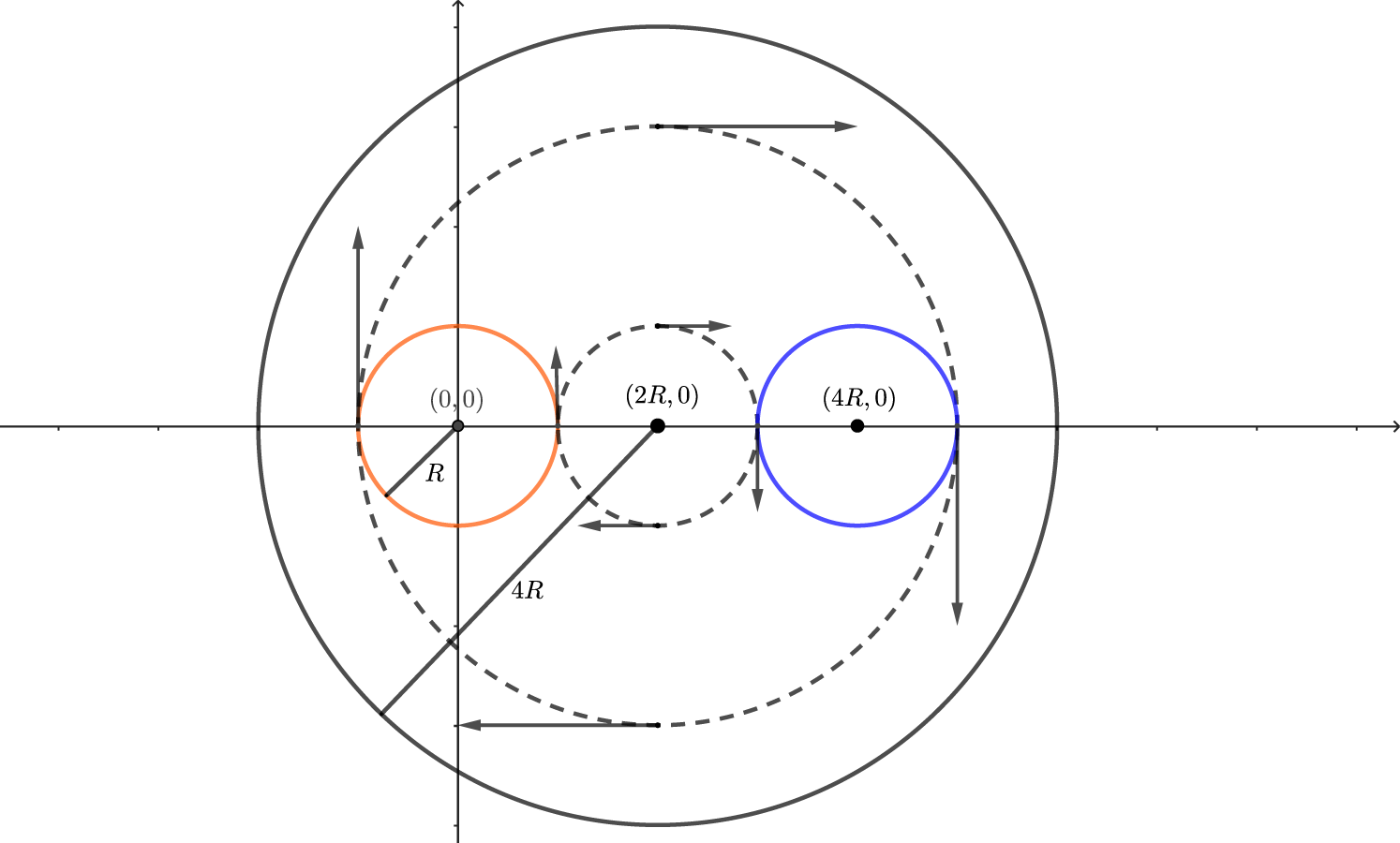
Figure 7 Long description
A diagram of the projection of the Hamiltonian vector field on the two-dimensional disc B4R(2R, 0) of the first copy of R2. The diagram features a coordinate system with axes labeled and a large circle representing the boundary of the disc centered at (2R, 0). Inside the disc, there are three smaller circles centered at (0, 0), (2R, 0), and (4R, 0), each with arrows indicating the direction of the vector field. The arrows show the flow of the vector field around these points. The diagram also includes labels for the radii R and 4R, indicating the distances from the origin and the points of interest.
We define $t := \varphi_\pi \in \text{Ham}_c({\mathbb{R}}^{2n})$
. Then, it is immediate to check that
$t := \varphi_\pi \in \text{Ham}_c({\mathbb{R}}^{2n})$
. Then, it is immediate to check that
 \begin{align*} t(K) \subset t( B_R(0, 0) \times A) \subset B_R(4R, 0) \times A, \end{align*}
which is disjoint from $B_R(0, 0) \times A$
; whence from K. Moreover, by construction we also have that
$B_R(0, 0) \times A$
; whence from K. Moreover, by construction we also have that $t^2$
coincides with the identity on K, since it is the identity over the larger set
$t^2$
coincides with the identity on K, since it is the identity over the larger set $B_{R}(0, 0) \times A$
. Thus,
$B_{R}(0, 0) \times A$
. Thus, $\text{Ham}_c({\mathbb{R}}^{2n}) \leq \text{Homeo}_c({\mathbb{R}}^{2n})$
satisfies Lemma 5.9(2), and we conclude.
$\text{Ham}_c({\mathbb{R}}^{2n}) \leq \text{Homeo}_c({\mathbb{R}}^{2n})$
satisfies Lemma 5.9(2), and we conclude.
5.7.2 Volume-preserving diffeomorphisms
For an n-manifold M with a volume form $\text{vol} \in \Omega^n(M)$
, we denote by
$\text{vol} \in \Omega^n(M)$
, we denote by $\text{Diff}_{c, \text{vol}}(M)$
the group of compactly supported diffeomorphisms that preserve the volume, and by
$\text{Diff}_{c, \text{vol}}(M)$
the group of compactly supported diffeomorphisms that preserve the volume, and by $\text{Diff}^0_{c, \text{vol}}(M)$
its identity component. The key example is that of
$\text{Diff}^0_{c, \text{vol}}(M)$
its identity component. The key example is that of ${\mathbb{R}}^n$
endowed with the standard volume form
${\mathbb{R}}^n$
endowed with the standard volume form $dx_1 \wedge \cdots \wedge dx_n$
. Note that symplectomorphisms of
$dx_1 \wedge \cdots \wedge dx_n$
. Note that symplectomorphisms of ${\mathbb{R}}^{2n}$
are volume preserving, since
${\mathbb{R}}^{2n}$
are volume preserving, since $\text{vol} = \omega^n/n!$
, where
$\text{vol} = \omega^n/n!$
, where $\omega$
is the standard symplectic form. Therefore, Corollary 5.11 already proves that
$\omega$
is the standard symplectic form. Therefore, Corollary 5.11 already proves that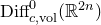 $\text{Diff}^0_{c, \text{vol}}({\mathbb{R}}^{2n})$
and
$\text{Diff}^0_{c, \text{vol}}({\mathbb{R}}^{2n})$
and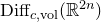 $\text{Diff}_{c, \text{vol}}({\mathbb{R}}^{2n})$
are
$\text{Diff}_{c, \text{vol}}({\mathbb{R}}^{2n})$
are $\mathfrak{X}^{\text{sep}}$
-boundedly acyclic. In order to include odd dimensions, we use the following trick.
$\mathfrak{X}^{\text{sep}}$
-boundedly acyclic. In order to include odd dimensions, we use the following trick.
Lemma 5.13
(Volume-preserving cut-off). Let $\{f_t\}_{t \in [0, 1]}$
be a smooth isotopy of diffeomorphisms of
$\{f_t\}_{t \in [0, 1]}$
be a smooth isotopy of diffeomorphisms of ${\mathbb{R}}^n$
such that
${\mathbb{R}}^n$
such that $f_t$
is volume preserving for all
$f_t$
is volume preserving for all $t \in [0, 1]$
. Let
$t \in [0, 1]$
. Let $\eta\colon {\mathbb{R}} \to [0, 1]$
be smooth. Then, the map
$\eta\colon {\mathbb{R}} \to [0, 1]$
be smooth. Then, the map $\varphi\colon {\mathbb{R}}^{n+1} \to {\mathbb{R}}^{n+1}$
defined as
$\varphi\colon {\mathbb{R}}^{n+1} \to {\mathbb{R}}^{n+1}$
defined as $\varphi(\underline{x}, z) = (f_{\eta(z)}(\underline{x}), z)$
is a volume-preserving diffeomorphism, where
$\varphi(\underline{x}, z) = (f_{\eta(z)}(\underline{x}), z)$
is a volume-preserving diffeomorphism, where $\underline{x} \in {\mathbb{R}}^n$
.
$\underline{x} \in {\mathbb{R}}^n$
.
Moreover, if the isotopy $\{f_t\}_{t \in [0, 1]}$
is compactly supported,
$\{f_t\}_{t \in [0, 1]}$
is compactly supported, $f_0 = \textrm{id}$
and
$f_0 = \textrm{id}$
and $\eta$
is compactly supported, then
$\eta$
is compactly supported, then $\varphi$
is compactly supported.
$\varphi$
is compactly supported.
Note that in the last statement, we are using two different notions of support: for the diffeomorphisms $f_t$
, we have
$f_t$
, we have $\textrm{supp}(f_t) = \{ x \in X : f_t(x) \neq x \}$
, while for the function
$\textrm{supp}(f_t) = \{ x \in X : f_t(x) \neq x \}$
, while for the function $\eta$
, we have
$\eta$
, we have $\textrm{supp}(\eta) = \{x \in X : \eta(x) \neq 0 \}$
.
$\textrm{supp}(\eta) = \{x \in X : \eta(x) \neq 0 \}$
.
Proof. As a composition of smooth functions, $\varphi$
is smooth, and it is a diffeomorphism since its inverse
$\varphi$
is smooth, and it is a diffeomorphism since its inverse $\varphi^{-1}(\underline{x}, z) = (f_{\eta(z)}^{-1}(\underline{x}), z)$
is also smooth. It remains to show that
$\varphi^{-1}(\underline{x}, z) = (f_{\eta(z)}^{-1}(\underline{x}), z)$
is also smooth. It remains to show that $\varphi$
is volume preserving, equivalently that its Jacobian
$\varphi$
is volume preserving, equivalently that its Jacobian $D_{(\underline{x}, z)} \varphi$
has determinant 1. We note that
$D_{(\underline{x}, z)} \varphi$
has determinant 1. We note that
 $$\left. \frac{\partial \varphi^i}{\partial x_j} \right|_{(\underline{x}, z)} = \frac{\partial f_{\eta(z)}^i}{\partial x_j}$$
for $1 \leq i, j \leq n$
, that
$1 \leq i, j \leq n$
, that
 $$\left. \frac{\partial \varphi^{n+1}}{\partial x_j} \right|_{(\underline{x}, z)} = 0$$
for $1 \leq j \leq n$
, and that
$1 \leq j \leq n$
, and that
 $$\left. \frac{\partial \varphi^{n+1}}{\partial z} \right|_{(\underline{x}, z)}= 1.$$
Therefore,
 \begin{align*} D_{(\underline{x}, z)}\varphi = \begin{pmatrix} D_{\underline{x}} f_{\eta(z)}\;\;\;\; & * \\ 0\;\;\;\; & 1 \end{pmatrix}, \end{align*}
which has determinant 1 since $f_{\eta(z)}$
is volume preserving.
$f_{\eta(z)}$
is volume preserving.
The last sentence follows from the following fact: $(\underline{x}, z) \in \text{supp}(\varphi)$
if and only if
$(\underline{x}, z) \in \text{supp}(\varphi)$
if and only if $\underline{x} \in \text{supp} (f_{\eta(z)})$
. Therefore,
$\underline{x} \in \text{supp} (f_{\eta(z)})$
. Therefore, $\text{supp} (\varphi) \subset (\cup_{t \in [0, 1]} \text{supp} (f_t)) \times \text{supp}(\eta)$
, which is compact by assumption.
$\text{supp} (\varphi) \subset (\cup_{t \in [0, 1]} \text{supp} (f_t)) \times \text{supp}(\eta)$
, which is compact by assumption.
Corollary 5.14
(Volume-preserving transformation groups of ${\mathbb{R}}^n$
). Let
${\mathbb{R}}^n$
). Let $n \geq 2$
and let
$n \geq 2$
and let ${\mathbb{R}}^n$
be endowed with its standard volume form. Let G be a group such that
${\mathbb{R}}^n$
be endowed with its standard volume form. Let G be a group such that $[\text{Diff}^0_{c, \text{vol}}({\mathbb{R}}^n), \text{Diff}^0_{c, \text{vol}}({\mathbb{R}}^n)] \leq G \leq \text{Homeo}_c({\mathbb{R}}^n)$
. Then G is
$[\text{Diff}^0_{c, \text{vol}}({\mathbb{R}}^n), \text{Diff}^0_{c, \text{vol}}({\mathbb{R}}^n)] \leq G \leq \text{Homeo}_c({\mathbb{R}}^n)$
. Then G is $\mathfrak{X}^{\text{sep}}$
-boundedly acyclic.
$\mathfrak{X}^{\text{sep}}$
-boundedly acyclic.
Note that we stop at the first derived subgroup, since it is perfect [Reference BanyagaBan97, Chapter 5].
Proof. As we mentioned above, by Corollary 5.11 it suffices to show the statement in odd dimensions. Therefore, we consider $ {\mathbb{R}}^{2n+1}$
, for
$ {\mathbb{R}}^{2n+1}$
, for $n \geq 1$
, and we show that
$n \geq 1$
, and we show that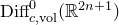 $\text{Diff}^0_{c, \text{vol}}({\mathbb{R}}^{2n+1})$
satisfies Lemma 5.9(2).
$\text{Diff}^0_{c, \text{vol}}({\mathbb{R}}^{2n+1})$
satisfies Lemma 5.9(2).
Let $K \subset {\mathbb{R}}^{2n+1}$
be compact. Then there exist a compact set
$K \subset {\mathbb{R}}^{2n+1}$
be compact. Then there exist a compact set $A \subset {\mathbb{R}}^{2n}$
and a compact interval
$A \subset {\mathbb{R}}^{2n}$
and a compact interval $I \subset {\mathbb{R}}$
such that
$I \subset {\mathbb{R}}$
such that $K \subset A \times I$
. Let
$K \subset A \times I$
. Let $f \in \text{Ham}_c({\mathbb{R}}^{2n})$
be such that
$f \in \text{Ham}_c({\mathbb{R}}^{2n})$
be such that $f(A) \cap A = \varnothing$
and
$f(A) \cap A = \varnothing$
and $f^2|_A = \textrm{id}|_A$
, given by the proof of Corollary 5.11. Since
$f^2|_A = \textrm{id}|_A$
, given by the proof of Corollary 5.11. Since $f \in \text{Ham}_c({\mathbb{R}}^{2n})$
is the time-one map of the flow of a compactly supported vector field, there exists a compactly supported smooth isotopy of volume-preserving diffeomorphisms
$f \in \text{Ham}_c({\mathbb{R}}^{2n})$
is the time-one map of the flow of a compactly supported vector field, there exists a compactly supported smooth isotopy of volume-preserving diffeomorphisms $\{f_t\}_{t \in [0, 1]}$
such that
$\{f_t\}_{t \in [0, 1]}$
such that $f_0 = \textrm{id}, f_1 = f$
. Let
$f_0 = \textrm{id}, f_1 = f$
. Let $\eta\colon {\mathbb{R}} \to [0, 1]$
be a compactly supported smooth function such that
$\eta\colon {\mathbb{R}} \to [0, 1]$
be a compactly supported smooth function such that $\eta|_I \equiv 1$
. Then, if we define
$\eta|_I \equiv 1$
. Then, if we define $\varphi(x, t) = (f_{\eta(t)}(x), t)$
, Lemma 5.13 implies that
$\varphi(x, t) = (f_{\eta(t)}(x), t)$
, Lemma 5.13 implies that $\varphi \in \text{Diff}^0_{c, \text{vol}}({\mathbb{R}}^{2n+1})$
. Moreover,
$\varphi \in \text{Diff}^0_{c, \text{vol}}({\mathbb{R}}^{2n+1})$
. Moreover, $\varphi|_{A \times I} = f|_{A} \times \text{id}$
; thus we have
$\varphi|_{A \times I} = f|_{A} \times \text{id}$
; thus we have
 \begin{align*} A \times I \cap \varphi(A \times I) = (f(A) \cap A) \times I = \varnothing \end{align*}
and
 \begin{align*} \varphi^2|_{A \times I} = f^2|_{A} \times \text{id} = \textrm{id}_{A \times I}. \end{align*}
This shows that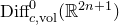 $\text{Diff}^0_{c, \text{vol}}({\mathbb{R}}^{2n+1})$
satisfies Lemma 5.9(2) and so the thesis follows.
$\text{Diff}^0_{c, \text{vol}}({\mathbb{R}}^{2n+1})$
satisfies Lemma 5.9(2) and so the thesis follows.
Remark 5.15
(Commuting cyclic versus commuting ${\mathbb{Z}}$
-conjugates) Note that all the transformation groups encountered so far, though they have commuting cyclic conjugates, do not have commuting
${\mathbb{Z}}$
-conjugates) Note that all the transformation groups encountered so far, though they have commuting cyclic conjugates, do not have commuting $ {\mathbb{Z}}$
-conjugates in general [Reference Campagnolo, Fournier-Facio, Lodha and MoraschiniCFFL+25, § 3.2].
$ {\mathbb{Z}}$
-conjugates in general [Reference Campagnolo, Fournier-Facio, Lodha and MoraschiniCFFL+25, § 3.2].
5.7.3 Portable manifolds
If we consider the entire group of compactly supported diffeomorphisms, then it is $\mathfrak{X}^{\text{sep}}$
-boundedly acyclic for all portable manifolds. Let us start by recalling the definition.
$\mathfrak{X}^{\text{sep}}$
-boundedly acyclic for all portable manifolds. Let us start by recalling the definition.
Definition 5.16
(Portable manifold [Reference Burago, Ivanov and PolterovichBIP08]). Let M be a smooth connected open manifold. We say that M is portable if it admits a complete vector field X and a compact subset $M_0$
, called the core of M, such that:
$M_0$
, called the core of M, such that:
-
(1)
$M_0$
is an attractor of the flow
$X^t$
generated by X. For every compact subset
$K \subset M$
there exists
$\tau \gt 0$
such that
$X^\tau(K) \subset M_0$
; and -
(2) There exists
$\theta \in \text{Diff}^0_c(M)$
such that
$\theta(M_0) \cap M_0 = \varnothing$
.





Remark 5.17
(Notation). Note that in the original paper by Burago, Ivanov, and Polterovich [Reference Burago, Ivanov and PolterovichBIP08], the authors use the notation $\text{Diff}_0(M)$
for
$\text{Diff}_0(M)$
for $\text{Diff}^0_c(M)$
.
$\text{Diff}^0_c(M)$
.
Any manifold that splits as the direct product of a closed manifold and ${\mathbb{R}}^n$
is portable; on the other hand, compact manifolds cannot be portable. The key property of portable manifolds is the following.
${\mathbb{R}}^n$
is portable; on the other hand, compact manifolds cannot be portable. The key property of portable manifolds is the following.
Lemma 5.18
(Displacement in portable manifolds [Reference Burago, Ivanov and PolterovichBIP08, Lemma 3.1]). Let M be a portable manifold, and let $M_0$
be its core. Then there exists
$M_0$
be its core. Then there exists $t \in \text{Diff}^0_c(M)$
such that
$t \in \text{Diff}^0_c(M)$
such that $t^p(M_0) \cap M_0 = \varnothing$
for all
$t^p(M_0) \cap M_0 = \varnothing$
for all $p \geq 1$
.
$p \geq 1$
.
We are now ready to prove the following.
Corollary 5.19
(Corollary 1.13). Let M be a portable manifold. Let G be a group such that $\text{Diff}^0_c(M) \leq G \leq \text{Homeo}_c(M)$
. Then G is
$\text{Diff}^0_c(M) \leq G \leq \text{Homeo}_c(M)$
. Then G is $\mathfrak{X}^{\text{sep}}$
-boundedly acyclic.
$\mathfrak{X}^{\text{sep}}$
-boundedly acyclic.
Note that we do not state this for derived subgroups, since $\text{Diff}^0_c(M)$
is perfect [Reference BanyagaBan97, Chapter 2].
$\text{Diff}^0_c(M)$
is perfect [Reference BanyagaBan97, Chapter 2].
Proof. We will prove that $\text{Diff}^0_c(M)$
satisfies Lemma 5.9(1). Let
$\text{Diff}^0_c(M)$
satisfies Lemma 5.9(1). Let $K \subset M$
be compact. By definition, there exists
$K \subset M$
be compact. By definition, there exists $\tau \gt 0$
such that
$\tau \gt 0$
such that $X^\tau(K) \subset M_0$
. Let t be as in Lemma 5.18. Then
$X^\tau(K) \subset M_0$
. Let t be as in Lemma 5.18. Then $s = X^{-\tau} t X^{\tau}$
belongs to
$s = X^{-\tau} t X^{\tau}$
belongs to $\text{Diff}^0_c(M)$
, since
$\text{Diff}^0_c(M)$
, since $\text{Diff}^0_c(M)$
is normal in the full diffeomorphism group of M. Moreover,
$\text{Diff}^0_c(M)$
is normal in the full diffeomorphism group of M. Moreover,
 \begin{align*} s^p(K) \cap K = X^{-\tau} (t^p X^{\tau}(K) \cap X^{\tau}(K) ) \subset X^{-\tau}(t^p(M_0) \cap M_0) = \varnothing \end{align*}
for all $p \geq 1$
.
$p \geq 1$
.
Example 5.20
(Portable manifolds). Corollary 5.19 applies to homeomorphisms and diffeomorphism groups of all regularities, as well as their identity components, of manifolds of the form ${\mathbb{R}}^n \times M$
, with M closed. This situation has already been studied by Monod and Nariman [Reference Monod and NarimanMN23]. It also applies to compactly supported diffeomorphisms and homeomorphisms of open handlebodies [Reference Burago, Ivanov and PolterovichBIP08].
${\mathbb{R}}^n \times M$
, with M closed. This situation has already been studied by Monod and Nariman [Reference Monod and NarimanMN23]. It also applies to compactly supported diffeomorphisms and homeomorphisms of open handlebodies [Reference Burago, Ivanov and PolterovichBIP08].
Remark 5.21
(Comparison with [Reference Monod and NarimanMN23]). As mentioned above, our Corollary 5.19 recovers certain results from Monod and Nariman [Reference Monod and NarimanMN23, Theorem 1.6]. However, our proof shows something more: diffeomorphism groups of portable manifolds have commuting ${\mathbb{Z}}$
-conjugates. In fact, they even satisfy the stronger criterion for
${\mathbb{Z}}$
-conjugates. In fact, they even satisfy the stronger criterion for $\mathfrak{X}^{\text{sep}}$
-bounded acyclicity introduced by Monod [Reference MonodMon22, Corollary 5]. This requires cutting off the flow outside a compact set in order to obtain compactly supported diffeomorphisms mapping a given compact set into
$\mathfrak{X}^{\text{sep}}$
-bounded acyclicity introduced by Monod [Reference MonodMon22, Corollary 5]. This requires cutting off the flow outside a compact set in order to obtain compactly supported diffeomorphisms mapping a given compact set into $M_0$
, which is already a step in the proof of Lemma 5.18 (see the proof of this fact by Burago, Ivanov, and Polterovich [Reference Burago, Ivanov and PolterovichBIP08, Lemma 3.1]).
$M_0$
, which is already a step in the proof of Lemma 5.18 (see the proof of this fact by Burago, Ivanov, and Polterovich [Reference Burago, Ivanov and PolterovichBIP08, Lemma 3.1]).
5.7.4 Contactomorphisms
A contact form on a $(2n + 1)$
-dimensional manifold M is a 1-form
$(2n + 1)$
-dimensional manifold M is a 1-form $\alpha \in \Omega^1(M)$
such that
$\alpha \in \Omega^1(M)$
such that $\alpha \wedge (d\alpha)^n$
is a volume form. A contact structure
$\alpha \wedge (d\alpha)^n$
is a volume form. A contact structure $\xi$
on M is an equivalence class of contact forms, where
$\xi$
on M is an equivalence class of contact forms, where $\alpha$
is equivalent to
$\alpha$
is equivalent to $\alpha'$
if there exists a positive function
$\alpha'$
if there exists a positive function $\lambda$
such that
$\lambda$
such that $\alpha = \lambda \alpha'$
. We denote by
$\alpha = \lambda \alpha'$
. We denote by $\text{Cont}_c(M, \xi)$
the group of compactly supported contactomorphisms of M, i.e. the group of compactly supported diffeomorphisms of M that preserve the contact structure
$\text{Cont}_c(M, \xi)$
the group of compactly supported contactomorphisms of M, i.e. the group of compactly supported diffeomorphisms of M that preserve the contact structure $\xi$
, and by
$\xi$
, and by $\text{Cont}^0_c(M, \xi)$
its identity component. The main example is that of
$\text{Cont}^0_c(M, \xi)$
its identity component. The main example is that of ${\mathbb{R}}^{2n+1}$
with coordinates
${\mathbb{R}}^{2n+1}$
with coordinates $(x_1, y_1, \ldots, x_n, y_n, z)$
endowed with its standard contact form
$(x_1, y_1, \ldots, x_n, y_n, z)$
endowed with its standard contact form $\alpha = dz + \sum_i x_i dy_i$
.
$\alpha = dz + \sum_i x_i dy_i$
.
Contact geometry is in many ways an odd-dimensional counterpart of symplectic geometry [Reference BanyagaBan97, Chapter 6], so it is natural to include contactomorphisms in our study. Since contact structures are only defined up to scalar, the situation here is much closer to that of the full diffeomorphism group. We will again use the framework of portable manifolds.
Definition 5.22
(Contact portable manifold [Reference Fraser, Polterovich and RosenFPR18]). Let $(M, \alpha)$
be an open connected contact manifold. We say that
$(M, \alpha)$
be an open connected contact manifold. We say that $(M, \xi)$
is contact portable if it admits a contact isotopy
$(M, \xi)$
is contact portable if it admits a contact isotopy $\{P_t\}_{t \gt 0}$
,
$\{P_t\}_{t \gt 0}$
, $P_0 = \textrm{id}_M$
and a connected compact set
$P_0 = \textrm{id}_M$
and a connected compact set $M_0 \subset M$
, called the core of M, such that:
$M_0 \subset M$
, called the core of M, such that:
-
(1)
$M_0$
is an attractor of
$P_t$
, and for every compact subset
$K \subset M$
and every open neighbourhood
$U_0 \supset M_0$
there exists
$\tau \gt 0$
such that
$P_\tau(K) \subset U_0$
; and -
(2) there exists a contactomorphism
$\theta$
such that
$\theta(M_0) \cap M_0 = \varnothing$
.



Remark 5.23
(Notation) Note that in the original paper, the authors use the notation $\mathcal{G}(M)$
for
$\mathcal{G}(M)$
for $\text{Cont}^0_c(M, \xi)$
(see [Reference Fraser, Polterovich and RosenFPR18]).
$\text{Cont}^0_c(M, \xi)$
(see [Reference Fraser, Polterovich and RosenFPR18]).
The definition is very similar to that of portable manifolds, although there are some important differences: for instance, $\theta$
is not required to be compactly supported. Still,
$\theta$
is not required to be compactly supported. Still, ${\mathbb{R}}^{2n+1}$
is contact portable [Reference Fraser, Polterovich and RosenFPR18, Example 3.12], and the key displacement property still holds.
${\mathbb{R}}^{2n+1}$
is contact portable [Reference Fraser, Polterovich and RosenFPR18, Example 3.12], and the key displacement property still holds.
Lemma 5.24
(Displacement in contact portable manifolds [Reference Fraser, Polterovich and RosenFPR18, Proof of Proposition 3.13]). Let $(M, \xi)$
be a contact portable manifold, and let
$(M, \xi)$
be a contact portable manifold, and let $M_0$
be its core. Then there exists an open neighbourhood
$M_0$
be its core. Then there exists an open neighbourhood $U_0 \supset M_0$
and
$U_0 \supset M_0$
and $t \in \text{Cont}^0_c(M, \xi)$
such that
$t \in \text{Cont}^0_c(M, \xi)$
such that $t^p(U_0) \cap U_0 = \varnothing$
for all
$t^p(U_0) \cap U_0 = \varnothing$
for all $p \geq 1$
.
$p \geq 1$
.
With this lemma at hand, the exact same proof as Corollary 5.19 shows the following.
Corollary 5.25
(Contactomorphism groups). Let M be a contact portable manifold. Let G be a group such that $\text{Cont}^0_c(M, \xi)^{(d)} \leq G \leq \text{Homeo}_c(M)$
for some
$\text{Cont}^0_c(M, \xi)^{(d)} \leq G \leq \text{Homeo}_c(M)$
for some $d \geq 1$
. Then G is
$d \geq 1$
. Then G is $\mathfrak{X}^{\text{sep}}$
-boundedly acyclic.
$\mathfrak{X}^{\text{sep}}$
-boundedly acyclic.
Example 5.26
(Contactomorphism groups). This applies to the group of contactomorphisms of ${\mathbb{R}}^{2n+1}$
, and to the group of contactomorphisms of contact handlebodies. However, it seems that these are the only known examples of contact portable manifolds [Reference Courte and MassotCM18, paragraph before Theorem D]. We state this corollary for all derived subgroups since it seems to be open whether any of them is perfect [Reference BanyagaBan97, Remark after Theorem 6.3.7].
${\mathbb{R}}^{2n+1}$
, and to the group of contactomorphisms of contact handlebodies. However, it seems that these are the only known examples of contact portable manifolds [Reference Courte and MassotCM18, paragraph before Theorem D]. We state this corollary for all derived subgroups since it seems to be open whether any of them is perfect [Reference BanyagaBan97, Remark after Theorem 6.3.7].
5.7.5 Products
We end this section by extending our results from ${\mathbb{R}}^n$
to products of the form
${\mathbb{R}}^n$
to products of the form ${\mathbb{R}}^n \times M$
, where M is a compact topological space. This kind of argument has already been considered by Monod and Nariman for the full diffeomorphism groups [Reference Monod and NarimanMN23].
${\mathbb{R}}^n \times M$
, where M is a compact topological space. This kind of argument has already been considered by Monod and Nariman for the full diffeomorphism groups [Reference Monod and NarimanMN23].
Corollary 5.27
(Transformation groups of products) Let $n \geq 2$
and let M be a compact topological space. Let
$n \geq 2$
and let M be a compact topological space. Let $D \leq \text{Homeo}_c({\mathbb{R}}^n)$
be one of the groups from Corollaries 5.11, 5.14, or 5.25. Let G be a group such that
$D \leq \text{Homeo}_c({\mathbb{R}}^n)$
be one of the groups from Corollaries 5.11, 5.14, or 5.25. Let G be a group such that $D \times \{ \textrm{id} \} \leq G \leq \text{Homeo}_c({\mathbb{R}}^n \times M)$
. Then G is
$D \times \{ \textrm{id} \} \leq G \leq \text{Homeo}_c({\mathbb{R}}^n \times M)$
. Then G is $\mathfrak{X}^{\text{sep}}$
-boundedly acyclic.
$\mathfrak{X}^{\text{sep}}$
-boundedly acyclic.
Note that we are requiring that M be compact to ensure that homeomorphisms in $D \times \{\textrm{id}\}$
are compactly supported.
$D \times \{\textrm{id}\}$
are compactly supported.
Proof. Such a group $D \leq \text{Homeo}_c({\mathbb{R}}^n)$
satisfies item (1) (in the case of
$D \leq \text{Homeo}_c({\mathbb{R}}^n)$
satisfies item (1) (in the case of $\text{Cont}^0_c$
) or item (2) (in the other cases) of Lemma 5.9. We claim that
$\text{Cont}^0_c$
) or item (2) (in the other cases) of Lemma 5.9. We claim that $D \times \{ \textrm{id} \} \leq \text{Homeo}_c({\mathbb{R}}^n \times M)$
also satisfies the same item, and the result follows.
$D \times \{ \textrm{id} \} \leq \text{Homeo}_c({\mathbb{R}}^n \times M)$
also satisfies the same item, and the result follows.
We prove this in the case that item (2) is satisfied; the other case is identical. Let $K \subset {\mathbb{R}}^n \times M$
be compact. Then there exists a compact set
$K \subset {\mathbb{R}}^n \times M$
be compact. Then there exists a compact set $A \subset {\mathbb{R}}^n$
such that
$A \subset {\mathbb{R}}^n$
such that $K \subset A \times M$
. Let
$K \subset A \times M$
. Let $t \in D$
be such that
$t \in D$
be such that $t(A) \cap A = \varnothing$
and
$t(A) \cap A = \varnothing$
and $t^2|_A = \textrm{id}|_A$
. Then
$t^2|_A = \textrm{id}|_A$
. Then $(t, \textrm{id})(A \times M) \cap A \times M = (t(A) \cap A) \times M = \varnothing$
, and
$(t, \textrm{id})(A \times M) \cap A \times M = (t(A) \cap A) \times M = \varnothing$
, and $(t, \textrm{id})^2|_{A \times M} = t^2|_A \times \textrm{id}|_M = \textrm{id}|_{A \times M}$
.
$(t, \textrm{id})^2|_{A \times M} = t^2|_A \times \textrm{id}|_M = \textrm{id}|_{A \times M}$
.
Example 5.28 (Transformation groups of products) Corollary 5.27 applies to the following cases.
-
(1) Suppose that M is a closed symplectic manifold, and endow
${\mathbb{R}}^{2n} \times M$
with the product symplectic structure. Then,
$\text{Ham}_c({\mathbb{R}}^{2n} \times M)$
,
$\text{Symp}^0_c({\mathbb{R}}^{2n} \times M)$
and
$\text{Symp}_c({\mathbb{R}}^{2n} \times M)$
are
$\mathfrak{X}^{\text{sep}}$
-boundedly acyclic. -
(2) Suppose that M is a closed manifold endowed with a volume form, and endow
${\mathbb{R}}^n \times M$
with the product volume form. Then,
$\text{Diff}_{c, \text{vol}}({\mathbb{R}}^n \times M)$
and
$\text{Diff}^0_{c, \text{vol}}( {\mathbb{R}}^n \times M)$
are
$\mathfrak{X}^{\text{sep}}$
-boundedly acyclic. -
(3) Suppose that M is a compact topological space endowed with a finite Borel measure, and endow
${\mathbb{R}}^n \times M$
with the product measure. Then, the group of compactly supported measure-preserving homeomorphisms of
${\mathbb{R}}^n \times M$
is
$\mathfrak{X}^{\text{sep}}$
-boundedly acyclic.










It also applies to the analogous groups in all regularities.
It is important in our argument that $n \geq 2$
. This motivates the following question.
$n \geq 2$
. This motivates the following question.
Question 5.29. Let M be a closed connected manifold endowed with a volume form, and let ${\mathbb{R}} \times M$
be endowed with the product volume form. Is
${\mathbb{R}} \times M$
be endowed with the product volume form. Is $\text{Diff}_{c, \text{vol}}({\mathbb{R}} \times M)$
(
$\text{Diff}_{c, \text{vol}}({\mathbb{R}} \times M)$
( $\mathfrak{X}^{\text{sep}}$
-)boundedly acyclic? In particular, is
$\mathfrak{X}^{\text{sep}}$
-)boundedly acyclic? In particular, is $\text{Diff}_{c, \text{vol}}({\mathbb{R}} \times S^1)$
(
$\text{Diff}_{c, \text{vol}}({\mathbb{R}} \times S^1)$
( $\mathfrak{X}^{\text{sep}}$
-)boundedly acyclic?
$\mathfrak{X}^{\text{sep}}$
-)boundedly acyclic?
5.8 Piecewise linear and piecewise projective groups
We show that many piecewise linear and piecewise projective groups already known to be 2-boundedly acyclic [Reference Fournier-Facio and LodhaFFL23] have commuting ${\mathbb{Z}}$
-conjugates, possibly up to an amenable extension, thus proving all the parts of Corollary 1.14.
${\mathbb{Z}}$
-conjugates, possibly up to an amenable extension, thus proving all the parts of Corollary 1.14.
The prime example of a piecewise linear group is Thompson’s group F, which has already been shown to be $\mathfrak{X}^{\text{sep}}$
-boundedly acyclic by Monod [Mon22]. However, Monod’s method does not apply to all piecewise linear groups: for instance, it does not apply to all subgroups of F.
$\mathfrak{X}^{\text{sep}}$
-boundedly acyclic by Monod [Mon22]. However, Monod’s method does not apply to all piecewise linear groups: for instance, it does not apply to all subgroups of F.
Corollary 5.30
(Compactly supported groups without fixed points) Let $\Gamma$
be a group of compactly supported homeomorphisms of the line acting without a global fixed point. Then
$\Gamma$
be a group of compactly supported homeomorphisms of the line acting without a global fixed point. Then $\Gamma$
is
$\Gamma$
is $\mathfrak{X}^{\text{sep}}$
-boundedly acyclic.
$\mathfrak{X}^{\text{sep}}$
-boundedly acyclic.
Proof. We show that $\Gamma$
satisfies Lemma 5.9(1), so it has commuting
$\Gamma$
satisfies Lemma 5.9(1), so it has commuting ${\mathbb{Z}}$
-conjugates, whence it is
${\mathbb{Z}}$
-conjugates, whence it is $\mathfrak{X}^{\text{sep}}$
-boundedly acyclic. Let
$\mathfrak{X}^{\text{sep}}$
-boundedly acyclic. Let $K \subset {\mathbb{R}}$
be compact. Then it is contained in some compact interval [a, b]. Let
$K \subset {\mathbb{R}}$
be compact. Then it is contained in some compact interval [a, b]. Let $t \in \Gamma$
be an element such that
$t \in \Gamma$
be an element such that $t(a) \gt b$
, which exists because
$t(a) \gt b$
, which exists because $\Gamma$
acts without a global fixed point. Since
$\Gamma$
acts without a global fixed point. Since $\Gamma$
is compactly supported, it acts preserving the orientation, and thus
$\Gamma$
is compactly supported, it acts preserving the orientation, and thus $t^p(a) \gt t^{p-1}(b)$
for all
$t^p(a) \gt t^{p-1}(b)$
for all $p \geq 1$
. This shows that the sets
$p \geq 1$
. This shows that the sets $t^p(K)$
are pairwise disjoint for all
$t^p(K)$
are pairwise disjoint for all $p \geq 1$
, and we conclude.
$p \geq 1$
, and we conclude.
We will now show that groups of piecewise linear homeomorphisms of [0,1] and piecewise projective homeomorphisms of ${\mathbb{R}}$
can always be expressed as an amenable extension of a group as in Corollary 5.30, and therefore are
${\mathbb{R}}$
can always be expressed as an amenable extension of a group as in Corollary 5.30, and therefore are $\mathfrak{X}^{\text{sep}}$
-boundedly acyclic by Theorem 2.8. This also applies directly to chain groups of homeomorphisms [KKL19] or groups that admit a coherent action on the line [Reference LodhaLod20a], which were already known to have vanishing second bounded cohomology with trivial coefficients [Reference Fournier-Facio and LodhaFFL23].
$\mathfrak{X}^{\text{sep}}$
-boundedly acyclic by Theorem 2.8. This also applies directly to chain groups of homeomorphisms [KKL19] or groups that admit a coherent action on the line [Reference LodhaLod20a], which were already known to have vanishing second bounded cohomology with trivial coefficients [Reference Fournier-Facio and LodhaFFL23].
Corollary 5.31
(Chain groups and coherent actions). Let $\Gamma$
be either a chain group of homeomorphisms of the line, or a group that admits a coherent action on the line. Then
$\Gamma$
be either a chain group of homeomorphisms of the line, or a group that admits a coherent action on the line. Then $\Gamma$
is
$\Gamma$
is $\mathfrak{X}^{\text{sep}}$
-boundedly acyclic.
$\mathfrak{X}^{\text{sep}}$
-boundedly acyclic.
Again using co-amenability and Theorem 1.3, we can deduce the following.
Corollary 5.32
(Piecewise linear and piecewise projective groups). Let $\Gamma$
be a group of piecewise linear homeomorphisms of the interval, or piecewise projective homeomorphisms of the line. Then
$\Gamma$
be a group of piecewise linear homeomorphisms of the interval, or piecewise projective homeomorphisms of the line. Then $\Gamma$
is
$\Gamma$
is $\mathfrak{X}^{\text{sep}}$
-boundedly acyclic.
$\mathfrak{X}^{\text{sep}}$
-boundedly acyclic.
Proof. Let $\Gamma$
be such a group, and suppose first that
$\Gamma$
be such a group, and suppose first that $\Gamma$
is orientation preserving. Under this assumption, it is known that there exists a subgroup
$\Gamma$
is orientation preserving. Under this assumption, it is known that there exists a subgroup $\Gamma_0 \leq \Gamma$
such that the quotient
$\Gamma_0 \leq \Gamma$
such that the quotient $\Gamma / \Gamma_0$
is amenable and
$\Gamma / \Gamma_0$
is amenable and $\Gamma_0$
has commuting conjugates [Reference Fournier-Facio and LodhaFFL23, Theorem 1.3]. More precisely, whenever
$\Gamma_0$
has commuting conjugates [Reference Fournier-Facio and LodhaFFL23, Theorem 1.3]. More precisely, whenever $H \leq \Gamma_0$
is finitely generated, there exist finitely many pairwise disjoint open intervals
$H \leq \Gamma_0$
is finitely generated, there exist finitely many pairwise disjoint open intervals $J_1, \ldots, J_k$
such that H is supported on their union and preserves each one, and pairwise disjoint open intervals
$J_1, \ldots, J_k$
such that H is supported on their union and preserves each one, and pairwise disjoint open intervals $I_i \supset J_i$
each preserved by
$I_i \supset J_i$
each preserved by $\Gamma_0$
, and an element
$\Gamma_0$
, and an element $t \in \Gamma_0$
such that
$t \in \Gamma_0$
such that $t(J_i)$
is disjoint from
$t(J_i)$
is disjoint from $J_i$
. Since t is orientation preserving, it follows that
$J_i$
. Since t is orientation preserving, it follows that $t^p(J_i)$
is disjoint from
$t^p(J_i)$
is disjoint from $J_i$
for all
$J_i$
for all $p \geq 1$
. Moreover, since
$p \geq 1$
. Moreover, since $J_i \subset I_i$
and the latter is preserved by
$J_i \subset I_i$
and the latter is preserved by $\Gamma_0$
, we have
$\Gamma_0$
, we have $t^p(J_i) \subset I_i$
, which is disjoint from
$t^p(J_i) \subset I_i$
, which is disjoint from $I_j$
, and thus from
$I_j$
, and thus from $J_j$
, for all
$J_j$
, for all $i \neq j$
. Thus the support of
$i \neq j$
. Thus the support of ${}^{t^p} H$
is disjoint from that of H for all
${}^{t^p} H$
is disjoint from that of H for all $p \geq 1$
. This shows that
$p \geq 1$
. This shows that $\Gamma_0$
has commuting
$\Gamma_0$
has commuting ${\mathbb{Z}}$
-conjugates, and so is
${\mathbb{Z}}$
-conjugates, and so is $\mathfrak{X}^{\text{sep}}$
-boundedly acyclic by Theorem 1.3. By Theorem 2.8, we conclude that
$\mathfrak{X}^{\text{sep}}$
-boundedly acyclic by Theorem 1.3. By Theorem 2.8, we conclude that $\Gamma$
itself is
$\Gamma$
itself is $\mathfrak{X}^{\text{sep}}$
-boundedly acyclic.
$\mathfrak{X}^{\text{sep}}$
-boundedly acyclic.
In the general case, $\Gamma$
contains an orientation-preserving subgroup
$\Gamma$
contains an orientation-preserving subgroup $\Gamma_+$
of index at most 2. We have shown that
$\Gamma_+$
of index at most 2. We have shown that $\Gamma_+$
is
$\Gamma_+$
is $\mathfrak{X}^{\text{sep}}$
-boundedly acyclic, so it again follows from Theorem 2.8 that
$\mathfrak{X}^{\text{sep}}$
-boundedly acyclic, so it again follows from Theorem 2.8 that $\Gamma$
is
$\Gamma$
is $\mathfrak{X}^{\text{sep}}$
-boundedly acyclic.
$\mathfrak{X}^{\text{sep}}$
-boundedly acyclic.
Note that in the proofs of both Corollaries 5.31 and 5.32, the $\mathfrak{X}^{\text{sep}}$
-bounded acyclicity is proved by exhibiting such groups as amenable extensions of groups with commuting
$\mathfrak{X}^{\text{sep}}$
-bounded acyclicity is proved by exhibiting such groups as amenable extensions of groups with commuting ${\mathbb{Z}}$
-conjugates. Therefore, we can apply Corollary 4.10 to obtain the following strengthening.
${\mathbb{Z}}$
-conjugates. Therefore, we can apply Corollary 4.10 to obtain the following strengthening.
Corollary 5.33
(Vanishing modulus of piecewise linear and piecewise projective groups). For every integer $n \geq 1$
, there exists a constant
$n \geq 1$
, there exists a constant $K_n \in [0, \infty)$
such that for every group
$K_n \in [0, \infty)$
such that for every group $\Gamma$
as in Corollary 5.31 or Corollary 5.32, and every separable dual Banach
$\Gamma$
as in Corollary 5.31 or Corollary 5.32, and every separable dual Banach $\Gamma$
-module E, we have that
$\Gamma$
-module E, we have that $\|H^n_b(\Gamma; E) \| \leq K_n$
.
$\|H^n_b(\Gamma; E) \| \leq K_n$
.
The group $G_0$
is a group of orientation-preserving piecewise projective homeomorphisms of the line, which is non-amenable and finitely presented [Reference Lodha and MooreLM16], in fact, it is even of type
$G_0$
is a group of orientation-preserving piecewise projective homeomorphisms of the line, which is non-amenable and finitely presented [Reference Lodha and MooreLM16], in fact, it is even of type $F_\infty$
(see [Reference LodhaLod20b]). The previous result readily implies the following.
$F_\infty$
(see [Reference LodhaLod20b]). The previous result readily implies the following.
Corollary 5.34
(Corollary 1.15). There exists a group of type $F_\infty$
that is non-amenable, but all of whose subgroups are
$F_\infty$
that is non-amenable, but all of whose subgroups are $\mathfrak{X}^{\text{sep}}$
-boundedly acyclic.
$\mathfrak{X}^{\text{sep}}$
-boundedly acyclic.
A homological version of the von Neumann–Day problem proposed by Calegari [Reference CalegariCal07] asks whether a finitely presented torsion-free group all of whose subgroups have vanishing stable commutator length is necessarily amenable. This has recently been shown to fail, even when one asks for the vanishing of second bounded cohomology: the desired counterexample is the piecewise projective group $G_0$
(see [Reference Fournier-Facio and LodhaFFL23]). Corollary 5.34 can be thus seen as an even stronger negative solution to this problem.
$G_0$
(see [Reference Fournier-Facio and LodhaFFL23]). Corollary 5.34 can be thus seen as an even stronger negative solution to this problem.
5.9 Highly transitive actions
We take a detour from producing examples of groups with commuting cyclic conjugates, and show how the previous results can be used as a basis for more complex computations of bounded cohomology rings. The main idea is to produce highly transitive actions with stabilizers falling in the classes of boundedly acyclic groups that have been presented so far. This method has already been used with success by several authors [Reference Fournier-Facio, Löh and MoraschiniFFLM23, Reference Monod and NarimanMN23, Reference Fournier-Facio and LodhaFFL23, Reference AndritschAnd22], and as in those cases we restrict to trivial coefficients for simplicity.
Corollary 5.35
(Corollary 1.16). Let $\Gamma$
be a group of orientation-preserving piecewise linear homeomorphisms of the circle, or piecewise projective homeomorphisms of the projective line. Suppose that there exists an infinite orbit S of
$\Gamma$
be a group of orientation-preserving piecewise linear homeomorphisms of the circle, or piecewise projective homeomorphisms of the projective line. Suppose that there exists an infinite orbit S of $\Gamma$
such that, for all
$\Gamma$
such that, for all $n \geq 1$
,
$n \geq 1$
, $\Gamma$
acts transitively on positively oriented n-tuples in S. Then there exists an isomorphism
$\Gamma$
acts transitively on positively oriented n-tuples in S. Then there exists an isomorphism
 \begin{align*} H^\bullet_b(\Gamma; {\mathbb{R}}) \cong {\mathbb{R}}[x], \end{align*}
where $|x| = 2$
, and x corresponds to the Euler class of the defining action on the circle of
$|x| = 2$
, and x corresponds to the Euler class of the defining action on the circle of $\Gamma$
.
$\Gamma$
.
The result is a generalization of the computation of the bounded cohomology of Thompson’s group T (see [Reference Fournier-Facio, Löh and MoraschiniFFLM23]). In that case, the proof relied on the bounded acyclicity of Thompson’s group F (see [Mon22]), but thanks to Corollary 5.32 we can drop all hypotheses on point stabilizers.
Proof. Corollary 5.32 implies that subgroups of $\Gamma$
fixing a point on the circle are boundedly acyclic, since they are isomorphic to a group of piecewise linear homeomorphisms of the interval, or a group of piecewise projective homeomorphisms of the line. Therefore, we can apply [Reference Fournier-Facio, Löh and MoraschiniFFLM23, Proposition 6.9] and conclude.
$\Gamma$
fixing a point on the circle are boundedly acyclic, since they are isomorphic to a group of piecewise linear homeomorphisms of the interval, or a group of piecewise projective homeomorphisms of the line. Therefore, we can apply [Reference Fournier-Facio, Löh and MoraschiniFFLM23, Proposition 6.9] and conclude.
Example 5.36
(Groups acting on the circle). Corollary 5.35 applies to Thompson’s group T, but also to the Stein–Thompson groups [Reference SteinSte92] of the form $T_{2,n_2, \ldots, n_k}$
. The (circular) high transitivity is proved in [Reference Fournier-Facio, Lodha and ZaremskyFFLZ24b, Example 3.7] (note that the reference assumes that
$T_{2,n_2, \ldots, n_k}$
. The (circular) high transitivity is proved in [Reference Fournier-Facio, Lodha and ZaremskyFFLZ24b, Example 3.7] (note that the reference assumes that $n_2 = 3$
, but this is not used in the proof of high transitivity). It also applies in other examples [Reference Fournier-Facio, Lodha and ZaremskyFFLZ24b, Examples 3.8 and 3.9] including the golden ratio Thompson’s group
$n_2 = 3$
, but this is not used in the proof of high transitivity). It also applies in other examples [Reference Fournier-Facio, Lodha and ZaremskyFFLZ24b, Examples 3.8 and 3.9] including the golden ratio Thompson’s group $T_\tau$
and its commutator subgroup [Reference ClearyCle00, Reference Burillo, Nucinkis and ReevesBNR22] and the piecewise projective group S (see [Reference LodhaLod19]).
$T_\tau$
and its commutator subgroup [Reference ClearyCle00, Reference Burillo, Nucinkis and ReevesBNR22] and the piecewise projective group S (see [Reference LodhaLod19]).
Another context in which highly transitive actions yield computations of bounded cohomology is group actions on the line. This is a slight variation of the method for groups acting on the circle. However, to the best of the authors’ knowledge, it is the first time that it has been used in this context.
Proposition 5.37
(Groups acting on the line). Let $\Gamma$
be a group of orientation-preserving homeomorphisms of the line, and let S be an infinite orbit of
$\Gamma$
be a group of orientation-preserving homeomorphisms of the line, and let S be an infinite orbit of $\Gamma$
. Suppose that, for all
$\Gamma$
. Suppose that, for all $n \geq 1$
, the action of
$n \geq 1$
, the action of $\Gamma$
on linearly ordered n-tuples in S is transitive and has boundedly acyclic stabilizers. Then
$\Gamma$
on linearly ordered n-tuples in S is transitive and has boundedly acyclic stabilizers. Then $\Gamma$
is boundedly acyclic.
$\Gamma$
is boundedly acyclic.
Proof. Since there are finitely many orbits of unordered n-tuples, and each has boundedly acyclic stabilizer, we can compute $H^\bullet_b(\Gamma; {\mathbb{R}})$
using the complex of invariant alternating cochains
$H^\bullet_b(\Gamma; {\mathbb{R}})$
using the complex of invariant alternating cochains $\ell^\infty_{alt}(S^{\bullet+1}, {\mathbb{R}})^\Gamma$
(see [Reference Li, Löh and MoraschiniLLM22, Corollary 5.15, Remark 5.17, Example A.11]). Recall that a cochain
$\ell^\infty_{alt}(S^{\bullet+1}, {\mathbb{R}})^\Gamma$
(see [Reference Li, Löh and MoraschiniLLM22, Corollary 5.15, Remark 5.17, Example A.11]). Recall that a cochain $f \in \ell^\infty(S^{\bullet+1}, {\mathbb{R}})$
is alternating if
$f \in \ell^\infty(S^{\bullet+1}, {\mathbb{R}})$
is alternating if $f(s_{\sigma(0)}, \ldots, s_{\sigma(n)}) = \text{sign}(\sigma) f(s_0, \ldots, s_n)$
for all
$f(s_{\sigma(0)}, \ldots, s_{\sigma(n)}) = \text{sign}(\sigma) f(s_0, \ldots, s_n)$
for all $\sigma \in \text{Sym}\{0, \ldots, n\}$
.
$\sigma \in \text{Sym}\{0, \ldots, n\}$
.
By the transitivity assumption, for all $n \geq 1$
, the space
$n \geq 1$
, the space $\ell^\infty(S^{n+1}; {\mathbb{R}})^\Gamma$
is one-dimensional, spanned by the cochain
$\ell^\infty(S^{n+1}; {\mathbb{R}})^\Gamma$
is one-dimensional, spanned by the cochain $f_n$
defined by
$f_n$
defined by $f_n(s_0, \ldots, s_n) = 1$
if
$f_n(s_0, \ldots, s_n) = 1$
if $s_0 < s_1 < \cdots < s_n$
, which can be extended uniquely to an alternating function, and is automatically
$s_0 < s_1 < \cdots < s_n$
, which can be extended uniquely to an alternating function, and is automatically $\Gamma$
-invariant since
$\Gamma$
-invariant since $\Gamma$
acts by preserving the orientation. Moreover, if
$\Gamma$
acts by preserving the orientation. Moreover, if $s_0 < s_1 < \cdots < s_n < s_{n+1}$
, we have
$s_0 < s_1 < \cdots < s_n < s_{n+1}$
, we have
 \begin{align*} \delta(f_n)(s_0, \ldots, s_{n+1}) = \sum_{i = 0}^{n+1} (-1)^i =\begin{cases}0 & \text{if } n \text{ is even}, \\1 & \text{if } n \text{ is odd}.\end{cases}\end{align*}
This shows that $\delta^n = 0$
if n is even, and
$\delta^n = 0$
if n is even, and $\delta^n(f_n) =f_{n+1}$
if n is odd. Therefore, the complex
$\delta^n(f_n) =f_{n+1}$
if n is odd. Therefore, the complex $\ell^\infty(S^{n+1};{\mathbb{R}})^\Gamma$
is isomorphic to the complex
$\ell^\infty(S^{n+1};{\mathbb{R}})^\Gamma$
is isomorphic to the complex
 \begin{align*} \cdots \to {\mathbb{R}} \xrightarrow{\text{id}} {\mathbb{R}}\xrightarrow{0} {\mathbb{R}} \to \cdots \end{align*}
whose cohomology is trivial in all positive degrees.
Corollary 5.38
(Corollary 1.17). Let $\Gamma$
be a group of orientation-preserving homeomorphisms of the line, and let S be an infinite orbit of
$\Gamma$
be a group of orientation-preserving homeomorphisms of the line, and let S be an infinite orbit of $\Gamma$
. Suppose that for all
$\Gamma$
. Suppose that for all $n \geq 1$
, the action of
$n \geq 1$
, the action of $\Gamma$
on linearly ordered n-tuples in S is transitive. Suppose moreover that, for
$\Gamma$
on linearly ordered n-tuples in S is transitive. Suppose moreover that, for $s \in S$
, the stabilizer
$s \in S$
, the stabilizer $\Gamma_s$
admits a co-amenable subgroup
$\Gamma_s$
admits a co-amenable subgroup $\Gamma_s^0$
, such that every finitely generated subgroup of
$\Gamma_s^0$
, such that every finitely generated subgroup of $\Gamma_s^0$
is isomorphic to a group of piecewise linear homeomorphisms of the interval. Then
$\Gamma_s^0$
is isomorphic to a group of piecewise linear homeomorphisms of the interval. Then $\Gamma$
is boundedly acyclic.
$\Gamma$
is boundedly acyclic.
Proof. By Proposition 5.37, it suffices to show that stabilizers of n-tuples in S are boundedly acyclic. In fact, we will show that every subgroup of $\Gamma_s$
is boundedly acyclic, and since the action of
$\Gamma_s$
is boundedly acyclic, and since the action of $\Gamma$
on S is transitive, this will suffice. By Theorem 2.8, it is enough to show that the co-amenable subgroup
$\Gamma$
on S is transitive, this will suffice. By Theorem 2.8, it is enough to show that the co-amenable subgroup $\Gamma_s^0$
is boundedly acyclic.
$\Gamma_s^0$
is boundedly acyclic.
Now, $\Gamma_s^0$
is the direct union of its finitely generated subgroups. Each of these is isomorphic to a group of piecewise linear homeomorphisms of the interval. Corollary 5.32 shows that these are
$\Gamma_s^0$
is the direct union of its finitely generated subgroups. Each of these is isomorphic to a group of piecewise linear homeomorphisms of the interval. Corollary 5.32 shows that these are $\mathfrak{X}^{\text{sep}}$
-boundedly acyclic, and, moreover, Corollary 5.33 shows that their vanishing moduli are uniformly bounded. Therefore, we can apply Proposition 2.24 and obtain that
$\mathfrak{X}^{\text{sep}}$
-boundedly acyclic, and, moreover, Corollary 5.33 shows that their vanishing moduli are uniformly bounded. Therefore, we can apply Proposition 2.24 and obtain that $\Gamma_s^0$
is
$\Gamma_s^0$
is $\mathfrak{X}^{\text{sep}}$
-boundedly acyclic, which concludes the proof.
$\mathfrak{X}^{\text{sep}}$
-boundedly acyclic, which concludes the proof.
Example 5.39
(Finitely generated left-orderable simple boundedly acyclic groups). In his 2018 ICM address, Navas asked a series of questions about the possible landscape of finitely generated left-orderable groups (equivalently, finitely generated groups of orientation-preserving homeomorphisms of the line) [Reference NavasNav18]. One of these questions asks whether there exists such a group $\Gamma$
with
$\Gamma$
with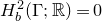 $H^2_b(\Gamma; {\mathbb{R}}) = 0$
, but which does not surject onto
$H^2_b(\Gamma; {\mathbb{R}}) = 0$
, but which does not surject onto ${\mathbb{Z}}$
(see [Reference NavasNav18, Question 8]). This is motivated in part by the Witte-Morris theorem [Reference Witte-MorrisWM06], which states that an amenable left-orderable group must surject onto
${\mathbb{Z}}$
(see [Reference NavasNav18, Question 8]). This is motivated in part by the Witte-Morris theorem [Reference Witte-MorrisWM06], which states that an amenable left-orderable group must surject onto $ {\mathbb{Z}}$
.
$ {\mathbb{Z}}$
.
An answer to Navas’s question is given by the first examples of infinite finitely generated simple left-orderable groups $G_\varrho$
(here,
$G_\varrho$
(here, $\varrho$
is a combinatorial object called a quasi-periodic labelling; see [Reference Hyde and LodhaHL19]), since they have vanishing second bounded cohomology with trivial real coefficients [Reference Fournier-Facio and LodhaFFL23]. Corollary 5.38 shows that
$\varrho$
is a combinatorial object called a quasi-periodic labelling; see [Reference Hyde and LodhaHL19]), since they have vanishing second bounded cohomology with trivial real coefficients [Reference Fournier-Facio and LodhaFFL23]. Corollary 5.38 shows that $G_\varrho$
is in fact boundedly acyclic. Indeed, the action is (linearly) highly transitive on the orbit
$G_\varrho$
is in fact boundedly acyclic. Indeed, the action is (linearly) highly transitive on the orbit ${\mathbb{Z}}[1/2]$
(by virtue of containing the natural copy of Thompson’s group F), and the condition on point stabilizers is satisfied [Reference Fournier-Facio and LodhaFFL23, Proposition 4.16 and proof of Proposition 4.17].
${\mathbb{Z}}[1/2]$
(by virtue of containing the natural copy of Thompson’s group F), and the condition on point stabilizers is satisfied [Reference Fournier-Facio and LodhaFFL23, Proposition 4.16 and proof of Proposition 4.17].
There are by now several more examples of finitely generated simple left-orderable groups, constructed by using dynamical systems on Cantor spaces and flows. The first instances of this approach were the groups $T(\varphi)$
by Matte Bon and Triestino [Reference Matte Bon and TriestinoMBT20] (where
$T(\varphi)$
by Matte Bon and Triestino [Reference Matte Bon and TriestinoMBT20] (where $\varphi$
is a minimal homeomorphism of a Cantor space). Later, a similar construction that also encompasses the groups
$\varphi$
is a minimal homeomorphism of a Cantor space). Later, a similar construction that also encompasses the groups $G_\varrho$
has been carried out by Matte Bon and Le Boudec, producing the groups
$G_\varrho$
has been carried out by Matte Bon and Le Boudec, producing the groups $T(\varphi, \sigma)$
(where
$T(\varphi, \sigma)$
(where $(\varphi, \sigma)$
is a minimal
$(\varphi, \sigma)$
is a minimal $D_\infty$
-dynamical system on a Cantor space; see [Reference Le Boudec and Matte BonLBMB22]). All of these act on the line, (linearly) highly transitively on a copy of
$D_\infty$
-dynamical system on a Cantor space; see [Reference Le Boudec and Matte BonLBMB22]). All of these act on the line, (linearly) highly transitively on a copy of ${\mathbb{Z}}[1/2]$
by virtue of containing a copy of Thompson’s group F. The condition on point stabilizers is also satisfied in the cases of the groups
${\mathbb{Z}}[1/2]$
by virtue of containing a copy of Thompson’s group F. The condition on point stabilizers is also satisfied in the cases of the groups $T(\varphi)$
(see [Reference Matte Bon and TriestinoMBT20, Lemma 7.2]) and
$T(\varphi)$
(see [Reference Matte Bon and TriestinoMBT20, Lemma 7.2]) and $T(\varphi, \sigma)$
(see [Reference Le Boudec and Matte BonLBMB22, Lemma 4.8]).
$T(\varphi, \sigma)$
(see [Reference Le Boudec and Matte BonLBMB22, Lemma 4.8]).
Similar in spirit to the above proofs is the strategy followed by de la Harpe and McDuff to show that certain large groups of automorphisms, such as the group of all permutations of an infinite set, or the group of all continuous linear automorphisms or of all invertible isometries of an infinite-dimensional Hilbert space, are acyclic [Reference de la Harpe and McDuffdlHM83]. They first show that the stabilizers of suitably defined flags are acyclic; then they build on that to construct appropriate classifying spaces for the entire groups and show that they are acyclic too. In fact, the proof of acyclicity of stabilizers [Reference de la Harpe and McDuffdlHM83, Lemma 3] shows that they have commuting $ {\mathbb{Z}}$
-conjugates, so that they are also
$ {\mathbb{Z}}$
-conjugates, so that they are also $\mathfrak{X}^{\text{sep}}$
-boundedly acyclic. However, it is less clear whether the second part of the argument can be adapted to the bounded cohomology setting. We can thus ask the following question.
$\mathfrak{X}^{\text{sep}}$
-boundedly acyclic. However, it is less clear whether the second part of the argument can be adapted to the bounded cohomology setting. We can thus ask the following question.
Question 5.40. Are the groups considered in [Reference de la Harpe and McDuffdlHM83, Theorem 1] boundedly acyclic?
5.10 Interval exchange transformations
Recall that an interval exchange transformation of the half-open interval [0, 1) is a right-continuous bijection given by cutting [0, 1) into finitely many half-open subintervals and rearranging by translations. We denote by $\text{IET}([0, 1))$
the group of interval exchange transformations of [0, 1). We can define analogously the group
$\text{IET}([0, 1))$
the group of interval exchange transformations of [0, 1). We can define analogously the group $\text{IET}([0, \infty))$
, where again we cut into finitely many half-open subintervals.
$\text{IET}([0, \infty))$
, where again we cut into finitely many half-open subintervals.
Lemma 5.41. $\text{IET}([0, \infty))$
is the direct union of the groups
$\text{IET}([0, \infty))$
is the direct union of the groups $\{ \text{IET}([0, n)) \}_{n \geq 1}$
. In particular,
$\{ \text{IET}([0, n)) \}_{n \geq 1}$
. In particular, $\text{IET}([0, \infty))$
is amenable, respectively contains non-abelian free subgroups, if and only if
$\text{IET}([0, \infty))$
is amenable, respectively contains non-abelian free subgroups, if and only if $\text{IET}([0, 1))$
does.
$\text{IET}([0, 1))$
does.
Proof. The first statement follows from the fact that the unique half-open interval of infinite length has to be preserved by an $\text{IET}$
. The second statement follows from the isomorphism
$\text{IET}$
. The second statement follows from the isomorphism $\text{IET}([0, 1)) \cong \text{IET}([0, n))$
given by affine conjugacy, and the fact that direct unions preserve amenability and the property of not containing non-abelian free subgroups.
$\text{IET}([0, 1)) \cong \text{IET}([0, n))$
given by affine conjugacy, and the fact that direct unions preserve amenability and the property of not containing non-abelian free subgroups.
To the best of the authors’ knowledge, nothing is known about the bounded cohomology of $\text{IET}([0, 1))$
. For the half line, we obtain the following.
$\text{IET}([0, 1))$
. For the half line, we obtain the following.
Corollary 5.42
(Corollary 1.18). The group $\text{IET}([0, \infty))$
is
$\text{IET}([0, \infty))$
is $\mathfrak{X}^{\text{sep}}$
-boundedly acyclic, and so are its derived subgroups.
$\mathfrak{X}^{\text{sep}}$
-boundedly acyclic, and so are its derived subgroups.
Proof. By Lemma 5.41, a finitely generated subgroup $H \leq \text{IET}([0, \infty))$
is contained in
$H \leq \text{IET}([0, \infty))$
is contained in $\text{IET}([0, n))$
for some
$\text{IET}([0, n))$
for some $n \geq 1$
. Let t be the
$n \geq 1$
. Let t be the $\text{IET}$
exchanging [0, n) with [n, 2n). Then
$\text{IET}$
exchanging [0, n) with [n, 2n). Then ${}^t H \leq \text{IET}([n, 2n))$
and thus
${}^t H \leq \text{IET}([n, 2n))$
and thus $[H, {}^t H] = 1$
. Moreover,
$[H, {}^t H] = 1$
. Moreover, $[H, t^2] = [H, 1] = 1$
, so
$[H, t^2] = [H, 1] = 1$
, so $\text{IET}([0, \infty))$
has commuting cyclic conjugates, and we conclude by Theorem 1.3. The statement on derived subgroups follows from Lemma 4.11.
$\text{IET}([0, \infty))$
has commuting cyclic conjugates, and we conclude by Theorem 1.3. The statement on derived subgroups follows from Lemma 4.11.
Remark 5.43. Corollary 5.42 can be easily generalized to groups of interval exchange transformations of the real line, to interval exchange transformations with flips [Reference Guelman and LiousseGL22], and to higher dimensions [Reference Cornulier and LacourteCL22], as long as these are defined by allowing only finitely many intervals or rectangles to be exchanged.
The infinite length of $[0, \infty)$
plays an important role in our proof. This motivates the following question.
$[0, \infty)$
plays an important role in our proof. This motivates the following question.
Question 5.44. Is the group $\text{IET}([0, 1))$
(
$\text{IET}([0, 1))$
( $\mathfrak{X}^{\text{sep}}$
-)boundedly acyclic?
$\mathfrak{X}^{\text{sep}}$
-)boundedly acyclic?
Note that a negative answer would imply that $\text{IET}([0, 1))$
is non-amenable.
$\text{IET}([0, 1))$
is non-amenable.
5.11 Direct limit groups in algebraic K-theory
We show that the direct limits of the classical linear groups and some groups appearing in algebraic K-theory are all $\mathfrak{X}^{\text{sep}}$
-boundedly acyclic. The cases of direct limits of
$\mathfrak{X}^{\text{sep}}$
-boundedly acyclic. The cases of direct limits of $\text{GL}_n(R)$
,
$\text{GL}_n(R)$
, $\text{Sp}_{2n}(R)$
and
$\text{Sp}_{2n}(R)$
and $\text{O}_{n, n}(R)$
give an answer to a question recently asked by Kastenholz and Sroka [Reference Kastenholz and SrokaKS23, Question 1.4] in the context of stability in bounded cohomology.
$\text{O}_{n, n}(R)$
give an answer to a question recently asked by Kastenholz and Sroka [Reference Kastenholz and SrokaKS23, Question 1.4] in the context of stability in bounded cohomology.
Corollary 5.45
(Corollary 1.9). Let R be a ring with multiplicative unit 1. The following groups are $\mathfrak{X}^{\text{sep}}$
-boundedly acyclic:
$\mathfrak{X}^{\text{sep}}$
-boundedly acyclic:
-
(1)
$\text{GL}(R)=\cup_{n\geq 1} \text{GL}_n(R)$
;GL -
(2)
$\text{SL}(R)=\cup_{n\geq 1} \text{SL}_n(R)$
;SL -
(3)
$\text{O}(R)=\cup_{n\geq 1} \text{O}_n(R)$
;O -
(4)
$\text{SO}(R)=\cup_{n\geq 1} \text{SO}_n(R)$
;SO -
(5)
$\text{Sp}(R)=\cup_{n\geq 1} \text{Sp}_{2n}(R)$
;Sp -
(6)
$\text{E}(R)=\cup_{n\geq 1} \text{E}_n(R)$
;E -
(7)
$\text{colim}_{n\rightarrow \infty}\text{O}_{n, n}(R)=\cup_{n\geq 1}\text{O}_{n, n}(R)$
; andO+- -
(8)
$\text{St}(R)=\cup_{n\geq 1} \text{St}_{n}(R)$
.St








For the groups (1)–(4) and (6), we consider the left upper corner inclusions:
 \begin{align*} \text{GL}_n(R)&\rightarrow \text{GL}_{n+1}(R)\\ M&\mapsto \left(\begin{array}{c@{\quad}c} M &0 \\ 0&1 \end{array}\right). \end{align*}
We realize $\text{Sp}_{2n}(R)$
as the subgroup of
$\text{Sp}_{2n}(R)$
as the subgroup of $\text{GL}_{2n}(R)$
preserving the symplectic matrix
$\text{GL}_{2n}(R)$
preserving the symplectic matrix
 $$\left(\begin{array}{c@{\quad}c} 0 &I_n \\ -I_n&0 \end{array}\right),$$
and for (5) we consider the inclusion
 \begin{align*} \text{Sp}_{2n}(R)&\rightarrow \text{Sp}_{2n+2}(R)\\ \left(\begin{array}{c@{\quad}c} M &N \\ R&S \end{array}\right)&\mapsto \left(\begin{array}{c@{\quad}c} \begin{array}{c@{\quad}c} M &0 \\ 0&0 \end{array} &\begin{array}{c@{\quad}c} N &0 \\ 0&1 \end{array}\\ \begin{array}{c@{\quad}c} R &0 \\ 0&-1 \end{array}&\begin{array}{c@{\quad}c} S &0 \\ 0&0 \end{array}\end{array}\right). \end{align*}
We realize $\text{O}_{n,n}(R)$
as the subgroup of
$\text{O}_{n,n}(R)$
as the subgroup of $\text{GL}_{2n}(R)$
preserving the bilinear form defined by the matrix
$\text{GL}_{2n}(R)$
preserving the bilinear form defined by the matrix
 $$I_n \otimes \begin{pmatrix} 1\;\;\;\; & 0 \\ 0\;\;\;\; & -1 \end{pmatrix}$$
and consider the left upper corner inclusions $\text{O}_{n,n}(R)\hookrightarrow \text{O}_{n+1,n+1}(R)$
. The group (8) is the universal central extension of the group (6).
$\text{O}_{n,n}(R)\hookrightarrow \text{O}_{n+1,n+1}(R)$
. The group (8) is the universal central extension of the group (6).
Proof. Ad (1)–(6) Let us denote by $\Gamma_{(i)}=\cup_{n\geq 1}\Gamma_{(i)}^n$
the groups appearing in the statement for
$\Gamma_{(i)}=\cup_{n\geq 1}\Gamma_{(i)}^n$
the groups appearing in the statement for $1 \leq i \leq 5$
. We are going to show that
$1 \leq i \leq 5$
. We are going to show that $\Gamma_{(i)}$
has commuting cyclic conjugates, so that we will conclude by Theorem 1.3. For
$\Gamma_{(i)}$
has commuting cyclic conjugates, so that we will conclude by Theorem 1.3. For $i = 6$
, we can just apply Lemma 4.11 since
$i = 6$
, we can just apply Lemma 4.11 since $[\text{GL}(R), \text{GL}(R)]=\text{E}(R)$
: this is called the Whitehead lemma (see, for example, [Reference MilnorMil71, Lemma 3.1]).
$[\text{GL}(R), \text{GL}(R)]=\text{E}(R)$
: this is called the Whitehead lemma (see, for example, [Reference MilnorMil71, Lemma 3.1]).
Consider the infinite alternating group $\mathrm{Alt}_\infty=\cup_{n\geq 1}\mathrm{Alt}(n)$
. Note that
$\mathrm{Alt}_\infty=\cup_{n\geq 1}\mathrm{Alt}(n)$
. Note that $\mathrm{Alt}_\infty\leq \Gamma_{(i)}$
. Indeed, for
$\mathrm{Alt}_\infty\leq \Gamma_{(i)}$
. Indeed, for $1 \leq i \leq 5$
, we see that
$1 \leq i \leq 5$
, we see that $\mathrm{Alt}(n)\leq \Gamma_{(i)}^n$
for every
$\mathrm{Alt}(n)\leq \Gamma_{(i)}^n$
for every $n\geq 1$
. For
$n\geq 1$
. For $1 \leq i \leq 4$
, we have the usual inclusion
$1 \leq i \leq 4$
, we have the usual inclusion $\sigma\mapsto M_\sigma$
by permuting the basis vectors according to the permutation
$\sigma\mapsto M_\sigma$
by permuting the basis vectors according to the permutation $\sigma$
; whereas for
$\sigma$
; whereas for $i = 5$
, we can choose the inclusion
$i = 5$
, we can choose the inclusion
 \begin{align*} \mathrm{Alt}(n) &\rightarrow \text{Sp}_{2n}(R)\\ \sigma &\mapsto \left(\begin{array}{c@{\quad}c} M_\sigma &0 \\ 0&M_\sigma \end{array}\right). \end{align*}
This indeed is a symplectic matrix. We are now ready to prove that $\Gamma_{(i)}$
has commuting cyclic conjugates.
$\Gamma_{(i)}$
has commuting cyclic conjugates.
Take a finitely generated subgroup $H\leq \Gamma_{(i)}$
. Then
$H\leq \Gamma_{(i)}$
. Then $H\leq \Gamma_{(i)}^n$
for some integer
$H\leq \Gamma_{(i)}^n$
for some integer $n\geq 1$
. Up to taking
$n\geq 1$
. Up to taking $n+1$
instead of n, we can assume that n is even. Inside
$n+1$
instead of n, we can assume that n is even. Inside $\mathrm{Alt}_\infty$
, we now identify a particular order 2 element:
$\mathrm{Alt}_\infty$
, we now identify a particular order 2 element:
 $$t=(1, n+1)\cdots(n, 2n)\in \mathrm{Alt}_\infty.$$
Under the above identifications, it is an element of $\Gamma_{(i)}$
for
$\Gamma_{(i)}$
for $1 \leq i \leq 6$
. Then
$1 \leq i \leq 6$
. Then $[H, {}^{t}H]=1$
, as
$[H, {}^{t}H]=1$
, as ${}^{t}H$
leaves the first n basis vectors unchanged, and
${}^{t}H$
leaves the first n basis vectors unchanged, and $[H, t^2]=[H, \mathrm{id}]=1$
by definition of t. This shows that all the groups
$[H, t^2]=[H, \mathrm{id}]=1$
by definition of t. This shows that all the groups $\Gamma_{(1)}, \ldots, \Gamma_{(6)}$
have commuting cyclic conjugates and so they are
$\Gamma_{(1)}, \ldots, \Gamma_{(6)}$
have commuting cyclic conjugates and so they are $\mathfrak{X}^{\text{sep}}$
-boundedly acyclic by Theorem 1.3.
$\mathfrak{X}^{\text{sep}}$
-boundedly acyclic by Theorem 1.3.
Ad (7) The order-2 permutation
 $$(1, 2n+1)(2, 2n+2)\cdots(2n-1, 4n-1)(2n, 4n)\in\mathrm{Alt}_\infty$$
can be realized inside the group $\text{O}_{2n,2n}(R)$
by exchanging the first 2n basis vectors with the last 2n basis vectors. We call this transformation t. Then, the same argument as above shows that if for every finitely generated subgroup H, taking n such that
$\text{O}_{2n,2n}(R)$
by exchanging the first 2n basis vectors with the last 2n basis vectors. We call this transformation t. Then, the same argument as above shows that if for every finitely generated subgroup H, taking n such that $H\leq \text{O}_{n, n}(R)$
, the element t above satisfies
$H\leq \text{O}_{n, n}(R)$
, the element t above satisfies $[H, {}^{t}H]=1$
and
$[H, {}^{t}H]=1$
and $[H, t^2]=[H, \textrm{id}]=1$
, so we conclude again by Theorem 1.3.
$[H, t^2]=[H, \textrm{id}]=1$
, so we conclude again by Theorem 1.3.
Ad (8) The Steinberg group $\text{St}(R)$
is the universal central extension of
$\text{St}(R)$
is the universal central extension of $\text{E}(R)$
, that is
$\text{E}(R)$
, that is $\mathfrak{X}^{\text{sep}}$
-boundedly acyclic as we have proved above. The kernel of the extension is abelian, and hence amenable. Then, by applying the inflation version of Gromov’s mapping theorem (Remark 2.7) to the surjective homomorphism
$\mathfrak{X}^{\text{sep}}$
-boundedly acyclic as we have proved above. The kernel of the extension is abelian, and hence amenable. Then, by applying the inflation version of Gromov’s mapping theorem (Remark 2.7) to the surjective homomorphism $\text{St}(R)\rightarrow\text{E}(R)$
with amenable kernel, we obtain the desired result.
$\text{St}(R)\rightarrow\text{E}(R)$
with amenable kernel, we obtain the desired result.
Remark 5.46
(Commuting cyclic versus commuting ${\mathbb{Z}}$
-conjugates) Note that though all the groups considered in Corollary 5.45 have commuting cyclic conjugates, they do not have commuting
${\mathbb{Z}}$
-conjugates) Note that though all the groups considered in Corollary 5.45 have commuting cyclic conjugates, they do not have commuting ${\mathbb{Z}}$
-conjugates in general [Reference Campagnolo, Fournier-Facio, Lodha and MoraschiniCFFL+25, § 3.2].
${\mathbb{Z}}$
-conjugates in general [Reference Campagnolo, Fournier-Facio, Lodha and MoraschiniCFFL+25, § 3.2].
5.12 Algebraically closed groups
We start by recalling the definitions.
Definition 5.47. Let $\Gamma$
be a group. A finite system of equations and inequations with constants in
$\Gamma$
be a group. A finite system of equations and inequations with constants in $\Gamma$
 \begin{align*} f_i(g_1, \ldots, g_n; x_1, \ldots, x_m) &= e : 1 \leq i \leq k; \\ f_j(g_1, \ldots, g_n; x_1, \ldots, x_m) &\neq e : k < j \leq l\end{align*}
is said to be consistent if there exists an overgroup $\Gamma \leq \Lambda$
over which the system has a solution
$\Gamma \leq \Lambda$
over which the system has a solution $(x_1, \ldots, x_m) \in \Lambda^m$
.
$(x_1, \ldots, x_m) \in \Lambda^m$
.
A group is said to be algebraically closed if every consistent finite system of equations with constants in $\Gamma$
has a solution in
$\Gamma$
has a solution in $\Gamma$
. A group is said to be existentially closed if every consistent finite system of equations and inequations with constants in
$\Gamma$
. A group is said to be existentially closed if every consistent finite system of equations and inequations with constants in $\Gamma$
has a solution in
$\Gamma$
has a solution in $\Gamma$
.
$\Gamma$
.
Algebraically closed groups were introduced by Scott [Reference ScottSco51]. Shortly thereafter, B. H. Neumann proved that the classes of algebraically closed and existentially closed groups coincide, and that all algebraically closed groups are simple [Reference NeumannNeu52]. Algebraically closed groups received much attention in the early days of combinatorial group theory and have been at the center of many important developments. For instance, MacIntyre’s construction of countable algebraically closed groups is among the first instances of the use of model-theoretic methods in group theory [Reference MacintyreMac72].
In the paper in which they introduced mitotic groups, Baumslag, Dyer, and Heller proved that algebraically closed groups are mitotic [Reference Baumslag, Dyer and HellerBDH80]. It follows that algebraically closed groups are acyclic [Reference Baumslag, Dyer and HellerBDH80] and boundedly acyclic [Reference LöhLöh17]. We extend this to encompass non-trivial coefficients.
Corollary 5.48
(Corollary 1.19). Algebraically closed groups are $\mathfrak{X}^{\text{sep}}$
-boundedly acyclic.
$\mathfrak{X}^{\text{sep}}$
-boundedly acyclic.
Proof. We show that every algebraically closed group has commuting cyclic conjugates, and conclude by Theorem 1.3. Let $\Gamma$
be an algebraically closed group, and let
$\Gamma$
be an algebraically closed group, and let $H = \langle g_1, \ldots, g_n \rangle \leq \Gamma$
be finitely generated. We consider the system of equations
$H = \langle g_1, \ldots, g_n \rangle \leq \Gamma$
be finitely generated. We consider the system of equations
 \begin{align*} [g_i, {}^x g_j] = e; \quad [g_i, x^2] = e : 1 \leq i, j \leq n. \end{align*}
This system is consistent, because it has a solution in the overgroup $\Gamma \wr {\mathbb{Z}}/2$
, by setting x to be the generator of
$\Gamma \wr {\mathbb{Z}}/2$
, by setting x to be the generator of ${\mathbb{Z}}/2$
. Since
${\mathbb{Z}}/2$
. Since $\Gamma$
is algebraically closed, there exists a solution
$\Gamma$
is algebraically closed, there exists a solution $t \in \Gamma$
. This solution must satisfy
$t \in \Gamma$
. This solution must satisfy $[H, {}^t H] = 1$
and
$[H, {}^t H] = 1$
and $[H, t^2] = 1$
. This shows that
$[H, t^2] = 1$
. This shows that $\Gamma$
has commuting cyclic conjugates and concludes the proof.
$\Gamma$
has commuting cyclic conjugates and concludes the proof.
5.13 The generic group
By an enumerated group, we mean a (countably infinite) group whose underlying set is ${\mathbb{N}}$
. We let
${\mathbb{N}}$
. We let $\mathcal{G}$
denote the set of enumerated groups. To each enumerated group G, we assign an associated multiplication function
$\mathcal{G}$
denote the set of enumerated groups. To each enumerated group G, we assign an associated multiplication function $\mu_G\colon{\mathbb{N}}\times {\mathbb{N}}\to {\mathbb{N}}$
, an inversion function
$\mu_G\colon{\mathbb{N}}\times {\mathbb{N}}\to {\mathbb{N}}$
, an inversion function $\iota_G\colon{\mathbb{N}}\to {\mathbb{N}}$
and an identity element
$\iota_G\colon{\mathbb{N}}\to {\mathbb{N}}$
and an identity element $e_G\in {\mathbb{N}}$
. It follows that each element of
$e_G\in {\mathbb{N}}$
. It follows that each element of $\mathcal{G}$
is an element of the zero-dimensional Polish space
$\mathcal{G}$
is an element of the zero-dimensional Polish space ${\mathbb{N}}^{{\mathbb{N}}\times {\mathbb{N}}}\times {\mathbb{N}}^{{\mathbb{N}}}\times {\mathbb{N}}$
. It is easy to show that
${\mathbb{N}}^{{\mathbb{N}}\times {\mathbb{N}}}\times {\mathbb{N}}^{{\mathbb{N}}}\times {\mathbb{N}}$
. It is easy to show that $\mathcal{G}$
is a closed subspace of this space, and hence a zero-dimensional Polish space in its own right. This endows the set of enumerated groups with a natural topology, which has been extensively studied [Reference Goldbring, Kunnawalkam Elayavalli and LodhaGKEL23] (for both the full space and various natural subspaces).
$\mathcal{G}$
is a closed subspace of this space, and hence a zero-dimensional Polish space in its own right. This endows the set of enumerated groups with a natural topology, which has been extensively studied [Reference Goldbring, Kunnawalkam Elayavalli and LodhaGKEL23] (for both the full space and various natural subspaces).
We consider group-theoretic words $w=w(x_1,\ldots,x_n)$
(here, group-theoretic means that the alphabet includes formal inverses of
$w=w(x_1,\ldots,x_n)$
(here, group-theoretic means that the alphabet includes formal inverses of $x_1,\ldots,x_n$
). By a system, we mean a finite system of equations and inequations of the form
$x_1,\ldots,x_n$
). By a system, we mean a finite system of equations and inequations of the form $w=e$
or
$w=e$
or $w\neq e$
, where w is a word. We use symbols such as
$w\neq e$
, where w is a word. We use symbols such as $\Sigma$
and
$\Sigma$
and $\Delta$
to denote systems. If the equations and inequations in a system
$\Delta$
to denote systems. If the equations and inequations in a system $\Sigma$
use variables among
$\Sigma$
use variables among $x_1,\ldots,x_n$
, we write
$x_1,\ldots,x_n$
, we write $\Sigma=\Sigma(x_1,\ldots,x_n)$
. Given an ordered n-tuple
$\Sigma=\Sigma(x_1,\ldots,x_n)$
. Given an ordered n-tuple $\overrightarrow{a}=(a_1,\ldots,a_{n})$
of elements in
$\overrightarrow{a}=(a_1,\ldots,a_{n})$
of elements in ${\mathbb{N}}$
, we denote the system with coefficients
${\mathbb{N}}$
, we denote the system with coefficients $\Sigma(\overrightarrow{a})=\Sigma(a_1,\ldots,a_{n})$
.
$\Sigma(\overrightarrow{a})=\Sigma(a_1,\ldots,a_{n})$
.
In this section, we will demonstrate the existence of a comeager set in $\mathcal{G}$
in which every element has commuting cyclic conjugates, and hence is
$\mathcal{G}$
in which every element has commuting cyclic conjugates, and hence is $\mathfrak{X}^{\text{sep}}$
-boundedly acyclic. To do so, we shall need the following method of model-theoretic forcing. Consider a two-player game in which the players take turns playing a system of equations and inequations to define a group structure on
$\mathfrak{X}^{\text{sep}}$
-boundedly acyclic. To do so, we shall need the following method of model-theoretic forcing. Consider a two-player game in which the players take turns playing a system of equations and inequations to define a group structure on ${\mathbb{N}}$
. For simplicity, throughout the game, the number 1 is assumed to be the identity element. In round
${\mathbb{N}}$
. For simplicity, throughout the game, the number 1 is assumed to be the identity element. In round $n\in {\mathbb{N}}\setminus \{0\}$
, player one plays a system with coefficients
$n\in {\mathbb{N}}\setminus \{0\}$
, player one plays a system with coefficients $\Sigma_n(\overrightarrow{a_n})$
and subsequently player two plays
$\Sigma_n(\overrightarrow{a_n})$
and subsequently player two plays $\Delta_n(\overrightarrow{b_n})$
(with no restrictions on the lengths of
$\Delta_n(\overrightarrow{b_n})$
(with no restrictions on the lengths of $\overrightarrow{a_n}, \overrightarrow{b_n}$
). There are three rules of the game.
$\overrightarrow{a_n}, \overrightarrow{b_n}$
). There are three rules of the game.
-
(1) At the end of each play, there is an enumerated group G that satisfies all systems played until then; that is,
$\bigcup_{1\leq i \leq n-1}(\Sigma_i(\overrightarrow{a_i})\cup\Delta_i(\overrightarrow{b_i}))\bigcup\Sigma_n(\overrightarrow{a_n})$
right after player one has played their nth play, and
$\bigcup_{1\leq i \leq n}(\Sigma_i(\overrightarrow{a_i})\cup \Delta_i(\overrightarrow{b_i}))$
after player one and player two have both played their nth play. -
(2) For each
$m_1,m_2\in {\mathbb{N}}$
, there is a round
$n\in {\mathbb{N}}$
and an
$m_3\in {\mathbb{N}}$
such that
$m_1\cdot m_2=m_3$
appears in a system played at this round. -
(3) For each
$m_1\in {\mathbb{N}}$
, there is a round
$n\in {\mathbb{N}}$
and an
$m_2\in {\mathbb{N}}$
such that
$m_1\cdot m_2=1$
appears in a system played at this round.







The game is played for infinitely many steps, and the (unique) enumerated group satisfying $\bigcup_{n\in {\mathbb{N}}}(\Sigma_n(\overrightarrow{a_n})\cup \Delta_n(\overrightarrow{b_n}))$
is called the compiled group of the game.
$\bigcup_{n\in {\mathbb{N}}}(\Sigma_n(\overrightarrow{a_n})\cup \Delta_n(\overrightarrow{b_n}))$
is called the compiled group of the game.
Remark 5.49
(Necessity). Items (2) and (3) in the rules ensure that the result of the infinite game is a group structure on ${\mathbb{N}}$
, not merely a set of relations that the group generated by
${\mathbb{N}}$
, not merely a set of relations that the group generated by ${\mathbb{N}}$
satisfy.
${\mathbb{N}}$
satisfy.
We say that property P of groups is enforceable if there is a strategy for player two that ensures that the compiled group satisfies P. We say that a property P is Baire measurable if the class of groups $\mathcal{C}_P\subseteq \mathcal{G}$
that satisfies P is a Baire measurable subset of
$\mathcal{C}_P\subseteq \mathcal{G}$
that satisfies P is a Baire measurable subset of $\mathcal{G}$
. We say that P is invariant if it is a property of the isomorphism type of the underlying group, and does not depend on the enumeration itself. It is immediate that the property of having commuting cyclic conjugates is invariant. We may also verify that it is Baire measurable, as follows. First, we note that for a fixed finitely generated subgroup generated by
$\mathcal{G}$
. We say that P is invariant if it is a property of the isomorphism type of the underlying group, and does not depend on the enumeration itself. It is immediate that the property of having commuting cyclic conjugates is invariant. We may also verify that it is Baire measurable, as follows. First, we note that for a fixed finitely generated subgroup generated by $a_1,\ldots,a_n\in {\mathbb{N}}$
, the existence of
$a_1,\ldots,a_n\in {\mathbb{N}}$
, the existence of $b\in {\mathbb{N}}$
that realizes the commuting cyclic conjugates condition can be expressed as a countable disjunction of quantifier-free formulas. It follows that having commuting cyclic conjugates for the whole group is a countable conjunction of these, and hence the property is Baire measurable. The following theorem, an easy version of a more general statement [Reference Goldbring, Kunnawalkam Elayavalli and LodhaGKEL23, Theorem 5.2.3], establishes the connection between Baire category and enforceability.
$b\in {\mathbb{N}}$
that realizes the commuting cyclic conjugates condition can be expressed as a countable disjunction of quantifier-free formulas. It follows that having commuting cyclic conjugates for the whole group is a countable conjunction of these, and hence the property is Baire measurable. The following theorem, an easy version of a more general statement [Reference Goldbring, Kunnawalkam Elayavalli and LodhaGKEL23, Theorem 5.2.3], establishes the connection between Baire category and enforceability.
Theorem 5.50
(Enforceable properties). Suppose that P is an invariant Baire measurable property. Then $\mathcal{C}_P$
is a comeager subset of
$\mathcal{C}_P$
is a comeager subset of $\mathcal{G}$
if and only if P is an enforceable property.
$\mathcal{G}$
if and only if P is an enforceable property.
Using this method, we are now ready to prove our result.
Corollary 5.51
(Corollary 1.20). The generic enumerated group is $\mathfrak{X}^{\text{sep}}$
-boundedly acyclic.
$\mathfrak{X}^{\text{sep}}$
-boundedly acyclic.
Note that the generic enumerated group contains non-abelian free subgroups (in fact, it contains a copy of every finitely generated group with solvable word problem [Reference Goldbring, Kunnawalkam Elayavalli and LodhaGKEL23, Theorem 1.1.2]), and therefore is non-amenable.
Proof. We will show that the property of having commuting cyclic conjugates is enforceable, by demonstrating a strategy for player two in the aforementioned game. At stage n, it is the goal of player two to ensure that in any compiled group H, there exists an element $f\in {\mathbb{N}}$
such that for
$f\in {\mathbb{N}}$
such that for $\{h_1=1,\ldots,h_n=n\}$
, the following relations hold:
$\{h_1=1,\ldots,h_n=n\}$
, the following relations hold:
 $$\{[{}^{f} h_i,h_j]=1,[h_i,f^2]=1\mid 1\leq i,j\leq n\}.$$
Let $\Sigma_n$
be the union of systems of equations and inequations that have been played by both players until stage
$\Sigma_n$
be the union of systems of equations and inequations that have been played by both players until stage $n-1$
, and the system played by player one at stage n. Let
$n-1$
, and the system played by player one at stage n. Let $k_n\in {\mathbb{N}}$
be such that all numbers that occur as coefficients in
$k_n\in {\mathbb{N}}$
be such that all numbers that occur as coefficients in $\Sigma_n$
are smaller than
$\Sigma_n$
are smaller than $k_n$
and, moreover,
$k_n$
and, moreover, $k_n \gt n$
. Let
$k_n \gt n$
. Let $f=k_n$
. At this stage, player two plays the union
$f=k_n$
. At this stage, player two plays the union $\Delta_n\cup \Delta_n'$
where:
$\Delta_n\cup \Delta_n'$
where:
 $$\Delta_n=\{[{}^{f} h_i,h_j]=1\mid \forall 1\leq i,j\leq n \}\cup \{[h_i,f^2]=1\mid 1\leq i\leq n\}$$
and the system $\Delta_n'$
that consists of
$\Delta_n'$
that consists of $h_i\cdot h_j=h_{i,j}$
and
$h_i\cdot h_j=h_{i,j}$
and $h_i\cdot \bar{h}_i=1$
for
$h_i\cdot \bar{h}_i=1$
for $1\leq i,j\leq n$
and some suitable
$1\leq i,j\leq n$
and some suitable $h_{i,j},\bar{h}_i\in {\mathbb{N}}$
in some enumeration of a group satisfying
$h_{i,j},\bar{h}_i\in {\mathbb{N}}$
in some enumeration of a group satisfying $\Sigma_n\cup \Delta_n$
.
$\Sigma_n\cup \Delta_n$
.
It suffices to show that $\Delta_n$
itself is a legal move, and the legality of
$\Delta_n$
itself is a legal move, and the legality of $\Delta_n\cup \Delta_n'$
will follow from construction. Our proof will follow from applying Theorem 5.50. To see that the move is legal, let
$\Delta_n\cup \Delta_n'$
will follow from construction. Our proof will follow from applying Theorem 5.50. To see that the move is legal, let $\Gamma$
be an enumerated group that satisfies
$\Gamma$
be an enumerated group that satisfies $\Sigma_n$
. It suffices to show that there exists an enumerated group G that satisfies
$\Sigma_n$
. It suffices to show that there exists an enumerated group G that satisfies $\Sigma_n\cup \Delta_n$
. Consider the group
$\Sigma_n\cup \Delta_n$
. Consider the group $G=(\bigoplus_{i\in \{0,1\}}\Gamma_i)\rtimes {\mathbb{Z}}$
, where each
$G=(\bigoplus_{i\in \{0,1\}}\Gamma_i)\rtimes {\mathbb{Z}}$
, where each $\Gamma_i$
is a copy of
$\Gamma_i$
is a copy of $\Gamma$
, and the automorphism given by the generator of
$\Gamma$
, and the automorphism given by the generator of ${\mathbb{Z}}$
permutes the two copies (and hence the square of the generator of
${\mathbb{Z}}$
permutes the two copies (and hence the square of the generator of $ {\mathbb{Z}}$
commutes with each copy). We can find an enumeration of G that satisfies
$ {\mathbb{Z}}$
commutes with each copy). We can find an enumeration of G that satisfies $\Sigma_n\cup \Delta_n$
, finishing our proof.
$\Sigma_n\cup \Delta_n$
, finishing our proof.
Remark 5.52
(Subspaces of enumerated groups). Let P be one of the following properties of groups: left-orderable, sofic, locally indicable, torsion-free, contains no non-abelian free subgroups, and non-amenable. Note that these properties are closed under taking semidirect products of the kind described in the last paragraph of the previous proof (for soficity, this has been proved by Hayes and Sale [Reference Hayes and SaleHS18] more generally for wreath products, but in our cases it suffices to use soficity of amenable extensions [Reference Elek and SzabóES06]). Moreover, it is known that the subspace $\mathcal{G}_P\subseteq \mathcal{G}$
consisting of groups satisfying P is also a Polish space [Reference Goldbring, Kunnawalkam Elayavalli and LodhaGKEL23]. Our proof above readily adapts to provide a proof (using a more general statement than Theorem 5.50 above [Reference Goldbring, Kunnawalkam Elayavalli and LodhaGKEL23, Theorem 5.2.3]) that there exists a comeager subset
$\mathcal{G}_P\subseteq \mathcal{G}$
consisting of groups satisfying P is also a Polish space [Reference Goldbring, Kunnawalkam Elayavalli and LodhaGKEL23]. Our proof above readily adapts to provide a proof (using a more general statement than Theorem 5.50 above [Reference Goldbring, Kunnawalkam Elayavalli and LodhaGKEL23, Theorem 5.2.3]) that there exists a comeager subset $\mathcal{C}_P\subset \mathcal{G}_P$
such that each enumerated group in
$\mathcal{C}_P\subset \mathcal{G}_P$
such that each enumerated group in $\mathcal{C}_P$
is
$\mathcal{C}_P$
is $\mathfrak{X}^{\text{sep}}$
-boundedly acyclic.
$\mathfrak{X}^{\text{sep}}$
-boundedly acyclic.
In particular, the generic group without free subgroup is $\mathfrak{X}^{\text{sep}}$
-boundedly acyclic; so, for instance, it admits no non-trivial quasimorphism. Whether this holds for all groups without free subgroups is an intriguing question, which is open to the best of the authors’ knowledge. Partial results have been obtained by Manning [Reference ManningMan05] and Calegari [Reference CalegariCal10]. A closely related question is whether groups without free subgroups are Ulam stable [Reference Fournier-Facio and RangarajanFFR24, Question 1.10]. Note that the generic group without free subgroups is non-amenable [Reference Goldbring, Kunnawalkam Elayavalli and LodhaGKEL23, Corollary 1.3.1].
$\mathfrak{X}^{\text{sep}}$
-boundedly acyclic; so, for instance, it admits no non-trivial quasimorphism. Whether this holds for all groups without free subgroups is an intriguing question, which is open to the best of the authors’ knowledge. Partial results have been obtained by Manning [Reference ManningMan05] and Calegari [Reference CalegariCal10]. A closely related question is whether groups without free subgroups are Ulam stable [Reference Fournier-Facio and RangarajanFFR24, Question 1.10]. Note that the generic group without free subgroups is non-amenable [Reference Goldbring, Kunnawalkam Elayavalli and LodhaGKEL23, Corollary 1.3.1].
6. Bounded acyclicity and rigidity
We end with a short discussion on $\mathfrak{X}^{\text{sep}}$
-bounded acyclicity and its role in the study of representations
$\mathfrak{X}^{\text{sep}}$
-bounded acyclicity and its role in the study of representations $\varrho \colon \Gamma \to G$
, where G is the isometry group of a non-positively curved space X. Recall that associated with each representation
$\varrho \colon \Gamma \to G$
, where G is the isometry group of a non-positively curved space X. Recall that associated with each representation $\varrho \colon \Gamma \to G$
there is an induced action of
$\varrho \colon \Gamma \to G$
there is an induced action of $\Gamma$
on the space X. Such actions produce bounded characteristic classes in the bounded cohomology of
$\Gamma$
on the space X. Such actions produce bounded characteristic classes in the bounded cohomology of $\Gamma$
and actions with a trivial bounded characteristic class are ‘elementary’ in a suitable sense. More precisely, the vanishing of the bounded characteristic classes of
$\Gamma$
and actions with a trivial bounded characteristic class are ‘elementary’ in a suitable sense. More precisely, the vanishing of the bounded characteristic classes of $\Gamma$
yields a rigidity theorem: all the actions induced by a representation
$\Gamma$
yields a rigidity theorem: all the actions induced by a representation $\varrho \colon \Gamma \to G$
must be elementary. In most classical settings, these bounded cohomology classes belong to the second bounded cohomology with trivial real coefficients
$\varrho \colon \Gamma \to G$
must be elementary. In most classical settings, these bounded cohomology classes belong to the second bounded cohomology with trivial real coefficients $H^2_b(-; {\mathbb{R}})$
. This happens, for example, when X is one of the following non-positively curved spaces: hyperbolic spaces [Reference Bestvina and FujiwaraBF02, Reference ManningMan08, Reference Handel and MosherHM21], CAT(0) spaces [Reference Bestvina and FujiwaraBF09], CAT(0) cube complexes [Reference Fernós, Forester and TaoFFT19], Hermitian symmetric spaces [Reference Burger and IozziBI04, Reference Burger, Iozzi and WienhardBIW07,], and the circle [Reference GhysGhy01, Reference MatsumotoMat86]. In such contexts, also weaker vanishing results suffice [Reference KotschickKot08, Reference Fournier-Facio and LodhaFFL23].
$H^2_b(-; {\mathbb{R}})$
. This happens, for example, when X is one of the following non-positively curved spaces: hyperbolic spaces [Reference Bestvina and FujiwaraBF02, Reference ManningMan08, Reference Handel and MosherHM21], CAT(0) spaces [Reference Bestvina and FujiwaraBF09], CAT(0) cube complexes [Reference Fernós, Forester and TaoFFT19], Hermitian symmetric spaces [Reference Burger and IozziBI04, Reference Burger, Iozzi and WienhardBIW07,], and the circle [Reference GhysGhy01, Reference MatsumotoMat86]. In such contexts, also weaker vanishing results suffice [Reference KotschickKot08, Reference Fournier-Facio and LodhaFFL23].
However, group actions on the circle are the only setting in which this really leads to a complete understanding. In the other aforementioned cases, there are either strong restrictions on the types of actions to consider, or the notion of an ‘elementary’ action is quite permissive. In such cases, certain characteristic classes with $\ell^p$
or
$\ell^p$
or $L^p$
coefficients,
$L^p$
coefficients, $1 < p < \infty$
, can be used to prove more powerful rigidity theorems. Spaces for which stronger rigidity results can be obtained include simply connected manifolds of pinched negative curvature [Reference SelaSel92, Reference GromovGro93], certain generalized notions of negatively curved spaces [Reference Mineyev, Monod and ShalomMMS04, Reference Monod and ShalomMS04, Reference Monod and ShalomMS06], and finite-dimensional CAT(0) cube complexes [Reference Chatterji, Fernós and IozziCFI16]. Up to possibly adding countability conditions on either the space or the group, the coefficients for the corresponding classes are dual and separable, and therefore we obtain rigidity results for
$1 < p < \infty$
, can be used to prove more powerful rigidity theorems. Spaces for which stronger rigidity results can be obtained include simply connected manifolds of pinched negative curvature [Reference SelaSel92, Reference GromovGro93], certain generalized notions of negatively curved spaces [Reference Mineyev, Monod and ShalomMMS04, Reference Monod and ShalomMS04, Reference Monod and ShalomMS06], and finite-dimensional CAT(0) cube complexes [Reference Chatterji, Fernós and IozziCFI16]. Up to possibly adding countability conditions on either the space or the group, the coefficients for the corresponding classes are dual and separable, and therefore we obtain rigidity results for $\mathfrak{X}^{\text{sep}}$
-boundedly acyclic groups.
$\mathfrak{X}^{\text{sep}}$
-boundedly acyclic groups.
So far, we have only talked about rigidity of representations. One can more generally consider measurable cocycles $\sigma \colon \Gamma \times \Omega \to G$
, for some probability
$\sigma \colon \Gamma \times \Omega \to G$
, for some probability $\Gamma$
-space
$\Gamma$
-space $\Omega$
. Measurable cocycles have been central to rigidity properties for higher-rank lattices, going back to the works of Margulis and Zimmer [Reference ZimmerZim84]. Motivated by this, several results using bounded cohomology to prove rigidity of representations have been generalized to encompass measurable cocycles [Reference Moraschini and SaviniMS22a, Reference Moraschini and SaviniMS22b, Reference Sarti and SaviniSS22, Sav21a, Sav21b, Reference Sarti and SaviniSS23]. The condition that ensures the rigidity of measurable cocycles is the vanishing of a characteristic class in
$\Omega$
. Measurable cocycles have been central to rigidity properties for higher-rank lattices, going back to the works of Margulis and Zimmer [Reference ZimmerZim84]. Motivated by this, several results using bounded cohomology to prove rigidity of representations have been generalized to encompass measurable cocycles [Reference Moraschini and SaviniMS22a, Reference Moraschini and SaviniMS22b, Reference Sarti and SaviniSS22, Sav21a, Sav21b, Reference Sarti and SaviniSS23]. The condition that ensures the rigidity of measurable cocycles is the vanishing of a characteristic class in $H^2_b(\Gamma; L^\infty(\Omega))$
.
$H^2_b(\Gamma; L^\infty(\Omega))$
.
The space $L^\infty(\Omega)$
is not separable, so we cannot directly apply
$L^\infty(\Omega)$
is not separable, so we cannot directly apply $\mathfrak{X}^{\text{sep}}$
-bounded acyclicity. However, as it has been noted by Monod and Shalom [Reference Monod and ShalomMS06, Corollary 3.5], for all countable
$\mathfrak{X}^{\text{sep}}$
-bounded acyclicity. However, as it has been noted by Monod and Shalom [Reference Monod and ShalomMS06, Corollary 3.5], for all countable $\Gamma$
, the map
$\Gamma$
, the map $H^2_b(\Gamma; L^\infty(\Omega)) \to H^2_b(\Gamma; L^2(\Omega))$
is injective. Since
$H^2_b(\Gamma; L^\infty(\Omega)) \to H^2_b(\Gamma; L^2(\Omega))$
is injective. Since $L^2(\Omega)$
is dual and separable (because
$L^2(\Omega)$
is dual and separable (because $\Omega$
is a probability measure space), we deduce that
$\Omega$
is a probability measure space), we deduce that $H^2_b(\Gamma; L^\infty(\Omega)) = 0$
for every countable
$H^2_b(\Gamma; L^\infty(\Omega)) = 0$
for every countable $\mathfrak{X}^{\text{sep}}$
-boundedly acyclic group
$\mathfrak{X}^{\text{sep}}$
-boundedly acyclic group $\Gamma$
, and therefore such groups enjoy the rigidity properties for measurable cocycles mentioned above.Footnote
1
$\Gamma$
, and therefore such groups enjoy the rigidity properties for measurable cocycles mentioned above.Footnote
1
The countability assumption on $\Gamma$
is important, in that it ensures the existence of a Zimmer-amenable space that is doubly ergodic with separable dual coefficients (the Poisson boundary [Reference KaimanovichKai03]). However, note that our proof of
$\Gamma$
is important, in that it ensures the existence of a Zimmer-amenable space that is doubly ergodic with separable dual coefficients (the Poisson boundary [Reference KaimanovichKai03]). However, note that our proof of $\mathfrak{X}^{\text{sep}}$
-bounded acyclicity for groups with commuting cyclic conjugates works by expressing them as a directed union of countable
$\mathfrak{X}^{\text{sep}}$
-bounded acyclicity for groups with commuting cyclic conjugates works by expressing them as a directed union of countable $\mathfrak{X}^{\text{sep}}$
-boundedly acyclic groups (see the proof of Theorem 4.4). Therefore, using Propositions 2.24 and 2.25 as in that case, we deduce that if
$\mathfrak{X}^{\text{sep}}$
-boundedly acyclic groups (see the proof of Theorem 4.4). Therefore, using Propositions 2.24 and 2.25 as in that case, we deduce that if $\Gamma$
has commuting cyclic conjugates, then
$\Gamma$
has commuting cyclic conjugates, then $H^2_b(\Gamma; L^\infty(\Omega)) = 0$
for every probability
$H^2_b(\Gamma; L^\infty(\Omega)) = 0$
for every probability $\Gamma$
-space
$\Gamma$
-space $\Omega$
, even when
$\Omega$
, even when $\Gamma$
is not countable.
$\Gamma$
is not countable.
Regarding higher degrees, there are several contexts in which characteristic classes of bundles can be proved to be bounded [Reference FrigerioFri17, Chapters 11–13]; in such contexts, vanishing results for higher-degree bounded cohomology imply triviality results for spaces of bundles. Higher-dimensional bounded cohomology groups also appear naturally in the study of the simplicial volume of a manifold [Reference FrigerioFri17, Chapters 7–9]. Even if one is only interested in computing bounded cohomology in degree 2, knowledge in degree 3 is sometimes required to carry out computations for group extensions [Reference MonodMon01, § 12], or to compute other invariants closely related to bounded cohomology [Reference Kawasaki, Kimura, Maruyama, Matsushita and MimuraKKM+24, Reference Glebsky, Lubotzky, Monod and RangarajanGLM+23].
Finally, as we have seen in § 5.9, $\mathfrak{X}^{\text{sep}}$
-bounded acyclicity can also be used as a starting point for more computations in bounded cohomology, beyond the vanishing case, which can provide rigidity results of a different nature [Reference Fournier-Facio and LodhaFFL23, Corollary 5.2].
$\mathfrak{X}^{\text{sep}}$
-bounded acyclicity can also be used as a starting point for more computations in bounded cohomology, beyond the vanishing case, which can provide rigidity results of a different nature [Reference Fournier-Facio and LodhaFFL23, Corollary 5.2].
Acknowledgements
The authors are indebted to Javier Aramayona, Jon Berrick, Benjamin Bode, Jonathan Bowden, Luigi Caputi, Carlo Collari, Pierre de la Harpe, Rodrigo De Pool, Dominik Francoeur, Camille Horbez, Thorben Kastenholz, Nicolás Matte Bon, Nicolas Monod, Sam Nariman, Pierre Py, Oscar Randal-Williams, George Raptis, Sven Sandfeldt, Arpan Saha, Lauro Silini, Marco Varisco, Xiaolei Wu, and Matt Zaremsky for useful conversations. They also thank the anonymous referees for their careful reading and helpful comments.
CC, FFF, and YL also thank the Instituto de Ciencias Matemáticas (ICMAT) for its hospitality during the Thematic program on geometric group theory and low-dimensional geometry and topology (May–July 2023), where part of this research was conducted. MM also thanks the Forschungsinstitut für Mathematik (ETH Zürich), where part of this research was conducted, for its hospitality.
Conflicts of interest
None.
Financial support
CC acknowledges support by the European Union in the form of a María Zambrano grant. FFF was supported by the Herchel Smith Postdoctoral Fellowship Fund. YL was partially supported by the NSF CAREER award DMS-2240136 and DMS-2552707. MM was partially supported by the INdAM–GNSAGA Project CUP E55F22000270001 and by the ERC ‘Definable Algebraic Topology’ DAT – Grant Agreement No. 101077154. This work has been supported by the Madrid Government (Comunidad de Madrid, Spain) under the multiannual Agreement with UAM in the line for the Excellence of the University Research Staff in the context of the V PRICIT (Regional Programme of Research and Technological Innovation). This work has been funded by the European Union – NextGenerationEU under the National Recovery and Resilience Plan (PNRR) – Mission 4 Education and research – Component 2 From research to business – Investment 1.1 Notice Prin 2022 – DD N. 104 del 2/2/2022, from title ‘Geometry and topology of manifolds’, proposal code 2022NMPLT8 – CUP J53D23003820001.
Journal information
Compositio Mathematica is owned by the Foundation Compositio Mathematica and published by the London Mathematical Society in partnership with Cambridge University Press. All surplus income from the publication of Compositio Mathematica is returned to mathematics and higher education through the charitable activities of the Foundation, the London Mathematical Society and Cambridge University Press.


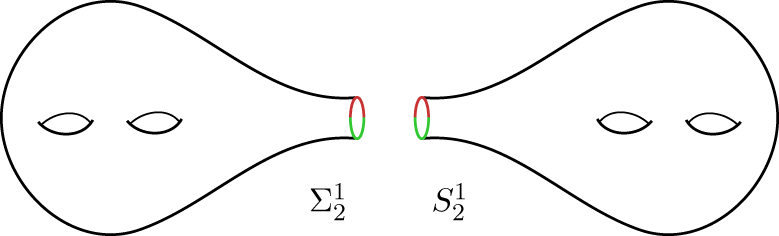
 Σ21
Σ21 S21
S21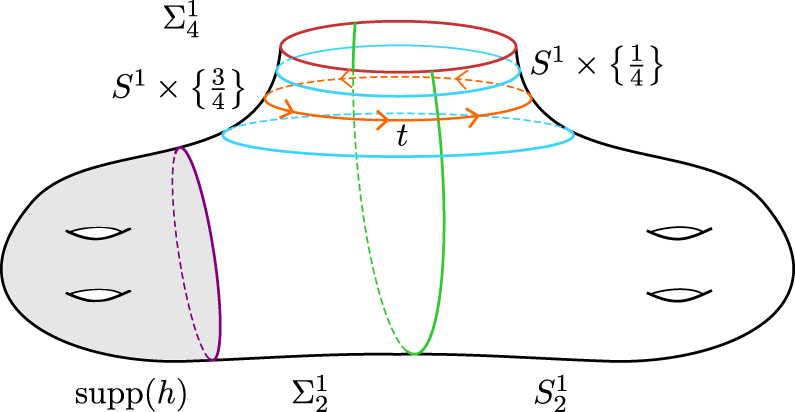
 t∈Γ2g1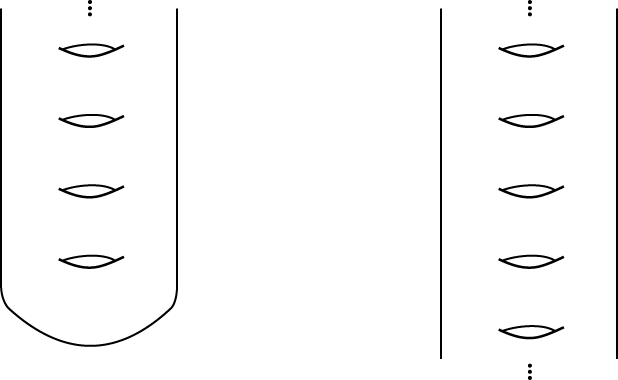
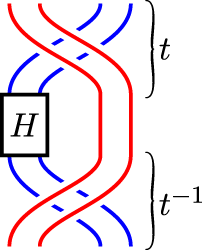
 tHt−1
tHt−1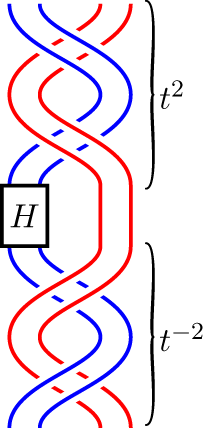
 t2Ht−2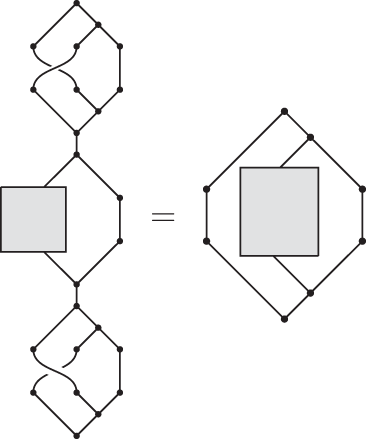
 tbV^(1)t−1
 B4R(2R,0)
 R2
R2
 Open access

