Book contents
- Frontmatter
- Contents
- Notes on contributors
- Foreword by Justice Tony North
- Acknowledgements
- Introduction
- Chapter 1 From refugee to judge of refugee law
- Chapter 2 Individual risk, armed conflict and the standard of proof in complementary protection claims:
- Chapter 3 Running scared since 9/11:
- Chapter 4 Asymmetrical sovereignty and the refugee:
- Chapter 5 Economic harm as a basis for refugee status and the application of human rights law to the interpretation of economic persecution
- Chapter 6 The fragmented nature of the international refugee regime and its consequences:
- Index
- References
Chapter 6 - The fragmented nature of the international refugee regime and its consequences:
a comparative analysis of the applications of the 1951 convention
Published online by Cambridge University Press: 17 February 2011
Edited by

Book contents
- Frontmatter
- Contents
- Notes on contributors
- Foreword by Justice Tony North
- Acknowledgements
- Introduction
- Chapter 1 From refugee to judge of refugee law
- Chapter 2 Individual risk, armed conflict and the standard of proof in complementary protection claims:
- Chapter 3 Running scared since 9/11:
- Chapter 4 Asymmetrical sovereignty and the refugee:
- Chapter 5 Economic harm as a basis for refugee status and the application of human rights law to the interpretation of economic persecution
- Chapter 6 The fragmented nature of the international refugee regime and its consequences:
- Index
- References
Summary
Introduction
This chapter critically examines the emergence of a global regime of accountability in international law in the area of refugee protection since the end of the Second World War. The 1951 United Nations Convention Relating to the Status of Refugees [1951 Convention hereafter] puts forward the claim of universal jurisprudence that supposedly overrides private norms and domestic legal practices in the area of refugee protection. However, in their application, the Convention and later developments in the area of domestic renditions of refugee jurisprudence systematically fell short of this intent. The chapter posits that the main reason for this failure is that the current international refugee regime was mainly designed to provide a back-up source for the protection of seriously at-risk persons. Its primary function, since its Westphalian origins, has been to support the state-centric status quo in international politics. The chapter regards international refugee law and, in particular, the 1951 Convention as an overly guarded safety net used only in the event that a state entirely fails to meet its most basic protective responsibilities towards its citizens and within constraints protecting the needs of the refugee-receiving states first and foremost. This observation is supported by the fact that the 1951 Convention and subsequent refugee jurisprudence disperses the duty of protection in a piecemeal fashion towards other states and international institutions. Furthermore, the Convention's applications vary immensely even among the states who are party to it.
Information
- Type
- Chapter
- Information
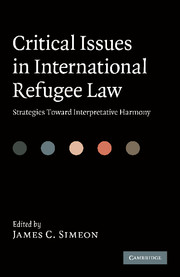
- Critical Issues in International Refugee LawStrategies toward Interpretative Harmony, pp. 174 - 210Publisher: Cambridge University PressPrint publication year: 2010
References
, “The Two Faces of Janus: Rethinking Legal Pluralism,” Cardozo Law Review 13 (1992), 1443Google Scholar
, “The Anonymous Matrix: Human Rights Violation by ‘Private’ Transnational Actors,” Michigan Law Review 69 (2006), 327Google Scholar
, , , and , “Global Restructuring and the Law: Studies of the Internationalization of Legal Fields and the Creation of Transnational Arenas,” Case Western Law Review 44 (1995)Google Scholar
, and , “Transnationalism in the Regulation of Labor Relations,” Law and Social Inquiry (2000); 25Google Scholar
and , “Trade Law, Labour and Global Inequality.” University of Wisconsin Law School Legal Studies Research Paper Series (2005), 1001Google Scholar
Accessibility standard: Unknown
Why this information is here
This section outlines the accessibility features of this content - including support for screen readers, full keyboard navigation and high-contrast display options. This may not be relevant for you.Accessibility Information
Accessibility compliance for the PDF of this book is currently unknown
and may be updated in the future.
- 4
- Cited by