Contents
Research Article
Periodic Fibonacci algebras
-
- Published online by Cambridge University Press:
- 20 January 2009, pp. 169-172
-
- Article
-
- You have access
- Export citation
Left ideals and 0-primitivity in matrix near-rings
-
- Published online by Cambridge University Press:
- 20 January 2009, pp. 173-187
-
- Article
-
- You have access
- Export citation
Asymptotic expansion of a series of Ramanujan
-
- Published online by Cambridge University Press:
- 20 January 2009, pp. 189-199
-
- Article
-
- You have access
- Export citation
-
An asymptotic expansion is given for the series
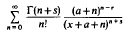
as x→∞ in the sector |Argx|≦π/2–δ. Here δ, Re(a), and Re(s) are positive and r is a positive integer. In the case a = r = s = 1, this yields the nontrivial result

stated by Ramanujan in his notebooks [6].
Normal
 -Fitting classes
-
- Published online by Cambridge University Press:
- 20 January 2009, pp. 201-212
-
- Article
-
- You have access
- Export citation
-
The authors together with M. J. Karbe [Ill. J. Math. 33 (1989) 333–359] have considered Fitting classes
 of -groups and, under some rather strong restrictions, obtained an existence and conjugacy theorem for -injectors. Results of Menegazzo and Newell show that these restrictions are, in fact, necessary.
The Fitting class
is normal if, for each  is the unique -injector of G. is abelian normal if, for each
 . For finite soluble groups these two concepts coincide but the class of Černikov-by-nilpotent -groups is an example of a nonabelian normal Fitting class of -groups. In all known examples in which -injectors exist is closely associated with some normal Fitting class (the Černikov-by-nilpotent groups arise from studying the locally nilpotent injectors).
Here we investigate normal Fitting classes further, paying particular attention to the distinctions between abelian and nonabelian normal Fitting classes. Products and intersections with (abelian) normal Fitting classes lead to further examples of Fitting classes satisfying the conditions of the existence and conjugacy theorem.
 -Fitting classes
 of
of  is the unique
  . For finite soluble groups these two concepts coincide but the class of Černikov-by-nilpotent
 Semigroups of left quotients—the uniqueness problem
-
- Published online by Cambridge University Press:
- 20 January 2009, pp. 213-226
-
- Article
-
- You have access
- Export citation
-
Let S be a subsemigroup of a semigroup Q. Then Q is a semigroup of left quotients of S if every element of Q can be written as a*b, where a lies in a group
 -class of Q and a* is the inverse of a in this group; in addition, we insist that every element of S satisfying a weak cancellation condition named square-cancellable lie in a subgroup of Q.
J. B. Fountain and M. Petrich gave an example of a semigroup having two non-isomorphic semigroups of left quotients. More positive results are available if we restrict the classes of semigroups from which the semigroups of left quotients may come. For example, a semigroup has at most one bisimple inverse ω-semigroup of left quotients. The crux of the matter is the restrictions to a semigroup S of Green's relations ℛ and ℒ in a semigroup of quotients of S. With this in mind we give necessary and sufficient conditions for two semigroups of left quotients of S to be isomorphic under an isomorphism fixing S pointwise.
The above result is then used to show that if R is a subring of rings Q1 and Q2 and the multiplicative subsemigroups of Q1 and Q2 are semigroups of left quotients of the multiplicative semigroup of R, then Ql and Q2 are isomorphic rings.
 -class of Q and a* is the inverse of a in this group; in addition, we insist that every element of S satisfying a weak cancellation condition named square-cancellable lie in a subgroup of Q.
Limits of pure states, II
-
- Published online by Cambridge University Press:
- 20 January 2009, pp. 227-231
-
- Article
-
- You have access
- Export citation
Existentially closed locally cofinite groups
-
- Published online by Cambridge University Press:
- 20 January 2009, pp. 233-253
-
- Article
-
- You have access
- Export citation
-
Let
 be a class of finite groups. Then a c-group shall be a topological group which has a fundamental system of open neighbourhoods of the identity consisting of normal subgroups with -factor groups and trivial intersection. In this note we study groups which are existentially closed (e.c.) with respect to the class Lc of all direct limits of c-groups (where satisfies certain closure properties). We show that the so-called locally closed normal subgroups of an e.c. Lc-group are totally ordered via inclusion. Moreover it turns out that every ∀2-sentence, which is true for countable e.c. L-groups, also holds for e.c. Lc-groups. This allows it to transfer many known properties from e.c. L-groups to e.c. Lc-groups.
 be a class of finite groups. Then a c
Unique factorisation rings
-
- Published online by Cambridge University Press:
- 20 January 2009, pp. 255-269
-
- Article
-
- You have access
- Export citation
Distinguishedness of weighted Fréchet spaces of continuous functions
-
- Published online by Cambridge University Press:
- 20 January 2009, pp. 271-283
-
- Article
-
- You have access
- Export citation
-
In this paper, we prove that if
 is an increasing sequence of strictly positive and continuous functions on a locally compact Hausdorff space X such that
  then the Fréchet space C(X) is distinguished if and only if it satisfies Heinrich's density condition, or equivalently, if and only if the sequence satisfies condition (H) (cf. e.g.‵[1] for the introduction of (H)). As a consequence, the bidual λ∞(A) of the distinguished Köthe echelon space λ0(A) is distinguished if and only if the space λ1(A) is distinguished. This gives counterexamples to a problem of Grothendieck in the context of Köthe echelon spaces.
 is an increasing sequence of strictly positive and continuous functions on a locally compact Hausdorff space X such that
  then the Fréchet space C
On the automorphism group of a connected locally compact topological group
-
- Published online by Cambridge University Press:
- 20 January 2009, pp. 285-294
-
- Article
-
- You have access
- Export citation
Countable periodic CC-groups as automorphism groups
-
- Published online by Cambridge University Press:
- 20 January 2009, pp. 295-299
-
- Article
-
- You have access
- Export citation
Distributive p-algebras and double p-algebras having n-permutable congruences
-
- Published online by Cambridge University Press:
- 20 January 2009, pp. 301-307
-
- Article
-
- You have access
- Export citation
-
Recent research on aspects of distributive lattices, p-algebras, double p-algebras and de-Morgan algebras (see [2] and the references therein) has led to the consideration of the classes
 (n≧1) of distributive lattices having no n + 1-element chain in their poset of prime ideals. In [1] we were obliged to characterize the members of by a sentence in the first-order theory of distributive lattices. Subsequently (see [2]), it was realised that coincides with the class of distributive lattices having n+1-permutable congruences. This result is hereby employed to describe those distributive p-algebras and double p-algebras having n-permutable congruences. As an application, new characterizations of those distributive p-algebras and double p-algebras having the property that their compact congruences are principal are obtained. In addition, those varieties of distributive p-algebras and double p-algebras having n-permutable congruences are announced.
 (n≧1) of distributive lattices having no n + 1-element chain in their poset of prime ideals. In [1] we were obliged to characterize the members of
 Normal embeddings of p-groups into p-groups
-
- Published online by Cambridge University Press:
- 20 January 2009, pp. 309-314
-
- Article
-
- You have access
- Export citation
Weak and cyclic amenability for non-commutative Banach algebras
-
- Published online by Cambridge University Press:
- 20 January 2009, pp. 315-328
-
- Article
-
- You have access
- Export citation
-
This paper is concerned with two notions of cohomological triviality for Banach algebras, weak amenability and cyclic amenability. The first is defined within Hochschild cohomology and the latter within cyclic cohomology. Our main result is that
 where ℱ is a Banach algebraic free product of two Banach algebras
  and ℬ. It follows that cyclic amenability is preserved under the formation of free products.
 where ℱ is a Banach algebraic free product of two Banach algebras
  and ℬ. It follows that cyclic amenability is preserved under the formation of free products.
Obituary
Robert Schlapp, M.A., Ph.D., F.R.S.E. 1899–1991
-
- Published online by Cambridge University Press:
- 20 January 2009, pp. 329-334
-
- Article
-
- You have access
- Export citation
Book Reviews
P. Wojtaszczyk, Banach spaces for analysts (Cambridge Studies in Advanced Mathematics 25, Cambridge University Press, 1991), pp. xiv + 382, 0 521 35618 0, £50.
-
- Published online by Cambridge University Press:
- 20 January 2009, pp. 335-336
-
- Article
-
- You have access
- Export citation
Front matter
PEM volume 35 issue 2 Cover and Front matter
-
- Published online by Cambridge University Press:
- 20 January 2009, pp. f1-f2
-
- Article
-
- You have access
- Export citation
Back matter
PEM volume 35 issue 2 Cover and Back matter
-
- Published online by Cambridge University Press:
- 20 January 2009, p. b1
-
- Article
-
- You have access
- Export citation