Contents
Office Bearers
Office-Bearers
-
- Published online by Cambridge University Press:
- 20 January 2009, p. 1
-
- Article
-
- You have access
- Export citation
Other
Some New Properties of the Triangle
-
- Published online by Cambridge University Press:
- 20 January 2009, p. 2
-
- Article
-
- You have access
- Export citation
Proofs of some optical theorems
-
- Published online by Cambridge University Press:
- 20 January 2009, p. 2
-
- Article
-
- You have access
- Export citation
Research Article
On the condition that the straight line lx+my+nz=0 should be a normal to the conic (a, b, c, f, g, h)(x, y, z)2=0 the co-ordinates being trilinear
-
- Published online by Cambridge University Press:
- 20 January 2009, pp. 2-4
-
- Article
-
- You have access
- Export citation
-
The condition in question may be found by using the following theorem:-
If the equation in trilinear co-ordinates

The triangle and its escribed parabolas
-
- Published online by Cambridge University Press:
- 20 January 2009, pp. 4-10
-
- Article
-
- You have access
- Export citation
-
The problem “to inflect a straight line between two sides of a triangle so that the intercepted portion is equal to the segments cut off” has been discussed in the third volume of the Proceedings.
If we discuss the same analytically; taking CB and CA as axes of x and y (Fig. 1) and calling each segment k, the equation of the line considered is

Some Geometrical Theorems
-
- Published online by Cambridge University Press:
- 20 January 2009, pp. 11-13
-
- Article
-
- You have access
- Export citation
Other
On the Heating of Conductors by Electric Currents, and the Electric Distribution in Conductors so heated
-
- Published online by Cambridge University Press:
- 20 January 2009, p. 13
-
- Article
-
- You have access
- Export citation
Research Article
The solution of the equation √{(x−a)(x−b)}(x−c)(x−d)}=e
-
- Published online by Cambridge University Press:
- 20 January 2009, pp. 13-23
-
- Article
-
- You have access
- Export citation
-
If P=a+b−c−d, and K=cd−ab, the solution of the equation

may be most readily found by putting (x−a)(x−b)=z2; whence (x−c)(x−d)=z2+Px+K, and therefore =z2−2ez+e2, and finally x is given by the equation

A problem in the theory of numbers
-
- Published online by Cambridge University Press:
- 20 January 2009, pp. 23-25
-
- Article
-
- You have access
- Export citation
Sur un Lieu Géométrique
-
- Published online by Cambridge University Press:
- 20 January 2009, pp. 25-27
-
- Article
-
- You have access
- Export citation
Note on the preceding Locus
-
- Published online by Cambridge University Press:
- 20 January 2009, p. 28
-
- Article
-
- You have access
- Export citation
The triangle and its escribed parabolas
-
- Published online by Cambridge University Press:
- 20 January 2009, pp. 28-30
-
- Article
-
- You have access
- Export citation
On the Use of Dimensional Equations in Physics
-
- Published online by Cambridge University Press:
- 20 January 2009, pp. 30-36
-
- Article
-
- You have access
- Export citation
Some relations between the orthic and the median triangles
-
- Published online by Cambridge University Press:
- 20 January 2009, pp. 36-39
-
- Article
-
- You have access
- Export citation
On some properties of a triangle of given shape inscribed in a given triangle
-
- Published online by Cambridge University Press:
- 20 January 2009, pp. 39-48
-
- Article
-
- You have access
- Export citation
Other
On the solitary wave
-
- Published online by Cambridge University Press:
- 20 January 2009, p. 49
-
- Article
-
- You have access
- Export citation
Research Article
On some applications of the pedal line of a triangle
-
- Published online by Cambridge University Press:
- 20 January 2009, pp. 49-50
-
- Article
-
- You have access
- Export citation
The pedal line of a triangle and theorems connected with it
-
- Published online by Cambridge University Press:
- 20 January 2009, pp. 50-55
-
- Article
-
- You have access
- Export citation
On a Representation of Elliptic Integrals by Curvilinear Arcs
-
- Published online by Cambridge University Press:
- 20 January 2009, pp. 55-58
-
- Article
-
- You have access
- Export citation
On the transformation and classification of Permutations
-
- Published online by Cambridge University Press:
- 20 January 2009, pp. 59-79
-
- Article
-
- You have access
- Export citation
-
Let
 represent any permutation of the first n natural numbers. If we take the first number, a1, and put it last, we get a new permutation; and if we perform this operation (n−1) times, we get the (n−1) permutations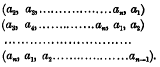
 represent any permutation of the first n natural numbers. If we take the first number, a