


Standardisation of methods and fieldwork is of crucial importance to compare dietary intake between European countries( Reference Brussaard, Lowik and Steingrimsdottir 1 ). The European Food Consumption Validation (EFCOVAL) study (http://www.efcoval.eu) aimed to further develop and validate a European food consumption method using a standardised 24 h dietary recall (24-HDR) – the EPIC-Soft software( Reference Slimani, Deharveng and Charrondiere 2 , Reference Slimani, Ferrari and Ocke 3 ) – for assessing dietary intake within and between European countries. The study was carried out in view of a future pan-European dietary monitoring system, which is foreseen to deliver high-quality food consumption data for between-country comparisons( Reference van der Voet and van Klaveren 4 ). In EFCOVAL, design aspects of 24-HDR assessments, such as mode of administration and day of the week, influenced the variation in protein and K bias across European centres( Reference Crispim, Geelen and de Vries 5 ). Thus, further investigating the different design aspects in collecting 24-HDR within different countries is relevant for future surveys.
Some studies have shown that 24-HDR administered by telephone and face-to-face interviews yield similar data( Reference Fox, Heimendinger and Block 6 , Reference Casey, Goolsby and Lensing 7 ). However, to know whether they really provide similar results, the validity of interviews administered by telephone should be compared with that of interviews administered face-to-face( Reference De Henauw, Brants and Becker 8 ).
The collection of at least two non-consecutive days of intake to estimate habitual intake through statistical modelling has been advised by EFCOSUM (the European Food Consumption Survey Methods Project)( Reference Hoffmann, Boeing and Dufour 9 ). In addition, a second dietary interview may be affected by a motivational or learning effect. Some studies have suggested that participants’ motivation decreases with increasing number of days of collection, leading to under-reporting of intake( Reference Gersovitz, Madden and Smiciklas-Wright 10 , Reference Buzzard, Faucett and Jeffery 11 ). Besides, the results of the second recall may differ because participants learned from their first recall. Therefore, it is important to investigate whether first and second 24-HDR estimates provide comparable results.
Another important issue concerns the dietary data collection on different days of the week. Food consumption on weekend days differs from weekdays in most European countries( Reference De Henauw, Brants and Becker 8 , 12 ). It is therefore advisable that dietary assessments are randomly allocated over all days of the week among the population( Reference De Henauw, Brants and Becker 8 ). However, it is questionable whether the accuracy of the assessments of 24-HDR is similar between weekend and weekdays.
Furthermore, to carry out dietary interviews on a Sunday for recalling the diet of Saturday is less feasible in some countries, like the Netherlands and Spain for example, because of aspects of family privacy on Sundays( 12 ). An alternative is to collect data from Saturday on the following Monday, but whether those assessments provide comparable results to those on Sunday is to be investigated.
In the current paper we evaluate the bias in protein and K intakes collected with 24-HDR between different modes of administration (telephone v. face-to-face), recall days (first v. second), days of the week (weekday v. weekend) and interview days (1 d later v. 2 d later) in five European centres.
Participants and methods
Data were collected in the framework of the EFCOVAL study in five European centres: Belgium, the Czech Republic, France, the Netherlands and Norway. Ethical committees from each study centre approved the research protocol and participants signed an informed consent. Detailed information about the study populations, including recruitment and sampling procedures, is given elsewhere( Reference Crispim, de Vries and Geelen 13 , Reference Crispim, Geelen and Souverein 14 ). In brief, 600 adults aged 45–65 years, about 120 per centre, were interviewed twice to report their intake using the computerised 24-HDR method (EPIC-Soft software)( Reference Slimani, Deharveng and Charrondiere 2 , Reference Slimani, Ferrari and Ocke 3 ). One recall was performed by telephone with participants at home and the other one face-to-face mostly in the study centre. The order of the two modes of administration of the 24-HDR was equally assigned at random, with at least four weeks between the recalls, in each centre. Furthermore, dietary recalls followed a randomised schedule that equally included all days of the week within each centre. However, in Belgium, the Czech Republic and the Netherlands dietary recalls about Saturdays were not conducted on Sundays but on Mondays. The number of trained interviewers (i.e. dietitians or nutritionists) was four in Belgium, six in the Czech Republic, two in France, seven in the Netherlands and three in Norway. On the same days on which 24-HDR data were reported, 24 h urine collections were used to determine N and K excretion in urine. These were used as biomarkers of protein and K intakes, respectively. p-Aminobenzoic acid was used to check the completeness of urine collections. Complete logistics and details of the study were reported elsewhere( Reference Crispim, de Vries and Geelen 13 , Reference Crispim, Geelen and Souverein 14 ).
The bias in protein and K intakes was defined as the mean of individual ratios between nutrient intake from 24-HDR and the excretion of its recovery biomarkers. Analysis of covariance (ANCOVA) was used to adjust the means for the interviewer and test them by centre and mode of administration (face-to-face v. telephone interview), recall day (first v. second), day of the week (weekday v. weekend day) or interview day (1 d later v. 2 d later – i.e. Saturday's intake collected on Monday). Weekdays were defined to include Mondays, Tuesdays, Wednesdays and Thursdays, and weekends Fridays, Saturdays and Sundays. We also performed the analysis including Friday as a weekday and the results were quite similar to the first definition, so they are not presented. Hereafter, ‘recall day’ is defined as the first or second day of application of the 24-HDR, ‘day of the week’ as the comparison of weekdays and weekend days, and ‘interview day’ as the dietary intake of 1 d later v. 2 d later. The analyses were not adjusted for participant characteristics and other design aspects because they were not necessary according to ANCOVA. This was mainly due to the fact that the comparisons included mostly repeated measurements of the same participant, as each individual provided two 24-HDR using two modes of administration and applied on different days of the week. In a few cases, participants only had one day of collection, either first or second; therefore the number of participants (n) in tables do not add up to 600. P values <0·05 were regarded as significant. Analyses were performed using the SAS statistical software package version 9·1 (SAS Institute Inc., Cary, NC, USA).
Results
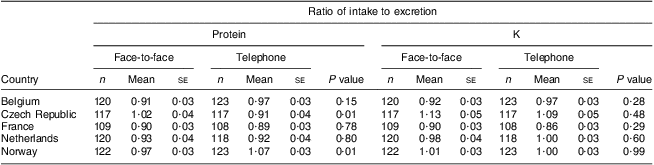
The bias in protein and K intakes, as represented by the ratios between intake and excretion, were comparable for face-to-face and telephone interviews in Belgium, France and the Netherlands (Table 1). In the Czech Republic and Norway, the bias in K intake was also comparable between these modes of administration, but not for protein. In these two centres, the bias for the assessment of protein was smaller by telephone than by face-to-face interviews (P = 0·01 in both countries). However, while an overestimation of the mean protein intake collected with face-to-face interviews was observed in Norway, an underestimation was seen in the Czech Republic.
Comparison of mean* ratios of nutrient intake to excretion by mode of administration in the EFCOVAL validation study
| Ratio of intake to excretion | ||||||||||||||
| Protein | K | |||||||||||||
| Face-to-face | Telephone | Face-to-face | Telephone | |||||||||||
| Country | n | Mean | se | n | Mean | se | P value | n | Mean | se | n | Mean | se | P value |
| Belgium | 120 | 0·91 | 0·03 | 123 | 0·97 | 0·03 | 0·15 | 120 | 0·92 | 0·03 | 123 | 0·97 | 0·03 | 0·28 |
| Czech Republic | 117 | 1·02 | 0·04 | 117 | 0·91 | 0·04 | 0·01 | 117 | 1·13 | 0·05 | 117 | 1·09 | 0·05 | 0·48 |
| France | 109 | 0·90 | 0·03 | 108 | 0·89 | 0·03 | 0·78 | 109 | 0·90 | 0·03 | 108 | 0·86 | 0·03 | 0·29 |
| Netherlands | 120 | 0·93 | 0·04 | 118 | 0·92 | 0·04 | 0·80 | 120 | 0·98 | 0·04 | 118 | 1·00 | 0·03 | 0·60 |
| Norway | 122 | 0·97 | 0·03 | 123 | 1·07 | 0·03 | 0·01 | 122 | 1·01 | 0·03 | 123 | 1·00 | 0·03 | 0·99 |
EFCOVAL, European Food Consumption Validation.
*Adjusted for interviewer.
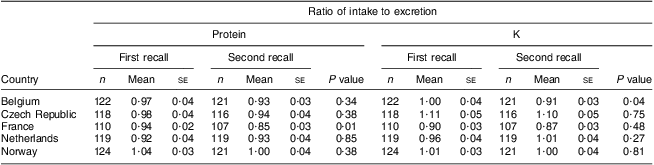
The protein and K intakes collected on the first and second recall days yielded similar bias in the Czech Republic, Norway and the Netherlands (Table 2). However, protein intake in France and K intake in Belgium collected during the second 24-HDR were apparently less accurate than intakes from the first recall (P = 0·01 and 0·04, respectively).
Comparison of mean* ratios of nutrient intake to excretion by recall day in the EFCOVAL validation study
| Ratio of intake to excretion | ||||||||||||||
| Protein | K | |||||||||||||
| First recall | Second recall | First recall | Second recall | |||||||||||
| Country | n | Mean | se | n | Mean | se | P value | n | Mean | se | n | Mean | se | P value |
| Belgium | 122 | 0·97 | 0·04 | 121 | 0·93 | 0·03 | 0·34 | 122 | 1·00 | 0·04 | 121 | 0·91 | 0·03 | 0·04 |
| Czech Republic | 118 | 0·98 | 0·04 | 116 | 0·94 | 0·04 | 0·38 | 118 | 1·11 | 0·05 | 116 | 1·10 | 0·05 | 0·75 |
| France | 110 | 0·94 | 0·02 | 107 | 0·85 | 0·03 | 0·01 | 110 | 0·90 | 0·03 | 107 | 0·87 | 0·03 | 0·48 |
| Netherlands | 119 | 0·92 | 0·04 | 119 | 0·93 | 0·04 | 0·85 | 119 | 0·96 | 0·04 | 119 | 1·01 | 0·04 | 0·27 |
| Norway | 124 | 1·04 | 0·03 | 121 | 1·00 | 0·04 | 0·38 | 124 | 1·01 | 0·03 | 121 | 1·00 | 0·04 | 0·81 |
EFCOVAL, European Food Consumption Validation.
*Adjusted for interviewer.
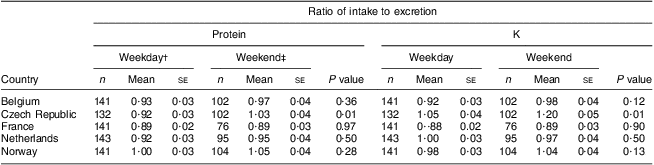
The bias in protein and K intakes collected on weekdays did not differ from weekend days, except in the Czech Republic (Table 3). While protein intake was underestimated during weekdays in the Czech Republic, K intake was overestimated during weekends (P = 0·01 for both).
Comparison of mean* ratios of nutrient intake to excretion of recalls performed on weekdays or weekend days in the EFCOVAL validation study
| Ratio of intake to excretion | ||||||||||||||
| Protein | K | |||||||||||||
| Weekday† | Weekend‡ | Weekday | Weekend | |||||||||||
| Country | n | Mean | se | n | Mean | se | P value | n | Mean | se | n | Mean | se | P value |
| Belgium | 141 | 0·93 | 0·03 | 102 | 0·97 | 0·04 | 0·36 | 141 | 0·92 | 0·03 | 102 | 0·98 | 0·04 | 0·12 |
| Czech Republic | 132 | 0·92 | 0·03 | 102 | 1·03 | 0·04 | 0·01 | 132 | 1·05 | 0·04 | 102 | 1·20 | 0·05 | 0·01 |
| France | 141 | 0·89 | 0·02 | 76 | 0·89 | 0·03 | 0.97 | 141 | 0··88 | 0.02 | 76 | 0·89 | 0·03 | 0·90 |
| Netherlands | 143 | 0·92 | 0·03 | 95 | 0·95 | 0·04 | 0·50 | 143 | 1·00 | 0·03 | 95 | 0·97 | 0·04 | 0·50 |
| Norway | 141 | 1·00 | 0·03 | 104 | 1·05 | 0·04 | 0·28 | 141 | 0·98 | 0·03 | 104 | 1·04 | 0·04 | 0·13 |
EFCOVAL, European Food Consumption Validation.
*Adjusted for interviewer.
†Monday–Thursday.
‡Friday–Sunday.
The bias in protein and K intakes from recalls collected on Mondays about Saturdays’ intake was similar to those of recalls about the other days of the week in the Netherlands and Belgium (not shown in tables). However, in the Czech Republic the bias in K intake from recalls performed 2 d later indicated overestimation of intake (ratio of 1·35 (sd 0·09) for Saturdays’ intake (n 28) v. 1·14 (sd 0·08) for the average of Fridays and Sundays (n 74) and 1·06 (sd 0·08) for the average of Mondays to Thursdays (n 132)). Furthermore, removing Saturdays’ K intake in the comparison of weekdays and weekend days reduced the difference observed in the Czech Republic (P = 0·05, data not shown).
A significant interviewer effect was observed in some of the analyses (P < 0·05), but it did not change the conclusions compared with the crude analyses. An exception was seen for Belgium, where the bias in protein intake was only similar between the two modes of administration after adjustment for interviewer.
Discussion
In the present study, we compared the bias in protein and K intakes estimated from a standardised 24-HDR between different modes of administration, recall days, days of the week and interview days in five European centres. Overall, the biases in protein and K intakes were rather small as was shown by the mean ratios of intake to excretion that were greater than 0·90. In addition, they were comparable between face-to-face and telephone interviews, first and second recall days, weekdays and weekend days, and interviews performed 1 d later and 2 d later in some, but not all, centres.
Other studies have indicated that dietary data collected by telephone are in good agreement with those by face-to-face interviews, especially when adjusted for interviewer( Reference Fox, Heimendinger and Block 6 , Reference Casey, Goolsby and Lensing 7 , Reference Brustad, Skeie and Braaten 15 ). However, these studies compared the intakes estimated by the two modes of administration rather than their validity. Contrarily, our validation results showed differences between the two modes of administration in the Czech Republic and Norway with significantly larger biases in protein intakes when face-to-face interviews were conducted, which in turn could lead to mistaken conclusions on the absolute intakes in these countries. The fact that participants were allowed to check foods consumed at home can hypothetically explain the better validity of recalls by telephone, as this was not possible during the face-to-face interviews performed at the study centre. Nevertheless, the study showed that bias in K intake was comparable between the two modes of administration in all centres.
In the OPEN (Observing Protein and Energy Nutrition) study, first and second 24-HDR assessments of protein intake showed similar bias( Reference Subar, Kipnis and Troiano 16 ). We, however, observed a less accurate performance of the method for second day assessments of protein or K intake in two of the centres in France and Belgium, respectively. This difference is hypothetically explained by less motivation of the participants for the second recall. However, also a learning effect may have affected the second recalls. Thus, the absence of a difference in bias observed in some centres may be explained by the fact that the two proposed effects could have cancelled each other out.
The Czech Republic was the only centre that did not present comparable biases in the assessments of protein and K intakes between weekdays and weekend days and between 24-HDR collected 1 d and 2 d after the intake. Reasons for these differences are not clear.
Three possible explanations for the observed differences in bias between modes of administrations, recall days, days of the week and interview days within some of the centres are given. First, food composition data are known to be a source of errors in dietary assessments( Reference Crispim, de Vries and Geelen 13 ), and may have invariably influenced the bias between the different design aspects of the 24-HDR assessment. For example, different factors were used to convert N into protein contents of foods in the food composition tables applied in the centres. Furthermore, an official national food composition table in the Czech Republic was not available during the study and the nutrient composition of foods consumed needed to be borrowed from Slovak and other foreign tables. A second explanation may be that specific foods or food groups, of which the intake varied between centres because of a different dietary pattern, may have been differentially misreported. Third, the degree of experience in using EPIC-Soft may have caused differences in bias among the centres. Thus, it could be hypothesised that a centre's degree of experience possibly in combination with the quality of the figures in food composition tables and its dietary pattern caused the differences in bias of the different design aspects within the centres.
A limitation of our study is that we probably included a health-conscious population, which may hinder the extrapolation of the results to the general population of the respective countries. Additionally, only two nutrients were evaluated. Nevertheless, as differences were observed in the performance of the method between different design aspects of the assessment, this may also be true for other nutrients and foods. Moreover, because of small sample sizes in the analysis of the interview day in the present study, we may lack power to conclude on the comparability of data collected 1 d or 2 d after the dietary intake. Finally, the comparison of mode of administration is weakened due to the difference in location of the participants’ interviews, at home v. study centre.
To our knowledge, the present study is the first one describing the bias in protein and K intakes between different modes of administration, recall days, days of the week and interview days across different European populations. The results presented here can provide a greater understanding of the performance of the 24-HDR methodology, which may have implications for the planning of future dietary surveys and the analyses and interpretation of the collected data.
We conclude that 24-HDR collected by telephone interviews seem to provide a more accurate assessment than by face-to-face interviews at a research centre in some European centres. In addition, second recall assessments may be less accurate than first recalls. Finally, it is suggested that the days of the week should be equally represented in dietary surveys or appropriately adjusted for during data analysis.
Acknowledgements
The work was supported by European Community funding under the Sixth Framework Programme for the EFCOVAL project (FOOD-CT-2006-022895). This document reflects only the authors’ views and the European Community is not liable for any use that may be made of the information contained herein. I.T.L.L. received grant support from the Norwegian Foundation for Health and Rehabilitation; the remaining authors have declared no financial interests. S.P.C. carried out data analyses and wrote the paper, taking into account comments from all co-authors. J.H.M.d.V., A.G. and P.v.V. designed and coordinated the validation study. J.H.M.d.V., A.G., E.S., I.H., I.L., I.M., I.R., M.C.O., N.S. and E.d.B. were involved in the fieldwork and gave input on the interpretation of results. All co-authors commented on the paper and approved the final version.



