

4 Word-formation processes with bound morphemes
[D]iachronically, the transmutation of a ‘blurred’ compound into an affixal derivative is an almost trivial phenomenon.
As with any other word-formation process, the significance of affixation in natural languages varies substantially. If we disregard the non-existence of any of the affixation processes in various languages, its distribution may range from about 400 suffixes in use in West Greenlandic to one genuine prefix in Estonian and Finnish. Affixes are in principle well-defined elements in linguistics by being labelled as bound morphemes. However, this term encompasses a range of phenomena which differ in their functional characteristics, in their degree of naturalness and in their role in word-formation.
This chapter discusses the status of affixes (4.1) and reviews the role of suffixation and prefixation (4.1.1), with emphasis on recursiveness (4.1.1.1) and base modification (4.1.1.2) and then on one-to-many (4.1.2) and many-to-one relations (4.1.3) within affixation. The chapter then presents minor types of affixation (4.2), notably infixation (4.2.1), prefixal-suffixal derivation (4.2.2), circumfixation (4.2.3), and prefixal-infixal and infixal-suffixal derivation (4.2.4).
4.1 Affixation
Morphology sometimes alludes to affixes as well-defined elements that in fact may vary considerably. A number of examples illustrate the difficulty in defining the boundaries of derivational affixes with respect to inflectional affixes or to other structural units.
Thus, Malkiel (Reference Malkiel and Greenberg1978) refers to German elements, most of which are formally and semantically paralleled by prepositions and/or adverbs (cf. Table 2.1). This might suggest that words containing these elements are compounds. However, the existence of prefixes without any corresponding lexical counterparts like be-, er-, ge- and ver- suggests that these words result from affixation. Malkiel (Reference Malkiel and Greenberg1978: 127–8) argues that it would be counterintuitive to separate be-, er-, ge- and ver- from the remainder of German prefixes with which they interact paradigmatically. A similar situation characterizes the majority of Latin verbal prefixes.
In fact, as pointed out by Kastovsky (Reference Kastovsky, Lieber and Štekauer2009: 327), affixes often go back to compound members due to loss of their content. Thus, English -less goes back to Old English less meaning ‘devoid of, free from’, -ship to Old English scipe ‘form, state’ and -dom to Old English dōm ‘evil fate’. Synchronically, this source may be traced in the existence of the so-called semiaffixes (English -berry, -man, etc., cf. Marchand Reference Marchand1960: 290ff.). These semiaffixes share features of bound morphemes (reduced pronunciation, loss of stress, generalized meaning, high productivity) and features of free morphemes as constituents of compounds, and justify Malkiel’s quotation in the chapter’s motto. Malkiel mentions cases like German -wärts in rückwärts ‘back’ and vorwärts ‘forward, ahead’ and English -ward which developed from the word meaning ‘turn, bent, slant’, a cognate of Latin vertere. Evidence of a similar development can be found in Ket, Kott and Yugh: their verbal semiaffixes developed from root morphemes, occurring in a series of compound words which are no longer used as an independent word. This can be illustrated with the Ket semi-suffix -bet(Werner Reference Werner1998: 105ff.):
(1)
- Ket
il’-bet
broken/destroyed-make
‘break, destroy’
(2)
- Ket
nan’bet
bread-make
‘bake bread’
Werner also gives examples of semantic bleaching of some common Ket morphemes used in compound nouns through which they have come to resemble derivational affixes. For instance, -git‘man’ now signifies the young of any animal or tree:
For Kastovsky (Reference Kastovsky, Lieber and Štekauer2009: 327), the diachronic shift from a compound constituent to a bound morpheme results in a synchronic cline. Kastovsky does not find the postulation of semiaffixes acceptable, as it ‘replaces a two-way by a three-way distinction adding an additional stepping stone on something which for diachronic reasons must be viewed as a cline without providing criteria for delimitation’.
The blurred limits of affixes also manifest themselves in the vague boundary between inflectional and derivational affixes, as in the infinitive suffix in Romance languages (Malkiel Reference Malkiel and Greenberg1978: 129), because many infinitives are subject to nominalization. The nominalized infinitives then behave like other nominalizations resulting from suffixation. In Romanian, all the original infinitives were nominalized and subsequently replaced by a new set of infinitives. The same kind of nominalization, e.g. lesen ‘read.v’ vs das Lesen ‘reading.n’ is very productive in German. In general, this is closely related to the role of inflectional paradigms as derivational devices. Thus, the Slovak adjective domáci ‘domestic’ can be converted into the corresponding noun meaning ‘landlord’ and also into a plural noun meaning ‘the home team’. If accounted for as zero-derivation or derivation by zero morpheme (e.g. Marchand Reference Marchand1960; Kastovsky Reference Kastovsky1969, Reference Kastovsky1982), then this and other cases of conversion fall within the scope of affixation.
Kwakw’ala provides another borderline case. As explained by Anderson (Reference Anderson and Shopen1985: 26), many suffixes are noun-like, verb-like or adjective-like, i.e. they correspond to nouns, verbs and adjectives in other languages. In addition, there are also suffixes that function as conjunctions. All in all, there are bound elements in Kwakw’ala corresponding to all major word-classes. Kwakw’ala is a good example of the difficulties inherent in the category of affix and in its subcategories, in that an affix can sometimes be analyzed as either a suffix or infix (Anderson Reference Anderson and Shopen1985: 32): the suffix -əm, which indicates that things whose location is specified by a following locative suffix are plural, may also be analyzed as an infix:
(4)
Anderson assumes that -əm- may be said to be infixed into a stem ending in a locative suffix and placed immediately before that.
This introduction finally presents another ambiguous case which illustrates how complex the issues in question may be. This time, it concerns the decision between the allomorphic vs morphemic status of Slovak prefix(es) pre- and prie- as in pre-behnút ‘run.v.pfv’ vs prie-beh ‘course (of events)’. Formally, they differ in quantity, as the former has a short vowel and the latter a diphthong. Furdík (Reference Furdík2004: 44) generalizes that in these and other similar cases we should speak about variants at morphematic level rather than at word-formation level, because the diphthongized variant does not result from a word-formation process, unlike the short variant which is an unambiguous case of prefixation from behat ‘run.v.ipfv’. In the subsequent word-formation step, prie- is not treated as a prefix. Instead, it is considered to be a part of the base. Some other examples cited by Furdík are na-/ná-(narazit ‘strike.v’ > náraz ‘stroke’), pri-/prí-(prisúdiť ‘predicate.v’ > prísudok ‘predicate.N’), etc.
While this non-derivational assumption holds for these pairs, this is not quite so in relation to pre-/prie- pairs, i.e. the short/long vowel opposition in other than pre-/prie- pairs occurs between a motivating verb and the resulting noun. In the pre-/prie- pairs this opposition often concerns the relation between two nouns. Consequently, as pointed out by Slančová(pers. comm.), while the prefix prie- is a quantitative variant of pre-, the quantitative difference may also have a semantic distinctive force, i.e. while prie- refers to location, pre- indicates action:
(5)
(6)
Unfortunately, this basic semantic specialization does not apply in all cases and sometimes the meanings may overlap partly or completely:
(7)
(8)
There are also cases when only one of the prefixes forms an actual word:
(9)
Thus, while a semantic difference supports the hypothesis of two prefixes, the inconsistency with which this opposition is applied and the semantic merger in other cases show that it is very difficult to make an unambiguous judgement about the status of pre-/prie- in the Slovak word-formation system.
4.1.1 Suffixation and prefixation
Suffixation is recorded in the languages shown in Table 4.1(96.36 per cent of the study sample).

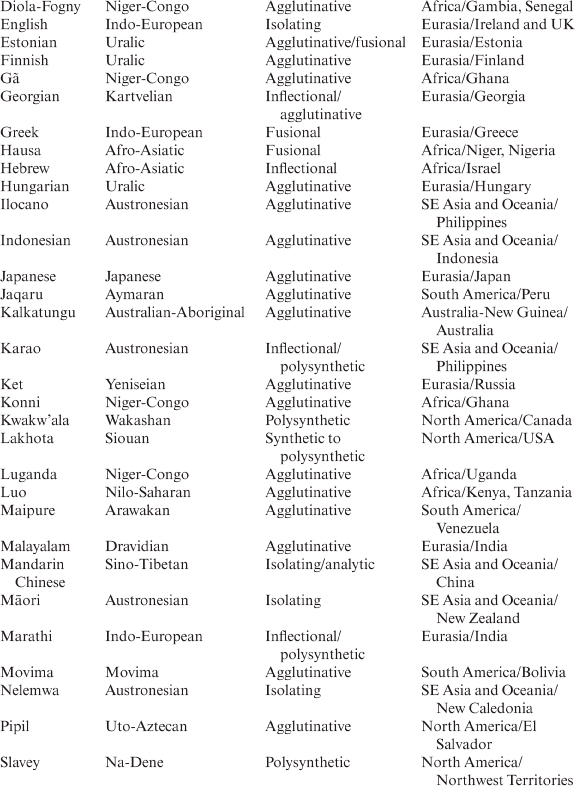

Prefixation is recorded in the languages shown in Table 4.2(70.91 per cent of the study sample).


There are only two languages in the study sample that do not use suffixation for coining new words: Vietnamese, which, as an isolating language par excellence, has no affixation at all, and Yoruba, another isolating language, which makes only use of prefixation. By contrast, prefixation is not so widespread, and this deserves further comment. It was pointed out in the opening lines of this chapter that Estonian has only one prefix, eba- ‘false, pseudo-, quasi-’ (Kilgi, pers. comm.),1 even if certain morphemes are sometimes also considered prefixes, e.g. mitte ‘non-, un-’, ala ‘under-, sub-’ and üli ‘over-, super-, ultra-, hyper-’:
(10)
- Estonian
mitte-soovitav
‘inadvisable’
(11)
- Estonian
ala-jaotis
‘subdivision’
(12)
- Estonian
üli-agar
‘overeager’
In Finnish there is also one prefix (epä- for negation),2 and even this is not considered very productive (Laakso, pers. comm.): it is applied to some adjectives and to even fewer nouns, and the meaning is not completely predictable. These are examples of the limited cross-linguistic frequency of prefixation, which has been reported in the literature to be lower than that of suffixation (E. Sapir Reference Sapir1921: 67; Cutler, Hawkins and Gilligan Reference Cutler, Hawkins and Gilligan1985: 747; Laca Reference Laca, Haspelmath, König, Oesterreicher and Raible2001).
This observation gives support to the view that the difference between suffixation and prefixation is not merely positional. In this connection, let us recall Marchand’s viewpoint (1967) which assigns prefixation and compounding to the word-formation processes of expansion, while suffixation is based on different principles and is a special case of transposition. Marchand’s distinction should be much appreciated, even if we cannot agree with all his arguments, in particular with the assumption that suffixes always function as determinata(heads), while prefixes are always determinants(modifiers). This assumption, later formulated by Williams (Reference Williams1981) as the Right-hand Head Rule, is a rather radical position which was subject to extensive criticism and raised discussion on headedness in terms of the content of the notion of head, its defining characteristics and, what is more important for the present topic, the capacity of prefixes to act as heads.3 Štekauer (Reference Štekauer2001) argues in favour of the capacity of prefixes to function as heads, on a par with suffixes, for formal and semantic reasons:
(a) like suffixes, prefixes can also be divided into class-changing and class-maintaining; in view of their postulated treatment as heads they may be preferably labelled as class-changing and class-confirming, and
(b) while one of the basic features of heads (determinata, onomasiological bases) is that they stand for a general conceptual group, a class or a species, modifiers (determinants, onomasiological marks) restrict their scope (Dokulil Reference Dokulil1962). Therefore, in complex words which contain ‘both a word-formation base and affix, the latter is the head because affixes stand for a more general category’(Štekauer Reference Štekauer2001: 352).
Consequently, although they are different processes, suffixation and prefixation play an equally important role in word-formation because both can function as heads. Furthermore, even if suffixation is recorded in a higher percentage in the sample, prefixation also plays a major role both in terms of the number of languages which use it for coining new words and for its functional load. This is so in a large number of languages, especially in Slavic and Romance languages, where a high productivity of prefixing derivation can be observed:
(13)
Latin examples are similarly comprehensive:
(14)
In reference to similar examples in Russian, Malkiel (Reference Malkiel and Greenberg1978: 135) notes that one can observe a ‘uniquely close enmeshment of aspect, tense and prefixation within the verbal system’. Example series (13) and (14) demonstrate that the scope of prefixes in the verbal system of these and a number of other languages by far exceeds the limits of aspect, as they can express very subtle shades of meaning. This contributes significantly to the word-formation capacity of these languages.
Prefixes may be selective in their combinability, a phenomenon which is well described for English. The restrictions may be various in nature. In Telugu, for example, prefixation occurs only with words of Sanskrit origin (Pingali, pers. comm.).
4.1.1.1 Recursiveness in affixation
4.1.1.1.1 Recursive suffixation
Recursive suffixation is recorded in the languages shown in Table 4.3.


Recursiveness varies widely from language to language. Slavic and Germanic languages offer a wealth of examples, Tibetan less so, and Slavey shows constraints, in that recursiveness is restricted to possessed augmentatives and diminutives. In some other languages, recursiveness depends on the standpoint taken. In Gã the only possible case of co-occurrence of two suffixes is the combination of the reduplication and suffixation processes. In particular, verbs that have the iterative suffix -mO may reduplicate to show distributive event, often with the additional suffix -i:
(15)
- Gã
tsO-mO-tsO-mO-i
turn-over-turn-over-sfx
‘turn over and over, many things in many places’
The number of permissible suffixes in a word also varies cross-linguistically. Hardman (Reference Hardman2000: 51) characterizes Jaqaru in terms of recursiveness as follows: ‘the processes of nominalization and verbalization are recursive. It is not uncommon for nouns to be verbalized and then renominalized, or vice versa.’ Apart from simpler cases like (16) and (17), there are also much more complex recursive derivations as in (18) and (19)(see Table 4.4).
Table 4.4 Recursive suffixation in Jaqaru

Jaqaru is also interesting for the capacity of some of its suffixes to recur on the same verb root:6
(20)
- Jaqaru
yanh-shi-rqay-ishi
yanh-ishi-rqaya-ishi
help-mut-everyone-mut
‘help each other’
Fortescue (Reference Fortescue1980: 261) maintains that there can be up to a dozen affixal morphemes in a West Greenlandic verb form and up to four of the same category. In his view, there are over 400 suffixes in West Greenlandic, ranging from fully productive to fully lexicalized. As in Jaqaru, these can be used recursively to build up complex verbs and nouns, with possible switches back and forth between verbal and nominal base several times within a single word:7
(21)
- West Greenlandic
allattu-i-vvi-ssaaliqi-sar-sima-qa-anga
write.down-aps-loc.of-lack-fre-pfv-int-
1sg.ind
‘I was really short of notebooks’
Unlike English, derivational suffixes in West Greenlandic may reverse their relative order, the result of which is a change of meaning, as in the following example (Fortescue Reference Fortescue1984: 313):
(22)
- West Greenlandic
a. Urnik-kusun-niqar-puq
come.to-want-pas-3sg.ind
‘Somebody wanted to come to him’
b. Urnin-niqa-rusup-puq
come.to-pas-want-3sg.ind
‘He wanted somebody to come to him’
The relative freedom of suffixes in Kwakw’ala is also a source of a specific sort of recursiveness, because it permits alternate orders of suffixes corresponding to distinct meanings. Anderson (Reference Anderson and Shopen1985: 33) gives an example of the suffixes -amas ‘cause’ and -exsd ‘want’. From the verb ne’nakw ‘go home’, we can form ne’nakw’exsd ‘want to go home’. By attaching the suffix -amas we obtain ne’nakw’exsdamas ‘cause to want to go home’. On the other hand, from q’aq’oλa ‘learn’ we can make q’aq’oλaamas ‘cause to learn, teach’ and, from this, q’aq’oλamadzexsd ‘want to teach’ can be formed in turn. In these examples, the same suffixes appear in opposite orders, corresponding to different meanings ‘cause to want’ vs ‘want to cause’. Consequently, new forms of arbitrary complexity can be produced (‘want to cause to want to cause to . . .’).
According to Cowan (Reference Cowan1969: 97), it is quite common for a radical stem in Tzotzil to be formed by a root followed by three derivational suffixes. Sometimes, a derivational affix is preceded by a perfective, referential,8 passive or subjunctive morpheme. Cowan considers these morphemes to be derivational, because they may be followed by other derivational suffixes:
(23)
(24)
According to Volpe (pers. comm.), recursive suffixation is also very productive in Japanese, in particular, in cases like (25) and (26):
(25)
(26)
The dominating word-classes in recursive suffixation are nouns and verbs, but examples of adjectives are also possible. Table 4.5 gives examples of all three cases.


Like simple suffixation, recursive suffixation can result in a change of word-class. This is fairly common, especially in the direction from verb to noun, as in (46) to (52), but is also possible in the direction from noun to verb (53) and from verb to adjective (54):
(46)
- Afrikaans
skei-baar-heid
separate-able-ity
‘separability’
(47)
(48)
- Indonesian
pakai-an-nya
wear-nmr-def
‘the clothes’
(49)
- Maipure
sunua-ta-tí
sit-cau-nmr
‘chair’
(50)
- Marathi
 गल-मय-
mangala-maya-taa
holy-full.of/with-abn.mrk
‘holiness’
 गल-मय-
(51)
- Telugu
prem-inc-aDam
love-vl.sfx-grn
‘the act of loving’

(52)
- Tibetan
ཐ་ག་པ
thag-a-pa
weave-nmr-pef
‘weaver’
(53)
- Kalkatungu
mimi-yan-ati
breast-having-become
‘getting breasts’
(54)
- Belorussian
буд-аў-нiч-ы
budaynichy
build-v.sfx-adj.sfx-adj(m.sg.nom)
‘building.adj’
4.1.1.1.2 Recursive prefixation
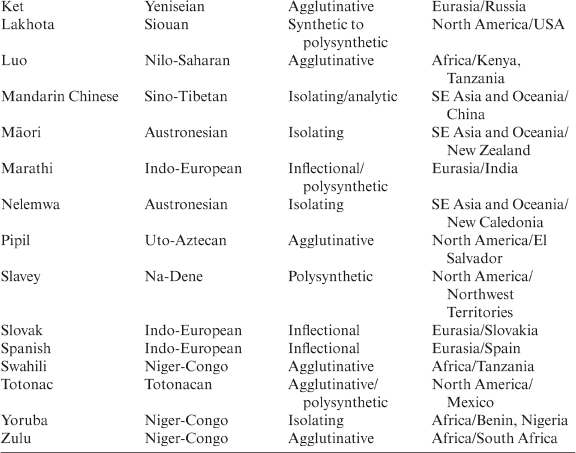
Recursive prefixation is recorded in the languages shown in Table 4.6.

While the identification of prefixes in terms of both form and meaning is usually easy (but cf. 4.1.1 above), the analysis is not always simple and it may influence the assumption of the (non-)existence of recursive prefixation. A case in point is the combination of prefixes mem- and per- in Indonesian:
(55)
- Indonesian
memper-kenal-kann
tr.act-know-tr
‘introduce (somebody)’
Müller (pers. comm.) maintains that, although memper- in cases like (55) can be analyzed as consisting of two prefixes (mem- and per-), it does not follow the usual morphophonemic constraints of the prefix mem-(specifically, the [p] following mem- should elide but it does not). So, if memper- is analyzed as two prefixes, then Indonesian has recursive prefixation, otherwise it does not.
Table 4.7 provides examples for nouns, verbs as well as adjectives, showing that recursive prefixation is bound to the same word-class. While suffixal recursiveness is cross-linguistically most characteristic of nouns, prefixal recursiveness is most typical of verbs.


Recursive prefixation, like simple prefixation, may have class-changing effects:
(74)
- Anejom
awo-nev-edou
cau-qsn-way
‘how to do (something)’
(75)
- French
dés-en-cadrer(un tableau)
neg-in-frame
‘take (a picture) out of its frame’
(76)
- Lakhota
i-wá-na
ˋuprx-prx-hear
‘radio’
 ˋu
ˋu(77)
- Māori
kai-whaka-haere
ag-cau-go
‘organizer’
(78)
- Romanian
ne-des-facut
prx-prx-touch
‘intact, untouched’
This analysis takes into consideration that in some polysynthetic languages it is very difficult to speak about word-classes at all:
(79)
- Clallam
nəsx wčɬɬqčšɬšá
nə-sx w-čɬ-ɬ qčšɬšá
my-cau-adv-affect-fifty
‘Fifty of them got me’
(80)
- Nelemwa
Hli pe-fa-k‚laxi I hli
3dua.rcp-cau-be.ashamed.of-3dua
‘They are making each other mutually ashamed’
Recursive derivational prefixation appears to occur in languages in which there is recursive derivational suffixation, with three exceptions in the study sample: Lakhota, Māori and Yoruba (the last of which does not use suffixation for word-formation processes) show recursive prefixation but not recursive suffixation. Recursive compounding also appears to occur in languages where recursive derivational suffixation occurs and, again, some languages show recursive compounding but not recursive suffixation: Amele and Movima.
4.1.1.2 Base modification in affixation
4.1.1.2.1 Word-formation base modification in suffixation
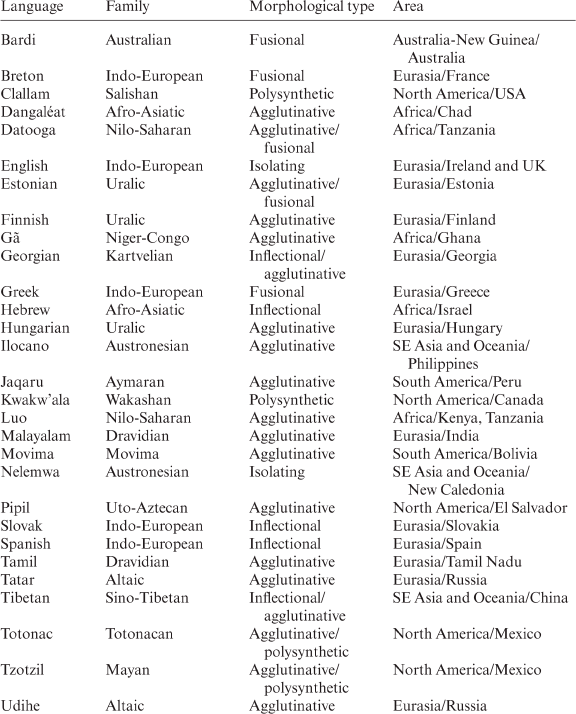
Base modification in suffixation is recorded in the languages shown in Table 4.8.

As in prefixation, the changes are mostly caused by assimilation, but other types of changes are also possible, as in Bardi, where suffixes with o cause vowel harmony, and -n initial suffixes cause trill deletion (rr + n > n)(Bowern, pers. comm.). A range of morphophonological stem modifications within the same language is illustrated by Estonian. Most common changes of the stem during the word-formation process of suffixation in Estonian are shown in Table 4.9.
Table 4.9 Base modification and suffixation in Estonian16

According to Laakso (pers. comm.), some suffixes in another Finno-Ugric language, Finnish, consist (in the traditional analysis) of vowels that replace the stem-final vowel by regular (morpho-)phonological processes, such as the labial vowel in action derivatives (historically going back to a *w suffix):
(86)
(87)
Other suffixes may contain satellite vowels which replace the stem-final vowel:
(88)
- Finnish
koivi-kko
koivu-kko
birch.tree.col
‘birch grove’
(89)
- Finnish
pahe-ne
paha-ne
bad-trn.v
‘get worse’
A characteristic change in the base due to the change of intransitive verbs to transitive verbs by suffixation in Malayalam is consonant gemination. Asher and Kumari (Reference Asher and Kumari1997: 275–6) distinguish five types of gemination:17
(a) the result of doubling k > kk, ʈ > ʈʈ , r > rr: kayar- ‘climb’ vs kayarr- ‘cause to climb’,
(b) a change from double nasal or homorganic nasal + plosive to the corresponding double plosive: ŋŋ > ŋk, mp > pp: kuump- ‘fold-intr’ vs kuupp- ‘fold-tr’,
(c) a change from a lateral to a double plosive: l > ʈʈ, l > rr: cuzȥal- ‘rotate’ vs cuzȥarr- ‘cause to rotate’,
(d) the addition of a double plosive: Ø > tt: poʈʈ- ‘break-intr’ vs poʈʈikk- ‘break-tr’, and
(e) the replacement of one double plosive by another: kk > tt: nilkk- ‘stop-intr’ vs nirtt- ‘stop-tr’.
In principle, stem modifications may be divided into vowel modifications (Table 4.10) and consonant modifications (Table 4.11).


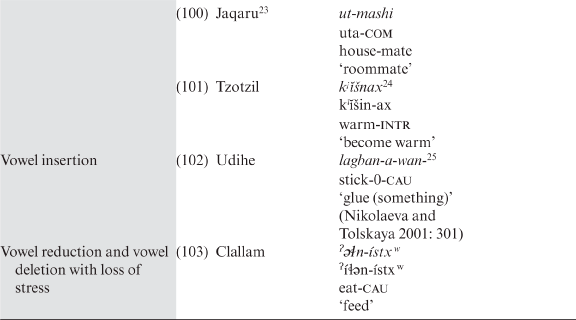
Example (104) from Ilocano shows the influence of suffix in a prefixal-suffixal derivation:
(104)
In (105), the suffix selects the Latin participle emiss- instead of the regular emesso:
(105)
- Italian
emissione
‘emission’
The formation of diminutives is a frequent source of morphophonological change. Example (106) illustrates diminutive formation accompanied by vowel alternation:
(106)
- Tibetan
rtevu
rta-vu
‘horse-dim’


A special variant of vowel change due to diminutive formation is Slovak diphthongization:
(107)
- Slovak
žienka
žen-k-a
‘woman-dim-f.nom.sg’
The category of diminutiveness brings us at the same time to the area of stem consonant changes, because it is a general phenomenon in Slavic languages, as illustrated in Serbian-Croatian and Slovak, but also in some other languages, like Romanian, and in Zulu, where root-medial and final labial consonants become palatal in the diminutive (also in the locative and the passive):
(108)
- Serbian-Croatian
ruč-ic-a
ruk-a
hand-dim-f.nom.sg
‘little hand, handle’
(109)
- Slovak
rúč-k-a
ruka-dim-f.nom.sg
hand-dim
‘little hand’
(110)
(111)
Stem consonant changes are not limited to the category of diminutiveness. Some other cases are shown in Table 4.11.
Table 4.11 Consonant modification and suffixation
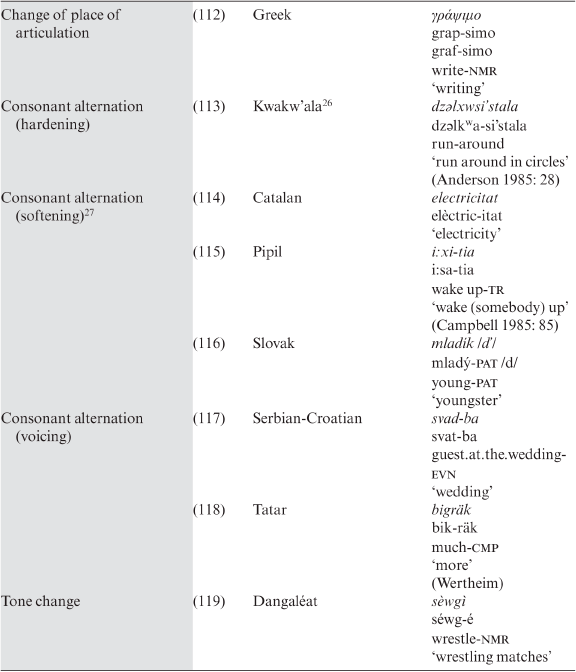
When the Tzotzil suffix -ol ‘act of’ combines with intransitive roots of the shape CVC plus -in, the final n changes to m:
The stem-final /n/ may change to /m/ also in Udihe and the causative suffix changes to -uAn-:
(121)
- Udihe
lagbam-uan-
stick-cau
‘glue (something)’
(Nikolaeva and Tolskaya Reference Nikolaeva and Tolskaya2001: 301)
With certain verbs (Class II), the stem-final /n/ in Udihe merges with suffix-initial /g/ of the repetitive suffix -gi-, which results in -ŋi-:
(122)
- Udihe
ilaktan-ŋi-
ilaktan-gi
appear-ite
‘appear again’
(Nikolaeva and Tolskaya Reference Nikolaeva and Tolskaya2001: 317)
As in Nelemwa prefixation and in Nelemwa suffixation, stem modification mostly concerns phonological lenition, in this case with transitive (123) and with possessive suffixes on nouns (traces of proto-stems)(124), while another example illustrates extension of stem due to suffixation (125):
(123)
- Nelemwa
cawi
cap-I
escape-tr
‘escape from (something)’
(124)
- Nelemwa
jixela-ny
jixet-pos.1sg
rifle-pos.1sg
‘my rifle’
(125)
- Nelemwa
haroon
aroo-n
husband-pos.3sg
‘marry.v’
As in English, suffixes in Spanish and Totonac may cause stress shift. In the latter case, the nominalizing suffix shifts the stress leftwards:
(126)
- Spanish
horroroso /oroɻóso/
horror-oso /oróɻ/
horror-sfx.adj
‘horrific’
(127)
Finally, Romanian shows a combination of vowel and consonant alternations ia ~ ie/ t ~ ţ:
(128)
- Romanian
băiat – băieţel – băieţaş – băieţandru – băieţoi
‘boy – ‘urchin’ – ‘a slip of a boy’ – ‘youngster’ –
‘tomboy, hoyden’
4.1.1.2.2 Word-formation base modification in prefixation
Base modification in prefixation is recorded in the languages shown in Table 4.12.
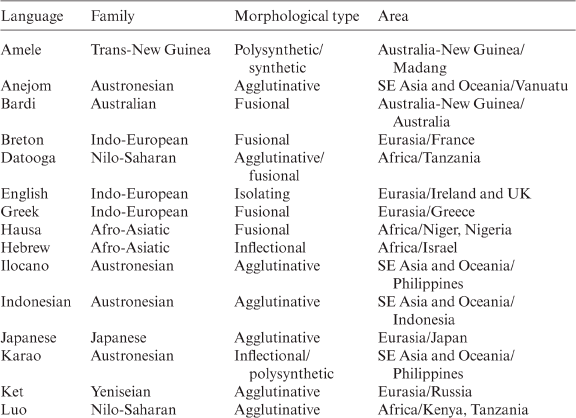

While prefixation with base modification is reportedly rare in Catalan, English, Hebrew and Russian, it is frequent in other languages, like Datooga, and occurs systematically in Breton, because it participates in the system of mutations (Stump, pers. comm.):
(129)
- Breton
digoulouma~n
di-koulouma~n
‘un-tie’
In Afrikaans, the only change in the base is orthographic: capitalization disappears in the names of languages after prefixation:
(130)
- Afrikaans
ver-afrikaans
vr-Afrikaans
‘make Afrikaans’
According to Carstens (pers. comm.), any other changes in the base are not a result of the prefix with which it combines, but a coincidental occurrence where fossilized ablaut has become associated with the use of a prefix in a particular complex word:
(131)
The changes recorded are of diverse nature and seem to be highly language-specific, often even affix-specific. Müller (pers. comm.) remarks that, although some processes may exist and indeed be very productive, they may be so only for a very small number of affixes. Müller illustrates this observation with an example from Indonesian, where morphophonemic alternation of the stem when adding a prefix occurs productively with the various allomorphs of the prefixes peng- and meng-, but not with any other Indonesian prefixes:
(132)
- Indonesian
mem-egang
meng-pegang
tr-hold
‘take hold of’
In Slavey, the changes bear on the voicing alternations of stem-initial fricatives determined by the immediately preceding prefix. The so-called D-effect combines a prefix d- with a stem-initial fricative or glottal stop.
As noted by Brainard (pers. comm.), Karao displays a set of complex morphophonological alternations in connection with prefixes and infixes. The processes are governed by the canonical shape of the affix and the root and may affect both the affix and the root. If the canonical shapes of the affix and root are eligible to undergo a particular process, then the process will automatically apply.28 Thus, when a prefix ending in N attaches to a root beginning with a CV (C) syllable, N assimilates to the same point of articulation as the root-initial consonant, and the root-initial consonant is then deleted. When e- attaches to a root beginning with a CeCV (C) root, the prefix changes to iya-, e is deleted and the root-initial consonant changes to its syllable-final allomorph (if it is different):
(133)
- Karao
ena-cha
eN-cha-cha
ag-help
‘help.v’
(134)
- Karao
iyalpek
e-depek
pas.real-wet
‘be wet’
In Bardi, all (C)V- prefixes cause changes in obstruent-initial roots and there is also a set of complex cluster reduction rules (Bowern, pers. comm.):
In Zulu, the root -mb- ‘dig’ becomes -emb- after a prefix ending in -a:
(136)
- Zulu
basemba
ba-sa-mb-a
‘They are still digging’
The vowel -a of the prefix falls away before e- and so (as assumed by van der Spuy, pers. comm.) this situation could be alternatively interpreted as the root changing a preceding -a to -e. However, there are only about five roots in the language that display this phenomenon. Other changes are shown in Table 4.13.
Table 4.13 Prefixation and base modification

4.1.2 One-to-many relation in affixation
The title of this section avoids speaking about polysemy/homonymy of affixes, because it is often unclear which of the two is present.34 In many cases, the borderline is fuzzy. Owing to the absence of clear criteria for the distinction between polysemy and homonymy in general and between polysemy and homonymy of affixes in particular, these cases are considered here as a combination of a single form with several meanings, without examining the degree of semantic relatedness which may lead to an interpretation as polysemy or as homonymy.
The one-to-many relation in prefixation is recorded in the languages shown in Table 4.14.
Table 4.14 One-to-many relation in prefixation in the study sample

The one-to-many relation in suffixation is recorded in the languages shown in Table 4.15.
Table 4.15 One-to-many relation in suffixation in the study sample

As with any other phenomenon, the degree and the extent of the one-to-many relation between form and meaning varies cross-linguistically. In Greek, Ket and Zulu it is rare, in Georgian suffixes tend to show one-to-one correspondence between form and meaning,35 and in Gã and Nelemwa each prefix and suffix has a single meaning, with the exception of the middle-reciprocal Nelemwa prefix pe-, which features significant polysemy/homonymy, as shown in Table 4.16 (Bril Reference Bril2005: 42), and of the gerundive Gã suffix -mO, which can form a gerundive but also derive an iterative/pluractional form of the verb (145).
(145)
Various semantic differences/semantic shades of pe-(collective (146), reciprocal (147) and spontaneous action (148)) are possible (Bril Reference Bril2005: 42):
(146)
(147)
(148)
In Mandarin Chinese, the one-to-many relation seems to be restricted to some verbal prefixes which have a basic (149) and an extended meaning (150):
(149)
- Mandarin Chinese
死別
sĭbié
die/death-part/be.parted
‘be parted by death’
(150)
- Mandarin Chinese
死等
sĭděng
death-wait
‘wait interminably (to the death)’
This is common in other languages too. Thus, in Hausa the most productive polysemantic/homonymous prefix is ma-, which derives agentive (151), instrumental (152) and locative nouns (153):38
(151)
- Hausa
maà-ikàc-ī
ag-work-m.sg
‘worker’
(152)
- Hausa
ma-girbī
‘harvesting tool’
(153)
- Hausa
majēmā
‘tannery’
The polysemy/homonymy of affixes has been widely discussed in the literature on Indo-European languages, especially in relation to the categories agent, instrument and, partly, location. To these categories, the category patient, defined as a ‘bearer of state’, should be added. The difference between agent and patient nouns is thus one between action and state, i.e. between the features [+ dynamic] and [– dynamic].
Table 4.16. Meanings of Nelemwa pe- in relation to the lexical category of the root

The following examples illustrate that the one-to-many relation between the form and the meaning of affixes in relation to the four semantic categories above is not restricted to Indo-European languages. A trivial condition for such a relation is the existence in a language of suffixation and/or prefixation processes. However, it should be noted that a similar kind of overlap can also be found in the relation between agents and patients formed by compounding, as illustrated by Cirecire (154) and Vietnamese (155):
(154)
- Cirecire
cóõ-coo
herbs-coo
‘doctor’
(155)
- Vietnamese
-
ŋɯəj21 dɯək31? fawŋm313 vən35
người được phỏng vần
human-pas-interview.v
‘interviewee’
(Thái Ân)
In Vietnamese, được is used to express passive meaning and functions as a constituent morpheme forming patient nouns. Since, however, its presence is not always necessary, an agent noun may look like a patient noun.
Otherwise, the affixal overlap does not seem to be restricted geographically or genetically. This is an important indication also in terms of what was pointed out by Rainer (Reference Rainer, Booij, Guevara, Ralli, Sgroi and Scalise2005: 29), in particular, that ‘we still don’t have even an approximate idea about how frequent our polysemy really is in the languages of the world’. This is largely due to the lack of research and relevant data in this field. Rainer (Reference Rainer, Booij, Guevara, Ralli, Sgroi and Scalise2005) provides a summary of the approaches to this problem, including a diachronic–synchronic discussion of agentive and instrumental nouns where he refers to several possible sources of the formal identity of agentive, instrumental and locative suffixes, notably reinterpretation and approximation,39 both based on semantic shift, and instances of non-semantic motivation, in particular ellipsis, homonymization and borrowing. Table 4.17 illustrates the multiplicity and diversity of one-to-many relations in the categories agent, patient and instrument across the languages of our sample.40

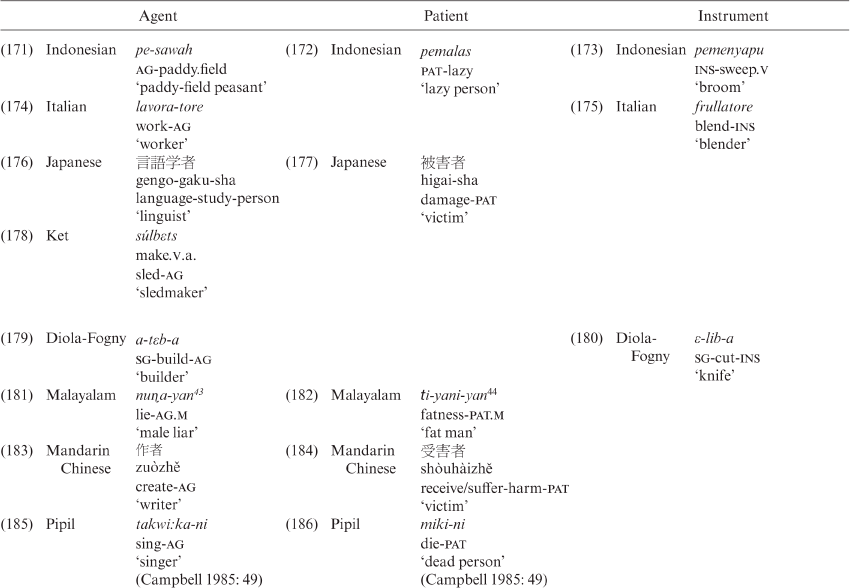
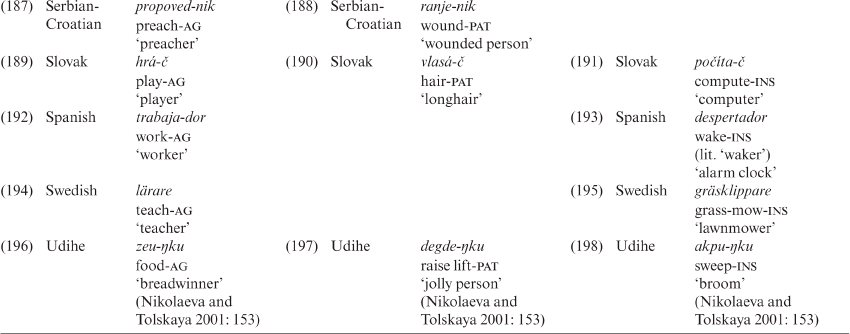
The complete series along with location can be observed in (199a) to (199d):
(199)
- Tzotzil
a. j-?ábtel
ag-work
‘worker’
(Cowan Reference Cowan1969: 109)
b. j-chamel
pat-sickness
‘a sick person’
(Haviland Reference Haviland1980)
c. k!áxan-eb < *k!áxan
harvest.it-ins
‘harvesting instrument’
(Cowan Reference Cowan1969: 105)45
d. váy-eb
sleep-loc
‘place for sleeping, bed’
(Cowan Reference Cowan1969: 105)
It seems from this brief overview that the one-to-two and even one-to-three relations between form and meaning of affixes have few geographic or genetic restrictions. The data also seem to suggest that it is the category agent (rather than patient) which conditions the existence of polysemantic/homonymous instrumental affixes, as there are no instances in our sample of patient/instrument polysemy/homonymy with no agent in this relation. On the other hand, the patient’s absence in the one-to-many relation between agent/instrument is quite common.
The one-to-many relations between form and meaning in word-formation are not limited to the above categories. The following reviews the diversity of one-to-many relations in some languages, first in suffixation and then in prefixation.
In general, the range of combinations of meanings bound to a single suffixal form in Estonian is large. However, according to Kilgi (pers. comm.), there are three groups of suffixes in Estonian:
(a) suffixes which have only one meaning,
(b) suffixes that have mostly one meaning but may have more than one, and
(c) suffixes that have a very general meaning (Table 4.18).
Table 4.18 One-to-many relation in Estonian suffixes

Similar tables could be designed for a number of languages: Finnish -iö combines the meanings of location (209a) and individual (209b)(Koivisto, pers. comm.):
(209)
- Finnish
a. keitt-iö
cooking-sfx
‘kitchen’
b. el-iö
live-sfx
‘organism’
Hebrew ון -on may express diminutive-derogatory (210a), periodical (210b), collection (210c) or other meanings (210d):
(210)
Hungarian -gat/-get combines iterativity (211a) and diminutiveness (211b):
(211)
- Hungarian
a. nyit-ogat
open-ite
‘open repeatedly’
b. dolgoz-gat
he.works-dim
‘go on working slowly’
Italian -ino combines the meanings of relational adjective (212a), diminutiveness (212b) and instrument (212c):
(212)
- Italian
a. sal-ino
salt-rel
‘saline’
b. tavol-ino
table-dim
‘small table’
c. spazz-ino
sweep-ins
‘road-sweeper’
Breton -enn has a range of uses: it is usually a singulative suffix (213a), but can also be used to name a countable unit of a substance named by a mass noun (213b), to name a particular object made of a substance (213c) or to name an expanse consisting of a substance named by a mass noun (213d):
(213)
The Malayalam infinitive suffix -uka(and its variants -a, -ka, -ika) can also have a nominalizing function and form verbal nouns, as in (214), where the verbal noun functions as subject of a sentence (Asher and Kumari Reference Asher and Kumari1997: 385):
(214)
The following examples from Russian are parallel to the notorious case of English -er:
(215)
- Russian
a. утр-ен-ник
utrennik
morning-lnk-sfx
‘matinee’
b. дн-ев-ник
dnevnik
day-lnk-sfx
‘diary’
c. началь-ник
nachal’nik
begin-ag
‘chief’
d. нoч-ник
nochnik
night-ins
‘night lamp’
While in Zulu (van der Spuy, pers. comm.) suffixes usually have only one meaning, there are exceptions: -is-(causative) means ‘make (somebody) do (something)’, but it can also mean ‘help (somebody) do (something)’; similarly, -el ‘on behalf of’ can also mean ‘in the direction of’:
(216)
- Zulu
w-a-gijim-el-a e-ndl-ini
‘He ran into the house’
Swahili illustrates the homonymy of an agentive (217a) and a negative present tense suffix (217b):
(217)
- Swahili
a. m-wind-i
n.class.prx.1-hunt-ag
‘hunter’
b. h-a-wind-i
neg-3sg.sbj-hunt-neg.prs
‘S/he does not hunt’
Finally, the following examples of Wichí combine stative (218a) and locative (218b):
(218)
- Wichí
a. o-awanta-hi
3sbj-to bear-sta
‘S/he bears’
b. o-yukwaj-hi
3sbj-bite.v-loc.in
‘S/he chews’
Prefixation also provides ample examples of diverse combinations of meanings. The following examples from Karao illustrate this point in relation to the fuzzy nature of the relation between inflection and derivation:
(219)
- Karao
a. pan-dotho/impan-dotho
nmr-cook
‘act of cooking, time of cooking’
b. pan-chinel-an mo-ak
ite-depend.on-ipf.pat erg.2sg-abs.1sg
‘You can always depend on me’
c. pan-apal taha
ipf.cau.pat-jealous 1sg/2sg
‘I will make you jealous of each other’
d. pan-dotho ka!
imp-cook abs.2sg
‘Cook!’
Acording to Stump (pers. comm.), the Breton prefix di- can be negative (220a), privative (220b) and reversative (220c) and em- can express reciprocity (221a) and reflexiveness (221b):
(220)
(221)
- Breton
a. em-gav49
rcp-find/meet
‘rendez-vous’
b. em-laz
rfl-kill
‘suicide.v’
The combination of reciprocity and reflexiveness is quite common cross-linguistically. It also characterizes the Karao verbal prefix man-/iyan-(intransitive form)(222a) and (222b) and the Wichí prefix lhi-, which indicates co-referentiality between subject and object like a reflexive (223a) and reciprocity, if the plural suffix is added (223b):
(222)
- Karao
a. manbakal
man-bakal
ipf.ag/pat-fight
‘fight each other’
b. manna-mes
man-na-mes
ipf.ag/pat-bathe
‘bathe oneself’
(223)
- Wichí
a. n’-lhi-w’en
1sbj-rfl-see
‘I see myself’
b. n’-lhi-w’en-hen
1sbj-rcp-see-pl
‘We see each other’
The reflexive-reciprocal combination of meanings is also a common feature of derivation in Slavic languages like Czech, Russian or Slovak, and it may be postulated to be one of the most regular types of the derivational one-to-many relation:
(224)
- Slovak
a. umývať sa
‘wash oneself’
b. nenávidieť sa
‘hate (each other)’
On the other hand, in Marathi, the prefix उप- upa- can express various semantic shades of secondariness, as in (225a) and (225b), and the prefix  र- gaira- may express semantic shades of negation, as in (226a) and (226b):
(225)
- Marathi
a. उप-आ
कupa-ayukta
‘deputy-commissioner’
b. उप-
मupa-naama
‘second/alternative-name’
 क
क म
म(226)
- Marathi
a.
र-हजरgaira-hajara
‘not present, absent’
b.
र-परgaira-vaapara
‘wrong-use’
 पर
परIn Pipil (Campbell Reference Campbell1985: 77ff.), the prefix ta- can express ‘unspecified object’ referring to a (non-human) object of a transitive verb, especially if the focus is on the verb and the object is of little relevance (227a), reduplicated ta-(with an additional h) is used productively for repetitive action (227b) and also with nouns derived from transitive verbs (227c):
(227)
- Pipil
a. ni-ta-hkwilua
I-something-write
‘I write (something)’
b. tah-taketsa
rdp-talk
‘chat.v’
c. ta-chalis
ta-chiya
nmr-look
‘sight’
Finally, the following examples are illustrative of an extremely rich polysemy/homonymy of prefixes in Slavic languages. Slovak pre- can express perfectiveness/completion of action (228a), excessiveness (228b) or change/modification (228c) and the Serbian-Croatian suffix ne- may express negation (229a), oppositeness (229b), evil (229c) or inconvenience (229d):50
(228)
- Slovak
a. pre-piť
cpl-drink
‘drink away’
b. pre-soliť
exc-salt
‘oversalt.v’
c. pre-hodnodiť
chn-evaluate
‘re-evaluate.v’
(229)
- Serbian-Croatian
a. ne-puš-ač
neg-smoke-ag
‘non-smoker’
b. ne-red
neg-order
‘disorder’
c. ne-delo
neg-deed
‘crime’
d. ne-doba
neg-time
‘bad time, wrong moment’
4.1.3 Many-to-one relation in affixation
This section examines the opposite relation between form and meaning, in particular, the existence of variants of affixes used in word-formation. A discussion on synonymy of affixes is also included in chapter 6. It is illustrated with numerous examples of both rival affixes and rival word-formation processes which can be used to express various semantic categories. The many-to-one relation in prefixation is recorded in the languages shown in Table 4.19.


The many-to-one relation in suffixation is recorded in the languages shown in Table 4.20.


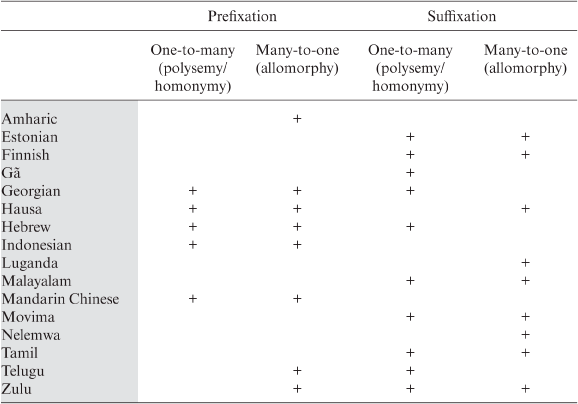
Two interesting conclusions can be drawn from Table 4.19 and from Table 4.20: one is that the many-to-one relation between form and meaning appears to be more frequent than the opposite relation, and the other is that there is a conspicuous analogy between prefixes and suffixes in both of the examined relations.
4.1.3.1 Suffixation
The most frequent reason for the existence of suffix variants is phonological conditioning (assimilation). Thus, in Estonian a suffix beginning with a vowel cannot be added to a vowel-final stem. Therefore, the stem is often shortened (230) and, if the stem is too short to be shortened, other variants of the suffix are used, such as -mus, -dus, -vus, -tus(Kilgi, pers. comm):
(230)
Another example of assimilation shows that, in Udihe, with certain verbs (Class II), the stem-final /n/ merges with the suffix-initial /g/ of the repetitive suffix -gi-, which results in -ŋi-(Nikolaeva and Tolskaya Reference Nikolaeva and Tolskaya2001: 301):
(231)
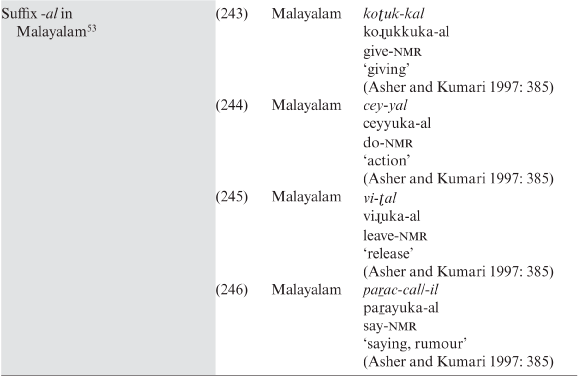
Further examples of this phenomenon are shown in Table 4.21. They illustrate a number of phonologically conditioned forms in Belorussian ((232) and (233)), Estonian ((239) and (240)) and Malayalam ((243) to (246)) or different realizations of suffixes according to what precedes and/or follows them (Luo (236) to (238)):

Dissimilation is sometimes at play as well. Cowan (Reference Cowan1969: 99, 101) shows that the variants of the Tzotzil intransitivizing suffix -ub ‘developmental’ and the transitivizing suffix -Vn are controlled by the dissimilation principle: the former suffix appears as -ib if the stem contains a back vowel and as -ub after other vowels. But when the stem vowel is o, the suffix vowel is also o(247). The latter suffix occurs with i after back vowels of root and with u after others (248):
(247)
- Tzotzil
a. p!ĭx-ub
wise-intr
‘become wise’
b. kúš-ib
rust, mould-intr
‘rust.v, mould.v’
c. šók-ob
šókol-ub
empty, unoccupied-intr
‘be unoccupied’
In Jaqaru, variants of suffixes result from systematic vowel-drop in combination with certain other suffixes following them. Hardman (Reference Hardman2000: 90) explains that ‘all suffixes with two vowels will drop at least one of the vowels in most constructions’. An example with the diminutive suffix -uña is given below:
(249)
- Jaqaru
utxitx t”ak-uñ-cha-qa
‘It is a little tiny road’
Swahili provides an example of allomorphy due to the opposition of vocalic vs consonantal environment. In Contini-Morava’s examples, the variants illustrate post-vocalic allomorphy in the applicative suffix combined with the vowel-harmony principle:
(250)
- Swahili
fik-ish-i-a
arrive-cau-app-ind
‘cause to arrive for (somebody)’
(251)
- Swahili
chuku-li-a
carry-app-ind
‘carry for (somebody)’
This brings us to another source of suffix variants, such as vowel harmony, which is typical of agglutinative languages. The following examples come from Hungarian:
(252)
- Hungarian
a. költöz-és
költözni-és
remove-nmr
‘removal’
b. ollóz-ás
ollóz-ás
plagiarize-nmr
‘plagiarism’
(253)
- Hungarian
a. barát-ság
friend-stt
‘friendship’
b. pék-ség
baker-loc
‘bakery’
Pipil illustrates an influence of an affix upon the form of another affix. In particular, the short variant of the adjectival suffix -a:wa-k/-a-k occurs in combination with the following suffix. From the inchoative verb we get the adjective chipa:wa-k ‘clear’ where -wa is an inchoative suffix. If the suffix -nah is attached, the long suffix -a:wak is reduced to -ak(Campbell Reference Campbell1985: 62).
Another source of suffixal variants is the so-called Rhythmical Law. This law imposes a requirement upon Slovak words to avoid two long syllables next to each other. The operation of the law is illustrated for the agentive suffix variants -ík(long variant) in (254a) and short -ik(short variant) in (254b):
(254)
- Slovak
a. rečn-ík
speak-ag
‘speaker’
b. básn-ik
poem-ag
‘poet’
In Zulu, there is a co-existence of a productive variant -kazi(phonologically identical with the augmentative) and a rare unproductive variant allomorph -azi:
Finally, Stump (pers. comm.) points out that several Breton suffixes participate in alternations of the form X ~ iX with lexical conditioning, though with some partial phonological regularities:
(256)
- Breton
a. gaou-iad
lie.n-sfx
‘lying’
b. hegar-ad
affable-sfx
‘amiable’
(257)
- Breton
a. ober-iant
do-sfx
‘active’
b. beg-ant
point-sfx
‘pointed’
There are also unpredictable variants. Cowan (Reference Cowan1969: 98ff.) illustrates this possibility with one of eight intransitivizing suffixes used in Tzotzil. This suffix is based on the combination of a V (owel) and x, where V is realized unpredictably as a, e, i, o or u:
(258)
- Tzotzil
a. tšáp-ax
roll it up56-intr
‘be taken care of, have affairs arranged by officials’
b. nát-ex
tall-intr
‘grow tall, long’
c. k!óp-ox
language-intr
‘talk’
The last example, taken from Dutch, is of similar flavour. At the same time, it demonstrates how complex the relation between variants of a morpheme may be in word-formation. Don (pers. comm.) refers to De Haas and Trommelen (Reference de Haas and Trommelen1993: 298), for whom the distribution of ‘-lijk and -elijk is not fully complementary and hence also not fully predictable’.57 De Haas and Trommelen discuss five tendencies which are summarized by Don as follows:
(a) after a stem-final syllable containing schwa, we get -lijk: open > openlijk, *openelijk ‘openly’,
(b) after a stem-final plosive we get -elijk: hoop > hopelijk ‘be hoped’,
(c) after a fricative there is preference for -elijk: stof > stoffelijk ‘material’(but also forms in -lijk are found after fricatives),
(d) after a stem-final long vowel followed by a nasal or liquid, we find -lijk: natuurlijk ‘natural’, and
(e) after a stem-final diphthong or glide, we usually get -elijk: vrouwelijk ‘female’.
4.1.3.2 Prefixation
As with suffixal allomorphy, the dominant reason for the existence of prefixal allomorphs is phonological conditioning. In Hausa, ma- often assimilates to /mu/ when the vowel in the following syllable is /u/(259). Some patronymic prefixes in Totonac also have variant forms, as in (260) and (261):
(259)
(260)
- Totonac
laka-/laʿha-
‘face’
(261)
- Totonac
aʿk-/aʿh-/kuk-/hoh-
‘head’
Phonological condition applies also in the transitive active verbal prefix me- in Indonesian (Mojdl Reference Mojdl2006: 46–8). It exists in five different variants depending on the stem-initial phoneme:
(a) the variant mem- is used before stem-initial -b-, -p- and -f-, as in mempakai ‘wear’,
(b) the variant men- is used before stem-initial -t-, -d-, -c- and -j-, as in mencari ‘look for, find’,
(c) the variant meng- is used before stem-initial -k-, -g-, -h- and before a vowel, as in mengolah ‘cheat.v’,
(d) the variant meny- is used before stem-initial -s- and -sy-(the initial -s- and -sy- is dropped), as in menyewa ‘rent.v’(from sewa ‘rent.n’), and
(e) the variant me- is used before -m-, -n-, -ng-, -ny-, -l-, -r-, -w- and -y-, as in melompat ‘jump.v’.
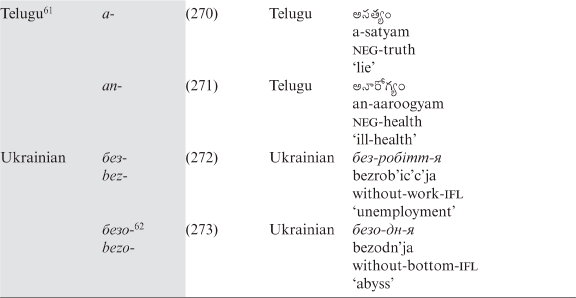
Phonological conditioning occurs in other languages, too (see Table 4.22).

The following example of Breton shows a different type of phonological conditioning in which, unlike the prototypical cases of phonological conditioning, there is no complementary distribution of the allomorphs:
(274)
- Breton
a. ken-vreur
together-brother
‘fellow member’
b. kevlusk
together-movement
‘commotion’
Stump (pers. comm.) explains that the alternation in the prefix ken-/kev- is phonologically conditioned in a rather weak sense: ken- can appear with essentially any stem and kev- appears with stems beginning with oral sonorant sounds. Similarly, the alternation in the prefix ad-/as- is phonologically conditioned in a weak way: ad- can appear with essentially any stem and as- appears with stems beginning with voiceless obstruents. In neither instance is the distribution complementary: ken-, like kev-, can precede an oral sonorant and ad-, like as-, can precede a voiceless obstruent. In this way, as noted by Stump, they are reminiscent of im-/in-(with the meaning ‘in’) in English: im- precedes bilabial sounds (import, immigrate), while in- precedes any sort of sound, including bilabials (inmate, input).
This leads to free variants, as exemplified by the Afrikaans prefix dis-. The choice between the two variants is reportedly arbitrary:
(275)
- Afrikaans
dis-infekteer
des-infekteer
‘disinfect’
Another important factor is stress. In Clallam, unstressed schwas tend to be deleted (Montler, pers. comm.):
(276)
- Clallam
nsƛ
ˀnə-s-ƛ’eʹˀ
my-nmr-like
‘I like it’
 ˀ
ˀAnother different type of allomorphy, i.e. other than phonologically conditioned, is illustrated by Tzotzil: according to Cowan (Reference Cowan1969: 109), the allomorph ax- of the prefix x- occurs after a pronoun:
(277)
- Tzotzil
a. x-?ábtel
ag-work
‘worker’
b. k ax-?ábtel
‘my hired help’
The following example from Zulu (van der Spuy, pers. comm.) shows a word-class-conditioned selection of allomorphs. Zulu adjectives and certain adverbial forms can be used as predicates. There, the prefix sa- ‘still’ is combined with verbs (278a) and se- with non-verbal predicates (278b):
(278)
- Zulu
a. si-sa-sebenz-a
we-still-work-v
‘We are still working’
b. si-se-khona
we-still-here
‘We are still here’
A completely different condition for the existence of variants of a prefix is mentioned by Hudson (pers. comm.): the use of the causative prefix a-/as- in Amharic is determined by the category of transitivity such that a- is used for intransitives and as- for transitives (however, with many exceptions):
(279)
- Amharic
a.
afälla
a-fla
cau-boil
‘He boiled’
b.
as-fällägä
as-flg
cau-seek
‘It made seek (~was necessary)’


The relations between the asymmetric form-meaning prefixal relations and the influence of prefixation on the form of the word-formation base are very diverse (see Table 4.23).
Table 4.23 Prefixation vs suffixation: discrepancies between one-to-many and many-to-one relations
4.1.4 Suffixation, prefixation and word order
Croft and Deligianni (2001) maintain that, cross-linguistically, the VO and OV word orders are found in approximately half of the world’s languages and are equally likely.63 However, our sample is characterized by a dominant position of the VO type. The OV word order is recorded in the languages shown in Table 4.24(25.45 per cent of the study sample).64
Table 4.24 The OV word order in the study sample
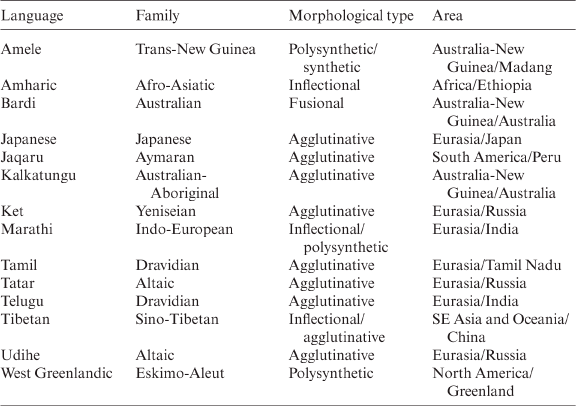
The VO word order is recorded in the languages shown in Table 4.25(52.73 per cent of the study sample).


One of the first achievements of extensive typological research in the second half of the twentieth century was an observation that inflectional prefixes are bound to languages with the default VO word order while suffixes occur in both VO and OV languages (cf., among others, Hawkins and Gilligan Reference Hawkins, Gilligan, Hawkins and Holmback1988: 219). Grandi and Montermini (Reference Grandi, Montermini, Booij, Guevara, Ralli, Sgroi and Scalise2005: 144) extended this assumption to derivational morphology, suggesting that prefixes may also occur in OV languages ‘although they are rarer than in VO languages’. The relation between word-formation processes and word order is analyzed in chapter 7.
4.2 Minor types of affixation
Minor word-formation processes may be labelled as less natural or even unnatural from the perspective of Natural Morphology. Conversion (5.1.1), derivation by stress (5.1.2) and tone/pitch change (5.1.3) are characterized by the absence of diagrammaticity (constructional iconicity) or even by anti-diagrammaticity, as in the case of subtracting techniques (back-formation, 5.2.1). Some of those processes are viewed in chapter 5, but we also include here those word-formation processes which violate the integrity of morphemes, either stem morphemes (infixation, 4.2.1), or derivational morphemes (like circumfixation, 4.2.3), or which produce new words by adding derivational material at two different points (prefixal-suffixal derivation (4.2.2) and prefixal-infixal derivation and infixal-suffixal derivation (4.2.4). Dressler (Reference Dressler and Dressler1987) predicts that these word-formation processes should be less frequent cross-linguistically than natural word-formation processes like prefixation, suffixation and compounding. Figure 7.1 confirms this in our sample (cf. 7.2).
4.2.1 Infixation
Moravcsik (2000: 546) defines a prototypical infix as an affix which is positioned inside the base such that the preceding and following portions are not meaningful by themselves. Moravcsik also mentions a number of peripheral types of infixation, such as those in which an infix is a free form or, instead of violating the integrity of the base, is inserted between two morphemes of the base. Infixation is recorded in the languages shown in Table 4.26(25.45 per cent of the study sample).
Table 4.26 Infixation in the study sample

Infixation has been described in the literature as chiefly derivational (Ultan Reference Ultan and Seiler1975: 160; Bybee Reference Bybee1985: 97). This is understandable because derivational infixes reflect ‘the closer semantic link between base and derivational affix than what holds between base and inflectional affix’(Moravcsik 2000: 548). In other words, inflectional morphemes serve to express grammatical relations between words, and placing them inside a word-base would mean an obstacle for this function. As usual, the picture is not completely clear in this respect. Thus, if transfixation (root-and-pattern) is viewed as a case of infixation, then infixation is productive in Arabic and Hebrew, where it would also cover inflectional processes.
The importance of laying emphasis on the word-formation nature of the infix follows from its definitions. Thus, Krupa and Genzor (Reference Krupa and Genzor1996) define infix in their encyclopedic book on languages of the world as a grammatical or derivational morpheme inserted in a word root. Similarly, the morphematic dictionary of Slovak (Sokolová, Moško, Šimon and Benko 1999: 48) defines infixes as extending morphemes, either grammatical (i.e. thematic submorphemes) or derivational (interfixed submorphemes) which can be attached in two different ways: they extend a grammatical or a derivational morpheme (Buzássyová, pers. comm.):
(280)
(281)
(282)
An interesting borderline case is offered by Wichí. According to Nercesian (pers. comm.), there are no infixes in Wichí. However, a root can be interrupted by a suffix and behave like an infix. Such is the case when a suffix, generally indicating direction, is co-lexicalized with root, but if any other suffix (e.g. plural) is added, then it occurs between the root and the co-lexicalized suffix:
(283)
- Wichí
a. ta-taypho
3sbj-sits.down
‘S/he sits down’
b. ta-ta. . .-che. . .pho
3sbj-sit down. . .-pl
‘They sit down’
An infix, like other affixes, is a bilateral unit with form and meaning. It must be distinguished from interfixes (empty morphs), as the latter ‘regularly intervene between stems and derivational suffixes or between two stems in composition, are not associated with any particular semantic or grammatical value, and are very often optional, as for instance, the morph -et- in Spanish lam-et-ón or the morph -s- in German Verfassung-s-treue’(Laca Reference Laca, Haspelmath, König, Oesterreicher and Raible2001: 1220–1). Szymanek (Reference Szymanek, Lieber and Štekauer2009) shows that interfixes, too, can play an important role in word-formation by being an inherent part of productive word-formation rules (albeit a formal one). This is characteristic of the so-called interfix-suffixing derivation and interfix-paradigmatic derivation. In the former, an interfix and a suffix together function as exponents of the category (Szymanek Reference Szymanek, Lieber and Štekauer2009: 468). Examples can be cited for Polish (284) and also for Czech (285) and Slovak (286):
(284)
- Polish
prac-o-daw-ca
praca-o-dawaċ-ca
job-itx-give-ag
‘employer’
(285)
- Czech
zákon-o-dár-ce
law-itx-give-ag
‘legislator’
(286)
- Slovak
nosorožec65
nose-itx-horn-pat
‘rhinoceros’
Sometimes, as observed by Szymanek (Reference Szymanek, Lieber and Štekauer2009: 469) the gender of the compound may differ from that of the head word when used separately. This, in turn, means that the compound belongs to a different inflection class. In that case, the word-formation process is labelled as interfix-paradigmatic:
(287)
- Polish
wod-o-głow-ie [+ntr]
woda-o-głowa-f
water-itx-head-ifl
‘hydrocephalus’
A slightly different example comes from Slovak, where the formation is of the same gender as the head constituent slov-o ‘word’([+neuter]), but the declensional paradigm changes:
(288)
- Slovak
tvar-o-slov-ie
form-itx-word-ifl
‘inflectional morphology’
Finally, the interfix also plays its role of formal indicator of compounding in formations whose second constituent is a converted deverbal noun with a zero marker of the nominative singular. Two of Szymanek’s examples (2009: 469) are:
(289)
- Polish
kork-o-ciag-ø
korek-o-ciagnąċ
cork-pull
‘corkscrew’
(290)
- Polish
śrub-o-kręt-ø
śruba-o-kręciċ'
screw-twist
‘screwdriver’
In many cases, the converted unit does not exist independently, e.g. *mierz or *kręt. There are also analogical formations in Slovak and other Slavic languages:
(291)
(292)
- Slovak
blesk-o-zvod-ø67
blesk-o-zvod
lightning-conductor,lead
‘lightning conductor’
A limited use of infixation in the languages of the world may be explained by the universal preference for morphotactic transparency, in particular, by the preference for continuous (rather than discontinuous) morphemes (Dressler Reference Dressler, Štekauer and Lieber2005: 273). It is probably for this reason that there are no languages which make use of infixation without employing prefixation or suffixation (Greenberg Reference Greenberg and Greenberg1963). From this it follows that, if a language makes use of infixation, it may also be expected to employ prefixation and/or suffixation in word-formation (cf. Plank Reference Plank2007: 58). Exceptions to this assumption include Yoruba, which uses infixation but not suffixation, and Tatar, which uses infixation but not prefixation.
4.2.1.1 Formal characteristics
It has been shown that infixes invariably appear near one of the edges of a root, a stem or a word (Yu 2003, 2007).68 Yu calls this the Edge-Bias Effect, and it has been explained diachronically by Plank (Reference Plank2007: 59–60): infixes developed from adfixes primarily by phonological reordering in order to optimize prosodic structures.69
According to Ultan (Reference Ultan and Seiler1975: 164–8), it is primarily the beginning of the base that serves for infixation. This clearly follows from the hierarchy of infix positions identified by Ultan according to frequency.70
The limited data on infixation available in the sample do not allow conclusions to be drawn on the formal and semantic patterns of infixing derivation. In principle, the data follow Ultan’s (1975: 162–4) and Moravcsik’s (2000: 547) observations that infixes seem to prefer to involve at least one consonant, and that the participating consonants tend to be sonorants, i.e. liquids and nasals and glides. The vowels, according to Ultan, are usually short and are mainly high or central.
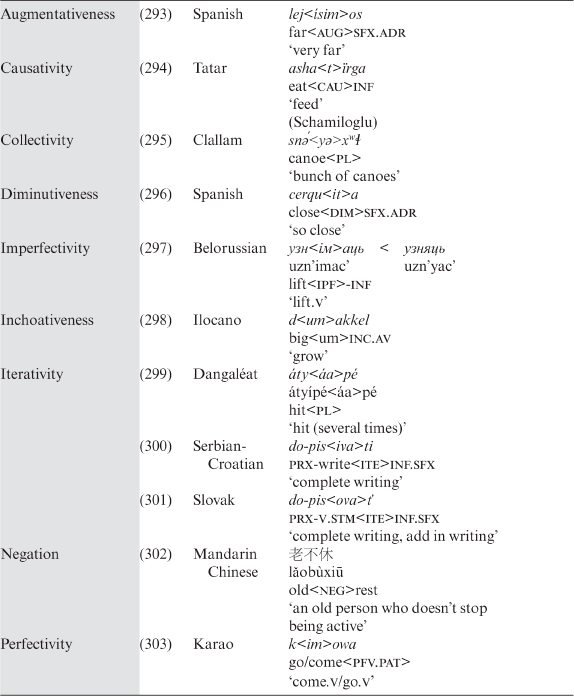
Ultan (Reference Ultan and Seiler1975: 162–4) also identifies C, CC, CV and VC as the most frequent infix structures, and the data also support this expectation. While our sample provides examples of various formal structures of infixes, the most frequent are structures with a consonant, especially the VC structure with a nasal or liquid (cf. the relevant examples of infixes in Belorussian -im-, Ilocano -um-, Indonesian -el- and Karao -im-), but other types of consonants also occur in this infix structure type, e.g. plosives, as in Spanish (-it-). Other structures include CV with a glide, as in Clallam (-yə) and a plosive, as in Mandarin Chinese (-bù-), VCV (with a fricative consonant), as in Serbian-Croatian (-iva-), single consonant (glottal stop in Clallam and -t- in Tatar), VCVC in Spanish (-isim-) and two (low) vowels, as in Dangaléat (-áa-).
As to word-classes, verbal infixation clearly dominates, but the semantics of verbal infixation ranges over a large number of different categories. This also confirms Moravcsik’s assumption (2000: 548) that the meaning of infixes covers ‘a broad semantic range’.
4.2.1.2 Semantic characteristics
The range of semantic categories found is shown in Table 4.27.
Table 4.27 Semantic range of infixes
4.2.2 Prefixal-suffixal derivation
It has been claimed that ‘clear examples of circumfixation are rare or nonexistent’(Carstairs-McCarthy Reference Carstairs-McCarthy and Brown2006: 86). This view does not separate prefixal-suffixal derivation from circumfixation: ‘a circumfix is a combination of a prefix and a suffix that co-occur (at least with bases of specified type) to fulfil a joint function’(Carstairs-McCarthy Reference Carstairs-McCarthy and Brown2006: 85). One of the few examples accepted as circumfixation in this framework is derivation of verbs meaning ‘become X’ from adjectival roots:
(304)
An opposite view is that of Hall (Reference Hall, Booij, Lehmann and Mugdan2000: 535), who defines circumfix as ‘an affix of which one part is bound before, and the other part after, the base’. It is this understanding of circumfixation that was used for this book, such that circumfixation is explained as the case when ‘the two parts of circumfix cannot exist independently. They represent a single meaning’(cf. Appendix II). Circumfixation is thus distinguished from prefixal-suffixal derivation,71 which is based on actual affixes and is defined for our research as follows: ‘the two forms represent two different morphemes each of them contributing to
the meaning of the word-formation base. Both of them are attached simultaneously, within a single word-formation process’(cf. Appendix II). Prefixal-suffixal derivation is recorded in the languages shown in Table 4.28(32.73 per cent of the study sample).


Malkiel (Reference Malkiel and Greenberg1978: 146) observes that this type of word-formation, sometimes called parasynthesis, is very productive with German adjectives in -lich. This suffix usually requires one of a long series of prefixes, as exemplified in (305):
(305)
As with other word-formation processes, the boundary between prefixal-suffixal derivation and circumfixation may be fuzzy. A borderline case can be found in Karao, where prefixal-infixal derivation and infixal-suffixal derivation are considered types of circumfixation because, according to Brainard (pers. comm.), both affixes are required and unique meanings cannot be assigned to each affix. Thus, two affixes are combined in Karao, which implies prefixal-infixal, infixal-suffixal type of derivation. Since, however, the two affixes cannot be assigned specific semantic contributions to a new word, the pattern resembles circumfixation.
Indonesian is also unclear in this respect. Mojdl (pers. comm.) notes that the suffix -an, which is a part of the confixes pe- -an, per- -an and ke- -an, can also be used independently for productive derivation.72 Consequently, from the synchronic point of view, the confixes per- -an and ke- -an are somewhere between the prefixal-suffixal and circumfixal status, because neither per- nor ke- is used for independent derivation. On the other hand, the verbal confixes me- -kan, di- -kan, me- -i, di- -i, memper- -kan, diper- -kan, memper- -i, diper- -i, ber- -an, ber- -kan, etc. are used for prefixal-suffixal derivation covering a diversity of verbal meanings. An outline of this system, including examples, is given in Table 4.29. The confixes form transitive verbs (and sometimes also causatives) from intransitive verbs, nouns and adjectives (Mojdl Reference Mojdl2006: 132–40).
Further examples of prefixal-suffixal derivation are given in (314) to (327):
(314)
- Afrikaans
ge-lag-ery
pst-laugh-nmr
‘laughing.n’
(315)
- Belorussian
пры-бярэж-н-ы
pryb’yarezhny
near-bank-adj.sfx(m.sg.nom/acc)
‘riverside.adj’
(316)
(317)
- English
em-bold-en
make-bold-make
(Carstairs-McCarthy)
(318)
(319)
- Hebrew
חד-כיװנ
xad-kivun-i
one-direction-adj.sfx
‘one-way.adj’
(320)
- Ilocano
agallayada
agaC-laya-da
smell.like-ginger-3pl
‘They smell like ginger’
(321)
- Japanese
無意識的
mu-ishiki-teki
non-conscious-adj.sfx
‘unconsciously’
(322)
- Lakhota
wa-ká
a-piprx-make-sfx
‘statue’
 a-pi
a-pi(323)
- Luo
kii-neet-at
nom-teach-nom
‘teaching’
(324)
- Marathi
- -आगत-अह
su-aagata-arha
good-come-like
‘which can be welcomed’
 -आगत-अह
(326)
- Serbian-Croatian
na-prst-ak
prx-finger-sfx
‘thimble’
Table 4.29 Confixes in Indonesian

4.2.3 Circumfixation
Circumfixation is recorded in the languages shown in Table 4.30(21.82 per cent of the study sample):
Table 4.30 Circumfixation in the study sample

Circumfixation is not a widespread means of word-formation but, as noted by Hall (Reference Hall, Booij, Lehmann and Mugdan2000: 540), it occurs in a large number of language families. Brainard (pers. comm.) remarks that, traditionally, Philippinists have analyzed co-occurring discontinuous affixes as circumfixation, because it is not possible to assign independent meanings to each affix consistently. Some linguists, however, do not accept this analysis. From this it follows that Karao circumfixations may also be classified as prefixal-suffixal derivation. This reduces the cross-linguistic power of circumfixation as a word-formation process even more and highlights the problems of its delimitation observed by Hall (Reference Hall, Booij, Lehmann and Mugdan2000: 542ff.). Some examples of circumfixation are given below:
(328)
- Ilocano
pag-basa-an
loc-read-loc
‘school’
(330)
- Maipure
ma-wana-tení
pri-body-pri
‘one who has no body’75
(Zamponi Reference Zamponi2003: 28)
(331)
- Totonac
xma:le:ni:má:ka’
ix-ma:-le:n-i:-má:-ka’
pst-cs-take-cau-prg-idf
‘S/he was being made to take it’
The evidence gathered here suggests that circumfixation is not bound to a single word-class. While nouns dominate, as exemplified in (328) to (330) and in Table 4.31, circumfixation in Romanian (333), Spanish (335), Totonac (331) is bound to verbs.
Table 4.31 Nominal and verbal circumfixation

Other possible word-classes are ordinal numbers (337):
(337)
- Georgian
მე-სამ-ე
me-sam-e
crx-three-crx
‘third’
4.2.4 Prefixal-infixal and infixal-suffixal derivation
Prefixal-infixal and infixal-suffixal types of derivation are even less natural than prefixal-suffixal derivation, because they violate the principles of naturalness by expressing the word-formation meaning by means of two separate elements and also violate the integrity of the word-formation base. These two word-formation processes are therefore rare. Prefixal–infixal derivation is recorded in the languages shown in Table 4.32(7.27 per cent of the study sample).
Table 4.32 Prefixal-infixal derivation in the study sample

Infixal-suffixal derivation is recorded in the languages shown in Table 4.33(10.91 per cent of the study sample).
Table 4.33 Infixal-suffixal derivation in the study sample

Prefixal-infixal derivation is used in the same group of languages as infixal-suffixal derivation, with the exception of Luganda and Mandarin Chinese. It should be noted that in Hebrew the infixation part of the process corresponds with the use of transfixes, as in (338) and (339):
(338)
(339)
According to Brainard (pers. comm.), prefixal-infixal derivation occurs in Karao in restricted classes of words, e.g. verbs in which the action may be performed reciprocally but the action is not inherently reciprocal. Within this restricted class, prefixal-infixal derivation is frequent:
(340)
- Karao
manchina-cha
man-cha-cha-in-
rcp.ipf-help-__
‘help each other’
Examples from some of the other languages are given in (341) to (343):
(341)
- Ilocano
pinnintasan
pintas{inn}-an
beauty{rcp}-N
‘beauty contest’
(342)
- Mandarin Chinese
傻里傻氣
shǎlishǎqì
silly-emp-silly-air
‘goofy, silly’
(343)
- Slovak
pretrvávať
pre-trv-áv-ať
prx-last.v-dur.ifx-inf.sfx
‘persist.v’
(Buzássyová)
4.3 Summary
Suffixation is the most frequent affixation process, followed by prefixation. The reason is obvious: these two types of affixation are natural word-formation processes. Both suffixation and prefixation are recursive in a number of languages, with the possibility of the class-change effect. Assimilation stands out as the major type of base modification.
The types of affixation which violate the integrity of morphemes, either stem morphemes (infixation) or derivational morphemes (circumfixation) or which produce new words by addition of affixes at two different points (prefixal-suffixal derivation, prefixal-infixal derivation and infixal-suffixal derivation or root-and-pattern derivation) are comparatively rare and allow for a variety of formal and semantic features, as well as for borderline cases.
1 The prefix eba- can also function as a stem: some words are formed by adding suffixes, e.g. eba-rd ‘monster, freak’ and eba-le-ma ‘hesitate.v’. In its capacity to combine with affixes, it resembles the combining forms of English neoclassical compounds.
2 This is, historically, a present participle of the negation verb e-.
3 Cf. Hudson (Reference Hudson1980), Lieber (Reference Lieber1981, Reference Lieber1992), Selkirk (Reference Selkirk1982), Zwicky (Reference Zwicky1985), Di Sciullo and Williams (Reference Di Sciullo and Williams1987), Scalise (Reference Scalise1988), L. Bauer (Reference Bauer1988, Reference Bauer1990), Anderson (Reference Anderson1992) and Kastovsky (Reference Kastovsky, Ahrens, Bald and Hüllen1995).
4 There is also the possibility of double prefixation by means of the prefix po- combining the durative and the perfective meanings: po-do-pisovať(‘ite-write into’), po-pre-pisovať(‘ite-re-write’), po-za-pisovať(‘ite-write down’), po-vy-pisovať(‘ite-write out’). In these cases, it is combined with durative versions of the prefixed ‘write’-based words.
5 The derivational suffixes are -ni and -w.
6 The two that most often recur are -ishi mutual/reflexive and -ya causative. When -ishi occurs twice, it is a lexicalization in the first occurrence, with the mutuality/reflexiveness coming from the second occurrence. The double occurrence of -ya results in a causation (Hardman Reference Hardman2000: 88).
7 Cf. Fortescue (Reference Fortescue1980, Reference Fortescue1984) for examples of many of them.
8 If a transitive clause is both perfective and passive, its verb is referential (i.e. inflected as though there were a referent).
9 Each other.
10 From the intransitive stem karaŋŋ-.
11 ken- is a prefix meaning ‘together’(cf. Latin con-), here lenited by di- and assimilated to the place of articulation of the following stop: ken > gem.
12 The ji- intensifier is only used (i.e. is potentiated) by the preceding diminutive or augmentative prefixes.
13 To get adverse effect by switching something, e.g. TV programmes at random.
14 Prefixes: teh ‘water’, ka ‘out of’.
15 A modified stem of niesť ‘carry’.
16 This rule applies regularly with vowels and s.
17 Gemination also accompanies other types of suffixation, e.g. the derivation of agentive names by the suffix -kaaran as in tooÔÔakkaaran < tooÔÔam-kaaran(garden-agent) ‘gardener’.
18 Before inceptive suffix.
19 The shortening of a long stem vowel is characteristic of Slovak, and is connected with the operation of the so-called Rhythmical Law. Cf. also (252).
20 Stump (pers. comm.) maintains that in Breton -enn causes a stem-final ou to change to aou. Because stress is penultimate, -enn puts the preceding syllable in tonic position, causing the vowel change. Other Breton suffixes may also have this effect.
21 Vowel alternation here restitutes the etymological vowel in Proto-Oceanic *taqun ‘year’.
22 In Hungarian adjectives end in a vowel if a causative suffix is added.
23 According to Hardman (Reference Hardman2000: 9), ‘each suffix of the language carries as part of its identity rules governing its combination with other morphemes of the language, subject to alternation for grammatical purposes. That is, some suffixes require the preceding morpheme to drop its vowel . . . some require that the preceding vowel be retained.’ Specifically, ‘the first vowel of all roots is never deleted. Three vowel roots normally lose at least one vowel when entering into derivational or inflectional constructions; where two vowel roots would lose one vowel, the three vowel roots may lose one or two of the vowels’(Hardman Reference Hardman2000: 5).
24 In Tzotzil, the stem loses its vowel when the intransitivizing suffix -Vx is attached to a stative stem (unlike transitive stems which preserve the vowel). When the suffix -Om ‘act’ or ‘process’ is combined with a transitive stem, the stem loses a vowel:
- Tzotzil
?ǐkatsnom
?ǐkatsin-om
carry.it.as.a.load-nmr
‘act of carrying loads’
(Cowan Reference Cowan1969: 106)
25 Insertion of an epenthetic vowel between the stem and the causative suffix -wAn-.
26 In Kwakw’ala there are two types of stem-final consonant modification by suffixes: hardening (glottalizing) and softening (voicing)(Boas Reference Boas, Boas Yampolsky and Harris1947: 226).
27 Here illustrated with an example of the so-called softening determined by the quality of the following [i](114). In (115) it is illustrated with velar softening. In the latter case the vowel reduction following stress shift is phonological.
28 Cf. Brainard (Reference Brainard1994).
29 Cf. irr-jambala ‘their feet’.
30 Caused by prefixation with git-.
31 Often caused by prefixation with ma-.
32 Often caused by prefixation with ma-.
33 For the stress shift due to Class 1 affixation in English, cf. Allen, M. R. 1978. ‘Morphological investigations’. Doctoral dissertation, University of Connecticut, Storrs, CT or Siegel (Reference Siegel1979).
34 This is also noted by Rice (pers. comm.), who emphasizes that the answer to this question depends on the theoretical framework from which the problem may be approached: ‘This depends on analysis. For instance, [in Slavey] ná- is analyzed as several morphemes, including continuative and “down”. The prefix d- is analyzed as an inceptive, as a noun class marker, as a self-benefactive, and as other things, including something with no identifiable meaning.’
35 However, the so-called thematic suffixes, among which -eb is most productive, have no clear single function. They are used with causatives, as a present marker, etc.
36 This refers to patients which are set in a symmetrical relation by an agent, as in (147).
37 Independent, deictic or anaphoric pronouns; pe- is never prefixed to subject or object personal pronouns.
38 Derivation of agent nouns by ma- is reportedly productive: according to Newman, one could morphologically create an agent noun from almost any verb. Most nouns of location end in -ā. A smaller number end in -ī.
39 According to Rainer (Reference Rainer, Booij, Guevara, Ralli, Sgroi and Scalise2005: 23), reinterpretation includes three stages: at first, there are only agentive formations, then some of them acquire an instrumental interpretation due to semantic shift and, finally, the instrumental formations are reinterpreted as an independent word-formation pattern. Approximation skips the second stage.
41 This apparently goes against Booij’s (Reference Booij1986) claim that this kind of polysemy/homonymy does not exist in Finnish.
42 The suffix variant ó is used for stems with back vowels, and the variant ő for stems with front vowels.
43 Compare its feminine counterpart:
- Malayalam
nuîa-cci
lie-ag.f
‘female liar’
44 Compare its feminine counterpart:
- Malayalam
taʈi-cci
fatness-pat.f
‘fat woman’
45 The asterisk means that the stem does not occur alone, without an affix.
46 di- + gwir.
47 di- + mamm.
48 di- + koulouma~n.
49 em- + kav.
50 All Serbian-Croatian examples are combinations of the prefix ne- and a noun.
51 From gubàa.
52 From ālìibī.
53 Possible realizations are -al, -tal, -kkal, -ccal and -ccil(Asher and Kumari Reference Asher and Kumari1997: 385).
54 The asterisk means that the stem does not occur alone.
55 From n-komo-azi.
56 As rope.
57 Translation by Jan Don.
58 The form eri- occurs before consonants and the form er- occurs before vowels.
59 In prevocalic position (Campbell Reference Campbell1985: 75–6).
60 Unlike Anejom and Telugu, Romanian requires that the prefix-final and the stem-intial phonemes be of the same type, i.e. two consonants or two vowels.
61 The form a- occurs before consonants and the forman- occurs before vowels.
62 With an epenthetic vowel between the consonant-final prefix and a consonant-initial stem.
63 Croft, W. and Deligianni, E. Reference Croft2001. ‘Asymmetries in NP word order’, paper presented at the International Symposium on Deictic Systems and Quantification in Languages Spoken in Europe and Northern and Central Asia, May Reference Croft2001, Udmurt State University, Izhevsk, Russia.
64 Amele is listed along with OV languages but not with SOV languages, and in chapter 7 it is not considered with the rest of the languages which are recorded as SOV in this table.
65 Also in Czech.
66 Also in Czech, where it is derived from psát ‘write.v’.
67 In Czech blesk-o-svod-ø is derived from svod, with the same meaning as in this example.
68 Yu, A. C. L. 2003. ‘The morphology and phonology of infixation’. PhD thesis, Department of Linguistics, University of California, Berkeley, CA.
69 ‘Edge-boundedness, with “edge” defined prosodically, and external occurrence in the case of some edges strongly support the analysis of “infixes” as created by phonological reordering from morphological adfixes’(Plank Reference Plank2007: 60).
70 In the following order, from most to least frequent: after the first consonant, after the first consonant cluster, after the first vowel, after the first syllable, after the second consonant, after the vowel of the penultimate syllable, before the final syllable, and before the final consonant. Other options are also possible, e.g. the infix is after the first consonant of the second syllable, as in the following examples:
- Spanish
lej-ísim-os
far<aug>sfx.adr
‘very far’
- Spanish
cerqu-it-a
close-<dim> sfx.adr
‘so close’
In the second example, there is an orthographical variation: to retain the phoneme /k/(spelt ‘c’ before ‘a’, ‘o’ or ‘u’, and ‘qu’ before ‘e’ and ‘i’).
71 Cases when a single morpheme is realized by two or more affixes are labelled as synaffixes by L. Bauer (Reference Bauer1988). Certainly, morpheme is then necessarily defined as an ‘abstract entity, which is realized by morphs’(L. Bauer Reference Bauer1988: 17). Out of a number of examples adduced from various languages, let us mention the derivational morpheme -istic, as in characteristic or stylistic. As stated by Bauer, the two affixes -ist and -ic should be treated as a single morpheme, borne out by such words as stylistic, which in terms of semantics cannot be considered as derived from stylist. Synaffixes may have a different structure, including cases with more than one prefix, more than one infix, suffix plus prefix, suffix plus infix, etc.
72 The prefixes per- and ke- used to be productive in the past, but are no longer used for derivation. The prefix pe- is synchronically productive, but its meaning is different from that in the confix pe- -an.
73 This suffix is used to derive deverbal nouns.
74 As in Toy pengedaan mo i? ‘Where will you get it?’(Brainard, pers. comm.)
75 I.e. ‘spirit’.


