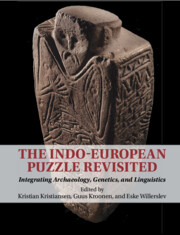
Book contents
- The Indo-European Puzzle Revisited
- The Indo-European Puzzle Revisited
- Copyright page
- Contents
- Figures
- Tables
- Contributors
- Preface
- Introduction
- Part I Early Indo-European and the Origin of Pastoralism
- 2 The Yamnaya Culture and the Invention of Nomadic Pastoralism in the Eurasian Steppes
- 3 Yamnaya Pastoralists in the Eurasian Desert Steppe Zone: New Perspectives on Mobility
- 4 Proto-Indo-Anatolian, the “Anatolian Split” and the “Anatolian Trek”: A Comparative Linguistic Perspective
- Part II Migratory Processes and Linguistic Dispersals between Yamnaya and the Corded Ware
- Part III The Cultural and Linguistic Significance of Bell Beakers along the Atlantic Fringe
- Part IV The Bronze Age Chariot and Wool Horizons
- Part V Kinship Systems, Marriage, Fosterage, Free, and Unfree
- Concluding Reflections
- Index
- References
2 - The Yamnaya Culture and the Invention of Nomadic Pastoralism in the Eurasian Steppes
from Part I - Early Indo-European and the Origin of Pastoralism
Published online by Cambridge University Press: 29 April 2023

Book contents
- The Indo-European Puzzle Revisited
- The Indo-European Puzzle Revisited
- Copyright page
- Contents
- Figures
- Tables
- Contributors
- Preface
- Introduction
- Part I Early Indo-European and the Origin of Pastoralism
- 2 The Yamnaya Culture and the Invention of Nomadic Pastoralism in the Eurasian Steppes
- 3 Yamnaya Pastoralists in the Eurasian Desert Steppe Zone: New Perspectives on Mobility
- 4 Proto-Indo-Anatolian, the “Anatolian Split” and the “Anatolian Trek”: A Comparative Linguistic Perspective
- Part II Migratory Processes and Linguistic Dispersals between Yamnaya and the Corded Ware
- Part III The Cultural and Linguistic Significance of Bell Beakers along the Atlantic Fringe
- Part IV The Bronze Age Chariot and Wool Horizons
- Part V Kinship Systems, Marriage, Fosterage, Free, and Unfree
- Concluding Reflections
- Index
- References
Summary
Between 3000 and 2500 BCE, populations derived genetically from individuals assigned to the Yamnaya archaeological culture migrated out of their steppe homeland eastward to the Altai Mountains and westward into the Hungarian Plain and southeastern Europe, an east–west range of 5,000 km across the heart of the Eurasian continent (Allentoft et al. 2015; Narasimhan et al. 2019). In Europe, their descendants created the Corded Ware and Bell Beaker horizons (Haak et al. 2015; Frînculeasa et al. 2015; Olalde et al. 2018), establishing a large part of the genetic ancestry in modern Europeans and probably their linguistic ancestry in the Indo-European language family as well (Anthony 2007; Reich 2018). The Yamnaya archaeological culture (or “cultural-historical community,” in Soviet archaeological jargon) has consequently become a focus of wide interest. One debated subject that is perhaps most relevant for understanding the outbreak of long-distance migrations is the nature of the Yamnaya pastoral economy – were they nomads? This essay addresses Yamnaya nomadism as an innovation that opened the Eurasian steppes to productive human exploitation. It does not consider nomadic pastoralism in other parts of the world. Because the Yamnaya culture is little known or understood by Western archaeologists, I begin with an overview of Yamnaya chronology and variability.
Information
- Type
- Chapter
- Information
- The Indo-European Puzzle RevisitedIntegrating Archaeology, Genetics, and Linguistics, pp. 13 - 33Publisher: Cambridge University PressPrint publication year: 2023
References
Allentoft, M. E., Sikora, M., Sjögren, K. G., Rasmussen, S., Rasmussen, M., Stenderup, J., Damgaard, P. B., Schroeder, H., Ahlström, T., Vinner, L., Malaspinas, A.-S., Margaryan, A., Higham, T., Chivall, D., Lynnerup, N., Harvig, L., Baron, J., Della Casa, P., Dąbrowski, P., Duffy, P. R., Ebel, A. V., Epimakhov, A., Frei, K., Furmanek, M., Gralak, T., Gromov, A., Gronkiewicz, S., Grupe, G., Hajdu, T., Jarysz, R., Khartanovich, V., Khokhlov, A., Kiss, V., Kolář, J., Kriiska, A., Lasak, I., Longhi, C., McGlynn, G., Merkevicius, A., Merkyte, I., Metspalu, M., Mkrtchyan, R., Moiseyev, V., Paja, L., Pálfi, G., Pokutta, D., Pospieszny, Ł., Price, T. D., Saag, L., Sablin, M., Shishlina, N., Smrčka, V., Soenov, V. I., Szeverényi, V., Tóth, G., Trifanova, S. V., Varul, L., Vicze, M., Yepiskoposyan, L., Zhitenev, V., Orlando, L., Sicheritz-Pontén, T., Brunak, S., Nielsen, R., Kristiansen, K., and Willerslev, E.. 2015. Population genomics of Bronze Age Eurasia. Nature 522: 167–172.CrossRefGoogle ScholarPubMed
Anthony, David W. 1986. The “Kurgan culture,” Indo-European origins, and the domestication of the horse: A reconsideration. Current Anthropology 27(4): 291–313.Google Scholar
Anthony, David W. 2007. The horse, the wheel, and language: How Bronze Age riders from the Eurasian steppes shaped the modern world. Princeton: Princeton University Press.Google Scholar
Anthony, David W. 2016. The Samara Valley Project and the evolution of pastoral economies in the western Eurasian steppes. In: Anthony, David W., Brown, D., Khokhlov, A., Kuznetsov, P., and Mochalov, O. (eds.), A Bronze Age landscape in the Russian steppes: The Samara Valley Project (Monumenta Archaeologica 37), 3–36. Los Angeles: Cotsen Institute of Archaeology Press.CrossRefGoogle Scholar
Anthony, David W. 2021. Early Yamnaya chronology and origins from an archaeological perspective. In: Heyd, Volker, Kulcsár, Gabriella, and Preda-Bălănică, Bianca (eds.), Yamnaya interactions: Proceedings of the international workshop held in Helsinki, 25–26th April 2019. Vol. 2 of The Yamnaya Impact on Prehistoric Europe. Budapest: Archaeolingua.Google Scholar
Anthony, David W., and Brown, D. R.. 2011. The secondary products revolution, horse-riding, and mounted warfare. Journal of World Prehistory 24(2): 131–160.CrossRefGoogle Scholar
Anthony, David W., Brown, D. R., and George, C.. 2006. Early horseback riding and warfare: The importance of the magpie around the neck. In Olsen, Sandra, Grant, Susan, Choyke, Alice, and Bartosiewicz, Laszlo (eds.), Horses and humans: The evolution of the equine-human relationship (British Archaeological Reports International Series 1560), 137–156. Oxford: Archaeopress.Google Scholar
Anthony, David W., Brown, D. R., Khokhlov, A., Kuznetsov, P. F., and Mochalov, O. (eds.). 2016. A Bronze Age landscape in the Russian steppes: The Samara Valley Project (Monumenta Archaeologica 37). Los Angeles: Cotsen Institute of Archaeology Press.CrossRefGoogle Scholar
Anthony, David W., Khokhlov, A. A., Agapov, S. A., Agapov, D. S., Schulting, R., Olalde, I., and Reich, D.. 2022. The Eneolithic cemetery at Khvalynsk on the Volga River. Praehistorische Zeitschrift 97(1): 22–67.CrossRefGoogle Scholar
Anthony, David W., and Ringe, Don. 2015. The Indo-European homeland from linguistic and archaeological perspectives. Annual Review of Linguistics 1: 199–219.CrossRefGoogle Scholar
Azzaroli, A. 1980. Venetic horses from Iron Age burials at Padova. Rivista di Scienze Preistoriche 35(1–2): 282–308.Google Scholar
Bakker, Jan Albert, Kruk, Janusz, Lanting, A. L., and Milisauskas, Sarunas 1999. The earliest evidence of wheeled vehicles in Europe and the Near East. Antiquity 73: 778–790.Google Scholar
Belinskii, A., Hansen, S., and Reinhold, S.. 2017. The great kurgan from Nalčik. A preliminary report. In: Tonussi, M. and Rova, E. (eds.), Subartu XXXVIII: At the northern frontier of Near Eastern archaeology: Recent research on Caucasia and Anatolia in the Bronze Age, 13–32. Turnhout: Brepols.Google Scholar
Bendrey, R. 2007. New methods for the identification of evidence for bitting on horse remains from archaeological sites. Journal of Archaeological Science 34: 1036–50.CrossRefGoogle Scholar
Bendrey, R. 2011. Some like it hot: Environmental determinism and the pastoral economies of the later prehistoric Eurasian steppe. Pastoralism: Research, Policy and Practice 1(8): 1–16.CrossRefGoogle Scholar
Bogaard, Amy, Fochesato, M., and Bowles, S.. 2019. The farming-inequality nexus: New insights from ancient Western Eurasia. Antiquity 93(371): 1129–1143.Google Scholar
Borisova, A. V., Krivosheev, M. V., Mimokhod, R. A., and El’tsov, M. V.. 2019. “Sod blocks” in kurgan mounds: Historical and soil features of the technique of tumuli erection. Journal of Archaeological Science: Reports 24: 122–131.Google Scholar
Brown, D. R., and Anthony, David W.. 1998. Bit wear, horseback riding, and the Botai site in Kazakstan. Journal of Archaeological Science 25: 331–347.CrossRefGoogle Scholar
Bunyatyan, K. 2003. Correlations between agriculture and pastoralism in the North Pontic steppe area during the Bronze Age. In: Levine, M., Renfrew, C., and Boyle, K. (eds.), Prehistoric steppe adaptation and the horse, 269–286. Cambridge: McDonald Institute.Google Scholar
Burmeister, Stefan. 2017. Early wagons in Eurasia: Disentangling an enigmatic innovation. In: Stockhammer, Philipp W. and Maran, Joseph (eds.), Appropriating innovations: Entangled knowledge in Eurasia 5000–1500 BCE, 69–77. Oxford: Oxbow Books.Google Scholar
Chang, Claudia. 2018. Rethinking prehistoric Central Asia: Shepherds, farmers, and nomads. London: Routledge.Google Scholar
Chernykh, E. N. 1992. Ancient metallurgy in the USSR. Cambridge: Cambridge University Press.Google Scholar
Chernykh, E. N. 2004. Kargaly: The largest and most ancient metallurgical complex on the border of Europe and Asia. In: Linduff, Katheryn M. (ed.), Metallurgy in ancient eastern Eurasia from the Urals to the Yellow River (Chinese Studies 31), 223–279. Lewiston: Edwin Mellen.Google Scholar
Clayton, Hilary M., and Lee, R.. 1984. A fluoroscopic study of the position and action of the jointed snaffle bit in the horse’s mouth. Equine Veterinary Science 4(5): 193–196.CrossRefGoogle Scholar
Clutton-Brock, Juliet. 1974. The Buhen horse. Journal of Archaeological Science 1: 89–100.CrossRefGoogle Scholar
Cook, W. R. 2011. Damage by the bit to the equine interdental space. Equine Veterinary Education 23(7): 355–360.Google Scholar
Dergachev, Valentin A. 2007. O Skipetrakh, O Loshadyakh, O Voine: Etiudy v zashchitu migrationnoi konseptsii M. Gimbutas. Saint Petersburg: Nestor-Istoriya.Google Scholar
Di Cosmo, Nicola 1994. Ancient Inner Asian nomads: Their economic basis and its significance in Chinese history. Journal of Asian Studies 53(4): 1092–1126.CrossRefGoogle Scholar
Diaz del Río, P., García, P. L., López Sáez, J. A., Martina Navarette, M. I., Rodrígues Alcalde, A. L., Rovira-Llorens, S., Vicent García, J. M., and de Zavala Morencos, I.. 2006. Understanding the productive economy during the Bronze Age through archaeometallurgical and paleo-environmental research at Kargaly. In: Peterson, D. L., Popova, L. M., and Smith, A. T. (eds.), Beyond the steppe and the sown: Proceedings of the 2002 University of Chicago Conference on Eurasian Archaeology, 343–357. Leiden: Brill.Google Scholar
Doumani, Paula N., Frachetti, M. D., Beardmore, R., Schmaus, T. M., Spengler, R. N., and Mar’yashev, A. N.. 2015. Burial ritual, agriculture, and craft production among Bronze Age pastoralists at Tasbas (Kazakhstan). Archaeological Research in Asia 1/2: 17–32.CrossRefGoogle Scholar
Dovchenko, N. D., and Rychkov, N. A.. 1988. K probleme sotsial’noi stratigrafikatsii plemen Yamnoi kul’turno-istoricheskoi obshchnosti. In Novye Pamyatniki Yamnoi Kul’tury Stepnoi Zony Ukrainy, 27–40. Kiev: Naukova Dumka.Google Scholar
Dremov, I. I., and Yudin, A. I., 1992. Drevneishie podkurgannye zakhoroneniya stepnogo zaVolzh’ya. Rossiskaya Arkheologiya 4: 18–31.Google Scholar
Ewers, John C. 1955. The horse in Blackfoot Indian culture. Washington, DC: Smithsonian Institution Press.Google Scholar
Fansa, M., and Burmeister, S. (eds.). 2004. Rad und Wagen: Der Ursprung einer Innovation. Wagen im Vorderen Orient und Europa (Archäologische Mitteilungen aus Nordwestdeutschland Beiheft 40). Mainz: Philipp von Zabern.Google Scholar
Frachetti, Michael D. 2008. Pastoralist landscapes and social interaction in Bronze Age Eurasia. Berkeley: University of California Press.Google Scholar
Frachetti, Michael D. 2011. Multiregional emergence of mobile pastoralism and nonuniform institutional complexity across Eurasia. Current Anthropology 53(1): 1–38.Google Scholar
Frînculeasa, Alin, Preda, Bianca, and Heyd, Volker. 2015. Pit-Graves, Yamnaya and kurgans along the Lower Danube: Disentangling IVth and IIIrd millennium BC burial customs, equipment and chronology. Praehistorische Zeitschrift 90(1/2): 1–69.Google Scholar
Furholt, Martin. 2014. Upending a “totality”: Re-evaluating Corded Ware variability in Late Neolithic Europe. Proceedings of the Prehistoric Society 80: 67–86.Google Scholar
Furholt, Martin. 2018. Massive migrations? The impact of recent aDNA studies on our view of third millennium Europe. European Journal of Archaeology 21(2): 159–191.Google Scholar
Gaunitz, C., Fages, A., Hanghøj, K., Albrechtsen, A., Khan, N., Schubert, M., Seguin-Orlando, A., Owens, I. J., Felkel, S., Bignon-Lau, O., de Barros Damgaard, P., Mittnik, A., Mohaseb, A. F., Davoudi, H., Alquraishi, S., Alfarhan, A. H., Al-Rasheid, K. A. S., Crubézy, E., Benecke, N., Olsen, Sandra, Brown, D., Anthony, D., Massy, K., Pitulko, V., Kasparov, A., Brem, G., Hofreiter, M., Mukhtarova, G., Baimukhanov, N., Lõugas, L., Onar, V., Stockhammer, P. W., Krause, J., Boldgiv, B., Undrakhbold, S., Erdenebaatar, D., Lepetz, S., Mashkour, M., Ludwig, A., Wallner, B., Merz, V., Merz, I., Zaibert, V., Willerslev, E., Librado, P., Outram, A. K., and Orlando, Ludovic. 2018. Ancient genomes revisit the ancestry of domestic and Przewalski’s horses. Science 360(6384): 111–114.Google Scholar
Gimbutas, Marija. 1956. The prehistory of Eastern Europe (American School of Prehistoric Research Bulletin 20). Cambridge, MA: Peabody Museum.Google Scholar
Gimbutas, Marija, 1970. Proto-Indo-European culture: The Kurgan culture during the fifth, fourth, and third millennia B.C. In: Cardona, George, Hoenigswald, Henry, and Senn, Alfred (eds.), Indo-European and the Indo-Europeans, 155–198. Philadelphia: University of Pennsylvania Press.Google Scholar
Gimbutas, Marija. 1977. The first wave of European steppe pastoralists into Copper Age Europe. Journal of Indo-European Studies 5(4): 277–338.Google Scholar
Gorodtsov, V. A. 1907. Rezul’taty arkheologichekikh issledovanii v Bakhmutskom uezdie Ekaterinoslavskoi gubernii 1905g. Trudy XIII A.S. 1: 211–365. Moscow: State Historical Museum.Google Scholar
Haak, Wolfgang, Lazaridis, I., Patterson, N., Rohland, N., Mallick, S., Llamas, B., Brandt, G., Nordenfelt, S., Harney, E., Stewardson, K.,Fu, Q., Mittnik, A., Bánffy, E., Economou, C., Francken, M., Friederich, S., Pena, R. G., Hallgren, F., Khartanovich, V., Khokhlov, A., Kunst, M., Kuznetsov, P., Meller, H., Mochalov, O., Moiseyev, V., Nicklisch, N., Pichler, S. L., Risch, R., Guerra, M. A. R., Roth, C., Szécsényi-Nagy, A., Wahl, J., Meyer, M., Krause, J., Brown, D., Anthony, D., Cooper, A., Alt, K. W., and Reich, D.. 2015. Massive migration from the steppe was a source for Indo-European languages in Europe. Nature 522(7555): 207–211.Google Scholar
Hanks, Bryan, Miller, Alicia V., Judda, M., Epimakhovd, A., Razhevf, D., and Privat, Karen. 2018. Bronze Age diet and economy: New stable isotope data from the Central Eurasian steppes (2100–1700 BC). Journal of Archaeological Science 97: 14–25.Google Scholar
Hansen, Sven 2013. The birth of the hero. The emergence of a social type in the 4th millennium BC. In: Starnini, Elisabetta (ed.), Unconformist archaeology: Papers in honour of Paolo Biagi, 101–112. Oxford: Archaeopress.Google Scholar
Häusler, A. 2003. Nomaden, Indogermanen, Invasionen. Zur Entstehung eines Mythos (Orientwissenschaftliche Hefte 5). Halle: Orientwissenschaftliches Zentrum der Martin-Luther-Universität.Google Scholar
Heyd, Volker. 2013. Europe at the dawn of the Bronze Age. In: Heyd, Volker, Kulcsár, G., and Szeverényi, V. (ed.), Transitions to the Bronze Age: Interregional interaction and socio-cultural change in the third millennium BC Carpathian Basin and neighbouring regions, 9–66. Budapest: Archaeolingua.Google Scholar
Ivanova, Svitlana V. 2006. Yamnaya kul’turno-istoricheskaya obshchnost’: problemy formirovaniya v svete radiouglerodnogo datirovaniya. Rossisskaya Arkheologiya 2: 113–120.Google Scholar
Ivanova, Svitlana V. 2010. Prirodnye resursy i ekonomika drevnikh obshchestv. Stratum plus 2: 49–97.Google Scholar
Ivanova, Svitlana. 2013. Connections between the Budzhak culture and Central European groups of the Corded Ware culture. Baltic-Pontic Studies 18: 86–120.Google Scholar
Ivanova, S. V., Nikitin, A. G., and Kiusak, D. V.. 2018. Mayatnikov’ye migratsii v tsirkum-Pontcheskoi i tsentral’noi Evrope v epokhu paleometalla i problema genesis a Yamnoi kul’tury. Arkheologia Davnya Istoriya Ukraini 1(26): 101–146.Google Scholar
Ivanova, Svitlana V., and Tsimidanov, V. V.. 1993. O sotsiologicheskoi interpretatsii pogrebenii povozkami Yamnoi kul’turno-istoricheskoi obshchnosti. Arkheologicheskii Al’manakh 2: 23–34.Google Scholar
Kaiser, Elke 2010. Der Übergang zur Rinderzucht im nördlichen Schwarzmeerraum. Godišnjak 39: 23–34.Google Scholar
Kaiser, Elke, Tuboltsev, O., Benecke, N., Evershed, R. P., Hochmuth, M., Mileto, S., and Riesenberg, M.. 2020. Der Fundplatz Generalka 2 der Jamnaja-Kultur in der Südukraine. Archäologische und naturwissenschaftliche Untersuchungen. Praehistorische Zeitschrift: aop.CrossRefGoogle Scholar
Kelly, R. L., Poyer, L., and Tucker, B.. 2005. An ethnoarchaeological study of mobility, architectural investment, and food sharing among Madagascar’s Mikea. American Anthropologist 107: 403–416.Google Scholar
Kent, Susan, and Vierich, Helga. 1989. The myth of ecological determinism: Anticipated mobility and site spatial organization. In: Kent, Susan (ed.), Farmers as hunters, 96–130. Cambridge: Cambridge University Press.Google Scholar
Khazanov, Anatoly. 1994. Nomads and the outside world. Rev. ed. Madison: University of Wisconsin Press. First published 1984.Google Scholar
Khokhlov, A. A. 2010. Naselenie Khvalynskoi Eneoliticheskoi kul’tury po antropologicheckii materialam gruntovykh mogilnikov Khvalynsk I, Khvalynsk II, Khokhlov Bugor. In: Agapov, S. A. (ed.), Khvalynskie Eneoliticheskie Mogil’niki i Khvalynskaya Eneoliticheskaya Kul’tura: Issledovanija materialov, 407–517. Samara: SROO IEKA “Povolzh’e.”Google Scholar
Kiashko, A. V. 2017. Kul’turnei bronzy poseleniya Razdorskoe I na Nizhnem Donu. In: Bokcharyev, V. S. and Alekshin, V. A. (ed.), Vneshnie I Vnutrennie Svyazi Stepnykh (Skorovodcheskikh) Kul’tur Vostochnoi Evropy v Eneolite I Bronzovom Veke (V-II tys. do n. e.), 84–88. Saint Petersburg.Google Scholar
Klochko, V. I. 2019. Metalevi sokiri rannogo etapu Yamnoi kulturi Ukraini. Arkheologiya i Davnya Istoriya Ukraini 2(31): 69–77.Google Scholar
Knipper, Corina, Reinhold, S., Gresky, J., Berezina, N., Gerling, C., Pichler, S. L., Buzhilova, A. P., Kantorovich, A. R., Maslov, V. E., Petrenko, V. G., Lyakhov, S. V., Kalmykov, A. A., Belinskiy, A. B., Hansen, S., Alt, K. W.. 2020. Diet and subsistence in Bronze Age pastoral communities from the southern Russian steppes and the North Caucasus. PLoS ONE 15(10): e0239861.Google Scholar
Kohl, Philip K. 2007. The making of Bronze Age Eurasia. Cambridge: Cambridge University Press.Google Scholar
Kohl, Philip L., and Trifonov, V.. 2014. The prehistory of the Caucasus: Internal developments and external interactions. In: Renfrew, Colin (ed.), Cambridge World Prehistory, 1571–1595. Cambridge: Cambridge University Press.Google Scholar
Korenevskii, S. N. 1980. O metallicheskikh veshchakh i Utyevskogo mogil’nika. In: Pryakhin, A. D. (ed.), Arkheologiya Vostochno-Evropeiskoi Lesostepi, 59–66. Voronezh: Vorenezhskogo Universiteta.Google Scholar
Korenevskii, S. N. 2016. Problemnye situatsii “post-Ubaidskogo perioda” v Predkavkaz’e (4500–3500 let do n.è.). Stratum plus 2: 1–26.Google Scholar
Korenevskii, S. N. 2020. Mif o dreve zhizni na poroge tsilivizatsii po dannym vaz iz Hafadzhi, Djirofta I nekropol Ura. In: Kashuba, M. T., Reinhold, S. E., and Piotrovskii, Y. Y. (ed.), Der Kaukasus zwischen Osteuropa und Vorderem Orient in der Bronze- und Eisenzeit: Dialog der Kulturen (Kultur des Dialoges, Archäologie in Iran und Turan 19), 199–214. Berlin: Deutsches Archäologisches Institut Eurasien-Abteilung and Dietrich Reimer.Google Scholar
Korobkova, G. F., and Shaposhnikova, O. G.. 2005. Mikhailovka: Etalonni Pamiatnik Drevnei Yamnoi Kul’tury. Saint Petersburg: Institut Istorii Material’noi Kul’tury RAN.Google Scholar
Koryakova, Ludmila, and Epimakhov, Andrie. 2007. The Urals and Western Siberia in the Bronze and Iron Ages. Cambridge: Cambridge University Press.Google Scholar
Kotova, Nadezhda, and Spitsyna, L. A. 2003. Radiocarbon chronology of the middle layer of the Mikhailivka settlement. Baltic-Pontic Studies 12: 121–131.Google Scholar
Kristiansen, Kristian, and Larsson, T. B.. 2005. The rise of Bronze Age society: Travels, transmissions, and transformations. Cambridge: Cambridge University Press.Google Scholar
Kuzmina, Elena E. 2008. The prehistory of the Silk Road. Edited by Mair, V.. Philadelphia: University of Pennsylvania Press.CrossRefGoogle Scholar
Kuznetsov, P. F. 2013. Datirovka pamyatnika u Repina Khutora i khronologiya kul’turno-rodstvenniykh materialov epokhi Rannei Bronzy stepnoi zony vostochnoi Evropy. Rossiiskaya Arkheologiya 1: 13–21.Google Scholar
Kyselý, R., and Peške, L.. 2016. Horse size and domestication: Early equid bones from the Czech Republic in the European context. Anthropozoologica 51(1): 15–39.Google Scholar
Lagodovskaya, E. F., Shaposhnikova, O. G., and Makarevich, M. L.. 1959. Osnovnye itogi issledovaniya Mikhailovskogo poseleniya. Kratkie Soobshcheniya Institut Arkheologii 9: 21–28.Google Scholar
Lagodovskaya, E. F., Shaposhnikova, O. G., and Makarevich, M. L.. 1962. Mikhailovka Poseleniye. Kiev: Naukova Dumka.Google Scholar
Lattimore, Owen. 1988. Inner Asian frontiers of China. Hong Kong: Oxford University Press. First published 1940 by the American Geographical Society (New York).Google Scholar
Lebedeva, E. Y. 2005. Archaeobotany and study of the Bronze Age agriculture in Eastern Europe. Opus: Mezhdistsiplinarnye Issledovaniya v Arkheologii (Moscow) 4: 50–68.Google Scholar
Librado, P., Khan, N., Fages, A., Kuslyi, M., Suchan, T., Tonasso-Calvière, L., Schiavinato, S., Alioglu, D., Fromentier, A., Perdereau, A., Aury, J., Gaunitz, C., Chauvey, L., Seguin-Orlando, A., Der Sarkissian, C., Southon, J., Shapiro, B., Alquraishi, S., Alfarhan, A. H., Al-Rasheid, K. A. S., Seregely, T., Klassen, L., Iversen, R., Bignon-Lau, O., Bodu, P., Olive, M., Castel, J-C., Alvarez, N., Germonpré, M., Wilczyński, J., Rannamäe, E., Saarma, U., Lōugas, L., Kyselý, R., Peške, L., Balasescu, A., Gerber, D., Kulcsár, G., Gál, E., Bendrey, R., Allentoft, M., Shephard, H., Tomadini, N., Grouard, S., Pitulko, V., Brem, G., Wallner, B., Keller, M., Kitagawa, K., Bessudnov, A., Taylor, W., Bayarsaikhan, J., Erdenebaatar, D., Kubatbeek, T., Mijiddorj, E., Boldgiv, B., Tsagaan, T., Pruvost, M., Olsen, S., Makarewicz, C., Valenzuela Lamas, S., Albizuri, S., Espinet, A. N., Garrido, J. L., Kotova, N., Pryor, A., Crabtree, P., Zhumatayev, R., Kuznetsova, T., Lordkipanize, D., Marzullo, M., Prato, O., Bagnasco, G., Clavel, B., Lepetz, S., Davoudi, H., Mashkour, M., Stockhammer, P., Krause, J., Haak, W., Morales, A., Benecke, N., Hofreiter, M., Ludwig, A., Graphodatsky, A., Kiryushin, K. Yu., Baryshnikov, G., Petrova, E., Sablin, M., Tishkin, A., Ananyevskaya, E., Logvin, A., Logvin, V., Kalieva, S., Kukushkin, I., Merz, I., Merz, V., Sakenov, S., Shevnina, I., Varfolomeyev, V., Zaibert, V., Arbuckle, B., Reinhold, S., Hansen, S., Roslyakova, N., Kosintsev, P., Kuznetsov, P., Anthony, D., Kroonen, G. J., Kristiansen, K., Wincker, P., Outram, A., and Orlando, Ludovic. 2021. Genomic origins and spread of domestic horses from the Bronze Age Pontic-Caspian steppes. Nature 598: 634–640.Google Scholar
Mallory, J. P. 1977. The chronology of the early Kurgan tradition (part two). Journal of Indo-European Studies 5(4): 339–368.Google Scholar
Manzura, Igor. 2005. Steps to the steppe: Or, how the North Pontic region was colonized. Oxford Journal of Archaeology 24(4): 313–338.Google Scholar
Mathieson, Iain, Lazaridis, I., Rohland, N., Mallick, S., Patterson, N., Roodenberg, S. A., Harney, E., Stewardson, K., Fernandes, D., Novak, M., Sirak, K., Gamba, C., Jones, E. R., Llamas, B., Dryomov, S., Pickrell, J., Luís Arsuaga, J., Bermúdez de Castro, J. M., Carbonell, E., Gerritsen, F., Khokhlov, A., Kuznetsov, P., Lozano, M., Meller, H., Mochalov, O., Moiseyev, V., Rojo Guerra, M. A., Roodenberg, J., Vergès, J. M., Krause, J., Cooper, A., Alt, K. W., Brown, D., Anthony, D., Lalueza-Fox, C., Haak, W., Pinhasi, R., and Reich, David. 2015. Genome-wide patterns of selection in 230 ancient Eurasians. Nature 528: 499–503.CrossRefGoogle ScholarPubMed
Merpert, N. I. 1974. Drevneishie Skotovody Volzhsko-Uralskogo Mezhdurechya. Moscow: Nauka.Google Scholar
Merpert, N. I. 1977. Comments on “The chronology of the early Kurgan tradition.” Journal of Indo-European Studies 5(4): 373–378.Google Scholar
Mileto, S., Kaiser, E., Rassamakin, Y., and Evershed, R. P.. 2018. New insights into the subsistence economy of the Eneolithic Dereivka culture of the Ukrainian North-Pontic region through lipid residue analysis of pottery vessels. Journal of Archaeological Science: Reports 13: 67–74.Google Scholar
Morgunova, Nina L. 2014. Pri-Uralskaya Gruppa Pamyatnikov v Sisteme Volzhsko-Ural’skogo Varianta Yamnoi Kul’turno-Istoricheskoi Oblasti. Orenburg: OGPU.Google Scholar
Morgunova, Nina L. 2015. Pottery from the Volga area in the Samara and South Urals region from Eneolithic to Early Bronze Age. Documenta Praehistorica 42: 311–319.CrossRefGoogle Scholar
Morgunova, Nina L., and Khokhlova, O. S.. 2013. Chronology and periodization of the Pit-Grave culture in the region between the Volga and Ural Rivers based on radiocarbon dating and paleopedological research. Radiocarbon 55(2/3): 1286–1296.Google Scholar
Motuzaite-Matuzeviciute, Giedre, Telizhenko, S., and Jones, M. K. 2012. Archaeobotanical investigation of two Scythian-Sarmatian period pits in eastern Ukraine: Implications for floodplain cereal cultivation. Journal of Field Archaeology 37(1): 51–61.Google Scholar
Mulder, Monique B., Fazzio, I., Irons, W., McElreath, R. L., Bowles, S., Bell, A., Hertz, T., and Hazzah, L.. 2010. Pastoralism and wealth inequality: Revisiting an old question. Current Anthropology 51(1):35–48.Google Scholar
Murphy, E. M. 2003. Iron Age archaeology and trauma from Aymyrlyg, South Siberia (BAR International Series 1152). Oxford: Archaeopress.Google Scholar
Murphy, E. M., and Khokhlov, A. A.. 2016. A bioarchaeological study of prehistoric populations from the Volga region. In: Anthony, D. W. (ed.), A Bronze Age landscape in the Russian steppes: The Samara Valley Project (Monumenta Archaeologica 37), 147–214. Los Angeles: Cotsen Institute of Archaeology Press.Google Scholar
Narasimhan, Vagheesh M., Patterson, N., Moorjani, P., Lazaridis, I., Lipson, M., Mallick, S., Rohland, N., Bernardos, R., Kim, A. M., Nakatsuka, N., Olalde, I., Coppa, A., Mallory, J., Moiseyev, V., Monge, J., Olivieri, L. M., Adamski, N., Broomandkhoshbacht, N., Candilio, F., Cheronet, O., Culleton, B. J., Ferry, M., Fernandes, D., Gamarra, B., Gaudio, D., Hajdinjak, M., Harney, É., Harper, T. K., Keating, D., Lawson, A. M., Michel1, M., Novak, M., Oppenheimer, J., Rai, N., Sirak, K., Slon, V., Stewardson, K., Zhang, Z., Akhatov, G., Bagashev, A. N., Baitanayev, B., Bonora, G. L., Chikisheva, T., Derevianko, A., Dmitry, E., Douka, K., Dubova, N., Epimakhov, A., Freilich, S., Fuller, D., Goryachev, A., Gromov, A., Hanks, B., Judd, M., Kazizov, E., Khokhlov, A., Kitov, E., Kupriyanova, E., Kuznetsov, P., Luiselli, D., Maksudov, F., Meiklejohn, C., Merrett, D., Micheli, R., Mochalov, O., Muhammed, Z., Mustafokulov, S., Nayak, A., Petrovna, R. M., Pettener, D., Potts, R., Razhev, D., Sarno, S., Sikhymbaeva, K., Slepchenko, S. M., Stepanova, N., Svyatko, S., Vasilyev, S., Vidale, M., Voyakin, D., Yermolayeva, A., Zubova, A., Shinde, V. S., Lalueza-Fox, C., Meyer, M., Anthony, D., Boivin, N., Thangaraj, K., Kennett, D. J., Frachetti, M., Pinhasi, R., and Reich, David. 2018. The formation of human populations in South and Central Asia. Science 365: 6457.Google Scholar
Nechitailo, A. P. 1991. Svyazi Naseleniya Stepnoi Ukrainy i Severnogo Kavkaza v Epokhy Bronzy. Kiev: Dumka.Google Scholar
Nedashkovskii, L. S. 2010. Economy of the Golden Horde population. Anthropology and Archeology of Eurasia 48(2): 35–50.Google Scholar
Olalde, Iñigo, Brace, S., Allentoft, M. E., Armit, I., Kristiansen, K., Rohland, N., Mallick, S., Booth, T., Szécsényi-Nagy, A., Mittnik, A., Altena, E., Lipson, M., Lazaridis, I., Patterson, N., Broomandkhoshbacht, N., Diekmann, Y., Faltyskova, Z., Fernandes, D., Ferry, M., Harney, E., de Knijff, P., Michel, M., Oppenheimer, J., Stewardson, K., Barclay, A., Alt, K. W., Avilés Fernández, A., Bánffy, E., Bernabò-Brea, M., Billoin, D., Blasco, C., Bonsall, C., Bonsall, L., Allen, T., Büster, L., Carver, S., Castells Navarro, L., Craig, O. E., Cook, G. T., Cunliffe, B., Denaire, A., Dinwiddy, K. E., Dodwell, N., Ernée, M., Evans, C., Kuchařík, M., Farré, J. F., Fokkens, H., Fowler, C., Gazenbeek, M., Garrido Pena, R., Haber-Uriarte, M., Haduch, E., Hey, G., Jowett, N., Knowles, T., Massy, K., Pfrengle, S., Lefranc, P., Lemercier, O., Lefebvre, A., Lomba Maurandi, J., Majó, T., McKinley, J. I., McSweeney, K., Gusztáv, M. B., Modi, A., Kulcsár, G., Kiss, V., Czene, A., Patay, R., Endrődi, A., Köhler, K., Hajdu, T., Luís Cardoso, J., Liesau, C., Pearson, M. P., Włodarczak, P., Price, T. D., Prieto, P., Rey, P.-J., Ríos, P., Risch, R., Rojo Guerra, M. A., Schmitt, A., Serralongue, J., Silva, A. M., Smrčka, V., Vergnaud, L., Zilhão, J., Caramelli, D., Higham, T., Heyd, V., Sheridan, A., Sjögren, K.-G., Thomas, M. G., Stockhammer, P. W., Pinhasi, R., Krause, J., Haak, W., Barnes, I., Lalueza-Fox, C., and Reich, D.. 2018. The Beaker phenomenon and the genomic transformation of northwest Europe. Nature 555: 190–196.CrossRefGoogle ScholarPubMed
Outram, A. K., Stear, N. A., Bendrey, R., Olsen, S., Kasparov, A., Zaibert, V., Thorpe, N., and Evershed, R. P.. 2009. The earliest horse harnessing and milking. Science 323: 1332–35.Google Scholar
Pashkevich, G. O. 1992. Do rekonstruktsii asortmentu kul’turnikh roslin epokhi Neolitu- Bronzi na territorii Ukraini. In: Pan’kov, S. V. and Voznesens’ka, G. O. (ed.), Starodavne Vibornitstvo na Teritorii Ukraini, 179–194. Kiev: Naukovo Dumka.Google Scholar
Pashkevich, G. O. 2003. Paleoethnobotanical evidence of agriculture in the steppe and the forest-steppe of east Europe in the Late Neolithic and the Bronze Age. In: Levine, Marsha, Renfrew, Colin, and Boyle, Katie (ed.), Prehistoric steppe adaptation and the horse, 287–297. Cambridge: McDonald Institute for Archaeological Research.Google Scholar
Piggott, Stuart. 1983. The earliest wheeled transport: From the Atlantic Coast to the Caspian Sea. New York: Cornell University PressGoogle Scholar
Rassamakin, Y. 1999. The Eneolithic of the Black Sea steppe: Dynamics of cultural and economic development 4500–2300 BC. In: Marsha Levine, Y. Rassamakin, A. Kislenko, and Tatarintseva, N. (ed.), Late prehistoric exploitation of the Eurasian steppe, 59–182. Cambridge: McDonald Institute for Archaeological Research.Google Scholar
Rassamakin, Y. 2013. From the Late Eneolithic period to the Early Bronze Age in the Black Sea steppe: What is the Pit Grave culture (late fourth to mid-third millennium BC)? In: Heyd, Volker,Kulcsár, G., and Szeverényi, V. (ed.), Transitions to the Bronze Age: Interregional interaction and socio-cultural change in the third millennium BC Carpathian Basin and neighbouring regions, 113–138. Budapest: Archaeolingua.Google Scholar
Reich, David. 2018. Who we are and how we got here: Ancient DNA and the new science of the human past. New York: Pantheon.Google Scholar
Reinhold, Sabine, Gresky, J., Berezina, N., Kantorovich, A. R., Knipper, C., Maslov, V. E., Petrenko, V. G., Alt, K. W., and Belinsky, Andrew B.. 2017. Contextualising innovation. Cattle owners and wagon drivers in the North Caucasus and beyond. In: Stockhammer, Philipp and Maran, Joseph (ed.), Appropriating innovations: Entangled knowledge in Eurasia, 5000–1500 BCE, 78–97. Oxford: Oxbow.CrossRefGoogle Scholar
Rosenstock, Eva, Masson, A., and Zich, B.. 2019. Moraines, megaliths and moo: Putting the prehistoric tractor to work. In: Müller, J., Hinz, M., and Wunderlich, M. (ed.), Megaliths – Societies – Landscapes: Early monumentality and social differentiation in Neolithic Europe, vol. 3, 1099–1110. Bonn: Dr. Rudolf Habelt GmbH.Google Scholar
Rühl, L., Herbig, C., and Stobbe, A.. 2015. Archaeobotanical analysis of plant use at Kamennyi Ambar, a Bronze Age fortified settlement of the Sintashta culture in the southern Trans-Urals steppe, Russia. Vegetation History and Archaeobotany 24(3): 413–426.CrossRefGoogle Scholar
Ryndina, N. V., and Degtyareva, A. D.. 2018. Tsvetoi metal Yamnoi kulturno-istoricheskoi oblasti iz pamyatnikov Ukrainy: morfologiya I tekhnologiya izgotovleniya. Stratum plus 2: 317–346.Google Scholar
Sanson, G. D., Kerr, S. A., and Gross, K. A.. 2007. Do silica phytoliths really wear mammalian teeth? Journal of Archaeological Science 34: 526–531.Google Scholar
Schulting, R. J., and Richards, Michael P.. 2016. Stable isotope analysis of Neolithic to Late Bronze Age populations in the Samara Valley. In: Anthony, David W., Brown, Dorcas, Khokhlov, Aleksandr, Kuznetsov, Pavel, and Mochalov, Oleg (ed.), A Bronze Age landscape in the Russian steppes: The Samara Valley Project (Monumenta Archaeologica 37), 127–147. Los Angeles: Cotsen Institute Press, UCLA.CrossRefGoogle Scholar
Secoy, R. F. 1953. Changing military patterns of the Great Plains Indians. Lincoln: University of Nebraska Press.Google Scholar
Sherratt, A. G. 1983. The secondary products revolution of animals in the Old World. World Archaeology 15: 90–104.Google Scholar
Sherratt, A. G. 2006. La traction animale et la transformation de l’Europe néolithique. In: Pétrequin, P., Arbogast, R.-M., Pétrequin, A.-M., van Willigen, S., and Bailly, M. (ed.), Premiers chariots, premiers araires. La diffusion de la traction animale en Europe pendant les IVe et IIIe millénaires avant notre ère (CRA Monograph 29), 329–60. Paris: CNRS.Google Scholar
Shevchenko, A. I. 1957. Fauna poseleniia epokhi bronzy v s. Mikhailovke na nizhnem Dnepre. Kratkie Soobshcheniya Institut Arkheologii (Kiev) 7: 36–37.Google Scholar
Shilov, V. P. 1975. Modeli skotovodcheskikh khozyaistv stepnykh oblastei Evrazii v epokhu eneolita i rannego bronzovogo veka. Sovietskaya Arkheologiya 1: 5–15.Google Scholar
Shilov, V. P. 1985. Problemy proiskhozhdeniya kochevogo skotovodstva v vostochnoi Evrope. In: Maksimov, K. N. (ed.), Drevnosti Kalmykii, 23–33. Elista: Kalmytskii Nauchno-Issledovatel’skii Institut Istorii, Filogii i Ekonomiki.Google Scholar
Shishlina, N. I. 2008. Reconstruction of the Bronze Age of the Caspian steppes: Life styles and life ways of pastoral nomads (British Archaeological Reports International Series 1876). Oxford: Archaeopess.Google Scholar
Shishlina, N. I., Zazovskaya, E. P., van der Plicht, J., Hedges, R. E. M., Sevastyanov, V. S., and Chichagova, O. A.. 2009. Paleoecology, subsistence, and 14C chronology of the Eurasian Caspian steppe Bronze Age. Radiocarbon 51(2): 481–499.Google Scholar
Shnirelman, Victor, A., 1992. The emergence of food-producing economy in the steppe and forest-steppe zones of Eastern Europe. Journal of Indo-European Studies 20: 123–43.Google Scholar
Spengler, Robert N., Ventresca Miller, A., Schmaus, T., Motuzaite-Matuzeviciute, G., Miller, B. K., Wilkin, S., Taylor, W. T. T., Li, Y., Roberts, P., and Boivin, Nicole. 2021. An imagined past? Nomadic narratives in Central Asian archaeology. Current Anthropology 62(3): 251–286.CrossRefGoogle Scholar
Taylor, W. T. T., and Isabelle Barrón‑Ortiz, C.. 2021. Rethinking the evidence for early horse domestication at Botai. Nature Scientific Reports 11: 7440.CrossRefGoogle ScholarPubMed
Telegin, D. Y., Pustalov, Sergei Z., and Kovalyukh, N. N.. 2003. Relative and absolute chronology of Yamnaya and Catacomb monuments: The issue of co-existence. Baltic-Pontic Studies 12: 132–184.Google Scholar
Trautmann, M., Frînculeasa, A., Preda-Bălănică, B., Petruneac, M., Focşǎneanu, M., Alexandrov, S., Atanassova, N., Włodarczak, P., Włodarczak, P., Podsiadło, M., Dani, J., Évinger, S., Bereczki, Z., Hajdu, T., Băjenaru, R., Ioniță, A., Măgureanu, A., Măgureanu, D., Popescu, A., Sârbu, D., Vasile, G., Anthony, D., Heyd, V.. 2022. First Bio-Anthropological Evidence for Yamnaya Horsemanship. Science Advances (In review.)Google Scholar
Tsalkin, V. I. 1970. Drevneishie Domashnie Zhivotnye Vostochnoi Evropy. Moscow: Nauka.Google Scholar
Tuboltsev, Oleg V., and Radchenko, S. B.. 2018. Generalka 2 “causewayed enclosures”: primery otrazheniya polyarnogo mirovzzreniya drevnego naseleniya Evropy. Stratum plus 2: 119–148.Google Scholar
Vybornov, A. A., Kosintsev, P. A., Kulkova, M. A., Doga, N. S., and Platonov, V. I.. 2019. Vremya poyavleniya proizvodyashego khozyaistva v Nizhnem PoVolzh’e. Stratum plus 2: 359–368.Google Scholar
Vybornov, A. A., Kulkova, M., Kosintsev, P., Platonov, V., Platonova, S., Philippsen, B., and Nesterova, L.. 2018. Diet and chronology of the Neolithic-Eneolithic cultures (from 6500 to 4700 cal BC) in the lower Volga basin. Radiocarbon 60(5): 1–14.CrossRefGoogle Scholar
Wang, C.-C., Reinhold, S., Kalmykov, A., Wissgott, A., Brandt, G., Jeong, C., Cheronet, O., Ferry, M., Harney, E., Keating, D., Mallick, S., Rohland, N., Stewardson, K., Kantorovich, A. R., Maslov, V. E., Petrenko, V. G., Erlikh, V. R., Atabiev, B. Ch., Magomedov, R. G., Kohl, P. L., Alt, K. W., Pichler, S. L., Gerling, C., Meller, H., Vardanyan, B., Yeganyan, L., Rezepkin, A. D., Mariaschk, D., Berezina, N., Gresky, J., Fuchs, K., Knipper, C., Schiffels, S., Balanovska, E., Balanovsky, O., Mathieson, I., Higham, T., Berezin, Y. B., Buzhilova, A., Trifonov, V., Pinhasi, R., Belinskij, A. B., Reich, D., Hansen, S., Krause, J., and Haak, Wolfgang. 2019. Ancient human genome-wide data from a 3000-year interval in the Caucasus corresponds with eco-geographic regions. Nature Communications 10: 590.CrossRefGoogle ScholarPubMed
Wilkin, Shevan, Ventresca Miller, A., Fernandes, R., Spengler, R., Taylor, W. T., Brown, D. R., Reich, D., Kennett, D., Culleton, B. J., Kunz, L., Fortes, C., Kitova, A., Kuznetsov, P., Epimakhov, A., Outram, A. K., Kitov, E., Khokhlov, A., Anthony, D., and Boivin, Nicole. 2021. Dairying enabled Early Bronze Age Yamnaya steppe expansions. Nature 598: 629–633.Google Scholar
Zakh, Viktor A., Ryabogina, N. E., and Chlachula, J.. 2010. Climate and environmental dynamics of the mid- to late Holocene settlement in the Tobol–Ishim forest-steppe region, West Siberia. Quaternary International 220: 95–101.CrossRefGoogle Scholar
Accessibility standard: Unknown
Why this information is here
This section outlines the accessibility features of this content - including support for screen readers, full keyboard navigation and high-contrast display options. This may not be relevant for you.Accessibility Information
Accessibility compliance for the HTML of this chapter is currently unknown
and may be updated in the future.
- 9
- Cited by