Book contents
- The Nature of the Ottoman City
- Studies in Environment and History
- The Nature of the Ottoman City
- Copyright page
- Dedication
- Contents
- Figures
- Maps
- Acknowledgments
- Maps
- Introduction
- 1 Water Supply and the Making of Early Modern Ottoman Sofia
- 2 Thermal Springs, Public Baths, and Ottoman Sofia’s Culture of Water
- 3 Coping with Disaster
- Epilogue
- Bibliography
- Index
- Studies in Environment and History ()
Book contents
- The Nature of the Ottoman City
- Studies in Environment and History
- The Nature of the Ottoman City
- Copyright page
- Dedication
- Contents
- Figures
- Maps
- Acknowledgments
- Maps
- Introduction
- 1 Water Supply and the Making of Early Modern Ottoman Sofia
- 2 Thermal Springs, Public Baths, and Ottoman Sofia’s Culture of Water
- 3 Coping with Disaster
- Epilogue
- Bibliography
- Index
- Studies in Environment and History ()
Summary
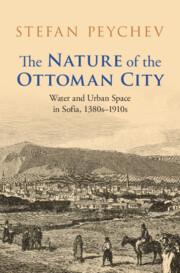
The Introduction begins with a description of the final days in the life of Sofia’s main thermal bath that in 1913 stood in the city’s historic center as the last representative of the Ottoman approach to place-making. I show how the decision to demolish one of the structures most characteristic of Sofia’s Ottoman experience cleared the path for the formulation of the national narrative of Sofia’s history. The narrative that still dominates both the scholarly and popular ideas of Sofia’s urbanistic identity is based on an ideologically biased interpretation of the Ottoman understanding of urban space, natural resource management, and public works. In the Introduction, I argue that Sofia’s key position within the Ottoman political and institutional landscapes as well as its role as a hub of cultural and technological exchange make the study of its history a good vantage point for overcoming the artificial spatial boundaries that still divide the research of the European, Asian, and African provinces of the Ottoman Empire. The Introduction shows how the environmental characteristics of Sofia and the Sofia plain make water the most natural and effective thematic pivot for the study of the construction and historical evolution of space and place.
Information
- Type
- Chapter
- Information
- The Nature of the Ottoman CityWater and Urban Space in Sofia, 1380s–1910s, pp. 1 - 26Publisher: Cambridge University PressPrint publication year: 2025
Accessibility standard: Inaccessible, or known limited accessibility
Why this information is here
This section outlines the accessibility features of this content - including support for screen readers, full keyboard navigation and high-contrast display options. This may not be relevant for you.Accessibility Information
The HTML of this chapter is known to have missing or limited accessibility features.
We may be reviewing its accessibility for future improvement, but final compliance is
not yet assured and may be subject to legal exceptions. If you have any questions,
please contact
accessibility@cambridge.org.
Content Navigation
Table of contents navigation
Allows you to navigate directly to chapters, sections, or non‐text items through a linked table of contents, reducing the need for extensive scrolling.
Allows you to navigate directly to chapters, sections, or non‐text items through a linked table of contents, reducing the need for extensive scrolling.
Index navigation
Provides an interactive index, letting you go straight to where a term or subject appears in the text without manual searching.
Provides an interactive index, letting you go straight to where a term or subject appears in the text without manual searching.
Reading Order & Textual Equivalents
Single logical reading order
You will encounter all content (including footnotes, captions, etc.) in a clear, sequential flow, making it easier to follow with assistive tools like screen readers.
You will encounter all content (including footnotes, captions, etc.) in a clear, sequential flow, making it easier to follow with assistive tools like screen readers.
Visualised data also available as non-graphical data
You can access graphs or charts in a text or tabular format, so you are not excluded if you cannot process visual displays.
You can access graphs or charts in a text or tabular format, so you are not excluded if you cannot process visual displays.
Visual Accessibility
Use of colour is not sole means of conveying information
You will still understand key ideas or prompts without relying solely on colour, which is especially helpful if you have colour vision deficiencies.
You will still understand key ideas or prompts without relying solely on colour, which is especially helpful if you have colour vision deficiencies.
Use of high contrast between text and background colour
You benefit from high‐contrast text, which improves legibility if you have low vision or if you are reading in less‐than‐ideal lighting conditions.
You benefit from high‐contrast text, which improves legibility if you have low vision or if you are reading in less‐than‐ideal lighting conditions.