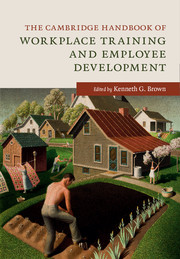


The cover of this volume was selected purposefully to depict the contrast between an image of rural life in the United States in the early 1900s, captured by Grant Wood in his landscape paintings, and the world we live in today. Wood was an Iowa-born artist inspired by the Iowa farms where he grew up. He was also a critic of cities, publishing Revolt against the City in 1935, and a man known for wearing overalls and speaking with a Midwest nonaccent (although he was far more complicated, see Evans, 2010). Best known for his painting American Gothic, Grant’s art shown here is entitled Spring in Town. It was his last painting.
Spring in Town captures a time in the United States when many small rural communities thrived: life centered around church, people worked the land as part of day-to-day life, individualism was celebrated, and technologies in common use were clothespins, pitchforks, and push mowers as well as metal wagons and ladders. Although Wood finished the painting in 1942, the lifestyle immortalized in this painting (and many of his other works) is a mixture of romantic myth and turn-of-the-century reality.
The world today is quite different. Increases in urbanization, technology, work and career specialization (demanding continual collaboration), and demographic and cultural diversity have created lifestyles that intersect more with Ridley Scott’s vision than Grant Wood’s. In the movie Blade Runner (an adoption of Philip K. Dick’s Do Androids Dream of Electric Sheep), Scott portrays futuristic Los Angeles as simultaneously decaying and technologically advancing. Particularly interesting was the city language portrayed, which was a mix of Japanese, Spanish, German, and English. In the film, Chinese, French, and Korean words were also used (http://bladerunner.wikia.com/wiki/cityspeak). It is not hard to imagine a future where increased globalization results in the blending not just of language but also of cultural traditions and social mores. As a result, the world we live in today is socially and technologically complicated. And it is hard to imagine that the pace of change will slow in the years to come.
The ultimate focus of this book is learning – how people do it, how they could do it with greater effectiveness and efficiency, how organizations benefit from investing in learning, and so on. To me, learning is among the most critical topics for modern society to address. We must wrestle with how to help kids and adults adapt successfully to a complex world that, at times, we may not even fully understand. There is so much we don’t know about the future except this one certainly – it will demand that we adapt to ever-changing social and technical landscapes.
Another thing that is clear to me is that no one can tackle this complex world alone; the romantic notion of the rugged individualist is fading even further into historical myth. To be successful, we require help from governments, companies, nonprofit organizations, technological resources, and other people including co-workers, managers, and teachers. And given this multilevel landscape, we will not keep pace without looking beyond one level, one perspective, or one field.
In the design of this book, I deliberately sought contributions from scholars with backgrounds in engineering, education, sociology, and economics as well as psychology. Although in the end I failed to obtain a chapter by a labor economist, the economic point of view nevertheless emerges in a few chapters. And I challenged authors to consider the increasingly complex, global landscape of learning as well as the many levels on which learning operates, beginning with the neurological. The authors took up these challenges, and the chapters offer many different views into the complex world of employee training and development. It is my hope that the chapters, taken together, are worthy of the challenges we face heading into the future.
References
Evans, R. T. 2010. Grant Wood: A Life. New York: Knopf.
