Book contents
- Frontmatter
- Table of Contents
- Acknowledgements
- Introduction
- 1 Early Verse Position-Taking in the Henrician Court
- 2 Traditions of Resistance and Verse Position-Taking
- 3 Translation and the Position-Taking Verse Tradition
- 4 Men’s and Women’s Approaches to Translation and Authority in the Late Henrician Court
- 5 Transcription as Translation: Writing the Language of Manuscript Poetry
- 6 Resistance and Unity in the Douglas-Howard Exchange
- Conclusion
- Bibliography
- Index
This chapter is part of a book that is no longer available to purchase from Cambridge Core
2 - Traditions of Resistance and Verse Position-Taking

Book contents
- Frontmatter
- Table of Contents
- Acknowledgements
- Introduction
- 1 Early Verse Position-Taking in the Henrician Court
- 2 Traditions of Resistance and Verse Position-Taking
- 3 Translation and the Position-Taking Verse Tradition
- 4 Men’s and Women’s Approaches to Translation and Authority in the Late Henrician Court
- 5 Transcription as Translation: Writing the Language of Manuscript Poetry
- 6 Resistance and Unity in the Douglas-Howard Exchange
- Conclusion
- Bibliography
- Index
Summary
Abstract: This chapter engages Henrician courtiers’ manipulation of historic traditions. Surrey and Wyatt draw on established practices in using kings of classical antiquity as allegorical stand-ins for the reigning king. Henry’s preferences in material self-presentation underline the political verse-making process that takes place when courtiers manipulate his choices of royal precedent as a tool for critique. References to tradition constitute composing choices that actively modify extant material to reflect participation in shared systems of position-taking. The limits of those shared systems are considered through Wyatt’s participation and Surrey’s apparent moments of resistance, as well as through Tottel’s editing and titling practices, which increase access but also assign and contain meaning for new audiences, emphasizing the distinct literacies of courtly position-taking.
Keywords: Henry Howard; Thomas Wyatt; Henrician verse; Tudor poetry; Tottel’s Miscellany; Davidic imagery
The changed perception of Henry’s reign over the twenty-five years after he largely stopped writing poetry was such that the opinion that he ‘had degenerated into tyranny was, by 1547, a commonplace […] both at home and abroad’. These perceptions ‘had as much to do with the character of the sovereign and the processes of political participation he favored as with the operation of his judicial system’. In his early performance as king, Henry emphasized spontaneity, implying accessibility; although the element of power was always present, it was also carefully contained. Perhaps what followed was merely the inevitable course of his original ambition, perhaps it was the result of several various disappointments, not least his loss of multiple children and the decline in his personal health. Whatever the case, in the 1530s, ‘when Henry, by launching his Great Matter, embarked upon a political journey a sizeable proportion […] of his advisers did not approve of, and which was evidently against the wishes of the mass of his people, he was forced to abandon […] those models of behaviour that gave his rule cultural legitimacy’. In light of this public resistance, Henry tried to reemphasize his willingness to accept good counsel; Greg Walker notes, for example, that ‘the proclamation proscribing erroneous books and biblical translation, issued on 22 June 1530 stressed that the King was acting, not on his own initiative but after widespread consultation’.
Information
- Type
- Chapter
- Information
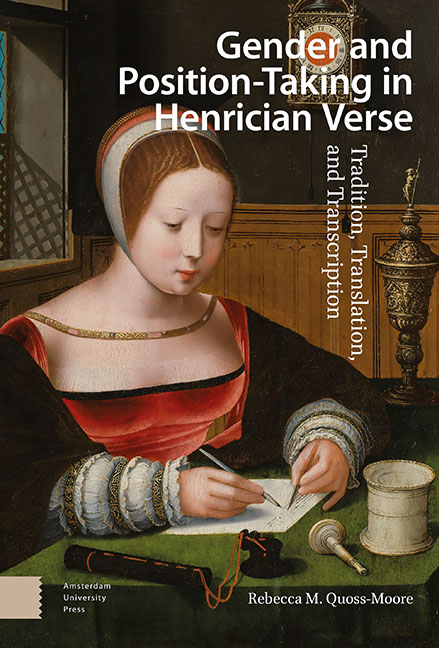
- Gender and Position-Taking in Henrician VerseTradition, Translation, and Transcription, pp. 61 - 82Publisher: Amsterdam University PressPrint publication year: 2023
Accessibility standard: Unknown
Why this information is here
This section outlines the accessibility features of this content - including support for screen readers, full keyboard navigation and high-contrast display options. This may not be relevant for you.Accessibility Information
Accessibility compliance for the PDF of this chapter is currently unknown
and may be updated in the future.