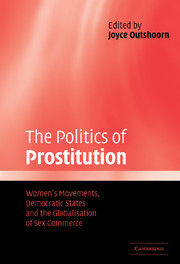
 The Politics of Prostitution
 Women's Movements, Democratic States and the Globalisation of Sex Commerce
Book contents
- Frontmatter
- Contents
- List of figures
- List of tables
- Notes on contributors
- Preface
- 1 Introduction: prostitution, women's movements and democratic politics
- 2 The women's movement and prostitution politics in Australia
- 3 Taxes, rights and regimentation: discourses on prostitution in Austria
- 4 Prostitution policies in Britain, 1982–2002
- 5 Prostitution as public nuisance: prostitution policy in Canada
- 6 Towards a new prohibitionism? State feminism, women's movements and prostitution policies in Finland
- 7 Prostitute movements face elite apathy and gender-biased universalism in France
- 8 The politics of prostitution and trafficking of women in Israel
- 9 Italy: the never-ending debate
- 10 Voluntary and forced prostitution: the ‘realistic approach’ of the Netherlands
- 11 State feminism and central state debates on prostitution in post-authoritarian Spain
- 12 Criminalising the john – a Swedish gender model?
- 13 The invisible issue: prostitution and trafficking of women and girls in the United States
- 14 Comparative prostitution politics and the case for state feminism
- Appendix 1 Independent variable indicators
- Appendix 2 Worksheets
- References
- Index
4 - Prostitution policies in Britain, 1982–2002
Published online by Cambridge University Press: 22 September 2009
Edited by

Book contents
- Frontmatter
- Contents
- List of figures
- List of tables
- Notes on contributors
- Preface
- 1 Introduction: prostitution, women's movements and democratic politics
- 2 The women's movement and prostitution politics in Australia
- 3 Taxes, rights and regimentation: discourses on prostitution in Austria
- 4 Prostitution policies in Britain, 1982–2002
- 5 Prostitution as public nuisance: prostitution policy in Canada
- 6 Towards a new prohibitionism? State feminism, women's movements and prostitution policies in Finland
- 7 Prostitute movements face elite apathy and gender-biased universalism in France
- 8 The politics of prostitution and trafficking of women in Israel
- 9 Italy: the never-ending debate
- 10 Voluntary and forced prostitution: the ‘realistic approach’ of the Netherlands
- 11 State feminism and central state debates on prostitution in post-authoritarian Spain
- 12 Criminalising the john – a Swedish gender model?
- 13 The invisible issue: prostitution and trafficking of women and girls in the United States
- 14 Comparative prostitution politics and the case for state feminism
- Appendix 1 Independent variable indicators
- Appendix 2 Worksheets
- References
- Index
Summary
Introduction
Within Britain's current legal framework prostitution is conceived of as a public nuisance. The position of the prostitute is ambiguous in relation to the law: the sale of sex is not an offence but many of the activities connected with it are. This framework was created by the Report on Homosexual Offences and Prostitution (Wolfenden et al. 1957). The Wolfenden Report aimed to apply a more rigid distinction between law and morality, claiming that however immoral prostitution may be, it was not the law's business. It also aimed to rationalise resources directed towards the control of prostitution while increasing the certainty of convictions. Finally, it encouraged a more systematic policing of the public sphere in order to remove the visible manifestations of prostitution in urban centres (Matthews 1986: 188–9). Within this legal framework two key pieces of legislation were swiftly introduced: the Sexual Offences Act 1956 and Street Offences Act 1959. While the Sexual Offences Act deals with the various activities, relationships and behaviours that might aid, manage, exploit or encourage prostitutes, the Street Offences Act deals directly with prostitutes and prostitution and regulates the manner and means by which prostitutes and their clients can contact each other (Phoenix 1999: 19–20). These two pieces of legislation proved successful in removing prostitution from view and encouraging the growth of more clandestine and commercialised operations (Matthews 1986: 189). However, since the 1970s there has been increasing dissatisfaction with the liberalism associated with Wolfenden.
Information
- Type
- Chapter
- Information
- The Politics of ProstitutionWomen's Movements, Democratic States and the Globalisation of Sex Commerce, pp. 62 - 82Publisher: Cambridge University PressPrint publication year: 2004
Accessibility standard: Unknown
Why this information is here
This section outlines the accessibility features of this content - including support for screen readers, full keyboard navigation and high-contrast display options. This may not be relevant for you.Accessibility Information
Accessibility compliance for the PDF of this chapter is currently unknown
and may be updated in the future.
- 2
- Cited by