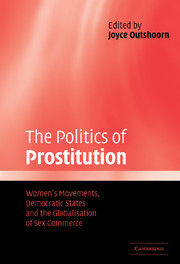
 The Politics of Prostitution
 Women's Movements, Democratic States and the Globalisation of Sex Commerce
Book contents
- Frontmatter
- Contents
- List of figures
- List of tables
- Notes on contributors
- Preface
- 1 Introduction: prostitution, women's movements and democratic politics
- 2 The women's movement and prostitution politics in Australia
- 3 Taxes, rights and regimentation: discourses on prostitution in Austria
- 4 Prostitution policies in Britain, 1982–2002
- 5 Prostitution as public nuisance: prostitution policy in Canada
- 6 Towards a new prohibitionism? State feminism, women's movements and prostitution policies in Finland
- 7 Prostitute movements face elite apathy and gender-biased universalism in France
- 8 The politics of prostitution and trafficking of women in Israel
- 9 Italy: the never-ending debate
- 10 Voluntary and forced prostitution: the ‘realistic approach’ of the Netherlands
- 11 State feminism and central state debates on prostitution in post-authoritarian Spain
- 12 Criminalising the john – a Swedish gender model?
- 13 The invisible issue: prostitution and trafficking of women and girls in the United States
- 14 Comparative prostitution politics and the case for state feminism
- Appendix 1 Independent variable indicators
- Appendix 2 Worksheets
- References
- Index
10 - Voluntary and forced prostitution: the ‘realistic approach’ of the Netherlands
Published online by Cambridge University Press: 22 September 2009
Edited by

Book contents
- Frontmatter
- Contents
- List of figures
- List of tables
- Notes on contributors
- Preface
- 1 Introduction: prostitution, women's movements and democratic politics
- 2 The women's movement and prostitution politics in Australia
- 3 Taxes, rights and regimentation: discourses on prostitution in Austria
- 4 Prostitution policies in Britain, 1982–2002
- 5 Prostitution as public nuisance: prostitution policy in Canada
- 6 Towards a new prohibitionism? State feminism, women's movements and prostitution policies in Finland
- 7 Prostitute movements face elite apathy and gender-biased universalism in France
- 8 The politics of prostitution and trafficking of women in Israel
- 9 Italy: the never-ending debate
- 10 Voluntary and forced prostitution: the ‘realistic approach’ of the Netherlands
- 11 State feminism and central state debates on prostitution in post-authoritarian Spain
- 12 Criminalising the john – a Swedish gender model?
- 13 The invisible issue: prostitution and trafficking of women and girls in the United States
- 14 Comparative prostitution politics and the case for state feminism
- Appendix 1 Independent variable indicators
- Appendix 2 Worksheets
- References
- Index
Summary
Introduction
Prostitution has existed for a long time and will continue to do so. This requires a realistic approach on the part of government … prohibition is not the way to proceed … but one should allow for voluntary prostitution. The authorities can then regulate prostitution and the prostitution sector. It can then become healthy, safe, transparent and cleansed from criminal side-effects.
This quote is taken from a speech by the Minister of Justice, the Liberal Korthals, in October 1999, when he defended the repeal of the brothel ban in parliament (Handelingen Eerste Kamer (HEK) 1999–2000, 25437, 5-10-1999, 11). He added that all forms of forced prostitution would be combated vigorously. The quote presents in a nutshell the basic philosophy of current prostitution policy in the Netherlands, with its distinction between voluntary prostitution, to be regulated as sex work, and forced prostitution, to be prosecuted as illegal. The repeal was supported by the secular parties in parliament and opposed by the religious parties. Feminists in the Netherlands and the national women's policy agency supported the repeal of the ban, arguing that it is an important step forward in improving prostitutes' position.
The new legislation marks a profound shift from the abolitionist legislation in the Morality Acts of 1911, which outlawed brothels and made pimping a criminal offence. Prostitutes or clients were never liable to prosecution.
Information
- Type
- Chapter
- Information
- The Politics of ProstitutionWomen's Movements, Democratic States and the Globalisation of Sex Commerce, pp. 185 - 204Publisher: Cambridge University PressPrint publication year: 2004
Accessibility standard: Unknown
Why this information is here
This section outlines the accessibility features of this content - including support for screen readers, full keyboard navigation and high-contrast display options. This may not be relevant for you.Accessibility Information
Accessibility compliance for the PDF of this chapter is currently unknown
and may be updated in the future.
- 6
- Cited by