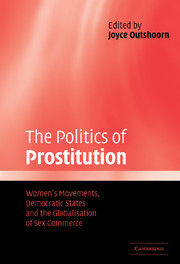
 The Politics of Prostitution
 Women's Movements, Democratic States and the Globalisation of Sex Commerce
Book contents
- Frontmatter
- Contents
- List of figures
- List of tables
- Notes on contributors
- Preface
- 1 Introduction: prostitution, women's movements and democratic politics
- 2 The women's movement and prostitution politics in Australia
- 3 Taxes, rights and regimentation: discourses on prostitution in Austria
- 4 Prostitution policies in Britain, 1982–2002
- 5 Prostitution as public nuisance: prostitution policy in Canada
- 6 Towards a new prohibitionism? State feminism, women's movements and prostitution policies in Finland
- 7 Prostitute movements face elite apathy and gender-biased universalism in France
- 8 The politics of prostitution and trafficking of women in Israel
- 9 Italy: the never-ending debate
- 10 Voluntary and forced prostitution: the ‘realistic approach’ of the Netherlands
- 11 State feminism and central state debates on prostitution in post-authoritarian Spain
- 12 Criminalising the john – a Swedish gender model?
- 13 The invisible issue: prostitution and trafficking of women and girls in the United States
- 14 Comparative prostitution politics and the case for state feminism
- Appendix 1 Independent variable indicators
- Appendix 2 Worksheets
- References
- Index
13 - The invisible issue: prostitution and trafficking of women and girls in the United States
Published online by Cambridge University Press: 22 September 2009
Edited by

Book contents
- Frontmatter
- Contents
- List of figures
- List of tables
- Notes on contributors
- Preface
- 1 Introduction: prostitution, women's movements and democratic politics
- 2 The women's movement and prostitution politics in Australia
- 3 Taxes, rights and regimentation: discourses on prostitution in Austria
- 4 Prostitution policies in Britain, 1982–2002
- 5 Prostitution as public nuisance: prostitution policy in Canada
- 6 Towards a new prohibitionism? State feminism, women's movements and prostitution policies in Finland
- 7 Prostitute movements face elite apathy and gender-biased universalism in France
- 8 The politics of prostitution and trafficking of women in Israel
- 9 Italy: the never-ending debate
- 10 Voluntary and forced prostitution: the ‘realistic approach’ of the Netherlands
- 11 State feminism and central state debates on prostitution in post-authoritarian Spain
- 12 Criminalising the john – a Swedish gender model?
- 13 The invisible issue: prostitution and trafficking of women and girls in the United States
- 14 Comparative prostitution politics and the case for state feminism
- Appendix 1 Independent variable indicators
- Appendix 2 Worksheets
- References
- Index
Summary
Introduction
US politics is striking in the absence of discussion of prostitution in public debate. In comparison with other aspects of sexuality, such as pornography, rape, child abuse or lesbian rights, prostitution has been low on just about everybody's agenda: moralists; law reformers; police; feminists. A majority of the public considers prostitution immoral, and the politicians seem content to leave the long-standing criminalisation regime in place (Weitzer 2000). Activists campaigned briefly for decriminalisation in the 1970s, but soon feminists were divided over policy options (Hobson 1987; Baldwin 1992). Most agreed that prostitution is the product of male domination. Liberal feminists, however, accepted the fact that some women choose prostitution, and supported removal of legal and social burdens on that choice. Radical feminists, on the other hand, rejected the idea that free choice is possible and considered prostitution, along with rape, sexual harassment, pornography and child sexual abuse, to be part of systematic sexual exploitation of women by men.
In the 1980s, prostitutes' rights groups formed; the most famous was Margo St James' COYOTE (Call Off Your Old Tired Ethics). They demanded complete decriminalisation and the guarantee of their right to engage in what they considered sex work. Little changed in the laws (Weitzer 1991). The high point of the campaign occurred in 1994 when the San Francisco Board of Supervisors formed a Task Force on Prostitution to examine alternatives to criminalisation (Weitzer 1999). The prostitutes' advocates dominated the task force which quickly recommended decriminalisation.
Information
- Type
- Chapter
- Information
- The Politics of ProstitutionWomen's Movements, Democratic States and the Globalisation of Sex Commerce, pp. 245 - 264Publisher: Cambridge University PressPrint publication year: 2004
Accessibility standard: Unknown
Why this information is here
This section outlines the accessibility features of this content - including support for screen readers, full keyboard navigation and high-contrast display options. This may not be relevant for you.Accessibility Information
Accessibility compliance for the PDF of this chapter is currently unknown
and may be updated in the future.
- 3
- Cited by