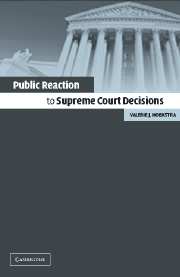
Book contents
- Frontmatter
- Contents
- List of Figures
- List of Tables
- Acknowledgments
- 1 The High-Wire Act: The Supreme Court and Public Opinion
- 2 From the Marble Temple to Main Street: Placing the Cases in Political and Legal Context
- 3 Media Attention and Public Awareness
- 4 Changing Hearts and Minds? Examining the Legitimation Hypothesis
- 5 Public Support for the Supreme Court
- 6 Conclusion: Balancing Independence and Support
- Appendix A Sampling
- Appendix B Survey Instruments Included in the Analysis
- Appendix C Local and National Media Coverage of a Sample of Supreme Court Cases: 1996–97 Term
- Appendix D Statistical Issues with the Analysis of Panel Data
- References
- Index
1 - The High-Wire Act: The Supreme Court and Public Opinion
Published online by Cambridge University Press: 02 September 2009

Book contents
- Frontmatter
- Contents
- List of Figures
- List of Tables
- Acknowledgments
- 1 The High-Wire Act: The Supreme Court and Public Opinion
- 2 From the Marble Temple to Main Street: Placing the Cases in Political and Legal Context
- 3 Media Attention and Public Awareness
- 4 Changing Hearts and Minds? Examining the Legitimation Hypothesis
- 5 Public Support for the Supreme Court
- 6 Conclusion: Balancing Independence and Support
- Appendix A Sampling
- Appendix B Survey Instruments Included in the Analysis
- Appendix C Local and National Media Coverage of a Sample of Supreme Court Cases: 1996–97 Term
- Appendix D Statistical Issues with the Analysis of Panel Data
- References
- Index
Summary
“The Court's authority – possessed of neither the purse nor the sword –ultimately rests on sustained public confidence in its moral sanction.”
– Justice Felix FrankfurterEvery few decades, the Supreme Court hands down a monumental decision that grasps both public and elite attention. It is almost impossible to think of the Court without conjuring up images of such decisions as Brown v. Board of Education (1954), Roe v. Wade (1973), and most recently, Bush v. Gore (2000). Each was followed by intense media coverage, heated debate among citizens and scholars alike about the issues in the cases, as well as discussions about the very legitimacy of the Court itself.
After Bush v. Gore, for example, many people wondered whether the ultimate winner of this strange presidential election would have an effective mandate to govern. The question on every mind, and at the forefront of many discussions, was whether or not the Court's decision would be able to cast legitimacy on an otherwise disputable electoral outcome. After a majority on the Court ruled in support of George W. Bush in what appeared to be a closely divided partisan and ideological division, a new topic of discussion emerged. Now, in addition to discussions about whether the Court could cast legitimacy on Bush's presidential administration, speculation about the consequences of the decision for the Court itself quickly emerged. By entering into such a contentious and political dispute, would the Court's decision ultimately cause itself immediate and long-term damage?
Information
- Type
- Chapter
- Information
- Public Reaction to Supreme Court Decisions , pp. 1 - 31Publisher: Cambridge University PressPrint publication year: 2003
Accessibility standard: Unknown
Why this information is here
This section outlines the accessibility features of this content - including support for screen readers, full keyboard navigation and high-contrast display options. This may not be relevant for you.Accessibility Information
Accessibility compliance for the PDF of this chapter is currently unknown
and may be updated in the future.