Book contents
- Frontmatter
- Contents
- List of contributors
- Acknowledgements
- 1 General introduction
- Part I Conservation needs and priorities
- Part II Conservation with and against people(s)
- 11 Introduction to Part II
- 12 Collaboration, conservation, and community: a conversation between Suraya Afiff and Celia Lowe
- 13 Hands off, hands on: communities and the management of national parks in Indonesia
- 14 Conservation and conflict in Komodo National Park
- 15 Another way to live: developing a programme for local people around Tanjung Puting National Park, Central Kalimantan
- 16 For the people or for the trees? A case study of violence and conservation in Ruteng Nature Recreation Park
- 17 Seas of discontent: conflicting knowledge paradigms within Indonesia's marine environmental arena
- 18 Strategy and subjectivity in co-management of the Lore Lindu National Park (Central Sulawesi, Indonesia)
- 19 Indigenous peoples and parks in Malaysia: issues and questions
- 20 Protecting Chek Jawa: the politics of conservation and memory at the edge of a nation
- 21 Integrating conservation and community participation in protected-area development in Brunei Darussalam
- 22 Conclusion to Part II
- Part III Legal and governance frameworks for conservation
- 29 General conclusion
- Index
- References
18 - Strategy and subjectivity in co-management of the Lore Lindu National Park (Central Sulawesi, Indonesia)
from Part II - Conservation with and against people(s)
Published online by Cambridge University Press: 12 November 2009

Book contents
- Frontmatter
- Contents
- List of contributors
- Acknowledgements
- 1 General introduction
- Part I Conservation needs and priorities
- Part II Conservation with and against people(s)
- 11 Introduction to Part II
- 12 Collaboration, conservation, and community: a conversation between Suraya Afiff and Celia Lowe
- 13 Hands off, hands on: communities and the management of national parks in Indonesia
- 14 Conservation and conflict in Komodo National Park
- 15 Another way to live: developing a programme for local people around Tanjung Puting National Park, Central Kalimantan
- 16 For the people or for the trees? A case study of violence and conservation in Ruteng Nature Recreation Park
- 17 Seas of discontent: conflicting knowledge paradigms within Indonesia's marine environmental arena
- 18 Strategy and subjectivity in co-management of the Lore Lindu National Park (Central Sulawesi, Indonesia)
- 19 Indigenous peoples and parks in Malaysia: issues and questions
- 20 Protecting Chek Jawa: the politics of conservation and memory at the edge of a nation
- 21 Integrating conservation and community participation in protected-area development in Brunei Darussalam
- 22 Conclusion to Part II
- Part III Legal and governance frameworks for conservation
- 29 General conclusion
- Index
- References
Summary
Introduction
In the wake of failures to maintain protected areas based on strict exclusion – the ‘fortress’ approach deriving from the Yellowstone model – considerable efforts have been made to involve peoples living in and around such areas in various co-management schemes to invoke their own sense of interest in protecting the natural resources of such areas. However, park managers have increasingly felt that effective deployment of committed participation in local co-management institutions requires fostering a ‘conservation awareness’, a subjectivity of care for the environment. In his exploration of the imposition of a conservationist subjectivity by the Indian government on some of its citizenry, a process that, following Foucault, he labels ‘environmentality’, Agrawal (2005a, b) emphasizes the role of government regulations in fostering a modern subjectivity of care for the environment through the medium of participatory mechanisms such as forest councils. Others (e.g. Severin 1997) have disputed the efficacy of governmental regulations in effecting such a transformation of sensibility, arguing that traditional orientations to the environment enshrined in custom or the exercise of volunteer participation in non-governmental organization (NGO) projects of conservation result in more profound inculcation of custodial attitudes or conservationist sensibility. What this chapter seeks to explore is the formation of other types of cooperation around a protected area of Sulawesi, the Lore Lindu National Park (Taman Nasional Lore Lindu or TNLL), specifically the politics surrounding the formation of conservation agreements and village-level conservation organizations in the region.
Information
- Type
- Chapter
- Information
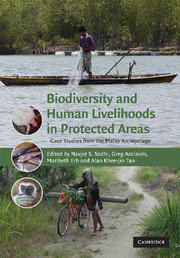
- Biodiversity and Human Livelihoods in Protected AreasCase Studies from the Malay Archipelago, pp. 266 - 288Publisher: Cambridge University PressPrint publication year: 2007
References
, & , eds. (2002). Interaksionisme Simbolik Dongi-Dongi. Jogjakarta, Indonesia: Debut Press.Google Scholar
(2001). Grounds of conflict, idioms of harmony: custom, religion, and nationalism in violence avoidance at the Lindu Plain, Central Sulawesi. Indonesia, 72, 81–112.CrossRefGoogle Scholar
(2002). Re-empowering the ‘art of the elders’: the revitalization of adat among the To Lindu people of Central Sulawesi. In ed. Beyond Java : Regional Autonomy and Local Societies in Indonesia. Adelaide, Australia: Crawford House Publishing, pp. 217–244.Google Scholar
(2004). The occupation of Dongi-Dongi: do resettlement program failures justify parkland deforestation? Inside Indonesia, 80, 7.Google Scholar
(2005a). Environmentality: community, intimate government, and the making of environmental subjects in Kumaon, India. Current Anthropology, 46, 161–190.CrossRef
(2005b). Environmentality: Technologies of Government and the Making of Subjects. Durham, NC: Duke University Press.Google Scholar
(1977). Outline of a Theory of Practice. Cambridge Studies in Social Anthropology 16. Cambridge, U K: Cambridge University Press.CrossRefGoogle Scholar
, & , eds. (1998). Parks in Peril : People, Politics, and Protected Areas. Washington, DC: The Nature Conservancy and Island Press.Google Scholar
Clad, J. C. (1988). Conservation and indigenous people s : a study of convergent interests. In ed. Tribal Peoples and Development Issues: A Global Overview. Mountain View: Mayfield Publishing Company, pp. 320–334.Google Scholar
Colchester, M. (1994). Salvaging nature: indigenous peoples, protected areas and biodiversity conservation. World Rainforest Movement website: http://www.wrm.org.uy/subjects/nature.html (accessed 19 April 2005).
Depagri, D.B. (1992). Untitled document. Jakarta: Depagri, Dirjen Bangdes/Departemen Dalam Negeri/Direktur Jendral Pembangunan Desa.
Desa Puroo, Langko, Tomado dan Anca (2005). Kesepakatan Konservasi Masyarakat Dataran Lindu, Kecamatan Kulawi, Kapubaten Donggala.
Draft Management Plan (2001) Lore Lindu National Park. 4 volumes. Palu, Indonesia: TNC office.
(1997). Gurig National Park: The First Ten Years of Joint Management. Australian Institute of Aboriginal and Torres Strait Islander Studies, Report Series. Canberra, Australia: Aboriginal Studies Press.Google Scholar
Haba, J. (1999). Resettlement and sociocultural change among the ‘Isolated Peoples’ in Central Sulawesi, Indonesia: a study of three resettlement sites. Unpublished Ph.D. thesis, Department of Anthropology, The University of Western Australia.
(2002). Kespekatan Konservasi Masyarakat di Lima Desa sekitar Taman Nasional Lore Lindu Sulawesi Tengah: Laporan Hasil Kegiatan. Palu, Indonesia: The Nature Conservancy.Google Scholar
KMAN [Kongres Masyarakat Adat Nusantara] (1999). Fact Sheet (II).
& (2004). Co-management of Protected Areas: the Case of Community Agreements on Conservation in the Lore Lindu National Park, Central Sulawesi, Indonesia. Eschborn, Germany: Deutsche Gesellschaft fuer Technische Zusammenarbeit (GTZ) GmbH (Tropical Ecology Support Programme (TOEB), F-VI/7e).Google Scholar
(2002a). Menuju Pengelolaan TNLL Berbasis Masyarakat (Kertas Posisi 01/WALHI /2002). Palu, Indonesia: WALHI Sulteng.Google Scholar
(2002b). Politik Konservasi: Orang Katu di Behoa Kakau. Bogor, Indonesia: Penerbit KpSHK.Google Scholar
, , , et al. (2004). Masyarakat dan Taman Nasional Lore Lindu. Jakarta, Indonesia: Yayasan Kemala and Yayasan Tanah Merdeka.Google Scholar
(1998). Seeing Like a State: How Certain Schemes to Improve the Human Condition Have Failed. New Haven, CT: Yale University Press.Google Scholar
(1997). The Spice Islands Voyage: The Quest for Alfred Wallace, the Man Who Shared Darwin's Discovery of Evolution. New York, NY: Carroll & Graf Publishers.Google Scholar
Stevens, S. (1997). The legacy of Yellowstone. In ed. Conservation through Cultural Survival: Indigenous Peoples and Protected Areas. Washington, DC: Island Press, pp. 13–32.Google Scholar
Accessibility standard: Unknown
Why this information is here
This section outlines the accessibility features of this content - including support for screen readers, full keyboard navigation and high-contrast display options. This may not be relevant for you.Accessibility Information
Accessibility compliance for the PDF of this chapter is currently unknown
and may be updated in the future.