A collection of out-of-copyright and rare books from the Cambridge University Library and other world-class institutions that have been digitally scanned, made available online, and reprinted in paperback.
To save content items to your account,
please confirm that you agree to abide by our usage policies.
If this is the first time you use this feature, you will be asked to authorise Cambridge Core to connect with your account.
Find out more about saving content to .
To save content items to your Kindle, first ensure no-reply@cambridge.org
is added to your Approved Personal Document E-mail List under your Personal Document Settings
on the Manage Your Content and Devices page of your Amazon account. Then enter the ‘name’ part
of your Kindle email address below.
Find out more about saving to your Kindle.
Note you can select to save to either the @free.kindle.com or @kindle.com variations.
‘@free.kindle.com’ emails are free but can only be saved to your device when it is connected to wi-fi.
‘@kindle.com’ emails can be delivered even when you are not connected to wi-fi, but note that service fees apply.
In 1871 the British government agreed to support an expedition to collect physical and chemical data and biological specimens from the world's oceans. Led by Charles Wyville Thomson (1830–82), the expedition used HMS Challenger, refitted with laboratories. They sailed nearly 70,000 nautical miles around the world, took soundings and water samples at hundreds of stops along the way, and discovered more than 4,000 new marine species. Noted for the discovery of the Mid-Atlantic Ridge and the Pacific's deepest trench, the expedition laid the foundations for modern oceanography. This acclaimed two-volume account, first published in 1877, summarises the major discoveries for the Atlantic legs of this pioneering voyage. Illustrated with plates and woodcuts, Volume 2 describes the voyage from the Caribbean via Madeira to the coast of Brazil, then to South Africa. The voyage home in 1876 from the Strait of Magellan is also covered. A final chapter summarises the principal conclusions.
Barthélemy Faujas de Saint-Fond (1741–1819) abandoned the legal profession to pursue studies in natural history. Appointed a royal commissioner of mines in 1785, he also served as professor of geology at the natural history museum in Paris from 1793 until his death. His keen interest in rocks, minerals and fossils led to a number of important discoveries, among which was confirmation that basalt was a volcanic product. The present work appeared in three parts between 1803 and 1809. The second volume was divided into two. This first part discusses rocks, minerals and metals, notably limestone, quartz and feldspar. Of related interest in the history of geology, Minéralogie des volcans (1784) and the revised English edition of A Journey through England and Scotland to the Hebrides in 1784 (1907) are two other works by Faujas which are also reissued in this series.
Classical scholar, art collector and connoisseur Richard Payne Knight (1751–1824) took a keen interest in aesthetics and was a key figure in the debate on the picturesque. Of independent means, he journeyed across Europe, often in the company of artists. His home, Downton Castle in Herefordshire, set the fashion for crenellations. He sat in Parliament from 1780 to 1806, but beauty interested him more than politics. Following important works on aesthetics by such writers as Edmund Burke and Uvedale Price, Knight published his most successful work in 1805, cementing his reputation as an authority on matters of taste. Here he moves away from the ideas of Price and Burke, instead exploring the role of associations in the expression of aesthetic judgement. Knight's Analytical Essay on the Greek Alphabet (1791) and Inquiry into the Symbolical Language of Ancient Art and Mythology (1818) are also reissued in this series.
An officer in the Royal Engineers, Sir Charles William Pasley (1780–1861) wrote on matters ranging from military sieges to architecture. In this substantial work, first published in 1838, he outlines the experimentally determined properties of various building materials, with a view to their practical application. Offering guidance on how to decide between different calcareous mortars and cements, Pasley discusses how to judge their comparative strengths. Heeding advice from the Institution of Civil Engineers, he made this work a broad overview, rather than simply focusing on his special area of interest: natural and artificial cements. His research on cements led to the large-scale manufacture of products such as Portland, patent lithic, and blue lias. Pasley discusses the research of other authors in the appendix. Also reissued in this series, in English translation, is Louis-Joseph Vicat's Practical and Scientific Treatise on Calcareous Mortars and Cements, Artificial and Natural (1837).
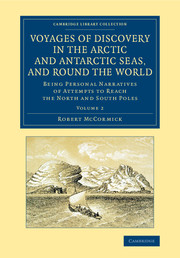
Published in 1884 and illustrated with over 100 of his own drawings and maps, this two-volume work by the doctor and naturalist Robert McCormick (1800–90) provides an account of his voyages in the Arctic with William Parry and in the Antarctic with James Clark Ross, noting also his part in the search for Sir John Franklin. Incorporating a very detailed autobiography, McCormick's work also provides many details relating to natural history and geology. Volume 2 describes his role in the 1852–4 mission to find Franklin in the Arctic, including an open boat voyage up the Wellington Channel. The appendices provide notes on maintaining health in polar climes. This is followed by McCormick's autobiography, tracing his struggles to gain promotion in his naval career. Copies of correspondence relating to the Franklin search reveal his battle to have his ideas accepted by the Admiralty.
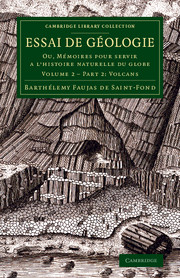
Barthélemy Faujas de Saint-Fond (1741–1819) abandoned the legal profession to pursue studies in natural history. Appointed a royal commissioner of mines in 1785, he also served as professor of geology at the natural history museum in Paris from 1793 until his death. His keen interest in rocks, minerals and fossils led to a number of important discoveries, among which was confirmation that basalt was a volcanic product. The present work appeared in three parts between 1803 and 1809. The second volume was divided into two. This second part lists the principal active volcanoes around the world and classifies volcanic products. Of related interest in the history of geology, Minéralogie des volcans (1784) and the revised English edition of A Journey through England and Scotland to the Hebrides in 1784 (1907) are two other works by Faujas which are also reissued in this series.
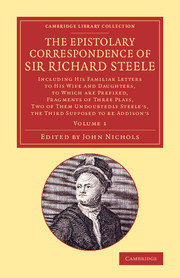
Including his Familiar Letters to his Wife and Daughters, to Which Are Prefixed, Fragments of Three Plays, Two of Them Undoubtedly Steele's, the Third Supposed to Be Addison's
Sir Richard Steele (1672–1729), soldier, courtier and dramatist, is best remembered for his founding of two literary and political periodicals, the Tatler and the Spectator (the latter jointly with his friend Joseph Addison). These two volumes of his letters to friends and family were compiled by the publisher John Nichols and published in 1809. Nichols claims in his preface that these letters, 'some of them evidently scribbled when their amiable Author was probably not in the very best condition for penmanship', are nonetheless of great interest, 'as they contain the private and undisguised opinions of the man who took upon himself to be the Censor of the age'. In Volume 1, many of the letters are addressed to his second wife (both before and after their marriage), others to Addison, Swift, and the duke of Marlborough. Fragments of two unfinished plays by Steele, and one by Addison, are also included.
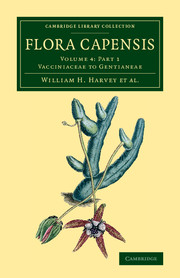
This seminal publication began life as a collaborative effort between the Irish botanist William Henry Harvey (1811–66) and his German counterpart Otto Wilhelm Sonder (1812–81). Relying on many contributors of specimens and descriptions from colonial South Africa - and building on the foundations laid by Carl Peter Thunberg, whose Flora Capensis (1823) is also reissued in this series - they published the first three volumes between 1860 and 1865. These were reprinted unchanged in 1894, and from 1896 the project was supervised by William Thiselton-Dyer (1843–1928), director of the Royal Botanic Gardens at Kew. A final supplement appeared in 1933. Reissued now in ten parts, this significant reference work catalogues more than 11,500 species of plant found in South Africa. Volume 4 appeared in two parts, the first comprising sections published between 1905 and 1909, covering Vacciniaceae to Gentianeae.
Although a well-connected music teacher by profession, Charles Burney (1726–1814) gained greatest recognition for his writings on music. In this 1773 work, reissued here in its 1775 second edition, Burney recounts the 1772 journey that he undertook as one of two research trips for his General History of Music (1776–89). Throughout his travels, he was welcomed by the leading musicians of the day and heard many performances of the latest music. The whole account provides an invaluable first-hand insight into European musical life in the eighteenth century. Burney's General History and The Present State of Music in France and Italy (1772), the record of his first tour, are also reissued in this series. Volume 2 includes his visit to Potsdam to hear Frederick the Great's flute playing, and to Hamburg where he was welcomed by C. P. E. Bach.
The physician and author John Ayrton Paris (1785–1856), several of whose other medical and popular works have been reissued in the Cambridge Library Collection, and his co-author J. S. M. Fonblanque (1787–1865), barrister and administrator, published this three-volume work in 1823. It remained almost the only work on the topic of medical jurisprudence for many years. The authors define the term as 'a science by which medicine, and its collateral branches, are made subservient to the construction, elucidation, and administration of the laws; and to the preservation of public health'. Volume 2 continues the discussion of homicide in all its various aspects (including suspicious deaths which might in fact be accidental): suffocation, drowning, hanging, and battery. Proceedings at coroners' inquests are described, and there is a very extensive section on the various types of poison.
Not much is known about the life of William T. Kilgour, apart from the fact that in the late nineteenth century he spent two decades as an irregular member of staff at the meteorological observatory on Ben Nevis. In 1905, a year after the observatory closed due to lack of funds, Kilgour published this account of his experiences, including some of 'the more outstanding incidents inseparable from an existence spent at such an altitude', both as a chronicle of life on the mountain and to encourage the public to support the reopening of the observatory. The text is illustrated with several photographs of the striking natural surroundings as well as images of the meteorologists working and relaxing at the inhospitably located station. The result is an accessible and charming record of scientific life on Britain's highest peak around the turn of the century.
The French pharmacist Nicolas Jean-Baptiste Gaston Guibourt (1790–1867) first published this work in two volumes in 1820. It provided methodical descriptions of mineral, plant and animal substances. In the following years, Guibourt became a member of the Académie nationale de médicine and a professor at the École de pharmacie in Paris. Pharmaceutical knowledge also progressed considerably as new methods and classifications emerged. For this revised and enlarged four-volume fourth edition, published between 1849 and 1851, Guibourt followed the principles of modern scientific classification. For each substance, he describes the general properties as well as their medicinal or poisonous effects. Volume 4 (1851) looks at pharmaceutical substances derived from animals. Guibourt draws on Cuvier's recent classificatory work, dividing animals into four groups: vertebrates (mammals, birds, reptiles, fish), articulates (insects, arachnids, crustaceans et al.), molluscs, and zoophytes.