A collection of out-of-copyright and rare books from the Cambridge University Library and other world-class institutions that have been digitally scanned, made available online, and reprinted in paperback.
To save content items to your account,
please confirm that you agree to abide by our usage policies.
If this is the first time you use this feature, you will be asked to authorise Cambridge Core to connect with your account.
Find out more about saving content to .
To save content items to your Kindle, first ensure no-reply@cambridge.org
is added to your Approved Personal Document E-mail List under your Personal Document Settings
on the Manage Your Content and Devices page of your Amazon account. Then enter the ‘name’ part
of your Kindle email address below.
Find out more about saving to your Kindle.
Note you can select to save to either the @free.kindle.com or @kindle.com variations.
‘@free.kindle.com’ emails are free but can only be saved to your device when it is connected to wi-fi.
‘@kindle.com’ emails can be delivered even when you are not connected to wi-fi, but note that service fees apply.
Joseph Pitton de Tournefort (1656–1708) was originally destined for the church, but his interest in botany led him to become professor of botany at the Jardin des plantes in Paris, and to travel all over Europe and beyond in search of interesting specimens. He was chiefly interested in the classification of plants, but is now best remembered for the accounts he wrote of voyages undertaken for the purpose of scientific discovery. This illustrated two-volume work, published posthumously in French in 1717 and translated into English the following year, recounts a journey begun in 1700, around the eastern Mediterranean and the Black Sea, visiting Crete and other Greek islands, Istanbul, Armenia and Georgia. Tournefort notes not only plants, but geographical features, antiquities, the people he encounters, and their way of life, agriculture and industry. Volume 1 begins with a biography of Tournefort, and ends with an account of Constantinople.
Based on his journals, with literary assistance provided by a ghostwriter, this 1832 publication gives an account of the early life and later voyages of the American sealer and explorer Benjamin Morrell (1795–1839). The titular adventures consisted of explorations of the Pacific and Antarctic between 1822 and 1831. The text describes unfamiliar bodies of land, sometimes violent interactions with native populations (several of Morrell's crew were killed in the Carteret Islands), and encounters with the slave trade. Morrell also claimed to have been the first American captain to cross the Antarctic Circle. However, there are doubts about the veracity of his narrative, as reported distances, times and locations, particularly in the Antarctic, have proven to be inaccurate. This has been attributed variously to error, exaggeration or outright deception. Morrell himself admits to enhancing his narrative by drawing on information furnished by other navigators.
In this nine-volume work, published between 1812 and 1815, the author and publisher John Nichols (1745–1826) provides biographical notes on publishers, writers and artists of the eighteenth century, and also gives 'an incidental view of the progress and advancement of literature in this kingdom during the last century'. (A shorter version had been published in 1782.) His subjects range from the publisher William Bowyer to Henry Fielding and Horace Walpole, and also include histories of individual publishing houses and of genres such as lexicography. The work remains a useful source of biographical material on authors and publishers at a period when many of the literary genres we take for granted, such as the novel, the autobiography and the analytical history, were first being developed. Volume 8 contains anecdotes of the ex-slave Ignatius Sancho, the botanist William Curtis and the antiquarian Samuel Pegge, among many others.
In the preface to this work, mathematician Augustus De Morgan (1806–71) claims that 'The most worthless book of a bygone day is a record worthy of preservation.' His purpose in writing this catalogue, published in 1847, was to provide an accurate record of the early history of publishing on arithmetic, but describing only those books which he had examined himself. He surveyed the library of the Royal Society, works in the British Museum, the wares of specialist booksellers, and the private collections of himself and his friends to compile a chronological list of books from 1491 to 1846 (the final book being a work of his own), giving bibliographical details, a description of the contents, and sometimes comments on the mathematics on display. De Morgan's Formal Logic and a Memoir of Augustus De Morgan by his widow are also reissued in the Cambridge Library Collection.
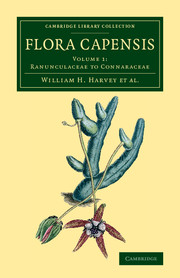
This seminal publication began life as a collaborative effort between the Irish botanist William Henry Harvey (1811–66) and his German counterpart Otto Wilhelm Sonder (1812–81). Relying on many contributors of specimens and descriptions from colonial South Africa - and building on the foundations laid by Carl Peter Thunberg, whose Flora Capensis (1823) is also reissued in this series - they published the first three volumes between 1860 and 1865. These were reprinted unchanged in 1894, and from 1896 the project was supervised by William Thiselton-Dyer (1843–1928), director of the Royal Botanic Gardens at Kew. A final supplement appeared in 1933. Reissued now in ten parts, this significant reference work catalogues more than 11,500 species of plant found in South Africa. Opening with a preface which clarifies the project's original scope, Volume 1 covers Ranunculaceae to Connaraceae.
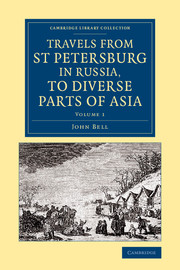
John Bell (1691–1780) trained as a physician, but preferred a life of travel and diplomacy. He entered the service of Tsar Peter the Great of Russia, and had already taken part (as the expedition's doctor) in a government mission to Persia in 1715–18 when he was asked to join a further embassy to China. This two-volume work, published in 1763, describes both these journeys. The first part of Volume 1 contains an account of the Persian expedition, and the second a narrative of the journey across Siberia to the walls of Beijing. It includes fascinating anecdotes of the peoples encountered, and their environment, beliefs and customs, including a female Siberian shaman, the pet musk deer of an exiled Swedish general, and the interdependence of marmots and rhubarb (at this time a valuable medicinal drug). This is a delightful account of an area then hardly known in the west.
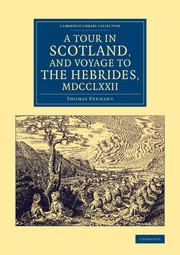
The naturalist and traveller Thomas Pennant (several of whose other works are reissued in the Cambridge Library Collection) published this account of a journey through Scotland and its islands in 1774. Pennant (1726–98) had already written one account of Scotland, in 1771. (He later claimed that by 'shewing that it might be visited with safety' he had created a tourist boom.) His great enthusiasm was for the Hebrides, and more than half of the book describes his voyage around the islands, though he was frustrated by bad weather in getting to Staffa. He transcribes instead an account by Sir Joseph Banks, who had visited in the same year, and in his preface he acknowledges the researches and notes on particular places which had been provided by friends and correspondents. This is a genial account of the history, environment and people of a region still exotic to many Britons.
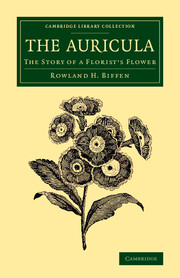
The plant geneticist Sir Rowland Biffen (1874–1949), who is best remembered for his work on the improvement of English wheat varieties using Mendelian principles, was also a keen botanist and gardener. This short work on the auricula, published posthumously in 1951, contains a full botanical account of the species, but also a social history of this most popular of 'florist's flowers'. Probably introduced to England by refugees from the continent in the late sixteenth century, the auricula, though delicate-looking, is extremely hardy, can be grown in pots, and hybridizes freely, and so it was an ideal plant for competitive growers, especially in the north of England, who in the eighteenth and nineteenth centuries vied with each other to breed ever more spectacular varieties, while adhering to strict guidelines on form and proportion. This work, illustrated with seven black-and-white plates, will be of interest to botanists and garden historians alike.
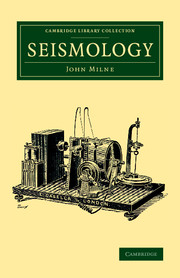
While living in Japan, John Milne (1850–1913) sought to study the 1880 Yokohama earthquake, soon realising that scientists lacked the proper tools. Aided by colleagues, he went on to develop the necessary instrumentation, and by 1896 he had built the first seismograph capable of recording major earthquakes in any part of the world. His textbook Earthquakes and Other Earth Movements (also reissued in this series) had appeared in 1886. In this follow-up work, published in 1898, Milne continues to discuss the nature of earthquakes, the methods and equipment needed to investigate them, and how to apply this knowledge to construction. He references the research, hypotheses and formulae of modern scientists, also noting in passing the suggestions made by earlier authors on the causes of seismic activity. The text is accompanied by many diagrams, especially of experimental apparatus, and several photographs illustrate damaged buildings and bridges.
The disappearance of Sir John Franklin's Arctic expedition of 1845 led to many rescue attempts, some by the British government and some by private individuals, as well as a large number of works recounting these expeditions and reflecting on the mystery. Little is known about the author of this 1857 work, James Parsons. He begins this dramatic account by noting that the disappearance of a large and well-equipped party is almost unprecedented in the Arctic: nothing certain was known about Franklin's fate twelve years after the last recorded sighting. Parsons' speculations derive from a knowledge of naval practice, and familiarity with the seas and climate of the Arctic region and the records of earlier expeditions. He offers practical suggestions about a new attempt using steam-boats, but knows that this will be to find out what actually happened, because there could now be no possibility of finding survivors.
The German artist Johann David Passavant (1787–1861) visited Britain in 1831 in order to examine works by Raphael in private and public galleries for a book he was preparing. He had not been able to find any helpful German accounts of British collections, and so decided to publish a narrative of his own travels and observations. The British writer and art critic Elizabeth Rigby (later Lady Eastlake) produced a two-volume translation in 1836, believing that English readers would benefit from Passavant's descriptions of little-known collections in their own country, as well as from his practitioner's response to the works themselves. Volume 2 begins with the duke of Marlborough's collection at Blenheim, and continues to cover Chatsworth, Althorpe, Holkham, and other 'country seats', finishing in Cambridge. Passavant also provides a catalogue of drawings at Buckingham Palace, a list of the pictures discussed, and an overview of collections not visited.
When John Brown (1797–1861) developed a defect in his eyesight, he could no longer embark on extended voyages for the East India Company. After making a fortune selling gold and diamonds, he cultivated his geographical interests, and was elected to the Royal Geographical Society in 1837. Brown was especially interested in the Arctic, and he became concerned about the missing Franklin expedition to find the North-West Passage. In this substantial work, first published in 1858 and reissued here in one volume with its 1860 sequel, Brown provides a detailed account of previous polar expeditions before turning to the efforts to find Franklin and his men. The sequel is devoted to the 1857–9 search expedition arranged by Lady Franklin and led by Leopold McClintock. A number of other works on Franklin's last expedition and the subsequent searches have also been reissued in this series.
The French geologist Barthélemy Faujas de Saint-Fond (1741–1819) abandoned the legal profession to pursue studies in natural history, working at the museum of natural history in Paris and as royal commissioner of mines. His enthusiasm for geology took him in 1784 to Britain, to investigate the basalt formations on the Hebridean island of Staffa described by Sir Joseph Banks in Pennant's Tour in Scotland (also reissued in this series). His subsequent account was published in France in 1797, and first translated into English in an abridged form in 1814. This two-volume annotated translation by the well-known geologist Sir Archibald Geikie (1835–1924), prefaced by a short biography of Faujas, was published in 1907. The work is interesting for its social as well as its geological observations. Volume 2 describes the geology and natural history of the Hebrides. On his return journey, Faujas also visits the geological marvels of Derbyshire.
Antiquary, zoologist and traveller, Thomas Pennant (1726–98) is remembered for his work in bringing natural history to popular attention and for his engaging writing about the journeys he made. Lavishly illustrated by Moses Griffith with fine engravings of the stunning scenery, buildings and artefacts, this work appeared in two volumes between 1778 and 1781. More than a mere travelogue, this tour of his native country is full of delightful vignettes and historical background. The descriptions of locations and buildings reveal Pennant's thorough mind and tireless capacity for observation. Several of Pennant's other works, including his Tour in Scotland (second edition, 1772), are also reissued in the Cambridge Library Collection. Volume 1 begins in Pennant's birthplace, Downing in Flintshire, and follows a route around North Wales, making 'a complete tour of the tamer parts of our country'. The places visited include Chester, Oswestry, Llangollen, Mold and Caerwys.
This textbook was originally published in 1870, but is here reissued in the third edition of 1884. Its object was 'to supply students and field-botanists with a fuller account of the Flowering Plants and Vascular Cryptograms of the British Islands than the manuals hitherto in use aim at giving'. Sir Joseph Dalton Hooker (1817–1911), one of the most eminent botanists of the later nineteenth century, was educated at Glasgow, and developed his studies of plant life through expeditions all over the world. (Several of his other works are also reissued in the Cambridge Library Collection.) A close friend and supporter of Charles Darwin, he was appointed to succeed his father as Director of the Botanical Gardens at Kew in 1865. The flora is followed in this reissue by an 1879 catalogue of British plants compiled by the botanist George Henslow (1835–1925), intended as a companion volume.
The British naval officer George Francis Lyon (1795–1832) survived extremes of African heat and Arctic cold during his colourful career. Remembered chiefly for the engaging journals he kept, and for his watercolours of the Arctic, he was fascinated by the indigenous peoples of the lands he explored, notably being tattooed by Inuit and eating raw caribou and seal meat with them. In 1826 he sailed to Mexico, then recovering from its war of independence, to serve as a commissioner for an English mining company. His vivid and often entertaining two-volume account of his experiences was published in 1828. In Volume 1, Lyon complains of his first nights being disturbed by 'dogs, pigs and restless cocks', and on his way to the mining area of Zacatecas he visits a church where a figure of Christ made him recall a 'creation of Frankenstein'.
The French historian Auguste Bouché-Leclercq (1842–1923) made major contributions to our knowledge of the Hellenistic period. A member of the Académie des Inscriptions et Belles-Lettres, he was also made an officer of the Légion d'Honneur. Bouché-Leclercq is also considered the first modern historian of astrology: he had developed a long-lasting interest in divination during his extensive researches on ancient Greek civilisation. This field had not been considered worthy of serious scholarly study until he published his Histoire de la divination dans l'antiquité between 1879 and 1882. L'Astrologie grecque, first published in 1899, is another important work, still referred to today. Bouché-Leclercq looks back to the oriental roots of Greek astrology. He delves into the specific influence of the zodiac signs, and explains how the celestial sphere was divided in order to draw horoscopes. Other topics include astrology in Roman culture, as well as astrological medicine.
In this nine-volume work, published between 1812 and 1815, the author and publisher John Nichols (1745–1826) provides biographical notes on publishers, writers and artists of the eighteenth century, and also gives 'an incidental view of the progress and advancement of literature in this kingdom during the last century'. (A shorter version had been published in 1782.) His subjects range from the publisher William Bowyer to Henry Fielding and Horace Walpole, and also include histories of individual publishing houses and of genres such as lexicography. The work remains a useful source of biographical material on authors and publishers at a period when many of the literary genres we take for granted, such as the novel, the autobiography and the analytical history, were first being developed. As well as individual short biographies, Volume 1 contains a history of Bowyer's press from 1699 to 1731.