A collection of out-of-copyright and rare books from the Cambridge University Library and other world-class institutions that have been digitally scanned, made available online, and reprinted in paperback.
To save content items to your account,
please confirm that you agree to abide by our usage policies.
If this is the first time you use this feature, you will be asked to authorise Cambridge Core to connect with your account.
Find out more about saving content to .
To save content items to your Kindle, first ensure no-reply@cambridge.org
is added to your Approved Personal Document E-mail List under your Personal Document Settings
on the Manage Your Content and Devices page of your Amazon account. Then enter the ‘name’ part
of your Kindle email address below.
Find out more about saving to your Kindle.
Note you can select to save to either the @free.kindle.com or @kindle.com variations.
‘@free.kindle.com’ emails are free but can only be saved to your device when it is connected to wi-fi.
‘@kindle.com’ emails can be delivered even when you are not connected to wi-fi, but note that service fees apply.
This interesting piece of social history, published in 1899, appears to have been the first non-fiction work by Teresa Praga (d.1920), the wife of a portrait painter and miniaturist, who also published novels. Her later output included books on cookery, housekeeping and dress, many with the emphasis on 'easy' (Easy French Sweets for English Cooks, for example). Like Jane Panton (several of whose books on lifestyle are also reissued in this series), Praga is writing for middle-class wives with not much money, and aspirations to gracious living. Appearances (subtitled How to Keep Them Up on a Limited Income) is presented as autobiography: how a newly married woman, on a very restricted income but used to - and liking - being 'waited on', manages a house. With detailed descriptions of finances, menus, the duties of servants, and other minutiae, this is a light-hearted account of late Victorian housekeeping.
Author and activist Helen Hunt Jackson (1830–85) is remembered for her work in support of Native American rights. She was also a friend and correspondent of the poet Emily Dickinson, and her own verse was praised by Ralph Waldo Emerson. Her highly popular novel Ramona (1884) addressed discrimination against Native Americans, raising public consciousness as Harriet Beecher Stowe had done for slavery in Uncle Tom's Cabin (1852). Jackson's novel emerged out of her passionate seeking of justice for her country's indigenous peoples. She describes decades of government-sanctioned mistreatment of Native Americans in this 1881 publication. The work introduces seven major tribes, their claims to ancestral lands, and the history of broken treaties and massacres they had endured. Alongside this, Jackson also presents details of Native American culture, resilience and creativity. This remains a vital and substantial account of minority persecution in North American history.
This seminal publication began life as a collaborative effort between the Irish botanist William Henry Harvey (1811–66) and his German counterpart Otto Wilhelm Sonder (1812–81). Relying on many contributors of specimens and descriptions from colonial South Africa - and building on the foundations laid by Carl Peter Thunberg, whose Flora Capensis (1823) is also reissued in this series - they published the first three volumes between 1860 and 1865. These were reprinted unchanged in 1894, and from 1896 the project was supervised by William Thiselton-Dyer (1843–1928), director of the Royal Botanic Gardens at Kew. A final supplement appeared in 1933. Reissued now in ten parts, this significant reference work catalogues more than 11,500 species of plant found in South Africa. Volume 5 appeared in three parts, the third comprising sections published between 1912 and 1913, covering Hydrocharideae to Scitamineae.
Ernest Newman (1868–1959) was undoubtedly the greatest Wagnerian critic of his age. (His magisterial four-volume Life of Richard Wagner is also reissued in this series.) In this 1914 work, he attempts 'a complete and impartial psychological estimate' of a complex and frequently misinterpreted genius. He notes that such an attempt would have been impossible before the publication in 1911 of Wagner's autobiographical Mein Leben, but in his opening chapter he also warns against a naïve reading of that work, and of others by people 'who combine the maximum of good intentions with the minimum of critical insight'. He is clear-sighted about the strengths of Wagner the artist, not least his need to be 'the central sun of his universe', which of course led to Wagner the man behaving pettily, selfishly and frequently as a tyrant. This lucid account richly deserves its place in the history of Wagner studies.
The French geologist Barthélemy Faujas de Saint-Fond (1741–1819) abandoned the legal profession to pursue studies in natural history, working at the museum of natural history in Paris and as royal commissioner of mines. His enthusiasm for geology took him in 1784 to Britain, to investigate the basalt formations on the Hebridean island of Staffa described by Sir Joseph Banks in Pennant's Tour in Scotland (also reissued in this series). His subsequent account was published in France in 1797, and first translated into English in an abridged form in 1814. This two-volume annotated translation by the well-known geologist Sir Archibald Geikie (1835–1924), prefaced by a short biography of Faujas, was published in 1907. The work is interesting for its social as well as its geological observations. Volume 1 describes life in scientific circles in London, before recounting Faujas' journey to the Highlands of Scotland via Edinburgh and Glasgow.
At the outset of the twentieth century, Antarctica was scarcely explored or understood. Penetrating the pack ice in the purpose-built Discovery, the British National Antarctic Expedition (1901–4) established a base in McMurdo Sound, enabling scientists and sledging parties to significantly push back the boundaries of the unknown. Published in 1905, this acclaimed two-volume work by the naval officer and expedition leader Robert Falcon Scott (1868–1912) recounts the trials, errors and achievements of an undertaking which laid the foundations for future research and Scott's later journey to the South Pole. The work is greatly enhanced by many photographs as well as illustrations by the doctor, zoologist and artist Edward A. Wilson (1872–1912). Volume 2 opens with the sledging journey made by Scott, Wilson and Ernest Shackleton which reached an unprecedented southern latitude. A second polar winter and further sledging exploits are also described. The appendices contain geological and zoological findings.
Thomas Tredgold (1788–1829) has been described as 'the most influential technical author of his generation and possibly of the nineteenth century'. His writings contributed greatly to the wider understanding of engineering, and it is his definition of civil engineering that the Institution of Civil Engineers wrote into their charter of 1828. Published in 1827, this work provides a historical survey and explanation of 'a masterpiece of human contrivance'. Tredgold breaks his subject down into ten sections, each covering areas such as the properties of steam, the differing means of harnessing its power, the history of the steam engine's invention and improvement, and the various applications of steam power. Containing many tables, formulae and line drawings, this thorough work complements Charles Frederick Partington's Historical and Descriptive Account of the Steam Engine (1822), which is also reissued in this series.
Although cast iron was used in pagoda construction in ancient China, it was in Britain in the eighteenth century that new methods allowed for its production in quantities that enabled widespread use. An engineer who had educated himself tirelessly in technical subjects from carpentry to architecture, Thomas Tredgold (1788–1829) first published this work in 1822. It served as a standard textbook for British engineers in the early nineteenth century, and several translations extended its influence on the continent. Reissued here in the fourth edition of 1842, edited and annotated by the structural engineer Eaton Hodgkinson (1789–1861), who presents his own research in the second volume, this work addresses both practical and mathematical questions in assessing metallic strength. In Volume 2, benefiting from twenty years of progress since Tredgold's original publication, Hodgkinson provides details of his own advanced experiments.
John Rickman, second lieutenant on one of the two ships commanded by James Cook on his last expedition, wrote this journal during the voyage. It was first published anonymously in 1781, because the Admiralty embargoed all personal accounts until an official report of the voyage was released. Rickman apparently wanted to anticipate any attempt to blame him (a party under his command had killed a Hawaiian chief) for precipitating Cook's death. This revised edition, 'compared with, and corrected from, the voyage published by authority' was published - again anonymously - in 1785. After an editorial preface and an introductory account of earlier voyages to the South Seas, the journal itself offers a detailed first-hand narrative of the four-year voyage, including the deaths of Cook and of Captain Clerke, who took over command of the expedition but died of tuberculosis while searching for the western entrance to the North-West Passage.
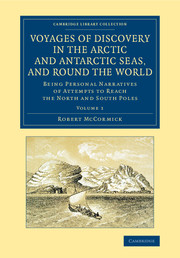
Published in 1884 and illustrated with over 100 of his own drawings and maps, this two-volume work by the doctor and naturalist Robert McCormick (1800–90) provides an account of his voyages in the Arctic with William Parry and in the Antarctic with James Clark Ross, noting also his part in the search for Sir John Franklin. Incorporating a very detailed autobiography, McCormick's work also provides many details relating to natural history and geology. Volume 1 is mainly devoted to his Antarctic voyage (1839–43), during which he also visited St Helena, the Kerguelen Islands, Australia, New Zealand, the Falkland Islands and Tierra del Fuego. During three attempts to reach the South Pole the expedition explored the Ross Sea, described the ice barrier, and raised the British flag to claim possession. The volume ends with the abortive attempt in 1827 to reach the North Pole via Spitsbergen.
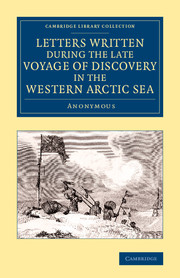
Sir Edward Parry (1790–1855) wrote accounts of his three Arctic expeditions, which have also been reissued in this series. This book takes the form of letters written to a sibling by an anonymous member of the crew on Parry's 1819–20 voyage. It was brought out in 1821 by the enterprising publisher Richard Phillips ahead of any other narrative, as all accounts and journals had first to be handed to the Admiralty Board for the extraction of any important details. It seems likely that the work, which is carefully constructed and elegant in style, was elaborated either from notes or from a genuine series of letters, to get round the restriction on publication. This is a fascinating narrative, full of striking details, such as entertainments on board to help morale, the reappearance of the sun at the end of the Arctic winter, and the sight of the aurora borealis.
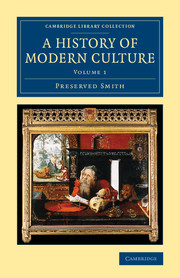
Preserved Smith (1880–1941), a professor in the history department of Cornell University, owed his unusual first name to Puritan ancestors who could be traced back to the seventeenth century. His great interest was in the Protestant reformation, and its wide-ranging political and cultural effects in Europe and America. An obituary remarks that his writings 'reveal a remarkable breadth of knowledge and interest and a consistent devotion to high standards of scholarly integrity'. This two-volume work of 1930–4, discussing 'modern culture' from 1543 to 1776, displays these qualities in abundance. Volume 1, after an introductory chapter, considers the state of the sciences in the sixteenth century, then the humanities and the social and political context of law, morality and art. The emphasis on the importance of science as a driver of change makes this a remarkable and readable overview of the emergence of modern society.
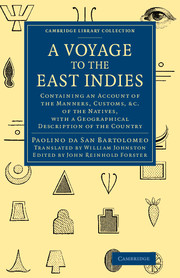
After a six-month voyage, the Carmelite missionary Paolino da San Bartolomeo (1748–1806) arrived in Malabar in India towards the end of July 1776. Later acclaimed as an orientalist, he was among the first to note the relationship between Sanskrit and European languages, and the present work gives a valuable account of the geography and culture he observed over the course of thirteen years. Returning to Rome in 1789, he wrote many books under the patronage of Cardinal Stefano Borgia, including one of the first works on Sanskrit grammar. Here he uses his impressive knowledge of Indian dialects to revise the accepted spelling and pronunciation of a number of cities and natural features. The book also contains observations on the religion, history, botany and laws of eighteenth-century India. First published in Italian in 1796, the work was soon translated into German, from which William Johnston produced this English translation in 1800.
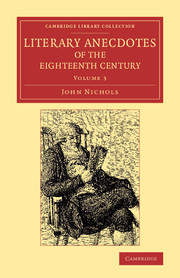
In this nine-volume work, published between 1812 and 1815, the author and publisher John Nichols (1745–1826) provides biographical notes on publishers, writers and artists of the eighteenth century, and also gives 'an incidental view of the progress and advancement of literature in this kingdom during the last century'. (A shorter version had been published in 1782.) His subjects range from the publisher William Bowyer to Henry Fielding and Horace Walpole, and also include histories of individual publishing houses and of genres such as lexicography. The work remains a useful source of biographical material on authors and publishers at a period when many of the literary genres we take for granted, such as the novel, the autobiography and the analytical history, were first being developed. Volume 3 includes memoirs of Henry Fielding and the printer John Baskerville, and a history of the Stationers' Company.
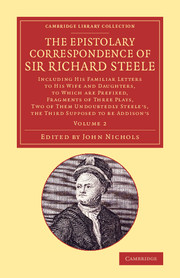
Including his Familiar Letters to his Wife and Daughters, to Which Are Prefixed, Fragments of Three Plays, Two of Them Undoubtedly Steele's, the Third Supposed to Be Addison's
Sir Richard Steele (1672–1729), soldier, courtier and dramatist, is best remembered for his founding of two literary and political periodicals, the Tatler and the Spectator (the latter jointly with his friend Joseph Addison). These two volumes of his letters to friends and family were compiled by the publisher John Nichols and published in 1809. Nichols claims in his preface that these letters, 'some of them evidently scribbled when their amiable Author was probably not in the very best condition for penmanship', are nonetheless of great interest, 'as they contain the private and undisguised opinions of the man who took upon himself to be the Censor of the age'. Volume 2 contains letters to his wife and daughters, and to literary and political figures of his day, including Sir Robert Walpole, Robert Harley, earl of Oxford, the duke of Newcastle, and the theatre managers Cibber and Booth.
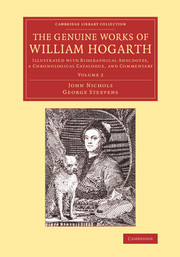
This illustrated three-volume catalogue of the works of painter and engraver William Hogarth (1697–1764) was the result of 'Hogarthomania', the enthusiasm for all his productions which arose soon after his death. The publisher and author John Nichols (1745–1826), assisted by the collector and literary critic George Steevens, published a life of Hogarth and a list of his works in 1781, and as disputes increasingly arose over the genuineness of some of the prints attributed to him, enlarged versions appeared in 1782 and 1785. This work, published between 1808 and 1817, is the last in the sequence of Nichols' works on Hogarth, and remains a useful source for art historians and anyone interested in the cultural life of the eighteenth century. Volume 2 contains a catalogue of his works, an appendix of anecdotes about some of Hogarth's subjects, and his essay The Analysis of Beauty.