A collection of out-of-copyright and rare books from the Cambridge University Library and other world-class institutions that have been digitally scanned, made available online, and reprinted in paperback.
To save content items to your account,
please confirm that you agree to abide by our usage policies.
If this is the first time you use this feature, you will be asked to authorise Cambridge Core to connect with your account.
Find out more about saving content to .
To save content items to your Kindle, first ensure no-reply@cambridge.org
is added to your Approved Personal Document E-mail List under your Personal Document Settings
on the Manage Your Content and Devices page of your Amazon account. Then enter the ‘name’ part
of your Kindle email address below.
Find out more about saving to your Kindle.
Note you can select to save to either the @free.kindle.com or @kindle.com variations.
‘@free.kindle.com’ emails are free but can only be saved to your device when it is connected to wi-fi.
‘@kindle.com’ emails can be delivered even when you are not connected to wi-fi, but note that service fees apply.
Richard Hakluyt (1552?–1616) was fascinated from his earliest years by stories of strange lands and voyages of exploration. A priest by profession, he was also an indefatigable editor and translator of geographical accounts, and a propagandist for English expeditions to claim new lands, especially in the Americas. His most famous work was first published in 1589, and expanded in 1598–1600: reissued here is the twelve-volume edition prepared by the Scottish firm of James MacLehose and Sons and first published between 1903 and 1905, which included introductory essays and notes. Hakluyt's subjects range from transcriptions of personal accounts and 'ruttiers' (descriptive charts of voyages) to patriotic attacks against rival nations (especially Spain). Volume 12 contains an essay on sixteenth-century voyages by the scholar Walter Raleigh (1861–1922), a general index to all the volumes, and an index to the individual ships referred to.
The surgeon Thomas Pettigrew (1791–1865) was interested in all aspects of antiquity, and gained fame in London society through his mummy-unwrapping parties. (His History of Egyptian Mummies is also reissued in the Cambridge Library Collection.) His interest in the early history of medicine is evidenced by this work, published in 1844, which describes the various forms of superstition which the science of medicine had always attracted since ancient times. Pettigrew considers alchemy and astrology, and the use of talismans, amulets and charms, as well as the history of Egyptian, Greek and Roman medicine, and some modern developments, including 'sympathetical cures' and the rejoining of severed fingers and ears. A chapter is devoted to the belief in the efficacy of the 'royal touch' against the King's Evil (scrofula), and another to the seventeenth-century faith healer Valentine Greatrakes, of whose alleged cures Pettigrew takes a robustly sceptical view.
In 1850, a small squadron of British naval vessels, under the command of Horatio Austin, sought to locate the missing Arctic expedition of Sir John Franklin. The ships were trapped in ice by September 1850 and the men were forced to endure the forbidding Arctic winter, finally returning to England in October 1851. This book, published in 1852 and reissued here in the second edition that quickly followed the first, is a collection of articles which appeared in the Aurora Borealis, a newspaper edited by the surgeon James John Louis Donnet (1816–1905) aboard HMS Assistance. It features contributions from the likes of Sir John Ross, Leopold McClintock, fellow officers and several crew members. Despite the serious nature of the mission and the difficulties of the Arctic conditions, the contributions are often light-hearted, making this work a colourful reflection of life on a polar expedition.
This illustrated three-volume catalogue of the works of painter and engraver William Hogarth (1697–1764) was the result of 'Hogarthomania', the enthusiasm for all his productions which arose soon after his death. The publisher and author John Nichols (1745–1826), assisted by the collector and literary critic George Steevens, published a life of Hogarth and a list of his works in 1781, and as disputes increasingly arose over the genuineness of some of the prints attributed to him, enlarged versions appeared in 1782 and 1785. This work, published between 1808 and 1817, is the last in the sequence of Nichols' works on Hogarth, and remains a useful source for art historians and anyone interested in the cultural life of the eighteenth century. Volume 1 contains a biography of Hogarth and a short account of the continuing issues of his prints after his death.
This three-volume bibliography of printing was published between 1880 and 1886 by E. C. Bigmore (1838–99) and C. W. H. Wyman (1832–1909), who had, unknown to each other, been working on similar projects and were brought together by the antiquarian bookseller and publisher Bernard Quaritch. The scope of the work, which quickly became a classic, includes 'typographic, lithographic, copperplate printing, etc., with the cognate arts of type-founding, stereotyping, electrotyping, and wood-engraving', but excludes the topics of paper and bookbinding. The three volumes are arranged in alphabetical order of surname of author; anonymous works are ordered by the wording of the title. Compiled with the assistance of such historians of printing as William Blades and John Southward (several of whose works are available in this series), this authoritative work is of continuing value to bibliographers. Volume 2, published in 1884, covers the letters M to S.
This three-volume bibliography of printing was published between 1880 and 1886 by E. C. Bigmore (1838–99) and C. W. H. Wyman (1832–1909), who had, unknown to each other, been working on similar projects and were brought together by the antiquarian bookseller and publisher Bernard Quaritch. The scope of the work, which quickly became a classic, includes 'typographic, lithographic, copperplate printing, etc., with the cognate arts of type-founding, stereotyping, electrotyping, and wood-engraving', but excludes the topics of paper and bookbinding. The three volumes are arranged in alphabetical order of surname of author; anonymous works are ordered by the wording of the title. Compiled with the assistance of such historians of printing as William Blades and John Southward (several of whose works are available in this series), this authoritative work is of continuing value to bibliographers. Volume 1, published in 1880, contains an introduction and covers the letters A to L.
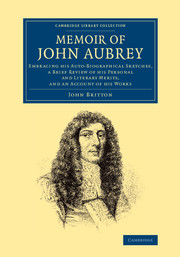
The antiquarian and topographer John Britton (1771–1857) is best remembered for his multi-volume series of The Beauties of England and Wales. A self-taught author and scholar, he was attracted by the work of John Aubrey (1626–97), who was born in the same Wiltshire village as him, and had very similar interests as an antiquarian and biographer, famous for his Brief Lives and for his surveys of and writings on Avebury and Stonehenge. Britton's research on Aubrey's life induced him to write a fresh account, using surviving manuscripts as well as printed sources, which would clear up the contradictions and errors of earlier versions. This 1845 book is a fascinating portrait of a sickly child who ended up a pauper because of family debts and lawsuits, but was a diligent and intelligent scholar, scientist and occultist, and a close friend of Thomas Hobbes and Robert Hooke.
John William Donaldson (1811–61), though somewhat unorthodox in his methods, was an important, if controversial, figure in the development of comparative philology. In this 1844 publication, he attempts to supply young English scholars of Latin with an introductory guide to Latin philology by outlining the origins of the Roman people and, through this, explaining the foundational structures of the Latin language and how they gave rise to Classical Latin. Epigraphic evidence, drawn from the Twelve Tables in particular, is examined as part of the enquiry into Old Latin, and other Italic languages such as Umbrian, Oscan and Etruscan are considered as part of the development of a more standardised Latin language. Although many of the conclusions Donaldson draws are based on limited evidence, the book remains an interesting specimen of early comparative philology. His earlier work on Greek, The New Cratylus (1839), is also reissued in this series.
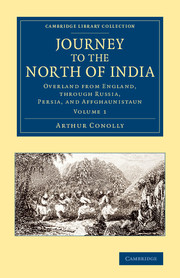
The Great Game, a coinage credited to the British officer Arthur Conolly (1807–42), refers to the nineteenth-century rivalry between Britain and Russia as each power sought supremacy in Central Asia. In a climate of tension and suspicion that the Russians might attempt to invade India via Afghanistan, Conolly, returning from sick leave in England, embarked in 1829 on an expedition through the region. His narrative provides observations on the various Asiatic peoples he encountered, including the social, religious and political aspects of their cultures. He describes also the many dangers he had to deal with, requiring him to assume a series of false identities. The risks that Conolly faced were underscored some years later, when he was captured and executed in Bukhara. Volume 1 recounts the first part of his journey, from St Petersburg, through the Caucasus, via Tiflis and Tehran, towards Herat.
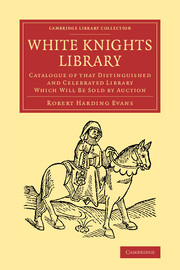
The dispersal of the library amassed by George Spencer-Churchill (1766–1840), Marquess of Blandford and later fifth Duke of Marlborough, is most commonly cited today as a preservative against folly. The collection contained some of the most sought-after incunabula of a period defined by the high prices paid for early printed books. It included a fine selection of Caxtons, spectacular botanical and emblem books, and the iconic Valdarfer Boccaccio - the first edition of the Decameron, purchased by Blandford in 1812 for the unprecedented sum of £2,260. The Boccaccio was symptomatic of the profligate expenditure of its buyer. By 1819 his spendthrift ways had ruined him, leading to the sale of his opulent estate at Whiteknights, near Reading, and the dispersal of one of the key libraries in the era of bibliomania. Reissued here together are the two parts of the auction catalogue, both annotated by an auction attendee who recorded details of the purchasers and the prices paid. Ed Potten, Head of Rare Books at Cambridge University Library, has provided a new introduction that places the catalogue in its wider context.
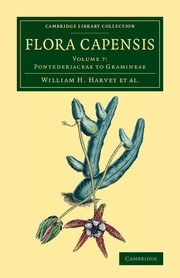
This seminal publication began life as a collaborative effort between the Irish botanist William Henry Harvey (1811–66) and his German counterpart Otto Wilhelm Sonder (1812–81). Relying on many contributors of specimens and descriptions from colonial South Africa - and building on the foundations laid by Carl Peter Thunberg, whose Flora Capensis (1823) is also reissued in this series - they published the first three volumes between 1860 and 1865. These were reprinted unchanged in 1894, and from 1896 the project was supervised by William Thiselton-Dyer (1843–1928), director of the Royal Botanic Gardens at Kew. A final supplement appeared in 1933. Reissued now in ten parts, this significant reference work catalogues more than 11,500 species of plant found in South Africa. Volume 7 comprises sections that were published individually between 1897 and 1900, covering Pontederiaceae to Gramineae.
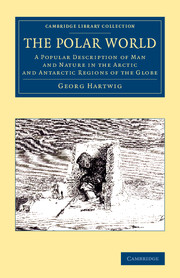
The German scientific writer Georg Hartwig (1813–80) produced many popular works on geographical and natural history topics, among them this book, published in English in 1869. (An American version, with additional chapters, came out in the same year.) Unusually for the period, it surveyed exploration in the Antarctic as well as the Arctic, though the coverage of the latter makes up the bulk of the book. Hartwig's intention is 'to convey solid instruction under an entertaining form', combining the history of exploration with descriptions of the polar regions explored by the mid-century, including Siberia as well as the islands and ice packs of the Arctic Ocean. In this very readable work, Hartwig describes geography, geology and climate, as well as the survival strategies of plant, animal and human life in an extreme environment, using a very wide range of earlier published material to create an integrated narrative.
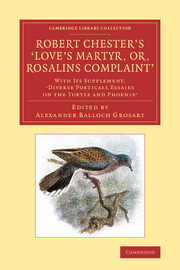
The literary scholar Alexander Balloch Grosart (1827–99) reprinted this allegorical poem by Robert Chester (fl.c.1586–1604) with an introduction and notes in 1878. Grosart incorrectly identified the poem's author as a certain Sir Robert Chester of Royston. Later research suggests Chester served as a chaplain or secretary in the household of the work's dedicatee, Sir John Salusbury. Originally printed in 1601, the grandiloquent, meandering poem is chiefly remembered for the works appended to it. These include original poems by Chester's contemporaries, Shakespeare, Jonson, Chapman and Marston, as well as the anonymous 'Ignoto' and 'Vatum Chorus'. All the poems treat Chester's theme, an invented myth describing the chaste, sacrificial love between a phoenix and a turtledove. Scholars continue to debate the identity of the historical figures signified by these birds, especially in Shakespeare's cryptic contribution.