A collection of out-of-copyright and rare books from the Cambridge University Library and other world-class institutions that have been digitally scanned, made available online, and reprinted in paperback.
To save content items to your account,
please confirm that you agree to abide by our usage policies.
If this is the first time you use this feature, you will be asked to authorise Cambridge Core to connect with your account.
Find out more about saving content to .
To save content items to your Kindle, first ensure no-reply@cambridge.org
is added to your Approved Personal Document E-mail List under your Personal Document Settings
on the Manage Your Content and Devices page of your Amazon account. Then enter the ‘name’ part
of your Kindle email address below.
Find out more about saving to your Kindle.
Note you can select to save to either the @free.kindle.com or @kindle.com variations.
‘@free.kindle.com’ emails are free but can only be saved to your device when it is connected to wi-fi.
‘@kindle.com’ emails can be delivered even when you are not connected to wi-fi, but note that service fees apply.
A professional author of art and literary criticism as well as travel writing, Anna Jameson (1794–1860) journeyed widely in Europe and North America, and moved in the literary circles which included the Brownings and Harriet Martineau. Many of her other works are also reissued in the Cambridge Library Collection. In 1844, she published this book on the great private art collections of London. She begins with an essay on the formation of the collections, from the seventeenth-century earl of Arundel onwards, and then describes in turn the Queen's Gallery, the Bridgewater, Sutherland, Grosvenor and Lansdowne galleries, and the collections of Sir Robert Peel and of the poet Samuel Rogers. For each collection there is an introductory essay, a catalogue raisonnée and a note of the most important items in the collection. This work is a fascinating and valuable guide to mid-nineteenth-century taste and fashion in art.
Antiquary, zoologist and traveller, Thomas Pennant (1726–98) is remembered for his work in bringing natural history to popular attention and for his engaging writing about the journeys he made. Lavishly illustrated by Moses Griffith with fine engravings of the stunning scenery, buildings and artefacts, this work appeared in two volumes between 1778 and 1781. More than a mere travelogue, this tour of his native country is full of delightful vignettes and historical background. The descriptions of locations and buildings reveal Pennant's thorough mind and tireless capacity for observation. Several of Pennant's other works, including his Tour in Scotland (second edition, 1772), are also reissued in the Cambridge Library Collection. Volume 2 follows a route around the area of Snowdonia, the Llŷn Peninsula, Caernarfon, Anglesey and the north-east coast. The latter part of the volume traces a journey from Downing in Flintshire to Shrewsbury via Montgomery.
The publisher and writer Charles Knight (1791–1873) was apprenticed to his printer father, but later became a journalist and then proprietor of various periodicals and magazines, many of which were driven by his concern for the education of the poor. As an author, he published a variety of works, including The Old Printer and the Modern Press (also reissued in this series). He claimed that this six-volume work on the architecture and history of London, published between 1841 and 1844, was neither a history nor a survey of London, but looked 'at the Present through the Past, and at the Past through the Present'. It relies on the skills of eminent artists to bring both the present and the past of London to life, and is arranged thematically rather than chronologically or geographically. This is a fascinating account of what was then the greatest city in the world.
Best known for this 1819 biography of his friend Thomas Paine, Thomas Clio Rickman (1761–1834) is sometimes called Paine's Boswell. His sympathetic portrait follows Paine's progress from simple stay-maker to one of the most influential political activists in the age of revolutions. Although acknowledging Paine's egoism and penchant for drink, Rickman presents these flaws alongside the better qualities of a man who did not merely 'live amid great events … he created them'. Rickman weaves together personal remembrances and historical commentary, quoting liberally from Paine's works and letters, as well as from other biographers and historians. The appendix serves to soften Paine's reputation as a fiery radical by including some of his more humorous and reflective short works and poems. Avid readers of early revolutionary history will find a scholarly take on Paine's influence in Moncure Conway's two-volume Life of Thomas Paine (1892), also reissued in this series.
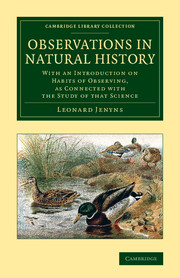
Although devoted to his parish, Leonard Jenyns (1800–93) combined his clerical duties with keen research into natural history. Notably, he was offered the place on the Beagle that later went to Charles Darwin. His numerous works include A Manual of British Vertebrate Animals (1835) and Observations in Meteorology (1858), both of which are reissued in this series. First published in 1846, the present work was originally intended as a companion volume to Gilbert White's acclaimed Natural History and Antiquities of Selborne (1789), which Jenyns had copied out as a student at Eton. The product of two decades of meticulous observation of Jenyns' surroundings in eastern England, the text includes journal entries with careful records on a wide variety of wildlife, including quadrupeds, birds, reptiles, fish, insects and molluscs. Also featuring a detailed calendar of periodic phenomena, this work illuminates the rhythms and quirks of the natural world in England.
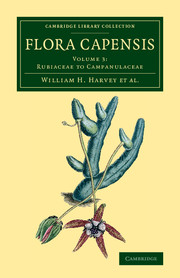
This seminal publication began life as a collaborative effort between the Irish botanist William Henry Harvey (1811–66) and his German counterpart Otto Wilhelm Sonder (1812–81). Relying on many contributors of specimens and descriptions from colonial South Africa - and building on the foundations laid by Carl Peter Thunberg, whose Flora Capensis (1823) is also reissued in this series - they published the first three volumes between 1860 and 1865. These were reprinted unchanged in 1894, and from 1896 the project was supervised by William Thiselton-Dyer (1843–1928), director of the Royal Botanic Gardens at Kew. A final supplement appeared in 1933. Reissued now in ten parts, this significant reference work catalogues more than 11,500 species of plant found in South Africa. Containing orders of the Calyciflorae with a monopetalous corolla and an inferior ovary, Volume 3 covers Rubiaceae to Campanulaceae.
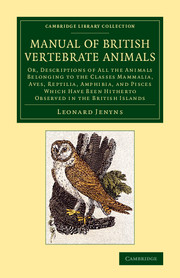
Or, Descriptions of All the Animals Belonging to the Classes Mammalia, Aves, Reptilia, Amphibia, and Pisces Which Have Been Hitherto Observed in the British Islands
Widely respected by contemporaries for his work in natural history, Leonard Jenyns (1800–93) combined research with his duties as an Anglican clergyman. He published and lectured extensively on zoology and botany. Having recommended Darwin for the Beagle voyage, he later produced a paper, 'On the Variation of Species', which Darwin personally requested to see. This 1835 work catalogues five classes of vertebrates: mammals, birds, reptiles, amphibians and fish. Native, introduced and extinct species of the British Isles are included, with binomial and common names given, along with the dimensions and a description. An improvement on previous works which had overly relied on secondary sources, Jenyns's manual also provides information on location, diet and propagation. The catalogue testifies to the diligent work being carried out in natural history in the era prior to Darwin's revolution. Jenyns's Observations in Natural History (1846) and Observations in Meteorology (1858) are also reissued in this series.
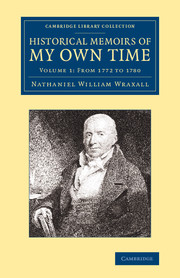
Sir Nathanial William Wraxall (1751–1831), traveller and writer, served as an MP from 1780 to 1794 and was made a baronet in 1813. Upon publication in 1815, his memoirs were an immediate, though controversial, success: 1,000 copies sold out within five weeks. Accused of libelling a Russian diplomat, and found guilty, Wraxall brought out this second edition later that same year, with the offending passages removed. Volume 1 covers 1772–81, a period of extensive travel, which took him across several European countries, including Portugal, France, Germany and Italy, returning to London in 1780. The volume also contains the start of the work's controversial second part, which deals with the beginning of Wraxall's parliamentary career under Lord North's administration. The memoirs make for an entertaining read, and few from the distinguished circles in which the author moved are spared from his merciless facility for description.
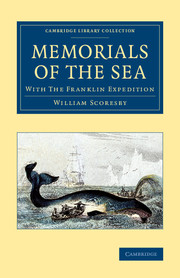
Son of an Arctic whaler, William Scoresby (1789–1857) made the first of many voyages to northern latitudes when he was just ten years old. Later a scientist and clergyman, he wrote on a wide range of topics, and his observations on the Arctic prompted further exploration of the region. The two works reissued here together draw on his experience of seafaring in difficult conditions. First published in 1835, Memorials of the Sea is coloured by Scoresby's belief in divine providence. He discusses the observance of the Sabbath at sea, and considers the Mary Russell murders of 1828, where a ship's captain killed his crew. Scoresby interviewed the perpetrator himself and draws his own conclusions as to the meaning of the incident. The second work included in this reissue is The Franklin Expedition (1850), drawing together considerations relating to the fate and whereabouts of the missing explorers.
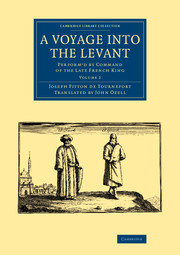
Joseph Pitton de Tournefort (1656–1708) was originally destined for the church, but his interest in botany led him to become professor of botany at the Jardin des plantes in Paris, and to travel all over Europe and beyond in search of interesting specimens. He was chiefly interested in the classification of plants, but is now best remembered for the accounts he wrote of voyages undertaken for the purpose of scientific discovery. This illustrated two-volume work, published posthumously in French in 1717 and translated into English the following year, recounts a journey begun in 1700, around the eastern Mediterranean and the Black Sea, visiting Crete and other Greek islands, Istanbul, Armenia and Georgia. Tournefort notes not only plants, but geographical features, antiquities, the people he encounters, and their way of life, agriculture and industry. Volume 2 continues the journey around the Black Sea and describes the voyage home.
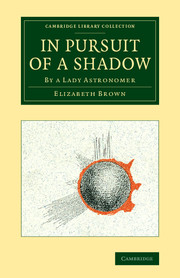
The title page calls the author of this 1888 work 'A Lady Astronomer'. She was Elizabeth Brown (1830–99), and the shadow she was pursuing was the eclipse of the sun on 19 August 1887, which could be best observed in northern Russia. Brought up by her father to make weather observations and to use a telescope, she became a member of the Liverpool Astronomical Society - on behalf of which she undertook her Russian expedition - and was later active in founding the British Astronomical Association. (The Royal Astronomical Society did not at this point admit women.) The book describes her journey, from her arrival at Hull to meet her travelling companion, to Russia, and home again. The actual viewing of the eclipse, at Kineshma, 200 miles north-east of Moscow, was spoiled by cloud cover, but her lively and observant account of her adventures is a fascinating record by a pioneering female scientist.
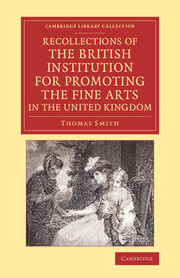
The British Institution for Promoting the Fine Arts in the United Kingdom was founded as a private art gallery in 1805, and took over the lease of publisher John Boydell's Shakespeare Gallery in Pall Mall, London. Its rich and noble subscribers (including the Prince of Wales, later George IV) patronised exhibitions of contemporary works, and also lent items for shows of Old Masters. The Institution also took in art students, and was a very popular public attraction in London: Jane Austen was among the many visitors from around the country. This 1860 book by Thomas Smith, a London historian, describes the founding and development of the Institution, with notices of its regular exhibitions and of special events such as the memorial dinner for Sir Joshua Reynolds. This is a fascinating account of a popular gallery in the first half of the nineteenth century, and of the tastes of its patrons and visitors.
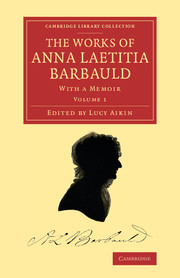
The writer Anna Laetitia Barbauld (1743–1825) was famous for her poems and essays, her writings for children (she and her husband ran a school), and for her edition of the correspondence of Samuel Richardson (also reissued in this series). The sister of John Aikin, the physician and writer, she moved in the dissenting circle of the Warrington Academy, where her father was a teacher: Joseph Priestley was a close friend. This two-volume edition of some of her poems and prose works was compiled by her niece Lucy Aikin (also a writer), and published soon after her death in 1825. The wit, elegance and deep feeling of Barbauld's works led to her being regarded as one of the most important writers of the early Romantic period. Volume 1 contains a short biography and a selection of poems in many genres, including a comic description of Priestley's study.
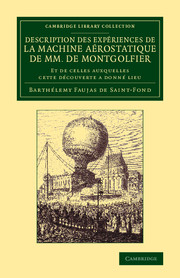
The French geologist and traveller Barthélemy Faujas de Saint-Fond (1741–1819) was a strong supporter of the aerostatic experiments of the Montgolfier brothers, seeking to publicise their pioneering endeavours in this 1783 work. Exploiting the principle that hot air is lighter than cold, the Montgolfiers developed and demonstrated their hot air balloons to great acclaim. In this collection of reports, Faujas presents the details of each experiment, describing the balloons as well as potential improvements. Where possible, he specifies the position of witnesses, precise timings and viewing angles. A number of finely engraved plates enhance the work, giving readers a flavour of the spectacle that impressed contemporary observers. Faujas published a second volume, containing additional accounts and illustrations, in 1784. His Minéralogie des volcans (1784) and Essai de géologie (1803–9) are also reissued in this series.
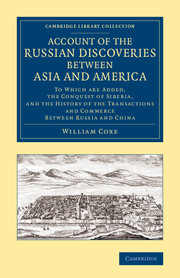
The historian William Coxe (1748–1828) was also an Anglican priest, and had travelled widely in Europe as tutor to various young noblemen on the Grand Tour. (His Anecdotes of George Frederick Handel, and John Christopher Smith is also reissued in the Cambridge Library Collection.) This work originated on a visit to St Petersburg, where Coxe had obtained sight of journals by Russian explorers, and also found an anonymous German work on Russian Arctic voyages between 1745 and 1770. Having checked its authenticity with the Russian authorities, he translated it to form part of this book, first published in 1780 and reissued here in its revised third edition of 1787. He also provides various journals and accounts of exploration in Siberia, Kamchatka and the American Arctic, together with information on trade between Russia and China. Readers will gain insights into a rarely considered aspect of Arctic exploration and economic exploitation.
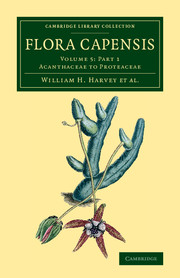
This seminal publication began life as a collaborative effort between the Irish botanist William Henry Harvey (1811–66) and his German counterpart Otto Wilhelm Sonder (1812–81). Relying on many contributors of specimens and descriptions from colonial South Africa - and building on the foundations laid by Carl Peter Thunberg, whose Flora Capensis (1823) is also reissued in this series - they published the first three volumes between 1860 and 1865. These were reprinted unchanged in 1894, and from 1896 the project was supervised by William Thiselton-Dyer (1843–1928), director of the Royal Botanic Gardens at Kew. A final supplement appeared in 1933. Reissued now in ten parts, this significant reference work catalogues more than 11,500 species of plant found in South Africa. Volume 5 appeared in three parts, the first comprising sections published between 1901 and 1912, covering Acanthaceae to Proteaceae.