A collection of out-of-copyright and rare books from the Cambridge University Library and other world-class institutions that have been digitally scanned, made available online, and reprinted in paperback.
To save content items to your account,
please confirm that you agree to abide by our usage policies.
If this is the first time you use this feature, you will be asked to authorise Cambridge Core to connect with your account.
Find out more about saving content to .
To save content items to your Kindle, first ensure no-reply@cambridge.org
is added to your Approved Personal Document E-mail List under your Personal Document Settings
on the Manage Your Content and Devices page of your Amazon account. Then enter the ‘name’ part
of your Kindle email address below.
Find out more about saving to your Kindle.
Note you can select to save to either the @free.kindle.com or @kindle.com variations.
‘@free.kindle.com’ emails are free but can only be saved to your device when it is connected to wi-fi.
‘@kindle.com’ emails can be delivered even when you are not connected to wi-fi, but note that service fees apply.
This biography of the naval officer and explorer Sir Albert Hastings Markham (1841–1918) was published in 1927 by two relatives (both professional authors), using the detailed journals which he kept from 1862. Markham was the cousin of Sir Clements Markham, the historian and geographer, and was greatly influenced by him. Having volunteered for Arctic service, he was rejected by the Admiralty, but took a period of leave in which he went to Baffin Bay as second mate on a whaler. (His account of this voyage, and several other works, are also reissued in this series.) Though best remembered for his Arctic exploration, Markham was involved in active service in China, the Mediterranean and Australian waters, and in the training of naval recruits. He continued in the Royal Navy until 1906, and in his retirement continued to encourage polar exploration, serving for many years on the Council of the Royal Geographical Society.
Born in Moravia, the philologist and historian Joseph (Giuseppe) Müller (1825–95) translated into Italian several major works of German classical scholarship. He held positions at the universities of Pavia and Padua, in the state archives of Florence, and finally in Turin. This work, published in Florence in 1879, prints original documents from the archives of the Tuscan city states in Latin, occasionally Greek, and later in Italian, ranging from the twelfth to the sixteenth century. The first half comprises correspondence with the crusader kings, the Christian communities of the Near East, and subsequently the Ottoman sultanate, introducing ambassadors and negotiating privileges for the city states' communities and representatives in the region. The second half contains the deliberations of the maritime republics on sailing routes and trade schedules. Together they illuminate political and practical relations between the Orthodox, Catholic and Muslim worlds surrounding the Mediterranean in this formative period.
Before the painter Benjamin Robert Haydon (1786–1846) committed suicide, he had left instructions that an account of his life should be published, using his autobiography up to 1820 and his letters and journals for the rest. The writer and dramatist Tom Taylor (1817–80) took on the editing, and the three-volume work was published in 1853. (The slightly enlarged second edition, also of 1853, is reissued here.) Haydon was a history painter at a time when that genre was perceived as the greatest form of the art, and his friends included Wordsworth, Keats, Shelley, Charles Lamb, Hazlitt and Elizabeth Barrett Browning. However, he was constantly in financial difficulties, and in later life a sense of failure seems to have turned into outright paranoia. Volume 2 uses Haydon's journals to continue the account to 1834. His two-volume Conversations and Table-Talk, edited by his son, is also reissued is this series.
An eminent geographer, Clements Markham (1830–1916) had searched for Sir John Franklin in the Arctic as a young man in the Royal Navy. This stimulated his lifelong passion for the polar regions. Published in 1873, this historical review of Arctic exploration was based on extensive research at the Royal Geographical Society, of which Markham was then secretary and later president. The chapters include coverage of early explorers from the sixteenth century, the voyages of Barents and Hudson, Dutch and English whaling voyages around Spitsbergen, exploration of Greenland's east coast, expeditions into Baffin Bay and Smith Sound, Russian discoveries, and possibilities for scientific progress. A discussion of the best route for future British exploration is provided, with an appendix setting out the case for the expedition of 1875–6. Illustrated with a number of maps, Markham's book keenly sought to stimulate further polar exploration by his countrymen.
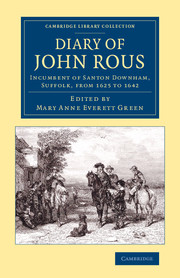
The diary of John Rous (1584–1644) was edited for the Camden Society in 1856 by Mary Anne Everett Green (1818–95). Rous kept this diary between 1625 and 1643, when he was vicar of Santon Downham in Suffolk, recording both local events and reports of momentous happenings in Britain and abroad from Charles I's accession to the outbreak of the Civil War. M. A. E. Green was educated by her father, a Methodist minister, and began research on historical topics in the British Museum Reading Room and other London archives. She was recommended to Sir John Romilly as an external editor for the Calendar of State Papers project, and was the first to be appointed: her work became the standard which later editors followed. Rous's diary is preceded by an introduction placing its author in his family and historical context, and Green's notes explicate references to the people and events described.
In 1867, Prince Alfred, Queen Victoria's second son, commissioned the Galatea for a voyage around the world which would include the first royal visit to Australia. Stopping along the way in Rio de Janeiro and Cape Town, Alfred was received with great ceremony at each port of call. These visits provided the ship's chaplain John Milner (1822–97) and the artist Oswald Brierly (1817–94) with ample material for this chronicle, published in 1869, which gives background details of each region alongside scenes from the tour, enhanced by illustrations based on Brierly's sketches. The authors drew on various recollections and writings, including a letter from Alfred to his brother describing an elephant hunt in South Africa. The tour was abruptly curtailed in Sydney when a Fenian sympathiser attempted to assassinate the prince, an act which boosted support for the British royal family.
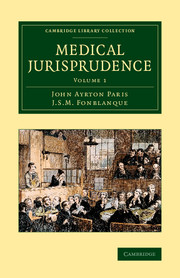
The physician and author John Ayrton Paris (1785–1856), several of whose other medical and popular works have been reissued in the Cambridge Library Collection, and his co-author J. S. M. Fonblanque (1787–1865) published this three-volume work in 1823. It remained almost the only work on the topic of medical jurisprudence for many years. The authors define the term as 'a science by which medicine, and its collateral branches, are made subservient to the construction, elucidation, and administration of the laws; and to the preservation of public health'. Volume 1 considers the context: the professional colleges and their powers and privileges, and historical cases involving a medical practitioner. It also deals with areas of the law where medical evidence may be needed: matrimonial and childbirth issues; insanity; public nuisance (e.g. pollution); and the adulteration of food. The volume ends with the first part of a consideration of unnatural death.
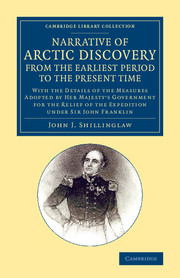
This 1850 account of the history of Arctic exploration was dedicated to Lady Franklin, whose energy in spurring on expeditions in search of her husband and his two ships, by then missing for five years, was widely admired. John Shillinglaw (d.1862), a fellow of the Royal Geographical Society, was able both to give a historical perspective and to describe the most recent efforts being made to discover Franklin's fate. The narrative begins with the Viking exploration and settlement of Iceland and Greenland, and possible landings in North America. While focusing on British voyages in more recent history, Shillinglaw also includes Russian and Danish activities, as well as the founding of trading firms like the Hudson's Bay Company. But the greater part of the book describes, in considerable detail, voyages from the late eighteenth century up to 1850, and offers a useful synthesis of the first-hand accounts published in this period.
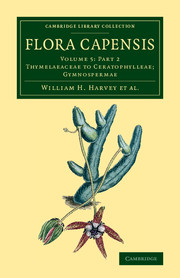
This seminal publication began life as a collaborative effort between the Irish botanist William Henry Harvey (1811–66) and his German counterpart Otto Wilhelm Sonder (1812–81). Relying on many contributors of specimens and descriptions from colonial South Africa - and building on the foundations laid by Carl Peter Thunberg, whose Flora Capensis (1823) is also reissued in this series - they published the first three volumes between 1860 and 1865. These were reprinted unchanged in 1894, and from 1896 the project was supervised by William Thiselton-Dyer (1843–1928), director of the Royal Botanic Gardens at Kew. A final supplement appeared in 1933. Reissued now in ten parts, this significant reference work catalogues more than 11,500 species of plant found in South Africa. Volume 5 appeared in three parts, the second comprising sections published between 1915 and 1925, covering Thymelaeaceae to Ceratophylleae. The 1933 supplement on Gymnospermae is also incorporated in this reissue.
First published in 1857, this work comprises assorted noteworthy writings by the mathematician and astronomer Sir John Herschel (1792–1871), reflecting his diverse scientific and literary interests. It includes a piece on terrestrial magnetism, a review of William Whewell's writings on the history and philosophy of science, and several addresses to the Royal Astronomical Society. Of particular interest is Herschel's commentary on Adolphe Quetelet's work on probability, which advocated applying statistics and probability calculus to social and political questions. Herschel's article not only influenced the growth of social science in Britain, but also played an important role in James Clerk Maxwell's development of a statistical treatment of heat phenomena. Also included in this collection are Herschel's translations of poems by Schiller (accompanied by the original German) as well as examples of his own verse. In an intriguing appendix, Herschel outlines a method for compiling vocabularies of indigenous peoples.
Preserved Smith (1880–1941), a professor in the history department of Cornell University, owed his unusual first name to Puritan ancestors who could be traced back to the seventeenth century. His great interest was in the Protestant reformation, and its wide-ranging political and cultural effects in Europe and America. An obituary remarks that his writings 'reveal a remarkable breadth of knowledge and interest and a consistent devotion to high standards of scholarly integrity'. This two-volume work of 1930–4, discussing 'modern culture' from 1543 to 1776, displays these qualities in abundance. Volume 2 deals with the Enlightenment from 1687 to 1776, and, like Volume 1, starts by considering the role of science as the driver of rapidly evolving cultural, social and political change. The work is a remarkable and readable overview of the emergence of modern society.
The Scottish landscape gardener and prolific horticultural writer John Claudius Loudon (1783–1843) published this guide to suburban living in 1838. The book is intended to provide instruction on choosing a house or 'villa' (or the site on which to build one); on the furnishing of the house; and on the laying out, planting and general management of the garden and grounds. Loudon had also planned a section on horticulture, but was forced to postpone this to a separate volume, which was never written. Like most of Loudon's books (several of which have been reissued in this series), the work is detailed and didactic: for example, the precise construction of chimneys is discussed, with reference to the various existing styles and the pros and cons, aesthetic and functional, of each. Offering insights into the practical and social aspirations of the emerging middle classes, the book also contains numerous engravings.
The writer Lucy Aikin (1781–1864) was the daughter of the physician and author John Aikin and the niece of Anna Laetitia Barbauld, whose works she edited after Barbauld's death in 1825. Given this literary background, it is not surprising that Lucy should have begun to write: her early works were poems, but she is best known for her two-volume Memoirs of the Court of Queen Elizabeth (1818), also reissued in this series. This 1864 work, edited by her niece's husband, contains a memoir of Aikin, a collection of her essays, and letters in which she expresses frequently humorous and often trenchant opinions on the literary and social topics of the day, such as the influence of wider knowledge of the German language on English writing, or the morally elevating effect of the British Museum. It will be appreciated by those interested in early nineteenth-century literature and women's writing.
Sir Nathanial William Wraxall (1751–1831), traveller and writer, served as an MP from 1780 to 1794 and was made a baronet in 1813. Upon publication in 1815, his memoirs were an immediate, though controversial, success: 1,000 copies sold out within five weeks. Accused of libelling a Russian diplomat, and found guilty, Wraxall brought out this second edition later that same year, with the offending passages removed. Volume 2 comprises the majority of the second, and more controversial, part of the work, which covers 1781–4. Wraxall's early parliamentary years were a difficult period in England, the American War of Independence dominating Lord North's administration until his unexpected resignation on 20 March 1782. The 'great despondency' continued; nevertheless, Wraxall's colourful delineations of Fox and Burke, the Earl of Shelburne, Sheridan and Pitt, as well as 'the less efficient members of the cabinet', make for an entertaining read.
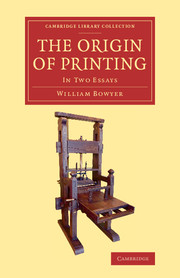
This work, first published in 1774, consists of a reissue of the Dissertation on the Origin of Printing in England by Conyers Middleton (1683–1750), first published in 1735, together with an abridgement of an account of the origin of printing by the Dutch lawyer Gerard Meerman (1722–71). It was compiled by the scholar and publisher William Bowyer (1699–1777) and his apprentice and later business partner John Nichols (1745–1826), several of whose works are also published in this series. Both essays debate the origins of printing, disputing the traditional account that Gutenberg introduced it to Europe and Caxton to England. Appendices describe the progress of printing in Greek and Hebrew, and the first printed polyglot Bibles. The names and achievements of Gutenberg's contemporaries in Germany and the Low Countries are given their due in this interesting overview of the earliest period of printing in the West.
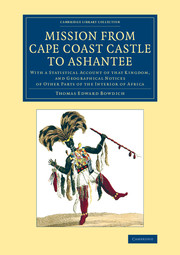
This work by Thomas Edward Bowdich (1791?–1824) describes the journey he made on behalf of the Royal African Company from Cape Coast Castle in West Africa into the territory of the Ashanti, a warlike tribe which had legendary resources of gold and which had been attacking European settlements along the Gold Coast. The intention was to make a peace and trade treaty with the Ashanti, and also to learn more about their culture and customs. Bowdich, not the original leader of the expedition, took control, and negotiated a treaty of mutual co-operation and trade. He returned to Europe in 1818, publishing this fascinating account in 1819, but he felt that his own efforts, and his book, did not receive the rewards they merited. He died on a second, scientific expedition to West Africa, leaving his widow, naturalist and artist Sarah (later Lee), to edit and publish his last work.