A collection of out-of-copyright and rare books from the Cambridge University Library and other world-class institutions that have been digitally scanned, made available online, and reprinted in paperback.
To save content items to your account,
please confirm that you agree to abide by our usage policies.
If this is the first time you use this feature, you will be asked to authorise Cambridge Core to connect with your account.
Find out more about saving content to .
To save content items to your Kindle, first ensure no-reply@cambridge.org
is added to your Approved Personal Document E-mail List under your Personal Document Settings
on the Manage Your Content and Devices page of your Amazon account. Then enter the ‘name’ part
of your Kindle email address below.
Find out more about saving to your Kindle.
Note you can select to save to either the @free.kindle.com or @kindle.com variations.
‘@free.kindle.com’ emails are free but can only be saved to your device when it is connected to wi-fi.
‘@kindle.com’ emails can be delivered even when you are not connected to wi-fi, but note that service fees apply.
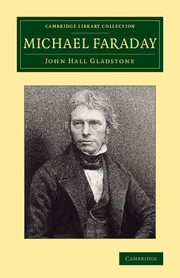
Encouraged to share his memories of Michael Faraday (1791–1867), John Hall Gladstone (1827–1902) published in 1872 this short work about his late friend's life and career. Faraday's successor as Fullerian Professor of Chemistry at the Royal Institution, Gladstone discusses how Faraday approached science, and the value of his discoveries. Offering informed insights into Faraday's character, Gladstone includes a number of extracts from personal letters. The work also includes a translation of part of the eulogy given by Jean-Baptiste Dumas at the Académie des Sciences, as well as an anonymous poem honouring Faraday and published in Punch shortly after his death. An appendix lists the numerous learned societies to which Faraday belonged. Also reissued in this series are The Life and Letters of Faraday (1870), compiled by Henry Bence Jones, and John Tyndall's Faraday as a Discoverer (1868).
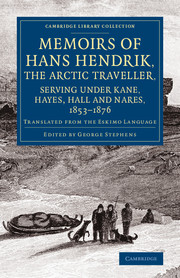
First published in 1878, this English translation of the memoirs of Hans Hendrik (c.1834–89), a native Greenlander, provides a valuable alternative perspective on polar exploration in the nineteenth century. Inuit were often employed on Arctic expeditions of the period. Hendrik is remarkable, however, not only because his skills as a guide and hunter were called on repeatedly during several expeditions - notably those led by Elisha Kent Kane, Isaac Israel Hayes, Charles Francis Hall and George Strong Nares - but also because he wrote his own account of these experiences. The memoirs show that Hendrik distinguished himself through his application of survival skills and that he dealt with numerous challenges, including the forced abandonment of ship and drifting for months on an ice floe. Instances of sickness and malnutrition are also recorded, as is the poor treatment that Hendrik and other Inuit sometimes experienced from their employers.
The French pharmacist Nicolas Jean-Baptiste Gaston Guibourt (1790–1867) first published this work in two volumes in 1820. It provided methodical descriptions of mineral, plant and animal substances. In the following years, Guibourt became a member of the Académie nationale de médicine and a professor at the École de pharmacie in Paris. Pharmaceutical knowledge also progressed considerably as new methods and classifications emerged. For this revised and enlarged four-volume fourth edition, published between 1849 and 1851, Guibourt followed the principles of modern scientific classification. For each substance, he describes the general properties as well as their medicinal or poisonous effects. Illustrated throughout, Volume 1 (1849) begins with an introduction that clarifies Guibourt's approach to pharmaceutical science. The volume then goes on to describe the properties of minerals.
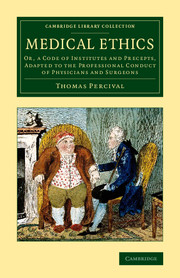
A physician and medical reformer enthused by the scientific and cultural progress of the Enlightenment as it took hold in Britain, Thomas Percival (1740–1804) wrote on many topics, but he was particularly concerned about public health issues arising from the factory conditions of the Industrial Revolution. Calling for improved standards of care, he believed that the working poor should be treated the same as wealthy private clients. Following a disastrous dispute in 1792 which closed the Manchester Infirmary's Fever Hospital during an epidemic, Percival was asked to draft regulations on professional medical conduct. In 1794 he privately circulated a tract, Medical Jurisprudence, which he later revised for this 1803 publication. Based on Hippocratic and Christian principles, Percival's work is considered the first modern formulation of doctor-patient etiquette. His Essays Medical and Experimental (revised edition, 1772–3) and the four volumes of his collected works (1807) are also reissued in this series.
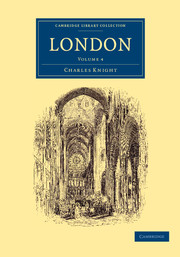
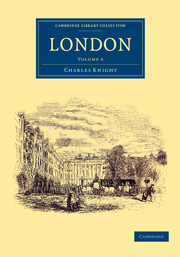
The publisher and writer Charles Knight (1791–1873) was apprenticed to his printer father, but later became a journalist and then proprietor of various periodicals and magazines, many of which were driven by his concern for the education of the poor. As an author, he published a variety of works, including The Old Printer and the Modern Press (also reissued in this series). He claimed that this six-volume work on the architecture and history of London, published between 1841 and 1844, was neither a history nor a survey of London, but looked 'at the Present through the Past, and at the Past through the Present'. It relies on the skills of eminent artists to bring both the present and the past of London to life, and is arranged thematically rather than chronologically or geographically. This is a fascinating account of what was then the greatest city in the world.
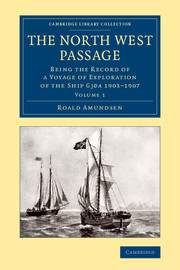
From an early age Roald Amundsen (1872–1928) was determined to be an explorer. Having gained valuable experience on the Belgian Antarctic Expedition (1897–9), he resolved to conquer the North-West Passage. After three years, using a small fishing vessel, the Gjøa, and only six crew, Amundsen succeeded in reaching Nome, Alaska. First published in Norwegian in 1907, and reissued here in its 1908 English translation, this two-volume account is copiously illustrated with photographs. Volume 1 describes how the ship was chosen and its departure from Norway in June 1903. The men spent two winters on King William Island, learning much about survival from the local Inuit. The observatory they established collected magnetic data for almost two years as well as meteorological data, both of which added greatly to existing Arctic knowledge. Sledge journeys ascertained that the position of the North Magnetic Pole had changed little for more than seventy years.
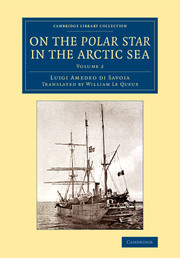
Prince Luigi Amedeo of Savoy, a grandson of King Vittorio Emanuele II of Italy, was well known as a mountaineer and traveller when, in 1899, he organised an expedition to the Arctic, obtaining a steam whaling ship in Oslo which he renamed the Stella Polare. His ambition was to reach the highest possible latitude (and possibly the North Pole itself) by careful logistical arrangements, wintering on the ice in Franz Josef Land and using dog-sledges to travel further north. He also intended a scientific survey of the area in which the team passed the winter. His account of the expedition was published in Italian in 1902 and this two-volume English translation by William Le Queux (better known as the author of sensationalist spy and crime novels) appeared in 1903. Volume 2 gives detailed accounts of the two sledge journeys undertaken by Commander Cagni and Dr Cavalli Molinelli.
This two-volume work on the life and activities of the printer William Caxton, a vital source for bibliographers, was written by another printer, William Blades, and published in 1861–3. Blades (1824–90), apprenticed into the family firm, developed a great interest in the history of his trade, collecting an extensive library of antiquarian books, and becoming an expert on early typefaces. He brings to his study of Caxton (which follows in the wake of works on incunabula by Ames, Herbert and Dibdin) his own practical experience of the craft of printing, largely unchanged, except for the addition of machine power, since Caxton's day. He examined more than 450 Caxton printings, in Britain, France and the Low Countries, while preparing the work. Volume 2 offers an essay on Caxton's working practices and a bibliographical account of every book printed by him then known to have survived.
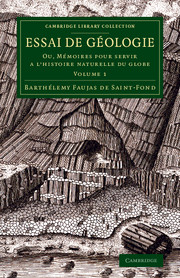
Barthélemy Faujas de Saint-Fond (1741–1819) abandoned the legal profession to pursue studies in natural history. Appointed a royal commissioner of mines in 1785, he also served as professor of geology at the natural history museum in Paris from 1793 until his death. His keen interest in rocks, minerals and fossils led to a number of important discoveries, among which was confirmation that basalt was a volcanic product. The present work appeared in three parts between 1803 and 1809. The first volume features an introductory discussion of the current state of geology, before going on to consider the fossils of plants, shells, fish, cetaceans, crocodiles, and various mammalian quadrupeds. Of related interest in the history of geology, Minéralogie des volcans (1784) and the revised English edition of A Journey through England and Scotland to the Hebrides in 1784 (1907) are two other works by Faujas which are also reissued in this series.
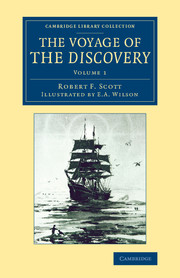
At the outset of the twentieth century, Antarctica was scarcely explored or understood. Penetrating the pack ice in the purpose-built Discovery, the British National Antarctic Expedition (1901–4) established a base in McMurdo Sound, enabling scientists and sledging parties to significantly push back the boundaries of the unknown. Published in 1905, this acclaimed two-volume work by the naval officer and expedition leader Robert Falcon Scott (1868–1912) recounts the trials, errors and achievements of an undertaking which laid the foundations for future research and Scott's later journey to the South Pole. The work is greatly enhanced by many photographs as well as illustrations by the doctor, zoologist and artist Edward A. Wilson (1872–1912). Volume 1 traces the expedition's preparatory phases and the voyage from England to Antarctica via New Zealand. Scott discusses the location of winter quarters and the first polar winter. Chapters on sledging conclude the volume.
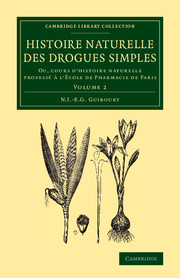
The French pharmacist Nicolas Jean-Baptiste Gaston Guibourt (1790–1867) first published this work in two volumes in 1820. It provided methodical descriptions of mineral, plant and animal substances. In the following years, Guibourt became a member of the Académie nationale de médicine and a professor at the École de pharmacie in Paris. Pharmaceutical knowledge also progressed considerably as new methods and classifications emerged. For this revised and enlarged four-volume fourth edition, published between 1849 and 1851, Guibourt followed the principles of modern scientific classification. For each substance, he describes the general properties as well as their medicinal or poisonous effects. Illustrated throughout, Volume 2 (1849) draws on systems pioneered by three renowned scientists for the classification of plants: Linnaeus, who laid the foundations of modern taxonomy; Jussieu, the first to publish a classification of flowering plants; and de Candolle, whose work influenced Darwin.
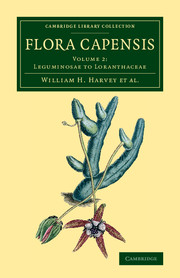
This seminal publication began life as a collaborative effort between the Irish botanist William Henry Harvey (1811–66) and his German counterpart Otto Wilhelm Sonder (1812–81). Relying on many contributors of specimens and descriptions from colonial South Africa - and building on the foundations laid by Carl Peter Thunberg, whose Flora Capensis (1823) is also reissued in this series - they published the first three volumes between 1860 and 1865. These were reprinted unchanged in 1894, and from 1896 the project was supervised by William Thiselton-Dyer (1843–1928), director of the Royal Botanic Gardens at Kew. A final supplement appeared in 1933. Reissued now in ten parts, this significant reference work catalogues more than 11,500 species of plant found in South Africa. Containing the remaining polypetalous orders of the Calyciflorae, Volume 2 covers Leguminosae to Loranthaceae.
An industrious journalist and editor of periodicals, Peter Lund Simmonds (1814–97) wrote across a range of subjects, including natural history and applied science. An active member of the Royal Society of Arts, he first published this dictionary in 1858. Reissued here in its revised and enlarged edition of 1867, it contains more than 22,000 entries. The curious can discover within that a calcar is a furnace in a glassworks, or that the best kind of Cuban tobacco is known as calidad. Readers will also learn that the hautboy can be either eaten or played, being the name for both a wild strawberry and a form of oboe. Testifying to the proliferation of manufactured goods in the nineteenth century, and the contemporary desire to diffuse 'sound and useful knowledge among the masses', this work will appeal to readers interested in the history and lexicon of trade and technology.
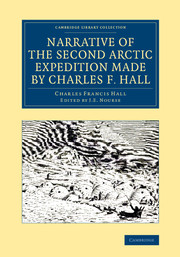
His Voyage to Repulse Bay, Sledge Journeys to the Straits of Fury and Hecla and to King William's Land, and Residence among the Eskimos during the Years 1864–69
The American explorer Charles Francis Hall (1821–71) made two voyages to the Arctic to determine the fate of Sir John Franklin's lost expedition. While there, he lived with Inuit, learning their language and adopting their way of life. Edited after his death and published in 1879, this account of his second expedition, from 1864 to 1869, brings the conditions he endured vividly to life. Two punishing sledge journeys to King William Island revealed evidence of Franklin's encampment there, but also the stark fact that rumours of survivors were unfounded. The work, which contains a number of fine engravings and maps, also includes appendices presenting Hall's detailed scientific observations and notes of his conversations with the Inuit, which disclosed evidence of cannibalism among Franklin's crew. Based on his earlier expedition, Hall's Life with the Esquimaux (1864) is also reissued in this series.
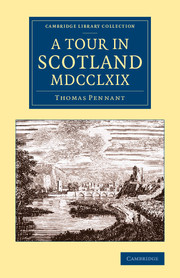
Thomas Pennant (1726–98) is remembered for his work in bringing natural history to popular attention and for his engaging travel writing. With a number of fine engravings, this work, first published in 1771 and reissued here in its second edition of 1772, is typical of Pennant's output. More than a mere travelogue, it recounts his tour - via Tayside, Inverness, Wick and Fort William - of the Scottish Highlands, then largely unknown to outsiders but of notable interest to students of natural history. The volume is of particular significance for its meticulous descriptions of significant locations, buildings and wildlife, revealing Pennant's thorough mind and tireless capacity for observation, and also for its methodology: Pennant drew on local knowledge gathered by circulating queries in advance (these are included as an appendix). Several of Pennant's other works, including his Tour in Wales, are also reissued in the Cambridge Library Collection.
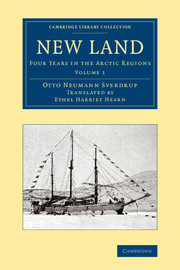
This well-illustrated account of polar exploration was originally published in Norway in 1903, and in this two-volume English translation in 1904. It tells the story of the four years spent by Otto Sverdrup (1854–1930) and his crew in surveying and charting the seas and coastlines of the Arctic. Sverdrup had qualified as a ship's master when he first met Fridtjof Nansen, whose Greenland expedition of 1888 he accompanied. He advised on the construction of Nansen's wooden ship, the Fram, and became its master in 1895. Both with Nansen and under his own leadership, he undertook many expeditions. In June 1898, he took the Fram and a crew including several scientists to Ellesmere Island in the Canadian Arctic, where they overwintered for four years. Volume 1 describes the life and work of the first two years, including extensive trips away from the Fram, both on land and on the ice.
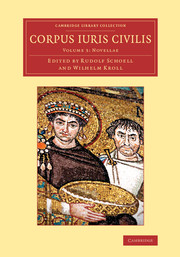
The most famous legal work of the ancient world was compiled at the order of the emperor Justinian (c.482–565) and issued in the period 529–34. It was intended to be a complete codification of all law, to be used as the only source of law in all the courts of the empire. The work was divided into three parts: the Codex Justinianus contained all of the extant imperial enactments from the time of Hadrian; the Digesta compiled the writings of great Roman jurists; and the Institutiones was intended as a textbook for law schools. However, Justinian later found himself obliged to create more laws, and these were published as the Novellae. This three-volume Latin edition of 1872–95, prepared by the great classical historian Theodor Mommsen (1817–1903) and his colleagues, is the culmination of centuries of palaeographical and legal studies. Volume 3 contains the Novellae.
The publisher and writer Charles Knight (1791–1873) was apprenticed to his printer father, but later became a journalist and then proprietor of various periodicals and magazines, many of which were driven by his concern for the education of the poor. As an author, he published a variety of works, including The Old Printer and the Modern Press (also reissued in this series). He claimed that this six-volume work on the architecture and history of London, published between 1841 and 1844, was neither a history nor a survey of London, but looked 'at the Present through the Past, and at the Past through the Present'. It relies on the skills of eminent artists to bring both the present and the past of London to life, and is arranged thematically rather than chronologically or geographically. This is a fascinating account of what was then the greatest city in the world.
Alexander Fisher (d.1838), ship's surgeon on the Arctic exploration ship H.M.S. Hecla, was the probable author of the anonymous 1819 Journal of a Voyage of Discovery to the Arctic Regions, also reissued in this series. The voyage of the Hecla and Griper began in 1819, and Fisher's account was published in 1821, going rapidly into further editions (of which this reissue is the third). The intention of the expedition, under William Edward Parry, was to find the North-West Passage. It was unsuccessful in this respect (an account by Captain G. F. Lyon of Parry's expedition of 1821–3 is also available in this series), but Fisher's detailed and lively account claims that the existence of the passage has been so far proved that it cannot be doubted. He describes the people and wildlife seen during the voyage, as well as providing technical details of latitude, weather and currents.