A collection of out-of-copyright and rare books from the Cambridge University Library and other world-class institutions that have been digitally scanned, made available online, and reprinted in paperback.
To save content items to your account,
please confirm that you agree to abide by our usage policies.
If this is the first time you use this feature, you will be asked to authorise Cambridge Core to connect with your account.
Find out more about saving content to .
To save content items to your Kindle, first ensure no-reply@cambridge.org
is added to your Approved Personal Document E-mail List under your Personal Document Settings
on the Manage Your Content and Devices page of your Amazon account. Then enter the ‘name’ part
of your Kindle email address below.
Find out more about saving to your Kindle.
Note you can select to save to either the @free.kindle.com or @kindle.com variations.
‘@free.kindle.com’ emails are free but can only be saved to your device when it is connected to wi-fi.
‘@kindle.com’ emails can be delivered even when you are not connected to wi-fi, but note that service fees apply.
This three-volume bibliography of printing was published between 1880 and 1886 by E. C. Bigmore (1838–99) and C. W. H. Wyman (1832–1909), who had, unknown to each other, been working on similar projects and were brought together by the antiquarian bookseller and publisher Bernard Quaritch. The scope of the work, which quickly became a classic, includes 'typographic, lithographic, copperplate printing, etc., with the cognate arts of type-founding, stereotyping, electrotyping, and wood-engraving', but excludes the topics of paper and bookbinding. The three volumes are arranged in alphabetical order of surname of author; anonymous works are ordered by the wording of the title. Compiled with the assistance of such historians of printing as William Blades and John Southward (several of whose works are available in this series), this authoritative work is of continuing value to bibliographers. Volume 3, published in 1886, covers the letters T to Z.
The Great Game, a coinage credited to the British officer Arthur Conolly (1807–42), refers to the nineteenth-century rivalry between Britain and Russia as each power sought supremacy in Central Asia. In a climate of tension and suspicion that the Russians might attempt to invade India via Afghanistan, Conolly, returning from sick leave in England, embarked in 1829 on an expedition through the region. His narrative provides observations on the various Asiatic peoples he encountered, including the social, religious and political aspects of their cultures. He describes also the many dangers he had to deal with, requiring him to assume a series of false identities. The risks that Conolly faced were underscored some years later, when he was captured and executed in Bukhara. Volume 2 recounts the time Conolly spent in Afghanistan. Included also are appendices addressing the possible overland invasion of India as well as the history of Afghanistan.
The publisher and writer Charles Knight (1791–1873) was apprenticed to his printer father, but later became a journalist and then proprietor of various periodicals and magazines, many of which were driven by his concern for the education of the poor. As an author, he published a variety of works, including The Old Printer and the Modern Press (also reissued in this series). He claimed that this six-volume work on the architecture and history of London, published between 1841 and 1844, was neither a history nor a survey of London, but looked 'at the Present through the Past, and at the Past through the Present'. It relies on the skills of eminent artists to bring both the present and the past of London to life, and is arranged thematically rather than chronologically or geographically. This is a fascinating account of what was then the greatest city in the world.
This seminal publication began life as a collaborative effort between the Irish botanist William Henry Harvey (1811–66) and his German counterpart Otto Wilhelm Sonder (1812–81). Relying on many contributors of specimens and descriptions from colonial South Africa - and building on the foundations laid by Carl Peter Thunberg, whose Flora Capensis (1823) is also reissued in this series - they published the first three volumes between 1860 and 1865. These were reprinted unchanged in 1894, and from 1896 the project was supervised by William Thiselton-Dyer (1843–1928), director of the Royal Botanic Gardens at Kew. A final supplement appeared in 1933. Reissued now in ten parts, this significant reference work catalogues more than 11,500 species of plant found in South Africa. Volume 4 appeared in two parts, the second comprising sections published in 1904, covering Hydrophyllaceae to Pedalineae.
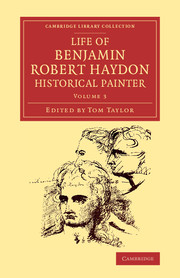
Before the painter Benjamin Robert Haydon (1786–1846) committed suicide, he had left instructions that an account of his life should be published, using his autobiography up to 1820 and his letters and journals for the rest. The writer and dramatist Tom Taylor (1817–80) took on the editing, and the three-volume work was published in 1853. (The slightly enlarged second edition, also of 1853, is reissued here.) Haydon was a history painter at a time when that genre was perceived as the greatest form of the art, and his friends included Wordsworth, Keats, Shelley, Charles Lamb, Hazlitt and Elizabeth Barrett Browning. However, he was constantly in financial difficulties, and in later life a sense of failure seems to have turned into outright paranoia. Volume 3 uses Haydon's journals to continue the account up to the day of his death. His two-volume Conversations and Table-Talk, edited by his son, is also reissued is this series.
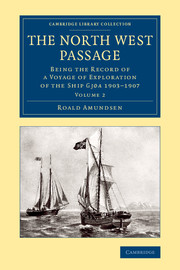
From an early age Roald Amundsen (1872–1928) was determined to be an explorer. Having gained valuable experience on the Belgian Antarctic Expedition (1897–9), he resolved to conquer the North-West Passage. After three years, using a small fishing vessel, the Gjøa, and only six crew, Amundsen succeeded in reaching Nome, Alaska. First published in Norwegian in 1907, and reissued here in its 1908 English translation, this two-volume account is copiously illustrated with photographs. Volume 2 begins with details of Inuit practices, including the building of snow houses, fishing, and the making of clothes. The navigation to Herschel Island, where the men spent a third winter among whaling vessels, is then recounted. One of the crew died from illness before the Gjøa reached Nome in August 1906. This volume contains a lengthy supplement by Godfred Hansen, describing the sledge journeys to map the coast of Victoria Island, and a detailed index to both volumes.
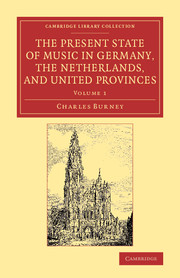
Although a well-connected music teacher by profession, Charles Burney (1726–1814) gained greatest recognition for his writings on music. In this 1773 work, reissued here in its 1775 second edition, Burney recounts the 1772 journey that he undertook as one of two research trips for his General History of Music (1776–89). Throughout his travels, he was welcomed by the leading musicians of the day and heard many performances of the latest music. The whole account provides an invaluable first-hand insight into European musical life in the eighteenth century. Burney's General History and The Present State of Music in France and Italy (1772), the record of his first tour, are also reissued in this series. Volume 1 includes his visits to Munich, Cologne and Frankfurt, and to Vienna where he spent considerable time with the librettist Metastasio and the composers Hasse and Gluck.
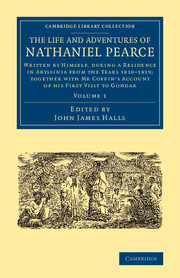
Nathaniel Pearce (1779–1820) was, according to J. J. Halls, who edited and published his autobiographical writings in 1831, 'one of those remarkable and adventurous beings, whom Nature … seems to take delight in creating'. Having run away to sea twice, deserted from the navy, accidentally killed a man, and briefly converted to Islam, he came into his own as a guide and factotum to British travellers in Egypt. He accompanied Henry Salt's 1805 mission to Abyssinia, where he married a local girl and served the ruler of Tigré until the latter's death in 1816. Pearce's humorous account of his life is particularly interesting in the details it gives of the land and people of Ethiopia, then little known by Europeans. Volume 1 begins the narrative of Pearce's life and his African travels and also contains an account of an expedition to the city of Gondar by his friend William Coffin.
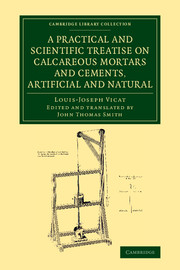
Having devised an artificial cement in 1817, Louis-Joseph Vicat (1786–1861) sought to share and further the science surrounding calcareous cements. His son, Joseph Vicat, went on to found the eponymous company which became an international manufacturer of cement. This work was first published in French in 1828 and is reissued here in the English translation of 1837. Vicat addresses the subject of limes, the ingredients used to prepare mortars and cements, and how these building materials are affected by environmental conditions, such as immersion in water or exposure to damp soil and inclement weather. He also compares binding products of the time with those developed by the ancient Egyptians, Romans and Greeks. The translator, J. T. Smith, provides helpful explanatory notes and clarifies technical terms. Charles William Pasley's Observations on Limes, Calcareous Cements, Mortars, Stuccos, and Concrete (1838) is also reissued in this series.
The physician and author John Ayrton Paris (1785–1856), several of whose other medical and popular works have been reissued in the Cambridge Library Collection, and his co-author J. S. M. Fonblanque (1787–1865), barrister and administrator, published this three-volume work in 1823. It remained almost the only work on the topic of medical jurisprudence for many years. The authors define the term as 'a science by which medicine, and its collateral branches, are made subservient to the construction, elucidation, and administration of the laws; and to the preservation of public health'. Volume 3 continues the discussion of homicide, dealing with abortion and infanticide, rules for dissection, and issues of criminal responsibility, such as pleas of insanity. This is followed by a 'synopsis of the objects of inquiry in cases of sudden death', and an appendix presenting many illustrative historical cases. The book ends with a comprehensive index to all three volumes.
The French pharmacist Nicolas Jean-Baptiste Gaston Guibourt (1790–1867) first published this work in two volumes in 1820. It provided methodical descriptions of mineral, plant and animal substances. In the following years, Guibourt became a member of the Académie nationale de médicine and a professor at the École de pharmacie in Paris. Pharmaceutical knowledge also progressed considerably as new methods and classifications emerged. For this revised and enlarged four-volume fourth edition, published between 1849 and 1851, Guibourt followed the principles of modern scientific classification. For each substance, he describes the general properties as well as their medicinal or poisonous effects. Illustrated throughout, Volume 3 (1850) continues to describe plant substances, drawing on the systems of Linnaeus, Jussieu and de Candolle. The volume covers the last two classes of dicotyledons.
The surgeon Thomas Pettigrew (1791–1865) was interested in all aspects of antiquity. He gained fame in society through his mummy-unwrapping parties, and his History of Egyptian Mummies is also reissued in the Cambridge Library Collection. His interest in the early history of medicine is evidenced by this edition of a work by John Hall, which was published by the Percy Society in 1844. Hall was a surgeon, born 1529/30, who published this work in 1565 as an appendix to his translation of the work of the thirteenth-century surgeon Lanfranc of Milan. Little is known about Hall except that he practised medicine in Maidstone, Kent, and had published acrostic verses. He was vociferous in his indignation against fraudulent medicine, and this work describes nine incidents where quacks, both male and female, had visited Maidstone and offered miraculous cures to the gullible: Hall himself was involved in prosecuting some of them.
The publisher and writer Charles Knight (1791–1873) was apprenticed to his printer father, but later became a journalist and then proprietor of various periodicals and magazines, many of which were driven by his concern for the education of the poor. As an author, he published a variety of works, including The Old Printer and the Modern Press (also reissued in this series). He claimed that this six-volume work on the architecture and history of London, published between 1841 and 1844, was neither a history nor a survey of London, but looked 'at the Present through the Past, and at the Past through the Present'. It relies on the skills of eminent artists to bring both the present and the past of London to life, and is arranged thematically rather than chronologically or geographically. This is a fascinating account of what was then the greatest city in the world.