To save content items to your account,
please confirm that you agree to abide by our usage policies.
If this is the first time you use this feature, you will be asked to authorise Cambridge Core to connect with your account.
Find out more about saving content to .
To save content items to your Kindle, first ensure no-reply@cambridge.org
is added to your Approved Personal Document E-mail List under your Personal Document Settings
on the Manage Your Content and Devices page of your Amazon account. Then enter the ‘name’ part
of your Kindle email address below.
Find out more about saving to your Kindle.
Note you can select to save to either the @free.kindle.com or @kindle.com variations.
‘@free.kindle.com’ emails are free but can only be saved to your device when it is connected to wi-fi.
‘@kindle.com’ emails can be delivered even when you are not connected to wi-fi, but note that service fees apply.
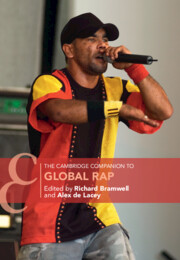
Rap has remapped the way we think about music. For more than fifty years its poetics, performance and political power has resonated across the globe. This Companion offers an array of perspectives on the form, from the fields of sociology, linguistics, musicology, psychology, literary studies, education and law, unpacking how this versatile form of oral communication has permeated nearly every aspect of daily life. Taking a decidedly global perspective, these accounts draw from practice in Australia, China, France, Germany, Jamaica, India and Tanzania; exploring how the form has taken hold in particular contexts, and what this can tell us about the medium itself and the environments in which it was repurposed. An indispensable resource for students and researchers, the collection provides an introduction to global rap studies as well as insights into the some of the most important and exciting new developments in this field.
Volume III of The Cambridge History of War covers the early modern world, offering a four-hundred-year perspective from the last Eurasian nomadic empires to the advent of ironclad, steam-driven warships in the mid-nineteenth century. Together, the chapters cover the rise of professional armies and purpose-built warships in Europe; the evolution of military societies in the great Islamic empires; the vicissitudes of Ming and Qing military organization and that of their Asian neighbours; and the raising and maintaining of armies in Africa and the Americas. Numerous processes of imperial expansion, both on land of sea, are examined, as are the processes of global confrontation and interchange across different military systems. Technology, organization, finance, and military cultures are each explored from a broad perspective. Bringing together an impressive team of experts in their fields, the volume provides a comprehensive and accessible history of war from 1450–1850.
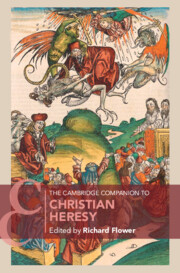
The concept of heresy has played a major role across Christian history. Traditionally, heretical sects have been regarded as distinct, real-life groups of people who had departed from the stable orthodox traditions of Christianity and who posed a threat that needed to be addressed, sometimes through violent repression. More recently, scholarship has focused on the notion of heresy as discourse, placing particular emphasis on its literary construction and the social and cultural contexts in which it was deployed. This literature has generated significant debates about the nature and historicity of many heresies. The Cambridge Companion to Christian Heresy provides a systematic and up-to-date guide to the study of this topic and its methodological challenges. The opening chapters explore different forms of written material that have played vital roles in historical disputes and in modern scholarly accounts. These are followed by case studies of thirteen notable heresies, ranging from the Gnostics through to the Hussites at the dawn of the Reformation.
This chapter considers the presentation of virtue and happiness in the Meditations and asks how far this matches the distinctive features of Stoic thinking on these topics. The main topics considered are (1) the virtue–indifferents distinction, (2) the presentation of the virtues as forming groups or as unified in some way, (3) the virtue-happiness relationship and the idea of happiness as ‘the life according to nature’, meaning according to human or universal nature (or both). Overall, it is suggested that, although Marcus’s focus in the work is on the contribution of these ideas to his overall project of ethical self-improvement, his presentation largely reflects the ideas and connections between them that we find in the standard ancient accounts of Stoic ethics.
In this chapter, I attempt to trace the influence of the Stoic tradition on Marcus Aurelius by focusing on his approach to impressions, material flux, and fate. The primary suggestion is that the influence of earlier Stoicism is best interpreted within the framework of how Marcus develops a normative response to the external world. It is within this context of getting to grips with fluctuating, alienating, and disturbing appearances that we should seek to locate his reception of the Stoic theories of the cognitive impression, material flux, and the philosophical life, more broadly. Such an emphasis on inculcating a reliable response in the soul to the outside world also helps to explain a much-discussed feature of the Meditations, namely the unusual incorporation of Epicurean atomism within the work. I also push back on recent claims that there is evidence of a flirtation with Platonism evident in this text. Marcus was an innovative interpreter of his tradition with a particular focus on psychological stability, but, for all that, he was also a thoroughgoing Stoic.
Outlines the aims and rationale of this guide to The Rite of Spring, sketching the book’s structure across four parts: The Paris Premiere; Contexts; Performance and Interpretation; and Scholarship. Situates the volume within a scholarly context, exploring how it relates to the enormous quantity of published literature on The Rite of Spring – a literature that can be difficult to navigate, especially for newcomers to the work. Also proposes a new, historically sensitive way of approaching the original 1913 production, combining historical and musical perspectives with a focus on the ballet’s intense corporeal impact as noted by some of the first critics inside the theatre.
Describes how Russian dancer-turned-choreographer Vaslav Nijinsky broke free from ballet conventions in his pre-war productions for Diaghilev’s Ballets Russes: L’Après-midi d’un faune (1912), Jeux (1913) and, most famously, The Rite of Spring (1913). Focuses on his characteristically reductive movement vocabulary, the arrangement of dancers on stage and his retreat from the traditions of illusionistic theatre as recognized and understood at the end of the long nineteenth century. Considers various source materials, including press reports, photographs, choreographic notation (where available) and oral testimony. Also explores possible influencing factors within the pre-war theatrical scene (modernist puppet theatre, two-dimensionality, the so-called ‘cinema of attractions’), as well as influences Nijinsky may have had on the choreographers who followed him.
This chapter explores Marcus’ concept of the soul and its main cognitive parts (hēgemonikon, nous, dianoia, daimon) and their relevance for the construction of a concept of the self that is closely interwoven with Stoic self-care. It also investigates Platonic influence on Marcus’ concept of the mind and its relation with the body. Selfhood, understood as an entity referring to itself, unfolds around the hēgemonikon and, to a lesser extent, the dianoia. Self-reference by cognitive acts is limited to the logical soul. These three rational elements are subordinated to the ‘I’ (or psychagogic subject) and serve as objects of its psychagogic self-(trans)formation, thereby construing its selfhood. The perfect starting point for mental self-transformation in Marcus is hypolēpsis ‘assumption’, a single mental act, similar to Epictetus’ prohairesis ‘choice’, to which Marcus’ concept of mental selfhood is heavily indebted. Platonising rhetoric supports the delineation and detachment of the soul’s rational part (esp. nous) from external entities and subordinate mental phenomena but offers no evidence for a dualist psychology or metaphysical concept of the mind. Instead, Marcus’ concepts of mind and body abide by Stoic orthodoxy and its materialist monism.
This chapter surveys the fields of musicology and dance studies, examining some of the most influential historically themed scholarship that has emerged within the two disciplines – and echoed across their own disciplinary histories – since the early twentieth century. Paying particular attention to the work of towering musicologist Richard Taruskin and dance expert Lynn Garafola, the chapter provides a useful account of the ballet’s scholarly legacy and the principal themes that have arisen across what has been a stupendous (and seemingly endless) volume of literature. Of these themes, race, gender and national identity prove particularly enduring, as generations of scholars seek to situate the ballet within coterminous histories of rupture and continuity.
This chapter sets Marcus Aurelius’ Meditations in the wider historical context of the emperor’s life and reign. It considers his family, upbringing, and route to the imperial purple, as well as his principal philosophical and intellectual influences. Marcus’ attitudes to proper imperial conduct are explored through his description of his adoptive father Antoninus Pius. Special attention is paid to comparing and contrasting Marcus’ own views in the Meditations with other ancient sources, particularly his correspondence with his tutor Fronto and later accounts by Cassius Dio and the Historia Augusta.
The Meditations of Marcus Aurelius is consistently one of the best-selling philosophy books among the general public. Over the years, it has also attracted a number of famous admirers, from the Prussian king Frederick the Great to US president Bill Clinton.1 It continues to attract large numbers of new readers, drawn to its reflections on life and death. Despite this, it is not the sort of text read much by professional philosophers or even, until recently, taken especially seriously by specialists in ancient philosophy. It is a highly personal, easily accessible, yet deceptively simple work.
On the face of it, what we find are a series of notebook jottings, reminders that Marcus has written to himself, comments on events that have happened to him, reflections on his own mortality, and a few quotations from things that he has been reading. There is little in the way of structure and a good deal of repetition.