To save content items to your account,
please confirm that you agree to abide by our usage policies.
If this is the first time you use this feature, you will be asked to authorise Cambridge Core to connect with your account.
Find out more about saving content to .
To save content items to your Kindle, first ensure no-reply@cambridge.org
is added to your Approved Personal Document E-mail List under your Personal Document Settings
on the Manage Your Content and Devices page of your Amazon account. Then enter the ‘name’ part
of your Kindle email address below.
Find out more about saving to your Kindle.
Note you can select to save to either the @free.kindle.com or @kindle.com variations.
‘@free.kindle.com’ emails are free but can only be saved to your device when it is connected to wi-fi.
‘@kindle.com’ emails can be delivered even when you are not connected to wi-fi, but note that service fees apply.
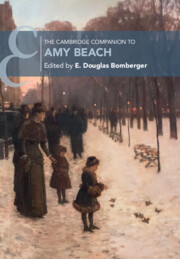
Amy Beach was a pathbreaking composer and pianist who transcended the restrictions of nineteenth-century Boston to become America's most famous turn-of-the-century female composer and, later in her career, a prominent performing artist and promoter of music education. The Cambridge Companion to Amy Beach makes her life and music accessible to a new generation of listeners. It outlines her remarkable talent as a child prodigy, her marriage to a prominent physician twice her age, and her subsequent international acclaim as a composer and piano virtuoso. Analytical chapters examine the range of her musical output, from popular songs and piano pieces to chamber and symphonic works of great complexity. As well as introducing Beach's compelling music to those not yet familiar with her work, it provides new resources for scholars and students with in-depth information drawn from recently uncovered archival sources.
When a female Yahoo makes sexual advances to Gulliver in Part IV of the Travels, he is forced to acknowledge that he ‘was a real Yahoo’. This recognition has disturbed readers as much as it appalled Gulliver. Is Swift a misanthropist? Or does he recommend a middle ground between Yahoo and Houyhnhnm? So many people found the last part of Swift’s Travels both unfathomable and distasteful that it was frequently omitted from nineteenth- and early twentieth-century editions, especially those intended for children. Part III suffered the same fate. Neither book seems to fit with Swift’s imaginatively appealing tales of little and large people. Yet it is likely that he conceived all four parts to work as a whole. This chapter argues that rather than being the spot of solid ground onto which the shipwrecked reader can crawl and from there look back over the rest of the text to find it resolves itself into an order that points at one clear meaning, Part IV leaves many readers baffled and discomforted – and that is the point. While animal fables generally end with an explanatory ‘moral’, Swift obliges readers to work through the complexities and conundrums of his text.
This chapter concerns itself with the Sophists’ professional activities. Their professionalism – especially the claim that they were first to teach for pay – has often been used as the only meaningful characteristic to distinguish them from other wisdom experts. When reviewing the evidence for their professional activities, however, a different picture emerges, one in which the Sophists appear to be less exceptional and more embedded in a broader economy of wisdom than has hitherto been realized. The chapter reviews the primary sources and discusses the difficulty of reconstructing the Sophists’ professional lives based on authors who, like Plato, seem hostile and frequently mention the Sophists in invective contexts. By paying attention to the Sophists’ professional activities, we can gain a better understanding of their social position and the cultural legitimacy accorded them by their contemporaries. How we interpret their professional activities can further help shape our understanding of their contribution to Greek philosophy and their intellectual legacy.
This chapter examines the ways in which pre-war drama explored growing fears over major international conflict. Works considered include Du Maurier’s An Englishman’s Home (1909), Zangwill’s The War God (1911) and a number of less well-known plays and comic skits. The chapter contextualises these works in relation to the fraught geopolitical landscape in which they were produced and the wider cultural phenomenon of ‘invasion fiction’. Both critical and public reactions to these productions are also examined. The chapter concludes by exploring how the pre-war plays established the play-book for propagandistic war-time drama as theatre mobilised for the war effort.
Known chiefly from sources related to democratic Athens, the Sophists emerge from the competitive ethos of aristocratic Greek society. The impetus for the Sophistic movement was the transformation of social and political relations within the Greek world following the defeat of Xerxes. These changes were most dramatically felt and best recorded at Athens. The phenomenal wealth of fifth-century Athens increased the number of Athenians aspiring to an aristocratic lifestyle and intensified the competition for social recognition and for preeminence in politics. Verbal dexterity was a key attribute in the pursuit of such standing. Sophists attracted students by promising to impart such skills in the young men of wealthy families. The turmoil of war in the late fifth century encouraged some of those influenced by Sophists to turn toward oligarchic revolution at Athens, tainting the reputation of Sophistic learning, leading to the condemnation of Socrates for his engagement with these self-proclaimed teachers of political virtue and wisdom.
“Gulliver has been a regular inspiration for film-makers since the earliest days of cinema. This chapter considers the various reasons for his popularity on screen and the challenges inherent in adapting Swift’s text. Among the latter are its lack of narrative unity and the discrepancies between what people think they know of the book and how it actually conducts itself. From silent French films to groundbreaking animations and Hollywood blockbusters, such concerns have always informed the kinds of Gulliver presented to the world. At the same time, each adapter of Gulliver’s Travels explicitly or implicitly considers its relevance for cinema as form and spectacle. Swift’s capacity to disorientate, both in the shifting physical proportions of his characters and in the questionable literary dignity of his text, helps to align him with the experience of cinematic audiences and innovators worldwide. When we assess not only the changing figure of Gulliver but also the different varieties of otherness encountered through his screen afterlives, we can better appreciate the adaptation process as one in which our ideas of history and literature are themselves subject to interrogation.”
In examining how practices of theatregoing were impacted by the war this chapter provides a partner to Claire Cochrane’s examination of theatre-making in Chapter 3. It considers changing audience demographics over the war and reveals how the ‘new’ audiences were often blamed for the deterioration of theatrical quality. It pays particular attention to the two groups of audiences that received the greatest attention during the war: women (especially single women and mothers) and servicemen. Whilst recognising the value of newspaper and magazine commentaries on audience, the chapter also draws on letters, memoirs, commentaries and diary entries to understand and draw out the first-person experience of theatre-going during the war. It highlights the impact of air raids, lighting restrictions, the Amusements Tax and other wartime conditions on audiences. It also shows how changing social realities and relations in the wider world impacted on the theatre, bringing new class and gender dynamics into the auditorium.
This chapter considers the close interrelationship between theatre and cinema during the First World War. As well as looking at key examples of plays which were adapted into films such as The Better ‘Ole (1917) it looks at the relationship between the two modes of popular entertainment, emphasising, for example, how film screenings often incorporated or were incorporated into live performance, and how the two industries shared business practices. The chapter examines the economics and practices of cinema exhibiting, drawing parallels to the regional theatre circuits. It argues for the role of government-endorsed films such as The Battle of the Somme (1916) in establishing the respectability of cinema and demonstrates how from 1917 cinema could shift to being more of a source of entertainment: a shift which threatened the theatre industry. It examines this competition through a focus on the growth of the ‘Super film’ and through attention to the dominance of American films on British screens. The chapter ends with a focus on post-war films. Through discussion the factual war films produced in the 1920s, as well as the fictional dramas, it highlights the ways in which post-war cinema became a means for mediating memory on the war.
“Gulliver’s Travels has long been connected to, and appropriated within, visual culture. The maps and portraits in early editions of the text are part of a complex paratextual apparatus which purports to establish its authenticity and veracity while simultaneously debunking that illusion. However, more recent use of imagery taken – often radically out of context – from the Travels bears witness to the work’s changing status, from literary satire to an element of popular visual culture. This chapter studies some of the various forms and representations involved in these processes, including illustrations, paintings, graphic novels, cartoons, and advertisements, and examines the ways in which images of and relating to Lemuel Gulliver and his travels, which were once unconvincing indicators of authorial reliability, have evolved. Over the centuries, Swift’s imaginary voyage has increasingly been epitomised and reworked, becoming part of a collective iconography familiar to a global audience that has often little to no direct knowledge of the original text.”
This chapter discusses connections between the Sophists and their wider intellectual context. It argues for the value of the term “enlightenment” as a characterization of the period in two respects: as pointing to a widespread self-consciousness of intellectual change, and as encompassing a range of discourses and thinkers beyond the philosophical. Using Aristophanes’ Clouds as a guide, the chapter discusses three modes of thinking that are characteristic of the sophistic period as an enlightenment, understood in these senses: an interest in empirical research and collection, particularly in the human social realm; a concentration on methods of argument and widespread employment of antilogistic forms; and a skepticism toward causal reasoning concerning divinity and the unseen generally. These three modes of thinking are found importantly among the Sophists, but are manifest widely beyond their thought, and are best understood as characteristic practices and attitudes of a fifth-century enlightenment.
This chapter concerns the pursuit of aretē among the sophists. It argues that such pursuit did not mean what it came to mean to Plato and his heirs. For the latter, the goal of human life, called eudaimonia, is personal flourishing; and aretē is used to refer to some highly valued psychological condition crucial to achieving eudaimonia. The sophists use aretē to refer to a psychological condition once. Predominantly, they use aretē to refer to a life of civic success, conceived as success in public affairs, saliently involving the agent’s making significant positive contributions to his fellow citizens and polis. As such, sophistic ethics tends to be civic ethics. Granted this, there is limited evidence of anti-civic ethics among the Sophists. Given traditional views of the Sophists, the locus of this evidence is ironic. It consists of attributions to the Socratic Aristippus and content in the Athenian Antiphon’s On Truth.