To save content items to your account,
please confirm that you agree to abide by our usage policies.
If this is the first time you use this feature, you will be asked to authorise Cambridge Core to connect with your account.
Find out more about saving content to .
To save content items to your Kindle, first ensure no-reply@cambridge.org
is added to your Approved Personal Document E-mail List under your Personal Document Settings
on the Manage Your Content and Devices page of your Amazon account. Then enter the ‘name’ part
of your Kindle email address below.
Find out more about saving to your Kindle.
Note you can select to save to either the @free.kindle.com or @kindle.com variations.
‘@free.kindle.com’ emails are free but can only be saved to your device when it is connected to wi-fi.
‘@kindle.com’ emails can be delivered even when you are not connected to wi-fi, but note that service fees apply.
Khalid Y. Long outlines the origins of the Black Lives Matter movement in 2013, following the murder of teenager Trayvon Martin and the acquittal of his killer. He traces how theatre producers and playwrights collaborated to create artistry in response to a series of contemporary murders of Black men, women, and children—Eric Garner and Michael Brown among others—often by police officers. Theatre speaks back to this tragic violence in two featured play collections: New Black Fest’s Facing Our Truth and Reginald Edmund’s Black Lives, Black Words.
Sandra G. Shannon celebrates Lynn Nottage, Adrienne Kennedy, Lorraine Hansberry, Alice Childress, and Shirley Graham Du Bois for their ability “to expand their worldview beyond the United States’ borders and to inspire, through their dramas, an emotional affinity with the sufferings of people from cultures other than their own.” She bridges these theatrical innovators both by highlighting their interest in Africa and by demonstrating how they were able to employ the theatre to comment upon world politics and with the intent of effecting social change.
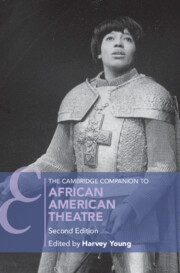
This new edition provides an expanded, comprehensive history of African American theatre, from the early nineteenth century to the present day. Including discussions of slave rebellions on the national stage, African Americans on Broadway, the Harlem Renaissance, African American women dramatists, and the New Negro and Black Arts movements, the Companion also features fresh chapters on significant contemporary developments, such as the influence of the Black Lives Matter movement, the mainstream successes of Black Queer Drama and the evolution of African American Dance Theatre. Leading scholars spotlight the producers, directors, playwrights, and actors who have fashioned a more accurate appearance of Black life on stage, revealing the impact of African American theatre both within the United States and around the world. Addressing recent theatre productions in the context of political and cultural change, it invites readers to reflect on where African American theatre is heading in the twenty-first century.
The twenty-four accessible and thought-provoking essays in this volume present innovative new scholarship on Japan’s modern history, including its imperial past and transregional entanglements. Drawing on the latest Japanese and English-language scholarship, it highlights Japan’s distinctiveness as an extraordinarily fast-changing place. Indeed, Japan provides a ringside seat to all the big trends of modern history. Japan was the first non-Western society to become a modern nation and empire, to industrialize, to wage modern war on a vast scale, and to deliver a high standard of living to virtually all its citizens. Because the Japanese so determinedly acted to reshape global hierarchies, their modern history was incredibly destabilizing for the world. This intense dynamism has powered a variety of debates and conflicts, both at home and with people and places beyond Japan’s shores. Put simply, Japan has packed a lot of history into less than two centuries.