To save content items to your account,
please confirm that you agree to abide by our usage policies.
If this is the first time you use this feature, you will be asked to authorise Cambridge Core to connect with your account.
Find out more about saving content to .
To save content items to your Kindle, first ensure no-reply@cambridge.org
is added to your Approved Personal Document E-mail List under your Personal Document Settings
on the Manage Your Content and Devices page of your Amazon account. Then enter the ‘name’ part
of your Kindle email address below.
Find out more about saving to your Kindle.
Note you can select to save to either the @free.kindle.com or @kindle.com variations.
‘@free.kindle.com’ emails are free but can only be saved to your device when it is connected to wi-fi.
‘@kindle.com’ emails can be delivered even when you are not connected to wi-fi, but note that service fees apply.
Samuel Beckett was a writer of the everyday. Despite his association with the literary avant-garde and his commitment to an increasingly austere aesthetic, his writing betrays an enduring preoccupation with the quotidian rhythms of modern life, including the experiences of boredom, routine, habit, and consumption. Quotidian Beckett: Art of Everyday Life explores the writer's evolving response to this realm of experience, which philosophers and sociologists have paradoxically described as both everywhere and nowhere, obvious and enigmatic. Drawing on Henri Lefebvre's influential theories of everyday life, the Element demonstrates how Beckett's writing, by producing forms that resist transparency and closure, invites us to see the mundane in unfamiliar, unsettling, and politically charged ways. In this regard, his artistic achievement lies in rendering the elusiveness of the quotidian with a vividness that other modes of discourse seldom achieve.
This Element revisits the relation between Giacomo Leopardi and Samuel Beckett to argue that the dialogue between them might offer new ways of thinking about the nature of both writers' pessimism. The authors suggest that Leopardi becomes increasingly important for Beckett, not only because he frames a literary philosophy of scepticism, but because he gives a rich account of the means by which thoroughgoing pessimism might open on to an unenchanted mode of persistence. In doing so, the Element looks past the impasse – between going on and not going on – that threatens to forestall imaginative possibilities for both writers.
Little has been written about Suzanne Beckett, née Déchevaux-Dumesnil (1900–1989). As Samuel Beckett's lifelong companion, she found herself in a peculiar quandary, owing to the amounts of support required by Beckett's unease with success and with the business of writing, and owing to her deep awareness of the damage that fame can cause to everyday life, friendships, and freedom. This Element offers the first full portrait of this elusive figure. It contextualises the texts she wrote under the name Suzanne Dumesnil, emphasises the significance of her artistic and literary accomplishments, and discusses her steady labour, her uncompromising discretion, and her profound reluctance to ever become a public figure as Beckett's wife.
Walking is a determining trope and structure in Samuel Beckett's oeuvre, furnishing a textual and performance figure, a framing device, and a material practice. The walk begins as a motif, becomes a rhythm, expands into a compositional principle, and culminates in an ontology -- a defining means by which his characters are cognitively embodied and by which meaning is grounded. The book contends that Beckett's literary pedestrianism involve passage from an evasive and narcissistic vestige of Romanticism and a solipsistic variation on Edwardian autonomy to an embrace of mutuality and transitory being: life not as a network of stations so much as a meshwork of ways, peripatetic coming and going as the basis of human possibility and ethical value. The study examines the Beckett walk with reference to, for instance, cognitive theory, materialities theory, environmental studies, infrastructure theory, cultural and literary history, speech-act theory, mobility studies and performance studies.
Uncannily similar projects, Beckett's and Derrida's oeuvres have been linked by literary and philosophy scholars since the 1990s. Taking into consideration their shared historical and personal contexts as writers whose main language of expression was 'adopted' or 'imposed', this Element proposes a systematic reading of their main points of connection. Focusing on their engagement with the intricacies of beginnings and origins, on genetic grounds or surfaces analogous to the Platonic khôra, and on their similar critiques of the aporias of sovereignty, it exposes the reasons why multiple readers, like Coetzee, consider Derridean deconstruction a philosophical mirror of Beckett's literary achievements.
This Element discusses the association between Samuel Beckett, and the Romanian-born philosopher, E. M. Cioran. It draws upon the known biographical detail, but, more substantially, upon the terms of Beckett's engagement with Cioran's writings, from the 1950s to the 1970s. Certain of Cioran's key conceptualisations, such as that of the 'meteque', and his version of philosophical scepticism, resonate with aspects of Beckett's writing as it evolved beyond the 'siege in the room'. More particularly, aspects of Cioran's conclusion about the formal nature that philosophy must assume chime with some of the formal decisions taken by Beckett in the mid-late prose. Through close reading of some of Beckett's key works such as Texts for Nothing and How It Is, and through consideration of Beckett's choices when translating between English and French, the issues of identity and understanding shared by these two settlers in Paris are mutually illuminated.
This Element focuses on the machinery of commercial theatre, on extra-authorial interventions into the creative process and on the people and institutional forces that foster them. Such a process challenges the autonomy of the artwork and authorial integrity. The primary focus of this Element is then on the hybrid genre of theatre where collective esthetics tends to override and so to supersede individual creation. The essay pays special attention to Samuel Beckett's first professionally produced play, Waiting for Godot, primarily its English language premieres in the US, UK, and the Republic of Ireland. Its implications, however, reach far beyond the genetic and production histories of a single theatrical work to deal with the nature of authorship in a monetized culture, the process of realizing dramatic texts in such a culture, and Samuel Beckett's engagement with such machinery of art.
Insufferable: Beckett, Gender and Sexuality rethinks the role of gender politics in the oeuvre, demonstrates Beckett's historical importance in the development of the 'antisocial thesis' in queer theory, and shows the work's attachment to sexuality as temporarily consolatory but ultimately unbearable. The Beckett oeuvre might seem unpromising material for gender and sexuality studies, but this is exactly what makes it worth considering. This Element brings to Beckett questions that have emerged from gender, queer, and trans theory, engages with the history of feminism and sexuality studies, and develops a theoretical framework able to account for what we have previously overlooked, underplayed, and misinterpreted in Beckett. In the spirit of being 'on the lookout for an elsewhere', it makes a case for a queerly generative de-idealisation of Beckett as an object of critical study.
What motivated Beckett, in 1937, to distance himself from the 'most recent work' of his mentor James Joyce, and instead praise the writings of Gertrude Stein as better reflecting his 'very desirable literature of the non-word'? This Element conducts the first extended comparative study of Stein's role in the development of Beckett's aesthetics. In doing so it redresses the major critical lacuna that is Stein's role and influence on Beckett's nascent bilingual aesthetics of the late 1930s. It argues for Stein's influence on the aesthetics of language Beckett developed throughout the 1930s, and on the overall evolution of his bilingual English writings, arguing that Stein's writing was itself inherently bilingual. It forwards the technique of renarration – a form of repetition identifiable in the work of both authors – as a deliberate narrative strategy adopted by both authors to actualise the desired semantic tearing concordant with their aesthetic praxes in English.
Beckett's work is somewhat out of step with the logic of commemoration and celebration. Festival, with its association with celebration, spectacle, and publicity, would not seem the ideal vehicle for Beckett's work. Yet that work has become highly festivalised, and the incongruities between it and festival forms provide a useful basis from which to examine both Beckett as festivalised commodity and festivals themselves. Festivalising Beckett in Ireland might be characterised as a way of bringing him back home, as well as a way of returning him to the canonical fold - he showed little interest in either during his later years, it need hardly be added. This Element examines Beckett's dissidence in the face of these imperatives of nation, home and the canon, utilising Beckett's work in festival contexts to highlight in the negative the nature of the festival form and to critique the festivalisation of culture.
Samuel Beckett's 1976 Television play Ghost Trio is one of his most beautiful and mysterious works. It is also the play that most clearly demonstrates Beckett's imaginative and aesthetic engagement with the visual arts and the history of painting in particular. Drawing on the work of Stanley Cavell and Michael Fried, On Ghost Trio demonstrates Beckett's exploration of the relationship between theatricality, absorption and objecthood, and shows how his work anticipates the development of video and installation art. In doing so Conor Carville develops a new and highly original reading of Beckett's art, rooted in both archival sources and philosophical aesthetics.
Drawing on evidence from his published works, manuscripts, and correspondence, Samuel Beckett and Cultural Nationalism explores Beckett's engagement with the theme of cultural nationalism throughout his writing life, revealing the various ways in which he sought to challenge culturally nationalist conceptions of art and literature, while never embracing a cosmopolitan approach. The Element shows how, in his pre-Second World War writings, Beckett sought openly to mock Irish nationalist ideas of culture and language, but that, in so doing, he failed to avoid what he himself described as a 'clot of prejudices'. In his post-war works in French and English, however, following time spent in Nazi Germany in 1936-7 as well as in the French Resistance during the Second World War, Beckett began to take a new approach to ideas of national-cultural affiliation, at the heart of which was a conception of the human as a citizen of nowhere.
This Element draws on the concept of ecosystems to investigate selected Beckett works across different media which present worlds where the human does not occupy a privileged place in the order of creation: rather Beckett's human figures are trapped in a regulated system in which they have little agency. Readers, listeners or viewers are complicit in the operation of techniques of observation inherent to the system, but also reminded of the vulnerability of those subjected to it. Beckett's work offers new paradigms and practices which reposition the human in relation to space, time and species.
Much has been written on Beckett and Sade, yet nothing systematic has been produced. This Element is systematic by adopting a chronological order, which is necessary given the complexity of Beckett's varying assessments of Sade. Beckett mentioned Sade early in his career, with Proust as a first guide. His other sources were Guillaume Apollinaire and Mario Praz's book, La Carne, La morte e il Diavolo Nella Letteratura Romantica (1930), from which he took notes about sadism for his Dream Notebook. Dante's meditation on the absurdity of justice provides closure facing Beckett's wonder at the pervasive presence of sadism in humans.
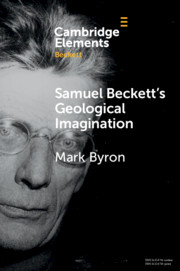
Samuel Beckett's Geological Imagination addresses the ubiquity of earthy objects in Beckett's prose, drama and poetry, exploring how mineral and archaeological objects bear upon the themes, narrative locus, and sensibilities of Beckett's texts in surprisingly varied ways. By deploying figures of ruination and excavation with etymological self-awareness, Beckett's late prose narratives – Company, Ill Seen Ill Said, and Worstward Ho – comprise a late-career meditation on the stratigraphic layerings of language and memory over an extended writing career. These layers comprise an embodied record of writing in their allusions to literary history and to Beckett's own oeuvre.
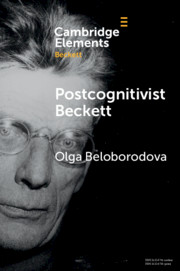
The aim of this Element is to offer a reassessment of Beckett's alleged Cartesianism using the theoretical framework of extended cognition – a cluster of present-day philosophical theories that question the mind's brain-bound nature and see cognition primarily as a process of interaction between the human brain and the environment it operates in. The principal argument defended here is that, despite the Cartesian bias introduced by early Beckett scholarship, Beckett's fictional minds are not isolated 'skullscapes'. Instead, they are grounded in interaction with their fictional storyworlds, however impoverished those may have become in the later part of his writing career.
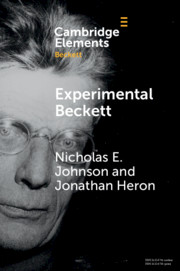
How do twenty-first century theatre practitioners negotiate the dynamics of tradition and innovation across the works of Samuel Beckett? Beckett's own tendencies toward fluidity of genre, iteration/repetition, and collaboration – modes that also define the 'experimental' – allow for greater openness than is often assumed. Reading recent performances for creative uses of embodiment, environment, and technology reveals the increasingly interdisciplinary, international, and intermedial character of contemporary Beckettian practice. The experimentation of current practitioners challenges a discourse based on historical controversies, exposing a still-expanding terrain for Beckett in performance.
Recommend this
Email your librarian or administrator to recommend adding this to your organisation's collection.