To save content items to your account,
please confirm that you agree to abide by our usage policies.
If this is the first time you use this feature, you will be asked to authorise Cambridge Core to connect with your account.
Find out more about saving content to .
To save content items to your Kindle, first ensure no-reply@cambridge.org
is added to your Approved Personal Document E-mail List under your Personal Document Settings
on the Manage Your Content and Devices page of your Amazon account. Then enter the ‘name’ part
of your Kindle email address below.
Find out more about saving to your Kindle.
Note you can select to save to either the @free.kindle.com or @kindle.com variations.
‘@free.kindle.com’ emails are free but can only be saved to your device when it is connected to wi-fi.
‘@kindle.com’ emails can be delivered even when you are not connected to wi-fi, but note that service fees apply.
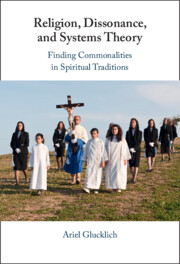
The introductory chapter compares two systems: the cosmological system of the Cherokee Nation and the Ogallala aquifer in Kansas. Ontological and epistemological systems are used to illustrate a new method of comparing phenomena across distinct cultural systems. Comparison is not based on the similarity between cultural or religious phenomena but on the analogy or homology of element function within distinct systems.
Religious belief systems are often marked by internal dissonance. Mitigating this dissonance can lead to surprising religious phenomena, including blood libels, scapegoating, religious violence, the worship of saints and martyrs, asceticism, austerities, as well as processions, fasting, and clowning. In this study, Ariel Glucklich provides a new approach to understanding how religious actions emerge in the context of belief systems. Providing an innovative psychological and social understanding of the causes that stimulate believers to action, he examines a range of religious phenomena in India, Israel, Austria, Italy, and the United States. Glucklich's new theory enables recognition of the patterns that account for the full complexity of actions inspired by religious beliefs and systems. His systematic comparison of actions across traditional boundaries offers a novel approach to cause and effect in comparative religion and religious studies more broadly. Glucklich's book also generates new questions regarding a universal phenomenon that has escaped notice up to now.
We present results from the first application of the Global Navigation Satellite System (GNSS; e.g., the Global Positioning System, GPS) for radio beam calibration using a commercial GNSS receiver with the Deep Dish Development Array (D3A) at the Dominion Radio Astrophysical Observatory (DRAO). Several GNSS satellites pass through the main and sidelobes of the beam each day, enabling efficient mapping of the 2D beam structure. Due to the high SNR and abundance of GNSS satellites, we find evidence that GNSS can probe several sidelobes of the beam through repeatable measurements of the beam over several days. Over three days of measurements, the smallest observed difference in the primary beam’s main lobe was 0.56 dB-Hz. We also compare our results in the sidelobes to simulations and find rough agreement in shape. When scaling the observations and simulations to match in the main lobe power levels, we find deviations in at least one of the first few nulls of approximately 5 dB or less. There is saturation in the main lobe for most satellites, which can likely be mitigated by better attenuation before the receiver input. We compare our work to other satellite systems that have been successful and are likely complementary to this technique. However, GNSS offers key advantages, including continuous transmission, broader frequency coverage relevant to CHORD, SKA-mid, and the DSA-2000, as well as more frequent satellite passes, making it a promising calibration method. These results also motivate further development of this technique for radio astronomy applications.
We are in a metacrisis caused by exponential growth, extraction and entitlement. When we strive to abolish the abundant absurdities of the current system (i.e., modernity) with rehabilitative or reformist responses, we risk reproducing, even reinforcing, the very dynamics we seek to transform. The sensing seed is a visual heuristic and practice of resonant embodied ethics to aid in unravelling the machinations of modernity. The seed identifies three polarities that reflect salient patterns of modernity: separateness, linearity and abstraction. The sensing seed is designed to surface the many materialisations of modernity while elucidating ethical entrées that are decolonially discordant with dominant dispositions by enabling reflexive, visceral and committed praxes of the many adjacent alternatives available, but largely imperceptible, even unimaginable, to modern humans. Through radical acceptance, attention to aesthesis and action, we can show up, cultivate connexion, kindle kin, grow groundward, tarry with trouble, abide in aporias and wallow in wiser lifeways akin to those of our pre-modern (i.e., primal) ancestors.
'Quasar Absorption Lines' is a comprehensive, detailed exposition on the science and analysis of quasar spectra in two volumes, for both aspiring and seasoned astronomers. This Volume 2: 'Astrophysics, Analysis, and Modeling' describes atomic transitions of hydrogenic and multi-electron ions, the theoretical foundation and practical application of the ΛCDM cosmological model, and radiative transfer from cosmological sources. The theory of spectrographs and the mathematical formalism and quantitative analysis of spectral absorption lines and ionization breaks are treated in detail, including column density measurements, line deblending, and Voigt profile fitting. The philosophies, methods, and techniques of large absorption line surveys are presented, including methods for correcting incompleteness and for measuring accurate absorber population statistics. Gas physics, heating/cooling, and ionization are also covered, followed by detailed methods for undertaking multi-component, multiphase chemical-ionization modeling.
This article introduces a fungal framework, both metaphorically and methodologically, for reimagining power, resistance, and world-making in International Relations (IR). Drawing on relational ontologies and ecological insights, it examines how fungal processes of decomposition and regeneration shed light on the entangled relations that constitute the pluriverse—a world of many worlds. By centering decay as a site of transformation, the framework proposes an ethic of research grounded in humility and care. It critiques the epistemic closures that structure dominant IR paradigms and offers tools for engaging ontological multiplicity beyond Eurocentric frames. In doing so, the article contributes to emerging debates on decolonial methodology, more-than-human agency, and pluriversal ethics, advocating for approaches that accompany, rather than assimilate, multiple worlds.
'Quasar Absorption Lines' is a comprehensive, detailed exposition on the science and analysis of quasar spectra in two volumes, for both aspiring and seasoned astronomers. This Volume 1: 'Introduction, Discoveries, and Methods' covers the evolution of the field of quasar spectroscopy over the six decades since quasars were discovered, including the development and application of observational methods and the knowledge gained from them. The broad treatment includes studies of the Ly α forest, Lyman limit systems, damped Ly α absorbers, deuterium (D/H), 21-cm absorbers, HI and HeII reionization, the warm/hot intergalactic medium, and the multiple ionization phases of metal lines. The connections between these absorbers and galaxies (the circumgalactic medium), galaxy groups (the intragroup medium), and clusters of galaxies (the intracluster medium) are treated in depth. Also covered are the taxonomy and classifications of AGN/quasar spectra, black hole accretion, broad and narrow associated absorption lines, and the quasar circumgalactic medium.
Huainanzi 淮南子 contributes a model of sage rulership as, among other things, rule through wuwei 無為, or “non-action.” Through analysis of several concepts core to the text’s political cosmology of governance by wuwei—qi 氣 (vital breath, energy-matter), resonance (gan-ying 感應), and sincerity (cheng 誠)—this article suggests that Huainanzian sagely wuwei refers to an act that seemingly straddles a patterned level of reality of distinct forms, on the one hand, and a primordial, chaos-like reality, beyond the bounds of form, on the other. In an effort to grasp, first, how a singular Huainanzian cosmos may present two seemingly structurally antithetical faces, and second, how the sage-ruler’s program may not only embrace, but put to powerful political effect, the paradoxical union of these two “faces,” this paper draws on a heuristic of fractal and Euclidean geometries, simplified from modern mathematics. The article thereby contributes a further representational modality for thinking through Huainanzi’s extensive, multi-faceted political cosmology, joining in discourse a recent swell of research interested in the same.
Chapter 8 tells the story of Lázaro, whose home collapsed and is now stuck in a long-term struggle to get the state authorities to assist him in rebuilding it. Here the focus is on the dire failures of the revolutionary state apparatus, though the twist is that, rather than cynically lamenting them, Lázaro maintains a steadfast conviction that the state will solve his problem. The reason for this, as we shall see, upends the whole framework of the revolutionary state’s relationship with people, since the source of Lázaro’s conviction in the state’s powers is not the revolutionary state itself, but rather certain spirits with which Lázaro has developed deep and abiding relationships, and who guide him through life, including in his interactions with the state authorities a propos his collapsed home. The chapter shows that the spirits’ mediation does not merely supplement Lázaro’s relationship with the revolutionary state, but rather upends its overall coordinates, drastically changing its shape. The signature ontological constitution of spirits is that they collapse dualist separations between spirit and matter, transcendence and immanence, ought and is – precisely the distinctions that mark out the coordinates within which the revolutionary project takes its shape. In so doing, the spirits present an altogether startling political possibility: a revolution able to deploy the transcendental structures and processes of the state in a way that somehow, per impossible, relates with people immanently in the intimate key of personal care.
We conduct a case study analysis of a proposal for the emergence of time based upon the approximate derivation of three grades of temporal structure within an explicit quantum cosmological model which obeys a Wheeler–DeWitt type equation without an extrinsic time parameter. Our main focus will be issues regarding the consistency of the approximations and derivations in question. Our conclusion is that the model provides a self-consistent account of the emergence of chronordinal, chronometric, and chronodirected structure. Residual concerns relate to explanatory rather than consistency considerations.
In a series of papers published during the last decades, with Mario Castagnino we developed a global and nonentropic approach to the arrow of time that follows John Earman’s “time direction heresy,” according to which the problem of the arrow of time can be addressed in terms of the geometry of space-time, independently of entropic arguments and without appealing to non–time-reversal invariance. The aim of this chapter is to present a review of the global and nonentropic approach to the arrow of time, and to consider some aspects that were not discussed in detail in those original works. In particular, it will be analyzed to what extent the arrow of time can still be defined if the conditions of time-orientability, cosmic time, and time-asymmetry are not satisfied. The role of time-reversal invariance in the present approach will also be discussed. Finally, certain issues about contingency, fundamentality, reducibility, and objectivity will be considered.
The 'arrow of time,' a concept first introduced by Sir Arthur Eddington, reflects the one-way flow of time and its association with various physical asymmetries in thermodynamics, cosmology, quantum mechanics, field theories, and beyond. Yet, the foundations of the arrow of time continues to challenge physicists and philosophers, having profound implications across multiple theories and disciplines.This volume compiles insights from the international colloquium 'The Arrow of Time: From Local Systems to the Whole Univers' held in Buenos Aires in 2023. It explores diverse perspectives on the arrow of time in thermodynamics, quantum mechanics and cosmology, its relation to counterfactual reasoning, free will and the growing-block universe, the interplay between consciousness and time, and the implications of time-reversal invariance. Collectively, these contributions provide a rigorous and comprehensive analysis of the enduring enigma of time's unidirectional nature.
Chapter 6 turns to a cluster of broadly cosmological episodes: the events and agents of creation, the texts that tell of these events and agents, and the authors who wrote these more and less authoritative texts. It focuses on two stretches of Cyril’s Against Julian, broadly concerning the modes of divine management of the cosmos but covering topics ranging from the breadth of human diversity to the Mosaic sacrificial system to the Tower of Babel and Homer’s Aloadae giant brothers. Cyril’s consistent objective is to dislodge the characters of the gods from Julian’s Hellenic story while also demonstrating how much better sense they make within the Christian story as fallen demons. That “all the gods of the nations are demons” (LXX Ps 95:5) was, of course, a common apologetic line. But this re-narrating claim is more than a polemical trope, structuring in fact a surprising range of arguments.
This chapter focuses on presocratic thinkers living in Magna Graecia (Sicily and southern Italy) in the sixth and fifth centuries bce. The main theme is the unity of opposites (a form of antithesis), treated in various ways by these thinkers, and the economic, political and mystic influences on their treatments. Parmenides’ radical separation between the one and plurality (or the paths of truth and opinion) reflects the contrast between possession of money and its circulation. This is informed by Parmenides’ aristocratic outlook; his account of the two paths is also modelled on mystic initiation. The Pythagoreans and Empedokles both adopt a more inclusive framework that embraces opposites within an overall unity, symbolising both the possession and circulation of money and a broad political structure. The Pythagorean cosmos, conceived in terms of fire, harmony and order or calculation, accommodates both poles in their table of opposites. Empedokles’ cosmic cycle includes the opposed subjectivities (with political connotations) of love and strife, while reincarnation accommodates divergent and opposed states of selfhood within an overall wholeness. Unity of opposites is framed by these thinkers in terms of the (introjected) inner self and (projected) cosmos, matching the wholeness offered by mystic initiation.
Since the inception of the United States, religion has long permeated its politics, so much so that racial construction cannot be fully understood without first dissecting America’s cosmological underpinnings. This article maps the founding of ethnic democracy within European modernity and its centrality to the development of the American nation-state. I contend that American ethnic democracy emerges when ethno-racial tyranny expresses itself as white supremacy that is built and sustained through a cosmological justification for its political existence. The political ramifications reveal an unfolding of transhistorical racial terror against the Black as a precondition for ethno-democratic continuity. Nevertheless, contestations against the US ethno-democratic state emerge via the heretical praxis of Black rebels who, through a commitment to subversive belief systems, struggle for Black freedom as a recovery of abolition–democracy.
Chapter Five was devoted to the metaphysics that underpins the Stoic theories of everlasting recurrence. The present chapter focusses on three of these theories in some detail. At least two of them, as I explain in section 6, are early Stoic. As we shall see, one is stronger than the other two, and the two weaker theories are revisions of it. A central component of this chapter is the thesis of Identity, according to which there must be a full type-identity between the events of any two cosmic cycles. Why should this thesis be true? Why could not the events be slightly, or even completely, different? Thus, sections 1 and 2 describe the three theories and how exactly they differ from one another. In sections 3 and 4 are devoted to the argument for Identity. The argument is based on the nature of the Stoic god. It is his full rationality that requires that the token-events of each new cosmos be fully type identical to those of the previous one. I close the chapter in Sections 5-6 with a discussion of the two weaker theories. What are their philosophical motivations? And in what order did they emerge in the history of Stoicism?
By way of conclusion, this chapter deals with two issues that are deeply connected to the argument of the book but that I shall leave open. The first one is Chrysippus’ own answer to question of why the Stoic god would want the conflagration if the new cosmos is identical to the old one and no improvement is possible. The second issue is when the Stoic god designs the cosmos if the series of cosmic cycle is beginningless and changeless. This second issue is related to the larger topic of cosmic creation and the link between the Stoic and the Christian god. Thus, it is of more general interest and may help to put the argument of the book in a wider historical perspective.
The chapter studies this mechanism in detail and focusses on the following questions. First, what are these ‘exhalations’ (ἀναθυμιάσεις) and why do they rise up in the sky? Secondly, why does the desiccation of the sublunary region cause celestial fire to descend to this region? More particularly, why does not celestial fire consume the sublunary region before it totally dries out, as an ordinary wildfire would consume a forest that is still relatively green and full of life? Thirdly, how does celestial fire consume the exhalations and the substances that it finds in the sublunary region? And, more generally, how do the Stoics conceive of the physical process by which a mass of fire consumes another body? In other words, how do they envision the phenomenon of combustion? Fourthly, what is the place of the concept of combustion in their elemental theory? And, finally, how long does the conflagration last?
The early Stoic cosmos is sharply different from that of Plato and Aristotle. But it is also unique compared to that of the Presocratics. In this chapter, I seek to prove that this is so by concentrating upon the Stoic theory of conflagration we just examined. The issue requires an in-depth discussion because Stoic cosmology owes enormously to the Presocratics, and the theory of conflagration is clearly the part of Stoic cosmology that has deeper roots in these early thinkers, much more so than the theories of cosmogony and everlasting recurrence
The conflagration is followed by a cosmony that restores the cosmos. In fact, a permanent end would be impossible given the rationality of the early Stoic god. In this chapter, I limit myself to asking what is the structure of the cosmogony. How, exactly, is the large mass of fire left by the conflagration transformed in the cosmogony into the differentiated masses of air, fire, water and earth that constitute the present cosmos? I shall argue that the cosmogony, which sets off as soon as the conflagration is over, divides into at least three basic stages: (a) the formation of the four elements and of the sublunary and supralunary regions as two differentiated parts of the cosmos, (b) the formation of composite homogeneous substances (gold, flesh, wood, etc.) out of the four elements; and (c) the formation of composite heterogeneous substances (animals and plants) out of homogeneous ones.