To save content items to your account,
please confirm that you agree to abide by our usage policies.
If this is the first time you use this feature, you will be asked to authorise Cambridge Core to connect with your account.
Find out more about saving content to .
To save content items to your Kindle, first ensure no-reply@cambridge.org
is added to your Approved Personal Document E-mail List under your Personal Document Settings
on the Manage Your Content and Devices page of your Amazon account. Then enter the ‘name’ part
of your Kindle email address below.
Find out more about saving to your Kindle.
Note you can select to save to either the @free.kindle.com or @kindle.com variations.
‘@free.kindle.com’ emails are free but can only be saved to your device when it is connected to wi-fi.
‘@kindle.com’ emails can be delivered even when you are not connected to wi-fi, but note that service fees apply.
Dialectologists working in the mid twentieth century established a tripartite division of US regional dialects into North, Midland and South. This work documented the retention of traditional usages and focused on lexical variation. Despite the grounding of these dialect divisions in centuries-old settlement and migration patterns, they remain relevant to regional variation in American English today. This is especially true for the boundary separating the Midland from the North. This chapter examines the history of this remarkably stable boundary in American dialectology. The discussion reviews the evidence produced by early linguistic atlas researchers to establish the dialect boundary along the Atlantic Coast and to trace its extension westward. The current status of the Midland–North divide is explored in the light of sociolinguistic research suggesting that dialect differences on either side have been reinforced over the twentieth century.
With legendary regionalisms like ‘r-dropping’, fronted palm vowels, ‘broad-a BATH vowels, and other features, New England has played a key role in the historical development of English in North America. Historically, the six small states of New England (Massachusetts, Rhode Island, Connecticut, Maine, New Hampshire, Vermont) have had an outsized influence on American English. Their modern sociolinguistic and geographic boundaries still reflect colonial-era settlement patterns from centuries past. Many prior studies on New England English have focused on phonological patterns and changes, but scholars have also examined regional grammatical patterns, lexical variation and change, and also the continuing influence of local Native American words on English. In fact, modern linguists have access to ninety years of detailed fieldwork reports on regional New England dialect features, dating as far back as the 1930s and continuing to the present era. Using this wealth of intergenerational data, the present chapter takes a historical perspective that traces the roots and development of New England English into the present time.
This chapter presents an overview of dialectology that sheds light on the diachronic development of American English varieties. Key projects in US dialect study are considered in light of their historic roots, perspectives and goals; data collection methods; target populations; sampling methods; and linguistic features of focus. Also examined are various types of dialect maps, as well as the use of historic sources that have proven to be useful in tracing the history of dialect forms. The contribution of social dialectological studies is discussed as well, since in-depth surveys across social space have been shown to add to the understanding of how dialect forms develop and diffuse across time and geographic space. The chapter concludes with a discussion of developments in twenty-first-century American dialectology. Throughout, the chapter illustrates how different methods and data sources can be fruitfully brought together to solve the difficult problem of retracing historic pathways for inherently ephemeral spoken language forms.
This chapter explores the importance of England’s traditional dialects for understanding the history of the English language more generally. These dialects are now largely moribund as a result of dialect levelling, standardisation and dialect death but were recorded in considerable detail by linguists in the late nineteenth and early to mid twentieth centuries, and were represented in literary dialect and, especially, dialect literature in the eighteenth and nineteenth centuries. The chapter discusses the nature of these dialects, the data we have for them, and gives examples of the kinds of things we can learn about the history of English from their study. The history of English has always been one of dialect variation, and the history of the language cannot be properly understood without an analysis of England’s traditional dialects.
This chapter addresses the study of the geographical aspects of English linguistic variation in England, from the beginnings to the sixteenth century. The major challenge in the study of early periods of English is the scarcity of sources, which are often not easy to localise. Only in the fifteenth century does the production of administrative materials in English, in a highly variable writing system, allow for a systematic study of geographical variation covering the entire country; for earlier periods materials are much scantier, and many studies have therefore made use of reconstructive methods. This chapter discusses and problematises the different approaches used by earlier scholars; finally, using the newly compiled Corpus of Middle English Local Documents (MELD), it addresses the possibilities of studying early geographical variation directly, with focus on individual items, rather than through the reconstruction of dialect areas or continua.
The study of the history of English has its roots in the work of English scholars who first concerned themselves with the nature of their language about four hundred years ago. Prior to the eighteenth century this work was pre-linguistic, positing a divine origin for language and comparing English (unfavourably) to Classical Greek and Latin. With the advent of modern linguistics in Indo-European research, the history of English became an object of academic interest and the first university positions for its study were established, mainly in Germany and Scandinavia. Simultaneously there arose a tradition of studying English dialects, first as an antiquarian occupation in the eighteenth and early nineteenth centuries, then later as an attempt to capture local history in the vocabulary of specific regions in the twentieth. This then led to the production of dialect dictionaries and surveys.
This chapter provides an overview of manuscript production and reception in the OE and ME periods. It focuses on how manuscripts were produced, the cognitive copying practices of its scribes, the subsequent use of manuscript texts by their readers, and the implications these issues have for the texts and data that survive. It considers the methodological issues arising from working on manuscripts in both their physical and edited forms. The chapter argues for the importance of considering manuscript evidence – including material aspects of the text – when using such texts as data for linguistic enquiry, and the value of this overlooked material for increasing our understanding of diachronic change. Finally, the chapter highlights and demonstrates some fruitful approaches to medieval textual material from the disciplines of historical sociolinguistics, dialectology, pragmatics and philology.
This chapter discusses the subdiscipline of micro-comparative syntax in its relation to dialectology and sociolinguistics. While micro-comparative syntax seeks to contribute to a theoretical cognitive model of the human language capacity, dialectology and sociolinguistics study the relation between linguistic properties and external factors such as geography, age, gender, and social class. Differences and similarities between the three subdisciplines are discussed, as well as the ways they can be combined. The chapter has a strong focus on methodology. The appendix to this chapter provides an overview of recent large-scale dialect syntax projects with links to the project websites and databases.
Languages in contact commonly leave an imprint on one other. The most straightforward of these imprints to identify is MAT-borrowing, which results in clearly identifiable lexical items of one language (the donor language) being used in utterances of another language (the recipient language). This stands in contrast with PAT-borrowing, which does not involve any such incorporation of “other language” material but rather results in the reshaping of existing structures of the recipient language on the model of the donor language. This type of language change is therefore arguably more “invisible” to speakers since no easily identifiable “other language” material is present.
This study presents a detailed examination of PAT-borrowing in Guernésiais, the Norman variety spoken in Guernsey (British Channel Islands), which is now at an advanced state of language shift. It also highlights a major difference between MAT- and PAT-borrowing, namely that, whereas MAT-borrowing can only be explained with reference to the dominant language, PAT-borrowing can on occasion admit an internal explanation.
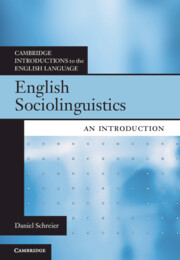
Covering both traditional topics and innovative approaches, this textbook constitutes a comprehensive introduction to English sociolinguistics. Reflecting the field's breadth and diversity, it guides students through the development of research on language and society over the last sixty years, as well as global trends and related fields such as World Englishes, language politics, language and inequality, and translanguaging. It features practical activities, for both individual work and in-class discussion, as well as vignettes introducing specific case studies, additional information on 'out of the box' topics, key terms, and examples from around the world and various social settings. Inspiring, personal and authoritative interviews with leading sociolinguists conclude the book. Assuming only a basic understanding of the English sound system and its grammar, and supported online by additional activities and selected model answers, this is the ideal text for undergraduates wanting an accessible and modern introduction to the field.
This article identifies factors that affect local dialect recognition in the north of the East Midlands, England. Central to the argument is the local belief in a ‘scale of northern-ness’: the general impression that accent moves geographically across the East Midlands, transitioning gradually southwards from northern to southern English. This theory bears similarities with Upton's description of the Midlands region as a ‘transition zone’ (2012, 267). Two dialect recognition tasks were completed by three age groups of respondents based primarily in Chesterfield, North East Derbyshire. The results indicate that Sheffield voices were the most recognisable to the Chesterfield audience, perhaps because they differed from the East Midland voices in the sample. Respondents' ‘dialect image’ (Inoue 1999, 162) of East Midland voices led to some errors being made, with the key belief in the north of this region that ‘north is better’.
Maps are important in many areas of linguistics, especially dialectology, sociolinguistics, typology, and historical linguistics, including for visualizing regional patterns in the distribution of linguistic features and varieties of language. In this hands-on tutorial, we introduce map making for linguistics using R and the popular package ggplot2. We walk the reader through the process of making maps using both typological data, based on the World Atlas of Language Structures, and dialect data, based on large corpora of language data collected from German and American social media platforms. This tutorial is intended to be of use to anyone interested in making maps of linguistic data, and more widely to anyone wanting to learn about mapping in R.
This chapter presents an up-to-date overview of what we know about contemporary grammatical variation in England, drawing on a range of sources such as traditional and variationist dialectological investigations, as well as those using new technologies such as smartphone apps and Twitter feeds. It begins with an assessment of how common the use of non-standard morphosyntax is vis à vis Standard English, before presenting a well-cited list of the most widespread features that are claimed to be found right across the country. The chapter then describes contemporary non-standard grammatical variation in England, examining, in turn: verbs, negation, adverbs, prepositions, plural marking, pronouns, comparison forms, articles and conjunctions. Beyond an account of contemporary morphosyntactic variability, this survey also helps us to locate those linguistic features and those geographical areas about which we hold very little up-to-date information, and, in the light of reports of widespread traditional dialect levelling, points to those non-standard features whose vitality appears to be precarious.
This chapter presents the processes that have resulted in dialectal fragmentation of Slavic languages. It starts with a discussion of early differences in Proto-Slavic, most notably those in reflexes of palatalizations. It then goes on to discuss the variation before the split of the common Slavic community into three branches. This is followed by the presentation of early East Slavic tribal dialects. Next, early lexical differences across and within Slavic languages are considered. The discussion continues by addressing inter-Slavic areal features and prosodic continua. Finally, external factors of fragmentation are discussed (economic, political), alongisde contacts with non-Slavic languages and sociolinguistic factors.
This chapter introduces the aims and structure of the book, familiarizes the reader with key concepts (variants and variables, probabilistic grammars, comparative sociolinguistics, regional variation, indigenization, etc.) and the various subfields of linguistics that are relevant, and sketches the design of the study.
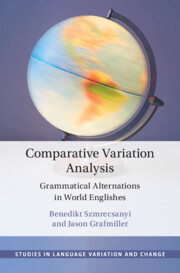
Variation studies is an increasingly popular area in linguistics, becoming embedded in curriculum design, conferences, and research. However, the field is at risk of fragmenting into different research communities with different foci. This pioneering book addresses this by establishing a canon of state-of-the-art quantitative methods to analyze grammatical variation from a comparative perspective. It explains how to use these methods to investigate large datasets in a responsible fashion, providing a blueprint for applying techniques from corpus linguistics, variationist, and dialectometric traditions in novel ways. It specifically explores the scope and limits of syntactic variability in a global language such as English, and investigates three grammatical alternations in nine varieties of English, exploring what we can learn about the grammatical choices that people make based on both observational and experimental data. Comprehensive yet accessible, it will be of interest to academic researchers and students of sociolinguistics, corpus linguistics, and World Englishes.
The chapter ’Linguistic Scratching Posts’ looks at how to analyse the collected data to describe a linguistic variety. Taking a dialectological approach, it shows lexical, morphological, and orthographical variation in a list of cat-related keywords. It also uses the categories of the feline purrspective and the human perspective, which illustrate the semantic variation in cat-related digital spaces. All the categories are listed with examples from the data. To show the vastness of the number of users and posts we are dealing with, the chapter provides some statistics for the four social media platforms from which the data was collected: Facebook, Instagram, Twitter, and YouTube.
The chapter ’The Feline Territory of Language’ shows us how we can approach online language variation with dialectology and outlines the steps to take for a dialectological description of a regional language variety, ranging from dialect data collection to dictionary-making. Using cat-related headwords and survey questions as examples, we look at how the data is collected and presented in the Survey of English Dialects and the Survey of Anglo-Welsh Dialects. The chapter then moves on to dialect lexicography, with cats illustrating the approaches of the EDD, the OED, and the Urban Dictionary, leading us into online dialectology and its use of computers to collect, analyse, and display the data. The last section of the chapter covers phonetics, including its acoustic and articulatory branches. Instead of the usually studied human sounds, however, it takes cat vocalisations to illustrate what to do in phonetics.
After conquering the Internet, cats are now taking on linguistics! Since the advent of social media, cats have become a topic central to online communication, and the multitude of cat-related accounts now online has made this a world-wide phenomenon. Through cat-inspired varieties of language, we have developed a genre of cat-inspired vocabulary. And on our special social media accounts for our cats, we take on their identities, as we post, write, talk, and chat - as our feline friends. This innovative book provides linguistic analyses of the cyber 'Cativerse', exploring online language variation, and explaining key linguistic concepts – all through the lens of cat-related communication. Each chapter explores a different sociolinguistic phenomena, drawing on fun and engaging examples including memes, hashtags, captions and 'LOLcats', from platforms such as Instagram, Facebook, YouTube and Twitter. Innovative yet accessible, it is catnip for all 'hoomans' interested in how language is used online.
The variation of the two past tense auxiliaries (HAVE and BE) is a well-studied phenomenon in European languages, especially in the West Germanic varieties. So far, however, the situation in Eastern Yiddish has not been examined. This paper focuses on auxiliary selection in these Yiddish dialects based on data from the Language and Culture Archive of Ashkenazic Jewry, which were collected in the 1960s. Like most of the current works on this topic, the following analysis uses and discusses Sorace’s (1993, 2000) Auxiliary Selection Hierarchy, which allows to examine the Yiddish structures in light of historical and diatopic evidence from other Germanic varieties, particularly German and Dutch. The main focus is on intransitive verbs that show a high degree of variation—state verbs, controlled and uncontrolled motional process verbs, and change-of-state verbs. However, the Auxiliary Selection Hierarchy also has weaknesses, as is demonstrated in the following.*