To save content items to your account,
please confirm that you agree to abide by our usage policies.
If this is the first time you use this feature, you will be asked to authorise Cambridge Core to connect with your account.
Find out more about saving content to .
To save content items to your Kindle, first ensure no-reply@cambridge.org
is added to your Approved Personal Document E-mail List under your Personal Document Settings
on the Manage Your Content and Devices page of your Amazon account. Then enter the ‘name’ part
of your Kindle email address below.
Find out more about saving to your Kindle.
Note you can select to save to either the @free.kindle.com or @kindle.com variations.
‘@free.kindle.com’ emails are free but can only be saved to your device when it is connected to wi-fi.
‘@kindle.com’ emails can be delivered even when you are not connected to wi-fi, but note that service fees apply.
The optimal jurisdiction size has been debated since Plato and Aristotle. A large literature has studied economic and democratic scale effects, but we have almost no knowledge of the effects of jurisdiction size on the effectiveness of local services. This is due to two methodological problems. First, selection bias and reverse causality often render change in jurisdiction size an endogenous variable. Second, there is a lack of empirical indicators of effectiveness, and most studies therefore focus on spending measures. Extant research thus studies economies of scale, leaving effectiveness of scale unexamined. We address both problems in a quasi‐experimental study of public schools. Our findings from the school area indicate that jurisdiction size does not have systematic effects on effectiveness. Our analysis therefore supports recent studies of economic and democratic scale effects that indicate that the search for the optimal jurisdiction size is futile.
The article examines the European Commission's use of its legal powers over mergers. It discusses and tests two views. One is that the ‘neoliberal’ Commission has ended previous industrial policies of aiding ‘national champion’ firms to grow through mergers and instead pursues a ‘merger‐constraining’ policy of vigorously using its legal powers to block mergers. The other is that the Commission follows an ‘integrationist policy’ of seeking the development of larger European firms to deepen economic integration. It examines Commission decisions under the 1989 EC Merger Regulation between 1990 and 2009. It selects three major sectors that are ‘likely’ for the ‘merger‐constraining’ view – banking, energy and telecommunications – and analyses a dataset of almost 600 Commission decisions and then individual merger cases. It finds that the Commission has approved almost all mergers, including by former ‘national champion’ firms. There have been only two prohibitions over 20 years in the three sectors and the outcome has been the creation of larger European firms through mergers. It explains how the Commission can pursue an integrationist policy through the application of competition processes and criteria. The wider implication is that the Commission can combine competition policy with achieving the ‘industrial policy’ aim of aiding the development of larger European firms.
This paper tests the insiders’ dilemma hypothesis in a laboratory experiment. The insiders’ dilemma means that a profitable merger does not occur, because it is even more profitable for each firm to unilaterally stand as an outsider (Stigler, 1950; Kamien and Zang, 1990, 1993). The experimental data provides support for the insiders’ dilemma, and thereby for endogenous rather than exogenous merger theory. More surprisingly, our data suggests that fairness (or relative performance) considerations also make profitable mergers difficult. Mergers that should occur in equilibrium do not, since they require an unequal split of surplus.
Chapter 4 opens up the black box of the firm to assess the effects of leadership on reform outcomes in China Infrastructure (CI) (pseudonym), a central SOE in the construction industry. The chapter features paired comparisons of the consecutive tenures of chairmen in CI and process tracing of original data gathered during fifteen months of fieldwork inside the company, primarily in its Beijing headquarters, between January 2014 and June 2016, with follow-up visits in June 2018, December 2019, and December 2023. It presents evidence that the chairman’s leadership generated variation in the degree to which market expansion was decentralized and in the balance of influence among intra-firm actors. The chapter also evaluates and rules out alternative explanations: guanxi with and intervention by higher-level officials, shifts in policy by administrative superiors, and changes in industry competition in domestic and international markets.
The multilingual landscape of Canada creates opportunities for many heterogeneous bilingual communities to experience systematic phonetic variation within and across languages and dialects, and exposes listeners to different pronunciation variants. This paper examines phonetic variation through the lens of an ongoing sound change in Cantonese involving word-initial [n] and [l] across two primed lexical decision tasks (Experiment 1: Immediate repetition priming task, Experiment 2: Long-distance repetition priming task). Our main question is: How are sound change pronunciation variants recognized and represented in a Cantonese-English bilingual lexicon? The results of both experiments suggest that [n]- and [l]-initial variants facilitate processing in both short and long-term spoken word recognition. Thus, regular exposure to Cantonese endows bilingual listeners with the perceptual flexibility to dually and gradiently map pronunciation variants to a single lexical representation.
Mergers that involve issues of monopsony are addressed in this chapter. In some cases, a merger may be procompetitive or competitively neutral. In others, however, a merger may be anticompetitive and, therefore, should be barred. Horizontal mergers combine two (or more) firms that operate in the same output market. Since they employ similar workers, the merger may create monopsony power. Antitrust policy regarding horizontal mergers is provided by §7 of the Clayton Act and its judicial interpretation. Typically, the focus is on concentration in the output market, but there has been some recent recognition that a merger may have ill effects in the labor market. We examine this recent concern and provide some examples.
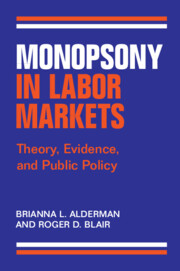
The economics of monopsony power results in lower wages and other forms of compensation, as well as reduced employment. Wealth is transferred from workers to their employers. In addition, the employer's output is reduced, which leads to increased prices for consumers. Monopsony in Labor Markets demonstrates that elements of monopsony are pervasive and explores the available antitrust policy options. It presents the economic and empirical foundations for antitrust concerns and sets out the relevant antitrust policy. Building on this foundation, it examines collusion on compensation, collusive no-poaching agreements, and the inclusion of non-compete agreements in employment contracts. It also addresses the influence of labor unions, labor's antitrust exemption, which permits the exercise of countervailing power, and the consequences of mergers to monopsony. Offering a thorough explanation of antitrust policy, this book identifies the basic economic problems with monopsony in labor markets and explains the remedies currently available.
In this final chapter, we emphasize the importance of competition in health care markets. The antitrust laws can be used to promote competition and thereby save consumers, health insurers, and the government billions of dollars. Although many policymakers call for a complete replacement of the US health care system, we offer remedies that can be implemented immediately.
Public interest issues have the potential to play a significant role in the evaluation of mergers and acquisitions in Africa's regional competition laws. A case in point is the Common Market for Eastern and Southern Africa (COMESA): its regional competition authorities have jurisdiction to evaluate transactions within the Common Market. To that end, COMESA's regional competition law enumerates specific public interest factors regarding mergers and acquisitions. Further, COMESA's regional competition law permits the consideration of additional factors under the rubric of public interest, without specifying what these factors are. On this basis, COMESA's regional competition authorities have gradually created precedents on incorporating public interest considerations. This illustrates the point that purist positions towards competition law do not serve Africa's socio-economic development goals. Therefore, the challenge facing COMESA's regional competition authorities is the application of the public interest in a manner that remains faithful to the economic doctrine that underpins competition law.
At Corn Products Refining (CPR), stockholders so disagreed with one another that they threatened to undermine the merger itself. Its predecessor, Corn Products (1902–1906), nearly failed, and so might have CPR. For several years, from its organization in 1906 to perhaps 1915, CPR’s owners weighed paying dividends against funding factories. Because paying dividends chanced syphoning off sums needed for plants, this might cause facilities to deteriorate and workers to face threats like factory fires that often set off explosions. CPR President E. T. Bedford managed this test and strove to upgrade facilities, which, by design or not, helped improve safety. His efforts almost came to naught given CPR’s anticompetitive tactics, yet the court’s antitrust decision—although highly critical—inadvertently gave the merger the chance to enhance profits and safety.
Chapter 19 explores U.S. agribiotech patent issues as they relate to the food supply chain. Agribiotech patents challenge how we think about fundamental issues of seed ownership, innovation, and when downstream uses are or should be permissible. The chapter first sketches the arc of agribiotech developments in the U.S. from its colonial past to the current day and observes the evolution of protection over seed traits transition from an open socialist-style franchise to a tightly controlled oligarchy subsisting on patent rights. It then assesses patent exhaustion through the lens of Bowman and the Court’s more recent decision in Impression Prod., Inc. v. Lexmark Int'l, Inc.Finally, the author offers observations on three issues: (1) patentees and generic seed companies will remain invested in maintaining compliance for transgenic seed exports; (2) the recent spate of mega-mergers continue the transformation set in motion by the privatization of agriculture more than a century ago, with these mergers benefiting agribiotech companies and farmers abroad, unfortunately, at the expense of U.S. farmers at home; and (3) developments such as retaliatory tariffs on transgenic seed exports will affect agribiotech innovation as surely as developments in patent law, and should be part of any comprehensive analysis of dynamic trends in the food value chain.
Chapter 5 examines the practice of the application of competition law by competition agencies, and identifies the major characteristics of agencies’ practice in countries ruled by populists’ governments. In doing this it examines the manifestations of the influence of populists’ governments on the enforcement of competition law. The chapter examines the nature of enforcement, the application of competition law to state-owned enterprises (SOEs), and the influence of exemptions to the application of competition law on its enforcement. In addition, the competition agencies’ advocacy efforts vis-à-vis anticompetitive legislative measures is subjected to scrutiny. The discussed manifestations include limited enforcement, politically motivated enforcement, limited enforcement of the prohibition of abuse of dominance and lenient review of mergers in relation to SOEs, the introduction of exemptions limiting the reach of competition laws, and agency’s limited advocacy role.
In this epilogue, we give a preview of the topics that we will develop in our next book on platform competition and platform regulation; we also summarize what this book has already taught us about these topics.
We study the effect of minor mergers on star formation using simulations. We use GADGET4 code which has both collisionless and hydrodynamical particles. Our goal is to establish a relation between gas percentage present in the galaxies and the star formation in the merged galaxy. We use 1:10 minor mergers and we run the isolated simulations with varying gas percentages in the primary galaxy. We observe that the gas particles convert into stars due to the impact of the minor merger. As the gas percentage increases in the primary disk of the galaxy, more number of stars are formed. We also observed that newly formed star particles settle down in the disk of the primary galaxy and increase the thickness of the disk. We also observe that the thickness of the stellar disk containing the old stars also increases due to the impact of the merger.
The historical dynamics of entry and exit in the financial exchange industry are analyzed for a panel of 327 US exchanges from 1855 through 2012. We focus on economic, technological and regulatory factors. Using novel panel data evidence, we empirically test whether these factors are consistent with existing financial theories. We find that US exchanges are more likely to exit per year after the passage of the Securities Exchange Act. The telephone, literacy and regulation are robust predictors of financial exchange dynamics, whereby an upward trend in literacy is an important driver of exchange entry.
At International Harvester, a 1902 merger, the defining feature was discord. A J. P. Morgan financier by the name of George W. Perkins and a formal agreement initiated changes to mitigate stress and struggle. Existing research dates improvement to 1906. This paper extends the analysis and documents that, among changes, entrepreneur William Deering and his children parted with some holdings, helping to diminish tensions. Meanwhile, the McCormicks agreed to a stock dividend. This action helped mellow strife and augment their power. How did discord affect efficiency? The conventional answer centers on management along with expansion abroad, but that analysis is enhanced through study of seven brands and their local factories, pricing, and an antitrust consent decree. When a voting trust ran out its clock in 1912, conflict at International Harvester was receding. The firm’s record suggests various governance formats could yield efficiency and profitability.
Agro-biotechnology is evolving from a pre-commerical phase dominated by basic research science to a commercial phase oriented around marketing products. In pursuing innovation rents in the commercial phase, firms are reorienting their strategies around complementary marketing and distribution assets. This is impacting vertical and horizontal industry structure. Conversely, industry structure is also impacting firm strategies. Horizontal alliances and consolidation continue from the pre-commercial phase into the commercial phase, while vertical coordination and integration strategies are accelerating rapidly. Interplay between firm strategy and industry structure is too complex for firms to anticipate early in the pre-commercial phase for long-term strategy formulation.
China and Australia are extremely significant trade partners and investors. Australia has a very well established competition law, now called the Competition and Consumer Law 2010, with a well-established merger regime. China has a relatively new competition law, the Anti-Monopoly Law 2007. This article compares merger control in the two jurisdictions. The Ministry of Commerce (MOFCOM) has already referred to an Australian decision in rejecting a merger, the only reference to a foreign decision to date, which confirms the utility of the comparison. This article critically evaluates the determinations of MOFCOM and compares the approach of the Australian Competition and Consumer Commission (ACCC), the Australian regulator. It assesses the transparency and predictability of procedures and decision-making in the two jurisdictions.