Refine search
Actions for selected content:
8 results
Political captives in East Asia: Thought reform and national security
-
- Journal:
- European Journal of International Security , First View
- Published online by Cambridge University Press:
- 04 March 2026, pp. 1-18
-
- Article
-
- You have access
- Open access
- HTML
- Export citation
2 - Sino–Soviet Anxiety
- from Part I - Revolution and the Transnational
-
-
- Book:
- Revolutionary Transformations
- Published online:
- 06 April 2023
- Print publication:
- 13 April 2023, pp 44-68
-
- Chapter
- Export citation
The Real Manchurian Candidates: Chinese war criminals in the postwar, prisoners of history
-
- Journal:
- International Journal of Asian Studies / Volume 20 / Issue 1 / January 2023
- Published online by Cambridge University Press:
- 03 November 2022, pp. 19-37
-
- Article
-
- You have access
- Open access
- HTML
- Export citation
Introduction
-
- Book:
- Unending Capitalism
- Published online:
- 08 May 2020
- Print publication:
- 14 May 2020, pp 1-9
-
- Chapter
- Export citation
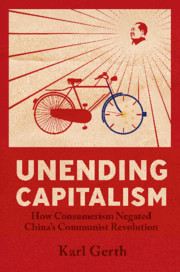
Unending Capitalism
- How Consumerism Negated China's Communist Revolution
-
- Published online:
- 08 May 2020
- Print publication:
- 14 May 2020
2 - ‘An Arrow in the Western World’s Quiver’
-
- Book:
- GATT and Global Order in the Postwar Era
- Published online:
- 02 May 2020
- Print publication:
- 09 April 2020, pp 62-103
-
- Chapter
- Export citation
STABILIZERS, $\text{NTP}_{2}$ GROUPS WITH $\text{f}$-GENERICS, AND PRC FIELDS
- Part of
-
- Journal:
- Journal of the Institute of Mathematics of Jussieu / Volume 19 / Issue 3 / May 2020
- Published online by Cambridge University Press:
- 10 May 2018, pp. 821-853
- Print publication:
- May 2020
-
- Article
- Export citation
-
In this paper, we develop three different subjects. We study and prove alternative versions of Hrushovski’s ‘stabilizer theorem’, we generalize part of the basic theory of definably amenable NIP groups to $\text{NTP}_{2}$ theories, and finally, we use all this machinery to study groups with f-generic types definable in bounded pseudo real closed fields.


From “Iron Rice Bowl” to Labor Market in Two Decades: Changing Workplace Relations in the People's Republic of China on the Eve of WTO Entry
-
- Journal:
- Journal of East Asian Studies / Volume 2 / Issue 2 / August 2002
- Published online by Cambridge University Press:
- 24 March 2016, pp. 7-35
-
- Article
- Export citation
