To save content items to your account,
please confirm that you agree to abide by our usage policies.
If this is the first time you use this feature, you will be asked to authorise Cambridge Core to connect with your account.
Find out more about saving content to .
To save content items to your Kindle, first ensure no-reply@cambridge.org
is added to your Approved Personal Document E-mail List under your Personal Document Settings
on the Manage Your Content and Devices page of your Amazon account. Then enter the ‘name’ part
of your Kindle email address below.
Find out more about saving to your Kindle.
Note you can select to save to either the @free.kindle.com or @kindle.com variations.
‘@free.kindle.com’ emails are free but can only be saved to your device when it is connected to wi-fi.
‘@kindle.com’ emails can be delivered even when you are not connected to wi-fi, but note that service fees apply.
Orthodox terrorism studies tend to focus on the activities of illiberal non-state actors against the liberal democratic states in the North. It thus excludes state terrorism, which is one of a number of repressive tools that great powers from the North have used extensively in the global South in the service of foreign policy objectives. I establish the reasons for the absence of state terrorism from orthodox accounts of terrorism and argue that critical–normative approaches could help to overcome this major weakness.
European far-right parties have enjoyed mixed success in the past few years. The primary elements in many of these parties’ policy platforms centre on security, terrorism, and foreign persons. Naturally, these platforms are designed to attract electoral support that these actors can parlay into governing positions. Our study offers an important test to ascertain how voters respond to terrorist attacks with respect to centre- and far-right parties. We contend that far-right parties are to likely benefit from terrorist attacks more than centre-right parties. The results from more than 30 European countries, spanning 1975–2013, affirm our hypothesis. The implications for partisanship, governance, and terrorism are explored in this paper as well.
This article examines the ethical and methodological challenges for the critical investigation of ‘terrorism’ and political violence. Who is such research ‘for’? How might critical research avoid replicating hegemonic accounts while still engaging with dominant discourses? The pressure to find answers to the real (and imagined) threats of ‘terrorist’ violence and the challenges of establishing a critical perspective while including an emancipatory dimension are addressed, and a suggested code of practice and research agenda for critical studies on terrorism is provided.
En el marco de la Comisión para el Acceso a la Verdad, el Esclarecimiento Histórico y el Impulso a la Justicia de las Violaciones Graves a los Derechos Humanos Cometidas de 1965 a 1990, creada en 2021 en México por decreto presidencial, entre los años 2022 y 2024 se organizaron foros regionales donde se presentaron diversos testimonios sobre la violencia política infringida durante dicho período histórico. Desde un enfoque que comprende a los mismos como prácticas narrativas de memoria y resistencia que son significadas desde el presente, este artículo aborda los testimonios narrados durante el Diálogo por la Verdad en el Estado de Chiapas. El análisis muestra formas de visibilización de la agencia política indígena en contexto contrainsurgente.
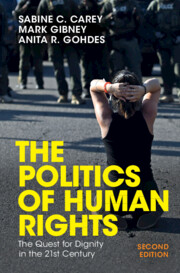
Accessible and engaging, The Politics of Human Rights offers a fresh, empirical approach to understanding human dignity and the global responsibility to protect it. Unlike traditional texts, this textbook moves beyond theory, using data-driven insights to explore why human rights violations occur and how they can be prevented. It emphasizes shared responsibility across borders to uphold human rights. Designed for students and educators, this fully updated edition enhances learning with discussion questions, recommended readings, and a unique collection of films, podcasts, and websites that bring human rights issues to life. It provides a well-rounded perspective, grounded in latest social scientific research, for anyone interested in human rights. Whether used for introductory courses or interdisciplinary studies, this book equips readers with the knowledge and tools to critically engage with human rights issues, making it an essential resource for understanding and advocating for human dignity in the twenty-first century.
How does the international security environment influence whether and how military regimes democratise? This paper argues that for militaries in power, sustained external threats facilitate democratisation by credibly assuring the armed forces of continuing influence after leaving office. The credibility of this assurance stems from the military’s monopoly on the provision of national security and the reliance of all parties on the armed forces for the country’s defence. Militaries, confident of their continued influence after returning to the barracks, are more likely to cede power to democratisers when facing prolonged threats from abroad. Utilising a comparative case study of ruling militaries in Burma and South Korea, this paper tests four implications of the theory for how crises over democracy unfold between governing militaries and the opposition in contrasting security environments. It finds support for each of the implications.
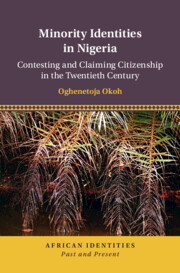
Ethnic majorities and minorities are produced over time by the same processes that define national borders and create national institutions. Minority Identities in Nigeria traces how western Niger Delta communities became political minorities first, through colonial administrative policies in the 1930s; and second, by embracing their minority status to make claims for resources and representation from the British government in the 1940s and 50s. This minority consciousness has deepened in the post-independence era, especially under the pressures of the crude oil economy. Blending discussion of local and regional politics in the Niger Delta with the wider literature on developmental colonialism, decolonization, and nationalism, Oghenetoja Okoh offers a detailed historical analysis of these communities. This study moves beyond a singular focus on the experience of crude oil extraction, exploring a longer history of state manipulation and exploitation in which minorities are construed as governable citizens.
The axiomatic claim that the volunteers ߢfought fascismߣ in Spain is often made in response to questions concerning their motivation for enlisting. Chapter three instead treats it as the starting-point for uncovering how they imagined, represented and engaged with the Nationalists and, in so doing, argues that the making of antifascist war was dependent on the making of fascist enemies. It traces the volunteersߣ vision of the conflict as a struggle between a sovereign nation and a fascist invader back to a transnational understanding of world politics before continuing the story within Spain itself, where representations of enemy soldiers as coerced Italian peasants, barbaric Moroccan mercenaries or ignorant Spanish conscripts reinforced their partisan interpretation of the violence and legitimised their own involvement within it. It then turns from abstract understandings of the enemy towards frontline encounters with flesh-and-blood soldiers. Whilst the volunteersߣ emotional responses therein were as varied as the kind of killing being done, they agreed that any feelings of sympathy had to be subordinated to the objective of violently defeating an uncompromising ideology.
To discern trends in violent extremism research, we present a machine-learning analysis of over 34,000 articles published since the early 1900s. We identify two primary waves of research and, different to previous reviews, a clear diversification in studied groups, contexts, and topics. Less than 20% of articles employ methodologies that are conducive to drawing causal inferences. While more studies are using experimental and longitudinal methods, this increase is outpaced by the rise of methods that preclude the assessment of causality. Nuancing previous reviews, at the broader field level, violent extremism research is profoundly multidisciplinary, with political science, international relations, psychology, history, and law emerging as the “Big Five” contributors. At the study level, contributions from single disciplines remain the norm. While single-author contributions have rapidly declined in favor of team-based research, one-time contributing authors remain consistently high over time. To enhance future violent extremism research, we make five recommendations: (1) prioritizing methodologies that allow for causal inferences; (2) incorporating state-based violent extremism perspectives also in individual-level research; (3) increasing the utilization of big data by interdisciplinary teams; (4) increasing the focus on developmental research to understand early life influences; and (5) initiating more interdisciplinary work at the study level.
The book’s first chapter provides background information about Operation Wrath of God, the Black September organisation, and the Club de Berne. This sets the scene and provides an understanding of the historical and political context in which the events described in the book take place. For instance, understanding how Operation Wrath of God was organised will later help explain ways in which European intelligence was useful to Mossad to carry out its assassinations.
We consider why people use political violence from the perspective of whether they wish to enforce group dominance or equality and whether they perceive the current intergroup power structure to be legitimate or illegitimate. The intersection of these desires for group dominance vs. equality and perceived system legitimacy vs. illegitimacy captures the possibility of four different goals of political violence: to maintain the current social hierarchy, to reduce inequality among groups, to maintain the structure of group-based dominance but with a new group in the hegemonic or subordinate position, or to keep an otherwise oppressed group in a dominant position to protect it from further harm. We contend that using violence to attempt to accomplish any of these power motives is political violence, and that differentiating political violence according to these four underlying motives is essential for developing informed intervention strategies. Furthermore, rather than defining certain forms of political violence as “extremist” in reference to “norms” that may not be shared, or with respect to whether violence is performed by governmental actors or their agents (vs. against them), we define extremist violence as being outside specified principles, such as human rights and international humanitarian law, regardless of the actor
Isotopes of strontium, oxygen, and carbon were analyzed in human tooth enamel from two Postclassic sites in the central Peten lakes region, Guatemala, to examine patterns of mobility and diet during a time of social unrest. Excavations at both sites, Ixlu and Zacpeten, have revealed evidence for purposeful dismemberment and interment of individuals. This study examines a possible shrine surrounded by rows of skulls at Ixlu, and a mass grave of comingled individuals interred at Zacpeten. The interments coincide with a period of conflict and warfare between two dominant polities, Itza and Kowoj. The 14 sampled individuals at Ixlu were young males, six of whom isotopically match the Maya Mountains of central Belize/southeastern Peten. At Zacpeten, isotopic signatures of adults and children (n = 68) suggested that many were either local or came from other parts of the Maya lowlands, but not the Maya Mountains. In the Late Postclassic, the Zacpeten individuals were exhumed, defiled, and deposited in a mass grave, probably by Kowojs. Although temporally and geographically related, the Ixlu and Zacpeten burials represent two distinct cases of ritual violence that reflect the tumultuous political landscape of the Postclassic period.
Most of what we know about organized criminal violence comes from research on illicit narcotics markets. Yet criminal groups also fight to capture markets for licit commodities, as evidenced by Sicilian lemons and Mexican avocados. When do organized criminal groups violently expand into markets for licit goods? We argue that rapid increases in the share of a good’s export value create opportunities for immediate profit and future market manipulation. These opportunities lead to violence as groups expand their territorial holdings and economic portfolio. We provide subnational evidence of our mechanism using data on avocado exports from Mexico, and address reverse causality with Google Trends data on the popularity of web searches for “avocado toast.” We also provide cross-national evidence by combining data from the Atlas of Economic Complexity, V-Dem, and the United Nations Office on Drugs and Crime (UNODC). We find that increases in a country’s share of global export value for agricultural goods are associated with more homicides—but only where organized criminal groups are present.
This article reviews the evolution of the representation of Italy’s ‘Catholic partisan’. In essence, this involved adaptation of the model of the Catholic soldier, who was able to kill out of love and ‘without hatred’, to the context of a civil war. With particular reference to the case of the central Veneto, this examination looks back to earlier Italian experiences during wartime to help explain how Catholic activists and the partisan groups linked to the Catholic world addressed the key issues of the legitimation of Resistance violence and the control of its use. It emphasises the disparity between the rhetoric directed at containing the violence and the realities of guerrilla warfare. The article goes on to analyse the different models of the ‘Catholic partisan’ put forward in the immediate postwar period (1945–1950): the ‘Catholic soldier’, with his military bearing; the ‘pure martyr’, who never initiated violence; and the ‘devout partisan’, who managed to restrict his use of violence, assessing its costs and benefits, and was characterised by his inclination to forgive and, especially, to kill as little as possible. The conclusions consider how a particular rhetoric helped to shape the narrative of the active involvement of Catholics in the Italian Resistance.
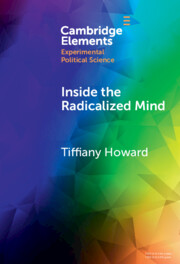
This Element aims to better understand the role of the internet in the radicalization process, focusing on how online factors contribute to self-radicalization. Specifically, it examines the neurocognitive process of online radicalization by analyzing the impact of terrorist and extremist propaganda videos on individuals' cognitive empathy using electroencephalography (EEG). Ultimately, this research aims to provide a more comprehensive understanding of online radicalization and the psychological effects of exposure to extremist content on the internet.
Prior research shows that the pro-Trump, anti-democratic January 6th insurrection (J6) led to a short-term reduction in Republican support for President Trump. However, it remains unclear why the anti-Trump backlash occurred among his electoral base. We theorize that white Republicans concerned about the declining status of Anglo whites in the American ethno-racial hierarchy were the least likely to backlash against Trump after J6. Leveraging an unexpected-event-during-survey design (UESD) and a large survey fielded shortly before and after J6, we find no difference in support for Trump due to J6 among white Republicans who strongly perceived anti-white discrimination (Study 1). We replicate this result with another UESD with a separate survey fielded during J6 (Study 2) and a difference-in-differences approach with additional panel surveys fielded around J6 (Study 3). Moreover, across four cross-sectional surveys, we find the negative relationship between J6 disapproval and Trump support post-J6 between 2021 and 2024 is attenuated among status-threatened white Republicans (Studies 4–7). Our evidence suggests racial status threat undercuts the ability of the white Republican mass public to hold co-partisan anti-democratic elites accountable for norm violations.
Nonviolent resistance against rebels has received increasing scholarly attention over the past decade. Research has explained why and when civilians engage in resistance or place different types of demands on rebels. However, the question of whether nonviolent resistance succeeds or fails to achieve its objectives remains understudied. This article addresses this gap by theorising and testing three key factors that shape rebel responses to civilian resistance: the nature of civilian demands, the power of civilian resisters, and the rebels’ own power. Fieldwork in Colombia’s Caquetá region reveals that FARC rebels accommodated civilian demands only when these did not threaten their strategic goals. The group responded with repression whenever resisters clashed with its politico-military objectives. While unarmed resistance campaigns have successfully overthrown repressive states, there is no evidence for civilians in Colombia or elsewhere managing to push armed groups to make far-reaching concessions, let alone defeat rebels via nonviolent action only.
Amongst the ways in which American democracy is distinct, the Weberian anomaly stands out: the United States equates to a classical Weberian state with the routine trappings of bureaucratic power, national organization, stable territorial parameters, a legal code and military power. But it is at best a quasi-Weberian state in respect of state monopolization of legitimate violence. The scope of the Second Amendment means the federal government has control in many instances over the use of physical force but historically this authority coexists with the (explicit or implicit) delegation of political violence to societal actors. In this article I argue that the legitimation of political violence outside the state is endogenous to the American constitutional settlement, a feature which arises from the country's origins and the institutional arrangements adopted in key constitutional clauses and judicial decisions.
Research on civil war termination typically classifies conflict outcomes into homogeneous categories. Civil wars are conventionally described as ending in ‘victory’ for one side, ‘negotiated settlement’, or ‘stalemate’. However, each of these common categories conceals a significant degree of unexplored variation. Not all peace processes are the same, nor should we assume equivalence between all ‘victory’ outcomes. Ignoring the variability in outcomes obscures our understanding of how civil wars actually end and can undermine efforts to examine how this may influence the sustainability of the ensuing peace. This article focuses on the concept of rebel victory and argues that it has been used to describe a wide range of civil war outcomes that share some features but that also differ along three dimensions: (i) the residual threat posed by the defeated regime; (ii) the role of external actors in enabling victory; and (iii) rebel fragmentation. The article describes these dimensions and the influence that they can exert on the likelihood of continued political instability in the aftermath of rebel victories. The examples of rebel victories in the Central African Republic (2003 and 2012) are used to demonstrate the analytical utility of this novel conceptualisation of rebel victory.
The end of the civil war, the fall of the Italian Social Republic, the allied occupation and the gradual transition to the new Italian Republic not only set Italy on the path to democracy, but also gradually gave Italians access to a new public space. This article proposes to revisit the classic question of the legacy of Fascism by looking at the question of space and the difficult construction of a genuine democratic space. During the ventennio, opponents were largely denied access to common spaces, both symbolically and physically. The article raises the question of violence and the exclusive appropriation of space, showing that the representations and practices inherited from Fascism did not disappear overnight. But these practices of space were not always violent: by looking at aspects that are often neglected (graffiti, manifestos, noises and singing), the aim is to show that the transition took time and was sometimes complicated, despite the political leaders of the Italian Republic claiming to have opened up a completely new era.