To save content items to your account,
please confirm that you agree to abide by our usage policies.
If this is the first time you use this feature, you will be asked to authorise Cambridge Core to connect with your account.
Find out more about saving content to .
To save content items to your Kindle, first ensure no-reply@cambridge.org
is added to your Approved Personal Document E-mail List under your Personal Document Settings
on the Manage Your Content and Devices page of your Amazon account. Then enter the ‘name’ part
of your Kindle email address below.
Find out more about saving to your Kindle.
Note you can select to save to either the @free.kindle.com or @kindle.com variations.
‘@free.kindle.com’ emails are free but can only be saved to your device when it is connected to wi-fi.
‘@kindle.com’ emails can be delivered even when you are not connected to wi-fi, but note that service fees apply.
This chapter presents a synthesis of results on the patterns of metaphor use in corpora of public discourse in Hong Kong. The corpora cover three critical periods: before and after the transfer of Hong Kong’s sovereignty from Great Britain to China in 1997, and during the COVID-19 crisis. We summarise and compare the use of metaphors over time in terms of two types of changes: fundamental changes involving the transformation of source domains and incremental changes involving the transformation of source-to-target domain mapping principles. We find that patterns of diachronic metaphor variations in Hong Kong English (HKE) reflect changes in target domains based on different social dynamics, especially shifting priorities in societal issues, such as a FREE ECONOMY and ELECTIONS. We also demonstrate that the shifts in focused target domains extend to mapping principles in frequently used source domains, such as WAR, JOURNEY and BUILDING. By examining metaphors and their associated mappings across different varieties of HKE, this study contributes to a framework for understanding cultural differences within the lexical-conceptual dimension of HKE.
This chapter starts out from the serendipitous observation of patterns where look forward to is complemented not by a verbal -ing form (as would be expected by standard grammars) but by a plain infinitive, as in I’m looking forward to meet you. It investigates the spread and frequency of this construction in a wide range of corpora, some of which also allow a diachronic comparison, and considers several potentially conditioning factors. Grammatically, this pattern can be explained as a case of reanalysis in the process of structural transmission, showcasing structural simplification that may characterise second-language acquisition. The form to, the final element in the phrasal-prepositional verb under discussion, is reinterpreted as a homonymic but functionally different form, the to infinitive marker. The results clearly support the hypothesis that the ’look forward to + plain infinitive’ pattern constitutes more than mere performance errors and appears to represent an ’embryonic’ manifestation of an incipient change, with a strong focus in Asian Englishes, and possibly with Indian English as an epicentre, although the trend may have been reversed recently in formal registers.
The study of English usage has to take account of changes in grammar, word choice and nuances of communication. In recent decades, developments in linguistic methodologies have catalysed modifications In our approach to linguistic variation, with perspectives changing from a primarily prescriptive to a more descriptive approach. Bringing together contributions from a team of distinguished scholars, this book explores sociolinguistic and structural dimensions of variability in English usage through new research and methods such as corpora and survey instruments. It embraces the variety and diversity of English usage, exploring global attitudes towards language, including examples from countries where English is either a first language, such as Australia and Britain, to second language users from China, South Africa and beyond. Variability is investigated across both a number of media and registers, while lively and engaging discourse is used to introduce the global language landscape to anyone interested in this fascinating field.
This volume offers in-depth coverage of varieties of English across the world, outside of the British and North American arenas. It is split into two parts, with Part one dedicated to varieties of English across Africa, and Part two looking at varieties in Asia, and Australia and the Pacific. There are introductory chapters dealing with the colonial transportation of English overseas, and the generic types of English which resulted, often labelled World Englishes, and examinations of English-lexifier pidgins and creoles. The remaining sections look at different geographic regions. Anglophone Africa divides into three blocks: west, east and south, each with different linguistic ecologies determined by history and demography. Asia, especially South Asia and South-East Asia, is similar in the kinds of English it now shows, with the significance of East Asia for varieties of English increasing in recent years. Varieties of English in Australia and the Pacific are also examined.
This Element introduces PrInDT (Prediction and Interpretation in Decision Trees), a statistical approach for modeling relationships between extra- and intralinguistic variables in World Englishes. It is based on decision trees and controls their size in a way that they are easy and straightforward to interpret. Furthermore, PrInDT optimizes their accuracy so that they best fit the data and can be reliably used for prediction. Moreover, it can handle unbalanced classes that occur, for example, when comparing non-standard with standard linguistic realizations. The various PrInDT functions can deal with classification and regression tasks and can analyze multiple endogenous variables jointly, even for models combining classification and regression. The authors introduce these features in some detail and apply them to World Englishes and sociolinguistic datasets. As examples, they draw on L1 child data from England and Singapore as well as linguistic landscapes data from the Eastern Caribbean island of St. Martin.
This chapter begins with a historical account of the expansion of English. Theoretical models of world Englishes and English as a Lingua Franca are outlined. The role of language contact in the development of world Englishes is discussed, along with the nature of pidgins and creoles. A section deals with controversies about the use of English, especially in education, in former British colonies. Differences in phonology, grammar, and vocabulary among some of the major varieties of English are outlined. The section on vocabulary uses evidence from the Oxford English Dictionary and notes the recent restoration of Indigenous place names in several countries.
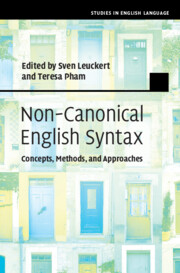
The term non-canonical syntax generally refers to deviations from 'typical' word order. These represent a fascinating phenomenon in natural language use. With contributions from a team of renowned scholars, this book presents a range of case-studies on non-canonical syntax across historical, register-based, and non-native varieties of English. Each chapter investigates a different non-canonical construction and assesses to what extent it can be called 'non-canonical' in a theory-based and frequency-based understanding of non-canonical syntax. A range of state-of-the-art methodologies are used, highlighting that an empirical approach to non-canonical syntactic constructions is particularly fruitful. An introduction, a synopsis, a terminological chapter, and three section introductions frame the case studies and present overviews of the theory behind non-canonical syntax and previous work, while also illustrating open questions and opportunities for future research. The volume is essential reading for advanced students of English grammar and researchers working on non-canonical syntax and syntactic variation. This title is also available as Open Access on Cambridge Core.
Recent years have seen an increase in forced migration from the Global South, e.g., Congolese refugees with long transits in Uganda, to countries in the Global North, like Norway. Many of these newly-arrived Congolese refugees in Norway have English in their linguistic repertoires after decades-long transits in Uganda. English can thus be used as a lingua franca in Norway while they are learning Norwegian, as many Norwegians also have English in their repertoires. However, the ways these refugees have learnt English differ starkly from the ways most Norwegians have learnt English. While most Norwegians have mainly learnt English formally, i.e. in school, these Congolese refugees have mainly learnt English informally, i.e. outside language classrooms. The present article explores specific examples of how these refugees have learnt English. Some have, for example, learnt English through lingua franca interaction with other refugees with whom they do not share any other languages than English; others have initiated English language awareness in the wild themselves through, for example, talking explicitly about the English language with motorcycle riders in Uganda; and others have listened to English-speaking radio programmes in order to learn English faster. I argue that many of these ways of learning English informally can be referred to as “grassroots learning” of English, since English learning is initiated by the refugees themselves. These findings from empirical research among newly-arrived Congolese refugees in Norway may contribute to developing our understandings of informal English language learning, as well as making sure forced migrants’ voices are heard.
This Element proposes to view World Englishes as components of an overarching Complex Dynamic System of Englishes, against the conventional view of regarding them as discrete, rule-governed, categorial systems. After outlining this basic idea and setting it off from mainstream linguistic theories, it introduces the theory of Complex Dynamic Systems and the main properties of such systems (systemness, complexity, perpetual dynamics, network relationships, the interplay of order and chaos, emergentism and self-organization, nonlinearity and fractals, and attractors), and surveys earlier applications to language. Usage-based linguistics and construction grammar are outlined as suitable frameworks to explain how the Complex Systems principles manifest themselves in linguistic reality. Many structural properties and examples from several World Englishes are presented to illustrate the manifestations of Complex Systems principles in specific features of World Englishes. Finally, the option of employing the NetLogo programming environment to simulate variety emergence via agent-based modeling is suggested.
The present paper provides a small–scale exploratory analysis of L2 English pronunciation and accent aims among secondary school students in Germany – with a focus on the bath and lot vowels, rhoticity, and T–flapping. The eight learners investigated in the current study show blended use of Standard Southern British English (StSBrE) and Standard American (StAmE) phonological variants with relatively high degrees of variation between learners. StSBrE–oriented productions were dominant overall. Agreement of accent aim and L2 pronunciation was largely feature–dependent and limited overall but varied between learners.
This article provides a Construction Grammar (CxG) analysis of the Complex Modifier Construction (CMC) in English and an investigation of its productivity in World Englishes with a particular focus on African and South-East Asian Englishes. By examining data from the Corpus of Global Web-based English (GloWbE), we seek to establish whether the productivity of the construction correlates with the developmental phase of the variety of English in Schneider’s Dynamic Model of Postcolonial Englishes, or whether language contact, and particularly the typological profiles of the local substrate languages (head-initial versus head-final syntax), affects productivity. We find that evolutionary progress is indeed a relevant factor insofar as the most advanced ‘Inner Circle’ varieties are concerned, but we also observe substantially lower productivity in the African varieties of English when compared to the South-East Asian Englishes represented in the corpus. As the main substrate languages in the African countries under study have head-initial syntax and those in the South-East Asian countries head-final syntax, we conclude that the productivity of complex premodifiers is affected by the multilingual situation in these regions and propose that language contact should be considered more closely as an explanatory factor in future studies of constructional productivity in World Englishes.
The use of the English language in many countries around the world greatly facilitates international communication. However, linguists have long pointed out that differences between established and emerging dialects of English may lead to miscommunication, especially because many users of the language may not be aware of many of these differences. Such issues may be particularly acute in high-stakes communicative endeavours such as persuading others to change their opinion or engage in a certain action. Psychologists have previously explored this construct mainly in experimental settings, whereas the present chapter uses a large database (‘corpus’) of natural language. The chapter thus provides an empirical, corpus-based analysis of the linguistic expression of persuasion across 21 international dialects (‘varieties’) of English from countries where English is widely used as a first or second language. Results indicate that there are substantial differences in the degree of overt expression of persuasion, with South Asian varieties of English indicating the lowest levels and (West) African varieties that greatest level of overt persuasion. The chapter concludes by discussing possible explanations of these patterns, implications for international communication as well as avenues for more detailed analyses of particular linguistic features involved in persuasion.