To save content items to your account,
please confirm that you agree to abide by our usage policies.
If this is the first time you use this feature, you will be asked to authorise Cambridge Core to connect with your account.
Find out more about saving content to .
To save content items to your Kindle, first ensure no-reply@cambridge.org
is added to your Approved Personal Document E-mail List under your Personal Document Settings
on the Manage Your Content and Devices page of your Amazon account. Then enter the ‘name’ part
of your Kindle email address below.
Find out more about saving to your Kindle.
Note you can select to save to either the @free.kindle.com or @kindle.com variations.
‘@free.kindle.com’ emails are free but can only be saved to your device when it is connected to wi-fi.
‘@kindle.com’ emails can be delivered even when you are not connected to wi-fi, but note that service fees apply.
This article studies the commissive use of can in conditionals such as I can do the dishes, if you like. Its main goal is to spell out the semantic building blocks of what we call offer-can, arguing that the seemingly speech act interpretation is a feature of the conditional statement as a whole rather than the modal itself. To achieve this, we disentangle authority and ability at the semantic level (in agreement with Copley 2009), and single out the notions of “issue to be solved” and “preferred solution worlds” as epistemic basis and bouletic ordering, respectively, for modal quantification. We propose a comparison between the conditional offer and other non-conditional conditionals, and offer some thoughts regarding permission-can and can-you-pass-me-the-salt questions, arguing for authority shift in questions, in a way akin to the interrogative flip in questions with evidentials and epistemic modals.
I begin with the bodily good of health, which perfects our organic functioning beyond the rudimentary level required for life. I detail how such functioning operates at different bodily levels, e.g., within cells, tissues, vessels, glands etc. I then move on to bodily abilities, which (not being autonomic functions) reflect the exercise of agency or voluntary control. Such abilities can be divided into active and passive powers, these affording a wider relation to the world in virtue of their intentionality. The third topic is bodily beauty. I argue that this is not a bodily perfection, since it is beholden less to our bodily powers or their configuration than to judgements of character and the social context in which our bodies operate. Finally, I explore body alteration. This constitutes a spectrum, from (perfective) medical intervention to (imperfective) mutilation, with what I call mere body ‘modification’ in the middle. I conclude with two cases that are difficult to place on this spectrum: namely male circumcision and cosmetic ‘surgery’. I argue that the former is likely a bodily imperfection or bad and the latter likely bound up with further imperfections.
This chapter argues that even though we all have a pretty good idea of what is meant by the term ‘social class’, it is far from being a straightforward matter. After all, there is only tenuous agreement about exactly what it is, how prevalent it is, how it organises the life opportunities of our citizens and how best to study it. To make it more difficult still, this is a subject that many feel uncomfortable discussing, let alone applying to themselves or anyone else.
The Ming dynasty’s survival depended on locating and employing men with the ability to direct military forces, and contemporary observers were deeply concerned with the nexus of command, troop morale, and dynastic fighting capacity. This essay focuses on the years following the Tumu Crisis of 1449, a time when dynastic authorities were particularly alive to issues of military ability, and it draws on the perspectives of two men, the Minister of War, Yu Qian 于謙 (1398–1457), and another more junior official, Ye Sheng 葉盛 (1420–72). The essay offers a snapshot of how military ability was defined, cultivated, assessed, and rewarded. Further, it suggests that, read carefully, the writings of Ye Sheng and Yu Qian not only offer insight into the views of elite civil officials but also shed light, however faint and wavering, on military labor and working conditions for those who fought and commanded for a living.
The upbringing and professional career of Wu Jian (1462–1506) and his uncle, Wu Cong, shed light on two key issues. First is the gradual transformation of merit nobles within the Ming polity, particularly their role in dynastic defenses. Second is the dynasty’s continued efforts to secure military ability through instituting new practices, including the education and training of young merit nobles and entrusting capable civil officials with substantial military responsibilities. Before turning to Wu Jian’s career, however, we first consider the experiences of his mother and other women, whose abilities both in managing large, complex households and negotiating with the dynastic state, were essential to the fortunes of all merit noble families.
Recounting the experiences of Wu Ruyin and his son, Wu Weiying, who between them held the title of Marquis of Gongshun in succession from 1599 to 1643, this chapter and the preceding one address two overarching issues. First, they explore how institutions and administrators persevere amidst crisis. It may be tempting to caricature late Ming bureaucrats as obdurately clinging to the past, but men like Wu Ruyin and Wu Weiying adapted to new demands by incorporating new technologies and new ways within established frameworks. Few felt the need to abandon the “institutions of the imperial forefathers.” Second, these chapters examine the place of merit nobles in late Ming society. Wu Ruyin and Wu Weiying were not men of the people, but by function of their social circles, they actively engaged in the capital’s broader cultural activities, and by virtue of their jobs as senior military administrators, they commanded surprisingly detailed information about common soldiers and officers, war captives and refugees, and even rumors circulating through Beijing. This chapter first examines Wu Ruyin’s role as the emperor’s representative in ceremony, which included officiating at rituals, offering prayers, and hosting banquets, and second, considers his experiences as a military administrator in a time of acute challenges.
Using Wu Jin’s tenure as Marquis of Gongshun from 1449 to 1461, this chapter explores issues of ability and difference in a time of upheaval at the Ming court. It traces the Wu family as it shifted from immigrant family at the empire’s western edge to members of the capital elite. The chapter also explores the divergent experiences of other Mongolians and merit noble families within the Ming polity.
Recounting the experiences of Wu Ruyin and his son, Wu Weiying, who between them held the title of Marquis of Gongshun in succession from 1599 to 1643, this chapter and the next address two overarching issues. First, they explore how institutions and administrators persevere amidst crisis. It may be tempting to caricature late Ming bureaucrats as obdurately clinging to the past, but men like Wu Ruyin and Wu Weiying adapted to new demands by incorporating new technologies and new ways within established frameworks. Few felt the need to abandon the “institutions of the imperial forefathers.” Second, these chapters examine the place of merit nobles in late Ming society. Wu Ruyin and Wu Weiying were not men of the people, but by function of their social circles, they actively engaged in the capital’s broader cultural activities, and by virtue of their jobs as senior military administrators, they commanded surprisingly detailed information about common soldiers and officers, war captives and refugees, and even rumors circulating through Beijing. This chapter first examines Wu Ruyin’s role as the emperor’s representative in ceremony, which included officiating at rituals, offering prayers, and hosting banquets, and second, considers his experiences as a military administrator in a time of acute challenges.
Using Wu Jijue’s career as a focal point, this chapter explores the power of appointment, the process of assessment, and the culture of patronage, before offering a few overarching observations about Wu Jijue’s experiences and what they say about China in the second half of the sixteenth century. The chapter also throws into clear relief how dramatically contemporary perceptions of the Wu family had changed from the early fifteenth century to the late sixteenth century. Once newly arrived immigrants at the edge of the realm whose Mongolian names and origins were obvious to all, the Wu family were now unquestionably “one-percenters,” a capital family ranking among the elites of the elites and whose foreign origins were completely overshadowed by its century-old ties to the imperial throne and service in the highest echelons of the dynastic administration.
The Wu family’s experiences illustrate in clear and human terms how institutions change over time. Far from lapsing into an ornamental or parasitic existence after the horrific purges of the Hongwu and Yongle reigns, merit nobles remained integral to the Ming dynasty. Reviewing the careers of the Wu men across the generations, we see their role change from field commanders, to a mix of field command and senior administration, and finally to exclusively capital administration. Rather than a caricatured image of corrupt irrelevance, merit nobles, properly considered, serve as a salutary reminder that military institutions, like other institutions, adapted to new circumstances. Examination of the Wu family yields a sharper understanding of who actually administered the dynasty’s core military institutions, what functions they served, and how they interacted with civil officials, palace eunuchs, officers, and the throne. Civil officials came and went, eunuchs held posts for longer, and military officers led campaigns, but merit nobles provided much of the continuity in personnel so essential for the operation of the Capital Training Divisions and Chief Military Commissions, pillars of the dynastic military.
Chapter 1 traces the experiences of Batu-Temür, his wife, their sons, and some 5,000 followers, who in 1405 migrated from the Mongolian steppe to the northwestern corner of the still-new Ming dynasty. In recognition of the military contributions of Batu-Temür and his sons, and their steadfast loyalty on refusing to join a local Mongolian insurrection, the Ming emperor granted the family a series of high-level military posts, gifts, honorary titles, a Chinese surname (Wu), and eventually investiture of Batu-Temür as Earl of Gongshun, a title that his descendants would hold until the mid seventeenth century. The Wu family’s experiences show both the Ming dynasty and recently arrived immigrants actively attempting to advance their interests in a time of rapid geopolitical change.
The last Marquis of Gongshun, Wu Weihua, not only survived but thrived during the traumatic transition from the fallen Ming dynasty to the newly founded Qing dynasty. His elder brother died in an epidemic of unprecedented scale in the capital, leaving vacant the title of marquis. His nephew was murdered in a rebel occupation of Beijing without parallel in the dynasty. His sovereign perished at his own hand (another unique event during the Ming period), and the Ming ruling house crumpled before his eyes. Wu Weihua then hurled himself across the dynastic divide, offering his services to the new Manchu regime in exchange for the title his family had held without interruption since the early fifteenth century. In addition to dogged pursuit of that title, he worked tirelessly to secure the survival – even prosperity – of his family in a new age, winning posts for his brothers and brokering at least one marriage alliance with the new Manchu elite.
The Introduction lays out the book’s arguments, organization, and significance. The basic arguments are: (1) there was more to the military than war; (2) there was more to government than civil officials; and (3) there was more to China than the Han majority. The story of the Wu family is told at three levels: (1) the professional and family lives of each generation of the men to hold the title Marquis of Gongshun, (2) broader events and trends occurring in Ming politics, society, economics, religion, and ethnic relations, and (3) periodic consideration of the big picture, that is, thinking about the Ming dynasty in its Eurasian context. Nearly all polities confront issues of ability and difference as they secure people of ability through means such as hereditary status, meritocratic evaluations, and patronage. Simultaneously, polities like the Ming dynasty developed institutional means to acknowledge and whenever possible leverage differences such as ethnicity, gender, professional training, and relation to the throne.
This chapter explores the career of Wu Kezhong from 1418, the year he succeeded his father’s investiture as Marquis of Gongshun, to 1449, the year he fell in combat. Like his father, Wu Kezhong served the Ming throne as a Mongolian specialist and military commander. Batu-Temür had offered his loyalty to the Ming throne at the head of some 5,000 supporters, and Wu Kezhong too acted as a patron and protector for the Mongolian community. Despite such similarities, both the dynasty and the place of Mongols in the polity were changing. Wu Kezhong was among the first generation of his family to live through imperial successions as first the Yongle and then Xuande emperor died, leaving the throne to new sovereigns who actively sought the support of proven commanders such as Wu Kezhong. The new sovereigns, especially the man for whom Wu Kezhong and his brother died, differed importantly from their forefathers not only in their styles of rulership but also in their policies. That mattered because, even more than his father, Wu Kezhong pursued patronage through imperial institutions, which required knowledge of salary structures, commutation rates, and the shifting balance of power at court.
This chapter begins with Wu Jijue’s early years and upbringing, including his family and his education, with an eye toward the strategies that capital elites like the Wu family used to protect their status. It then turns to his long – nearly half a century – career in the capital and the provinces. As the sovereign’s man, Wu Jijue – like all merit nobles – performed a wide variety of tasks, and this chapter offers a series of snapshots to give a sense of the range of his duties, including (1) ritual officiant, (2) envoy to princely courts, (3) regional commander, and (4) participant in imperial reviews. The following chapter traces Wu Jijue’s service as a senior administrator in key military institutions with special attention to the light it sheds on the dynasty’s regularized assessment and reward of administrative performance.
This chapter is organized into four sections. First, using Wu Shixing as a focal point, it examines the role of merit nobles as envoys of the throne in missions to provincial courts and in offerings to the souls of the imperial house’s deceased members. Second, it briefly reviews the heightened prominence of military affairs during the reign of Zhengde (1505–21), including important changes to the organization of the Capital Garrisons, which was where Wu Shixing and other merit nobles held posts. Third, it considers the military laborscape of the early sixteenth century, with particular attention to how the Ming court addressed issues of ability and difference in the suppression of a series of large-scale rebellions. Fourth, this chapter returns to debates at the Ming court surrounding the education and training of merit nobles like Wu Shixing.
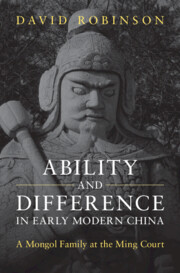
In 1405, a family left their home in the Mongolian steppe and moved to China. This daring decision, taken at a time of dramatic change in eastern Eurasia, paved the way for 250 years of unlikely success at the Ming court. Winning recognition for military skill and loyalty, the family later known as the Wu gained a coveted title of nobility and became members of the capital elite until the dynasty's collapse in 1644. By tracing the individual fortunes of a single family, David Robinson offers a fresh and accessible perspective on the inner workings of Ming bureaucracy. He explores how the early-modern world's most developed state sought to balance the often contradictory demands of securing ability and addressing difference, a challenge common to nearly all polities.
A fundamental task for you, as a teacher, is to get to know and understand the students you teach in the broad context of the school, community and society in which they live. By doing this, you will increase your awareness of the diverse backgrounds, experiences and needs of your students and their families. Knowledge and understanding will shape your teaching philosophy, influence your views and attitudes, and guide you in effectively teaching and supporting your students. This chapter aims to support you in answering the question: Who are my students? We will examine several theories to help you explore ways of viewing, understanding and thinking about teaching for diversity. Australian data and statistics, and teacher and student narratives, will provide you with a snapshot of today’s student cohort. This includes students from diverse family, religious, cultural, linguistic and socio-economic backgrounds, and those with a range of abilities, disabilities and orientations. You will gain insight into some of the impacts of mental health and complex trauma on children and young people and consider your role in fostering positive school experiences for all students.
The analysis in this paper searches for individual and group determinants of learning behavior in Monty Hall's Three Door problem examined in Friedman (1998, American Economic Review. 88, 933-946). The results show that the size of monetary incentives, individuals’ initial abilities, and social interactions with others are all important determinants of initial choices and subsequent learning in this problem: (i) More able students have a greater initial propensity to make the right choice than less able students, and their learning curves are initially steeper; (ii) Individual learning can also be enhanced through social interactions; (iii) Interestingly, less able students benefit more than more able students from social interactions in the sample. These findings support the argument that learning models that take into account individuals’ abilities and that allow for social interactions where agents can exchange information hold a great deal of promise for enhancing our understanding of actual learning environments, learning processes, and the formation of rationality.
We expand the scope of the literature on willingness to compete by asking how it varies with academic ability and whether and how it predicts career choices at different ability levels. The literature so far has mainly focused on career choices made by students at the top of the ability distribution, particularly in academic institutions. We experimentally elicit the willingness to compete of 1500 Swiss lower-secondary school students at all ability levels and link it to the study choice that students make upon finishing compulsory school. Our analysis of the relationship between willingness to compete and the study choice considers the full set of study options, including the options in vocational education. We find that willingness to compete predicts which study option high-ability students choose, not only among academic specializations but also among vocational careers, and, importantly, it also predicts whether low-ability boys pursue upper-secondary education upon finishing compulsory schooling. Our second main contribution is to systematically explore how willingness to compete varies with academic ability. We find that high-ability boys, but not girls, are substantially more willing to compete compared to all other children. As a consequence, the gender gap in willingness to compete is significantly lower among low-ability students than among high-ability students. Overall, our study highlights that insights from the literature on willingness to compete are relevant for a broader set of policy questions, populations and choices.