To save content items to your account,
please confirm that you agree to abide by our usage policies.
If this is the first time you use this feature, you will be asked to authorise Cambridge Core to connect with your account.
Find out more about saving content to .
To save content items to your Kindle, first ensure no-reply@cambridge.org
is added to your Approved Personal Document E-mail List under your Personal Document Settings
on the Manage Your Content and Devices page of your Amazon account. Then enter the ‘name’ part
of your Kindle email address below.
Find out more about saving to your Kindle.
Note you can select to save to either the @free.kindle.com or @kindle.com variations.
‘@free.kindle.com’ emails are free but can only be saved to your device when it is connected to wi-fi.
‘@kindle.com’ emails can be delivered even when you are not connected to wi-fi, but note that service fees apply.
Chapter 6 examines five of the nine modal cases of political instability in the region (the seventh chapter examines the other four). These are the ones where T is neither below nor above one standard deviation of its mean. My model anticipates 77 percent of the years with successful military coups in Argentina, the Dominican Republic, Guatemala, El Salvador, Honduras, Peru, Panama, Brazil, and Venezuela. Unlike the highly unstable cases I analyze in Chapter 5, each of the modal cases stumbled into more liberalized political orders. Chapter 6 also explores why military coups ended democratic experiments or reformist interludes in Argentina, Guatemala, El Salvador, Peru, and Brazil.
The conclusions distill the key findings of this book’s encounter with theory, cross-national statistical models, and case studies. A prediction-centered multi-method approach demonstrates how case studies fill in the causal gaps of cross-national statistical models to explain the rise and fall of the Coup Trap. And the conclusions identify the mechanisms that kept most political systems submerged in chronic instability – and allowed half a dozen to consolidate stable democratic or authoritarian political orders.
Chapter 7 examines how a handful of incumbents managed to establish long-lasting dictatorships in the Dominican Republic, Honduras, Panama, and Venezuela, the four other political systems with modal levels of instability (Chapter 6 examines the five other such systems). This chapter also explains why, of the nine modal cases, only the Venezuelan political system managed to leave the Coup Trap by building a constitutional democracy. It is the ability to continue organizing coup coalitions, I argue, that ends democratic experiments; it takes time for a large enough coalition of interests to impose civilian solutions on acute political conflicts, that is, to punish and therefore prevent defection from its ranks.
Chapter 3 statistically tests implications of my theory of the coup trap. I try to disconfirm my hypotheses by using event history or duration models of instability on a database of military coups, economic variables, political system characteristics, and levels of instability for eighteen countries between 1900 and 2014. While controlling for economic and political variables, statistical models show that autocracies are more unstable than democracies and that instability breeds coups. The likelihood of a successful military coup, in other words, remains high in the wake of the overthrow of a president, especially in non-democratic political orders and during election years. Logit models comparing golpes that manage and do not manage to overthrow governments also confirm a key implication of my theory of the coup trap: that military conspiracies are much more likely to prosper if they count upon the support of the opposition. These findings cement my argument that the overthrow of governments is a function of military as well as civil coalitions that reflect the unstable nature of political competition in less institutionalized political systems.
The first of this chapter’s three goals is to unveil a new catalog of more than 320 military coups, slightly less than half of which succeeded in overthrowing the executive. A second goal is to remind ourselves that elections were an integral part of constitutional or quasi-constitutional political orders – regimes best described as electoral autocracies because their incumbents ran the risk of losing regularly scheduled elections. This chapter concludes by combining data on military coups and regimes to produce a typology of political trajectories – and whose origins and persistence the rest of this book explores, documents, and explains.
Chapter 5 of The Coup Trap in Latin America examines the political systems of Bolivia, Ecuador, and Paraguay, the three most unstable of the region. The model anticipates 89 percent of the years of instability in these systems. It presents qualitative evidence that false positive predictions tell us something important: that conditions can be ripe for a military coup for decades at a time. What I call an atmosphere of crisis – that conflicts between pro- and anti-government supporters are severe enough so that it is increasingly certain that the president’s survival is uncertain – can, in other words, persist for decades. To explain when assaults on the executive take place requires analyzing micro-political factors, which the statistical model cannot easily grasp. This chapter also begins to explain what makes T such a powerful predictor of instability; it turns out to be a proxy for factional strife, which, among other things, disseminates the practical knowledge necessary to organize and execute a military coup d’état.
Chapter 2 provides a political theory of the origins and dynamics of the coup trap. It does not infer the behavior of pro- and anti-forces from their economic interests or their social position but instead argues that structural features of political systems – their competitiveness, how often presidents fall to military coups, and the length of their electoral cycle – explain why instability persists. At its core, the theory argues that the monopolization of power incites the opposition to form coalitions with dissident officers (the “coup coalition”) to oust governments weakened by the recent overthrow of presidents. These structural properties also explain why some coalitions of officers and politicians manage to navigate out of the coup trap, either by forging an autocratic or democratic political order.
Chapter 4 presents and interprets the core results of the prediction-centered multi-method The Coup Trap in Latin America pioneers. It converts the statistical coefficients in Chapter 3 into probability estimates of successful military coups for every country-year, which accurately predict almost 80 percent of the years with such golpes in the region. This chapter reveals that almost 98 percent of its negative predictions – that the armed forces will stay in their barracks – are accurate. Only 2 percent of its negative predictions are false (type 2 errors), which this chapter identifies and begins to analyze. This chapter also begins to explore inaccurate positive predictions of successful golpes (or type 1 errors), showing that the model warns that conditions can be propitious for the unconstitutional seizure of power for years at a time. This chapter uses a key independent variable – T, or time since the last coup – to place political systems in one of three groups, each of which subsequent chapters examine. Chapter 4 is the pivot between the quantitative and qualitative chapters of The Coup Trap in Latin America.
The introduction to The Coup Trap in Latin America outlines this book’s objectives, methods, and key conclusions. My theory, in a nutshell, suggests that the structure of political competition – its formal and informal rules – determines whether a political system sinks into or escapes from the Coup Trap. The introduction discusses the book’s two-pronged multi-method research design, which pioneers the use of statistical predictions to explain when military coups do and do not occur – and uses analytic narratives to assess their plausibility. The introduction also previews the implications of this book’s findings for theories of dictatorship and democracy, for the study of the military coup and instability more generally, and for explanations of regime development in modern Latin America.
Why do governments get overthrown? Why are many political systems chronically unstable? The Coup Trap in Latin America answers these questions by looking to the origins and dynamics of the military coup d'état that, since the late nineteenth century, have turned several Latin American political systems into some of the most unstable in the world. The book also explores how others escaped from chronic instability, either by constructing constitutional democracy (in Chile, Costa Rica, and Uruguay) or by establishing durable autocracies (in Mexico and Nicaragua). The Coup Trap in Latin America pioneers the use of statistical predictions to explain when military coups do and do not occur – and uses historical narratives to illustrate and develop these findings. The book provides an innovative explanation of the unconstitutional seizure of power, making it a valuable resource for political scientists, historians, sociologists, and readers interested in Latin American politics and history.
Flows of Spanish American silver have long been bound up in narratives of early modernity, the growth of globalization, and the coming of capitalism. This article reconsiders these narratives through a trial held in seventeenth-century Ottoman Istanbul of imported lion dollar coins that were suspected of being false. The trial shows the different ways groups—both within and outside the state and transacting on different scales from local to interstate—sought to impose criteria of evaluation on coins as they crossed oceans and empires in an era of incomplete state power and growing interstate trade. The trial worked to align competing understandings of money and restored confidence through a performance of measurement. In reckoning with competing understandings of money before multiple monetary authorities, social relations, as much as the physical coins, were on trial. By moving past a traditional divide between thinking globally about money as a trade commodity and thinking comparatively about money as a creature of the state in distinct polities, the trial of the lion dollars shows how early modern money was made and remade through a process of global circulation and far-reaching interactions with competing authorities.
This article comparatively examines expertise and policy-making related to school maturity in postwar Czechoslovakia and Poland. Through an analysis of published sources and archival material, it traces the intensive development of pedagogical and psychological expertise about school maturity from the early 1960s onward and examines how that development influenced the policies introduced in both countries in the late 1960s and early 1970s. Using the concept of the expertise as a network as our analytical lens, we show that despite considerable differences in education systems and particular features of expertise in the two countries, pedagogical expertise affected policies in a very similar way through intensive networking, leading to the introduction of measures such as preparatory departments and compensatory classes in Czechoslovakia and early enrollment in Poland. We argue that educational policy-making in post-Stalinist Czechoslovakia and Poland was largely expert-driven. Nevertheless, there were limitations on the experts’ influence, as not all the proposed changes were introduced.
At the end of the book, the conclusion revisits the current debate among world historians whether to favour comparative approaches or search for cultural connections. Based on the themes analyzed in the current volume, this chapter argues in conclusion that ancient world history will have to combine both. Macro- and micro-perspectives should be seen as complementary; the former makes it possible to identify broader patterns while the latter enables the study of cultural exchanges. The latter, however, has often been preoccupied with marginal phenomena while the former sometimes has been too teleological, subsuming everything to a developmental logic ending in Europe. The view of ancient world history developed here seeks to identify a set of global patterns that combine both the population majority and the most central social, political and cultural developments of the period into a unified whole while exploring how these phenomena interacted across ancient Afro-Eurasia. Roman historians can gain a lot from intensifying the dialogue with students of other premodern Afro-Eurasian societies.
This chapter introduces the growing field of world history and its intellectual predecessors to make the argument why Greco-Roman society needs to find its place within this fast evolving discourse. Recontextualizing the classical experience within a wider world history will allow Greco-Roman history to be aligned more closely with the global norm, rather than remain an anomaly in European history. But ancient history does not simply have to be at the receiving end of the putative dialogue. The field has a long prior record of engaging in a creative dialogue both with anthropology and historical sociology. The former favoured the study of culture; the latter promoted societal comparison. Currently, world history is torn between a focus on cultural connection and on historical comparison. Building on the past experience of classics, this chapter will equally show how a glance at Greco-Roman society may help the field of world history both to overcome this division. An Afro-Eurasian arena is identified as the context for parallel and interconnected developments of peasantries and slavery, universal empires, literary cultures, world trade in charismatic goods and rebellions.
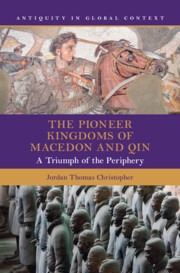
Macedon and Qin are introduced, providing separate summary histories of these two polities, examining the differing types and quality of evidence for the study of each, examines the geographic and cultural location of these polities relative to their cores of their cultural networks, and argues for the usefulness of the center-periphery axiom in the study of these entities. Lastly, the nature of the Macedonian and Qin identity is explored, suggesting that prior attempts to define them as Greek/Zhou or not Greek/Zhou miss the clearer dynamic that they are frontier cultures. Their significant divergences from Greek and Zhou norms are explained by the same factors that cause colonial and frontier societies throughout human history to “deviate” from norms of a core culture. I also point out the significant ways in which their identities seek to preserve earlier cultural modes.
The Pioneer Kingdoms of Macedon and Qin critically compares the cultures of Ancient Greece and Early China in the first millennium BC through following the histories of two of its peripheral cases: Argead Macedon and Qin. Emerging from being fringe states to producing Alexander the Great and the First Emperor of China, then rapidly collapsing, these polities had a unique parallel historical experience, though vastly separated by the political developments brought on by the unique features of Greek and Zhou culture within which they operated. Jordan Thomas Christopher undertakes a holistic comparison of these states from their earliest origins through to the reigns of Alexander the Great and the First Emperor, which receive an extended and multi-layered analysis. He thereby highlights the particularities of Greek and Zhou cultures that often go underappreciated as causal factors in history.
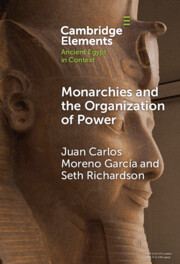
This Element explores the organization of power in ancient Egypt and Mesopotamia and the interaction of diverse social actors between 2100 and 1750 BC. On the one hand, the forms of integration of towns and villages in larger political entities and the role played by local authorities, with a focus on local agency, the influence of mobile populations, the exercise of power in small localities, and the contrast between power reality and royal ideological claims, be they legal, divinely sanctioned, or other. On the other hand, the modalities of penetration of the royal authority in the local sphere, the alliances that linked court dignitaries and local potentates, and the co-option of local leaders. Finally, the influence of such networks of power on the historical evolution of the monarchies and the adaptability of the latter in coping with the challenges they faced to assert and reproduce their authority.
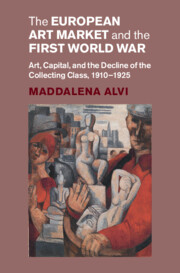
The outbreak of the First World War shattered the established European art market. Amidst fighting, looting, confiscations, expropriation fears and political and economic upheaval, an integrated marketplace shaped by upper-class patrons broke down entirely. In its place, Maddalena Alvi argues, can be found the origins of a recognisably modern market of nationalised spheres driven by capitalist investment and speculation, yet open to wider social strata. Delving into auction records, memoirs, newspaper articles, financial and legal documents in six languages, Alvi explores these cultural and socio-economic developments across the British, French, and German markets, as well as trade spheres such as Russia and Scandinavia. 1914 marked the end of the European art market and cemented the connection between art and finance.
The “othering” of international humanitarian law has a demonstrated past resulting from the exclusion of so-called “Enemies of the Faith” from the laws of chivalry. It is no surprise, then, that the idea of “sharp war” should seem so natural to some commentators given its historical application “by the discretion of the commander and such rules of justice and humanity as recommend themselves in the particular circumstances of the case”. The application of humanitarian principles, in other words, was the measure of the commander's charity rather than the result of legal compulsion.
The viability of sharp war appears to have increased in attractiveness as conventional State-on-State warfare has seemingly decreased in frequency; however, the question of sharp war has never been approached through a legal historical lens. Utilizing the research found in The Laws of Yesterday's Wars, a multi-author series edited by the present author, this paper seeks to fill this gap by scoping over a range of geographically and temporally disconnected case studies and the customary law developed to mitigate warfare. Ultimately, the paper highlights that “soft war” has naturally evolved in all cultures and that arguments for sharp war are a historical anomaly.
The conclusion brings together the themes that have emerged throughout the book, provides comparative perspectives, teases out some of the wider implications for the study of gender and suggests directions for future research. It also comes back to the multitude of animals that have appeared sporadically throughout the different chapters, discussing the role they played in gender construction and the potential of human/animal connections to decentre the man in the process of creating male subjectivities.