Refine search
Actions for selected content:
13 results
Hyperasymptotics for linear difference equations with an irregular singularity of rank one: polynomial coefficients
- Part of
-
- Journal:
- Proceedings of the Royal Society of Edinburgh. Section A: Mathematics , First View
- Published online by Cambridge University Press:
- 10 March 2026, pp. 1-45
-
- Article
- Export citation

Signals, Systems, and Signal Processing
-
- Published online:
- 29 August 2024
- Print publication:
- 13 June 2024
-
- Textbook
- Export citation
5 - Recursive Difference Equations
-
- Book:
- Signals, Systems, and Signal Processing
- Published online:
- 29 August 2024
- Print publication:
- 13 June 2024, pp 163-210
-
- Chapter
- Export citation
2 - The Basics of Feedback
-
- Book:
- A Guide to Feedback Theory
- Published online:
- 09 April 2021
- Print publication:
- 22 April 2021, pp 52-115
-
- Chapter
- Export citation
Effective finiteness of solutions to certain differential and difference equations
- Part of
-
- Journal:
- Canadian Mathematical Bulletin / Volume 65 / Issue 1 / March 2022
- Published online by Cambridge University Press:
- 16 February 2021, pp. 52-67
- Print publication:
- March 2022
-
- Article
- Export citation
-
For $R(z, w)\in \mathbb {C}(z, w)$ of degree at least 2 in w, we show that the number of rational functions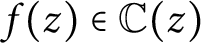 $f(z)\in \mathbb {C}(z)$ solving the difference equation $f(z+1)=R(z, f(z))$ is finite and bounded just in terms of the degrees of R in the two variables. This complements a result of Yanagihara, who showed that any finite-order meromorphic solution to this sort of difference equation must be a rational function. We prove a similar result for the differential equation $f'(z)=R(z, f(z))$, building on a result of Eremenko.
Criteria for periodicity and an application to elliptic functions
- Part of
-
- Journal:
- Canadian Mathematical Bulletin / Volume 64 / Issue 3 / September 2021
- Published online by Cambridge University Press:
- 14 August 2020, pp. 530-540
- Print publication:
- September 2021
-
- Article
- Export citation
-
Let P and Q be relatively prime integers greater than 1, and let f be a real valued discretely supported function on a finite dimensional real vector space V. We prove that if $f_{P}(x)=f(Px)-f(x)$ and $f_{Q}(x)=f(Qx)-f(x)$ are both $\Lambda $-periodic for some lattice $\Lambda \subset V$, then so is f (up to a modification at $0$). This result is used to prove a theorem on the arithmetic of elliptic function fields. In the last section, we discuss the higher rank analogue of this theorem and explain why it fails in rank 2. A full discussion of the higher rank case will appear in a forthcoming work.


Stability of Equilibrium Solutions in Planar Hamiltonian Difference Systems
-
- Journal:
- Canadian Journal of Mathematics / Volume 67 / Issue 6 / 01 December 2015
- Published online by Cambridge University Press:
- 20 November 2018, pp. 1270-1289
- Print publication:
- 01 December 2015
-
- Article
-
- You have access
- Export citation
Surface energies in a two-dimensionalmass-spring model for crystals
-
- Journal:
- ESAIM: Mathematical Modelling and Numerical Analysis / Volume 45 / Issue 5 / September 2011
- Published online by Cambridge University Press:
- 23 February 2011, pp. 873-899
- Print publication:
- September 2011
-
- Article
- Export citation
-
We study an atomistic pair potential-energy E (n)(y) that describesthe elastic behavior of two-dimensional crystals with n atoms where $y \in {\mathbb R}^{2\times n}$
 characterizes the particle positions. The mainfocus is the asymptotic analysis of the ground state energy as ntends to infinity. We show in a suitable scaling regime where theenergy is essentially quadratic that the energy minimum of E (n)admits an asymptotic expansion involving fractional powers of n:
${\rm min}_y E^{(n)}(y) = n \, E_{\mathrm{bulk}}+ \sqrt{n} \, E_\mathrm{surface} +o(\sqrt{n}), \qquad n \to \infty.$

The bulk energy density E bulk is given by an explicitexpression involving the interaction potentials. The surface energyE surface can be expressed as a surface integral where theintegrand depends only on the surface normal and the interactionpotentials. The evaluation of the integrand involves solving a discrete algebraic Riccati equation. Numerical simulations suggestthat the integrand is a continuous, but nowhere differentiable function ofthe surface normal.

INVERSE FACTORIAL-SERIES SOLUTIONS OF DIFFERENCE EQUATIONS
-
- Journal:
- Proceedings of the Edinburgh Mathematical Society / Volume 47 / Issue 2 / June 2004
- Published online by Cambridge University Press:
- 01 July 2004, pp. 421-448
-
- Article
-
- You have access
- Export citation
Increment-Vector Methodology: Transforming Non-Stationary Series to Stationary Series
- Part of
-
- Journal:
- Journal of Applied Probability / Volume 35 / Issue 1 / March 1998
- Published online by Cambridge University Press:
- 14 July 2016, pp. 64-77
- Print publication:
- March 1998
-
- Article
- Export citation
Stability of Weighted Darma Filters
-
- Journal:
- Canadian Mathematical Bulletin / Volume 41 / Issue 1 / 01 March 1998
- Published online by Cambridge University Press:
- 20 November 2018, pp. 49-64
- Print publication:
- 01 March 1998
-
- Article
-
- You have access
- Export citation
The Representation and Decomposition of Integrated Stationary Time Series
- Part of
-
- Journal:
- Advances in Applied Probability / Volume 26 / Issue 3 / September 1994
- Published online by Cambridge University Press:
- 01 July 2016, pp. 799-819
- Print publication:
- September 1994
-
- Article
- Export citation
