To save content items to your account,
please confirm that you agree to abide by our usage policies.
If this is the first time you use this feature, you will be asked to authorise Cambridge Core to connect with your account.
Find out more about saving content to .
To save content items to your Kindle, first ensure no-reply@cambridge.org
is added to your Approved Personal Document E-mail List under your Personal Document Settings
on the Manage Your Content and Devices page of your Amazon account. Then enter the ‘name’ part
of your Kindle email address below.
Find out more about saving to your Kindle.
Note you can select to save to either the @free.kindle.com or @kindle.com variations.
‘@free.kindle.com’ emails are free but can only be saved to your device when it is connected to wi-fi.
‘@kindle.com’ emails can be delivered even when you are not connected to wi-fi, but note that service fees apply.
This article links the consequences of the Great Recession on protest and electoral politics. It innovates by combining the literature on economic voting with social movement research and by presenting the first integrated, large‐scale empirical analysis of protest mobilisation and electoral outcomes in Europe. The economic voting literature offers important insights on how and under what conditions economic crises play out in the short‐run. However, it tends to ignore the closely connected dynamics of opposition in the two arenas and the role of protests in politicising economic grievances. More specifically, it is argued that economic protests act as a ‘signalling mechanism’ by attributing blame to decision makers and by highlighting the political dimension of deteriorating economic conditions. Ultimately, massive protest mobilisation should, thus, amplify the impact of economic hardship on the electoral losses of incumbents and mainstream parties more generally. The empirical analysis to study this relationship relies on an original semi‐automated protest event dataset combined with an updated dataset of electoral outcomes in 30 European countries from 2000 to 2015. The results indicate that the dynamics of economic protests and electoral punishment are closely related and point to a destabilisation of European party systems during the Great Recession.
Electoral politics constitute a formative, agenda-setting phase in the development of mixed-economy approaches to social welfare. This study examines issue-salience and policy framing related to the welfare role of the third sector in party manifestos in UK Westminster and regional elections 1945–2011. The findings reveal a pronounced increase in salience over recent decades. Welfare pluralism, whereby voluntary organisations complement state and market-based services, is shown to be the dominant approach at both state-wide and regional levels. Yet election data also reveal inter-party and inter-polity contrasts in policy framing. This is significant to contemporary understanding of mixed-economy approaches to welfare because it shows electoral discourse to be a driver of policy divergence in multi-level systems. The result is differing policy prescriptions for the third sector that (re-)define governance practices and underpin the rise and territorialisation of welfare pluralism. In turn this poses questions about policy co-ordination and differential welfare rights in the unitary state.
In liberal systems governing-party-turnover and third sector organisations’ engagement in public policy-making are seen as key factors maintaining the health of democracy. However, a significant lacuna in current understanding is the effect on engagement when governing-party-turnover is absent. Accordingly, drawing on qualitative interview data, this study examines the effects of one-party-dominance (OPD) in Wales; a regional polity in the UK where the Left-of-centre Labour Party has held uninterrupted government office since a new meso-legislature was created in 1999. The findings reveal OPD introduces a range of pathologies related to party institutionalisation, path-dependency and cognitive locks. These affect third sector organisations’ resource dependency and strategic bridging to elected representatives. The resulting democratic ills are self-sustaining and include diminution of NGOs’ autonomy, trust and criticality. This study’s wider significance lies in underlining the importance of governing-party-turnover- not only to effective third sector public policy engagement, but also the health of contemporary liberal democracies.
In the early nineteenth century the idea of self-making emerged along America’s many frontiers: western lands and growing cities; plus political, commercial, technological, cultural, material, communication, and religious frontiers. These all beckoned, demanding new choices and encouraging new feelings of self-agency. As before, the label “self-made” could point to a flawed person who had gone astray. However, use of the idea of “self-made” began to shift toward positive connotations that sanctified individualism and ambition if applied to religious, social, or patriotic service. Storytellers who grasped that connection transformed self-seeking and ambition from dangers into bulwarks against aristocracy’s evils. Competitors for political power told stories of self-improvement, self-fashioning, and self-making to align themselves with progress for their nation. Electoral politics increasingly induced ambitious candidates to claim that they had risen from lowly origins by their own efforts. Frontier tales of spirited heroes, such as Andrew Jackson and David Crockett, appealed to audiences who appreciated a rough-and-ready masculinity that the Founders had disdained.
Over the last few decades, the concept of Indigeneity has gained traction in Cambodia and Thailand, partially because of its potential to assist Indigenous Peoples in gaining more control over contested lands and forests. The Cambodian government recognizes Indigenous Peoples and their communal land titles. Since 2009, when a sub-decree was issued for registering Indigenous communities and their lands, dozens of villages in northeastern Cambodia have obtained communal land titles. The government of Thailand, however, does not officially recognize the existence of Indigenous Peoples. Nevertheless, the concept of Indigenous Peoples is gaining support in Thailand. Over the last few years, Indigenous activists in both countries have increasingly engaged in electoral politics. The Cambodia Indigenous Peoples’ Democracy Party (CIPDP) contested the commune and national elections of 2017 and 2018, respectively. In Thailand, Indigenous activists have also become more involved in electoral politics, especially during the 2019 national elections, when the first ethnic Hmong person was elected to Parliament. This Indigenous engagement in electoral politics represents a new strategy to gain more cultural and language rights at the legislative level, as well as tenure over land and other natural resources.
In order to cast a satisfying vote, understand politics, or otherwise participate in political discourse or processes, voters must have some idea of what policies parties are pursuing and, more generally, 'who goes with whom.' This Element aims to both advance the study of how voters formulate and update their perceptions of party brands and persuade our colleagues to join us in studying these processes. To make this endeavor more enticing, but no less rigorous, the authors make three contributions to this emerging field of study: presenting a framework for building and interrogating theoretical arguments, aggregating a large, comprehensive data archive, and recommending a parsimonious strategy for statistical analysis. In the process, they provide a definition for voters' perceptions of party brands and an analytical schema to study them, attempt to contextualize and rationalize some competing findings in the existing literature, and derive and test several new hypotheses.
Christian evangelicals now represent a significant share of the global population. Notably, they are expected to soon outnumber Roman Catholics in several low- and middle-income countries. This paper examines whether such episodes of religious minority growth can reshape electoral politics. To address this, I combine novel data spanning over two decades (1994–2018) of Christian evangelicals’ expansion across Brazilian municipalities with indicators of structural changes in electoral politics: voter turnout, competition, polarization, and conservatism. Regression models with unit and year-fixed effects reveal no impact of the evangelical boom on electoral competition and polarization, suggestive evidence of increasing conservatism in recent years, and a clear and robust negative effect on turnout. Regression discontinuity design estimates, leveraging an exogenous and discontinuous growth of Christian evangelicals in Brazil’s rural areas, support these findings. The results suggest that the rise of religious minorities may drive gradual transformations in electoral politics.
This chapter explores the link between eternity clauses and electoral democracy by looking at two instances of unamendable democracy: party bans, both direct and indirect, and the protection of parliamentary mandates. These two approaches are illustrated via a range of case studies: the ban of anti-democratic parties in Germany; bans of ethnic, separatist, and religious parties in Turkey; indirect unamendability and its chilling effect on party competition in Israel; and the judicial protection of parliamentary mandates as unamendable in Czechia. Whereas such measures are adopted in the name of protecting democracy, the analysis here indicates that courts will not always strike the right balance between safeguarding and unduly narrowing democratic commitments. In some cases, they may even unintentionally undermine multipartyism itself or significantly influence electoral outcomes. Thus, the bluntness and open-ended nature of unamendability risks having a chilling effect on electoral democracy in both fragile and more stable democratic contexts.
In this paper, we develop a framework for studying the role of group identities in contemporary cleavage formation. Identities, we suggest, hold the key to a central conundrum of current political sociology: the fact that today’s electoral realignments appear to be rooted in the social structure of post-industrial societies, while the decline of mass organizations has dissolved traditional links between politics and social structure. Bringing cleavage theory into dialog with the sociology of Pierre Bourdieu, we theorize how group identities may play an important role in stabilizing a new universalism-particularism cleavage emerging in Western Europe today. We identify two key processes of cleavage identity formation: bottom-up processes of “social closure” and top-down “classification struggles” waged by political entrepreneurs. For both processes, we review empirical findings and formulate an agenda for further research.
Chapter 7 identifies and tests implications of the argument for contemporary Brazilian politics. Specifically, I test whether black identifiers with high levels of education exhibit distinct patterns of behavior, mainly in the electoral arena. I compile and analyze high-quality election survey data collected by reputable domestic firms between 2002 and 2018 and show that highly educated, black voters have become a loyal leftist constituency, rallying consistently around the leftist Workers’ Party since 2002. These voters are more ideologically leftist than either their lesser-educated black or better-educated white counterparts. This pattern holds even in the face of political instability stemming from major corruption scandals in 2005 and 2015, as well as the rise of far-right populist leader Jair Bolsonaro in 2018. This chapter illustrates the expectations of the policy feedback literature, showing that policy reforms “feed back” into the political process by altering the identities, interests, and behavior of citizens.
Asylum seekers, the war in Iraq, and the threat of terrorism dominated foreign policy in the first years of the twenty-first century not only in the political arena but also in the polls. Not since the 1980s and the debate about Asian immigrants had questions of immigration loomed so large; not since the Vietnam War had the deployment of Australian troops in a US-led invasion of a distant land proved so divisive; and never before had Australia had to grapple with the threat of international terrorism. Border protection and terrorism figured prominently in the run-up to the 2001 election; security issues and, to a lesser extent, the war in Iraq were factors in the election held in 2004.
Regional interests and tensions are manifest in regional bloc voting in multiparty elections (1990s–2010s). We present an electoral geography analysis of constituency-level voting in presidential elections in twelve countries from 1990 to 2015 (44 elections). We describe the economic attributes of the electoral blocs using forty rounds of DHS surveys for geocoded education and ethnicity data, nighttime luminosity, historical maps of producer regions, and raster data for population densities and contemporary crop production profiles. Most electoral blocs arise in rural regions that are wealthier, better educated, more densely populated, and more deeply incorporated into the national economy than other rural areas. Most are specialized in high-value export crops (or traded food crops.) Some have nonagricultural production profiles as labor-exporting or mining regions. Most coalesce within provincial-level administrative units. Almost all are multiethnic. The evidence is consistent with the argument that state institutions work to channel politics arising from uneven economic development into the national political arena. Microlevel mechanisms contributing to this outcome are related to interests, organizations, ideology, and actions of political agents and coalition-builders.
This chapter considers the structure of territorial cleavage from a national perspective. It focuses on patterns of polarization between regional electoral blocs, or “territorial oppositions,” in national politics. Axes of territorial cleavage arising between predominantly rural regions tend to take canonical forms associated with core–periphery politics in countries that are undergoing national economic integration and the growth of the central state. Stable axes of sectional competition, whereby leading regions square off against each other or against those on the periphery, are visible in the electoral data and in persistent policy cleavages in countries in this study. In broad outlines, these conform to models of territorial opposition in national politics advanced by earlier scholars (Lipset & Rokkan 1967; Gourevitch 1979; Bayart 2013). The analysis is built around four countries – Kenya, Zambia, Malawi, and Uganda – that serve as archetypes of different patterns of territorial opposition and core–periphery politics. Tanzania is a shadow case.
Although liberals and conservatives tended to disagree about the specific ways in which the franchise might be expanded, both parties accepted by 1860 that reform was inevitable. Yet to whom should the vote be extended and on what basis? These questions animated discussions within and outside the House of Commons. They also informed significant works of nonfiction in this decade, including several of John Stuart Mill’s most important writings, as well poetry and fiction, including many of Anthony Trollope’s parliamentary novels. This chapter constellates Mill’s speculative thought and Trollope’s fiction in order to consider the persistent tensions between thought and feeling that are constitutive features of Victorian liberalism itself.
Between 2014 and 2022, the Bharatiya Janata Party (BJP) made a determined bid to establish its electoral and discursive dominance in regions beyond its traditional strongholds in Northern and Western India. In the North-east, in the Christian-majority states of Mizoram, Meghalaya, and Nagaland, it encountered fierce hostility from the Church which exercised a hegemonic control over the religious, social, and political life in these states. This article focuses on the political tussle between the BJP and the Church in this time period and attempts to explore the deeper ideological contestations and competing narratives underlying this struggle and their implications for the Indian political discourse. These include contestations over the very conceptualization of secular democracy in India and the role of religion in it; different understandings of religious conversions and freedom of conscience; and the conflicting agendas around the categories of ‘tribe’, ‘indigenous people’/‘adivasi’, and ‘janjati’/‘vanvasi’.
Why have some states adopted policies expanding ballot access while others have restricted access to the ballot? Since the 1990s, some states have been adopting policies restricting access to the ballot such as requiring identification. At the same time, states have been adopting a variety of registration reforms that lower the barriers to registration and voting. Using an original, 45-state dataset, we examine state innovation within the policy domain of electoral reforms in US states. We find reforms have an independent and, sometimes, negative effect on the innovation of states in electoral reforms. Next, we use dyad analysis to examine the spread of a single policy: automatic voter registration. We find that the propensity to innovate both within and across a state makes the spread of automatic voter registration more likely. Our paper contributes to the broader understanding of why states adopt electoral reforms.
In 2009, after decades of single party rule under the Liberal Democratic Party (LDP), Japan had its first taste of a real alteration of power. However, just 3 years later, the LDP regained control of government with no significant challenger in sight. Historically, LDP dominance is a common tale, but its resurgence in recent years poses a significant puzzle in Japanese politics. What exactly has contributed to the LDP's return to power? In the years that have passed, the LDP's strength has come from a combination of cash, clientelistic networks, and strong candidates, but recent research has found that Japanese politics has become more programmatic and party-focused. While LDP dominance since its return to power in 2012 can be attributed in part to its candidates, I find that the appeal of the party label has played a large role in securing the LDP's large majorities.
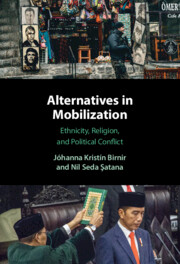
What determines which identity cleavage, ethnicity or religion, is mobilized in political contestation, be it peaceful or violent? In contrast to common predictions that the greatest contention occurs where identities are fully segmented, most identity conflicts in the world are between ethnic groups that share religion. Alternatives in Mobilization builds on the literature about political demography to address this seeming contradiction. The book proposes that variation in relative group size and intersection of cleavages help explain conundrums in the mobilization of identity, across transgressive and contained political settings. This theory is tested cross-nationally on identity mobilization in civil war and across violent conflict in Pakistan, Uganda, Nepal and Turkey, and peaceful electoral politics in Indonesia. This book helps illustrate a more accurate and improved picture of the ethnic and religious tapestry of the world and addresses an increasing need for a better understanding of how religion contributes to conflict.
Modern Thai constitutionalism, though often meaningful and rich in form and substance, has experienced great volatility since its inception in 1932. At the same time, behind the twenty constitutions that have emerged since then, some recurring ideal-typical figurations that have dominated certain periods of constitutional politics in Thailand can be observed. These historically derived ideal-typical notions of constitutional politics mostly represent inherently hegemonic conceptions. They are defined for instance by how they conceive western and autochthonous elements of constitutionalism, majoritarian electoral politics and the monarchy, the rule of law and authoritarian governance by men. This chapter explores some of the most significant historical experiences and ensuing figurations of Thai constitutionalism that together form a rich reservoir of different, sometimes diverging notions to understand and practice constitutional governance in Thailand.