To save content items to your account,
please confirm that you agree to abide by our usage policies.
If this is the first time you use this feature, you will be asked to authorise Cambridge Core to connect with your account.
Find out more about saving content to .
To save content items to your Kindle, first ensure no-reply@cambridge.org
is added to your Approved Personal Document E-mail List under your Personal Document Settings
on the Manage Your Content and Devices page of your Amazon account. Then enter the ‘name’ part
of your Kindle email address below.
Find out more about saving to your Kindle.
Note you can select to save to either the @free.kindle.com or @kindle.com variations.
‘@free.kindle.com’ emails are free but can only be saved to your device when it is connected to wi-fi.
‘@kindle.com’ emails can be delivered even when you are not connected to wi-fi, but note that service fees apply.
Somalia today stands as one of the most persistent contexts of child soldier recruitment and use globally. The emergence of the Islamic militant group Al Shabaab has intensified fears about the insecurity of – and threat posed by – children as agents of war in Somalia. This article contextualises Al-Shabaab’s recruitment and use of children within its specific historical, political and cultural dimensions, challenging the emphasis in terrorism studies on the ‘unique’ phenomenon of children in extremist groups and relating the pathways of youth in Al-Shabaab with wider trends in criminality and violence, including piracy. This research responds to the need for deeper analysis of Somalia’s history of youth mobilisation that considers the specific constructions of age and masculinity that have influenced the participation of young people in diverse armed groups.
By the mid-fifteenth century, the Safavid order had militarized, emerging as a significant threat to regional powers like the Aqquyunlu, Qaraquyunlu, Shirvanshah, and later, the Ottomans. This provoked the deaths of key Safavid leaders – Sheikh Junayd, Haydar, and Sultan ʿAli – along with thousands of their followers, who were killed in battle or executed. Despite these devastating losses, the Safavid community’s loyalty to their cause remained steadfast.
After highlighting patterns of types and targets of human rights violations, we introduce the main perpetrators. Trying to understand what motivates them, and, more importantly, how they can be constrained, is key to improving respect for human rights. We start by introducing a theoretical framework that helps us understand why human rights are violated. Why do peaceful forms of communication and negotiation collapse in favour of violence and destruction? Are acts of atrocity born out of rational calculations or are they the product of erratic and unpredictable behaviour? We then apply this theoretical model to understand the behaviour of the most common perpetrators of life integrity violations, the military and the police, as well as less prominent perpetrators, such as militias, rebel groups, and criminal cartels. Throughout this chapter we focus primarily on perpetrators of physical violence but integrate brief examples of other types of human rights violations.
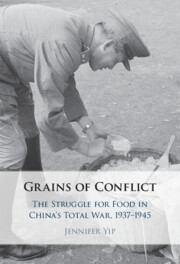
China's war against Japan was, at its heart, a struggle for food. As the Nationalists, Chinese Communist Party, and Japanese vied for a dwindling pool of sustenance, grain emerged as the lynchpin of their strategies for a long-term war effort. In the first in-depth examination of how the Nationalists fed their armies, Jennifer Yip demonstrates how the Chinese government relied on mass civilian mobilization to carry out all stages of provisioning, from procurement to transportation and storage. The intensive use of civilian labor and assets–a distinctly preindustrial resource base– shaped China's own conception of its total war effort, and distinguished China's experience as unique among World War Two combatants. Yip challenges the predominant image of World War II as one of technological prowess, and the tendency to conflate total war with industrialized warfare. Ultimately, China sustained total war against the odds with premodern means: by ruthlessly extracting civilian resources.
This study uniquely explores the impact of militarization on carbon emissions in North Atlantic Treaty Organization (NATO) countries from 1985 to 2019 using panel econometric techniques. NATO countries, characterized by substantial defense budgets, advanced technologies, high industrialization, and significant energy consumption, offer a unique context for examining these factors. Employing the Pooled Mean Group Autoregressive Distributed Lag (PMG-ARDL) and FMOLS models, the research analyzes the long-term and short-term dynamics across three groups: traditional NATO members (Group 1), new NATO members (Group 2), and a combined group (Group 3). Relevant variables used in the estimation are industrialization, technological innovation, energy consumption, and economic growth. Findings reveal that in Group 1, military expenditure and energy consumption significantly increase carbon emissions, while industrialization and technological innovation reduce them. In Group 2, increased military spending and industrialization reduce emissions, but energy consumption and technological innovation increase them. For Group 3, economic growth significantly drives emissions, whereas industrial advancements and selective technological innovations mitigate them. The study underscores the need for tailored environmental policies and technological advancements to reduce carbon emissions, contributing to sustainable development within military alliances. These insights are crucial for policymakers aiming to balance defense needs with environmental sustainability in NATO countries.
The chapter traces change of international order from the Peace of Westphalia to the Congress of Vienna. International order shifted from a hierarchical order upheld by courtly ceremonial and diplomatic precedence to an order based on a territorial balance of power. A quest for status from Great Britain, Prussia, and Russia animated the change. These actors were unable to enhance their standing with diplomatic precedence, and consequently they outright mocked it. Simultaneously, unrestricted by the requirements of ceremonial, they dramatically rationalized the military. While for the ancien régime powers, the Holy Roman Emperor, the French king, and the Spanish king, court culture impregnated the military, the challengers had the military infiltrate court life. The aesthetic dimensions of military innovations played as much of a role in these dynamics as the military’s functional dimensions. Britain, Prussia, and Russia became the masters of new, rationalized forms of warfare, that brought the ancien régime powers to their knees. The resulting glory for the challengers led to reforms and/or revolution in the ancien régime powers. Courtly ceremonial and diplomatic precedence lost their meaning. The Congress of Vienna bestowed it onto five great powers (defined by their military potential) to manage the balance of power.
This chapters traces the evolution of the Nova Holanda gang’s governance practices from the mid-1990s until the occupation of Maré by the Brazilian Military in April 2014 through the analysis of newspaper archives, oral histories with residents and gang members, and a dataset of anonymous gang denunciations. Following its integration into the Comando Vermelho faction, CVNH maintained a benevolent dictator regime, combining high levels of coercion with responsive benefits, until several years of warfare with their primary rival led to the use of extreme forms of coercion against residents as disorder prevailed. By 2004, the war between CVNH and Terceiro Comando Puro (TCP) had ended though enforcement continued to be active and frequent, leading to a social bandit regime, in which the gang offered significant benefits and engaged in low levels of coercion. Then, following the resurgence of TCP in 2009 until the arrival of the Brazilian military, CVNH can be considered a benevolent dictator gang once again. They ramped up their coercive behavior in response to TCP’s more aggressive posture while providing significant benefits to avoid frequent police enforcement efforts.
The third of Maré’s gangs, Terceiro Comando Puro (TCP), controls an enormous territory, encompassing ten contiguous neighborhoods with an estimated population of 68,000 residents, more than twice that of Maré’s Comando Vermelho-connected gangs. Moreover, TCP’s turf has changed significantly over time as the gang has lost and won territory through violent battles with several rivals, which have had horrifying consequences for both gang members and residents. This chapter also shows how the nature of enforcement against gangs can shift radically as TCP developed highly collaborative relations with the police especially after 2009. The chapter traces these developments in TCP’s historic territories as well as the housing projects that they would control from the mid-1990s until 2002 and again after 2009. This chapter interweaves multiple types of data, including eighteen months participant observation, dozens of interviews with current and former gang members and residents, as well as journalistic accounts and denunciations to an anonymous hotline, to trace how TCP’s shifting security environment has shaped their governance practices over time.
In April 2014, two months before the start of the World Cup, 2,500 Brazilian Army and Marine soldiers occupied Complexo da Maré. They would stay there for the next fifteen months. The occupation of Maré was the culmination of Rio’s once-heralded Police Pacification Units, a public security program intended to recapture the state’s monopoly of violence from drug-trafficking gangs in hundreds of favelas throughout the city. This chapter begins by tracing the confluence of factors which led to the Brazilian military’s intervention. A mix of participant observations, interviews, and newspaper accounts then document the military’s arrival and their various operations and activities to combat gangs and gain the support of the local population. The chapter proceeds to analyze how and why each of Maré’s gangs responded differently to the challenges of occupation, arguing that the military lacked the capacity to fully expel or dismantle them though their presence shifted the dynamics of rival competition and threat, which produced the divergent gang responses observed.
In the context of the transnational rule-of-law crisis the world is experiencing, this chapter asks whether the institutional solutions typically embraced by contemporary Latin American constitutions make a difference in fighting contemporary patterns of rule-of-law violations, and what sort of difference they make. The chapter advances the preliminary hypothesis that Latin American last-wave constitutions make a positive difference. After recalling historic trends with regard to democracy and the rule of law in Latin America and providing an overview of the standard institutional tools contained in Latin American constitutions, it describes the patterns of rule-of-law undermining that dominate the current political scenario in Mexico. The chapter especially addresses attacks on the National Electoral Institute and the quest to weaken electoral reliability, and the militarization of public life and state functions. The analysis shows that the Mexican constitution is successfully used to resist these developments, but it also suggests that existing dynamics excessively rely on ex post reaction and the overcharge judiciary.
The environmental history of the Vietnam War is unique in the twentieth century for the unprecedented scale of aerial bombing and use of incendiaries such as napalm, as well as the United States military’s use of tactical herbicides to destroy forest cover in combat zones. Drawing on recent trends in environmental and military history, this chapter aims to provide a more comprehensive sketch of the environmental legacies of the Vietnam War. Besides the effects of bombing and herbicides, these include inquiries into the footprints of warfare in urban and industrial development, in ethnic and demographic shifts in former warzones, in the dispersion of invasive species, and even in the creation of wilderness or conservation areas.
To date, there is no systematic research on the overlapping challenges of wildlife conservation and security in South Sudan, where the wildlife service (WLS) has institutionally survived for over a century while contending with poor state capacity and responsibility for protected areas (PAs) that cover vast territories characterized by chronic insecurity and food scarcity. Integrated into the country’s “Organized Forces,” South Sudan’s park rangers play roles beyond conservation as armed actors in complex conflicts. Data obtained from archival research and field interviews shows that South Sudan’s wildlife authorities have persisted since the colonial period in spite and because of chronic warfare.
The first chapter explores the new presence of the military in the city after the start of the war. It analyzes the militarization of civil society and the blend of increased prestige and tensions in civil–military relations characteristic of wartime. During the mobilization days, reactions in Prague resembled scenes in other European cities: streets buzzing with anxious agitation as crowds thronged army barracks and train stations. Increasingly ubiquitous gray uniforms delineated new visible wartime hierarchies. Contacts between soldiers and civilians sometimes led to violent clashes, especially prevalent around cafés and pubs. These locales were also hubs for spreading information in a context of increased censorship and military repression. General suspicion by the military authorities transformed Prague residents’ experience of the rule of law. The different facets of military mobilization and emergency measures in urban space are examined to contribute to the discussion on the nature of the Habsburg military wartime government.
This article offers the first scholarly analysis of the shift from revolvers to semi-automatic handguns in Canada to contribute to our knowledge of police militarization. In the 1990s, most Canadian police handed in their venerable service revolvers and received modern semi-automatic pistols. Advocates of new weapons pointed to relatively rare but high-profile shootings of police to show the dangers of law enforcement work and the need to have better firearms. The gun industry encouraged the rearming of police through an aggressive marketing campaign emphasizing that modern police forces required more advanced weapons and the military lineage of their products. The transition to semi-automatic handguns sometimes proved controversial, as human rights advocates believed the new handguns could result in excessive use of force. Despite this concern, most police were rearmed by the beginning of the twenty-first century.
The so-called ‘civil police’ which originated in London and then spread to the US and the rest of the world has been a crucial institution for maintaining the international order. This is because the civil police, unlike the army, is a coercive regime meant for ‘citizens’ rather than ‘foreigners’ or ‘subjects’. The civil police regulates ‘domestic’ space, while the military is oriented to ‘foreign’ or ‘international’ space. This essay examines the origins of this important institution in the United Kingdom and the United States and reveals its colonial genealogy. The first civil police, the London Metropolitan Police, founded in the nineteenth century, was modelled after a colonial counter-insurgency force, the Irish Constabulary. In the United States, the civil police was initially modelled after the London police but later, in the early twentieth century, appropriated a series of techniques and tactics from America’s colonial regime in the Philippines. The strategic operation of both civil police institutions has been to draw upon the colonial site while covering up its colonial counter-insurgency and militaristic origins.
This chapter analyzes the formation and expansion of social spaces for political debate and their impact on the formation of political identities as well as its entanglements with an increasing militarization of society. This chapter studies how the military quarters, the camps, and the campaign regiments transformed themselves into privileged spaces for public debate. During the process of Independence, the military forces engaged more in political debates, and members of these forces expressed their political opinions and affiliations in broadsides, manifestos, and printed proclaims. By bringing these often separated social and political spaces, we seek to analyze the impact and relevance that public opinion had in the processes of independence, paying particular attention to the formation of political identities, the emergence of a new political languages, as well as the diverse discursive strategies that leaders in different regions used to mobilize people militarily or to raise political awareness on soldiers. In this way, this chapter seeks to create original analytical connection between political knowledge and debate, and military mobilization in Latin America during the wars of independence.
Bringing together experts across Latin America, North America, and Spain, The Cambridge Companion to Latin American Independence innovatively revisits Latin American independence within a larger regional, temporal, and thematic framework to highlight its significance for the Age of Atlantic Revolutions. The volume offers a synthetic yet comprehensive tool for understanding and assessing the most current studies in the field and their analytical contributions to the broader historiography. Organized thematically and across different regions of the Iberian Peninsula and Spanish and Luso America, the essays deepen well-known conclusions and reveal new interpretations. They offer analytical interventions that produce new questions on periodization, the meaning of anti-colonialism, liberalism, and republicanism, as well as the militarization of societies, public opinion, the role of sciences, labor regimes, and gender dynamics. A much-needed addition to the existing scholarship, this volume brings a transnational perspective to a critical period of history in Latin America.
Chapter 9 chronicles the postwar trajectory of extrajudicial killings within the Guatemalan police. It first examines state violence during the transition period and subsequent postwar police reforms, which included the creation of the new National Civilian Police (PNC) in 1997. The chapter then analyzes how the dominant wartime distributional coalition managed to survive peacebuilding reforms and uphold the undermining rules governing extrajudicial executions to eliminate “undesirables.” In an important contrast from the case of Guatemala’s customs administration, the PNC saw the direct reentry of these groups into the upper echelons of the security cabinet, highlighting a different pathway of institutional persistence.
Chapter 2 presents the book’s theory of wartime institutional change, which accounts for why civil war is a site of institutional transformation, conceptualizes different wartime institutional logics, and elaborates the causal process through which undermining rules evolve amid conflict. It argues that the perceived escalation of the insurgent threat within civil war unsettles prevailing institutional arrangements and empowers political and military elites who, as the architects of counterinsurgency, possess high levels of decision-making discretion. Under the pretext of combatting the “internal enemy,” this counterinsurgent elite introduces alternative rules of the game, which correspond to its narrow interests. The latter half of the chapter tackles why undermining rules persist within and beyond conflict. Where counterinsurgent leaders can knit together a broader set of interests with a stake in the wartime procedures and successfully co-opt new peacetime political and economic spaces, the undermining rules are more likely to survive. By contrast, shifting postwar elite alignments generate chronic instability, disrupting the institutional status quo.
Chapter 5 offers the first systemic examination of the strategic considerations that underpin an emerging trend that has not yet gained enough attention in either academic or policy circles – the growing role of counterterrorism in China’s foreign policy. China needs to enhance its force’s counterterrorism capabilities, protect the growing number of Chinese nationals and assets abroad, and build an image as a responsible international stakeholder. However, these goals conflict with China’s desire to minimize grievances arising from its economic activities, which could lead to the country becoming a target for international terrorist groups. Empirical analyses of original data on the counterterrorism joint military exercises held by China and foreign forces indicate that China is highly cautious and selective when it comes to these exercises. Military counterterrorism cooperation tends to closely follow Chinese economic investments.