To save content items to your account,
please confirm that you agree to abide by our usage policies.
If this is the first time you use this feature, you will be asked to authorise Cambridge Core to connect with your account.
Find out more about saving content to .
To save content items to your Kindle, first ensure no-reply@cambridge.org
is added to your Approved Personal Document E-mail List under your Personal Document Settings
on the Manage Your Content and Devices page of your Amazon account. Then enter the ‘name’ part
of your Kindle email address below.
Find out more about saving to your Kindle.
Note you can select to save to either the @free.kindle.com or @kindle.com variations.
‘@free.kindle.com’ emails are free but can only be saved to your device when it is connected to wi-fi.
‘@kindle.com’ emails can be delivered even when you are not connected to wi-fi, but note that service fees apply.
When a country sees multiple mass mobilisations over time, what accounts for variation in where protest occurs across the different protest waves? This article examines the case of mass protests in Ukraine 1990-2004, exploring how the emergence and development of activist networks aligns with changes in the geospatial dispersion of protest over time. It draws on archives and interviews with activists made available by The Three Revolutions Project, and newspaper reports from Ukrainska Pravda, Korrespondent.net and Radio Svoboda, utilising protest event analysis, along with QGIS software to visually represent findings. The article presents novel empirical findings on the geospatial scope of protest events across Ukraine from 1990 onwards, and demonstrates some of the ways in which regional activist networks expanded, developed, and sought cross-cleavage collaboration, aiming to facilitate increasing nationwide mobilisation. It provides valuable context for understanding subsequent Ukrainian mobilisation, such as the 2013-14 Euromaidan protest, and ongoing resistance to Russia’s full-scale invasion.
Political choice is central to citizens’ participation in elections. Nonetheless, little is known about the individual‐level mechanisms that link political choice and turnout. It is argued in this article that turnout decisions are shaped not only by the differences between the parties (party polarisation), but also by the closeness of parties to citizens’ own ideological position (congruence), and that congruence matters more in polarised systems where more is at stake. Analysing cross‐national survey data from 80 elections, it is found that both polarisation and congruence have a mobilising effect, but that polarisation moderates the effect of congruence on turnout. To further explore the causal effect of political choice, the arrival of a new radical right‐wing party in Germany, the Alternative for Germany (AfD), is leveraged and the findings show that the presence of the AfD had a mobilising effect, especially for citizens with congruent views.
One of the principal chants that was raised during the Egyptian uprising of 2011 was aish, huriyya, karama insaniyya, or ‘bread, freedom, human dignity’. This slogan encapsulated the three primary collective action frames that activists employed during the uprising. I argue that these frames were drawn from, and engaged with, three broad themes in Egypt's political discourse that had been developed over the previous decade: poor economic conditions, lack of democracy, and police abuse.
Focusing on the3million—a major organisation that was formed after the 2016 Brexit Referendum to represent EU citizens in the UK, this article explores the role of online communication in supporting civic actors’ lobbying and mobilisation strategies at local, national and international levels. Apart from multi-scalar dimensions of these civic organisations’ work and of the way EU citizens themselves engage, we identify different strategies of impact. These are inter-linked and performed in a nonlinear fashion and include: emotionalising; politicising; channelling; contesting. These findings elaborate on the way multinational diaspora formation and mobilisation in the 21st century should be conceptualised, and their importance for stakeholder empowerment. We argue that contextual factors—both in terms of the socio-political capital of the people engaged in mobilisation and the features and dynamics of opportunity structures in a particular country and historical moment—are important in understanding why civic actors emerge, how they mobilise and the way their status and focus of their work transforms over time. The article significantly contributes to research studying the use of digital communications and especially e-newsletters and e-mails by non-state actors for mobilising and lobbying purposes.
Although scholars have long speculated about how organised interests link the public to decision makers, there has actually been little empirical research on this important element of democratic theory. This important gap in the literature is addressed in this article by examining, in addition to other supply‐side and demand‐side factors, whether groups mobilise on issues in policy areas that are regarded as salient by the public. Based on an analysis of 4,501 contributions in 142 European Commission online consultations, it is found that organised interests potentially can act as a transmission belt between the public and decision makers. Although the results vary to some degree by issues, higher rates of mobilisation are found on those issues that fall within policy areas that are regarded as salient by the general public and those with consequences for budgetary spending.
This short essay provides a concise top-down picture of the Red Army during the Great Patriotic War, 1941–1945. It looks at not only its leadership and command (including the State Defence Committee, Stavka, and General Staff) but also size and structure, political supervision, mobilisation and training, and military equipment. When looking at mobilisation and training, it briefly considers not only wider issues but also the mobilisation of specific national groups and women. When considering equipment it identifies some key pieces of equipment that the Soviet Union was able to produce in large numbers, and that proved to be not only relatively easy to manufacture but also rugged and effective.
As soon as Italy entered the war, mobilisation orders were issued, from which emigrants were not exempted. From May–December 1915, two-thirds of the 300,000 emigrant soldiers would depart from their adopted homelands. Their passage was paid by the Italian government, but transporting thousands of reservists across the Atlantic was a formidable logistical challenge. This chapter examines the initial mobilisation of the reservists, their motivations for enlisting and their journeys to Italy in 1915. Their decisions to depart rested on many factors, including country of emigration, family situation, economic considerations, the length of time a man had spent abroad, degree of adherence to a sense of Italian national identity and political beliefs. Youthful naivety and a desire for adventure were also common motivators and the dangers of submarine attack when crossing the Atlantic a significant deterrent. Despite the mobilisation orders to emigrants, the Italian government had limited power to compel them to return from abroad to serve. The main incentive was a negative one: if reservists did not respond to the draft, they would be subject to severe penalties at a later date if they were to return to Italy.
This chapter explores the experiences of Italian emigrant veterans during the Fascist regime (1922–1943) and the Second World War. There were many contradictions in the Fascist treatment of emigrant veterans. On some occasions, they were fêted and lauded for their service. Unlike the Liberal state, Mussolini’s government highlighted the contribution of the emigrant soldiers during the Great War as exceptional and worthy of recognition, most notably at the landmark Mostra della Rivoluzione Fascista, held in Rome in 1932. However, on the whole, emigrant veterans did not become politically active once they returned abroad and were not the dominant standard-bearers for Fascism, and were often badly treated or ignored by the regime. Most of the Fascist government’s attention to the emigrants and the war surrounded the issue of wartime draft evaders, and new laws were passed in the 1920s to permit them to travel to Italy for short periods without being inducted into the Italian Army or otherwise punished. The outbreak of the Second World War upended the emigrant veterans’ lives once more, resulting in experiences of occupation, internment as enemy aliens or mobilization in the Italian or other armies.
In 1911, Italians living abroad constituted one-sixth of Italy’s population, numbering roughly five million people. However, the experiences of emigrant communities have not been incorporated into the narrative of Italy’s war. This chapter discusses the place of migration within the historiography of the First World War and of the war within migration history. It introduces the cohort of 300,000 emigrant soldiers who returned to Italy to complete their conscripted military service during the war, a mass mobilisation which was a uniquely Italian phenomenon. Scholars are divided as to whether this should be regarded as a success or a failure: I argue it is remarkable that so many made the journey considering that, in most locations, there were no coercive measures obliging them to do so. The chapter lays out the global micro-history approach adopted in the book and the decision to focus on four emigrant soldiers, each typical and atypical in different respects: Americo Orlando in São Paulo, Esterino Alessandro Tarasca in New York, Cesare Bianchi in London and Lazzaro Ponticelli in Paris.
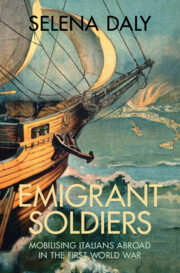
During the First World War, over 300,000 Italian emigrants returned to Italy from around the world to perform their conscripted military service, a mass mobilisation which was a uniquely Italian phenomenon. But what happened to these men following their arrival and once the war had ended? Selena Daly reconstructs the lives of these emigrant soldiers before, during and after the First World War, considering their motivations, combat experiences, demobilisation, and lives under Fascism and in the Second World War. Adopting a micro-historical approach, Emigrant Soldiers explores the diverse fates of four men who returned from the United States, Brazil, France, and Britain, interwoven with accounts of other emigrants from across Europe, the Americas, Africa, the Middle East and Australia. Through letters, diaries, memoirs, oral histories, newspapers, and diplomatic reports, Daly focuses on the experiences and voices of the emigrant soldiers, providing a new global account of Italians during the First World War.
This compendium of essential works clarifies that the Australian Army’s force structure is organic and constantly changing. It provides a starting point for quickly acquiring new capabilities at short notice when required to meet emerging threats and challenges. The Army’s response to realising government direction and investment in new capabilities is being examined via a series of options under the Army Objective Force. It involves a careful and deliberate program of analysis that will provide a framework to develop the Army of the future. Readers can be assured that the Australian Army’s future is informed through understanding of its past – understanding that is provided to the Army’s planners today through contributions such as this.
This chapter describes and analyses national force projection rehearsals called the Kangaroo series of joint exercises, conducted in 1989, 1992 and 1995. These exercises measured Australia’s military proficiency in defending the homeland. The chapter finds that the major challenge during these early post–Cold War years involved synchronising Australian maritime, land and air power under joint command and control arrangements. Despite not stress testing other force projection functions, the ADF struggled for military self-reliance on home soil.
In the last few years, the issue of mobilisation for war has, in Australia at any rate, shifted from the arcane to the highly pertinent. Concerns publicly manifested in the government’s 2020 Defence Strategic Update, which asserted that the long-held notion of up to 10 years’ warning for a possible conventional attack on Australia had – as 10-year rules tend to eventually do – evaporated. Moreover, it alluded to what was thought to be a remote, but nevertheless alarming, possibility of a ‘high-intensity conflict’ in Australia’s region. Suddenly, generating combat power, perhaps more than what was readily to hand, has taken on some urgency.
This chapter uses three declassified case studies to examine the varying and complex mobilisation processes that led to each of Australia’s major Afghanistan commitments throughout 2005–6. It examines how the Department of Defence implemented its decisions – what it did to organise for operations – up until the point that military forces deployed overseas. Questions of manpower, supply and logistics, force preparation, combined planning with coalition partners, force insertion and policy development were different for each of these deployments. What worked, and what did not? What was done, and what was left undone? And what impact did any of this have on subsequent operations?
What can be said about the operational performance of the Australian Defence Force when federal governments ordered selective mobilisations and projections of land force contingents overseas? This chapter examines force projection functions for six selected overseas ADF operations during the period 1987–2003. It applies a grading matrix to each function to produce an audit report. It then compares the reports to derive observations relating to evident systemic problems with operational performance and mitigation of risk.
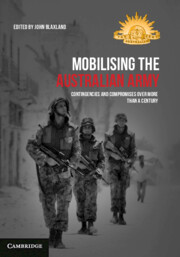
Army has always been faced with the questions of what type of war it should aim to prepare for, and in what context it should prepare. Mobilising the Australian Army explores the rich history of the Australian Army, the challenges of preparing armies for war in uncertain times, and the many possibilities for their continuing strength and future success. Comprising research presented at the 2021 Chief of Army History Conference, this collection examines how contingency and compromise are crucial elements for both the historical and the modern-day Army. Key themes include the mobilisation of resources for war in the first half of the twentieth century, the employment of women in the war effort at a time of rapid force expansion, alliance and concurrency pressures in the Cold War and post–Cold War years, utilisation in crisis and war of the reserve forces, and deployment challenges in the 1990s and beyond. Written by leading Australian and international military historians and practitioners, Mobilising the Australian Army will appeal to both casual history enthusiasts and future Army.
This chapter analyses the auction milieu’s cultural responses to war-induced developments. Within societies deeply entrenched in the mentality of mobilisation and sacrifice, the commercialisation of art stirred moral apprehensions, feelings of possession, and envy, both among the general public and within the art industry. Debates on nouveaux riches and profiteers underscored the construction of antagonist figures during the war, highlighting threats to the market from both external and internal forces. The widespread destruction of heritage also catalysed nationalist feelings, deepening the cultural fragmentation of a formerly integrated trade sphere. By scrutinising the biographies of dealers, examining art’s vulnerability in wartime upheaval, and exploring the interplay between art and finance, this chapter also outlines how the war acted on the tensions characteristic of each market and brought them to a conflagration.
Exhibitions suggest a more complicated history than the familiar caricature of early twentieth-century Japan, which sees the country sliding inexorably into authoritarianism from the late 1920s, then embracing peace and democracy in 1945. The military had always been present at exhibitions and became more prominent in the 1930s. Wartime exhibitions did what they could to mobilize the Japanese people for ‘national defense’. Overseas, however, the government continued to use exhibitions to convince the world of its pacific intent. At home, exhibitions testify as much to commercial energy, municipal ambition, and colonial aspirations, as to militarism. This chapter explores the complicated, increasingly contradictory weave of war and peace during the 1930s and 1940s. Exhibitions not only articulated the need to expand empire and mobilize the nation but also continued to insist on the possibility of international amity and modern life, even as Japan descended into total war. Once it was over, peace and democracy became new keynotes, but the sites, protagonists, and ambitions of exhibitions remained much the same.
Chapter 2 traces the emergence of humane literary genealogies and animal-centred literary criticism. These new kinds of writing reveal the movement’s creative efforts to simultaneously draw from and re-imagine the canon in order the present a longstanding accord between literature and animal protectionism. The chapter then argues that reformers such as Frances Power Cobbe, Henry Salt, and Stephen Coleridge tried to establish a connection between aesthetic experience, ethical awareness, and political action; by carefully choreographing the appearance of stories, poems, and literary-criticism, association periodicals played a vital role in managing textual encounters and responses. However, expressions of excessive sentiment often endangered the efficacy, public image, and political legitimacy of the cause. The movement’s efforts to promote literary writing and antivivisectionism as natural bedfellows raised problems as well as opportunities: ‘Dipping’ into literary works and traditions was rarely carefree.
The Australian Army served in numerous theatres and campaigns throughout World War II, earning distinction and at times facing significant challenges. During the Pacific War, the infantry brigade, as an intermediate formation commanding multiple infantry battalions and numerous attached units, was key in Australian efforts to secure victory. The 18th Infantry Brigade participated in a variety of combat operations with a range of allies allowing it rare experience among Australian units. It's involvement in operations from Europe to the Middle East and onto the Pacific ensured that it was one of the most modern brigades at the close of the war. Assault Brigade examines the challenges and development of the Australian Army's 18th Infantry Brigade throughout World War II. It investigates a series of campaigns fought across the South West Pacific Area, highlighting lessons learnt and adaptations implemented as a result of each battle.